Using Clustering to Improve Retrieval Evaluation without
Relevance Judgments
Zhiwei Shi
Institute of Computing Technology
Chinese Academy of Science
[email protected]
Peng Li
Institute of Computing Technology
Chinese Academy of Science
[email protected]
Bin Wang
Institute of Computing Technology
Chinese Academy of Science
[email protected]
Abstract
Retrieval evaluation without relevance judgments is a hard but also very mean-ingful work. In this paper, we use clus-tering technique to improve the per-formance of judgment free retrieval evaluation. By using one system to rep-resent all the systems that are similar to it, we can largely reduce the negative ef-fect of similar retrieval results in Re-trieval evaluation. Experimental results demonstrated that our method outper-formed all the previous judgment free evaluation methods significantly. Its overall average performance outper-formed the best previous result by 20.5%. Besides, our work is a general framework that can be applied to any other judgment free evaluation method for performance improvement.
1
Introduction
Generally, to compare the effectiveness of in-formation retrieval systems, we need to prepare a test collection composed of a set of documents, a set of query topics, and a set of relevance judgments indicating which documents are rele-vant to which topics. Among these requirements, relevance judgment is the most human resource exhausting and time consuming part. It even becomes infeasible when the test collection is
extremely large. To address this problem, the TREC conferences used a pooling technology (Voorhees and Harman, 1999), where the top n
(e.g., n=100) documents retrieved by each par-ticipating system are collected into a pool and then only the documents in the pool are judged for system comparison. Zobel (1998) has shown that this pooling method leads to reliable results in term of determining the effectiveness of re-trieval systems and their relative rankings. Yet, the relevance determination process is still very resource intensive especially when the test col-lection reaches or exceeds terabyte, or much more queries are included. More seriously, when we change to a new document collection, we have to redo the entire evaluation process.
In this paper, we focus our effort on the re-trieval evaluation without relevance judgments. Although ‘blind’ evaluation is really a hard problem and its evaluation performance is far less than that of methods with incomplete judgments, it is undeniable that non-judgment evaluation has its own advantages. In some cases, relevance judgments are non-attainable. For example, when researchers compare their novel retrieval algorithms to existing methods, or search for optimal parameters of their algo-rithms, or conduct data fusion in a dynamic en-vironment, relevance judgment usually seems impossible. Besides, to construct a good evalua-tion method without relevance judgments, re-searchers need to mine the retrieval results thor-oughly, and try to find laws that indicate the correlation between the effectiveness of a sys-tem and features of its retrieval result. These laws are not only useful for ‘blind’ evaluation methods but also valuable for evaluation meth-ods with incomplete judgments.
One of the useful laws for ‘blind’ evaluation methods is Authority Effect (Spoerri, 2005). Yet it always ruined by multiple similar results.
In this work, we use clustering technique to solve this problem. By selecting one system to represent all the systems that are similar to it, we can largely reduce the negative effect of similar retrieval results. Details of this method will be presented Section 3. Experimental re-sults, which are reported in Section 4, also veri-fied that our idea is feasible and effective. Our method outperformed all the previous judgment free evaluation methods on every test bed. The overall average performance outperformed the best previous result by 20.5%. Finally, we con-clude our work in Section 5.
2
Related Work
In 2001, Soboroff et al. (2001) firstly proposed the concept of evaluating retrieval systems in the absence of relevance judgments. They generated a set of pseudo-relevance judgments by randomly selecting and declaring some documents from the pool of top 100 documents as relevant. This set of pseudo-relevance judgments (instead of a set of human relevance judgments) was then used to determine the effectiveness of the retrieval systems. Four versions of this random pseudo-relevance
method were designed and tested on data from the ad hoc track in TREC 3, 5, 6, 7 and 8. They were simple random pseudo-relevance method, the variant with duplicate documents, the variant with Shallow pools and the variant with Exact-fraction sampling. All their resulting system assessments and rankings were well correlated with actual TREC rankings, and the variant with duplicate documents in pools got the best performance, with an average Kendall’s tau value 0.50 over the data of TREC 3, 5, 6, 7 and 8.
Soboroff et al.’s idea came from two results in retrieval evaluation. One is that incomplete judgments do not harm evaluation results greatly. Zobel’s (1998) research had showed that the results obtained using pooling technol-ogy were quite reliable given a pool depth of 100. He also found that even though the pool depth was limited to 10, the relative perform-ance among systems changed little, although actual precision scores did change for some sys-tems. The other is that partially incorrect rele-vance judgments do not harm evaluation results greatly. Voorhees (1998) ascertained that de-spite a low average overlap between assessment sets, and wide variation in overlap among par-ticular topics, the relative rankings of systems remained largely unchanged across the different sets of relevance judgments. These two points are bases of Soboroff et al.’s random pseudo-relevance method, and give explanation to the result that their rankings were positively related to that of the actual TRECs. As a matter of fact, the two points are bases of all the retrieval evaluation methods without or with incomplete relevance judgments.
sug-gested that the ‘popularity’ effect was caused by considering all the runs submitted by a retrieval system, instead of only selecting one run per system. Our later experimental results will show that this point of view is partially correct. The ‘popularity’ effect could not be avoided com-pletely by only selecting one run per system. This is indeed a hard problem for all the evalua-tion methods without relevance judgments.
Wu and Crestani (2003) developed multiple ‘reference count’ based methods to rank re-trieval systems. They made the distinction be-tween an ‘original’ document and its duplicates in all other lists, called the ‘reference’ docu-ments, when computing a document’s score. A system’s score is the (weighted) sum of the scores of its ‘original’ documents. Several ver-sions of reference count method were carried out and tested. The basic method (Basic) scored each ‘original’ document by the number of its ‘reference’ documents. The first variant (V1) assigned different weights to ‘reference’ docu-ments based on their ranking positions. The second variant (V2) assigned different weights to the ‘original’ document based on its ranking position. The third variant (V3) assigned differ-ent weights to both the ‘original’ documdiffer-ents and the ‘reference’ documents based on their rank-ing positions. The fourth variant (V4) was simi-lar to V3, except that it normalized the weights to ‘reference’ documents. Wu and Crestani’s method output similar evaluation performance to that of the random pseudo-relevance method. Their work also showed that the similarity be-tween the multiple runs submitted by the same retrieval system affected the ranking process. If only one run was selected for any of the partici-pant system for any query, for 3-9 systems, V3 outperformed random pseudo-relevance method by 45.6%; for 10-15 systems, random pseudo-relevance method outperformed V3 by 6.5%.
Nuray and Can (2006) introduced a method to rank retrieval systems automatically using data fusion. Their method consists of two parts. One is selecting systems for data fusion, and the other is selecting documents as pseudo relevant documents as the fusion result. In the former part, they hypothesized that systems returning documents different from the majority could provide better discrimination among the docu-ments and systems. In return, this could lead to a more accurate pseudo relevant documents and
more accurate rankings. To find proper systems, they introduced the ‘bias’ concept for system selection. In their work, bias was 1 minus the similarity between a system and the majority, where the similarity is a normalized dot product of two vectors. In the latter part, Nuray and Can tested three criterions, namely Rank position, Borda count and Condorcet. Experimental re-sults on data from TREC 3, 5, 6 and 7 showed that bias plus Condorcet got the best evaluation results and it outperformed the reference count method and random pseudo relevance method greatly.
More recently, Spoerri (2007) proposed a method using the structure of overlap between search results to rank retrieval systems. This method provides us a new view on how to rank retrieval systems without relevance judgments. He used local statistics of retrieval results as indicators of relative effectiveness of retrieval systems. Concretely, if there are N systems to be ranked,N groups are constructed randomly with the constraint that each group contains five sys-tems and each system will appear in five groups; then the percentages of a system’s documents not found by other systems (Single%) as well as the difference between the percentages of docu-ments found by a single system and all five sys-tems (Single%-AllFive%) are calculated as in-dicators of relative effectiveness respectively. Spoerri found that these two local statistics were highly and negatively correlated with the mean average precision and precision at 1000 scores of the systems. By utilizing the two statistics to rank systems from subsets of TREC 3, 6, 7 and 8, Spoerri obtained appealing evaluation results. The overlap structure of the top 50 documents were sufficient to rank retrieval systems and produced the best results, which outperformed previous attempts to rank retrieval systems without relevance judgments significantly.
simi-lar to the majority for data fusion. Spoerri (2007) performed his method on a selected subset of all the systems. All these treatments led to evalua-tion performance improvement. Yet we will say it could be improved more. In the next section, we will present a new solution to this problem. Its performance is examined in Section 4.
3
Using Clustering to Improve
Re-trieval Evaluation without Relevance
Judgments
3.1 Problem
As we reviewed in Section 2, previous research had shown that incomplete relevance judgments and partially incorrect relevance judgments do not harm retrieval evaluation greatly. This is why pooling technique can lead to reliable retrieval evaluation results. It is also the theoretical foundation of evaluation without relevance judgments.
Besides, non-judgments methods armed with more laws inside retrieval results. These laws indicate the correlation between retrieval effec-tiveness of a system and features in its retrieval results. One of the most important laws used in non-judgments evaluation is Authority Effect (Spoerri, 2005): document, which is retrieval by more systems, is more likely being relevant. Unfortunately, similar retrieval results ruined this law. Aslam and Savell (2003) called this the ‘tyranny of the masses’. So, how to alleviate the negative effect of similar retrieval results is a big issue in non-judgments evaluation.
3.2 Solution
Generally, our solution to the ‘tyranny of the masses’ is removing similar systems by cluster-ing. The whole process is as follows:
Firstly, all systems to be evaluated are clus-tered into several subsets.
Secondly, for each subset, one system is se-lected as a representative.
Thirdly, all the information used for system evaluation comes from these representatives.
Finally, score every system according to the information collected in the previous step.
This is the general framework of our method-ology. Notice that, in the third step, only se-lected systems contribute to the information required for system evaluation. So we can
elimi-nate the negative effect caused by similar re-trieval results.
This solution can be applied to any method of retrieval evaluation without relevance judg-ments. To illustrate how to apply it to a retrieval evaluation method, we will describe using clus-tering to improve Average System Similarity, which is proposed by Aslam and Savell (2003), in detail as an example.
3.3 Average System Similarity Based on Clustering
In Aslam and Savell’s (2003) method, each sys-tem is evaluated based on a criterion named Av-erage System Similarity. The avAv-erage system similarity of a given system S0 is calculated ac-cording to formula (1).
¦
where n is the number of systems to be evalu-ated, and similarity between two systems S and
S0, SysSim(S, S0), is calculated based on
for-where Reti indicates the set of documents re-turned by System i (i = 1, 2).
When applying clustering technique to the system similarity method, we need to define an equivalence relation first.
Definition 1 (System Equivalence): Suppose that all systems are clustered into m clusters namely C1, C2, …, Cm. Two systems S1 and S2
Given the definition of System Equivalence, we get the average system similarity based on clustering as follows:
Replacing formula (1) with formula (4), we get the retrieval evaluation method Average System Similarity Based on Clustering, shortly ASSBC.
There are two important issues for ASSBC that need to be addressed. Issue 1: How to select representative system from a cluster? Issue 2: How to decide the number of clusters we need?
Before we address Issue 1, we introduce an-other definition, Cluster Similarity.
Definition 2 (Cluster Similarity): for any given two clusters C1 and C2, with their respec-tive representarespec-tive systems S1 and S2, the cluster similarity between C1 and C2 is the system simi-larity between S1 and S2.
) , ( SysSim )
, (
ClusterSim C1 C2 S1 S2 (5) Now we come to selecting representative sys-tems for clusters. Here, we utilize a hierarchical bottom up clustering technique. The entire clus-tering process is as follows.
Initially, each system forms a cluster. Loop Until the number of clusters is m
Two most similar clusters merge, and one of their representatives with higher average system similarity survives as the representative of the new cluster. End Loop.
In the initial step, since every cluster contains only one system, the representative system is unquestionable. Within each loop, two represen-tative systems of the old clusters are candidates of the new cluster, and the one with higher score, which means higher retrieval performance, be-comes the representative of the new cluster.
For Issue 2, technically, how to decide the number of clusters is always a problem for clus-tering. Yet, we do not have to rush in the deci-sion. Let us examine the evaluation perform-ance on different values of m first.
4
Experiments
In this section, we will illustrate the evaluation performance of Average System Similarity Based on Clustering vs. different values of m. Before we come to the experimental results, we would like to make some details clear first.
4.1 Some Clarification
4.1.1 Dataset
We perform our experiments on the ad hoc tasks of TREC-3, -5, -6 and -7. Most existing works on retrieval evaluation without judgments are tested on these tasks. To make a direct compari-son with these work mentioned in Section 2 later, we also choose these tasks as our test bed.
4.1.2 Performance Measurement
One of the measures of retrieval effectiveness used by TREC is mean non-interpolated average precision (MAP). Since average precision is based on much more information than other ef-fectiveness measures such as R-precision or P(10) and known to be a more powerful and more stable effectiveness measure (Buckley and Voorhees, 2000), we utilize MAP as the effec-tive measurement of retrieval systems in our experiments.
The correlation of the ranking with our pro-posed methods, as well as other methods, to the TREC official rankings is measured using the Spearman’s rank correlation coefficient. One reason is that it suits better for evaluating corre-lation between ratio sequences, e.g. MAP, than Kendall’s tau. The other reason is that we can directly compare our results with those of pre-vious attempts reviewed in Section 2, since most of them provided Spearman’s rank correla-tion coefficient results.
4.1.3 Substitute for Number of Clusters
TREC Runs
3 40 5 61 6 74 7 103
Table 1. Number of TREC runs
4.2 Experimental results
Figure 1-4 show the plots of the correlation of our method to the TREC official rankings vs. the percentage of systems removed from the representative group on TREC-3, -5, -6 and -7 respectively. The percentage of systems re-moved goes from 0 to 85%, where 0 means no system removed and represents the original Av-erage System Similarity method, and 85% is an up bound in our experiments. The horizontal line indicates the original performance. The tagged number on the curve says when the per-formance curve reaches its peak and the peak value.
Figure 1. Spearman Coefficient of ASSBC vs. different percentage of removed systems on TREC -3.
In Figure 1, the Spearman coefficients of ASSBC vs. different percentage of removed systems on TREC-3 are presented. Except for the beginning, almost all the points are above the horizontal line. The curve reaches its top at 65%-67%, where the Spearman coefficient is 0.8929.
Figure 2. Spearman Coefficient of ASSBC vs. different percentage of removed systems on TREC -5.
Figure 2 depicts the evaluation performance on TREC-5. From 0 to 63%, the performance curve fluctuates around the horizontal line. This means deficient clustering does not bring sub-stantial performance variation. After 63%, the
curve begins to rise and reaches its peak at 78%, where the performance is 0.8691. Then it drops dramatically as more systems removed from the representative group.
The situation on TREC-6 is plotted in Figure 3. In this case, the curve rises gently in the in-terval between 0 and 70% except for some fluc-tuation. After 70%, the curve starts to climb and reaches the peak at 75% with the peak value of 0.8576. It remains high performance until 80%, and then decline quickly.
Figure 3. Spearman Coefficient of ASSBC vs. different percentage of removed systems on TREC -6.
Figure 4 presents the evaluation performance on TREC-7. The trend in this figure is pretty much like that in Figure 2. The curve fluctuates first, and then climbs the hill, where the peak value is 0.6557 and 75% systems are removed. The only difference is in this figure the curve is gentler. This means on TREC-7 ASSBC does not obtain as much improvement as on TREC-5.
Figure 4. Spearman Coefficient of ASSBC vs. different percentage of removed systems on TREC -7.
65% indicates 26 systems removed and 14 sys-tems left as representatives. Interestingly, for other TRECs, 78% (the biggest peak position) means at least 14 systems left as well. So, this can be interpreted as the minimum number of clusters.
To examine the general effect on evaluation performance of cluster number, we also plot the average performance of TREC -3, -5, -6 and -7 vs. the percentage of systems removed from the representative group in Figure 5. With slight fluctuation, the average performance curve climbs stably, and reaches its peak 0.7754 at the position 78%. Then it drops dramatically.
5HPRYHG3HUFHQWDJH
6S
HDUPD
Q&RH
IILFLH
QW
Figure 5. Average Spearman Coefficient of ASSBC vs. different percentage of removed systems on TREC 3, -5, -6 and -7.
To make the result more intuitive, we present a comparison of the performance of original
Average System Similarity (ASS) and the best performance of Average System Similarity Based on Clustering (ASSBC) in Table 2. Ac-cording to the table, we can see that clustering systems improve the evaluation performance significantly.
ASS ASSBC Improvement Trec3 0.7086 0.8929 26.0% Trec5 0.5277 0.8691 64.7% Trec6 0.6300 0.8576 36.1% Trec7 0.5855 0.6557 12.0% Avg 0.6129 0.7754 26.5%
Table 2. Spearman coefficients of original Average System Similarity (ASS) and the best performance of Average System Similarity Based on Clustering (ASSBC) on TREC -3, -5, -6, -7 and the over all aver-age.
4.3 Comparison with All Previous At-tempts
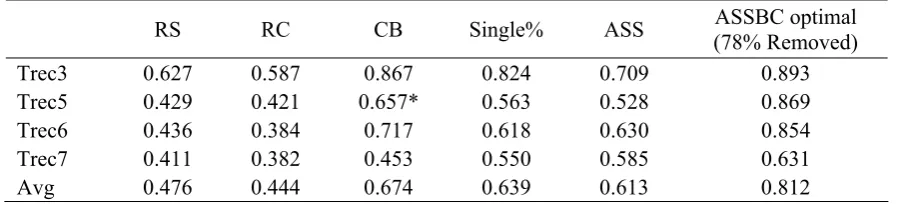
Meanwhile, we also provide a comparison among the ASSBC method and all the existing non-judgment evaluation methods mentioned in Section 2. The result is given in Table 3.
RS RC CB Single% ASS ASSBC optimal
(78% Removed) Trec3 0.627 0.587 0.867 0.824 0.709 0.893 Trec5 0.429 0.421 0.657* 0.563 0.528 0.869 Trec6 0.436 0.384 0.717 0.618 0.630 0.854 Trec7 0.411 0.382 0.453 0.550 0.585 0.631 Avg 0.476 0.444 0.674 0.639 0.613 0.812
Table 3. Spearman coefficients for best results from different evaluation methods
In Table 3, RS represents the result of ran-dom pseudo relevance method, where relevance ratio is set to 10% rather than the actual ratio in its original version; RC is the best result pro-duced by reference count method; BC accounts for the best result of Bias plus Condorcet method, a data fusion based method. Results of these three methods are cited from Nuray and Can’s (2006) paper. For the number with a ‘*’ (BC on TREC 5), in their original paper, same result in different tables conflict, and we pick
as the percentage of removed systems and 14 as the minimum number of clusters1. Clearly, our method outperforms all the previous attempts on every TREC. The overall average performance outperforms the best previous result (from CB) by 20.5%.
5
Conclusion
Retrieval evaluation without relevance judg-ments is a hard problem. Meanwhile it is also an important problem that we can not avoid it in many research areas and applications.
One of the main factors that depress the per-formance of judgments free evaluation is: simi-lar retrieval results ruined the Authority Effect, which is one of the important bases for all the judgment free evaluation methods.
In this paper, we use clustering technique to address this problem. By using one system to represent all the systems that are similar to it, we can largely reduce the negative effect of similar retrieval results. Experimental results also verified our idea. Our method outperforms all the previous judgment free evaluation meth-ods on every test bed. The overall average per-formance outperforms the best previous result by 20.5%.
Besides, improving judgment free evaluation via clustering is more than just a method. It is a general framework that can be applied to any judgment free evaluation method. The Average System Similarity Based on Clustering method is an example. It works well means that the framework is feasible and successful. We will apply it to other judgment free evaluation meth-ods in our future work.
Acknowledgement This work is supported by the National Science Foundation of China under Grant No. 60776797, the Major State Ba-sic Research Project of China (973 Program) under Grant No. 2007CB311103 and the Na-tional High Technology Research and Devel-opment Program of China (863 Program) under Grant No. 2006AA010105.
1
Since we add a terminal criterion for clustering with 14 as the minimum number of clusters, the av-erage performance in Table 3 gains an improvement compared to that presented in Figure 5 and Table 2.
References
Allan J., Carterette B., Aslam J. A., Pavlu V., Dachev B., and Kanoulas E. 2007 Overview of the TREC 2007 Million Query Track, Proceedings of TREC.
Aslam J. A., Pavlu V. and Yilmaz E. 2006 A statisti-cal method for system evaluation using incom-plete judgments, Proceedings of the 29th annual international ACM SIGIR conference on Research and development in information retrieval, August 06-11, 2006, Seattle, Washington
Aslam J. A. and Savell R. 2003 On the effectiveness of evaluating retrieval systems in the absence of relevance judgments, Proceedings of the 26th an-nual international ACM SIGIR conference on Re-search and development in informaion retrieval, July 28-August 01, 2003, Toronto, Canada
Buckley, C. and Voorhees, E. M. 2000 Evaluating evaluation measure stability, Proceedings of the
23rd ACMSIGIR conference pp. 33Ω40
Carterette B., Allan J. and Sitaraman R. 2006 Mini-mal test collections for retrieval evaluation, Pro-ceedings of the 29th annual international ACM SIGIR conference on Research and development in information retrieval, August 06-11, 2006, Se-attle, Washington, USA
Nuray R. and Can F. 2006 Automatic ranking of information retrieval systems using data fusion, Information Processing and Management: an In-ternational Journal, v.42 n.3, p.595-614, May 2006
Soboroff I., Nicholas C. and Cahan P. 2001 Ranking retrieval systems without relevance judgments, Proceedings of the 24th annual international ACM SIGIR conference on Research and development in information retrieval, p.66-73, September 2001, New Orleans, Louisiana, United States
Spoerri A. 2005 How the overlap between search results correlates with relevance. In: Proceedings of the 68th annual meeting of the American Soci-ety for Information Science and Technology (ASIST 2005).
Spoerri A. 2007 Using the structure of overlap be-tween search results to rank retrieval systems without relevance judgments, Information Proc-essing and Management: an International Journal, v.43 n.4, pp.1059-1070, July, 2007
devel-opment in information retrieval, p.315-323, Au-gust 24-28, 1998, Melbourne, Australia
Voorhees E. M. and Harman, D. 1999 Overview of the eighth text retrieval conference (TREC-8). The eighth text retrieval conference (TREC-8), Gaithersburg, MD, USA, 1999. U.S. Government Printing Office, Washington
Wu S. and Crestani F. 2003 Methods for ranking information retrieval systems without relevance judgments, Proceedings of the 2003 ACM sympo-sium on Applied computing, March 09-12, 2003, Melbourne, Florida