ZHANG, ZHE. Adding Coordination to the Management of High-End Storage Systems. (Under the direction of Dr. X. Ma).
Today’s scientific and commercial applications rely heavily on high-end computing (HEC) facilities, including large scale datacenters, supercomputers, and so forth. In these facilities, the storage subsystems are playing an increasingly important role in the overall computing experience perceived by users. Meanwhile, it is a challenging task to provide high performance and reliability to those high-end storage systems due to their high I/O demands, large scales, and complex architectures.
We observe that in addition to the well-recognized lack of I/O resources relative to computing demands in an aggregate perspective, one main challenge faced by high-end storage systems lies in the growing scale and complexity of the entire environment. Individually developed system components or algorithms often behave with isolated local optimizations, and handle concurrent user workloads without considering inter-workload relationships.
The author’s Ph.D. research focuses on three novel instances of bringing adaptive coordination to the management of commercial and scientific high-end storage systems, at different levels of the HEC storage hierarchy. Firstly, on a single storage server, we present a memory cache allocation mechanism which coordinates multiple concurrent sequential ac-cess streams with different request rates. Our work is based on the interesting observation that this problem bears a strong resemblance to situations long studied in the field ofsupply chain management (SCM), used by large vendors and retailers. Furthermore, in a multi-level storage architecture, we address the problem of information distortion in uncoordinated prefetching operations on different storage caches. We develop a simple information shar-ing mechanism, as well as a transparent hierarchy-aware optimization component named
PreFetching-Coordinator (PFC), which monitors both upper- and lower-level caches, and adjusts the aggressiveness of lower-level prefetching. Finally, we improve the data availabil-ity in an entire distributed storage system by coordinating it with the HPC job scheduler and remote data sources.
by Zhe Zhang
A dissertation submitted to the Graduate Faculty of North Carolina State University
in partial fullfillment of the requirements for the Degree of
Doctor of Philosophy
Operations Research and Computer Science
Raleigh, North Carolina 2009
APPROVED BY:
Dr. R. Handfield
Dr. F. Mueller Dr. S. Vazhkudai
Dr. X. Ma Dr. W. Stewart
DEDICATION
BIOGRAPHY
ACKNOWLEDGMENTS
During my graduate study at the North Carolina State University I have been very fortunate to work with and learn from many people.
First of all I would like to give special gratitude to my advisor, Dr. Xiaosong Ma, for her extraordinary patience and insights in guiding me through this stressful yet exciting period of time. Most importantly, her encouragement and respect for my creativity and her own attitude toward work inspired my interest in doing research and deeply affected my life. I am also very thankful to Dr. Sudharshan Vazhkudai and Dr. Frank Mueller who provided so much invaluable advice throughout my Ph.D. research and in particular directed the project on data fault tolerance. Sudharshan also mentored my internship at the Oak Ridge National Laboratory, which is the kickoff of my life in systems research filled with segmentation faults and kernel panics. I would also like to sincerely thank Dr. William Stewart and Dr. Robert Handfield for serving on my dissertation committee, and for providing the precious feedbacks in my preliminary exam.
I am also deeply grateful to my collaborators in my thesis research projects. Amit Kulkarni has made crucial contributions to the implementation of SCM-based algorithms in the Linux kernel, and I owe him an apology for dragging him to the lab in midnights before paper deadlines to fix our testbed. Kyuhyung Lee has contributed equally as myself in the development of PFC, and I have learned from his passionate and hard-working attitude. I am especially thankful to Chao Wang, my close collaborator in the fault tolerance project in the past three years and my two-time roommate in Oak Ridge and Raleigh. The project would not have succeeded without Chao’s major contributions in developing the replication and recovery mechanisms in Lustre, and through working with him I gained tremendously on both development skills and vision on computer systems. My sincere appreciation also goes to Dr. Yuanyuan Zhou for her guidance in the prefetching projects and the great career advice, as well as Dr. John Cobb and Dr. Gregory Pike for their help in setting up experimental environments at ORNL.
I would like to thank the National Science Foundation and the United States De-partment of Energy for funding my Ph.D. research, and the Oak Ridge National Laboratory for providing multiple cluster testbeds and valuable job traces.
Li, Alex Balik, Feng Ji, Amey Deshpande, Jagan Srinivasan, Divya Dinakar, Fei Meng, Prakash Ramaswamy and Steve Koonce, for the inspiring discussions and interesting chats, which make the office an attractive place.
I am much obliged to Dr. Fan Ye, Dr. Hao Yang and Dr. Minkyong Kim at IBM T.J. Watson Research Center as well as Dr. Eno Thereska and Dr. Dushyanth Narayanan at Microsoft Research Cambridge for their wonderful mentorship of my internships, and their warm help in many aspects of my career development. I also want to thank Dr. David McAllister, who directed my Mater’s thesis project and taught me a lot on doing research at the beginning of my graduate study.
My life would have been much less enjoyable without my friends at NCSU and elsewhere: Yuan Sun, Zhuang Wu, Yue Chao, Wei Mu, Hong Tian, Yingjie Li, Xuezhong Wang, Huiying Zhang, Hanyu Cui, Jianying Li, Dong Wu, Liming Pan and Zushou Hu. Thanks for all the wonderful moments.
I thank my dear parents, Shuqing Zhang and Xiuqing Du, who have always trusted and encouraged me without reservation, and taught me a lot about how to be an honest and humble person.
TABLE OF CONTENTS
LIST OF TABLES . . . viii
LIST OF FIGURES . . . ix
1 Introduction . . . 1
1.1 High-end Computing Facilities . . . 1
1.2 Challenges in High-end Storage Systems . . . 2
1.3 Motivation for Adding Coordination in System Management . . . 6
1.4 Our Contributions . . . 8
1.5 Dissertation Outline . . . 10
2 Coordinated, Speed-aware Multi-stream Prefetching . . . 11
2.1 Motivation and Contributions . . . 11
2.2 Inventory Theory Overview . . . 14
2.3 Related Work . . . 16
2.4 Problem Mapping . . . 17
2.4.1 Requests →Demand . . . 18
2.4.2 Access Time →Lead Time . . . 19
2.4.3 Batched Prefetching → Batched Replenishment . . . 20
2.4.4 Prefetched Items → Inventory . . . 20
2.5 SCM Algorithms for Data Prefetching . . . 22
2.5.1 Performance Metrics and Objective . . . 22
2.5.2 Equal Time Supplies . . . 23
2.5.3 Equal Safety Factors . . . 24
2.5.4 Implementing ETS/ESF in the Linux Kernel . . . 25
2.6 Performance Evaluation . . . 26
2.6.1 Platform and Workload Overview . . . 26
2.6.2 Concurrent Streams with Varied Access Rates . . . 27
2.7 Summary . . . 36
2.8 Future Work . . . 36
3 Coordinated, Hierarchy-aware Multi-level Prefetching . . . 38
3.1 Motivation and Contributions . . . 38
3.2 Related Work . . . 42
3.3 Sample Sequential Prefetching Algorithms . . . 44
3.4 SCM Mapping and Approach . . . 46
3.4.1 Multi-level Prefetching → Multi-echelon Inventory Control . . . 46
3.4.2 SCM-based Information Sharing Approach . . . 47
3.5.1 PFC Architecture . . . 48
3.5.2 PFC Algorithm . . . 50
3.6 Performance Evaluation . . . 54
3.6.1 Simulator Overview . . . 54
3.6.2 Test Workloads . . . 54
3.6.3 Evaluation Results of Information Sharing Approach . . . 55
3.6.4 Evaluation Results of PFC . . . 59
3.7 Summary . . . 65
3.8 Future Work . . . 66
4 Coordinated Job Data Staging, Scheduling, Replication and Recovery . . 67
4.1 Motivation and Contributions . . . 67
4.2 Background . . . 71
4.2.1 Lustre Parallel File System . . . 71
4.2.2 Job Scheduling . . . 73
4.3 Related Work . . . 73
4.4 Automatic Scheduling of Data Operations . . . 76
4.4.1 Specification of I/O Activities: . . . 77
4.4.2 ”Zero Charge” Data Transfer Queue: . . . 78
4.4.3 Planning and Orchestration: . . . 79
4.5 Temporal File Replication . . . 80
4.5.1 Justification and Design Rationale . . . 80
4.5.2 Delayed Replica Creation . . . 82
4.5.3 Eager Replica Removal . . . 84
4.5.4 Implementation of Temporary Replication . . . 84
4.6 Transparent Data Recovery . . . 85
4.6.1 Extending Metadata for Recovery Hints . . . 86
4.6.2 Failure Detection . . . 86
4.6.3 Data Reconstruction . . . 87
4.7 Performance Evaluation . . . 88
4.7.1 Experimental Setup . . . 88
4.7.2 Data Scheduling and Pre-execution Recovery Results . . . 89
4.7.3 Temporary Replication Results . . . 93
4.7.4 On-the-fly Recovery Results . . . 96
4.8 Summary . . . 100
4.9 Future Work . . . 101
5 Conclusions. . . 102
LIST OF TABLES
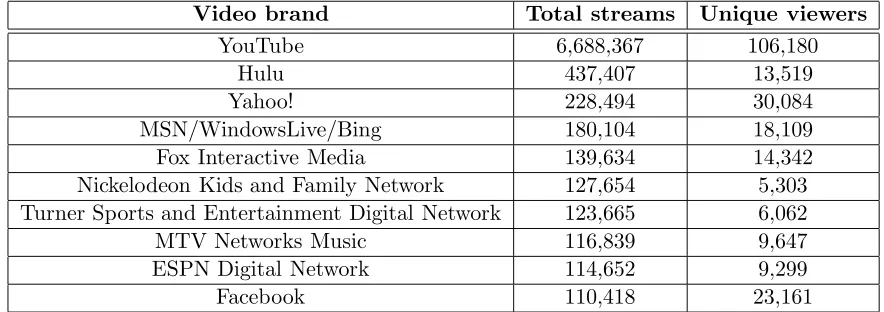
Table 1.1 US online video usage data of September 2009 . . . 4
Table 3.1 RA-SARC performance under different SARC sequentiality detection thresh-olds . . . 57
Table 3.2 Factors contributing to the performance gain of the SCM technique in the RA-SARC combination . . . 57
Table 3.3 Summary of PFC’s improvement on the system overall performance. . . 62
Table 4.1 Reliability statistics from several large-scale systems, including the top sources of hardware failures (top four lines are from [56]). To this list, we have appended MTBF numbers for the National Leadership Computing Facility at ORNL [69], which is No. 2 [81] in the Top500 [113] supercomputers as of this writing. MTBF/I stands for mean time between failures or interrupts. . . 68
LIST OF FIGURES
Figure 1.1 Growth of active Facebook users . . . 3
Figure 1.2 Storage architecture of Jaguar . . . 5
Figure 2.1 Similarities in SCM and storage system problems . . . 13
Figure 2.2 Sample inventory level fluctuation and associated terms . . . 15
Figure 2.3 Distribution of application requested data per 10 mili-seconds . . . 19
Figure 2.4 Inventory behavior in the prefetching context . . . 21
Figure 2.5 Two streams with growing rate differences . . . 28
Figure 2.6 Two streams with growing rate variances . . . 30
Figure 2.7 Throughput of file transfer applications . . . 31
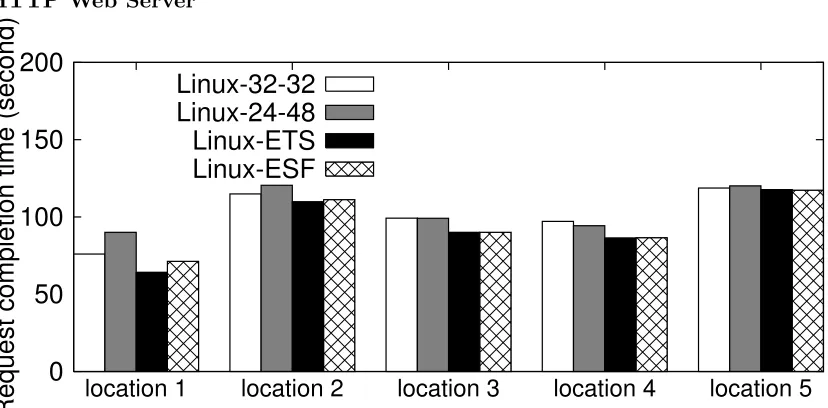
Figure 2.8 Request completion time for web clients . . . 32
Figure 2.9 Throughput of SPC-2 VOD-like workload . . . 33
Figure 2.10 Memory usage of SPC-2 VOD-like workload . . . 33
Figure 2.11 Throughput of mixed SPC-2 VOD-like and TPC-H workloads . . . 34
Figure 3.1 Sample architecture and behavior of uncoordinated multi-level prefetching 40 Figure 3.2 Software architecture for two-level systems using PFC. . . 49
Figure 3.3 Sample PFC actions on L1 requests . . . 50
Figure 3.4 Multi-level prefetching with and without SCM approach . . . 56
Figure 3.5 Impact of PFC on overall performance and unused prefetches for OLTP trace. Figures in the right column use log-scale at the y-axis. . . 59
Figure 3.7 Impact of PFC on overall performance and unused prefetches for Multi trace.
Figures in the right column use log-scale at the y-axis. . . 61
Figure 3.8 Case studies for tests where PFC obtained best and worst performance gain 62 Figure 3.9 Average L2 cache hit ratio . . . 64
Figure 3.10 Effect of combining the bypass and the readmore actions . . . 65
Figure 4.1 Event timeline with ideal and implemented replication intervals . . . 70
Figure 4.2 Round-robin striping over 4 OSSs . . . 72
Figure 4.3 Architecture for coordinated data and job orchestration. Also shown are var-ious I/O activities such as staging, regular I/O operations and on-demand recovery from data sources in the machine-room and beyond. . . 76
Figure 4.4 Per-node memory usage from 300 uniformly sampled time points over a 30-day period based on job logs from the ORNL Jaguar system. For each time point, the total memory usage is the sum of peak memory used by all jobs in question. . 84
Figure 4.5 Simulation results with the original trace. Zero-wait jobs are omitted. . . 90
Figure 4.6 Simulation results with varying system work load . . . 91
Figure 4.7 Simulation results using a 3-year Jaguar log with replication covering jobs up toαS nodes; Infinity(inf) denotes replication for all Jobs. . . 95
Figure 4.8 The ratios of jobs at risk in the month of August in 2005, 2006 and 2007. 97 Figure 4.9 Mean wait time for all jobs . . . 98
Figure 4.10 Standard deviation (SD) for wait time of all jobs. . . 98
Figure 4.11 Mean wait time for affected jobs . . . 99
Chapter 1
Introduction
1.1
High-end Computing Facilities
High-end computing (HEC), as opposed to commodity computing, refers to com-puting systems designed and developed for high performance and high reliability, which also have relatively high costs. Such systems are typically owned and operated by research institutes or companies, for purposes exceeding personal computing and entertainment. In the rest of this section, we discuss HEC in more details in the scientific and commercial
contexts, respectively.
In the field of scientific computing, or computational science, programs are usu-ally executed in parallel to solve large problems with high speed. HEC facilities with highly parallel architectures are critical for this parallel processing paradigm. Representative ex-amples of such parallel systems includeclusters of servers with high-speed interconnections, and supercomputers, which are large-scales proprietary machines with tightly integral of components.
supercomputer in the world as of June 2009 [58], their simulation is expected to finish in 2011.
In the commercial world, high-enddatacenters( orserver farms) have been heavily used by contemporary enterprises of all sizes to perform different types of business oper-ations, such as web hosting, financial transaction processing, and database management. Compared with scientific computing, commercial applications have relatively irregular and asynchronous computing patterns. Therefore, although most datacenters also use clustered servers to achieve high performance, their components display more heterogeneity.
Besides the traditional model of executing the aforementioned business applica-tions on local datacenters, the rapid emergence of Cloud Computing causes more large scale datacenters to be used. As of May 2009, Amazon’s cloud computing system, called AWS [5], has a peak workload of 80,000 work requests per second, 52 billion objects stored and thousands of developers making use of it [6]. It even uses 30% more bandwidth than Amazon’s e-commerce business. In Cloud Computing, customers’ applications are virtual-ized into portable units, and executed on shared computing resources. While eliminating the necessity for small and medium businesses to maintain separate computing facilities, this trend shifts more responsibilities to large scale datacenters that are “on the clouds”. We quote from a widely cited report by researchers at UC Berkeley about the importance of large scale datacenters in Cloud Computing [4]:
We argue that the construction and operation of extremely large-scale, commodity-computer datacenters at low-cost locations was the key necessary enabler of Cloud Computing, for they uncovered the factors of 5 to 7 decrease in cost of electricity, network bandwidth, operations, software, and hardware available at these very large economies of scale. These factors, combined with statistical multiplexing to increase utilization compared a private cloud, meant that cloud computing could offer services below the costs of a medium-sized datacenter and yet still make a good profit.
1.2
Challenges in High-end Storage Systems
of hard disk drives, which are main data storage devices in today’s computer systems, is improving at a much slower rate. The disk bandwidth has been improving at about 40% per year due to increases in rotation speed and recording density, while the disk latency is improving at only about 10% per year [54]. Therefore, storage and I/O have been ob-served as major bottlenecks constraining the overall computing experience perceived by users [3, 4, 91, 114].
With the processor-I/O gap discussed above, it has become increasingly important to efficiently manage high-end storage systems. However, this is a challenging task due to many reasons, and we view the following as the key ones.
0 50 100 150 200 250 300 350
2010 2009
2008 2007
2006 2005
Number of active users
(millions)
Time
Figure 1.1: Growth of active Facebook users
heavy and highly concurrent I/O demands is the intensive competition for limited system resources, especially during peak times.
Table 1.1: US online video usage data of September 2009
Video brand Total streams Unique viewers
YouTube 6,688,367 106,180
Hulu 437,407 13,519
Yahoo! 228,494 30,084
MSN/WindowsLive/Bing 180,104 18,109
Fox Interactive Media 139,634 14,342
Nickelodeon Kids and Family Network 127,654 5,303 Turner Sports and Entertainment Digital Network 123,665 6,062
MTV Networks Music 116,839 9,647
ESPN Digital Network 114,652 9,299
Facebook 110,418 23,161
Secondly, growing with the volume of demands are the scales of high-end storage systems that handle them. Figure 1.2 illustrates the architecture of the Jaguar supercom-puter. Within the dashed rectangle is the storage subsystem. As of early 2008, Jaguar has 72 Dell dual-core I/O servers with 174 Gigabytes of main memory. The underlying disk storage is provided by 18 Silicon Storage Appliance (S2A) 9550 couplets from Data Direct Network Inc. [35], with a total of 576 Terabytes of capacity. The current storage system, named theSpider File System, has been expanded to 192 dual-socket quad-core I/O servers with over 14 Teraflops in performance and 3 Terabytes of memory, as well as 48 S2A 9900 storage couplets providing 10 Petabytes of RAID 6 capacity from 13,440 1 Terabyte SATA drives. Many issues arise with the large numbers of storage components. For example, the number of failures in a system increases with a roughly linear rate with the number of components. It has therefore become a challenging task to provide high availability to stored data.
…
…
…
Spider
File System
26,604 Compute nodes 362TB memory
192 I/O service nodes 3TB memory 48 DDN S2A9900 13,440 X 1TB SATA drives
Staging Staging
Jaguar
User’s Local cluster Archival
system
blocks are placed on different storage components. In the Jaguar system shown in Figure 1.2, the Lustre parallel file system [26] is deployed on both the I/O servers and the compute nodes, which divides each file into 1MB chunks and stripes it over 4 storage nodes by default. Users of Jaguar also need to submit their computation jobs to job queues managed by the scheduler, and perform data transfers along the lifetime of jobs: the input data for a job is to be staged in from archival systems or users’ local clusters before the job is dispatched for execution, and the result data is to be staged out after job completions. The impact of this factor is manyfold. Both resource allocation and fault tolerance become more challenging with the interactions and interdependencies among multiple components.
1.3
Motivation for Adding Coordination in System
Manage-ment
From the issues stated in Section 1.2, it can be observed that the main challenge faced by high-end storage systems is not merely the lack of I/O resources relative to com-puting demands in an aggregate perspective. The difficulty also lies in the large and ever-increasing scale of the entire environment, and the emerging complexity of interactions and interdependencies among entities within the environment. Individually developed system components or algorithms, however, often behave with isolated local optimizations and fail to address the growing scale and complexity. Moreover, in handling concurrent workloads they often ignore inter-workload relationships, and lose opportunities of optimized global resource allocation. Therefore, we consider adding coordination in system management as an intuitive and fundamental solution to address the challenge faced by high-end storage systems.
The benefits of adding coordination in system management comes from many perspectives. Actually, this strategy has been successfully adopted in various areas in modern computing systems.
available capacity, current load level, failure probability and so forth. After placing of a piece of data on a storage node, the system will also adaptively rebalance the data layout due to events like node failures, new node joining, node storage device expansion and so forth. It has been pointed out in the above papers that, without adding the above coordination among storage nodes, certain nodes will soon become too “hot” and severely degrade the performance of the entire system.
Caching is a fundamental technique to address the processor-I/O gap mentioned above, by putting certain data blocks in the main memory based on prediction of future accesses, in order to reduce visits to the hard disk drive. Caching was originally done in a computer’s local memory, typically for data stored on its locally attached disks. With the network latency and bandwidth approaching and surpassing those of hard disk, a number of cooperative caching mechanisms have been proposed, which coordinate the contents of local caches in a distributed system, so that one node’s data request can be satisfied from another node’s cache [33, 55, 102].
There has also been much work on adding coordination in fault tolerance tech-niques. In a recent paper [133], Zhong et al. propose calculating storage objects replication degrees according to its object request probabilities, object sizes, and space constraints. This mechanism maximizes the expected overall service availability at the price of weaken-ing the protection for certain objects.
1.4
Our Contributions
Based on the above observations, the author’s Ph.D. research focuses on three novel instances of adding coordination to the management of commercial and scientific high-end storage systems, which significantly improve the overall performance and reliability, as summarized below.
Coordinated, Rate-aware Multi-stream Prefetching As an important technique to hide disk I/O latency, prefetching has been widely studied, and dynamic adaptive prefetch-ing techniques have been deployed in diverse storage environments. However, one significant issue not well addressed by previous research is how to handle the prefetching resource al-location between concurrent sequential access streams with different request rates.
Interestingly, we found that these problems bear a strong resemblance to situations long studied in the field ofsupply chain management (SCM), used by retailers such as Wal-Mart. In this dissertation, we demonstrate how to perform the problem mapping and then apply SCM principles in practice, particularly from the branch ofinventory theory, to improve data prefetching performance in storage systems. More specifically, we applied two SCM policies to capture data access rates of sequential streams and dynamically configure the sequential prefetching parameters.
We implemented these SCM-based strategies in the Linux kernel prefetching mod-ule, and evaluated the performance with three types of workloads. The results indicate that the SCM approaches are able to generate up to a 55.0% of performance improvement for a real-world server workload benchmark, and up to 33.3% for a combination of Linux I/O-intensive applications.
This work produced the majority of results of the paper [130]. A patch of the Linux 2.6.18 kernel was developed with new prefetching algorithms.
Coordinated, Hierarchy-aware Multi-level Prefetching The multi-level storage ar-chitecture has been widely adopted in servers and data centers. However, existing multi-level storage studies have focused mostly on cache replacement strategies, leaving multi-multi-level prefetching a relatively unexplored topic.
conservative prefetching will not be able to effectively use the lower-level cache space, while overly aggressive prefetching will be compounded across levels and generate large amounts of wasted prefetch. We consider information distortion as the main reason for this deficiency, and map it to the “bullwhip effect” in multi-echelon inventory management.
Based on this vision we take an innovative approach to this problem: rather than designing a new, multi-level prefetching algorithm, we develop coordination mech-anisms which are compatible with existing single-level algorithms. We first present a sim-ple information sharing scheme directly based on SCM policies. Furthermore, we develop PreFetching-Coordinator (PFC), a hierarchy-aware optimization applicable to any existing prefetching algorithms. PFC does not require any application hints, a priori knowledge on the application access pattern or the native prefetching algorithm, or modification to the I/O interface. Instead, it monitors the upper-level access patterns as well as the lower-level cache status, and dynamically adjusts the aggressiveness of the lower-lower-level prefetching activities.
We evaluate the proposed mechanisms with an extensive simulation study using a verified multi-level storage simulator, an accurate disk simulator, and access traces with different access patterns. Our results indicate that simple information sharing can effec-tively improve the performance of certain pairs of single-level algorithms. Meanwhile, PFC dynamically controls lower-level prefetching in reaction to multiple system and workload parameters, improving the overall system performance in all 96 test cases. Working with four well-known existing prefetching algorithms adopted in real systems, PFC obtains an improvement of up to 35% to the average request response time, with an average improve-ment of 14.6% over all cases.
This work generated the paper [131] and part of [130]. We also developed a multi-level storage simulator as described above.
Coordinated Job Data Staging, Scheduling, Replication and Recovery Storage systems in supercomputers are a major reason for service interruptions. RAID solutions alone cannot provide sufficient protection as: 1) the growing average disk recovery time makes RAID groups increasingly vulnerable to additional disk failures during reconstruc-tion, and 2) RAID does not help with higher-level faults such as I/O node failures.
availability for supercomputing centers. Our work is based on the observation that files in the supercomputer scratch space are typically accessed by batch jobs, whose execution can be anticipated. Therefore, we propose an automatic scheme which stages in job data “just-in-time” for the job execution. We also transparently, selectively, and temporarily replicate ”active” job input data by coordinating the parallel file system with the batch job scheduler. We further extend the parallel file system with the awareness of job data’s remote sources and the ability to transparently fetch unavailable pieces in order to reconstruct corrupted files.
We have implemented the staging, replication and reconstruction schemes in the Moab job scheduler and the Lustre parallel file system. We also take data operation time tested on real clusters as inputs and evaluate the schemes with extensive simulation studies. Our results show that with our solution the average wait time for supercomputing jobs could be reduced by up to 80%, while the additional storage space overhead is always below 1.8%. This work has generated three research papers [120, 119, 132], and a job scheduling software that is currently deployed at the Oak Ridge National Laboratory.
1.5
Dissertation Outline
Chapter 2
Coordinated, Speed-aware
Multi-stream Prefetching
2.1
Motivation and Contributions
Prefetching is an important technique widely used in computer systems. In storage systems, single- or multi-level alike, it reduces the visible disk I/O costs by exploiting spatial localities in applications’ access patterns.
Despite the plethora of studies done on data prefetching for storage systems, cer-tain fundamental issues have not been well addressed. In particular, currently storage systems face the increased scale in two dimensions.
First, with the advances in server configurations, especially due to the emergence of multi-core/many-core nodes, the level of request concurrency is expected to continue to rise for both server and personal computing workloads. Existing adaptive prefetching algorithms focus on identifying the sequentiality versus randomness in the application access pattern, as well as identifying individual sequential access streams. Such analysis helps manage space allocation between prefetching and demand paging, and allows per-stream prefetching aggressiveness control [45, 75].
the same prefetching settings will be applied to slow and fast streams, as long as they display the same sequentiality in accesses. Fast streams may not be able to have sufficient prefetched blocks to catch up with the application’s pace, while slow streams may have many blocks unconsumed sitting in the buffer cache. To make it worse, the faster streams often have shorter computation periods to overlap with the I/O requests even when the program does I/O asynchronously, making the penalty directly visible to end users.
Second, the I/O stack is becoming increasingly deep with multiple layers of servers and their buffer caches, including database buffer caches, file system caches, storage server caches, etc. In multi-level storage systems, the caching/prefetching strategies working at an upper level may alter the application access behavior and mislead lower levels to prefetch too aggressively or conservatively [128, 131].
Interestingly, we discovered that the above unaddressed data prefetching issues share many common properties with another field of study with a history of over half a century -supply chain management (SCM). This is illustrated in Figure 2.1, where we see the one-to-one correspondence between SCM and dynamic data prefetching problems. Ba-sically, in both contexts, items are retrieved to better serve anticipated customer requests, based on observations on the past and current request behavior. Correct and timely fetch-ing of the predicted items will greatly enhance the customer perceived system performance, while mistakes (such as stocking up the wrong items or performing the fetching too ea-gerly/leisurely) can waste precious resources in terms of storage/inventory and data/goods transportation capacity.
In this chapter, we present a fresh approach to improving prefetching: borrowing and extending ideas from SCM theory and practice to enhance data prefetching algorithms deployed in modern storage systems. Our major contributions are summarized below:
1. We identified the mapping between data prefetching and supply chain management problems, and proposed the novel application of SCM principles to controlling adap-tive prefetching parameters.
(a) SCM scenario: grocery store
(b) Storage system scenario: buffer cache
directly applied in the prefetching context due to significant differences in the problem spaces.
3. We implemented the SCM-based algorithms in the Linux kernel, as well as a verified multi-level storage server simulator, and evaluated their performance with Linux I/O intensive applications and real-world server workload traces. Our results indicate that SCM solutions generate considerable performance improvements over existing prefetching algorithms.
The rest of this chapter is organized as follows. Section 2.2 provides background discussions in both SCM and prefetching. Section 2.4 presents the mapping of a prefetch-ing problem in modern storage systems to an SCM problem, so that SCM solutions can be applied. In Section 2.5 we discuss how to use SCM policies to data prefetching. Experi-mental methods and results are presented in Section 2.6. Finally, Section 2.7 provides a brief conclusion and discussions about future directions.
2.2
Inventory Theory Overview
In this section, we give an overview on relevant studies in supply chain manage-ment.
A supply chain is consists of “all the parties involved, directly or indirectly, in fulfilling a customer request” [24]. In particular, SCM research is still very active today, partly due to the challenges and opportunities brought by the advances in IT technology and supply chain globalization.
While many researchers have been renovating SCM for the web era, in this research we exploit technology transfer in the other direction. The specific SCM area of interest is
inventory theory, which studies how to efficiently manage the inventory for goods and satisfy customer demands with low costs, by carefully distributing limited resources.
Let us give a brief introduction on inventory theory.1
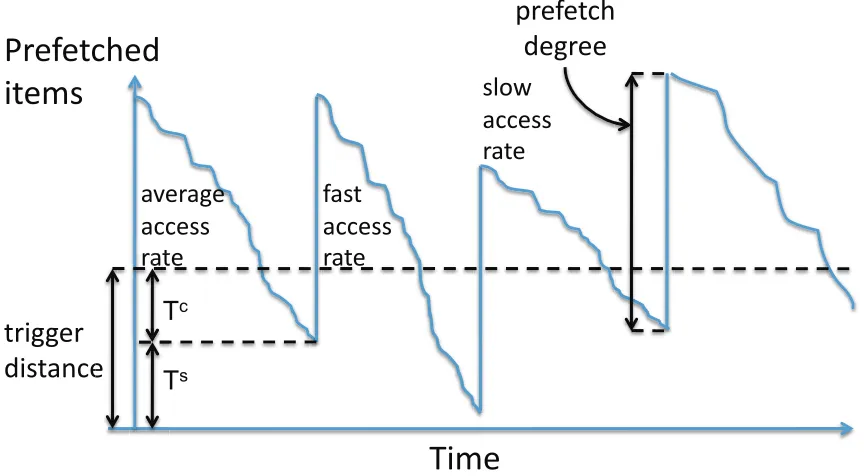
Figure 2.2 illustrates the pe-riodic fluctuation in the inventory level for each type of goods in the grocery store example. The items are consumed by customers, so the inventory level will decrease. When the inven-tory level drops to thereorder point, another batch of items will be ordered, which will arrive
1
!"#$"%&'()
*$#$*)
+,-$)
'$&'.$')
/&,"%)
0#$'01$) .$-0".)
203%) .$-0".)
3*&4) .$-0".)
302$%() ,"#$"%&'() 5(5*$) ,"#$"%&'()
Figure 2.2: Sample inventory level fluctuation and associated terms
after a certain amount of time, and boosts the inventory level. Much inventory research effort has been spent on configuring the two components of the desired inventory level: thecycle inventory, used to handle stable customer requests and achieve economic/efficient ordering and transportation, and the safety inventory, used to prepare for irregularity or burstiness in customer demands. Intuitively, if the customer demand for this type of goods is constant, then the safety inventory can be lowered to zero.
In Section 2.4, we describe detailed mapping of our target data prefetching problem to this inventory theory context.
2.3
Related Work
The problem of data prefetching has been widely studied [115]. In this section we present a survey of related work on this topic.
Access pattern detection Many sophisticated prefetching algorithms have been pro-posed to prefetch data blocks in a non-sequential manner (e.g., with strided patterns) based on access pattern analysis and mining [7, 32, 40, 70, 74, 108]. However, most modern stor-age systems adopt sequential prefetching [44, 45, 107], which prefetches a number of blocks right next to the blocks requested, due to its simplicity and applicability to a wide range of application workloads [44]. Therefore, the discussion in this chapter is based on sequential prefetching, although our proposed approaches are portable to prefetching algorithms that establish correlations between data blocks.
Prefetching aggressiveness control For sequential prefetching, “what to prefetch” is given and the key problem is to decide “how much to prefetch” and “when to prefetch”, two metrics related to prefetching aggressiveness. In many systems today, this is determined at runtime through two prefetching parameters: prefetch degree, to control how much data to prefetch for each prefetching request, andtrigger distance, to control how early to issue the next prefetch request. While there have been a number of studies on intelligent dynamic prefetching, by manipulating the trigger distance and/or the prefetch degree [44, 73], they focus more on identifying the sequentiality in accesses and do not measure or exploit the application request rate information.
limit of 32 blocks. If the streak of sequential accesses is interrupted, the Linux algorithm will scale back the prefetching degree (by default to 3 blocks).
Another important related issue is how to allocate the shared memory cache space between prefetching and demand paging, both of which hide the I/O latency. There are a number of previous studies about managing prefetched data in a cache shared with demand paged data [18, 63, 72, 93, 96]. Several other solutions alleviate the problem of cache pollution [92, 100] by carefully bounding the space that prefetched data can use. As a recent example, the SARC algorithm deployed in IBM production systems [45] uses two separate LRU queues for sequential and random data respectively, and adjusts their sizes according to the access pattern. Our proposed approach can be used in a complementary way, partitioning resource between prefetching and demand paging through one of the above strategies, then among concurrent sequential access streams.
Resource allocation among multiple streams There has been a number of projects on caching/prefetching for workloads with multiple concurrent access streams [9, 17, 44, 73, 75, 112]. With two of them, namely LRU-SP [17] and AMP [44], although access rates are not measured explicitly, fast and slow streams will be treated differently through eviction and detection of request waiting events. However, LRU-SP is designed for cache replacement and does not change the prefetching behavior. The underlying model for AMP does consider the per-stream request rate, while its algorithm design and evaluation focus on throttling the overall prefetching aggressiveness without distinguishing between fast and slow streams. The TIPTOE algorithm [112] estimates computation time between I/O requests. But it does so by relying on application hints, and at most two concurrent applications are used in the simulation-based evaluations. Our approach, in contrast, explicitly performs per-stream resource allocation based on level and deviation of access rates observed at runtime.
2.4
Problem Mapping
challeng-ing differences that prevent straight-forward or accurate mappchalleng-ing. These similarities and differences are discussed next, where we go through the key pairs of concepts.
2.4.1 Requests → Demand
The applications’ requests for data, mapped to blocks by the file systems, can be intuitively translated into customers’ demands for goods in an SCM context. Modern file and storage systems use dynamic algorithms that adjust the prefetching aggressiveness based on access pattern analysis. Similarly, in SCM, much effort has been spent on under-standing and forecasting customer demands, where the demand patterns for a certain item are often modeled as time series of separate values. Advanced time series analysis tech-niques have been used to capture different characteristics of demand patterns [106]. It is also natural for us to map each sequential access stream (i.e., blocks requested by one client in a server system) to a type of goods in the SCM context, as shown in Figure 2.1. In both areas, access/demand pattern analysis and subsequent prefetching have been performed on per-stream or per-type basis.
The normal distribution and other distributions from the exponential family [65] are the mostly commonly observed customer demand patterns in SCM [24]. Most SCM techniques, including the algorithms to be discussed in section 2.5, are based on such demand models. In our analysis of real read-intensive applications’ I/O traces, we have found that their data access patterns share several important properties with the exponential family distributions, while at the same time possessing unique characteristics. Figure 2.3 shows the data access pattern of a representative stream from an SPC2
OLTP trace. We partitioned the access trace into many 10ms time windows. Thex axis lists different demand rates (in terms of KBs of data requested in a window), while the height of the vertical bars illustrates the count of windows within the corresponding rate interval. In the figure we also show a fitting gamma distribution pattern. We can see that while the two patterns fit relatively well at and after gamma’s peak value at 7, the stream from the trace shows rather irregular patterns in the region with lower rates.
Fortunately, the medium and higher access rates are of more interest to most prefetching algorithms, since modern storage servers typically have high expected cache hit rates (around or above 50%) [23, 134], especially for sequential access patterns. More
2
comprehensive and detailed analysis of real world applications’ data access patterns will potentially lead to enhanced algorithms and we consider it interesting future work.
0
0.02
0.04
0.06
0.08
0.1
0.12
1 2 3 4 5 6 7 8 9 10 11 12 13 14 15 16 17 18 19 20 21
N
u
rmb
e
r
o
f
w
in
d
o
w
s
KBytes per 10ms window
trace
gamma
Figure 2.3: Distribution of application requested data per 10 mili-seconds
However, there is a fundamental challenge in mapping data requests to customer demands. In the SCM model, there are typically duplicate items of the same good. The customer demand specifies the type and quantity of goods needed (e.g., “six apples”). In the data storage scenario, though, each data block is unique. However, when studying sequential prefetching we can achieve the mapping: assuming that correlations between data blocks have been correctly detected, any incoming data request can only refer to one possible block, which is “next to” the last accessed block in the detected logical correlation. Therefore, the unique data blocks belonging to the same access stream can be viewed as a sequence of “the next block”, hence becoming a group of identical items.
2.4.2 Access Time → Lead Time
from the disk, or a lower-level server in multi-layer architectures. Its SCM counterpart is the lead time, the time that elapses from the moment that an order is placed, till the requested items are physically on the shelf.
In general, we found the data access time in storage systems possess different characteristics than the lead time modeled in SCM studies. The data access cost depends on (1) the location (in terms of placement on disk) and the amount of data requested, and (2) the system load and disk head location. In contrast, SCM models typically assume the lead time as constant or i.i.d. (independent and identically-distributed) over time, insensitive to the demand volume or supplier workload. While bridging these differences for more accurate problem mapping makes interesting future work, in this chapter, we report initial results achieved without extension of existing SCM theories to accommodate more sophisticated lead time modeling.
2.4.3 Batched Prefetching → Batched Replenishment
Contemporary file system prefetching algorithms fetch blocks in batches, rather than one at a time. Doing so takes advantage of the spatial locality in disk accesses, lowers the disk/network request overhead, and reduces energy consumption. In particular, due to the high start latency of disk accesses, a certain request size may be required to match the request rate. In SCM, intuitively, the same practice is adopted so that supply chain entities issue batched replenishments to lower entities or the factory. The motivation here is to exploit the economics of scale, examples of which include quantity discounts, sharing of per order costs, etc.
2.4.4 Prefetched Items → Inventory
Prefetching is about stocking up data blocks that are predicted to be soon accessed in the future. Many prefetching algorithms control the size of this set of fetched but not accessed data by manipulating the trigger distance, which dictates how early the prefetch request should be issued. In SCM models, the set of prefetched goods corresponds to an extensively studied concept of inventory, the list of goods held available in stock.
!"#$%
&'$(&)$%
&**$++%
(&,$%
-&+,%
&**$++%
(&,$%
+./0%
&**$++%
(&,$%
1($-$,*2$3%
",$#+%
4($-$,*2%
3$)($$%
,("))$(%
3"+,&5*$%
$%
((&
&
&
&,,
T
cT
sFigure 2.4: Inventory behavior in the prefetching context
insights on differentiating the functionality of the prefetched items in stock, into cycle inventory and safety inventory, as introduced in Section 2.2. We believe that the trigger distance is closely associated with the inventory notion and can be similarly decomposed.
Figure 2.4 shows how the dynamic prefetching parameters can be mapped to the inventory problem. Here the trigger distance, T, is equivalent to the reorder point in Figure 2.2. After each time the prefetch is triggered, the number of prefetched items un-consumed is expected to drop by a certain amount before the next batch of prefetched data arrives. This amount is determined by the average application request rate, as well as the fetch time (lead time) for this prefetch operation. It then corresponds to the cycle inventory and we denote this component ofT asTC. The other component, TS =T−TC,
corresponds to the safety inventory. The prefetching degree can be intuitively mapped to the size of the batched replenishment. In Section 2.5, we describe how we leverage SCM policies to determine these prefetching parameters with multi-stream workloads.
our mapping is achieved within the sequential prefetching context. When each strictly sequential stream is mapped to a type of goods, then after a prefetched block is accessed, this item can be viewed as “consumed” and will be taken off the inventory.
2.5
SCM Algorithms for Data Prefetching
As mentioned earlier, existing prefetching algorithms, while identifying the con-current sequential access streams in mixed or multi-request workloads, do not explicitly consider the individual access rates of these streams. With SCM practices, it is intuitive that if apples and bananas are consumed at very different speeds, it does not make sense to stock up the equal amount of them in store. The counterparts in replenishment policy for trigger distance and prefetch degree areorder pointand order quantity. A fixed quantityQ is ordered whenever the inventory level drops under the reorder point s. Inventory theory determines the reorder pointsaccording to the rate of and the uncertainty in the incoming demands for a certain item. Next, we discuss the SCM optimization goal and introduce two commonly used policies for determining reorder points. Although there are more advanced SCM techniques, we choose these two relatively simple policies. This is due to their poten-tial of being adopted in widely used operating systems such as Linux, considering several factors, including runtime overhead, implementation complexity, and capacity to work for a large range of applications. We then apply them to dynamically configuring the prefetching trigger distance. In particular, we focus on the problem of concurrent, long sequential access streams with different access speeds. Such scenarios are common in personal computing, web servers, multimedia servers, and scientific data centers.
2.5.1 Performance Metrics and Objective
In the prefetching and caching environment, the cache hit ratio is one of the most important factors contributing to the overall I/O performance, measured either in request response time or throughput.
distribution and the replenishment policy, the fill rate, FR, can be estimated as:
FR= 1−ESC
Q
In the above ESC denotes Expected Shortage per Cycle (the average number of unsatisfied customer demands in each replenishment cycle), and Q is the order quantity (prefetching degree in the storage context). SCM studies have shown that the optimization of FR is a very challenging problem [106], and two heuristics policies have been widely adopted, as discussed in the following sections.
Notice that the ultimate objective of the policies is to optimize the overall system performance, a common goal in file and storage system research, especially with adaptive techniques [72]. The policies can be extended in the future to consider other objectives or constraints, such as fairness across streams and real time requirements. Further, our current policies mainly focus on improving the performance of pure sequential access patterns, which are common and important in today’s servers and data centers, running applications such as video-on-demand (VOD) and scientific data visualization.
2.5.2 Equal Time Supplies
The first policy,Equal Time Supplies (ETS), is an intuitive, widely used approach: A large U.S.-based international consulting firm estimates that 80%∼90% of its clients use this policy for setting safety inventory levels [106]. It is applied after the total amount of safety inventory for an SCM entity has been determined, e.g., by a grocery store’s physical storage space. Given this total inventory level, with ETS, the individual safety inventories are set so that each type of goods has an equal time period’s worth of supply. In other words, the safety inventory level for individual types of goods is set proportional to their demand rates.
With the given total inventory level set, our prefetching algorithm will determine the desired trigger distance for each sequential stream. Its goal is to maintain a certain overall prefetching aggressiveness, in terms of Ttotal, the sum of the trigger distances for
all concurrent sequential streams. Suppose at a given time, there are n concurrent access streams in the system, each with an access rate ofRi. Based on the ETS policy, the safety
inventory component of the trigger distance, TS, is proportional to the per-stream access
rate:
∀i,T
S i
Ri
=C1
As can be seen in Figure 2.4, the cycle inventory component,TC, is determined by
how much of the prefetched items will be consumed during the time to complete the next prefetch order. As most adaptive prefetching algorithms have a fixed upper limit for the batch size (prefetching degree), all pure sequential streams will be able to reach this upper limit after a short ramp-up stage. So the time to prefetch each batch of data blocks can be assumed to be equal across all streams. Therefore, the expected amount of data to be requested while the batched prefetch request is in-flight, is then proportional to the data request rate as well:
∀i,T
C i
Ri
=C2
Consequently, the individual trigger distance should be proportional to the request rate according to the ETS policy. We can calculate the ETS-based trigger distanceTi as
Ti=TiS+TiC =
Ri
X
1≤i≤n
Ri
·Ttotal
2.5.3 Equal Safety Factors
As discovered by SCM researchers, one significant limitation of the ETS policy is that it does not consider the difference in the demand uncertainties of the streams. It works best when the customer demand for each type of good remains stable, which is often not the case in SCM or storage scenarios.
should receive a higher safety inventory level. With this approach, we first calculate the cycle inventory component of the per-stream trigger distance explicitly using the stream access rates. Suppose the time to fetch a batch of blocks using the maximum prefetch degree istpref etch, we have
TiC =Ri·tprefetch
Then the per-stream safety inventory component is allocated from the total safety inventory level proportionally, considering the standard deviation of access rate rather than the average rate. Suppose the standard deviation in access rate for stream iisσi, we have
TiS= Xσi
1≤i≤n
σi
·(Ttotal−
X
1≤i≤n
TiS)
Finally, for each streami, the trigger distance is again
Ti=TiS+TiC
2.5.4 Implementing ETS/ESF in the Linux Kernel
inventory level as the Linux prefetching default parameters, we get
T +P/2 =P/2 +P/2 = 32 + 32/2 = 48
This gives us the default ETS/ESF trigger distance,Tdefault, of 24, and the max-imum prefetching degree of 48. A lower limit for trigger distances is set to 4. In our evaluation, we compared our SCM-based strategies with both the original Linux prefetch-ing algorithm (32-32) and the algorithm with modified parameters (24-48).
More details about the implementation of ETS and ESF algorithms in the Linux 2.6.18 kernel can be found in [67].
2.6
Performance Evaluation
We implemented our SCM-based optimizations in the Linux 2.6.18 kernel (see Section 2.3) and a multi-level storage simulator (described below in Section 2.6.1). In the rest of the section, we first give an overview of our test platforms and workloads, then report experiment results.
2.6.1 Platform and Workload Overview Platforms
Platforms We tested our modified Linux kernel for single-level prefetching on a Dell PowerEdge 2950 III server, with two 2.33GHz quad-core Intel Xeon E5410 processors, 16GB main memory, and integrated RAID 5 with six 146 GB 15K RPM SAS 3Gbps hard drives.
Workloads We evaluate our proposed approach with three types of workloads:
1. Synthetic benchmarks. These benchmarks are created to include a group of sequen-tial access streams, where we can easily control the per-stream access rate and rate deviation, as well as the number of concurrent streams.
3. Two types of server benchmarks. The first is an HTTP web server workload. At the server side we run Apache on our Dell server with modified Linux kernel. On the client side we use httperf-0.9.0 [84] to generate 20 clients (again running on PlanetLab nodes) that request file downloads with different bandwidth. The second is a SPC2-VOD-like benchmark that we implemented according to SPC specifications3
to simulate video-on-demand workloads. In SPC2-VOD, each sequential stream has a fixed think time between consecutive I/O requests. To assess our algorithms’ impact on concurrent random accesses, we also run a TPC-H trace collected on workstations at Purdue University [14], which has highly random accesses.
Unless otherwise noted, all experiments are repeated 7 times and for each result (from our proposed approaches or baseline algorithms for comparison) we report the average after eliminating the best 2 and worst 2 results. This allows us to filter out “outliers” caused by other concurrent system activities (periodic system daemons, login attempts, etc.), which are observed to happen in similar ways when we switch between prefetching algorithms.
2.6.2 Concurrent Streams with Varied Access Rates Synthetic Benchmarks
As our research in prefetching for concurrent streams focus on sequential streams, we first use synthetic workloads to examine the behavior of the original and SCM-based Linux prefetching algorithm with controllable stream access characteristics. In the synthetic benchmarks used in this section, we create multiple concurrent streams which issue pure sequential 4KB read requests, each accessing a different file of 1GB size (which is larger than any per-stream access footprint). The streams are fully overlapped with each other, starting together and running for the same length of time.
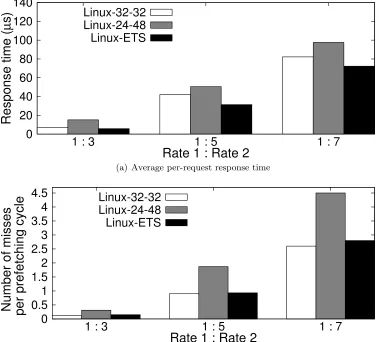
In these experiments, the system response time under four different policies are evaluated: “Linux 32-32” for original Linux kernel prefetching algorithm with both prefetch degree and trigger distance being 32 pages, “Linux 24-48” for the policy which increases prefetch degree to 48 and decreases trigger distance to 24, plus the ETS and ESF algorithms. First, to evaluate how the ETS algorithm responds to different levels of access rate contrasts between streams, we generate a set of traces, each containing two streams
3
0 20 40 60 80 100 120 140
1 : 7 1 : 5
1 : 3
Response time (
µ
s)
Rate 1 : Rate 2
Linux-32-32 Linux-24-48 Linux-ETS
(a) Average per-request response time
0 0.5 1 1.5 2 2.5 3 3.5 4 4.5
1 : 7 1 : 5
1 : 3
Number of misses
per prefetching cycle
Rate 1 : Rate 2
Linux-32-32 Linux-24-48 Linux-ETS
(b) Average number of misses per prefetch cycle
with a pre-specified rate difference. The rate of the first stream is fixed at 1000 requests/s, while that of the second stream is set to 3000, 5000 and 7000 requests/s in 3 experiments respectively. Figure 2.5(a) shows the results in terms of the average request response time (for all requests in both streams). Figure 2.5(b) portraits the average number of cache misses per prefetching cycle (ESC).
With 24-48, the total number of prefetching cycles is decreased by a third from 32-32, by enlarging the prefetching degree limit from 32 to 48. However, the overall re-sponse time is worse due to the disproportionally higher number of misses per cycle, due to the shorter and uniformly set trigger distance. Although ETS has the same number of prefetching cycles as 24-48, it efficiently allocates the total amount of trigger distance between the two streams. Thus it is able to control the number of misses per cycle to be very close to 32-32 and improves the request response time by 19.0% on average, with a maximum enhancement of 25.4%. The trigger distances used by ETS for the two streams (averaged over all prefetching cycles) are (13,35), (8,40), and (7,41), for the three different rate combinations respectively.
Next, we assess the effectiveness of the ESF algorithm by comparing it with ETS. with a different trace setting. Here again we have two streams, with the same mean access rates but different rate variances. The standard deviation of the first stream is fixed at the square root of the mean rate, while for the second stream it is varied from the 3 times to 5 times and then to 7 times the mean value. Figure 2.6(a) shows the average per-request response time, while Figure 2.6(b) shows the response time of the two streams separately.
As expected, ESF does perform better than ETS with less stable access streams, winning by an average of 25.4% and up to 35.7%, due to its capability of adjusting the safety inventory level according to the observed variance in request rate. As can be seen from Figure 2.6(b), the unstable stream obtains a significant performance improvement under ESF, while the more stable one suffers small degradation.
0 10 20 30 40 50
7 5
3
Response time (
µ
s)
SD of stream 2 as
factor of the mean
Linux-ETS Linux-ESF
(a) Average response time
0 10 20 30 40 50 60 70 80
7 5
3
Response time of
individual streams(
µ
s)
SD of stream 2 as
factor of the mean
Stream 1 w/ Linux-ETS Stream 1 w/ Linux-ESF Stream 2 w/ Linux-ETS Stream 2 w/ Linux-ESF
(b) Response time for each stream
Real Linux Applications
We then evaluate both ETS and ESF using a combination of local and remote Linux file transfer applications, each transferring multiple 128MB files. Among them, cp-local copies to a local file system, cp-NFS copies to an on-campus machine via NFS, and
scp1∼scp6copy to different PlanetLab nodes (with decreasing bandwidth). Here we mea-sure the I/O throughput of individual streams as well as the aggregate system throughput, during a fixed time period where the concurrent streams fully overlap. This experimen-tal environment mirrors a file system in a high performance computing center where users frequently need to transfer job input/output files between the local and remote sites.
70%
60%
50%
40%
30%
20%
10%
0%
-10%
-20%
-30%
aggregate
scp5
scp4
scp3
scp2
scp1
cp-NFS
cp-local
Improvement in throuput
19K pg/sec 831 pg/sec 766 pg/sec 753 pg/sec 597 pg/sec 174 pg/sec 107 pg/sec 22K pg/sec
Linux-24-48
Linux-ETS
Linux-ESF
Figure 2.7: Throughput of file transfer applications
HTTP Web Server
0
50
100
150
200
location 5
location 4
location 3
location 2
location 1
Request completion time (second)
Linux-32-32
Linux-24-48
Linux-ETS
Linux-ESF
Figure 2.8: Request completion time for web clients
In this section we perform experiments on a HTTP web server handling file down-load requests from multiple clients. Our web clients are generated by httperf [84], a web workload generator developed by HP labs and used by previous system research work [1, 53]. Httperf is able to create a realistic environment where multiple concurrent clients connect to the server through the Internet and issue HTTP requests with specified patterns.
We use five PlanetLab nodes at different geographical locations, with decreasing connection bandwidth to the server. On each node we start four file download requests using httperf. Instead of system throughput, in this set of experiments we calculate the average request completion time for clients on each location, which is measured by httperf and is a more natural metric from a web client’s point of view. To make the download requests overlap with each other, we let faster clients download larger files, so that all download requests have close execution time. This is a realistic scenario since web servers often recommend files with higher qualities to faster clients.
section 2.6.2. For workloads where the access rates do not vary rapidly over time, ESF’s does not have an advantage in resource appropriation. On the other hand, the calculation overhead and unstable trigger distance caused by the measurement of standard deviation degrade its performance.
Server Benchmarks
0
2000
4000
6000
8000
10000
12000
14000
16000
32
28
24
20
16
12
8
Throughput (pages/sec)
Number of streams
Linux-32-32
Linux-24-48
Linux-ETS
Figure 2.9: Throughput of SPC-2 VOD-like workload
0
500
1000
1500
2000
2500
32
28
24
20
16
12
8
Average unused but
prefetched memory (pages)
Number of streams
Linux-32-32
Linux-24-48
Linux-ETS
0 1000 2000 3000 4000 5000 6000 7000 8000 9000
32 28
24 20
16 12
8
Total Throughput(pages/sec)
Number of sequential streams
Linux-32-32 Linux-ETS
(a) Aggregate throughput
0 100 200 300 400 500
32 28
24 20
16 12
8
TPC-H Throughput (pages/sec) Number of sequential streams
Linux-32-32 Linux-ETS
(b) TPC-H throughput
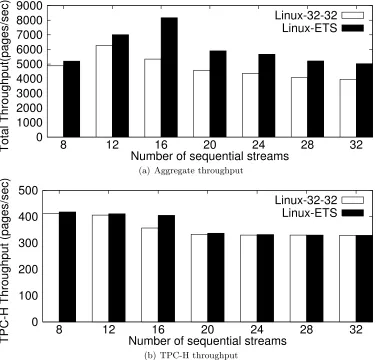
Figure 2.9 depicts the performance for an SPC2-VOD-like workload using different algorithms. Here a certain number of sequential streams access the server, each sending requests to a separate file. All streams have the same think time between consecutive I/O requests, which is set to 33 ms. To create streams with different access rates, we use four different per-stream request size levels (16KB, 32KB, 64KB, 128KB), simulating varying video qualities. In the figure we show the aggregate throughput with different numbers of streams, each randomly selects a request size level. Since the relative performance of ESF compared with ETS is similar to that observed in sections 2.6.2 and 2.6.2, we omit it in this section. From the results we can see that when the number of streams is small, all three algorithms have nearly the same performance. That is because with relatively idle disks and short disk access time, all streams can be satisfied. However, ETS is performing significantly better than the other two algorithms when there are more than 16 streams, and therefore fast streams need more aggressive prefetching. The average improvement of ETS over the native Linux algorithm is 20.1% and the peak improvement is 55.0%. The performance of 24-48, on the other hand, is almost the same with 32-32, due to the same reason as discussed in Section 2.6.2.
Also, in Figure 2.9 we plot the average per-stream memory usage by the three algorithms. As expected, the 32-32 and 24-48 algorithms have approximately the same memory usage level. ETS, in contrast, settles to a lower number although it is designed to maintain the same memory usage as the base algorithms. This is due to that the trigger distance needs to be bounded by the prefetching degree, and the fastest streams are not able to grow their trigger distance as indicated their access rates. Overall, this shows that ETS is able to generate a 20% performance enhancement while using about 13% less memory space.
Finally, we examine the impact of our SCM algorithms on random accesses that co-exist with sequential access streams, by running the above VOD workload concurrently with a TPC-H workload, which is composed of mostly random accesses. Figure 2.11 shows the aggregate throughput of both workloads and Figure 2.9 shows the throughput of TPC-H accesses. Since the relative performance of 24-48 compared with the other two algorithms is similar to that in Figure 2.9, we focus on the comparison between 32-32 and ETS here.
26.1% and a maximum of 53.0%. The average improvement is slightly higher than that with SPC2-VOD alone, mainly because that with the additional TPC-H workload, the disk access time increases, which enables ETS to show performance benefits even for small number of streams.
Finally, we observe that the TPC-H throughput is increased slightly with ETS, by up to 13% and on average 2.6%. The impact of ETS on the performance of random accesses is twofold. On one hand, with a larger prefetch degree compared with 32-32, its disk traffic pattern is more favorable to random accesses. In addition, it uses a smaller amount of memory as we observe in Figure 2.10. On the other hand, the increased sequential access throughput causes a higher workload to the disks which are shared with random accesses. The observed change in TPC-H throughput is the result of these two counter acting factors.
2.7
Summary
In this chapter, we revealed that the data prefetching problem is closely mirrored in the business discipline of supply chain management (SCM). In particular, the inventory theory models can be used to draw insights into the prefetching resource allocation prob-lem when concurrent application request streams possess different accessing speeds. Our experiments demonstrated that the corresponding inventory theory solutions, when applied to data prefetching, can successfully improve multi-stream I/O performance.
2.8
Future Work
Through our experiments, we have found that the complexity in disk access time modeling currently prevents certain SCM policies, such as Equal Safety Factor, from work-ing well consistently. The simpler Equal Time Supplies policy, on the other hand, gener-ates rather stable improvement and can easily be plugged into existing dynamic sequential prefetching algorithms.
Chapter 3
Coordinated, Hierarchy-aware
Multi-level Prefetching
3.1
Motivation and Contributions
As we discussed in Chapters 1 and 2, prefetching is an important technique which exploits data locality to address the challenge of data intensive applications. The SCM-based algorithms introduced in Section 2.5 effectively improve the performance of cur-rent prefetching approaches by coordinating resource allocation among multiple sequential streams with different access rates.
hosting/streaming. Such applications benefit tremendously from file system prefetching. In a multi-level system, prefetching is needed at each level to hide the latency of fetching data blocks from the lower layer. However, if prefetching is carried out indepen-dently at each layer, the system will not be able to make a coordinated use of the combined cache space. In particular, when a single-level prefetching algorithm is too conservative or too aggressive for a certain application workload, this mismatch will be magnified when multiple levels of prefetching are stacked up together.
On one hand, a conservative prefetching scheme, when applied to the lower level, may not be able to effectively use the cache space to hide I/O costs. Other researchers have recently observed that due to the low temporal locality at the lower level caused by higher-level caching, as well as the increasingly bottleneck-prone storage device performance, aggressive lower-level prefetching is especially appealing [75]. The lower level cache space may be better utilized when used as a staging area for higher levels to hide disk I/O costs, than as a backing store for demand paging. Also, aggressive lower-level prefetching helps handle the larger and more bursty requests caused by the batching effect of upper-level prefetching. Conservative prefetching at the upper level may use a small, fixed prefetch depth, or grow the prefetching depth very slowly. This in turn gives the lower level less encouragement for prefetching even with highly sequential accesses. Therefore, a slightly conservative single-level prefetching algorithm may need to be speeded up a lot when applied to multiple levels.
On the other hand, as people realize the growing appeal of prefetching [94], more aggressive prefetching strategies are likely to be adopted at each level. When multiple such uncoordinated software layers are stacked together, there is a compounding effect causing overly aggressive prefetching, which may significantly increase the burden of the storage devices, waste both the cache space and the I/O bandwidth, and degrade the application performance. Known problems associated with aggressive prefetching will be intensified when a system is expanded into multiple layers with uncoordinated prefetching: namely
L1 cache Network
L2 cache Disk L1 prefetching
L2 prefetching Application
(a) Multi-level storage system architecture
1 2 R R 3 4 R R 5 6 R R … … R R
(b) Application access sequence. Dark blocks indicate sequential accesses and light ones random.
(i) L1 fetches 1~4; L2 fetches 1~8
(iii) At end of sequential stream, 7~24 are wasted (ii) L2 has evicted block 5
when L1 needs it
4 5 6 7 8 3 2
1 4
6 7 8 R R 20 21222324
3 4 R R 2
1 R R 5 6 7 8 9 101112 L1
L2
(c) Cache status snapshots corresponding to the three access points indicated in (b)
Figure 3.1: Sample architecture and behavior of uncoordinated multi-level prefetching
Finally, these problems related to agg