COLLINS, JOSEPH WESLEY. Calling: A Phenomenological Study. (Under the direction of John M. Pettitt.)
The research describes the phenomenon of calling from the perspectives of lay adult Sunday School teachers. Using a phenomenological approach involving in-depth interviews, the study focuses on the experiences of ten teachers from Southern Baptist churches in western North Carolina. Collectively, these participants have approximately 202 years of teaching experience in adult Sunday School. They range in age from thirty-seven to eighty-three and include five men and five women. Nine are Caucasian; one is Afro-American.
Ontologically, the conceptual framework of this study is interpretivistic.
Epistemologically, it assumes that the knower and the known are essential elements that collide and create the phenomenon under investigation. The object of research is the perception of the participants concerning calling. It is not the purpose of the research to define or prove the existence of calling, but to describe admittedly subjective
perspectives of it. These collective descriptions serve to construct a social meaning of the phenomenon.
Using phenomenological methodology, the study recognizes six horizons, or essences, of the phenomenon of calling. Three are related to the participants’ perceptions of an entity working outside themselves who communicates with them. These are labeled “direct communication,” “communication via others,” and “divinely orchestrated
recommendations are aimed at further research. In the area of motivational theory, it points out a blurring of the distinction between intrinsic and extrinsic motivation. Further investigation of this blurring is recommended in order to understand religious motivation. The study also provides a basis for further research and development of recruiting models and instruments for use in adult Christian education. Because the study focuses on a very narrow population, transferability of the proposed description of calling is
by
JOSEPH WESLEY COLLINS
A dissertation submitted to the Graduate Faculty of North Carolina State University
in partial fulfillment of the requirements for the Degree of
Doctor of Education
ADULT AND COMMUNITY COLLEGE EDUCATION
Raleigh 2004
APPROVED BY:
_________________________ _________________________
PERSONAL BIOGRAPHY
Joseph Wesley Collins was born in Fort Benning, Georgia on March 20, 1956 to Sergeant Parks A. Collins and his wife Aldia. After his father retired from the military in 1965, Joseph began attending Troutman Baptist Church in Troutman, North Carolina, where he committed himself to Christianity. It was in Troutman that he had his first experiences with teaching in the church when he was given the opportunity to lead Sunday School classes and Royal Ambassador meetings of his peers. As a three-time state wrestling champion at South Iredell High School, he also had many opportunities to coach fellow teammates. The joy he experienced in teaching continued to influence his educational and professional choices.
As a student at East Carolina University in Greenville, North Carolina, he became a member of Immanuel Baptist Church where he eventually taught youth Sunday School, Royal Ambassadors, and Training Union. His professional plans were to pursue a career in teaching English while he continued to teach in a volunteer capacity in church. However, after receiving a Masters degree in English, he began to sense a calling to go to seminary and study to become a professional Christian educator.
Most of Joseph’s professional career has been in the area of Christian Education. As a Minister of Education, Director of Church Development, Associational Sunday School Director, and North Carolina Baptist State Convention Adult Specialist, his greatest joy has always been in teaching. To help others discover the joy of a calling to teach became a driving force of his ministry.
education to help him develop such resources. In 1999, he enrolled in the Adult and
ACKNOWLEDGMENTS
Without the support of my dear wife Pam, neither this dissertation nor any part of the doctoral program would have been possible. I thank her from the bottom of my heart for the many hours she gave me to travel, write, and study. I thank her for keeping me up with the latest and greatest in computer technology. I thank her for transcribing all of the interviews just for sheer love of me. I am humbled by her sacrifice for me to pursue my professional and educational goals.
I also want to thank my advisory committee for their suggestions and their
TABLE OF CONTENTS
Page
LIST OF TABLES... ix
LIST OF FIGURES ...x
CHAPTER ONE: INTRODUCTION & CONCEPTUAL FRAMEWORK ...1
Introduction...1
Conceptual Framework ...3
Interpretivist Ontology Defined ...3
The Inadequacy of Positivist Ontology for this Study...4
Case for Interpretivist Ontology as a Conceptual Framework...7
The Role of the Researcher...8
Significance of the Study ...10
To Practice ...10
To Research ...11
Limitations of the Study...12
Definitions...13
CHAPTER TWO: LITERATURE REVIEW...16
The Literature...16
Literature on Calling and the Experiences that Accompany It ...16
Motivation Literature ...25
Calling – extrinsic or intrinsic?...25
Calling – incentive or goal? ...27
Calling as cognitive dissonance or cognitive consistency ...30
Adult Education Programming Literature ...33
Planning ...34
Evaluation ...36
Self-direction and calling...37
Adult Education Organization Literature...39
CHAPTER THREE: METHODOLOGY ...47
Choosing Research Participants...47
Data Collection ...51
Practicing Epoche in Data Collection ...51
Conducting In-Depth Interviews...52
Confidentiality and Data Management ...55
Data Analysis ...55
Phenomenological Reduction ...55
Epoche...56
Horizonalizing...57
Constructing a complete textural description ...58
Synthesis of Ideas ...59
Presentation of Findings ...60
CHAPTER FOUR: FINDINGS...61
Description of Research Participants ...61
Ashley Doddard ...62
Stephanie Michaels ...63
Cliff Starbucks ...64
Elwood Nash...65
Jack Parker ...65
Betty Smith ...66
Delores Wilder ...67
Frank Moore...68
Hilda Gill ...69
Pat Tyler...71
Common Characteristics...71
The Phenomenon Described ...73
An Overview...73
Direct Communication...79
Use of language metaphors...79
Audible voices ...81
Inaudible communication...81
Strong feelings ...83
Communication via Others ...86
Approached to teach by other people...86
Words of affirmation through other people ...89
Divinely Orchestrated Circumstances...90
Burden over Needs of Others...93
Personal Needs, Interests, and Desires ...94
A hybrid horizon ...95
Recognition of personal needs, interests, and desires...96
Peace of mind...97
Joy ...99
Gifts/Talents...100
Gifts considered at the “front end” of calling ...100
Lack of consensus about relative importance ...101
Gifts/talents as a filter for calling...101
Feeling of inadequacy about gifts/talents ...102
A Systemic Understanding of Calling ...104
Conclusion ...108
CHAPTER FIVE: SUMMARY AND IMPLICATIONS...109
Summaries...109
The Choice of Process ...109
The Findings ...110
Implications...113
For Motivational Theory...113
For Religious Education ...115
For Further Research on Calling...118
Conclusion ...120
REFERENCES ...121
APPENDICES ...126
Appendix A: Interview Guide...126
Appendix B: Informed Consent Form ...128
Appendix C: Cover Sheet for Transcript ...130
LIST OF TABLES
Page
CHAPTER TWO: LITERATURE REVIEW
LIST OF FIGURES
Page
CHAPTER FOUR: FINDINGS
1. Relationship of horizons in the phenomenon of calling ...76 2. A 3-Dimensional representation of calling ...107 CHAPTER FIVE: SUMMARIES AND IMPLICATIONS
Chapter One: Introduction and Conceptual Framework Introduction
For two millennia, Christians have described their experiences with God in numerous ways. There are those who use anthropomorphic terms, as if God were their neighbor with whom they talk just like they do with their families and friends. They use language that suggests they hear the audible voice of God. The religious texts of the Judeo-Christian tradition may be the source of this type of language. For example, in the Bible, Abraham heard a voice that told him to sacrifice his son (Genesis 22:1-3; New International Version) and then to refrain from sacrificing him (Genesis 22:9-12). Moses heard a voice speaking to him out of a burning bush to go and lead the Israelites out of Egypt (Exodus 3:1-4:17). Paul heard a divine voice on his way to Damascus (Acts 9:3-9).
The use of such descriptions, however, is not confined to ancient religious texts. In a pilot study for this research, one respondent explained how God “spoke” to her about a younger friend who died of cancer only a few months after diagnosis:
When the word came that Janet Hanson was sick and I started praying, He [God] said, ‘Leave it.’ I didn't know what that meant. But He was telling me then that there was something better for Janet than what I could do. I did not stop praying for her; I stopped praying for healing because He had already told me that that was in His hands and to leave it alone.
Not all experiences describe a voice, however.
1996). Others use mystical language to describe an outside force that shapes or conquers their own wills (Palmer, 2000). In evangelical Christianity, some explain their experiences in terms of convictions arising out of their discourse with what they believe to be the written word of God, the Bible (Barnette, 1965; Tozer, 1948). Other descriptions see divine-human interactions as natural processes through which God endows believers with particular gifts and interests. It assumes that people can understand what God wants them to do by truly knowing themselves, their gifts, and their interests (Edge, 1971; Jones, 1996). The myriad lenses through which Christians view God affect how they talk about God’s interactions with them. Therefore, when they discuss how they come to a conviction that God wants them to do something, there are many diverse stories.
As a Christian educator, I am particularly interested in how people come to a
conviction that God wants them to teach. It has been my perception through eighteen years of observation as a religious educator that people who have such a conviction have more longevity as teachers, a greater interest in developing teaching skills, and a more profound effect on their students. The popular terminology for describing the event or events that lead to this conviction is “calling.”
churches who want to know and follow a “call” from God, I am all the more eager to be able to describe what it is.
In the years since that missionary initiation event, I have read what others have
written about calling, struggled with my own continuing sense of calling, and even developed conferences and classes on the topic. However, the essence of spiritual calling is still
difficult to describe out of my own experience, and the literature seems to fall short of describing the phenomenon comprehensively. Authors generally interpret calling from one or two particular perspectives of how God interacts with people, but how those
interpretations are related to one another or to other perspectives is unclear. For example, Palmer (2000) suggests that calling does not come from an outer voice, but an inner one arising out of the very essence of who we are. The inward journey, he believes, is the beginning of calling. Barnette (1965), on the other hand, sees the starting point as biblical exposition. Calling, in the experience of people with whom I have counseled, seems to be broader than either one of these interpretations. What is lacking in the literature is a definition that is broad enough to encompass a wide variety of experiences and narrow enough to have meaning. The question I propose in this study then is “What is calling from the perspectives of those who have experienced it?”
Conceptual Framework
Interpretivist Ontology Defined
research are epistemology and ontology. Epistemology focuses on the relationship between the knower and the known. Ontology concerns itself with the nature of reality. This study applies interpretivist ontology, treating calling as a phenomenon that is different for each individual because of what he/she brings into the experience. Admittedly subjective, this describes an epistemology, a relationship between the knower and the known that melds the knower and the known into a unique reality that only that individual can truly know.
Husserl, a nineteenth and early twentieth century philosopher building on the ideas of Hegel, distinguished between cogitatum, the object in nature that is being perceived, and cogitatio, an experience of the conscious mind. The cogitatio is different for every
individual because he/she brings all that he/she is into the experience with the thing in nature. Therefore, how one perceives a tree is different from the way everyone else perceives it. One’s memories of a tree, full of life, outside his/her window as a small child, may play a part in how he/she perceives every tree. Husserl suggests that the beginning point of scientific inquiry is the cogitatio. The cogitatum is unknowable except through the
experience that the individual has with it. Therefore, in studying the phenomenon of calling, it is the experience of each individual, the cogitatio, that is the primary focus of investigation (Moustakas, 1994).
The Inadequacy of Positivist Ontology for This Study
The realm of phenomenology seems to be a proper place to continue my investigation within this conceptual framework. Moustakas (1994) describes transcendental
religious studies in which structures and doctrines, rather than the experiences of religious people, are used to describe religion (Smith, 1959).
Even in studies of Christianity by Christians, the understanding of events that happen in the spiritual lives of individuals are often shaped as much by established doctrine as by the experience itself. For example, Edward Hammett (1999), who is a proponent of Christians living out their calling even when it means breaking away from churches’ traditional ways of doing things, finds justification for his “radicalism” in theology. He states that “we must reclaim Pauline theology and the servant model of Christ as we learn to exercise our gifts and callings” (p.23) and that “calling . . . is the avenue of living out the incarnational faith we embrace” (p. 24).
For centuries, Protestant Christians have looked to theological doctrine to illuminate spiritual phenomena. John Wesley, the eighteenth century preacher and founder of
In a positivist worldview, reality is perceived to be stable and measurable, existing outside the one observing it. Objectivity is a primary goal of positivist research because it is believed that in an ideal world, researchers, devoid of any bias, can all see the same reality and thus confirm it. Therefore, researchers are obligated to detach themselves as much as possible from the phenomenon under investigation (LeCompte, Preissle, & Tesch, 1993). Assuming that a high degree of objectivity can actually be achieved in research, one depends on facts and principles to make an assertion about reality. Until there is other objective, quantified evidence that those facts and principles are faulty, the proposed understanding of reality stands.
However, the burden of proof generally lies with those trying to contradict long-established understandings of reality. One example of this dogmatic nature of science is reported by Craig Holdrege (1999), a scientist and educator who investigates presuppositions of evolutionary science and their shaping of interpretations of the classic peppered moth research in England in the late 1950s by Kettlewell. Holdrege agrees with evolutionary theory for the most part but says, in light of new information about the peppered moth, “A significant problem in the way science is taught, popularized, and in general filtered down into the minds of children is that students are filled with scientific dogmas: They ‘know’ that in evolution the fittest survive, they ‘know’ that the brain is a computer, they ‘know’ that the heart is a pump, they ‘know’ that genes determine heredity” (n.p.). This knowledge, he argues, tends to solidify into dogma that even evidence cannot overthrow.
authority in the Catholic Church, Martin Luther and reformers that followed him established a high view of the authority of the Bible as the primary rule, the dogma, upon which one could depend for knowing what God expects of His people (Bainton, 1952).
Like science, religion in Western society can be dogmatic. Rather than being dogmatic over well-established principles derived at and supported by observation of the physical world, religion can be dogmatic over well-established principles derived at and supported by canonical writings, oral traditions, or interpretations thereof that have a tradition of perceived validity among a body of practitioners. For example, Henry and Richard Blackaby (2002) argue, “We must not take the words of Scripture and run them through the filter of our own beliefs and feelings in order to decide what the Bible verse means to us. Such an approach mistakenly elevates experience over the Word of God” (p. 9). To them, there is an objective reality that is reflected in the Bible. They do not deny the value of experiences; without them, they say, the Bible is a “lifeless set of doctrines” (p. 11). However, they believe experiences should be interpreted through the dogma of Scripture. Case for Interpretivist Ontology as a Conceptual Framework
Western Protestant theology has become equated with the study and interpretation of the Bible at least partially because of this type of positivist ontology, the belief that a
Interpretivist ontology informs and expands the study of religious phenomena. It sees reality as an interaction between the known and the knower. In other words, each individual constructs reality as what is perceived collides with all that the knower brings to the experience of knowing. The object of research, the phenomenon to be studied, is the perception of the knower, not the external thing, the cogitatum. Such a view does not preclude the possibility of an objective thing to be perceived; it does preclude the idea that anyone can realize it without perceptual filters. Whether the cogitatum exists or not is of little consequence (Moustakas, 1994). Therefore, an interpretivist researcher is less likely to define or prove the existence of the cogitatum than to describe admittedly subjective
perspectives of it. These collective descriptions serve to construct a social meaning of phenomena.
The Role of the Researcher
Unlike the detached, objective observer role of positivism, the role of the researcher with this epistemology is complex. It includes personal involvement and empathetic understanding, requiring the researcher to enter the world of the subject (Glesne, 1999). It also has the potential of placing the researcher in a role as co-constructor of reality. His/her interaction with the subject has the potential of changing the subject’s perception, and his/her own perceptions influence how data are collected and interpreted. Though not impossible, scholarly rigor is much more difficult to establish.
of religion . . . was that the student be without a faith of his own, be not engage” (Smith, 1959, p. 45). A scholar champion of an opposing view arose in Romania in the 1920s and remained productive for over fifty years as a proponent of the researcher/participant. In his youthful writings in the 1920s, Mircea Eliade made some strong claims about the role of empathy in the investigation of religious phenomena. In these early days, he expressed the need for the scholar to be a believer to adequately interpret such phenomena (Allen, 1998). Smart (1973) illustrates this point with the phenomenon of prayer. An unbeliever, he says, may observe prayer and record the words, but would not fully grasp the phenomenon without understanding “the nature of the Focus at which [the prayer is] directed” (p. 56). This
understanding, he believes, depends on personal experience. My role as researcher in this study was affected by my Christian beliefs and experience with calling, and I believe that background helped me understand better the experiences of those whom I interviewed. However, such attachment to the phenomenon can cause problems too.
Eliade’s contemporaries attacked him for pushing his own theological agenda, allowing a distinctly Christian bias to shape his interpretation of religious or mythical data. After his early years, he seldom spoke of his personal convictions, perhaps for fear of giving ammunition to his critics. Later in his long life of scholarship, Eliade tempered his views to allow that "the interpreter must believe in the mythic phenomena in the sense of taking them seriously, acknowledging that for mythic people the myths are real, and trying, at least as part of one's scholarship, to empathize with and describe just what myths and their reality claims mean for mythic people” (Allen, 1998, p. 10).
to achieve some degree of scholarly detachment required in qualitative research. Methods for gaining empathy, however, are not as easily prescribed.
Therefore, ontologically, the conceptual framework of this study is interpretivistic. Epistemologically, it assumes that the knower and the known are essential elements that collide and create the phenomenon under investigation. Given this framework, the researcher must be aware of and deal with how his/her own experience interacts with the object of study. The methodology one uses to accomplish this will be discussed in Chapter Three.
Significance of the Study
To Practice
An increased understanding of the meaning and essence of calling could have a significant impact on the evangelical church in America. A sense of calling is critical in terms of motivation, especially among lay leaders (Barnette, 1965; Edge, 1971; Jones, 1996; Palmer, 2000). It is their work that makes the ministry of the evangelical church possible, and their work is generally not rewarded monetarily. However, an understanding that they are “called” by God to particular ministries provides motivation. On the other hand, ignorance about calling can be detrimental to churches and “may be at the root of much of the discouragement, insecurity, frustration and guilt that plagues many Christians and curtails their total effectiveness for God” (Wagner, 1994, p. 24).
and laywomen into crusades of some sort or other. Jim Jones and David Koresh are only two of a host of examples of people who led entire groups to follow a “call” to their own demise.
It is critical for laypeople to understand their own sense of calling, not one imposed on them by ecclesiastics. The first step in this process is having some understanding of what calling is, from both a theological and a phenomenological perspective. As individual members of the Church process their own sense of personal calling, there can be a
democratization of the ministries of the Church marked by an empowerment of the laity to do the work of the Church. Such empowerment engenders motivation at the most basic level of Church organization, the rank and file members. As they come to a better understanding of personal calling, they no longer serve the Church as much as they become the Church serving.
To Research
The proposed study can contribute to the practice of individual Christians and the churches of which they are a part, but it could also contribute to research. As a
phenomenological study, it does not attempt to explain a phenomenon, but to describe it richly. By describing personal experiences of lay teachers with calling, I hope to add to the literature in the phenomenology of religion, which serves as a basis for much of modern comparative religion studies.
My study is not intended to contend with theology, but to back away from it in order to investigate calling from a different viewpoint. Groome (1980) argues that “while
understanding of calling, but it must also be informed by the perceptions of people who experience it. This study will focus on those lived experiences.
The study may serve to enhance theologians’ abilities to interpret biblical texts concerning the phenomenon of calling. With a rich description of the experiences of modern lay people with calling, theologians will have an experiential base against which to test their interpretations. For example, this study could support or show inconsistencies in theological interpretations of what Jesus meant when He told His disciples that He would send the paraclete, the Holy Spirit, to comfort, counsel and guide them (John 14:26). Furthermore,
theologians could use the results of this study to place their interpretations in a modern context, making them more meaningful for today’s believer. Such an enhancement is long overdue.
Limitations of the Study
Therefore, this study has no lofty goals like proving or disproving that a divine being actually “talks” to people and reveals His will to them. Nor does it attempt to explain why people experience calling. It simply reports what calling means to these participants.
The pool from which I drew participants is admittedly narrow. Since my primary interest is how Sunday school teachers I work with come to a sense of calling, I did not broaden the scope of my study to include other religious or even other Christian groups. All of the participants are professing Christians and, more specifically, Southern Baptists from western North Carolina. Because the participants share a distinct belief system and culture, the resulting textural description makes no claim to universality. It would be very interesting to compare the results of this study with similar studies done among other groups and
cultures, but those comparisons are beyond the scope of this study. Definitions
There are several writing conventions and words used in this study by both me and my participants that may need to be explained. The word “God” is capitalized when it is used as a name for a divinity by participants and by me. It is not capitalized when referring to a divinity in the generic sense. The second convention is one I share with many writers – the capitalization of pronouns referring specifically to God. According to The Little-Brown Handbook (1980), my old college grammar, such capitalization is optional in most contexts,
and I find that it sometimes clarifies the antecedent as God in the conversation of my participants. Therefore, I stuck with the convention throughout this study.
Altar call - A portion of the worship service practiced in many evangelical churches. It is a time, usually at the end of the service, in which people are encouraged and given the opportunity to come to the front of the congregation to make some spiritual decision public. Association - a voluntary alliance of churches that cooperate in mission and
educational endeavors. It is the predominant diocesan structure used by Southern Baptists. It differs from most diocesan
structures in that it holds no political or even theological authority over the constituent churches.
Laypeople - people who are not ordained as clergy (i.e. who are not pastors or professional ministers).
Parachurch -organization
A religious organization that is not officially affiliated with any particular church or denomination, but functions to supplement the ministries of churches.
Pentecostal -Holiness
An evangelical Christian denomination known for its emphasis on the use of charismatic gifts.
precedent.
Chapter Two: Literature Review The Literature
I have identified three different strands of literature that relate to calling. The first is the literature that directly addresses calling or the experiences that accompany it. This strand includes several writers from different time periods whom I have arranged in a chronological sequence to get a feel for historical shifts in thinking about the phenomenon of calling. Secondly, I have chosen to review literature on motivational theory that I believe relates to the phenomenon of calling. Last, I have taken a look at writers who address adult education organizational issues that I believe relate to the way one perceives calling.
Literature on Calling and the Experiences that Accompany It
The main sources that attempt to explain or describe the phenomenon of calling are religious texts and the theological treatments and interpretations of those texts. A few attempts have been made to talk about the phenomenon through popular Sunday school textbooks for religious educators, but little in the way of research exists. The textbooks generally are theologically or anecdotally based.
The lack of a good research base plagues the entire field of religious education (McKenzie & Harton, 2002). This is one reason this present study is so important. As a phenomenological study, it can serve as a basis for other research to follow. However, there is a dearth of research literature on the subject of calling now. Therefore, I will focus on religious and anecdotal literature that has served as sources of information for both my participants and me.
(Exodus 3:1-9). God called Nehemiah to rebuild the walls of Jerusalem by placing a “burden” on his heart (Nehemiah 1:1-4). In the New Testament, Jesus personally called several disciples to the particular ministry of apostleship in Matthew 4:18-22. Paul reports an epiphany of the resurrected Christ, calling him to embrace apostleship instead of
persecuting the early Church in Acts 9:1-18. Timothy’s calling, described by Paul in I Timothy 4:11-16, was confirmed and maybe even recognized by the spiritual gifts that Paul perceived God gave Timothy. These biblical passages along with others have served as touchstones for Christians who seek to understand how God calls people to a particular task.
Christian history also cites some notable examples of calling. One that sounds particularly down-to-earth and similar to those related to me by participants in this study is found in the personal recollections of John Bunyan, a preacher in seventeenth century England. He talks about a process of gift-recognition first by his elders and then a growing self-recognition as he stepped out to use his gifts of biblical discernment and communication. He talks about the struggle he underwent to understand his calling and the extreme
importance of encouragement from those whom he taught (Bunyan, 1873).
A. W. Tozer (1948) speaks to the experience of calling from an evangelical Christian perspective. His premise is that our pursuit of knowing God and His will is not possible without God’s initiation. It is God, he says, who pursues us and wants to speak to us. In fact, God speaks continuously and His word, once spoken, continues to speak. From Tozer’s perspective, the Bible is more than a record of God speaking to others in the ancient past; it speaks today to those who are willing to listen. Thus, one can begin the process of
However, Tozer argues that one’s ability to perceive specific directions from the Bible depends on his acceptance and compliance with the lordship of Christ.
Although Mircea Eliade does not talk about calling specifically in The Sacred and the Profane (1959), he talks about hierophanies, the manifestations of the sacred among the
profane. According to Eliade, one of the functions of religion is to mark the places where hierophanies occur as portals where communication occurs between two different modes of existence. He argues that in Western culture, desacralized man sees no heterogeneity in space. One space is the same as another, no more or less sacred. Eliade indicates that primordial man seems to have had less difficulty and thus was more open to the idea of portals where communication between God and humankind occurs and where calling is likely to happen.
Henlee Barnette (1965), an evangelical scholar, is in basic agreement with Tozer. He does not go into the same philosophical depth, but he seems to assume the critical role that the Bible plays in calling. His starting point for investigation into the experience of calling is biblical exposition. Four of his seven chapters delineate what the Bible says about calling and its relationship to spiritual gifts or charismata. A major tenet he proposes is that
“calling” applies equally to both clergy and laity. Historical distinctions between the calling of clergy and laity, he argues, are artificial layers of meaning applied to the original intent of the New Testament.
subject feels right about responding to a certain area of ministry. Because of the subjective nature of feelings, Edge recommends that these feelings be discussed and processed through a group that is “concerned and knowledgeable” (p. 141). The second principle is creative preoccupation with a ministry. The subject will simply be able to come up with an abundance of ideas of what to do in that ministry as he/she thinks about it. The third principle is the need to talk about that area of ministry. The subject “doesn’t talk about it because he feels he ‘ought’ to, but because he wants to because of his great interest and concern” (p.142). Edge implies a universality of these principles, but universality is a bit premature. His “principles” are really anecdotal, recitations of things that worked for him as he struggled with discerning his own calling.
There is an abundance of literature on spiritual gifts that has been created since 1970. Although references to charismata are evident throughout Christian history, modern
elaborations on the place of spiritual gifts in one’s calling were slow to come. According to C. Peter Wagner (1994), the Pentecostal movement of the early twentieth century
Although not directly related to the experiences of calling and gift-recognition, the study of Margolis and Elifson (1979) attempts to provide a typology for mystical religious experiences. This typology is helpful in coming to an understanding of how people experience what they see as God’s call in their lives. Using content analysis of sixty-nine reported religious experiences, Margolis and Elifson identify four basic types. The Transcendental Experience “involves coming into contact with a higher or metaphysical plane of reality; and this contact dramatically changes the way the subject perceives himself and the world” (p. 64). The second type, the “Vertigo Experience,” is described as an experience that is disorienting, at least temporarily, to the subject. The third type is called “Life Change Experience” and is based on vague descriptions of experiences that mark beginnings of profound changes in the way the subject feels or thinks about things. The fourth type, known as the “Visionary Experience,” describes experiences such as dreams, voices, and other experiences of what they perceive to be “genuine contact with a divine presence” (p. 66). Margolis and Elifson’s study was like the present one in that it collected primary data from interviewing people with a designated experience, but their purpose did not focus on calling.
with Luther and the Reformation, she argues, calling became a phenomenon shared by ordinary people in ordinary stations of life.
When she attempts to show modern equivalents of calling, she does not describe it as something that happens to a person. Rather it is something the person plays a major part in developing through will (shaped by and shaping one's gifts and satisfactions), inner
reflection, and reflection on the effect of the call on the common good. These are not separate phases of understanding one's call, but they constantly interplay with each other. Calling is thus "developed over time as gifts are learned and redefined in light of relations to others" (p. 121). To this point in my research, Rehm is the only writer who attempts to describe what calling is from a non-biblical perspective. She articulates that educators need to learn the lessons of the Church on how to embrace calling to instill a new, creative force in the field of education. However, her view is more humanistic than most theological interpretations of calling in that it assumes that people are naturally driven to support the common good and the source of calling ultimately lies within the individual rather than with an outside source of inspiration.
However, Collins never attempts to define vocation, or calling. His main point is that calling is something that brings with it a clear sense of mission. He identifies calling as a necessity to overcome the hegemony of the "cult of efficiency," so predominant in adult education practice, but he does not deal with what it is or how one comes to recognize it.
Wimberly's Soul Stories: African American Christian Education (1994) suggests a method for involving intergenerational groups in reflection on their personal sense of calling. She alludes to roots that go back to an informal educational practice of slaves in America, but does not really trace the practice back historically. Although the method focuses on an African American perspective, the methodology could be adapted to any cultural group, especially those in what Freire (1985) calls silent societies, trapped in a repressive culture of silence. The method that Wimberly refers to as story-linking starts with engaging learners in an everyday story, preferably one of their own. The facilitator then guides the group to link that story with a biblical story and then with a faith story from the African American
heritage. The group then is led to address vocation, what it is God wants them to do as a result of their personal, biblical, and cultural reflection. Thus she alludes to calling as a critical issue for her culture and even addresses processes for discovering it, but she does not attempt to define it.
discovering passions and perceiving giftedness, two things she considers cornerstones for discerning calling.
Alice Cullinan’s Sorting it out: Determining God’s call to ministry (1999) is based largely on her personal experiences as a professional religious educator and a survey taken by 365 men and women who had “felt and answered God’s call to ministry” (p. x). She
recognized several common elements in the experiences of people with calling: a discomfort or restlessness with one’s present situation, “an inner tug or word from God,” and
affirmations from others in the Church (pp. 22-23). Her treatment of calling is heavily theological, but she recognizes several points at which people must process both theological and emotional data introspectively and logically. Of all the literature I surveyed, Dr.
Cullinan’s book most closely reflects the experience of participants in this study even though she dealt with calling to professional ministry. However, most of the subjects of her survey were Southern Baptists as the participants of this study are.
Parker J. Palmer (2000) suggests that calling is not an outer voice, but an inner one arising out of the very essence of who we are. It is a Judeo/Christian concept in that he equates “who we are” with the “who God created us to be.” His concept of calling is driven by transcendental philosophy, which focuses on the “inward journey” and the discovery of one’s own inner truth. These, he believes, are the keys to vocational recognition. The true self, he argues, is filled with potentials and limitations. Both, he says, should be considered as one attempts to discover his/her true self and, thus, his/her calling.
accounts, prepare his/her heart to “hear,” become aware of the theological significance of life circumstances, and listen to Christians surrounding him/her. The authors emphasize that a balance between sound doctrine based on the Bible and an intimate relationship with God must be maintained in order to really “hear” God’s voice. They even offer suggestions about how such a relationship can be developed, but they do not really define what “relationship” is. Instead, they offer biblical instruction on how to develop it and assume people will “know it” when it comes. Therefore, the book is predominantly theological in nature, and
unapologetically so.
This literature looks at the phenomenon of calling from many perspectives. There is a basic agreement that calling is a focal point for ministry, work, and/or life. However, differences exist. This survey suggests that viewpoints may fall in and out of predominance. In the mid twentieth century when many of my participants received religious training, calling was defined in biblical terms. To understand calling, it was thought, one needed to understand what the Bible said about it. With the exception of Blackaby and Blackaby (2002) and Cullinan (1999), in the last couple of decades the predominant perspective seems to focus more on knowing ourselves than on knowing the Bible.
question posed in this research, namely, the essence of “calling,” what it actually is in the experience of the Christian lay teacher.
Motivation Literature
Motivational theory offers several vantage points to begin investigating the phenomenon of calling. The dichotomy of extrinsic and intrinsic motivation gives a base from which one can question assumptions about the source of calling. Incentive/goal theories help one explore how calling moves someone to invest his/her sense of self into the task of teaching. Cognitive consistency theories help one address changes in behavior
brought about by calling. Like calling, motivation is a phenomenon that is difficult to define. It is not something that is observed; it can only be inferred by trying to establish a
relationship between stimulus and response in the form of a behavior change (Petri, 1996). However, research in the area of motivation is helpful in an understanding of calling because it attempts to address why people do what they do, the same concern in the study of calling.
Calling - extrinsic or intrinsic? Sources of motivation are either extrinsic or intrinsic.
Extrinsic sources are rewards that come from outside the person like grades, presents, or oral commendations. Intrinsic sources are those that lie within the person like feelings of
accomplishment, pleasure, or pain. Although extrinsic sources are used by many educators, much modern research is recognizing that intrinsic sources provide the most successful motivation for long-term learning (Bandura, 1982; Lent, Brown, & Larkin, 1984).
When extrinsic motivation is translated to a drive to achieve self-satisfaction by these processes, intrinsic motivation is created. Intrinsic motivation, in his study, gives one an ability to persist longer that one who is pursuing extrinsic rewards alone.
Lent, Brown, and Larkin (1984) extended Bandura’s self-efficacy theory to the world of academics. According to their study, academic self-efficacy seems to be “an important cognitive factor relative to the educational/vocational behavior of students considering engineering and science fields” (p. 362). Both of these studies indicate that intrinsic motivation is born out of self-efficacy, a belief that one can accomplish a desired goal.
Kroth and Boverie (2000) suggest that there are three possible sources for life mission: biological, social, and spiritual. Biological sources are intrinsic and include
instincts and drives which are encoded in human DNA for the survival of the species. Social sources are extrinsic and are those expectations of society, family, and friends communicated overtly and covertly, presumably for the survival of the social status quo. This paper will focus on the spiritual, which Kroth and Boverie describe as either a summons or a strong inclination.
Calling - incentive or goal? Incentives and goals are common focal points for many
motivational theories, but there is some disagreement about their meanings. In Lewin (1938) and Bindra (1959), incentives and goals are the same. Lewin believes that people operate in a force field of various, competing incentives. The strongest incentive wins the behavior. Bindra speaks of an incentive as a goal when it is the focus of an investigator's analysis, when motivation for a behavior is under investigation, but the idea of the incentive as a force field that pushes or pulls someone to action remains intact in his theory.
Some of the religious literature on calling reviewed earlier recognizes calling as a force that bends the will of the individual experiencing it. For example, one faith story tells of Jeremiah, the preacher who spoke to an apathetic audience for decades about the eminent fall of Jerusalem to the Babylonians. In the biblical text, he says of his calling to preach,
O LORD, you deceived me, and I was deceived; you overpowered me and prevailed. I am ridiculed all day long; everyone mocks me. Whenever I speak, I cry out proclaiming violence and destruction. So the word of the LORD has brought me insult and reproach all day long. But if I say, "I will not mention him or speak any more in his name," his word is in my heart like a fire, a fire shut up in my bones. I am weary of holding it in; indeed, I cannot (Jeremiah 20:7-9).
Klinger (1977) makes a finer distinction between incentives and goals which can further inform an understanding of calling as a motivational force. He defines an incentive as anything that attracts or repels a person, but it may or may not be a goal. A goal is an
incentive which a person commits to actively pursue or avoid. Commitment introduces an element of volition into the equation of motivation.
Malcolm Knowles (1973) recognizes volition as a primary characteristic of adult learning. He calls it self-direction and argues that as one matures into adulthood, he/she develops a need to be perceived as self-directing. According to Knowles, when the adult is not allowed to be self-directing in a learning situation, resentment and resistance to learning occur.
Rehm (1990) argues that the source of calling ultimately lies within the individual rather than with an outside source of inspiration. She says, “Whether an ancient prophet or modern teacher, the individual’s phenomenological sense of calling guides will and action along meaningful and higher ideas” (p. 119). She does not deny a religious nature of calling, but to her the ultimate source of inspiration is from within. Calling, to her, is not something that happens to a person. It is developed out of personal volition in an attempt to shape a better world. The will both shapes and is shaped by one’s gifts and satisfactions. Calling is realized through a constant interplay of the will and a "spirit of subjectivity," which seems to be related to reflection. It involves recognition of how one's motivations and gifts contribute to the common good. However, she dismisses the idea that true calling is initiated by any external force.
motivated if his/her calling is only an incentive, a force that has exerted more pressure than other incentives in his/her life? The importance of the will in adult learning and motivational theory demands that the role of volition in calling be examined because it could provide some understanding of how calling interfaces with the individual’s sense of self.
Another aspect of incentive theories that can inform a study of calling is the
distinction between ultimate and subsidiary incentives. The perceived value of an incentive changes constantly (Bindra, 1959; Klinger, 1977). If one is successful at achieving the incentive, he/she can become satiated and the value of the incentive will decrease. For example, if satisfying hunger is an incentive, that incentive loses value after a large meal. Another factor that affects the value placed on an incentive is expectancy. Good prospects of achieving the incentive increases its value while poor prospects of achieving the incentive decrease its value (Feather, 1961). However, some incentives derive their value from the value placed on other incentives. Klinger refers to these as subsidiary incentives. In an address to Adult School teachers in England in 1814, Pole (1969) illustrates this dichotomy of incentives:
Klinger (1977) supports Pole’s proposition by explaining that incentives that are remote, not immediately realizable, keep their value longer as long as the subject remains convinced that they are achievable. A very strong incentive to teach Sunday school,
therefore, is that higher incentive to please God (the ultimate incentive for one who commits his/her life to the lordship of Christ). The incentive to teach stays strong even after one achieves a teaching ministry, not necessarily because of inherent fulfillment but because it is subsidiary to an incomplete goal that retains its value.
Calling as cognitive dissonance or cognitive consistency. Cognitive consistency and
cognitive dissonance theories of motivation assume that humans attempt to maintain a consistency between beliefs, attitudes, and thoughts with the behavior that they outwardly display (Petri, 1996). For example, when one believes he/she should teach adults and actions are not consistent with that belief, he/she is motivated either to change behavior and begin teaching or modify the belief. Until one or the other is changed, the individual lives in an uncomfortable tension. That uncomfortable tension produces motivation.
Several writers have recognized that people are motivated to change in order to create consistency. Wlodkowski (1999) mentions change events as times when the adult learner alters previous goals, attitudes and/or behaviors. He points to education as the starting place for many of these change events. Vogel (1991) associates calling with these times of disruption in a person’s life. According to her, a call will come as a result of dissonance or, like education, will produce dissonance.
and one’s self, to see both as separate from present reality. Only by objectifying the situation and themselves do they see the dissonance and become motivated to deal with the situation constructively.
Mezirow’s (1990) “critical reflection” is similar to Freire’s conscientization. It too places an emphasis on the need for individuals to question the validity of presuppositions learned at an earlier time. According to Mezirow, those presuppositions can be transformed only by recognizing or naming them and then reflecting on them. The dissonance that can result motivates to action.
calling is a spiritual phenomenon, an understanding of cognitive dissonance can help him to question assumptions and evidence.
Second, if the investigator views calling as a phenomenon that causes cognitive dissonance, he/she can trace calling by investigating the dissonance that results. For example, a man who long resisted invitations to teach decides that it is time to teach a Sunday school class. Observing an overt behavior change, the investigator can use
consistency theory to assume that a change in belief, attitude or knowledge has occurred in the subject. Investigation could focus on identifying the change and tracing its cause.
Another aspect of consistency theory informs the investigator of a possible obstacle in researching the phenomenon of calling - post-decisional dissonance. A classic example cited by Petri (1996) is when two different sets of subjects are given payment to convince other people that a dull, boring task is actually quite interesting and fulfilling. The first group are given $1 each while the second group are given $20 each. Later when asked about what they thought of the task, the $1 group consistently rated the task more interesting and fulfilling than the $20 group. According to Petri, they placed higher value on the task in order to justify their expenditure of energy in it. Post-decisional dissonance could complicate a simple recollection of the phenomenon of calling. What one recalls may be an enhanced version of what actually happened in order to justify the time, effort, and life energy poured into a volunteer teaching job.
formulate questions to help those who have experienced calling to articulate what has happened to them to shape their beliefs, attitudes, knowledge, and behavior.
Adult Education Programming Literature
When one perceives that he/she is called to teach adults in Sunday school, that perception usually occurs in the context of an organization. There is little question that organizations exert a profound influence on the perceived social roles of their constituent members through a consensus of expectations (Baker & Associates, 2001; Klinger, 1977). Since calling to adult Sunday school teaching leads one to a social role recognized by a church organization, the climate of the organization can enhance, shape, or impede one’s perception of calling. Rehm (1990) states it this way: “Because modern bureaucracy, specialization, and dependence on experts and instrumental policies present great structural barriers in all areas of life, individuals can fail to manifestly create and use gifts. . . .
Sometimes the individual simply cannot find a concrete place that allows the freedom to carry out intended good will” (pp. 122-123). The ability of individuals to perceive a calling to teach adult Sunday school is enhanced by the health of the organization. I base this contention on the idea that healthy organizations remove the barriers that stifle the creativity of those who do the work (Brookfield, 1986; Collins, 1991; Houle, 1972; Senge, 1990; Smith, 1999; Stenmark, n.d.; Vogel, 1991).
implementation, and evaluation. Each of these aspects of programming can affect one’s perception of calling by creating an organizational climate in which one responds to his/her calling. Conceptual programming processes are organic; every part continually affects the others. However, issues that come to light in the sub-processes of planning and evaluation are especially relevant to a study of calling.
Planning. Planning is the process whereby adult educational organizations’ purposes
and goals are linked with the needs of the publics they are trying to serve (Boone, 1985). According to Caffarella (2002), it involves interpreting structural, political, and cultural factors in the organization and the wider community. It is not a one-time process, but a continuous process that involves environmental scanning and assessment of needs, purposes, and resources. Although it is not directly associated with calling, it impacts and is impacted by calling. Therefore, a review of adult education literature about planning is appropriate in a study of calling.
Lindeman (1961), Freire (1993), and Collins (1991) all point out that education is political. Because of education’s political nature, planning can be manipulated to serve the interest of an individual or an organization. Since the late nineteenth and early twentieth centuries, much of Sunday school has been driven by curriculum publishing houses, both denominational and non-denominational, that have business and ideological interests in catering to the status quo (Eavey, 1964). Based on their views of hegemony in education, the authors cited above would see a conflict of interests in this situation.
defines a traditionalist church as one that sees itself as a haven to the oppressed. This type of church ultimately serves the purposes of the dominant elite. The modernizing church is only a revised version of the traditionalist church. It maintains the status quo by reforming the structures of the church without radically transforming them. They have the illusion of progressing while they stand still. "It speaks of the poor or of the underprivileged rather than the oppressed" (p. 136). Their purpose is self-perpetuation accomplished through a thinly masked alliance with the dominant elite.
Planning is best carried out as a collaborative effort of educators and students. Freire (1987) says,
When curriculum designers ignore important variables such as social-class differences, when they ignore the incorporation of the subordinate cultures' values in the curriculum, and when they refuse to accept and legitimize the students' language, their actions point to the inflexibility, insensitivity, and rigidity of a curriculum that was designed to benefit those who wrote it (p. 124).
Houle (1972) points out that it is especially important that the designing of a format for adult education be a collaborative art. Kèung (1976) describes good Christian education as a mutual act between teacher and student that is not repressive in either direction. Knowles (1996) acknowledges a need for adults to be self-directed in their learning, having input at every level possible.
teachers rather than collaboration in the planning process, it undermines their sense of calling and represses the creativity born in that sense of calling (Smith, 1999).
Evaluation. Programming is viewed by modern adult educators as an evaluative tool
(Boone, 1985; Brookfield, 1986; Caffarella, 2002; Tyler, 1971). Evaluation is used throughout the process in planning and assessment of needs to be met, in improving the program along the way (formative evaluation), and in justifying the existence or continuation of the program (Knox, 1986). The models not only have evaluation as one of their
components; the programming process in each evaluates the adult education organization’s relevance and effectiveness in its environment. “[W]ithout effective mechanisms to implement renewal, the organization becomes progressively less well adapted to its environment and, like the dinosaur, eventually becomes extinct" (Boone, 1985, p. 156). Therefore, evaluation is essential to organizational health and survival.
The process constantly calls the organization to renewal. According to Boone (1985), a programming model should emphasize proactivity in the change arena. Programming is not primarily a response to a shifting environment although that is a part of its purpose. Rather, programming is a means to define, anticipate, and even construct change. It views the adult education organization, learners, and leaders as essential pieces of the programming puzzle. All play collaborative roles in evaluating the program. Together they identify, assess, and analyze needs that serve as the bases for evaluation as well as design and implementation.
Knox (1986), Queeney (1995), Tyler (1971), Boone (1985), and most of the
(2002) suggests that evaluation criteria be placed on every instructional plan. One question these theories raise is, “Who determines the criteria?”
Collins (1991) suggests that although criteria are needed, predetermining them can limit the scope of evaluation. In the hands of those who support the status quo, evaluation can perpetuate an organization into irrelevance. Scriven (1993) has proposed a goal-free approach to evaluation, believing that predetermined criteria keep evaluators from seeing unexpected results, degrees of success, or how valuable the goals actually are. In a goal-free approach, needs assessment, as far as evaluation is concerned, takes place after the program and is done by the consumers themselves. Thus, in a goal-free approach, participation of participants in evaluation is a necessity.
According to Vogel (1991), "evaluation must be done in a broad context that invites planners and participants to examine assumptions and goals on a constant basis as well as to assess how the process and content are aiding people and groups in journeying toward their goals” (p. 147). She suggests that evaluation involves a participatory approach that considers “context, content, strategies, and methodologies” (p. 147).
Self-direction and calling. “Self-direction in learning involves the adult's assumption
of control over setting educational goals and generating personally meaningful evaluative criteria" (Brookfield, 1986, p. 19). Speaking from an industry perspective, Stenmark (n.d.) recognizes that self-initiated activities tend to be more powerful and allow for more creative work. According to him, the planning and evaluative processes need to be less controlled and left to the initiatives of those working.
houses setting our educational goals and handing us criteria by which we are to evaluate our programs of religious education. Even when our churches become disgruntled with a
particular curriculum, their answer is to look for another external source for educational goals and evaluative criteria rather than looking to the participants themselves. It seems that they are blinded to the resources that reside among those with a sense of calling to teach.
Collins (1991) decried a similar situation in the field of adult education as he spoke against what he calls the “cult of efficiency,” “a growing, and seductive, tendency to make more and more areas of human endeavour (the practical, moral, and political projects of everyday life) amenable to measurement and techno-bureaucratic control according to what is invoked as scientific approach” (p. 2). He calls on educators to look on their teaching as a vocation that commits them to go beyond the tightly controlled definitions and
methodologies of standard practice.
Respect, according to Brookfield (1986), is at the core of an adult teaching-learning process in which there is a "continual negotiation of objectives, methods, and evaluative criteria" (p. 3). It is respect that encourages participation and makes learning possible. Brookfield points out that there is still room for criticism in adult education, but good practice has an underlying focus of building the learner's sense of self-worth. He goes on to say that collaboration and respect are the elements that separate adult education from
education of children.
important part of understanding calling according to Smith (1999). An atmosphere where that can be done without fear of reprisal can be critical to discernment according to Palmer (2000). He illustrates the importance of collaboration in the discernment of calling in the following description of his own religious community’s practice:
Vexed as I was about vocation, I was quite certain that this was the job for me. So as is the custom in the Quaker community, I called on half a dozen trusted friends to help me discern my vocation by means of a “clearness committee,” a process in which the group refrains from giving you advice but spends three hours asking you honest, open questions to help you discover your own inner truth (p. 44).
Preconceived roles for people are purposely suspended in Palmer’s community as they collaboratively seek understanding of an individual’s calling.
Wimberly (1994), speaking from an Afro-American perspective finds the same need for support when she relates, “Not every person comes to Christian education with notions of what the word vocation means. Often, it is in dialogue and storytelling that its meaning for them takes shape. Moreover, they may only begin to personalize its meaning when helpful questions are asked" (p. 29).
Adult Education Organization Literature
calling. Vocation was elevated in this church as the centerpiece of organization. Part of the process of discovering calling came to include sharing it with a close group of friends first, and then with the larger congregation. As painful as it was to put one’s sense of calling to the inspection of others who might criticize it, members found the input invaluable in coming to a clearer understanding of what it was they were called to do. Members often found themselves uncomfortable about supporting a new ministry on the basis of one’s or a group’s conviction of calling; however, the respect and the collaborative process allowed them to move ahead to start hundreds of mission groups, the basic organizational unit of the church (O'Conner, 1995).
Similar decisions about organization goals and structures were later made at Saddleback Community Church in California. Pastor Rick Warren (1995) encourages a system of religious education that leads to an understanding of personal ministry. Members are encouraged to share that understanding with the congregation through processes designed to elicit church support, both monetary and non-monetary. Sub-organizations are started as needed when members’ callings turn into larger ministries that involve still other members. Church of the Savior and Saddleback Community Church have shown that organizations based on calling can be successful, but only a relatively few churches have adopted the concept. The success of these two churches, however, has spawned an interest in developing and adapting some of their principles elsewhere.
become an innovation. He compares it to the version of the Wright Brothers’ plane that took flight at Kitty Hawk, North Carolina in 1903. The plane proved that powered flight was possible, but it was thirty years before it became a practical mode of transportation. At that point, he says, the airplane became an innovation of public transportation. In the same way, the learning organization is an invention of the nineties that shows great promise for
organizations, but years of experimentation and refining are necessary before it becomes a true innovation. Currently, it is an idea that may or may not revolutionize the way
organizations work.
The most comprehensive work on learning organizations to date comes from Peter Senge in his book, The Fifth Discipline (1990), in which he elaborates on five key disciplines that must be in place for a learning organization to exist. The “fifth” discipline is systems thinking. Systems thinking involves thinking in circular, interrelated patterns and knowing that all of the parts of an organization connect to all of the other parts. Systems thinking involves looking at feedback loops. A feedback loop in an organization denotes a reciprocal flow of information. Feedback loops show how a change in one part of the system influences changes in other parts of the system and allows us to diagram these effects. In the previous examples of churches, the calling of individuals is perceived as being connected to the mission of the entire church. It both influences and is influenced by that mission.
mastery is not something that one possesses, but is a process to which one is committed. Included in that process are two sub-processes. The first is a continual clarification of one’s present reality, evaluating one’s present circumstances truthfully and honestly. The second sub-process is continually clarifying what is important. For many, this sub-process requires some digging below the surface and doing the difficult job of evaluating belief systems and reevaluating them continually. It is this deep look into intrinsic desires that gives one purpose and vision, which allows one to determine where he/she wants to be in the future. The churches cited above are purposely leading members to practice both of these sub-processes in coming to a sense of personal calling.
A learning organization is committed to an atmosphere conducive to personal mastery. It is committed to truth in analyzing its current conditions, thus allowing its
members to be constructively critical of present practices. It encourages members to initiate change both personally and organizationally, to think for themselves, and communicate freely. Personal mastery is a tool that allows the organization to anticipate needed changes, an inevitable necessity for organizational survival (Senge, 1990).
In Church of the Savior and Saddleback Community Church, the pastors were driven to initiate changes in organizational structure because of a concern that churches were out of touch with their world and headed toward organizational irrelevance. They found that by interfacing the ministry of the church with individual understandings of calling, they were able to build vibrant, cutting-edge ministries, relevant to the culture in which they existed.
Senge (1990) writes that learning organizations need to master dialogue and
views. For example, the modus operandi of an organization contains ingrained patterns of defensiveness that can undermine learning if the defensiveness is not handled and
extinguished. If this defensiveness is recognized and discussed creatively, learning can accelerate (Marquat, 1996).
Dialogue is essential when utilizing systems thinking. Otherwise, groups may decide that they would rather smooth over potential problems, practice a winner take all philosophy, or get into a group think mode where people lose their individual perspectives and go along with the way the majority in the group are thinking. Bohm stated in The Special Theory of Relativity (1996) that dialogues do not seek agreement, but a better grasp of complex issues.
When consensus has to be reached, dialogue makes participants more sensitive to one another’s viewpoints. According to Senge (1990), balancing decision-making with mutual understanding born in dialogue is important for coming up with new courses of action. Calling could be that individual distinctive in an organization around which productive dialogue could take place.
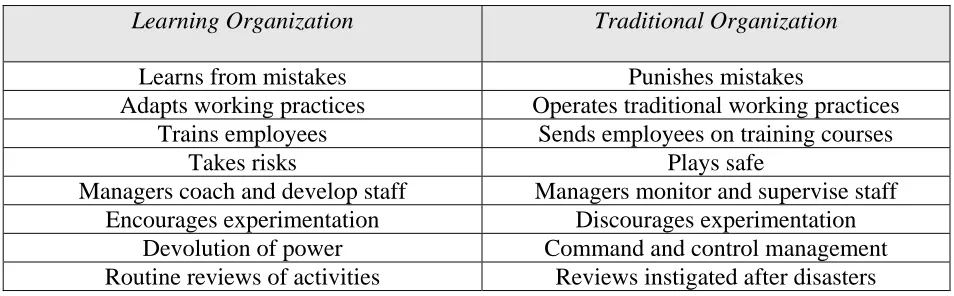
Churches tend to be traditional organizations. Below is a table adapted from Peter Lassey (1998) that contrasts learning organizations with more traditional organizations.
Table 1. Comparison of learning organizations and traditional organizations.
Learning Organization Traditional Organization
Learns from mistakes Punishes mistakes
Adapts working practices Operates traditional working practices Trains employees Sends employees on training courses
Takes risks Plays safe
Managers coach and develop staff Managers monitor and supervise staff Encourages experimentation Discourages experimentation