6
INFRARED WIRELESS
COMMUNICATION SYSTEM
Abu Sahmah Mohd Supa’at
Rohaya Binti Mahbar
6.1 INTRODUCTION
The term wireless is normally used to refer to any type of electrical or electronic operation which is accomplished without the use of a "hard wired" connection. Wireless communication is the transfer of information over a distance without the use of electrical conductors or wires [1].
Wireless infrared communications refers to the use of free-space propagation of light waves in the near infrared band as a transmission medium for communication [2]. The communication can be between one portable communication device and another or between a portable device and a tethered device, called an access point or base station. Typical portable devices include notebook, personal digital assistants, and portable telephones, while the base stations are usually connected to a computer with other networked connections. Although infrared light is usually used, other regions of the optical spectrum can be used (so the term wireless optical communications" instead of wireless infrared communications" is sometimes used).
communication, and the degradation is much deviated by the meteorological condition while the degradation is calculated using the cable length in the optical fiber communication. Consequently the infrared communication system must include the large system margin against the deviation of the signal quality.
In the infrared communication system the signal quality, that is the system availability, is affected by the meteorological condition and remarkably affected by the regional difference. The infrared communication system uses many technical solutions in order to provide the stable transmission path against these environmental conditions.
Anyone who has used an infrared remote control is familiar with some of the limitations of optical systems. The range tends to be short, the signal will not pass through walls or other opaque objects, and usually the transmitter must be carefully pointed in the direction of the receiver. A short-range infrared system called Infrared Data Association (IrDA) has been used for some time to allow two devices to communicate with each other [3].
A typical example would be the synchronization of data between a desktop and a notebook computer. The system is deliberately restricted to a range of one meter to allow several independent infrared links to operate simultaneously in the same room. LEDs operating at a wavelength of about 860 nm are used. Several data rates are specified, up to a maximum of 4 Mb/s, but most systems operate at a significantly lower data rate, since it is common to connect an infrared transceiver to the serial port on computers without built-in infrared ports [4].
6.1.1 Applications
high-speed network access or metropolitan- or campus-area networks. Wireless input and control devices, such as wireless mice, remote controls, wireless game controllers, and remote electronic keys.
6.1.2 Link Type
Another important way to characterize a wireless infrared communication system is by the “link type", which means the typical or required arrangement of receiver and transmitter. Figure 2 depicts the two most common configurations: the point-to-point system and the diffuse system.
The simplest link type is the point-to-point system. There, the transmitter and receiver must be pointed at each other to establish a link. The line-of-sight (LOS) path from the transmitter to the receiver must be clear of obstructions, and most of the transmitted light is directed toward the receiver. Hence, point-to-point systems are also called directed LOS systems. The links can be temporarily created for a data exchange session between two users, or established more permanently by aiming a mobile unit at a base station unit in the LAN replacement application.
In diffuse systems, the link is always maintained between any transmitter and any receiver in the same vicinity by reflecting or “bouncing" the transmitted information-bearing light or reflecting surfaces such as ceilings, walls, and furniture. This allows the computers to be moved around, but they must in the same room [3]. Here, the transmitter and receiver are non-directed; the transmitter employs a wide transmit beam and the receiver has a wide field-of-view. Also, the LOS path is not required. Hence, diffuse systems are also called non directed non-LOS systems. These systems are well suited to the wireless LAN application, freeing the user from knowing and aligning with the locations of the other communicating devices.
6.2 OPTICAL DESIGN
6.2.1 Modulation and demodulation
However, it is difficult to detect such a signal following non-directed propagation, and more expensive narrow-linewidth sources are required [5]. An effective solution is to use intensity modulation, where the transmitted signal's intensity or power is proportional to the modulating signal.
At the demodulator (usually referred to as a detector in optical systems) the modulation can be extracted by mixing the received signal with a carrier light wave. This coherent detection technique is best when the signal phase can be maintained. However this can be difficult to implement and additionally, in non-directed propagation, it is difficult to achieve the required mixing efficiency. Instead, one can use direct detection using a photo detector. The photo detector current is proportional to the received optical signal intensity, which for intensity modulation, is also the original modulating signal. Hence, most systems use intensity modulation with direct detection (IM/DD) to achieve optical modulation and demodulation.
In a free-space optical communication system, the detector is illuminated by sources of light energy other than the source. These can include ambient lighting sources, such as natural sunlight, fluorescent lamp light, and incandescent lamp light. These sources cause variation in the received photocurrent that is unrelated to the transmitted signal, resulting in an additive noise component at the receiver. We can write the photocurrent at the receiver as
Y (t) = X(t) - Rh(t) + N(t) (1)
R in “(1)” is the responsivity of the receiving photodiode (A/W). Note that the electrical impulse response c(t) is simply R times the optical impulse response h(t).
6.2.2 Receivers and Transmitters
than for a laser diode, which usually have very narrow transmit beams.
The principal advantages of laser diodes are their high energy-conversion efficiency, their high modulation bandwidth and their relatively narrow spectral width. Although laser diodes offer several advantages over LEDs that could be exploited, most short-range commercial systems currently use LEDs.
A receiver or detector converts optical power into electrical current by detecting the photon flux incident on the detector surface. Silicon p-i-n photodiodes are ideal for wireless infrared communications as they have good quantum efficiency in this band and are inexpensive [6]. Avalanche photodiodes are not used here since the dominant noise source is background light-induced shot noise rather than thermal circuit noise.
6.2.3 Transmission Wavelength and Noise
The most important factor to consider when choosing a transmission wavelength is the availability of effective, low-cost sources and detectors. The availability of LEDs and silicon photodiodes operating in the 800 nm to 1000 nm range is the primary reason for the use of this band [4]. Another important consideration is the spectral distribution of the dominant noise source: background lighting.
Receiver noise is due to thermal effects in the receiver circuitry, and is particularly dependent on the type of preamplifier used. With careful circuit design, it can be made insignificant relative to the photon noise [7].
Periodic noise is the result of the variation of fluorescent lighting due to the method of driving the lamp using the ballast. This generates an extraneous periodic signal with a fundamental frequency of 44 kHz with significant harmonics to several MHz [4]. Mitigating the effect of periodic noise can be done using high-pass filtering in combination with baseline restoration [8], or by careful selection of the modulation type.
6.2.4 Safety
There are two safety concerns when dealing with infrared communication systems. Eye safety is a concern because of a combination of two effects: the cornea is transparent from the near violet to the near infrared. Hence, the retina is sensitive to damage from light sources transmitting in these bands. However, the near infrared is outside the visible range of light, and so the eye does not protect itself from damage by closing the iris or closing the eyelid. Eye safety can be ensured by restricting the transmit beam strength according to IEC or ANSI standards [9, 10].
Skin safety is also a possible concern. Possible short-term effects such as heating of the skin are accounted for by eye safety regulations (since the eye requires lower power levels than the skin). Long-term exposure to infrared light is not a concern, as the ambient light sources are constantly submitting our bodies to much higher radiation levels than these communication systems do.
6.3 STANDARDS AND SYSTEMS
6.3.1 Infrared Data Association Standards (IrDA)
The Infrared Data Association, an association of about one hundred member companies, has standardized low-cost optical data links [11]. The IrDA link transceivers or “ports”, appear on many portable devices including notebook computers, personal digital assistants, and also computer peripherals such as printers.
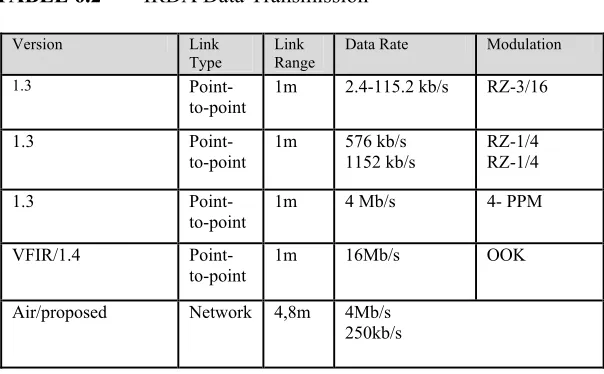
The series of IrDA transmission standards are described in Table 2. The current version of the physical layer standards is IrPHY 1.3. Data rates from 2.4 kb/s to 4 Mb/s are supported. The link speed is negotiated by starting at 9.6 kb/s. Most of the transmission standards are for short-range, directed links which an operating range from 0 m to 1 m. The transmitter half angle must be between 15 and 30 degrees, and the receiver field-of-view half angle must be at least 15 degrees. The transmitter must have a peak-power wavelength between 850 nm and 900 nm [4].
6.3.2 IEEE 802.11 and wireless LANs
The IEEE has published a set of standards for wireless LANs, IEEE 802.11 [12]. The IEEE 802.11 standard is designed to fit into the structure of the suite of 802 LAN standards. Hence, it determines the physical layer (PHY) and medium-access control layer (MAC) leaving the logical-link control (LLC) to 802.2. The MAC layer uses a form of carrier-sense multiple access with collision avoidance (CSMA/CA).
The original standard supports both radio and optical physical layers with a maximum data rate of 2 Mb/s. The 802.11b standard adds a 2.4 GHz radio physical layer at up to 11 Mb/s and 802.11a standard adds a 5.4 GHz radio physical layer at up to 54 Mb/s.
The two supported data rates for infrared 802.11
using PPM. 16-PPM carries log 2(16)=16=1/4 bits/chip, and 4-PPM carries log2(4)=4 = 1=2 bits/chip, resulting in the same chip time for both types. The transmitter must have a peak-power wavelength between 850 nm and 950 nm. The required transmitter and receiver characteristics are intended to allow for reliable operation at link lengths up to10 m [4].
6.3.3 Building-to-building systems
Long range (greater than 10 m) infrared links must be directed LOS systems in order to ensure a reasonable path loss. The emerging products for long- range links are typically designed to be placed on rooftops [13,14], as this provides the best chance for establishing line-of-sight paths from one location to another in an urban environment. These high data rate connections can then be used for enterprise net-work access or metropolitan- or campus-area net-works.
There are several design issues specific to these systems that are unique to these long-range systems [15]. The first is atmospheric path loss, which is a combination of clean-air absorption from the air and absorption and scattering from particles in the air, such as rain, fog, and pollutants. Secondly, an effect called scintillation, which is caused by temperature variations along the LOS path, causes rapid fluctuations in the channel quality. Finally, building sway can affect alignment and result in signal loss unless the transceivers are mechanically isolated or active alignment compensation is used.
6.3.4 Other Applications
use infrared communication systems due to the attractive combination of low cost, reliability, and light weight in a transmitter/receiver pair that achieves the required range, data rate, and data integrity required
6.4 CONCLUSIONS
Wireless infrared communication systems provide a useful complement to radio-based systems, particularly for systems requiring low cost, light weight, moderate data rates, and only requiring short ranges.
When LOS paths can be assured, range can be dramatically improved to provide longer links. Infrared systems have already proven their effectiveness for short-range temporary communications and in high data rate longer range point-to-point systems
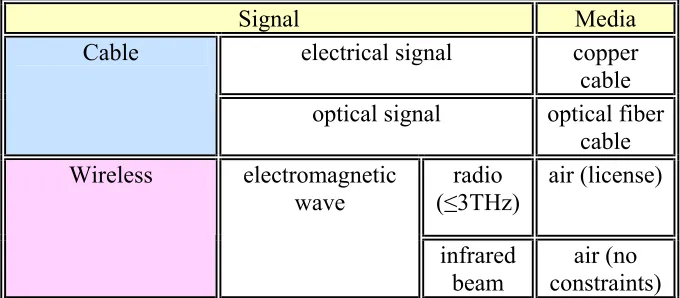
TABLE 6.1 Infrared Versus Other Communication Method
Signal Media
electrical signal copper
cable Cable
optical signal optical fiber
cable radio
(≤3THz)
air (license)
Wireless electromagnetic
wave
infrared beam
air (no constraints)
TABLE 6.2 IRDA Data Transmission
Version Link Type
Link Range
Data Rate Modulation
1.3
Point-to-point 1m 2.4-115.2 kb/s RZ-3/16 1.3
Point-to-point 1m 576 kb/s 1152 kb/s RZ-1/4 RZ-1/4 1.3
Point-to-point 1m 4 Mb/s 4- PPM VFIR/1.4
Point-to-point
1m 16Mb/s OOK Air/proposed Network 4,8m 4Mb/s
250kb/s
REFERENCES
[1] http://en.wikipedia.org/wiki/Wireless"
[2] Roy Blake, Electronic Communication System, 2nd ed
Niagara College of Applied Arts & Technology Welland, Ontorio, Canada, pp 865-873
[3] Jefrey B. Carruthers, Wireless Infrared Communication.
Boston University, Boston, MA 02215 USA. [5] J. M. Kahn and J. R. Barry, “Wireless infrared
communications,” Proceedings of the IEEE, vol. 85, pp. 265{98, Feb. 1997}
[6] J. R. Barry, Wireless Infrared Communications. Boston: Kluwer Academic Publishers, 1994.
[7] J. R. Barry and J. M. Kahn, “Link design for non-directed wireless infrared communications,” Applied Optics, vol. 34, pp. 3764{3776, July 1995.
links," IEE Proceedings-Optoelectronics, vol. 143, pp. 347-354, Dec. 1996.
[9] International Electrotechnical Commission, CEI/IEC825-1: Safety of Laser Products, 1993.
[10] ANSI-Z136-1, American National Standard for the Safe Use of Lasers, 1993.
[11] http://www.irda.gov.
[12] IEEE Std 802.11-1999 Wireless LAN Medium Access Control (MAC) and Physical Layer (PHY) specifications. [13] http://www.canobeam.com.
[14] http://www.terabeam.com.
[15] D. Heatley, D. Wisely, I. Neild, and P. Cochrane, “Optical
wireless: The story so far,” IEEE Communications