http://www.ijcmph.com pISSN 2394-6032 | eISSN 2394-6040
Original Research Article
The visual outcomes after cataract surgery in urban slums of Raipur,
Chhattisgarh, India: a cross sectional study
Anjana Tiwari, Indu Padmey*
INTRODUCTION
Cataract is the world’s leading cause of blindness, affecting an estimated 20 million people. Because of population growth and increased longevity, this figure is expected to increase to 50 million by the year 2020 if no additional interventions are implemented.1 One third of the world’s blindness caused by cataract occurs in India.2
Each year about 3.8 million in India are blinded by cataract.3 The National Program for Control of Blindness in India aimed at controlling cataract induced blindness to
reduce the prevalence of blindness from 1.4% to 0.3%.4 Cataract surgery aims to rehabilitate blind or visually impaired persons by restoring their eyesight so that their quality of life and ability to function are returned to normal or as near normal as possible.5
Several studies have indicated that poor outcomes of cataract surgery is a major problem in developing countries.6,7, 8, This can be due to concurrent sight impairing eye diseases, surgical complications, inadequate optical correction, or long term
ABSTRACT
Background: Poor outcomes of cataract surgery are a major problem in developing countries, including India which affects the demand and uptake of cataract surgical services. The present study was aimed to assess the visual outcomes after cataract surgery and identify factors associated with it, among persons aged 50 year and above in urban slums of Raipur.
Methods: A community-based, cross-sectional study was conducted in15 randomly selected clusters (urban slums) of Raipur from June 2012 to March 2013. Interviews, Visual Acuity measurements and ocular examinations were performed on all persons aged 50 year and above through house to house visits. Details about surgical intervention i.e. date, setting, type of cataract surgery were obtained from cataract operated persons, for each eye that had cataract surgery. Collected data were analyzed by using both descriptive and inferential statistics. The chi- square test was used to determine the associations of different cataract related parameters with visual outcomes in cataract operated eyes.
Results: Of the 870 participants, 203 persons (329 eyes) had undergone cataract surgery. Among all operated eyes, visual outcome was good (VA ≥6/18) in 84.5%, borderline (VA <6/18 and ≥6/60) in 12.5%, and poor (VA <6/60) in 3% of eyes with available correction. Visual outcome of cataract surgery was significantly associated with age at time of surgery, literacy, type of surgery, place of surgery and time since surgery.
Conclusions: The visual outcomes of cataract surgery were excellent in study area; it can be further improved by appropriate refractive correction, provision of glasses and adequate follow up after cataract surgery.
Keywords: Visual outcomes, Cataract surgery, Urban slums, Raipur, Chhattisgarh Department ofCommunity Medicine, CCM Medical College, Durg, Chhattisgarh, India
Received: 11 November 2018
Accepted: 08 December 2018
*Correspondence:
Dr. Indu Padmey,
E-mail: [email protected]
Copyright: © the author(s), publisher and licensee Medip Academy. This is an open-access article distributed under the terms of the Creative Commons Attribution Non-Commercial License, which permits unrestricted non-commercial use, distribution, and reproduction in any medium, provided the original work is properly cited.
complications.9,10 Poor visual acuity following surgery will affect the demand and uptake of cataract surgical services.3,11 The most important factor to motivate person to utilize cataract surgical services, is the visual outcome of past operated persons in community. In order to improve quality of cataract surgery, the surgical outcome in a population based study must be analyzed at a regular interval. To monitor the visual outcomes of cataract surgery, WHO has recommended values of ≥85%, <10% and <5% with good (VA=6/6-6/18), borderline (VA <6/18-6/60), and poor outcome (VA <6/60) with available correction respectively, as adequate outcome results.12
Previous population based studies reported that there are some socio-demographic factors (age, sex and literacy) and surgical variables (place of surgery, type of the surgery and time since surgery) play an important role in the final outcome of cataract surgery. Poor visual outcomes after cataract surgery were associated with older age, female gender and illiteracy, non- IOL surgery, surgery performed at an eye camp or government hospital and year of surgery.13,14
Reliable population based data regarding visual outcomes of cataract surgery were lacking in Chhattisgarh. Community-based study is of great importance to assess the quality of cataract surgery. Hospital or camp based study may not be representative of community to assess outcome. Baseline data about quality cataract surgical services in a population based study are important for effective planning of services. The National Survey on Blindness, India, indicated that of all age-related cataract blindness, 95% occurs in the age group of 50 years and older and to facilitate comparison with other population based surveys, this study focused on 50 years and older people.15 Keeping in view the above points, the present study was conducted with aim to assess the visual outcomes of cataract surgery and associated factors that influenced visual outcomes in study population.
METHODS
A community- based, cross-sectional study was conducted in15 randomly selected urban slums of Raipur, from June 2012 to March 2013. All people aged 50 years and above residing for at least 6 months in study area were interviewed along with visual acuity testing and eye examination, through house to house visits, by a survey team consisting of 2 ophthalmic assistants and 1 Doctor.
Sample size was calculated by taking the prevalence rate of 10% for blindness (presenting vision<6/60) among those aged 50 years and above with relative error of 25%, confidence level of 95% and design effect of 1.5.16 In present study, sample size calculated was 864 subjects with taking cluster of 15 urban slums and each slum with 58 person per cluster.
In present study, survey population was selected by cluster random sampling. Sampling frame consisting of the list of 281 slums of Raipur city with their populations which was obtained from the office of Nagar Nigam and 15 clusters were randomly selected from the list. To select household random walk method was used.
The selected households were visited by the survey team. All eligible persons in the households were explained the purpose of the study and verbal informed consent was obtained before interview and eye examination. All information was recorded in a designed and pre-tested proforma. For each selected subject the presenting visual acuity (VA) of each eye was measured with a Snellen chart with ―E‖ or English alphabet optotypes in the vicinity of the households, outdoors in front of the house during the full daylight. Presenting visual acuity of all the eligible persons was recorded. The aided VA was considering as presenting VA, if a subject was using spectacles and unaided VA was considered as presenting VA, if a subject had no spectacles.
After measuring visual acuity, the examinee is taken inside the house, into the shaded dark area. Both eyes of all eligible subjects in the selected households were examined with a torch to assess lens status. The lens in each eye is examined and graded as normal lens, obvious lens opacity present, lens absent (aphakia), IOL implanted (pseudophakia). In cataract operated persons for each eye that had cataract surgery, details about cataract surgical intervention were obtained. These details were included subject’s age at the time of surgery; the place of surgery, the type of the surgery, use of spectacles and reasons for not using spectacles. If an eligible person was not available after two visits the person was labeled as a no responder.
Data analysis
Collected data was entered in the Microsoft excel sheet and were analyzed. Visual outcomes after cataract surgery were categorized according to WHO criteria as ―Good outcome‖ was defined as a visual acuity of ≥6/18‖ borderline outcome'' as 6/24 to 6/60; and ―poor outcome‖ as <6/60 with the available correction. The association of age at time of surgery, sex, education, type of surgery, place of surgery and time since surgery with visual outcome of surgery was investigated by chi-square test. P≤0.05 were considered statistically significant.
RESULTS
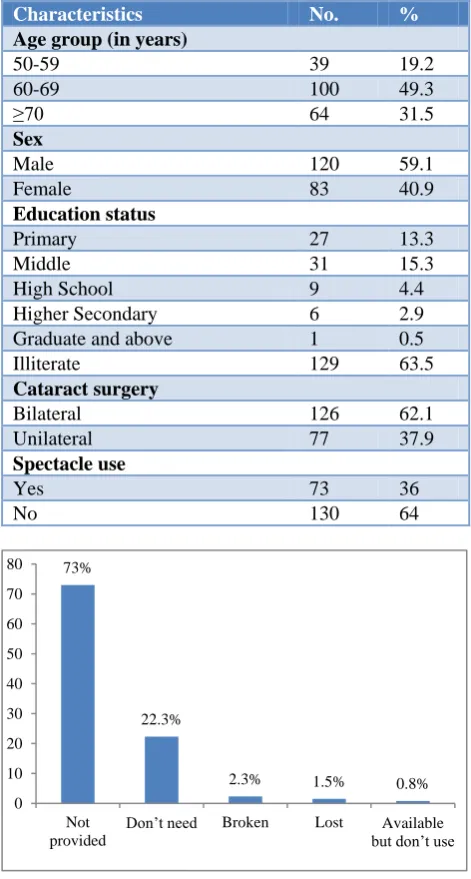
130 cataract operated persons who were not using spectacles, the main reasons for not using spectacles were that 95 (73%) persons were not provided spectacles after operation, 29 (22.3%) persons felt no need to use spectacle after operation while 2 (1.5%) persons had lost, 3 (2.3%) had broken spectacles and remaining 1 (0.8%) subjects reported that spectacle available but they don’t use (Figure 1).
Table 1: Characteristics of cataract operated persons (n=203).
Characteristics No. %
Age group (in years)
50-59 39 19.2
60-69 100 49.3
≥70 64 31.5
Sex
Male 120 59.1
Female 83 40.9
Education status
Primary 27 13.3
Middle 31 15.3
High School 9 4.4
Higher Secondary 6 2.9
Graduate and above 1 0.5
Illiterate 129 63.5
Cataract surgery
Bilateral 126 62.1
Unilateral 77 37.9
Spectacle use
Yes 73 36
No 130 64
Figure 1: Main reason for not using spectacle among cataract operated persons who were not using
spectacles.
Majority of eyes (66%) were operated between 60 and 69 years of age. Only 3.6% of eyes were operated before 50 years of age. Most of the cataract surgeries were performed in males (62.3%) and illiterates (60.8%). Of all cataract operated eyes, 90% had intra ocular lens
(IOL) implant. Most of the surgeries were performed in Charitable/NGO hospitals (31.3%) and private hospitals (29.8%) and only 18.5% of surgeries were performed in the eye camps. Most of the eyes (37.1%) were operated within 1 year prior to survey (Table 2).
Table 2: Cataract related parameters of cataract operated eyes (n=329).
Variables No. %
Age at time of surgery (in years)
<50 12 3.6
50-59 72 21.9
60-69 217 66
≥70 28 8.5
Sex of operated persons
Male 205 62.3
Female 124 37.7
Literacy of operated persons
Literate 129 39.2
Illiterate 200 60.8
Type of surgery
IOL 296 90
Non-IOL 33 10
Place of surgery
Eye camps 61 18.5
Charitable/NGO hospitals 103 31.3
Govt. hospitals 67 20.4
Private hospital 98 29.8
Duration since surgery
≤ 1 year 122 37.1
2-4 years 114 34.6
5-10 years 58 17.6
>10 years 35 10.6
Among all cataract operated eyes, visual outcome was good (VA ≥6/18) in 84.5%, borderline (VA <6/18 and ≥6/60) in12.5%, and poor (VA <6/60) in 3% of eyes with available correction (Table 3).
Table 3: Visual outcomes of cataract operated eyes (n=329).
Visual outcome No. %
Good (PVA ≥6/18) 278 84.5
Borderline (PVA <6/18 and ≥6/60) 41 12.5
Poor (PVA <6/60) 10 3.0
Total 329 100
PVA: Presenting visual acuity.
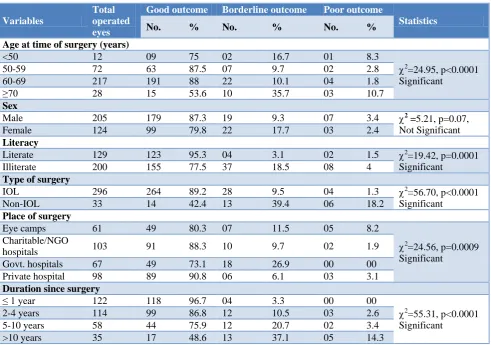
Majority of cataract operated eyes had attained good outcome where surgeries were performed at 50-59 years age group (87.5%) and 60-69 years age group (88%) whereas only 53.6% of eyes attained good outcome where surgeries performed at age 70 years and above. Visual outcome was significantly associated with age (p<0.0001).
73%
22.3%
2.3% 1.5% 0.8% 0
10 20 30 40 50 60 70 80
Not provided
More male eyes attained good visual outcomes compared to females (87.3% versus 79.8%) but visual outcome was not statistically associated with sex (p=0.07).
Majority of eyes of literate persons (95.3%) had attained good visual outcome compared to illiterates (77.5%) and association between visual outcomes and education status of operated persons was found to be statistically significant (p=0.0001).
Majority of eyes (89.2%) that had undergone IOL surgery (pseudophakic eyes) had attained good outcomes compared to the eyes with non IOL surgery/aphakic eyes
(42.4%). In case of non IOL surgery, 18.2% of aphakic eyes presented with poor outcome and an additional 39.4% of eye presented with borderline outcome whereas among pseudophakic eyes, the presentation of poor outcome and borderline outcome was 1.3% and 9.5% of eyes respectively. Visual outcomes was statistically associated with type of surgery (p<0.0001).
Majority of eyes operated in private hospital had good visual outcome (91%) followed by Charitable or NGO hospital (88.35%) whereas surgeries performed in government hospital and camp setting good outcome was attained in 73.1% and 80.3% of eyes respectively.
Table 4: Association of visual outcomes of cataract operated eyes with cataract related parameters (n=329).
Variables
Total operated eyes
Good outcome Borderline outcome Poor outcome
Statistics
No. % No. % No. %
Age at time of surgery (years)
<50 12 09 75 02 16.7 01 8.3
2
=24.95, p<0.0001 Significant
50-59 72 63 87.5 07 9.7 02 2.8
60-69 217 191 88 22 10.1 04 1.8
≥70 28 15 53.6 10 35.7 03 10.7
Sex
Male 205 179 87.3 19 9.3 07 3.4 2
=5.21, p=0.07, Not Significant
Female 124 99 79.8 22 17.7 03 2.4
Literacy
Literate 129 123 95.3 04 3.1 02 1.5 2
=19.42, p=0.0001 Significant
Illiterate 200 155 77.5 37 18.5 08 4
Type of surgery
IOL 296 264 89.2 28 9.5 04 1.3 2
=56.70, p<0.0001 Significant
Non-IOL 33 14 42.4 13 39.4 06 18.2
Place of surgery
Eye camps 61 49 80.3 07 11.5 05 8.2
2
=24.56, p=0.0009 Significant
Charitable/NGO
hospitals 103 91 88.3 10 9.7 02 1.9
Govt. hospitals 67 49 73.1 18 26.9 00 00
Private hospital 98 89 90.8 06 6.1 03 3.1
Duration since surgery
≤ 1 year 122 118 96.7 04 3.3 00 00
2
=55.31, p<0.0001 Significant
2-4 years 114 99 86.8 12 10.5 03 2.6
5-10 years 58 44 75.9 12 20.7 02 3.4
>10 years 35 17 48.6 13 37.1 05 14.3
Majority of eyes operated in within 1years prior to the examination (96.7%) had attained good outcome whereas only 48.6% of eyes operated more than 10 years presented with good outcome. Duration since cataract surgery was significantly associated with visual outcome (p<0.0001).
DISCUSSION
The present community-based study was aimed to assess the visual outcomes after cataract surgery among 203 cataract operated persons aged 50 year and above (329 cataract operated eyes). It was carried out using cluster sampling method to eliminate selection bias from study.
cataract operated persons are poor who cannot afford good quality spectacles. Therefore, there is the need of proper post-operative refractions, provision of glasses and adequate follow up after cataract surgery, in study area.
The visual outcomes of the present study were comparable to the WHO recommended value of ≥85%, <10% and <5% with good, borderline and poor outcome with available correction respectively.19 The proportion of eyes with good visual outcome (84.5%) as found in present study was much higher than other population based studies Tirunelvelli (64%), Gujarat (50.7%), Andhra Pradesh (68.2%), Nigeria (25.6%) and Bangladesh (43.8%).6,14,17,18,20 The proportion of eyes with poor visual outcome (3%) in present study was much lower than other population based studies Tirunelvelli (11.8%) and Gujarat (18%), Andhra Pradesh (14.2%), Nigeria (58.3%) and Bangladesh (28.3%).6,14,17,18,20 This result may be due to that current study was done in urban area with better surgical facilities and majority of cataract operated eyes (90%) had intra ocular lens (IOL) implant in study population. Recent surveys have reported higher success rates following cataract surgery with Intra Ocular Lens implantation as compared to conventional surgery.21 In present study, majority of cataract operations (66%) were performed at 60-69 years age and only 3.6% of cataract operations were performed at age less than 50 years. Similarly, a study by Bechani et al also reported that among the examined eyes, more eyes were operated above 70+ years compared to younger ages.22 This finding shows poor awareness of the public for timely intervention.
In present study, it was observed that majority of cataract operated eyes (90%) had intra ocular lens (IOL) implant which is very impressive finding. The proportion of eyes with intra ocular lens (IOL) implant of present study was higher than other population based studies Tirunelvelli (56.5%), Gujarat (88.1%), Nigeria (34.8%) and Bangladesh (10.2%).6,14,18,20
The present study revealed that the Charitable/NGO hospitals (31.3%) and private hospitals (29.8%) were the commonest place of surgery and most surgeries (37.1%) had been performed within 1 year prior to survey. Performance of cataract surgery in Government hospitals is low contributing only 20% of operations. Several other population based studies also reported that the largest provider of surgical services was the NGO sector.14,23 In present study, it was found that some socio-demographic factors and surgical variables were most important determinant of visual outcome. Visual outcome of cataract surgery was significantly associated with age at time of surgery, literacy, type of surgery and place of surgery and time since surgery but gender was not important.
Regarding visual outcomes in relation to age at time of surgery, the present study revealed that better visual outcomes were found where surgeries had been performed between age of 50-59 years and 60-69 years compared to age more than 70 years. Similar finding was reported in the other community based studies that the increasing age might have negative influence on visual outcome after cataract surgery.14,24,25 Possible explanation for this finding may be that the older person are more likely associated with other co-existing ocular morbidities such as retinal pathologies which may limit the effectiveness of cataract surgery and its visual outcome among this population segment.
The present study revealed that more male operated eyes had attained good outcomes compared to female operated eyes (87% vs 80.2%). Although this was not statistically significant (p=0.07). So this finding shows that gender did not influence cataract surgical outcome.
The result of present study showed that significantly more literates eyes attained good outcome after surgery compared to illiterates (95.3% vs 77.5%). Similar finding was reported in the other community based studies.14,18 This may be due to good awareness and health seeking behavior of cataract surgical services among literates.
Present study revealed that a significantly greater numbers of eyes that had undergone IOL implantation attained good outcomes compared to the Non-IOL (89.2% vs. 42.4%). Many other studies had also reported that visual outcome was better with IOL implantarion than without it.14,17,18
Present study reported that that better visual outcomes were found in private hospitals and charitable/ NGO hospitals as opposed to that in government hospitals and camp surgery. This finding was consistent with other studies.6,17,20
Current study showed that majority of eyes (96.7%) attained good visual outcome where surgeries had been performed within 1 years or equal (in recent surgeries) before examination whereas only 48.6% of eyes obtained good outcome where surgeries performed 10 year or more prior to examination. Similar finding was also reported in other studies.14,18 It means that the shorter the duration between the surgery and the survey, the better the visual outcome in all operated eyes. This finding indicates that there was improvement in the quality of recent surgery.
CONCLUSION
ACKNOWLEDGEMENTS
The authors are thankful to all participants of present study for their valuable cooperation and also acknowledge the immense help received from the scholars whose articles are cited and included in references of this manuscript.
Funding: No funding sources Conflict of interest: None declared
Ethical approval: The study was approved by the Institutional Ethics Committee
REFERENCES
1. Foster A. Cataract—a global perspective:output, outcome and outlay. Eye. 1999;13:449–53.
2. Thylefors B. A simplified methodology for the assessment of blindness and its main causes. World Health Stat Q. 1987;40:129-41.
3. Fletcher AE, Donoghue M, Devaram J, Thulasiraj RD, Scott S, Abdalla M, et al. Low uptake of eye services in rural India:a challenge for programmes of blindness prevention. Arch Ophthalmol. 1999;117:1393-9.
4. Kishore J. National Health Programs of India.7th edition, New Delhi: Century Publication; 2007: 362. 5. Hennig A, Shrestha SP, Foster A. Results and evaluation of high volume intracapsular cataract surgery in Nepal. Actaophthalmologica, 1992;70:402–6.
6. Nirmalan PK, Thulasiraj RD, Maneksha V, Rahmathullah R, Ramakrishnan R, Munoz SR, et al. A population based eye survey of older adults in Tirunelveli district of south India: blindness, cataract surgery, and visual outcomes. J Comm Eye Health. 2002;15(43):46.
7. Murthy GVS, Gupta S, Ellwein LB, Munoz SR, Bachani D, Dada VK. A population-based eye survey of older adults in a rural district of Rajasthan:I. Central vision impairment, blindness, and cataract surgery. Ophthalmology. 2001;108:679–85.
8. Thulasiraj RD, Rahamathulla R, Saraswati A, Selvaraj S, Ellwein LB. The Sivaganga Eye Survey:I, Blindness and cataract surgery. Ophthalmic Epidemiol. 2002;9(5):299–312.
9. Snellingen T, Shrestha BR, Gharti MP, Shrestha J, Upadhyay M, Pokhrel R. Socioeconomic barriers to cataract surgery in Nepal: the south Asian cataract management study. Br J Ophthalmol. 1998;82:1424–8.
10. He M, Xu J, Li S, Wu K, Munoz SR, Ellwein LB. Visual acuity and quality of life in patients with cataract in Doumen County, China. Ophthalmology. 1999;106:1609–15.
11. Vaidyanathan K, Limburg H, Foster A, Pandey RM. Changing trends in barriers to cataract surgery. Bull World Health Organ. 1999;77:104–9.
12. Limburg H. Monitoring cataract surgical outcomes: Methods and tools. Community Eye Health. 2002;15:51-3.
13. Verma R, Khanna P, Prinja S, Rajput M, Arora V. The National Programme for Control of Blindness in India. Australasian Med J. 2011;4(1):1-3. 14. Murthy GVS, Vashist P, John N, Pokharel G,
Ellwein LB. Prevalence and vision-related outcomes of cataract surgery in Gujarat, India. Ophthalmic Epidemiol. 2009;16(6):400–9.
15. Hans L, Allen F. Cataract surgical coverage: An Indicator to Measure the Impact of Cataract Intervention Programmes. Community Eye Health. 1998;11(25):3-6
16. Neena J, Rachel J, Praveen V, Murthy GVS. Rapid Assessment of Avoidable Blindness in India. PLoS One. 2008;3(8):e2867.
17. Khanna RC, Pallerla SR, Eeda SS, Gudapati BK, Cassard SD, Rani PK, et al. Population Based Outcomes of Cataract Surgery in Three Tribal Areas of Andhra Pradesh, India: Risk Factors for Poor Outcomes. PLoS One. 2012;7(5):e35701.
18. Odugbo OP, Mpyet CD, Chiroma MR, Aboje AO. Cataract Blindness, Surgical Coverage, Outcome and Barrier to Uptake of Cataract Services in Plateau State, Nigeria. Middle East African J Ophthalmol. 2012;19(3):282-8.
19. World Health Organization. Informal consultation on analysis of blindness prevention outcomes. Geneva: WHO; 1998. WHO/PBL/98.68.
20. Bourne RRA, Dineen BP, Ali SM, Huq DMN, Johnson GJ. Outcomes of cataract surgery in Bangladesh: results from a population based nationwide survey. Br J Ophthalmol. 2003;87:813– 9.
21. Jose R. Present Status of the National Programme for Control of Blindness in India. Community Eye Health J. 2008;21(65):103–4.
22. Bechani D, Gupta SK, Murthy GVS, Jose R. Visual outcomes after cataract surgery and cataract surgical coverage in India. Int Ophthalmol. 1999;23:49-54. 23. National program for control of blindness. Rapid
Assessment of Avoidable Blindness - India. Report.2006-2007. New Delhi: Directorate General of Health Services, Ministry of Health and Family Welfare, Government of India.
24. Westcott MC, Tuft SJ, Minassian DC. Effect of age on visual outcome following cataract extraction. Br J Ophthalmol. 2000;84:1380-2.
25. Lumme P, Laatikainen LT. Factors affecting the visual outcome after cataract surgery. Int Ophthalmol. 1993;17:313-9.