http://www.ijcmph.com pISSN 2394-6032 | eISSN 2394-6040
Original Research Article
Prevalence and determinants of excessive daytime sleepiness among
resident doctors at a tertiary care institution in India
Siddalingaiah H. S.
1*, David F. Mastin
2, Bruce D. Moore
2, W. Jeff Bryson
3,
Chandrakala D.
1, Amarjeet Singh
4INTRODUCTION
Modern socio-occupational settings, especially medical settings, often involve shift work, long work hours, and concomitant maladaptive sleep habits. These factors may result in daytime sleepiness, an increase in the prevalence
of sleep disorders, and/or an exacerbation of existing sleep disorders in the contemporary workforce.
It has been well documented that poor sleep contributes to ill health.1-11 Epidemiological studies have associated excessive daytime sleepiness (EDS) and other sleep
ABSTRACT
Background: Modern socio-occupational settings, especially medical settings, often involve shift work, long work hours, and concomitant maladaptive sleep habits. These factors may result in daytime sleepiness, an increase in the prevalence of sleep disorders, and/or an exacerbation of existing sleep disorders in the contemporary workforce. Aim was to measure the prevalence and determinants of excessive daytime sleepiness (EDS) among medical residents at a Tertiary Care Institution in India.
Methods: A cross-sectional study was designed and a list of all enrolled medical residents was obtained (N=430). The eligible subjects (N=428) were interviewed and administered the study instruments. The information on socio-demographics and sleep-related factors were collected using the sleep assessment proforma. The Epworth sleepiness scale (ESS) was used to measure excessive daytime sleepiness (EDS) and the sleep hygiene index (SHI) was used to measure sleep hygiene. Data were analyzed with appropriate statistical methods.
Results: A total of 350 residents responded (82%). The prevalence of EDS and Maladaptive sleep hygiene were 47.4% and 85.5% respectively. A positive association was found between EDS and weekly work hours, SHI score, sleep duration, sleep quality, midnight awakenings, clinical stream, and rotating shift work. Coffee intake and smoking within 4 hours of bedtime, restless legs and allergies had weak association with EDS.
Conclusions: EDS and unhygienic sleep were highly prevalent among resident doctors. The factors associated with EDS were mainly related to work, sleep quantity, sleep quality and sleep hygiene which are amenable to suitable modifications by behavioural change communications, awareness programs and by administrative actions.
Keywords: Excessive daytime sleepiness, Sleep hygiene, Work hours, Sleep quality, Shift work
Department of Community Medicine, 1Shridevi Institute of Medical Sciences and Research Hospital, Tumkur, Karnataka, 4Post Graduate Institute of Medical Education and Research, Chandigarh, India
Department of Psychology, 2University of Arkansas at Little Rock, Arkansas, 3Fielding Graduate University, Alabama, USA
Received: 30 January 2018
Revised: 05 March 2018
Accepted: 06 March 2018
*Correspondence:
Dr. Siddalingaiah H. S., E-mail: [email protected]
Copyright: © the author(s), publisher and licensee Medip Academy. This is an open-access article distributed under the terms of the Creative Commons Attribution Non-Commercial License, which permits unrestricted non-commercial use, distribution, and reproduction in any medium, provided the original work is properly cited.
disorders with a reduced life span, cardiovascular diseases and breast cancer, etc.2-7,10,12
EDS is also associated with increased risk of accidents when operating motor vehicles or other machinery.13-15 The World Health Organization’s International Agency for Research on Cancer has classified sleep disturbing shift work as the 2A-Group (probable) carcinogen.16-19
EDS may be behaviourally defined as an inability to stay alert during the major awake period of the day, resulting in falling asleep at inappropriate times.20,21 Maladaptive sleep hygiene practices are documented to be predictive of both EDS and poor sleep quality.21,22 EDS is more likely to occur in monotonous situations when alerting stimuli are absent and may result in an increase in daily total sleep time without a significant feeling of restoration.20,21 The severity of sleepiness can be quantified subjectively using scales such as the Epworth Sleepiness Scale (ESS).20
The incidence and prevalence of sleep disturbances are steadily rising in modern society due to changing lifestyles, fast and stressful life, increased travel, 24-hour economic activity, and other similar factors. The prevalence of EDS varies from 5-10% in general population to 40-80% in working population such as resident doctors, nurses, shift workers, business process
outsourcing (BPO) employees, and information
technology professionals.8,9,23-26 Sleep disorders are documented in all age groups, and all societies and sections.24,27,28 EDS may also result from internal factors such as organic illness, CNS dysfunction/damage, degenerative disorders, and advanced age, as well as from external factors such as sleep deprivation, alteration in circadian rhythm due to night shifts, caffeine, etc.1,8,9,29
With ongoing sleep deprivation (getting two to three hours less sleep than optimal), individuals develop a sleep debt.30 If the sleep debt continues over 5 to 10 days, alertness at a maximum potential is often impaired. Their
general performance, and particularly cognitive
performance, becomes verifiably worse. Sleep debt also leads to slower response times, altered mood and motivation, and reduced morale and initiative. Sleep debt arising from sleep deprivation (shift work, prolonged work hours, etc.) is one of the most common causes of EDS.31 This is problematic in that resident physicians have to make many critical decisions regarding patient care under these conditions.
The aim of the present study is to examine the prevalence of EDS among resident physicians, especially those working in rotating shifts and those working longer weekly-hours. Sleep hygiene, sleep quality, and sleep duration were also examined in their relationship to EDS.
METHODS
This study included all medical residents enrolled in clinical, pre-clinical and para-clinical departments of a
tertiary care medical institution of India. The study was conducted from July 2008 to June 2009. There were 6 groups of residents at any point of time in the institute. There were more than 70 residents per group. The list of all the residents was obtained from the concerned authorities with a prior approval from an IRB.
A cross sectional descriptive study was designed in which all participants were interviewed and administered the assessment protocol once. The information on socio-demographics and sleep-related factors was collected using the sleep assessment proforma.32 The assessment of EDS was conducted using the Epworth sleep scale (ESS) with qualitative definition of EDS as normal (scores 0-9), mild EDS (score 10-12), moderate EDS (scores 13-14) and severe EDS (score >14).20,33,34 The sleep hygiene index (SHI) was used to measure the level of sleep hygiene with greater than 26 indicating maladaptive sleep hygiene and 26 or less indicating adaptive sleep hygiene practices.21
There were 430 residents enrolled at the time of assessment and all were included in the study. A list of all the resident physicians enrolled was obtained from the training branch administration. The list consisted of resident physicians from all parts of India. The study population was a uniform homogenous population with regard to age as most of the physicians were in mid and late 20’s. The study subjects were visited at their work place and a suitable appointment was taken from them for the initial interview. Consent was obtained after explaining the purpose of the study. Residents who were pregnant, sick, or admitted to the hospital were excluded from the study. After an initial brief interview, socio demographic data was collected followed by self-administration of tools and questionnaire in sequence i) sleep assessment proforma ii) ESS iii) SHI, which took about 30 minutes. Clarifications were made to the study participants on various aspects of the study tools and questionnaire. The collection of the data was conducted mainly in the afternoons, post lunch sessions, and in the early evening.
Most residents (70%) completed the assessment forms during their free time. Subjects asked for 2 days to 2-4 weeks of time for completing the forms. The phone numbers and e-mail addresses of these residents were collected. They also fixed a probable place for returning the filled forms which was noted and followed. Residents were later contacted for clarifications in almost all cases where forms were incomplete.
conducted on 10-15 residents of the outgoing batch in the hospital setting to test the feasibility of the survey methodology. The time taken to complete each questionnaire was noted. Necessary changes in the tools/ survey plan were executed as per the observations during the pilot study.
The data was entered into SPSS® Statistical Package 10.00 for analysis. The statistical tests used were percentage, mean, S.D., χ2 test, t- test, ANOVA, Cronbach’s alpha, kappa statistics, logistic regression analysis, and multivariate analysis. The analysis was performed to evaluate the association of study variables with the outcome and not the causation. The results were
presented in terms of mean differences, differences in proportions, odds ratios/β co-efficient with statistical significance using appropriate statistical methods.
RESULTS
The prevalence of EDS was high with nearly half of the studied residents reporting EDS (Table 1). The SHI revealed a high prevalence of maladaptive sleep hygiene practices among the resident physicians (Table 1). Chi-square tests demonstrated a significant difference between the prevalence ratios of the normal, mild moderate and severe groups based on EDS and maladaptive sleep hygiene practices.
Table 1: Prevalence of EDS and maladaptive sleep hygiene (N=350).
Sleep domain Normal Mild Moderate Severe Total abnormal 2 test p
n (%) n (%) n (%) n (%) n (%)
EDS 183 (52.3) 91 (26) 33 (9.4) 42 (12) 166 (47.4) 0.000
Maladaptive sleep hygiene 50 (14.3) 290 (82.9) 9 (2.6) 299 (85.5) 0.000
Table 2: Comparison of study variable means between EDS and non-EDS groups (N=350).
Variable EDS(n=166),
M (SD)
Non-EDS(n=183)
M (SD) t
P (2-tailed)
Sleep hours in last 1 week 44.47 (10.47) 47.72 (12.69) 2.590 0.010
Work hours in last 1week 86.98 (21.59) 79.39 (23.17) -3.155 0.002
Night shifts in last 1 month 6.86 (6.48) 4.82 (6.39) -2.917 0.004
Duty offs in last 1 month 1.59 (2.02) 2.44 (3.02) 3.045 0.003
Number of night-time awakenings 1.91 (0.97) 1.40 (1.12) -2.569 0.012
The comparison of cumulative sleep and work hour means over a week revealed the presence of a significant difference between EDS and non-EDS groups. Similarly, there was a significant difference of total number of night shifts and off duty periods over the past one month. The number of night-time awakenings also differed significantly between EDS and non-EDS groups (Table 2).
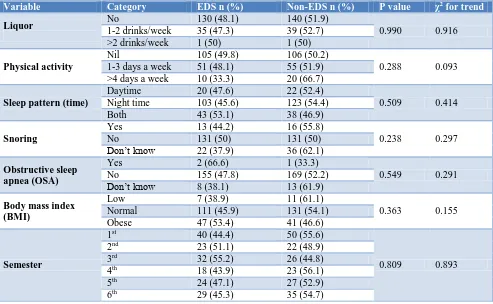
Tables 3a and 3b show the summary of the distribution of study variables between EDS and Non-EDS groups and their association. An analysis of the magnitude and direction of the association of study factors with EDS found that the odds of developing EDS was 2.98 times more likely for physicians reporting maladaptive sleep hygiene (95% CI = 1-54-5.83 (p<0.001). Further, a strong positive association is observed for self-rated sleep
quality (OR=1.85, 95% CI=1.18-2.78, p=0.006);
disrupted sleep continuity (OR=1.69, 95% CI=1.37-2.09, p<0.001); work hours in the past week (OR=1.70, 95%
CI=1.10-2.61, p=0.015); and clinical department
(OR=3.45, 95% CI=1.69-7.03, p<0.001). Although there was a positive association (odds ratio >1) of EDS with factors such as sex, intake of >2 cups of coffee per day, intake of coffee within 4 hours of bedtime, smoking,
restless leg syndrome (RLS), and allergies, the association was not statistically significant.
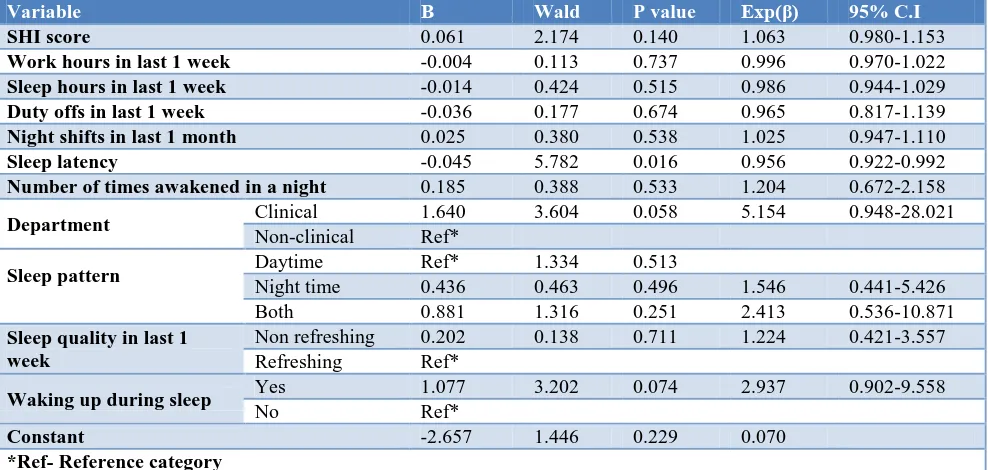
Table 4 demonstrates the direction and magnitude of association of the studied explanatory variables which are non-overlapping domains with EDS using a logistic regression model. This model is not adjusted for interaction and confounding variables. Here, SHI scores and weekly sleep and work hours are taken on a continuous scale, along with other important continuous and categorical variables. The observed results are consistent with the earlier measures of linearity and crude odds ratios. It is evident that variables such as SHI score, night shifts in past month, number of nocturnal awakenings, being in a clinical department, mixed sleep pattern, and non-refreshing sleep in past week have a positive relationship.
Tables 5a and 5b depict the association of EDS with sleep hygiene and weekly work hour categories before and
after adjusting for interaction and confounding
Table 3a: Association of the study variables with EDS (N=350).
Variable Category EDS n (%) Non-EDS n (%) P value Crude OR 95% CI(P)
Department Clinical 155 (51.3) 147 (48.7) 0.000 3.45 1.69-7.03 (0.001)
Non-clinical 11 (23.4) 36 (73.6)
Sex Male 131 (46.5) 151 (53.5) 0.394 1.26 0.74-2.14
(0.395)
Female 35 (52.2) 32 (47.8)
Married Yes 46 (50) 46 (50) 0.586 0.88 0.54-1.41
(0.586)
No 120 (46.7) 137 (53.3)
Coffee/tea >2cups 63 (49.2) 58 (50.8) 0.220 1.31 0.84-2.05 (0.220)
0-2cups 103 (45.2) 125 (54.8)
Smoking Yes 16 (57.1) 12 (42.9) 0.297 1.21 0.86-1.71
(0.300)
No 150 (46.9) 170 (53.1)
Coffee/tea within 4 hours of bedtime
Yes 75 (50.7) 73 (49.3)
0.519 1.07 0.86-1.33
(0.519)
No 91 (47.2) 102 (52.8)
Smoking within 4 hours of bedtime
Yes 13 (61.9) 8 (38.1)
0.178 1.32 0.92-1.88
(0.184)
No 152 (46.8) 173 (53.2)
Waking during the sleep period
Yes 40 (72.7) 15 (27.3)
0.000 1.69 1.37-2.09
(0.000)
No 126 (42.9) 168 (57.1)
RLS Yes 31 (54.4) 26 (45.6) 0.260 1.38 0.78-2.45
(0.261)
No 135 (46.2) 157 (53.8)
Legs jerking during sleep
Yes 44 (52.4) 40 (47.6)
0.293 1.30 0.79-2.13
(0.294)
No 120 (45.8) 142 (54.2)
Allergies Yes 49 (48) 53 (52) 0.906 1.02 0.06-1.63
(0.906)
No 116 (47.3) 129 (52.7)
Work hours in 1 week
≥80 105 (53.3) 92 (46.7)
0.015 1.70 1.10-2.61
(0.015)
≤80 61 (40.1) 91 (59.9)
Sleep hygiene by SHI Un hygienic 153 (51.2) 146 (48.8) 0.001 2.98 1.54-5.83 (0.001)
Hygienic 13 (26) 37 (74)
Self-rated sleep quality
Non-refreshing 83 (41.3) 65 (58.7)
0.006 1.85 1.18-2.78
(0.006)
Refreshing 83 (56.1) 118 (43.9)
Table 3b: Association of categorical study variables with EDS (N=350).
Variable Category EDS n (%) Non-EDS n (%) P value χ2 for trend
Liquor No 1-2 drinks/week 130 (48.1) 35 (47.3) 140 (51.9) 39 (52.7) 0.990 0.916
>2 drinks/week 1 (50) 1 (50)
Physical activity
Nil 105 (49.8) 106 (50.2)
0.288 0.093
1-3 days a week 51 (48.1) 55 (51.9)
>4 days a week 10 (33.3) 20 (66.7)
Sleep pattern (time)
Daytime 20 (47.6) 22 (52.4)
0.509 0.414
Night time 103 (45.6) 123 (54.4)
Both 43 (53.1) 38 (46.9)
Snoring
Yes 13 (44.2) 16 (55.8)
0.238 0.297
No 131 (50) 131 (50)
Don’t know 22 (37.9) 36 (62.1)
Obstructive sleep apnea (OSA)
Yes 2 (66.6) 1 (33.3)
0.549 0.291
No 155 (47.8) 169 (52.2)
Don’t know 8 (38.1) 13 (61.9)
Body mass index (BMI)
Low 7 (38.9) 11 (61.1)
0.363 0.155
Normal 111 (45.9) 131 (54.1)
Obese 47 (53.4) 41 (46.6)
Semester
1st 40 (44.4) 50 (55.6)
0.809 0.893
2nd 23 (51.1) 22 (48.9)
3rd 32 (55.2) 26 (44.8)
4th 18 (43.9) 23 (56.1)
5th 24 (47.1) 27 (52.9)
Table 4: Logistic regression model with non-overlapping domains for EDS (N=350).
Variable Β Wald P value Exp(β) 95% C.I
SHI score 0.061 2.174 0.140 1.063 0.980-1.153
Work hours in last 1 week -0.004 0.113 0.737 0.996 0.970-1.022
Sleep hours in last 1 week -0.014 0.424 0.515 0.986 0.944-1.029
Duty offs in last 1 week -0.036 0.177 0.674 0.965 0.817-1.139
Night shifts in last 1 month 0.025 0.380 0.538 1.025 0.947-1.110
Sleep latency -0.045 5.782 0.016 0.956 0.922-0.992
Number of times awakened in a night 0.185 0.388 0.533 1.204 0.672-2.158
Department Clinical 1.640 3.604 0.058 5.154 0.948-28.021
Non-clinical Ref*
Sleep pattern Daytime Ref* 1.334 0.513
Night time 0.436 0.463 0.496 1.546 0.441-5.426
Both 0.881 1.316 0.251 2.413 0.536-10.871
Sleep quality in last 1 week
Non refreshing 0.202 0.138 0.711 1.224 0.421-3.557
Refreshing Ref*
Waking up during sleep Yes 1.077 3.202 0.074 2.937 0.902-9.558
No Ref*
Constant -2.657 1.446 0.229 0.070
*Ref- Reference category
Table 5a: Logistic regression for association of SHI and work hours with EDS (without adjustment for interaction/confounding).
Variable B Wald P value Exp(β) 95% C.I
Intercept 0.292 3.687 0.055
Work in 1 week ≤80 hours -0.559 6.325 0.012 0.572 0.370-0.884
>80 hours 0 - - - -
Sleep hygiene Adaptive -1.122 10.541 0.001 0.326 0.165-0.641
Maladaptive 0 - - - -
Table 5b: Logistic regression for association of SHI and work hours with EDS (with adjustment for interaction/confounding).
Variable B Wald P value Exp(β) 95% C.I
Intercept 0.215 1.921 0.166
Work in 1 week ≤80 hours -0.383 2.681 0.102 0.682 0.431-1.078
>80 hours 1 - - - -
Sleep hygiene Adaptive -0.563 1.909 0.167 0.569 0.256-1.266
Maladaptive 1 - - - -
Interaction Work in 1 week*
sleep hygiene -2.264 4.110 0.043 0.104
DISCUSSION
The medical residents studied were found to have greater EDS with poorer sleep hygiene. Almost 50% of the studied residents reported the presence of EDS and 85% reported the presence of maladaptive sleep hygiene. Further, these residents were found to work more, sleep less, have more night shifts, have fewer duty shifts off, and have more night time awakenings. These findings also suggest the resident physicians are at much higher risk of EDS with maladaptive sleep hygiene and identified contributing work factors.
in the amount of physical activity/exercise between EDS and non-EDS groups appeared to be approaching statistical significance (p=0.093). The amount of physical activity/exercise as a factor should be a focus for future investigations.
Further analysis using logistic regression models provided strong evidence that there is a positive
association between maladaptive sleep hygiene
(measured by SHI) and night shifts in past month, number of nocturnal awakenings, work in a clinical department, self-rated and sleep quality. Analysis with logistic regression also supports the protective effects of adaptive sleep hygiene and limiting weekly work hours to less than 80. This also supports earlier reported findings regarding sleep hygiene and work hours among resident physicians.21 It is clear that work hours are a major concern in this population.
As the study was a cross sectional survey, further confirmations of the risk factors and the magnitude of risks may be attempted by follow up or interventional studies. Also, the results reported here may be specific to this population and environment and not necessarily generalizable globally. However, it should be understood that there may be many work environments where conditions are similar. Future studies should also examine the effects of sleep hygiene practices on longitudinal health quality, burn out, and cognitive impairments. Studies on sleep hygiene and EDS should also be expanded to include resident physicians in different countries and in different specialities.
CONCLUSION
Medical residents are a risk group for developing the EDS and engaging in maladaptive sleep hygiene. We suggest there are specific identifiable factors related to work and sleep patterns which predispose to the development of EDS. These factors are amenable to
suitable modifications by behavioural change
communications, awareness programs and by
administrative actions.
ACKNOWLEDGEMENTS
We thank all resident doctors who participated in this study. We also thank the Director of the institution for necessary administrative approvals.
Funding: No funding sources Conflict of interest: None declared
Ethical approval: The study was approved by the Institutional Ethics Committee
REFERENCES
1. Whitney CW, Enright PL, Newman AB, Bonekat
W, Foley D, Quan SF. Correlates of daytime
sleepiness in 4578 elderly persons: the
Cardiovascular Health Study. Sleep. 1998;21(1):27-36.
2. Newman AB, Spiekerman CF, Enright P, Lefkowitz
D, Manolio T, Reynolds CF, et al. Daytime sleepiness predicts mortality and cardiovascular disease in older adults. The Cardiovascular Health Study Research Group. J Am Geriatr Society. 2000;48(2):115-23.
3. Haas DC, Foster GL, Nieto FJ, Redline S, Resnick HE, Robbins JA, et al. Age-dependent associations
between sleep-disordered breathing and
hypertension: importance of discriminating between systolic/diastolic hypertension and isolated systolic hypertension in the Sleep Heart Health Study. Circulation. 2005;111(5):614-21.
4. Gami AS, Hodge DO, Herges RM, Olson EJ,
Nykodym J, Kara T, et al. Obstructive sleep apnea, obesity, and the risk of incident atrial fibrillation. J Am Coll Cardiol. 2007;49(5):565-71.
5. Lavie P. Mortality in sleep apnoea syndrome: a review of the evidence. Eur Respir Rev. 2007;16:203-10.
6. Marshall NS, Wong KK, Liu PY, Cullen SR,
Knuiman MW, Grunstein RR. Sleep apnea as an independent risk factor for all-cause mortality: the Busselton Health Study. Sleep. 2008;31(8):1079-85.
7. Young T, Finn L, Peppard PE, Szklo-Coxe M,
Austin D, Nieto FJ, et al. Sleep disordered breathing and mortality: eighteen-year follow-up of the Wisconsin sleep cohort. Sleep. 2008;31(8):1071-8.
8. Siddalingaiah HS, Singh A, Lal V. Excessive
Daytime Sleepiness: prevalence, pattern and determinants among PGIMER Junior Resident doctors. Chandigarh: Post Graduate Institute of Medical Education and Research; 2009.
9. Mastin DF, Siddalingaiah HS, Singh A, Lal V.
Excessive Daytime Sleepiness, Sleep Hygiene, and Work Hours Among Medical Residents in India. J Trop Psychol. 2012;2:4.
10. Xiao Q, Signorello LB, Brinton LA, Cohen SS, Blot
WJ, Matthews CE. Sleep duration and breast cancer risk among black and white women. Sleep Med. 2016;20:25-9.
11. Siddalingaiah HS. Sleep problems: an emerging
public health issue. Int J Community Med Public Health. 2017;4(12):4386-8.
12. Siddalingaiah HS, Chandrakala D, Singh A. Sleep pattern, sleep problems and comorbidities among resident doctors at a tertiary care institution in India: a cross sectional study. Int J Community Med Public Health. 2017;4(12):4477-84.
13. Powell NB, Schechtman KB, Riley RW, Li K,
Troell R, Guilleminault C. The road to danger: the comparative risks of driving while sleepy. The Laryngoscope. 2001;111(5):887-93.
14. Suzuki K, Ohida T, Kaneita Y, Yokoyama E,
15. Pandi-Perumal SR, Verster JC, Kayumov L, Lowe AD, Santana MG, Pires ML, et al. Sleep disorders, sleepiness and traffic safety: a public health menace. Braz J Med Biol Res. 2006;39(7):863-71.
16. Costa G. Shift work and breast cancer. Giornale italiano di medicina del lavoro ed ergonomia. 2010;32(4):454-7.
17. Erren TC. Shift work, cancer and "white-box"
epidemiology: Association and causation.
Epidemiologic perspectives & innovations: EP+I. 2010;7:11.
18. Humans IWGotEoCRt. Painting, firefighting, and
shiftwork. IARC monographs on the evaluation of carcinogenic risks to humans / World Health Organization, International Agency for Research on Cancer. 2010;98:9-764.
19. Savvidis C, Koutsilieris M. Circadian rhythm
disruption in cancer biology. Molecular Med. 2012;18:1249-60.
20. Johns MW. A new method for measuring daytime
sleepiness: the Epworth sleepiness scale. Sleep. 1991;14(6):540-5.
21. Mastin DF, Bryson J, Corwyn R. Assessment of
sleep hygiene using the Sleep Hygiene Index. J Behav Med. 2006;29(3):223-7.
22. Bryson WJ, Mastin DF. Sleep hygiene predictors of
excessive daytime sleepiness and poor subjective sleep quality. J of Psychological Pract. 2013;18:88-104.
23. Howard SK, Gaba DM, Rosekind MR, Zarcone VP.
The risks and implications of excessive daytime sleepiness in resident physicians. Acad Med. 2002;77(10):1019-25.
24. Tsuno N, Jaussent I, Dauvilliers Y, Touchon J, Ritchie K, Besset A. Determinants of excessive daytime sleepiness in a French community-dwelling elderly population. J Sleep Res. 2007;16(4):364-71.
25. Siddalingaiah HS, Chaudhuri A, Chandrakala D,
Singh A. Excessive daytime sleepiness and its determinants: do they have a pattern with study
semesters among postgraduate medical resident doctors? Int J Community Med Public Health. 2017;5(1):382.
26. Kaur G, Singh A. Excessive daytime sleepiness and
its pattern among Indian college students. Sleep medicine. 2017;29:23-8.
27. Souza JC, Magna LA, Reimao R. Excessive daytime
sleepiness in Campo Grande general population, Brazil. Arq Neuropsiquiatr. 2002;60(3):558-62.
28. Joo S, Shin C, Kim J, Yi H, Ahn Y, Park M, et al.
Prevalence and correlates of excessive daytime sleepiness in high school students in Korea. Psychiatry Clin Neurosci. 2005;59(4):433-40. 29. Kaur G, Sharma V, Singh A. Association of sleep
quality with general health: an Indian college students study. Int J Med Sci Public Health. 2015;4(12):1767.
30. Horne J. Is there a sleep debt? Sleep.
2004;27(6):1047-9.
31. Pagel JF. Excessive daytime sleepiness. Am Fam Physician. 2009;79(5):391-6.
32. Sandia National Laboratories, Sandia Corporation. Health Benefits employee Services. HBE preventive health sleep assessment form California Lockheed Martin; 2007. Available at: http//hbe.sandia.gov. Accessed on 3 June 2017.
33. Johns MW. Reliability and factor analysis of the Epworth Sleepiness Scale. Sleep. 1992;15(4):376-81.
34. Miletin MS, Hanly PJ. Measurement properties of the Epworth sleepiness scale. Sleep medicine. 2003;4(3):195-9.