Original Research Article
A study to assess and develop injection administration skill in
medical undergraduates of GMC, Bhopal
Padma Bhatia
1, Harshima Sawlani
1*, Rajesh Tarachandani
2INTRODUCTION
The art of parenteral injection administration is a must know pursuit for any undergraduate medical student.1 In the race for Post-graduate seats, students tend to miss their clinics and internship postings rendering many undergraduate students inadequately exposed for this technique even till their internship.1 Thus, resulting in lack of acquisition of proper skills.1 In a report by WHO, globally around 12 billion injections are administered every year, of which 50% are unsafe and 75% are unnecessary.2
It should be realized that life of the patient is being dealt. Conditions like vein puncture, bleeding, hematoma, infections at the injection site, etc. are few patient related complications due to improper technique.1 It can also lead to transmission of certain diseases due to needle prick injury.1
Exposing students to the patients, improves their practical and problem solving skills. Skills and confidence could be improved ensuing reiterated exposures with augmented experience.3 But the key component of learning and its sustention is its repeated practice.4
ABSTRACT
Background: Injections are one of the vital route of drug administration in emergency medical practice. WHO has estimated that out of 12 billion injections administered worldwide annually 50% are unsafe and 75% are unnecessary. Despite of humungous efforts medical students still lack the confidence in injecting drugs due to stress for post graduation selection. The objectives of the study were to assess the knowledge of students regarding administration of I.M. and I.V. injections; to make students confident and skilful about administration of I.M. and I.V. injections and to assess the proportion of students who can skilfully administer I.V. and I.M. before and after this intervention.
Methods: This was a Quasi experimental study carried out on 150 students of junior final medical students of GMC Bhopal for a period of three months.
Results: Out of effective 136 students, 93.4% had ever seen I.M./ I.V. administration. 29.4% have administered I.M. and 16.9% I.V. injection ever. A significant increase in knowledge regarding I.M. and I.V. administration technique is observed following interventional training of the participants. Significant gain in self confidence among the students was perceived.
Conclusions: There was a convincing increase in skillful knowledge and self-confidence for parenteral injection technique among medical undergraduates.
Keywords: I.M. and I.V. injection, Quasi experimental study, GMC Bhopal, Medical undergraduates
1
Department of Community Medicine, 2Department of Medicine, Gandhi Medical College, Bhopal, Madhya Pradesh, India
Received: 05 November 2018
Accepted: 06 December 2018
*Correspondence:
Dr. Harshima Sawlani,
E-mail: [email protected]
Copyright: © the author(s), publisher and licensee Medip Academy. This is an open-access article distributed under the terms of the Creative Commons Attribution Non-Commercial License, which permits unrestricted non-commercial use, distribution, and reproduction in any medium, provided the original work is properly cited.
Assessment of these skills of medical students needs to be more of objective in nature. Hence the objectives of the present study were 1) To assess the knowledge of students regarding administration of I.M. and I.V. injections. 2) To make students confident and skillful about administration of I.M. and I.V. injections. 3) To assess the proportion of students who can skillfully administer I.V. and I.M. before and after this intervention.
METHODS
Study design: Educational interventional study.
Study area: Casualty room of Hamidia Hospital which is
affiliated to Gandhi Medical College, Bhopal.
Study subjects: All students of MBBS-III part-1
accounting to be 150 students were invited to participate.
Study duration: 12 weeks from September to November
2017.
Study tool: Tool I- Semi structured questionnaire, Tool II- Checklist for supervision.
Methodology
Institutional ethical clearance was attained for the study. Permission was taken from the superintendent. Written consent was taken after explaining the purpose of study to the participants. Casualty duty roaster was released according to which 150 students were divided into 10 groups of 15 each. Every group was posted for a period of 1 week divided in 2 evening shifts.
Tool-I: Set of semi structured knowledge based
questionnaire was prepared based on WHO guidelines on I.M. and I.V. administration which was filled by the participants before and after the training/educational intervention. The participants were also asked to rate themselves on the Likert scale of 1 to 5, regarding their confidence towards injection techniques before and after the training.
Tool-II: According to W.H.O. guidelines, checklists were
prepared for the observation of steps of administration. Checklists were prepared separately (I.M. and I.V.) consisting of 12 steps for I.M. and 17 steps for I.V. injection administration. A target of minimum 10 I.M and 5 I.V. administered during interventional process was set. Drop out = 9.3% (14 participants)
Statistical analysis
Information was collected organized, tabulated, and statistically analyzed using Microsoft excel and Epi info. The qualitative variables were expressed in proportion and quantitative variables were summarized by mean and standard deviation. Chi-square test was used to analyze
difference in proportion and p<0.05 was taken as the cutoff for commenting statistically significant association.
RESULTS
A total of 150 medical students participated in the study. 136 out of 150 (90.7%) participants responded to the questionnaire.
Table 1: Distribution of participants whether they have ever seen I.M./I.V. administration.
S.No. Seen I.M./ I.V. administration
Frequency
(n=136) %
1. Yes 127 93.4
2. No 09 06.6
Table 1 shows that out of 136 participants, 93.4% have seen administration of I.M. or I.V. injection ever.
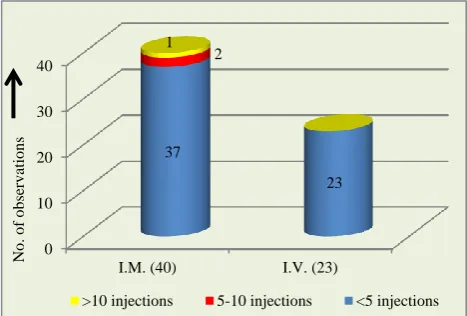
Figure 1: Distribution of participants on the basis of number of parenteral injection administered.
Table 2 shows that only 29.4% of the participants have ever administered I.M. injections, out of which majority (27.2%) have administered less than 5 injections. As far as I.V. injection administration is considered only 16.9% of participants have administered I.V. injections ever and among them, all i.e. 16.9% have administered less than 5 injections (Figure 1).
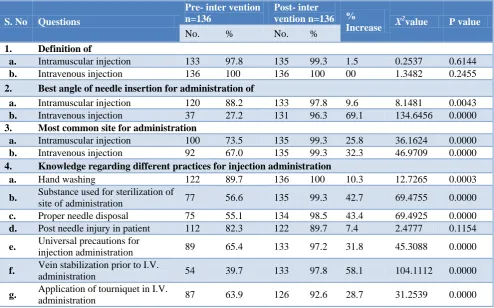
Table 3 shows the assessment of the participants about knowledge on injection administration skills. After the training, a significant increase in knowledge was observed. Initially the definition of I.M. and I.V. injection was appropriately answered by 97.8% and 100% participants respectively. Knowledge regarding the angle of insertion of syringe into the muscle was correctly answered by 88.2% and into the vein by 27.2% participants. Increment of 9.6% for I.M. and 69.1% for I.V. administration was observed following intervention, which was statistically significant as well (PIM=0.0043,
PIV=0.0000). Common site for the injection
administration was appropriately responded by 73.5%
0 10 20 30 40
I.M. (40) I.V. (23) 37
23 2
1
>10 injections 5-10 injections <5 injections
No
.
o
f
o
b
serv
atio
n
(I.M.) and 67% (I.V.) participants, which was further increased by 25.8% and 32.3% respectively after the training. The increment was highly significant statistically (PIM=0.0000, PIV=0.0000). Knowledge
regarding different practices followed during injection administration including hand washing, sterilization of site of injection administration, needle disposal, post
needle injury, universal precautions taken, vein stabilization and tourniquet application were assessed pre and post-interventionally, which increased by 10.3%, 42.7%, 43.4%, 7.4%, 31.8%, 58.1% and 28.7% respectively (which was statistically significant, mostly p<0.05).
Table 2: Distribution of participants whether they have ever administered I.M./I.V. injection.
S.No. Type Response Number of injections administered Frequency (n=136) %
1. I.M. Yes
40 29.4
<5 37 27.2
5-10 02 01.5
>10 01 00.7
No 96 70.6
2. I.V. Yes
23 16.9
<5 23 16.9
5-10 00 00
>10 00 00
No 113 83.1
Table 3: Distribution according to correctly answered questions (proportions).
S. No Questions
Pre- inter vention n=136
Post- inter
vention n=136 %
Increase X
2
value P value
No. % No. %
1. Definition of
a. Intramuscular injection 133 97.8 135 99.3 1.5 0.2537 0.6144
b. Intravenous injection 136 100 136 100 00 1.3482 0.2455
2. Best angle of needle insertion for administration of
a. Intramuscular injection 120 88.2 133 97.8 9.6 8.1481 0.0043
b. Intravenous injection 37 27.2 131 96.3 69.1 134.6456 0.0000
3. Most common site for administration
a. Intramuscular injection 100 73.5 135 99.3 25.8 36.1624 0.0000
b. Intravenous injection 92 67.0 135 99.3 32.3 46.9709 0.0000
4. Knowledge regarding different practices for injection administration
a. Hand washing 122 89.7 136 100 10.3 12.7265 0.0003
b. Substance used for sterilization of
site of administration 77 56.6 135 99.3 42.7 69.4755 0.0000
c. Proper needle disposal 75 55.1 134 98.5 43.4 69.4925 0.0000
d. Post needle injury in patient 112 82.3 122 89.7 7.4 2.4777 0.1154
e. Universal precautions for
injection administration 89 65.4 133 97.2 31.8 45.3088 0.0000
f. Vein stabilization prior to I.V.
administration 54 39.7 133 97.8 58.1 104.1112 0.0000
g. Application of tourniquet in I.V.
administration 87 63.9 126 92.6 28.7 31.2539 0.0000
Table 4 shows Number of observations with >8 correctly followed steps for I.M. administration increased from 31 (22.8%) to 128 (94.1%) after the training of one week. Similarly, number of observations with >9 correctly followed steps for I.V. administration increased from 58 (42.6%) to 83 (61%).
Table 4: Number of steps followed while administering I.M. and I.V. injection.
S. No. Correctly followed steps
1st Day Last Day
Frequency
(n=136) %
Frequency
(n=136) %
1. For I.M. administration (out of 12 steps)
<6 56 41.2 03 02.2
6-8 49 36 05 03.7
>8 31 22.8 128 94.1
2. For I.V. administration (out of 17 steps)
<6 42 30.9 03 02.2
6-9 36 26.5 50 36.8
>9 58 42.6 83 61
Figure 2: Confidence rating of participants for parenteral (I.M. and I.V.) injection technique.
DISCUSSION
In the present study, 90.7% of the participants were assessed and trained for safe I.M. and I.V. administration techniques. Similar finding was observed in studies, Peesthala et al where 89% of internees received the training in safe injection practices, Mohan et al where 95.5% participants responded to questionnaire and training process and Sahu et al where 93.5% participants were trained.5-7
The present study revealed a significant increase in knowledge of the participants after the training process. In a study conducted by Peethala et al, 48% of the internees knew about the correct disposal of sharps and
74% had knowledge on complications due to unsafe injections following training.5 In a study Mohan et al perceived a statistically significant increase in terms of improvement of pre-existing knowledge of injection techniques (p=0.012).6 In a study Bharath Kumar et al, 98% of students sterilized their hands before giving injection and 93% of them identified the injection site properly.8 Study of Šakić et al revealed that 92.7% students administered IM injection at 90º.9 In the study Trivedi et al, participants had good knowledge on use of universal precautions for injection.10
In present study, step-wise analysis was conducted where significant increment of responses was observed after educational intervention, similar to study conducted by Srividya et al with stepwise analysis.11
The current study highlights remarkable increase where 81% (110) were fully confident in administering I.M. and 47% (64) in administering I.V. injection. This finding corroborates with the study by Mohan et al where improvement in self-confidence among participants increased to 75%.6
CONCLUSION
It was for the first time a separate training schedule focused on I.M. and I.V. administering skills was designed for the M.B.B.S. undergraduates, as an interventional part of a study. The study concludes that knowledge of medical undergraduates regarding parenteral injection administration was good but confidence and hassle free administration, following all the steps from counseling to disposal of needle can be achieved only by hands on training. Also not single training program but periodic scheduling will be most effective.
Recommendations
and not limited to internship. Dummies can be provided for initial practice of I.M/I.V administration.
Limitation
The study was performed on a single institution and that to on a set of students, therefore the findings may not be generalized. Likert scale application represents inter-person subjectivity variation. Due to unavailability of patients the students under this study had to wait for longer time than expected. Patients were not willing to get themselves administered by the students. Because of this there were few delays in achieving the weekly target by certain groups.
ACKNOWLEDGEMENTS
The authors would like to thank all those students for being part of the study and all staff, Casualty (Gandhi Medical College, Bhopal) for the co-operation. The authors would also like to thank Professor and Head of Department of Community medicine, GMC, Bhopal for the kind cooperation and consent to execute the study.
Funding: No funding sources Conflict of interest: None declared
Ethical approval: The study was approved by the Institutional Ethics Committee
REFERENCES
1. Dolan SA, Felizardo G, Barnes S, Cox TR, Patrick M, Ward KS, et al. APIC position paper: safe injection, infusion, and medication vial practices in health care. American journal of infection control. 2010;38(3):167-72.
2. Deena KA, Nashwan AA. An iatrogenic sciatic nerve injuries following gluteal intramuscular injection among children. Int Res J Pharm 2014;5(4):267-70.
3. Lateef F. Simulation-based learning: Just like the real thing. J Emerg Trauma Shock. 2010;3(4):348– 52.
4. Rosen KR. The history of medical simulation. J Critical Care. 2008;23:157–66.
5. Peethala S, Garapati S. A study on assessment of safe injection practices among internees in government general hospital, Kakinada, Andhra Pradesh, India. Int J Community Med Public Health. 2017;4:4321-5.
6. Mohan ME, Lavanya SH, Kalpana L, Veena RM. Learning injection techniques with simulators: medical students' perspectives. Int J Med Health Sci. 2015;4(3):332-6.
7. Sahu D, Gandhi N. Assessment of Safe Injection Practices in a Tertiary Care Hospital: A CrossSectional Study from Chhattisgarh. Ntl J Community Med. 2015;6(4):500-3.
8. Bharat Kumar VD, Kalpana L, Veena RM, Lavanya SH, Manasa CR. A study to evaluate injection techniques of medical undergraduates on mannequins in a medical college. Int J Biological Pharma Res. 2015;6:12.
9. Šakić B, Milutinović D, Simin D. An assessment of intramuscular injection practices among nursing students and nurses in hospital settings: is it evidence-based? East Eur Health Sci J. 2012;2(2):114-21.
10. Trivedi A, Kasar PK, Tiwari R, Verma P, Sharma A. An Educational Interventional Programme for Prevention and Management of Needle Stick Injuries among Nursing Students at a Tertiary Care Hospital, Jabalpur, Madhya Pradesh. Natl J Community Med 2013;4(1):132-6.
11. BP, Srividya; H, Nagabushan; HS, Drupad HS. Assessment of knowledge among health care providers regarding intramuscular injection administration. Asian J Pharma Clin Res. 2015;8(1):220-2.
Cite this article as: Bhatia P, Sawlani H, Tarachandani R.A study to assess and develop injection administration skill in medical