IJSRSET185307 | Published : 28 April 2018 | March-April-2018 [(5) 3 : 01-07 ]
Themed Section : Engineering and Technology
© 2018 IJSRSET | Volume 5 | Issue 3 | Print ISSN: 2395-1990 | Online ISSN: 2394-4099
01
Spectrum Allocation for Downlink 4G Networks
P.Sakthibalan1, J.Brindhadevi2, Dr. K.Devarajan31Research Scholar, Annamalai University, Chidambaram, Tamil Nadu, India
2M.E, Communication Systems, Annamalai University, Chidambaram, Tamil Nadu, India
3Assistant Professor, Annamalai University, Chidambaram, Tamil Nadu, India
[email protected], [email protected]2, [email protected]3
ABSTRACT
The rapid growth of 4G network give more wireless services to many users at a time in network. Many services are providing by service providers but it can face many problems in network like traffic congestion, call dropping and call blocking during handover process. In this paper, we are introducing a spectrum allocation in 4G network, which can reserve some amount spectrum from the network resource. By using adaptive CAC is reserved spectrum resource are allocated for handoff calls and new calls during users handover. It used to regulate the traffic, improved QoS, efficient spectrum efficiency and reduce spectrum degradation. The results are shown in numerical result and analytical study that the adaptive call admission control is guarantee the allocation of spectrum is used to regulate the calls by providing efficient QoS in the network resources.
Keywords: CBP, CDP, Handoff calls, new calls, 4G, QoS
I.
INTRODUCTIONThe enormous growth of cellular network was introduced by the 3rd generation partnership project (3GPP) 4G -long term evolution (LTE). To provide high data rate, more desired spectral efficiency and increase wide area coverage to large number of users. These objectives are achieved by only reducing traffic, delay, loss and also give effective quality of services to the users. The radio resources management (RRM) provide solution to above objectives by one of its fundamental techniques known as (CAC) call admission control. The CAC scheme gives opportunity to new call and handoff call when handover occur. It also regulates the QoS of existing calls without degrading any call drops. This scheme satisfy the users by providing continuation of calls when handover occur, its achieved by reserved some amount of bandwidth in the network resources. So
the scheme provides effective network resources allocation and excellent QoS to the users.
In this scheme some amount of bandwidth is dynamically reserved for handoff cal and new call using time varying status. But there is some disadvantage due to reservation of bandwidth, because reserved network resource is unutilized or wasted when there is no handover occurred and it become inefficient use of network resources. We introduced an adaptive call admission control with reservation spectrum to overcome the inefficient use of the network utilization. In this paper it will provide three important makeovers they are
Reducing (CBP) call blocking probability for new calls and (CDP) call dropping probability for handoff calls.
Improving quality of services by regulating calls in network, even under heavy traffic intensity.
The next section of this paper is, we provide the overview of the related works in II section, the introduction of the system model of our proposed scheme in section III, the Analytical study is illustrated in section IV, Numerical result and discussion in section V. Finally, conclusion of this paper is given in section VI.
II.
RELATED WORKSIn [3] proposed work was a channel borrowing scheme which is borrowed the bandwidth from the available network resources and its reserved for high priority calls from the best effort traffic (BE). This scheme is dynamically reserved bandwidth using time varying status for handoff calls.
In [4] this paper shown the lot of momentum in LTE network based on reservation of CAC scheme relies on allocation of adaptive multilevel bandwidth for non–real time (NRT) calls. The disadvantage of this scheme is ignored the high CBP due to allocation of bandwidth which cause low utilization of network resources.
In [5] this proposed work scheme based on cognitive radio network for an interference aware spectrum handover. Which is maximised the network capacity and reduce the usage of spectrum. The spectrum handover problem is solved by heuristic algorithm.
In [6] this paper present the multiple sectors in cellular network for overlapping region is used by channel reservation and pre-emption (CRP). Here its reducing the CDP for handoff calls by using directional antennas are installed on enodeB which is coverage area is divided into equal sized sectors.
In [7] this work investigated about the effect of vertical handoff in heterogeneous networks.
Congestion game problem is solved by this scheme. In [8] this paper showed the achievement of efficient resources utilizations by calculating total throughput of QoS performance in CAC algorithm.
In [9] the scheme of wireless broadband cognitive network work designed framework and an optimization techniques is formulated to considering the demands for each service providers and cognitive subscriber. In [10] this paper shown the CAC reservation algorithm has two kinds of applications known as narrow band and wide bands. But it has poor resources utilization to reserve and predict for avoid QoS degradation.
In [11] proposed scheme have statically and dynamically reserves network resources due to sustain the undetectable quality fluctuations throughout the handover process in LTE networks, which is based on prior knowledge for dynamically reserve resources. But it increases the system complexity and inefficient network resources.
The above-related works show the benefits and challenges of CAC scheme in network resources. We proposed the spectrum reservation by adaptive call admission control in cellular networks in the next sections.
III.
PROPOSED SYSTEMthe available spectrum to increase the number of admitted calls with adaptive QoS, avoid starvation in BE traffic, adaptive CAC scheme is use different traffic loads to admit new users according to the priority of the calls and its employs the different adaptive threshold value by QoS requirement according to the consideration of user traffic to increase the efficient spectrum utilization in the network.
According to the priority of calls, the real time traffic (RT) has high priorities for handover process. Spectrum requirement for handoff call or new call in the network resources can be described in equation as
= (1)
The call admission criteria for call i is denoted as while the maximum spectrum for call i is denoted as
The spectrum requirement of handoff or new call belongs to NRT or BE traffic, which is calculated as follows:
(2)
Where denote the minimum spectrum requirement for call i. Furthermore, when the available spectrum cannot be enough to admit new call, spectrum degradation approach is applied to RT traffic since they were assigned enough; this will save the BE traffic from starvation. Therefore, to compute spectrum degradation for each class j considers the given equation below:
= - (3)
Where denote degraded spectrum for class j, represent available spectrum and
is the present degradation level. However,
Equation (3) must satisfy Equation (4) as given below:
- ≥ (4)
Therefore, the maximum spectrum degradation size is derived as follows:
=
(5)
Where represent maximum spectrum degradation size of class j. To accept a new call or handoff into the network using the proposed criterion, the spectrum allocated to an admitted new call or handoff is represented as and over time. A handoff call handoff is accepted into the network when the
following condition is satisfied.
Handoff – (
) (6)
Where is the admission criterion for call
i. A threshold value is introduced, to change the reservation spectrum using various traffic loads for handoff calls. The threshold block new request when the number of call is higher than the threshold value.
= (τ handoff * K)* (7)
Where =
represent the traffic load, and denote the arrival rate and mean
service of handoff call respectively. Moreover,
is the required spectrum for each handoff call, while K is the reservation spectrum factor, K 𝜖 (0,1) . A new call is accepted into the network
when the below condition is satisfied.
New- =
(8)
Where is the new admission criterion for
spectrum for the new call. While the last term at the RHS ensures that new calls are admitted even when there is inadequate number of spectrum.
IV.
ANALYTICAL STUDYIn this section we described the analytical model for our proposed CAC scheme. Using this model we derive CDP and CBP for the different traffic classes and extensive experimental simulation is carried out to verify its accuracy. In this model, we have one base station called evolved NodeB (eNodeB) and several UEs, as illustrated in Fig.1 some UEs are within the cell and are requesting for the new call, while others are outside the cell hence requesting for handoff call.
Figure 1. Simulation Topology
When there is an incoming handoff or new call the UEs request for the available bandwidth from the eNodeB. We have two different types of calls in our model: (a) Handoff call, an example is RT traffic with highest priority (b) New call consists of NRT traffic and BE traffic with lowest priority respectively. Each of this traffic has different QoS requirements and therefore. The QoS guarantees to enable them a request for the new call or handoff call. At the eNodeB, a CAC mechanism is employed which admits new call and reserves bandwidth for handoff calls, when there is unused bandwidth, while admitted calls are degraded to their lowest level. Otherwise, neither of the calls is admitted. Accordingly, the user call might either be effectively handed off to a new base station or just dropped when it is about to depart the current cell.
Figure 2. System Architecture
In Fig .2 we describe the model of the proposed scheme. The new call CBP and the handoff CDP are used as evaluation measure for the proposed scheme. The handoff calls have priority over new calls since the termination of handoff call in progress is more frustrating, less tolerable and less desirable than blocking anew call. This can be achieved by limiting a new call into the cell when the total number of user calls or the total occupied bandwidth is greater than the threshold value.
Furthermore, to obtain CDP, CBP, global balance equation, and a steady probability of the proposed scheme let makes the following assumptions. The arrival rate of handoff call ( ),new calls ( ) and
BE traffic ( ) used Poisson distribution while their
mean service uses exponential distribution with parameters as µ, µ and µ respectively
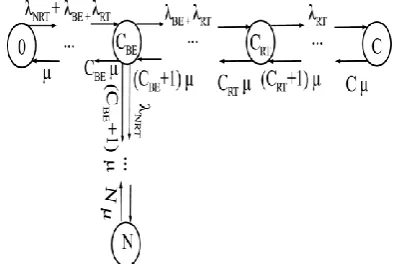
while the queue size of new calls is represented as N. These probabilities are obtained by modelling the proposed using two level Markov chain transition diagram as shown in Figure. 3.
Figure 3. Markov Chain State Transition Diagram
number of channels in Fig. 4. Is busy then the probability P (i) can be obtained from the transition diagram. The global balance equations can be derived as follows:
= ( ) 1), 0 ≤ (9)
= (10)
= ( ) ), (11)
= , (12)
The steady probability P (i) can be derived as: = { (13)
The summarized steady-state probability of the propose model is δ 0, , , C and characteristic function is given as π (0, , ). Equations 14 below avoid the model being in an invalid state. = { (14)
Furthermore, normalized condition for the proposed model is given as: ∑ = 1 (15)
Therefore, the CDP and CBP are computed as: CDP = ∑ (16)
CBP = ∑ (17)
Thus the global balanced equation is used to obtain CDP and CBP from the probability of the proposed scheme.
V.
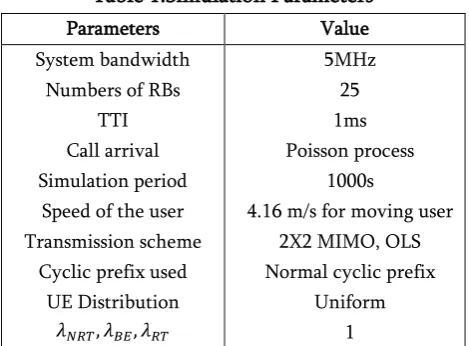
NUMERICAL RESULTS AND DISCUSSIONThe performance of the proposed scheme is measured in terms of CBP, CDP, and throughput and degradation ratio. The simulation scenario consists of one hexagonal cell with 500 m radius. The total spectrum used is 5 MHz with 25 resource block per slot of 12 subcarriers spacing. The call request can be classified into different classes based on their QoS requirement and call types. Based on QoS requirements the call scan is categorized as HC and NC. The HC these are RT traffic with the highest priority and the best example is live streaming. On the other hand, the NC is differentiated into two types of traffic: NRT traffic example YouTube and the BE traffic example email. The arrival rate for both RT and NRT is in the form of a Poisson distribution with the service mean exponentially distributed. The total simulation time is 1000s, while the results are obtained by taken the average over 20 times of simulation.
Table 1.Simulation Parameters
Parameters Value
System bandwidth Numbers of RBs
TTI Call arrival
Simulation period Speed of the user
Transmission scheme Cyclic prefix used
UE Distribution
5MHz 25
1ms Poisson process
1000s 4.16 m/s for moving user
2X2 MIMO, OLS Normal cyclic prefix
Uniform 1
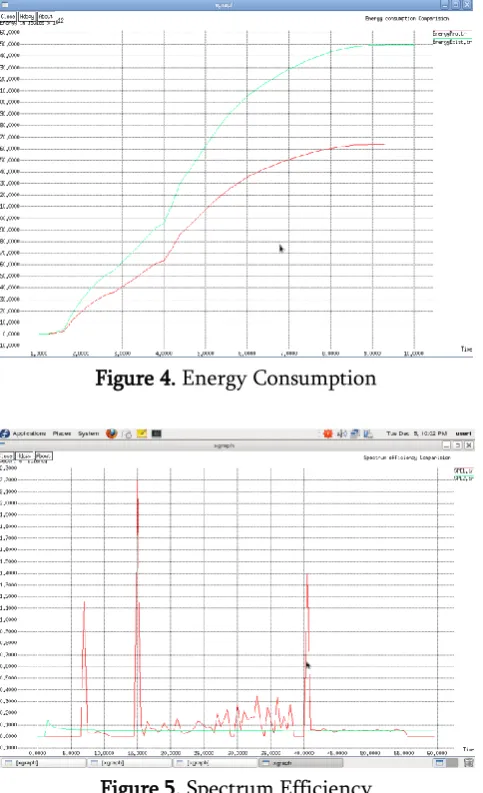
In proposed system the energy consumption is reduced when its compared to the existing system. Due to the low traffic intensity (arrival rate 1-2.4), the improvement was done by avoid starvation. In figure, 5 shown 86.15% of energy consumption is used in proposed scheme.
Figure 4. Energy Consumption
Figure 5. Spectrum Efficiency
VI.
CONCLUSION AND FUTURE ENHANCEMENTSpectrum allocation with adaptive call admission control in 4G cellular Networks to prevent starvation of user traffic and improved the effective usage of network resources. The new scheme introduced adaptive CAC criteria to avoid starvation of user traffic. The criteria use spectrum degradation to admit many users when there are insufficient network resources to accommodate new users. The proposed scheme in addition to its spectrum degradation included an adaptive threshold value which adjusted the network conditions to enable efficient use of network resources. Simulation results and numerical results are in total agreement with negligible differences.
Results also show the outstanding performance of the proposed scheme as it was able to achieve an improvement of data throughput, reduces CBP, CDP and degradation ratio as compared to the Reservation-Based scheme and other spectrum degradation schemes. This further indicates that the proposed scheme achieves higher resource utilization and provides effective QoS assurance for cellular networks. In the future, we intend to look at how to manage the energy efficiency of user traffic and eNodeB for an effective handover.
VII.
REFERENCES[1] Y. Xiao, C. P. Chen, and B. Wang, ‘‘Bandwidth degradation Qos provisioning for adaptive multimedia in wireless/mobile networks,’’ Comput.Commun, vol. 25, no. 13, pp. 1153–1161, 2002.
[2] S. K. Das, S. K. Sen, K. Basu, and H. Lin, ‘‘A framework for bandwidth degradation and call admission control schemes for multiclass traffic in next-generation wireless networks,’’ IEEE J. Sel. Areas Commune., vol. 21,no. 10, pp. 1790–1802, Dec. 2003.
[3] M. Ghaderi and R. Boutaba, ``Call admission control in mobile cellular networks: A
comprehensive survey,'' Wireless
Communication. Mobile compute. vol.6, no. 1, pp. 69_93, 2006.
[4] J. C. Ikuno, M. Wrulich, and M. Rupp, ‘‘System level simulation of LTE networks,’’ in Proc. IEEE 71st Veh. Technol. Conf. (VTC-Spring),Jun. 2010, pp. 1–5.
[5] M. Tsang, K. Tsang, J. C.-K. Wong, and H. Tung, ‘Call admission control for long term evolution,’’ in Proc. IET Int. Communication. Conf. Wireless mobile Compute (CCWMC), 2011, pp.455–460.
[7] M. Khabazian, O. Kubbar, and H. Hassanein, ``Call admission control with resource reservation for multi-service OFDM networks,'' in Proc. Int. Conf. Compute., Network Communication. (ICNC), 2012, pp. 781_785.
[8] S. A. Khanjari, B. Arafeh, K. Day, and N. Alzeidi, ‘‘Bandwidth borrowing based Qos approach for adaptive call admission control in multiclass traffic wireless cellular networks,’’ Int. J. Communication. Syst., vol. 26, no. 7, pp. 811–831, 2013.
[9] D.-H. Kim, D. Zhang, N. Bhushan, R. Pankaj, and S.-J. Oh, ``Admission control for cellular networks with direct QoS monitoring,'' Wireless Network., vol. 19, no. 2, pp. 131_144, 2013.
[10] M. Shehada, B. Fu, S. Thakolsri, and W. Kellerer, ‘‘QoE-based resource reservation for unperceivable video quality fluctuation during handover inLTE,’’ in Proc. IEEE Consume. Communication. Network. Conf. (CCNC), Jan. 2013, pp.171–177.