Original Research Article
An epidemiological study of menstrual hygiene practices in school going
adolescent girls from urban slums of Nalgonda, Telangana
Jyothi Veleshala
1*, Varun M. Malhotra
2, Suresh J. Thomas
3, Kondagunta Nagaraj
4INTRODUCTION
Adolescence (in Latin: adolescere means to grow) is the developmental period which follows childhood and precedes maturation. As per World Health Organization (WHO), adolescence is defined as age between 10 and 19 years.1 It is a vital period of life involving the transition of physical, psychological, emotional and social development.2 The National Population Policy of India
2000 recognizes adolescents as a vulnerable group with specific needs.3 They comprise 20% of the total Indian population, which in actual numbers translate into 200 million Adolescents.4
Reproductive health of adolescent girls is crucial as it determines the health of future generations. One of the vital psychological and biological changes in girls during adolescent period is the onset of menstruation.
ABSTRACT
Background: Reproductive health of adolescent girls is crucial as it determines the health of future generations. School girls when experiencing menarche find themselves in a setting without water, toilets or a supportive female teacher to explain the changes happening in their body. Hence, the present study was conducted to assess knowledge and practices about menstruation in adolescent school girls of an urban slum and to find some socio-demographic determinants of menstrual hygiene.
Methods: This was a descriptive cross-sectional study conducted among 6th to 10th class school going adolescent girls from an urban slum of Telangana state. A total of 300 girls participated.
Results: The mean age of the students was 11.9±3.3 years. The mean age at menarche was 13.09 (95% CI: 12.07– 14.11). 25.3% had acquired prior knowledge about attaining menarche. For majority (74.2%) the knowledge was imparted by their mothers. 96.9% of school girls used sanitary pads. Significant association observed between educational status and employment status of mother and usage of sanitary pads by respondent. Almost 90% of the young women faced physical complaints or health problems during menstruation. Majority (94.3%) had religious restrictions on them during the menstruation.
Conclusions: Menstrual hygiene is an issue which needs to be addressed to all adolescents, with special emphasis in slum area. Lack of awareness is a roadblock in adopting safe and hygienic menstrual practices. More emphasis should be given on improving adolescent literacy for achieving hygienic menstrual practices.
Keywords: Adolescents, Awareness, Hygiene, Menstruation 1
Department ofCommunity Medicine, Government Medical College, Mahbubnagar, Telangana, India
2Department ofCommunity Medicine, Adesh Institute of Medical Sciences and Research, Bathinda, Punjab, India 3Department of Pediatrics, Kamineni Institute of Medical Sciences, Narketpally, Telangana, India
4Department ofCommunity Medicine, Padmavathi Medical College, Tirupathi, Andhra Pradesh, India
Received: 13 November 2019
Revised: 06 December 2019
Accepted: 07 December 2019
*Correspondence:
Dr. Jyothi Veleshala,
E-mail: [email protected]
Copyright: © the author(s), publisher and licensee Medip Academy. This is an open-access article distributed under the terms of the Creative Commons Attribution Non-Commercial License, which permits unrestricted non-commercial use, distribution, and reproduction in any medium, provided the original work is properly cited.
Menarche (in Greek it means month and origin), the onset of menstruation, is one of manifestation of pubertal changes seen during adolescents.5 The name “menstruation” comes from the Latin word “menses” meaning moon, with reference to the lunar month and which lasts approximately 28 days.6 The age of attaining menarche differs by geographical region, race, ethnicity, etc., but commonly occurs in developing countries between the ages of 8 and 16 years with a median age of 13 years.7
Morbidities related to menstruation are generally unrecognized and uncared for due to the culture of silence in Indian society. It has been documented that menstrual problems in the majority of the adolescent girls are mainly due to emotional immaturity and psycho-social stress.8 In Indian culture, it is associated with several misconceptions and practices. Following menarche, various myths, restrict the woman from everyday tasks like touching water, attending religious ceremonies, cooking/entering the kitchen, running/participation in sports activities, cleaning, socializing or sleeping in one’s own home or bed.9 Due to these restrictions women often adopt practices that are unhygienic or inconvenient leading to adverse health outcomes including reproductive tract infections and urinary tract infections.
Every day, schoolgirls around the world experience menarche and find themselves in a setting without water, toilets or a supportive female teacher to explain the changes happening in their body. Cultural taboos and secrecy about menstruation further compound the problem.10 Despite growing attention to Menstrual Health Management (MHM) globally, significant gap persists in developing countries. MHM is defined as “Women and adolescent girls using a clean menstrual management material to absorb or collect blood, that can be changed in privacy as often as necessary for the duration of the menstruation period; using soap and water for washing the body as required and having access to facilities to dispose of used menstrual management materials”.11
Various studies have shown that in the developing countries girls from a poor socioeconomic background lack adequate supplies of sanitary materials and are forced to manage menses as best they can with cloth, tissues or toilet paper.12 In the schools, there is a lack of adequate means for disposal of used sanitary materials and safe, single-sex and private toilets which can be closed from inside and with water and soap for washing.13 These problems along with menstrual pain often lead to school absenteeism for girls. Hence, the present study was done to assess knowledge and practices about menstruation in school going adolescent school girls of an urban slum.
Aim and objectives
To assess menstrual hygiene practices of school going adolescent girls in urban slums of Nalgonda. To assess menstrual hygiene practices of school going adolescent girls from classes 6th to 10th. To study the association of various socio demographic factors with menstrual hygiene practices of school going adolescent girls.
METHODS
This was a school based cross sectional study done from August 2017 to October 2017 among school going adolescent girls of classes 6th to 10th residing and studying in selected high schools located in an urban slum of Nalgonda, Telangana. Data was collected by face to face interview using a pre-tested, semi structured questionnaire. Cluster sampling was done. Five schools out of 10 high schools in Panagal Slum of Nalgonda town, Telangana were selected randomly. All girl students of classes 6th to 10th meeting inclusion and exclusion criteria were included in the study. Out of 300 girls screened, 194 who had attained menarche were included in the study. The flow diagram depicts the sampling procedure (Figure 1).
Figure 1: Sampling procedure for selection of study participants.
Nalgonda Town
•50 wards
•103 registered schools
Panagal slum
•8th,9th,10th and 11th wards •10 schools
5 schools
•Selected by simple random sampling
All adolescent girls from selected schools, who were present on the day of visit, residing in Panagal slum for at least 7 years, and their parents had given consent for participation in the study were included in the study. Those who were not willing to participate in the study or not present in the school during school visits on three days were excluded.
Ethics considerations
Approval from Institutional Ethics Committee of Kamineni Institute of Medical Sciences, Narketpally, Nalgonda district and permission of management of the schools were obtained before the commencement of the study. Informed consent of the parents and verbal assent from the girl students were ensured.
Data collection and analysis
Data was collected on pre-tested semi-structured questionnaire. The questionnaire captured data on socio-demographic profile of the subjects, menstruation and menstrual hygiene practices. Data was entered into Microsoft Excel spreadsheet and various variables were coded. It was then analysed using SPSS version 20. Summary statistics is tabulated. Chi-square test has been applied to identify associations. P<0.05 is taken as statistically significant.
RESULTS
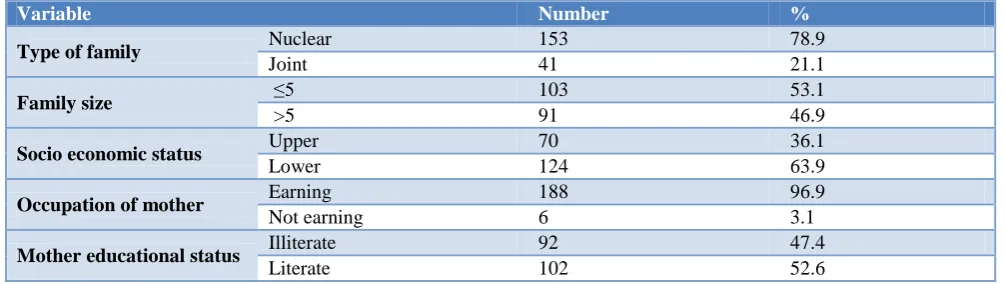
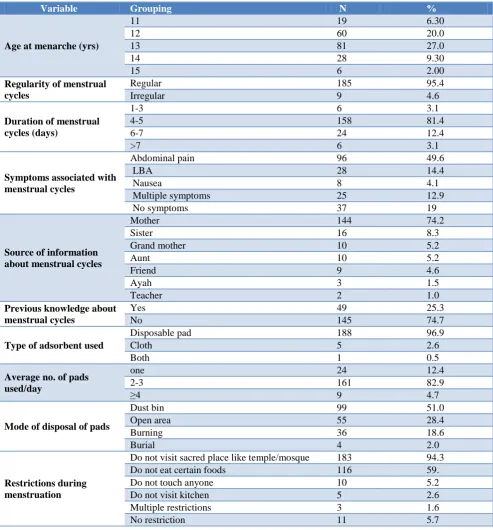
Out of 300 girls screened, 194 girls had menarche and were included in the study. Table 1 depicts the relevant socio-demographic variables. A total of 300 girl students were interviewed. Out of these 106 (35.3%) had not yet attained menarche, hence were not studied. Thus, the study participants were 194. Majority (27.0%) of the study participants were in the aged 13 years, followed by 12 years (20.0%), 14 years (9.3%), 11 years (6.3%) and 15 years (2%), respectively Mean age at menarche in
study population was 13.09±1.02 years. Majority (78.9%) of participants were from nuclear family, while the rest 21.1% from joint family. Majority of mothers were literate (52.6%).
Major source of information about menstruation was mother (74.2%) followed by sister (8.3%), grand mother and aunt (5.2%), respectively. It is disheartening to see that school teacher had educated only 1.0% of students. Only 25.3% girls were aware of menstruation prior to attainment of menarche. Majority (95.4%) of participants who have attained menarche were having regular menstrual cycles and 81.4% have cycles for 3-5 days/month.
Pain abdomen (49.6%) followed by low back pain (14.4%) were the most common symptoms during menstrual cycles while 12.9% had multiple symptoms.
More than 96% of adolescent girls were using sanitary pads as adsorbent which was changed majority (82.9%) more than 3 times a day by 82.9% of the participants. In the study only 2.6% and 0.5% were using only cloth and both the cloth and sanitary pad as adsorbent, respectively.
In this study, 51.0% were disposing the adsorbent in dust bin, 28.4% in open area, 18.6% by burning and 2.0% by burial. Majority (94.3%) of the study participant were restricted form religious activities during the menstruation period followed by restrictions of certain foods (59%), not touching others (5.2%) and not visiting kitchen (2.6%) (Table 2).
In this study the type of adsorbent used during menstruation among the study population was found to be significantly associated with mother’s education and employment status. Similarly, mode of disposal of adsorbent and mother’s education, socio-economic status of family, type of family and number of family members were associated (p<0.05) (Table 3 and 4).
Table 1: Socio-demographic profile of study participants (n=194).
Variable Number %
Type of family Nuclear 153 78.9
Joint 41 21.1
Family size ≤5 103 53.1
>5 91 46.9
Socio economic status Upper 70 36.1
Lower 124 63.9
Occupation of mother Earning 188 96.9
Not earning 6 3.1
Mother educational status Illiterate 92 47.4
Table 2: Distribution of study participants based on variables associated with menstrual cycles (n=194).
Variable Grouping N %
Age at menarche (yrs)
11 19 6.30
12 60 20.0
13 81 27.0
14 28 9.30
15 6 2.00
Regularity of menstrual cycles
Regular 185 95.4
Irregular 9 4.6
Duration of menstrual cycles (days)
1-3 6 3.1
4-5 158 81.4
6-7 24 12.4
>7 6 3.1
Symptoms associated with menstrual cycles
Abdominal pain 96 49.6
LBA 28 14.4
Nausea 8 4.1
Multiple symptoms 25 12.9
No symptoms 37 19
Source of information about menstrual cycles
Mother 144 74.2
Sister 16 8.3
Grand mother 10 5.2
Aunt 10 5.2
Friend 9 4.6
Ayah 3 1.5
Teacher 2 1.0
Previous knowledge about menstrual cycles
Yes 49 25.3
No 145 74.7
Type of adsorbent used
Disposable pad 188 96.9
Cloth 5 2.6
Both 1 0.5
Average no. of pads used/day
one 24 12.4
2-3 161 82.9
≥4 9 4.7
Mode of disposal of pads
Dust bin 99 51.0
Open area 55 28.4
Burning 36 18.6
Burial 4 2.0
Restrictions during menstruation
Do not visit sacred place like temple/mosque 183 94.3
Do not eat certain foods 116 59.
Do not touch anyone 10 5.2
Do not visit kitchen 5 2.6
Multiple restrictions 3 1.6
No restriction 11 5.7
Table 3: Association of socio-demographic factors with type of adsorbent used by subjects (n=194).
Variables Grouping Adsorbent pad
(n=188)
Cloth (n=6)
Mid p exact value
N (%) N (%)
Type of family Nuclear (n=153) 148 (96.7) 5 (3.3) 0.4
Joint (n=41) 40 (97.6) 1 (2.4)
Family size <5 (n=103) 102 (99.0) 1 (1.0) 0.04*
>5 (n=91) 86 (94.5) 5 (5.5)
Variables Grouping Adsorbent pad (n=188)
Cloth (n=6)
Mid p exact value
N (%) N (%)
Occupation of mother Working (n=188) 187 (99.5) 1 (0.5) <0.01*
Not working (n=6) 1 (16.7) 5 (83.3)
Educational status of mother
Educated (n=102) 86 (84.3) 6 (5.9)
<0.01*
Illiterate (n=92) 102 (100.0) 0
*Statistically significant.
Table 4: Association of socio-demographic factors with mode of disposal of used adsorbent by subjects (n=194).
Variables Grouping Dustbins
(n=139)
Open (n=55)
P value
N (%) N (%) Type of family Nuclear (n=153) 107 (69.9) 46 (30.1)
0.004*
Joint (n=41) 32 (78.0) 9 (22.0)
Family size <5 (n=103) 70 (68.0) 33 (32.0) 0.04*
>5 (n=91) 69 (75.8) 22 (24.2)
Socio economic status Upper (n=70) 57 (81.4) 13 (18.6) 0.02*
Lower (n=124) 82 (66.1) 42 (33.9)
Occupation of mother Working (n=188) 133 (70.7) 55 (29.3) 0.26
Not working (n=6) 6 (100) 0
Educational status of mother
Educated (n=102) 85 (83.3) 17 (16.7)
0.01*
Illiterate (n=92) 54 (58.7) 38 (41.3)
*Statistically significant.
DISCUSSION
Adolescence is a crucial phase of development which encompasses beginning of transition from childhood to adulthood, or girl to a woman. This period is critical as these are formative years where pubertal, psychological and behavioural changes take place. It is known that age at menarche varies across different cultures, regions and places. The mean age at menarche in our study was 13.1±1.02 years which was lower than observed in study by Esimai et al (14.18 years), but higher than in study by Thakre et al conducted in Maharashtra (12.85±0.867 years).14 This difference could be because of biological or nutritional factors, although secular trend may also be playing its role.
Awareness regarding menstruation
Only 25.3% of adolescent girls had prior knowledge regarding menstruation before menarche, which was lower than compared to other studies: West Bengal (67.5%) and Uttarakhand (64.5%). A study conducted in Nagpur by Patle et al.15 found that 63.38% girls in urban area were aware of menstruation before menarche. The difference in awareness could be due to the fact that the present work studied slum population, although cultural difference between the populations may also be contributing to the variance.14,15 Importance of awareness regarding menstruation prior to menarche is well understood and obvious as ignorance leads to lack of preparation around puberty and menstruation, propagates false beliefs and taboos that renders young girls
vulnerable to embarrassment and low confidence. Our study corroborated the finding that girls continue to be ignorant, thus ill-prepared for the physiological change.
This study identified mothers (74.2%), sister/relatives (8.3%), friends (4.6%) and teacher (1.0%) as main source of information to the girls. Study done in Nagpur by Thakre et al supported the present study’s findings where mothers were the first informants for 71.33% of the girls.14 This fact has been proved in other similar studies to be of foremost influence on the menstrual health of adolescent girls.16 It is, therefore, important that mothers have appropriate information on reproductive health matters so as to pass the same information to their growing girl. Unfortunately, teachers were found to constitute only a small proportion from whom the menstrual information was received. Similar findings were also seen in a study conducted in rural Kenya, and definitely a matter of concern.17
Hygienic practices during menstruation
using sanitary napkin and use of cloth was the norm.18,19 This reflects positive impact of Government of India project on social marketing of sanitary napkins which has been implemented in letter and spirit in the state of Telangana. Other factors that can be ascribed are media exposure including films, and interpersonal communication that have adequately enhanced the awareness about sanitary napkins.
Each woman decides for herself what is comfortable, but for optimal hygiene, menstrual absorbent should be changed at least 3-5 times a day or more frequently may be necessary.20 82.9% of the study population were changing their sanitary pads two to three times a day. Over half of the respondents in the study by Aniebue et al also changed their menstrual absorbent three or more times a day.21 The survey done by Aid et al in Nepal and the El-Gilany et al study showed that on an average the girls change the absorbent material 2-3 times a day.22,23
The prevalence of dysmenorrhea in the present study was observed to be 81% whereas it ranged from 60% to 93% by studies conducted in Multan city, Pakistan, East Delhi, Karnataka and Indore.24-27
In the present study, the commonly practiced method of disposing the absorbent was dust bins (51.0%) followed by open area disposal (28.4%) and burning (18.6%). Jailkhani et al in a cross‑sectional study done in urban settings reported significant association of education of the mothers with type of absorbent materials used/reused during menstruation. This finding is consonance with the present study.28-32
Restrictions followed by menstruating girls
In India, different communities follow a different type of restrictions during menstruation. This could be possibly due to the different rituals in their communities. Jogdand et al in a community-based cross-sectional study in an urban slum area found that 78.99% girls were restricted to attend religious occasions during menstruation.35 A study in Rajasthan by Goyal et al also shows that 92% were restricted in religious and social activities, which is also consistent with our findings (94.3%).33 In contrast, Verma et al recorded playing and going outside home were the most common restrictions.9,34 Shubhas et al showed that 73.64% and Dasgupta et al found that 85% girls practiced different restrictions during menstruation.14,18,28-30
CONCLUSION
To conclude, the present study has underscored the necessity of adolescent girls to have adequate and precise knowledge about menstruation before menarche. Health promotion interventions in this area should include improving the school’s wash environment. Menstrual pain is a very common problem reported by majority of adolescent girls which points out the need for suitable
required to bring them out of traditional beliefs, taboos, misconceptions, and restrictions. This can be achieved with the help of media, sex education in school curriculum, and group discussions. Improved involvement of teachers in promotion of reproductive health is desired. Universal availability and use of sanitary pads can be advocated to every girl by social marketing.
Limitation
As this study was conducted among school going adolescent girls from urban slum, findings may not be generalized to all adolescent girls.
ACKNOWLEDGEMENTS
I express my deep gratitude to parents of all subjects and all adolescent girls who have participated in the study, their teachers, as well as school principals for permitting to conduct study in school premises.
Funding: Funding provided by ICMR Conflict of interest: None declared
Ethical approval: Institutional Ethical Committee, KIMS, Narketpally
REFERENCES
1. Chhadva D, Kacker P. Effectiveness of life skill education on adolescents. Int J Res Educ Methodol. 2013;3:213–20.
2. Aparna N, Raakhee AS. Life skill education for adolescents: its relevance and importance. GESJ: Ed Sci Psychol. 2011;2:1–6.
3. Sharanya T. Reproductive health status and life skills of adolescent girls dwelling in slums in Chennai, India. Natl Med J India. 2014;27:305. 4. Registrar General I. Census of India 2011:
provisional population totals-India data sheet. Office of the Registrar General Census Commissioner, India. Indian Census Bureau; 2011.
5. Bhatia N. Jeffcoate’s Principles of Gynaecology. 5th edition. New Delhi: Arnold Publisher; 2001: 90-100. 6. Thakur H, Aronsson A, Bansode S, Stalsby Lundborg C, Dalvie S, Faxelid E. Knowledge, practices, and restrictions related to menstruation among young women from low socioeconomic community in Mumbai, India. Front Public Health. 2014;2:72.
7. Sharma K. Age at menarche in northwest Indian females and a review of Indian data. Ann Hum Biol. 1990;17:159–62.
8. Jain K, Garg SK, Singh JV, Bhatnagar M, Chopra H, Bajpai SK. Reproductive health of adolescent girls in AN urban population of Meerut, Uttar Pradesh. Heal Popul Perspect Issues. 2009;32:204–9.
impact of girls’ experiences of menstruation and schooling in Tanzania. J Adolesc. 2010;33:521–9. 10. Sommer M, Vasquez E, Worthington N, Sahin M.
WASH in schools empowers girls’ education: Proceedings of the menstrual hygiene management in schools virtual conference 2012. New York: UNICEF; 2013.
11. UNICEF. MHM in Ten: advancing the MHM in WASH in Schools agenda. New York: UNICEF and Columbia University; 2014.
12. Sommer M, Murat S. Overcoming the Taboo: advancing the global Agenda for menstrual hygiene man: EBSCOhost. Am J Public Health. 2013;103:1556–9.
13. Bodat S, Ghate M, Majumdar J. School absenteeism during menstruation among rural adolescent girls in Pune. Natl J Community Med. 2013;4:212–6. 14. Thakre SB, Thakre SS, Reddy M, Rathi N, Pathak
K, Ughade S. Menstrual hygiene: Knowledge and practice among adolescent school girls of Saoner, Nagpur district. J Clin Diagn Res. 2011;5:1027-33. 15. Patle R, Kubde S. Comparative study on menstrual
hygiene in rural and urban adolescent girls. Int J Med Sci Public Health. 2014;3:129-32.
16. Shanbhag D, Shilpa R, D’Souza N, Josephine P, Singh J, Goud BR. Perceptions regarding menstruation and practices during menstrual cycles among high school going adolescent girls in resource limited settings around Bangalore city, Karnataka, India. Int J Collab Res Intern Med Public Heal. 2012;4:1353–62.
17. McMahon SA, Winch PJ, Caruso BA, Obure AF, Ogutu EA, Ochari IA, et al. The girl with her period is the one to hang her head Reflections on menstrual management among schoolgirls in rural Kenya. BMC Int Health Hum Rights 2011;11:7.
18. Dasgupta A, Sarkar M. Menstrual hygiene: How hygienic is the adolescent girl? Indian J Community Med. 2008;33:77‑80.
19. Balamurugan SS, Shilpa S, Shaji S. A community-based study on menstrual hygiene among reproductive age group women in a rural area, Tamil Nadu. J Basic Clin Reprod Sci. 2014;3:83‑7. 20. Salem R, Shetty V. Key facts about the menstrual
cycle, INFO Reports No 7 Baltimore, Johns Hopkins Bloomberg School of Public Health, The INFO Project; 2006.
21. Uzochukwu UA, Patricia NA, Theophilus ON. The impact of pre-menarcheal training on menstrual practices and hygiene of Nigerian school girls. Pan African Med J. 2009;2:9.
22. Is menstrual hygiene and management an issue for adolescent school girls? - A comparative study of four schools in different settings of Nepal, report by water aid. Available at: www.wateraid.org/nepal. Accessed on 07 November 2019.
23. EL-Gilany AH, Badvi K. Menstrual Hygiene among adolescent school girls in Mansoura Egypt. Reprod Health Matters. 2005;13:147-52.
24. Ali S, Sultana H, Sayyada I, Parveen N. Primary dysmenorrhea in adolescence. Med Forum Mon. 2009;20:14‑7.
25. Nair P, Grover VL, Kannan AT. Awareness and practices of menstruation and pubertal changes amongst unmarried female adolescents in a rural area of East Delhi. Indian J Community Med. 2007;32:156‑7.
26. George NS, Priyadarshini S, Shetty S. Dysmenorrhea among adolescent girls‑ characteristics and symptoms experienced during menstruation. Nitte Univ J Health Sci. 2014;4:2249‑ 7110.
27. Kural M, Noor NN, Pandit D, Joshi T, Patil A. Menstrual characteristics and prevalence of dysmenorrhea in college going girls. J Family Med Prim Care. 2015;4:426‑31.
28. Pundkar RD, Zambare MB, Baride JP. The knowledge and practice of menstrual hygiene among adolescent girls in one of the municipal corporation school of Ahmednagar. VIMS Health Sci J. 2014;1:118‑24.
29. Adhikari P, Kadel B, Dhungel SI, Mandal A.. Knowledge and practice regarding menstrual hygiene in rural adolescent girls of Nepal. Kathmandu Univ Med J. 2007;5(3)19:382-6. 30. Drakshayani Devi K, Venkata Ramaiah P. A study
on menstrual hygiene among rural adolescent girls. Indian J Med Sci. 1994;48:139-43.
31. Jailkhani SMK, Naik JD, Thakur MS, Langre SD, Pandey VO. Patterns & Problems of menstruation amongst the adolescent girls residing in the urban slum. Sch J App Med. Sci. 2014;2(2A):529-34. 32. Paria B, Bhattacharyya A, Das S. A comparative
study on menstrual hygiene among urban and rural adolescent girls of West Bengal. J Fam Med Primary Care. 2014;3:413-7.
33. Khanna A, Goyal RS, Bhawsar R. Menstrual practices and reproductive problems a study of adolescent girls in Rajasthan. J Health Manag. 2005;7:91–107.
34. Verma P, Ahmad S, Srivastava RK. Knowledge and practices about menstrual hygiene among higher secondary school girls. Indian J Community Health. 2013;25:265‑71.
35. Jogdand K, Yerpude P. A community-based study on menstrual hygiene among adolescent girls. Indian J Mat Child Health. 2011;13(3):1-6.