Original Research Article
Description of knowledge and promotion media for Healthy Living
Movement (Germas) in higher education institutions in Indonesia
Lina Handayani*, Zahroh Shaluhiyah, Suroto
INTRODUCTION
Development to improve health is founded on the principles of humanity, human rights, fairness, and equality. It is also based on people‟s independence and empowerment.1 On the macro scale, people have the right to get proper health care, while on the micro scale, the paradigm of healthy living involves both promotion and
preventive measures.2 In 2008, non-communicable
diseases (NCDs) caused 63% of death in the world. That is 36 million out of 57 million deaths.3,4
NCDs are the main cause of 68% death in the world in 2012, and more than 42% of death of people below 70.
NCDs include 37%, cardiovascular diseases, 27% cancer, 8% lung diseases (including asthma and obstructive chronic lung illness), and 4% diabetes.5 The year 2014 saw 41 million people or 71% death caused by NCDs. Each year, NCDs cause the death of 15 million people. Each 2 seconds, a person between the age of 30 and 70 is killed by NCDs.6 In 2016, it was estimated that 41 million deaths were caused by NCDs. That is 71% of the total 57 million deaths. Most deaths are caused by the four main NCDs: cardiovascular diseases (44%); cancer (22%); chronic lung diseases (3.8 million deaths or 9%); and diabetes (4%).7
Data from the World Health Organization (WHO) in non-communicable diseases health monitor progress 2017
ABSTRACT
Background: Health problems that arise today are results of unhealthy lifestyle. As an effort to overcome these problems, the government launched the Healthy Living Movement (Germas) involving several approaches. This research aims to study the description of knowledge and promotion media about Germas among academics in higher education institutions.
Methods: This is a qualitative research that aims to understand a social phenomenon. Research respondents were academics belonging to the groups of department heads, lecturers, academic staff, students, and canteen personnel. The study was conducted from February to April 2019.
Results: Results of this research show that Germas related activities have been partially carried out in the university. Meanwhile, results from the health college and the health polytechnic indicate that Germas related activities are better implemented. They are better integrated with the Germas itself as a whole.
Conclusions: Knowledge of Germas among academics in higher education institutions is adequate. This is even better for the case of the health college and health polytechnic in which information about health is disseminated routinely via both formal and informal forums. On the other hand, academics from the university obtain more health information about health from external sources.
Keywords: Germas, Qualitative method, Non-communicable diseases Master Program of Health Promotion, Diponegoro University, Indonesia
Received: 07 July 2019 Revised: 24 July 2019 Accepted: 25 July 2019
*Correspondence: Lina Handayani,
E-mail: [email protected]
Copyright: © the author(s), publisher and licensee Medip Academy. This is an open-access article distributed under the terms of the Creative Commons Attribution Non-Commercial License, which permits unrestricted non-commercial use, distribution, and reproduction in any medium, provided the original work is properly cited.
show that NCDs caused the death of 15 million men and women between the age of 30 and 70 each year.8 The Southeast Asia region witnessed 50% of death in 2000
and 80% of death in 2010 caused by NCDs.9
In Indonesia, with a total population of 258 million, the year 2017 saw 73% death caused by NCDs, and 27% of the population is at risk of death due to NCDs.8,10 According to results from Basic Health Research 2013, NCDs prevalence in Indonesia was 2.1%, hypertension was at 9.5%, and stroke was at 12.1% per million people.11
Data from health profile of the Province of Central Java in 2016 revealed that among NCDs, hypertension racked up 60.00 %, diabetes was at 16.42%, asthma was 8.94%, heart disease was 4.54%, and stroke made up 3.91% of cases.12 Data from health profile of the municipality of Semarang in 2017 showed that cases of NCDs are in an increase for people between the ages of 15 to 44.13 The year 2017 witnessed the following proportion of new NCDs cases in central Java; hypertension (64.83%), diabetes (19.22%), asthma (6.47%), heart disease (3.61%), and chronic obstructive pulmonary disease/
COPD (2.41%).14
Health issues that are common nowadays are caused by unhealthy lifestyle. In order to deal with these matters, the Indonesian government launched an initiative called Healthy Living Movement (Germas). This movement is implemented as integral part in activities carried out by ministries, agencies, and the regional governments. Higher education institutions belong to the Ministry of Research, Technology, and higher education. They are tasked to implement Germas via improvement of physical activities and promotion of healthy lifestyle. This is only natural as higher education institutions are deemed as role models by other members of the community. This will certainly be beneficial for the success of Germas to mitigate NCDs. Therefore, there needs to be a study on the perception and understanding of Germas among academics in higher education institutions.
METHODS
This is a qualitative research. Qualitative research is a
method aimed at understanding certain social
phenomena.15 What this research tried to understand was the holistic perception of academics towards Germas in
higher education institutions and their greater
understanding of this movement. A qualitative research does not base its finding on statistical figures or numbers.16,17 This means that a qualitative research observes events, activities, norms, and values of the perspective of respondents.18,19 A qualitative research tries to understand a phenomenon in its natural setting and context, that it does not interfere observed data.16,17 Research respondents are academics comprising of department heads, lecturers, academic staff, students, and canteen personnel of university, a health college, and a
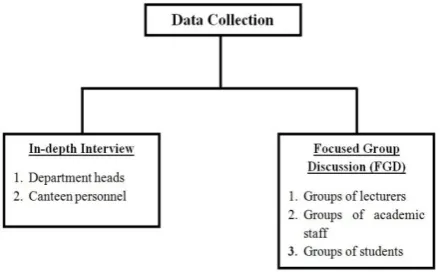
health polytechnic. Respondents of this research were 22 people from the university, 23 people from the health college, and 25 people from the health polytechnic. Data collection was obtained from FGD in groups of lecturers, academic staff, and students. In-depth interviews were carried out with the groups of department heads and canteen personnel (Figure 1). This research was conducted from February to April 2019.
Figure 1: Flow chart of data collection.
Data were analyzed using content analysis techniques. Content analysis is a way of searching for written or visual material meaning by means of systematic content allocation to detailed categories that have been predetermined and then calculated and interpreted the results. The steps taken are:
The results of the interview are rewritten by making
improvements to eliminate irrelevant information.
Deepen data by re-reading, marking key words and important things that are relevant to the research objectives.
Marking each unit different meanings of all key
words and important things that are relevant to the research objectives. All irrelevant information is excluded from the subsequent analysis process.
Grouped similar units in one unit and provide codes
for each unit.
Provide names for each unit as the initial category using keywords taken from the marked text. Look back at categories while coding data.
If it turns out that real and clear information is not found in the text, then the category is marked as missing.
Look back at all interview transcripts to identify different units, group and rearrange similar and non-similar units, and rename the found categories.
Re-read all meaning units per category and
re-separate units, re-name categories, delete or redistribute categories if needed.
Repeat all the steps above until you are sure that the
The study began with processing ethical clearance at the ethics committee of the faculty of public health at Diponegoro University. While waiting for the licensing process, researchers used to visit directly to the three universities in order to establish communication with the leaders of the higher education institutions.
RESULTS
This research collected data from respondents in the university, the Health College and health polytechnic. Characteristics of respondents involved in this research are given in Table 1.
Table 1:Respondent characteristics.
Group Category Total
University Health colleges Health polytechnics
Dept. heads 3 2 2 7
Lecturers 6 7 6 19
Academic staff 6 6 7 19
Students 6 7 9 22
Canteen personnel 1 1 1 3
Total 22 23 25 70
Aspects investigated in this research include knowledge and promotion media that are used by higher education institutions.
Knowledge about Germas
As can be seen from answers given during interviews with department heads and FGD with lecturers, academic staff, and students, their knowledge about Germas is adequate. Those respondents were able to talk about Germas in different ways but of the same essence. The results of in-depth interviews and Focus Group Discussions (FGD) on participant knowledge were “Germas is the healthy living movement. It is the attempts of the government and the public or specific communities who carry out activities oriented towards health. This means that it is not only a movement but real measures to reach the goal of a healthier Indonesia.”
Promotion media for Germas
Results of in-depth interviews and FGD revealed the promotion media people used to obtain information about Germas in higher education institutions. No specific promotional events organized by the university were reported: “Promotion has not reached the details. I think promotion should be sent via email as it can be forwarded to the entire members of the university. Top down promotion should also be conducted via email, instead of in person. I was informed about Germas from banners, billboards, social media, and TV commercials. I got information mostly outside campus.”
The health college is also found to routinely disseminate information about Germas to lecturers and academic staff via morning meetings, as given the following statement: “We promote Germas by conducting a seminar in June 2017. We also promote Germas to all staff by doing physical activities such as gymnastics every day and providing fruits and vegetables for consumption on
Fridays. We use internal media in our health college to promote Germas, instead of dropping media. We create the media ourselves. We always try to disseminate health related information on our Monday meetings.”
Academics in the health polytechnic also mentioned that
they get information about Germas from TV
commercials, billboards, and banners, as described in statement: “This health polytechnic has been promoting Germas on our Monday meetings. Even in pictures taken, you can see that we always do that Germas salute. It all started in 2017, if I am not mistaken. We often promote Germas, especially to freshmen. We always mention the importance of healthy lifestyle. We use banners, both during gymnastics and ceremony.”
Supporting activities for Germas
Results from in-depth interviews and FGD with lecturers, academic staff and students revealed that activities involved in the implementation of Germas in the university include:
Routine gymnastics every Friday for department
heads, lecturers, academic staff and students.
Establishment of no smoking areas at the Faculty of Public Health of the Faculty of Medicine.
Medical check-up for lecturers and academic staff who are older than 40.
Fruit as snack program that is initiated by the Faculty of Medicine.
Curriculum that emphasizes on health management.
Research and community service in support of
Germas.
Promotion of stretching for prolonged activities.
Counselling provided for students to manage stress.
Gymnastics on Fridays from 7 to 8 AM.
Establishment of no smoking areas and a quit
smoking clinic.
Medical check-up for academics.
Snacks of fruits and vegetables provided during
routine meetings.
Promotion of Germas during morning meetings.
Stress management for lecturers and academic staff in
the form of out bound activities and recreations.
Implementation of curriculum that emphasizes health
management.
In the meantime, activities involved in the
implementation of Germas in the health polytechnic include:
Routine gymnastics on Wednesdays for students and
on Fridays for lecturers and academic staff known as „Senam Cerdik‟.
Stretching exercise after more than 2 hours of
activities with the help of an instruction video.
Banning of smoking in the campus area.
Provision of fruits and vegetables as snack during routine and incidental events.
Provision of tumblers to reduce the use of plastic caps.
Routine health check for lecturers and academic
staff.
Encouragement for the use of stairs for academics going only 1 floor up or down.
Encouragement for students to walk from their boarding house to campus, instead of riding motorcycles.
DISCUSSION
Knowledge about Germas
Knowledge is gained from curiosity in the form of
information.20 Results from collected data about
knowledge of academics in the university, the health college, and the health polytechnic show that they have adequate knowledge.
Out of the three categories of higher education institutions involved, the health college-which is the working unit of the Ministry of Health-has academics who are better informed about Germas, compared to the other two higher education institutions. Nonetheless, dissemination of information about Germas in higher education institutions still needs to be optimized, yet down to earth. The university faces a more difficult task of comprehensively implementing Germas activities as the number of students there is massive. Most faculties in the university are not health related and therefore, Germas is even harder to be comprehensively implemented. This is certainly not the case of the health college as all faculties are health related and the number of students is significantly lower. Meanwhile, the health
polytechnic has all the features of the health college plus an added advantage of being linear with the programs of the Ministry of Health of the Republic of Indonesia. Academics in health departments do have better knowledge on health, and hence, better understanding of Germas, compared to their peers in non-health departments.21
Promotion media for Germas
Socialization is the process of seeking knowledge and is also a necessary process to be involved in a community. When behavioral potential of an individual is not contradict values and norms, it becomes personality.22 Answers about sources of information for Germas from department heads, lecturers, and students prove that they are obtained outside campus. Included in these sources are billboards, TV commercials, social media, leaflets, and posters.
Department heads, lecturers, and academic staff of the health college mention that promotion was performed in June 2017 to all lecturers and administration staff. Lecturers and academic staff involved also confirmed that such promotion was actually performed. Other than internal information from campus, those academics also obtain information from external sources such as TV, billboards, and banners.
Meanwhile, the health polytechnic already promotes healthy living during the launching of Germas in 2017, which involved all academics. Other than that, routine promotion is also conducted orally on Mondays during flag ceremony by the ceremony commander. Promotion is also conducted for freshmen. In the meantime, media promotion includes the use of banners, posters, and during routine meetings.
Promotion of Germas in the health polytechnic is running well and routinely. This is aimed at instilling healthy behavior and lifestyle among academics. It was also found that the media used for promotion affects results.
23-26
Continuous exposure to proper information and updated knowledge about Germas will build awareness of healthy lifestyle over time. Therefore, it can be concluded that promotion of Germas in the health polytechnic is running well and it is very routine. This is aimed at
instilling healthy behavior and lifestyle among
academics. In the health college, promotion of Germas has also been widely carried out, via forums such as morning meetings and welcoming events for freshmen.
Supporting activities for Germas
more measures to better coordinate and integrate activities in support of Germas.
However, these activities are not well monitored and evaluated, despite the fact that organizing committees for each event are already established. Therefore, there should be better monitoring and evaluation in the future.
The polytechnic believes in the process that it emphasizes continuity to obtain better results of improved healthy living behavior for its academics both as individuals and as groups of people. However, monitoring and evaluation for those Germas activities have not been conducted. Therefore, there needs to be proper monitoring and evaluation of Germans program in the future.
CONCLUSION
Knowledge of Germas among academics in higher education institutions is adequate. This is even better for the case of the Health College and health polytechnic in which information about health is disseminated routinely via both formal and informal forums. On the other hand, academics from the university obtain more health information about health from external sources. Therefore, it can be concluded that promotion of Germas in both the Health College and health polytechnic is adequate as they make the most of special events to get their academics engaged. In the meantime, promotion of Germas in the university is not yet adequate as academics gain information about this movement mainly from outside the campus. This is because Germas related activities in the university are not well integrated, despite the fact that numerous partial events were already carried out. This is in contrast to Germas related activities in both the health college and health polytechnic which are carried out in an integrated manner.
ACKNOWLEDGEMENTS
Thank you to University, the Health College, and the Health Polytechnic which has been pleased to be the object of research on Germas in universities.
Funding: No funding sources Conflict of interest: None declared
Ethical approval: The study was approved by the Health Research Ethics Committee, Faculty of Public Health Diponegoro University. Number: 49/EA/KEPK-FKM/2019, Date: 15 March 2019.
REFERENCES
1. Moeloek NF. Ministry of Health of the Republic of
Indonesia. Strategic Plan of the Ministry of Health for 2015-2019. Jakarta, 2015.
2. Ministry of Law and Human Rights of the Republic
of Indonesia. Regulation of the President of the Republic of Indonesia No. 72 of 2012 on National Health System. Jakarta, 2012.
3. Global Status Report on non-communicable
diseases 2010. World Health Organization. Geneva, WHO; 2010.
4. World Health Organization. World Health Statistics
2011. Geneva, WHO; 2011.
5. World Health Organization. Global Status Report on
non-communicable diseases 2014. Geneva, WHO; 2014.
6. World Health Organization. Non-communicable
diseases (NCDS) and mental health: Challenges and Solutions. Geneva, WHO; 2014.
7. World Health Organization. World Health Statistics
2018, Monitoring Health for the SDGs. Geneva, WHO; 2018.
8. World Health Organization. Non-communicable
diseases Progress Monitor 2017. Geneva, WHO; 2017.
9. World Health Organization. Assessing national
capacity for the prevention and control of non-communicable diseases, report of the 2010 Global Survey. Geneva: WHO; 2012.
10. Ministry of Health of the Republic of Indonesia. Pocket Book of Data and Information of 2016. Jakarta, 2016.
11. Ministry of Health of the Republic of Indonesia. Basic Health Research). Research and Development Agency of the Ministry of Health of the Republic of Indonesia, 2013.
12. Provincial Health Agency of Central Java. Health Profile of Central Java Province in 2017. Central Java; 2017.
13. Municipal Health Agency of Semarang. Profile of the Municipal Health Agency of Semarang in 2017. Semarang, 2017.
14. Ministry of Health of the Republic of Indonesia. Data and information of health profile of Indonesia in 2017. Jakarta, 2018.
15. Flick U. An introduction to qualitative research. 5th ed. London, Sage; 2014.
16. Borg WR, Gall MD. Educational Research.
Longman Caporaso; 1983.
17. Davidson J, de Gregorio S. Qualitative research and
technology: In the midst of a revolution, eds. Norman K. Denzin, Yvonna S. Lincoln. Handbook of Qualitative Research, 4th ed. Thousand Oaks, CA: Sage; 2011: 627-643.
18. Saldaña, J. The coding manual for qualitative
researchers. Sage; 2015.
19. O‟Donnell O, van Doorslaer E, Wagstaff A, and Lindelow M. Analyzing Health Equity Using Household Survey Data. World Bank Publications; 2008.
20. Mohammadi K, Tavafian S, Ghofranipoor F,
Amin-Shokravi F. Health education program and tuberculosis preventive behaviors. 2012;14(10):97-9.
21. Askarian M, Dehghani Z, Danaei M, Vakili V.
22. Arum R, Irenee B, and Karly F. The structure of schooling: Readings in the sociology of education. 2nd ed. Thousand Oaks, CA: Pine Forge; 2011. 23. Prot S, Anderson CA, Gentile DA, Warburton W,
Saleem M. Media as agents of socialization, handbook of socialization. 2nd ed. New York, NY: Guilford Press; 2015.
24. Maibach E. The Influence of the Media
Environment on Physical Activity : Looking for the Big Picture. Am J Heal Promot. 2007;21(4):353-62.
25. Chan K, Prendergast G, Grønhøj A, Bech-larsen T.
The role of socializing agents in communicating healthy eating to adolescents : a cross-cultural study
the role of socializing agents in communicating healthy eating to adolescents : a cross-cultural study. J Int Consum Mark. 2010;23(1):57-74.
26. Genner S, Süss D. Socialization as Media Effect. Switzerland: John Wiley and Sons; 2017.