Original Research Article
Awareness and satisfaction about state health insurance scheme among
beneficiaries at tertiary care hospital in Maharashtra
Roza G. Bhaisare
1, Gaurav M. Rangari
2*
INTRODUCTION
Health is one of the integral parts of the development of country. According to Alma-Ata declaration “Health for All by the year 2000 (HFA)” put forward with a concept of „equity in health.1 But still some people are not getting
even primary health care in rural, tribal and remote areas. Universal health coverage (UHC) is a concept which has to achieve at all level and which refers to the health care facilities to provide health care and financial protection to each and every citizen. To improve the access to health
services, health care facilities are providing package of benefits to the individuals of the community, so that health outcome should get improved.2 Universal health coverage (UHC) itself means that whether rich or poor everyone should get health care services according to their need without facing any financial crisis.
In India large number of laborer works on daily wages in informal sector in rural and urban area. They are mainly illiterate and poor, living and working in unhygienic condition. So they are more vulnerable to infectious and chronic diseases. In a year, out-of-pocket payments to
ABSTRACT
Background: The Rajiv Gandhi Jeevandayee Arogya Yojana (RGJAY) is cashless medical insurance scheme launched in 2nd July 2012 by Maharashtra government is for poor families like below poverty line, above poverty line categories, Antyodaya and Annapurna cards holders with annual income less than Rs. 1 lakh. It‟s implemented throughout the state of Maharashtra in phased manner for a period of 3 years. The aim is to provide quality care and free medical facilities worth Rs. 1.5 lakh. Aim of this study is to see awareness of the scheme and satisfaction level among beneficiaries about RGJAY scheme.
Methods: It‟s a cross sectional hospital based study. 500 Patient enrolled under RGJAY scheme selected daily during study period January 2013 to June 2014 in Raigad district. Statistical analysis was done by using SPSS 21.0.
Results: Most of the beneficiaries were male (63.4%), age group 40-70 (51.2%). 67.2% participants were aware about RGJAY and 35% were came to know through media. Only 20% participants utilized services under RGJAY scheme more than one time. 31% participant‟s family members had taken benefits of the scheme. 45.4% participants were highly satisfied, 28.8% satisfied with services provided under RGJAY scheme.
Conclusions: The participants were aware about the scheme, but utilization of the scheme was low in the population. Most of the participants were satisfied with services provided under scheme. It shows that scheme was successful in Raigad district.
Keywords: Awareness, Below poverty line, Rajiv Gandhi Jeevandayee Arogya Yojana, State health insurance scheme, Satisfaction
1Department ofCommunity Medicine, 2Department of Pharmacology, Gayatri Vidya Parishad Institute of Health Care
and Medical Technology, NTR university, Visakhapatnam, Andhra Pradesh, India
Received: 23 March 2019
Accepted: 08 May 2019
*Correspondence:
Dr. Gaurav M. Rangari,
E-mail: [email protected]
Copyright: © the author(s), publisher and licensee Medip Academy. This is an open-access article distributed under the terms of the Creative Commons Attribution Non-Commercial License, which permits unrestricted non-commercial use, distribution, and reproduction in any medium, provided the original work is properly cited.
seek health care could push 2.2% of all healthcare users and one-fourth of all hospitalized participants, into poverty.3 Illness is a threat for people which are living in below poverty line. When there is need to seek for a treatment, they ignore it often because of fear of loss of wages. Also there is lack of information and awareness about government schemes. They usually wait till problem become very serious. So that person becomes bedridden and seeks health care facilities at last stage when it is too late. It may lead to suffering and death. Even if they go for treatment, most of the time they have to spend all their savings to get quality health care or has to sale their assets. Even in general, people above poverty line also faces burden of expenses occurred during period of illness. Health insurance is a better option for a people to cope with high expenses and to get quality health care. There are various concerns which needs to address properly by health insurance policies such as benefits of families, type of care getting from policies, how much people will pay, etc.4
Health insurance in India is now days a growing segment of India‟s economy. Pre–payment of small amount by individuals can finance health care costs of enrolled members later if required. It minimizes the uncertainty of both illness and cost of treatment. There are various insurance schemes available in India. For example, ESIS, Central Government Health Scheme (CGHS), Rashtriya Swasthya Bima Yojna (RSBY), etc. All schemes have various benefits and different beneficiaries. Some States have also established local health insurance arrangements for people e.g. Rajiv Aarogyasri in Andhra Pradesh, Vajpayee Arogyashree in Karnataka.
The Rajiv Gandhi Jeevandayee Arogya Yojana (RGJAY) scheme offered by the Maharashtra government is a good health insurance option for poor families. In Maharashtra, state government launched the RGJAY in 2nd July 2012. In this scheme, below poverty line and above poverty line categories and Antyodaya and Annapurna ration cards holders with annual income of less than Rs. 1 lakh families are covered. It is a cashless medical insurance scheme for the poor people, across the state. The Yojana, which is being run in a public private partnership (PPP) mode with the National Insurance Company. The RGJAY would be implemented throughout the state of Maharashtra in phased manner for a period of 3 years. Initially implemented in eight “most needy” districts on pilot basis in Phase-1, benefiting 50 lakh families. The tribal district of Gadchiroli is one of the eight districts chosen, along with Amravati, Mumbai, suburban Mumbai, Solapur, Raigad, Nanded and Dhule. Second phase started from 21st November 2013 in all districts of Maharashtra. The aim of the government is to provide quality care for low income families and still prevent them for getting impoverished on account of out of pocket spending on health. The beneficiaries will each get a health insurance policy and the EMIs of which will be paid by the State government. The main goal of this
scheme is to avail free medical facilities worth Rs. 1.5 lakh.
The objective of the RGJAY is to improve access of below poverty line (BPL) and above poverty line (APL) families (excluding white card holders) to quality medical care.
This scheme could be a way of improving quality medical care and removing the financial barriers for the poor. As this is new scheme, we propose to conduct this study to find out overall awareness, benefits to the patient and satisfaction.
METHODS
Study design: Hospital based cross sectional study.
Study period: January 2013 to June 2014.
Study settings
The study was conducted at M.G.M. Medical College, Kamothe, Raigad District in Maharashtra.
Sample size: 500 sample.
Study sample
Patients admitted under RGJAY scheme.
Sampling technique
Daily one patient selected during study period by convenient method who were admitted under RGJAY scheme. An informed consent was taken and semi structured questionnaire was filled by the investigator at the time of discharge of patient. The key person to give information was either patient or relatives of patient.
Inclusion criteria
Inclusion criteria were patients of all age who were admitted under RGJAY scheme; patients who were willing to participate in the study.
Exclusion criteria
Exclusion criteria were patients who were not admitted under RGJAY scheme; patients who were not willing to participate in the study.
Study tool
Statistical analysis
Collected data entered into excel sheet and analyzed by using SPSS 21.0.
Ethical approval
The Ethical approval was taken from Institutional Ethics Committee of MGM medical college, Navi Mumbai.
RESULTS
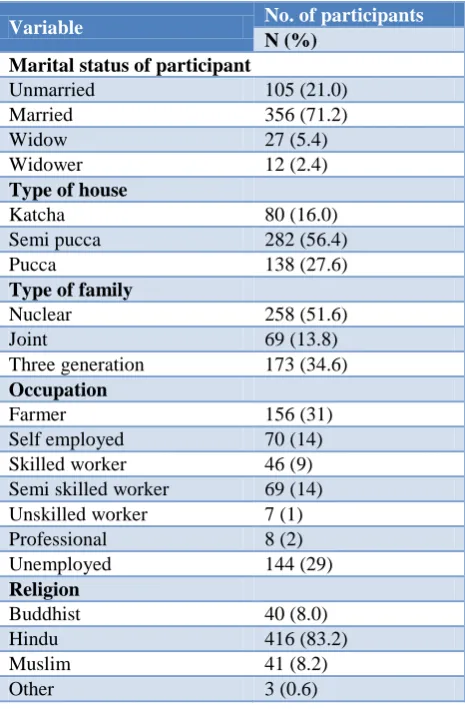
In this study more than 50% beneficiaries who were hospitalized of age above 40 years and 63.4% were male. The Mean age of the participants in this study was 44.71. Majority of participants were married 356 (71.2%), (51.6%) were from nuclear family. In this study around (31%) participants were farmer, (14%) participants were self-employed and (29%) participants were unemployed. Majority of about (26.8%) of the participants had completed their secondary education and (18.4%) participants were illiterate (Table 1).
Table 1: Socio-demographic characteristics of the participants (n=500).
Variable No. of participants
N (%) Marital status of participant
Unmarried 105 (21.0)
Married 356 (71.2)
Widow 27 (5.4)
Widower 12 (2.4)
Type of house
Katcha 80 (16.0)
Semi pucca 282 (56.4)
Pucca 138 (27.6)
Type of family
Nuclear 258 (51.6)
Joint 69 (13.8)
Three generation 173 (34.6)
Occupation
Farmer 156 (31)
Self employed 70 (14) Skilled worker 46 (9) Semi skilled worker 69 (14) Unskilled worker 7 (1) Professional 8 (2) Unemployed 144 (29)
Religion
Buddhist 40 (8.0)
Hindu 416 (83.2)
Muslim 41 (8.2)
Other 3 (0.6)
Most of the participants were aware about RGJAY scheme 336 (67.2%) (Figure 1). Majority of participants
117 (35%) were came to know about RJGAY through Newspaper/TV/Radio/Internet (Table 2).
Table 2: Sources of information about RGJAY awareness (n=336).
Source Frequency %
Newspaper/TV/radio/internet 117 35
Billboards/posters/booklets/
leaflets 47 14
Relatives/ friends 43 13
Doctors/health staff/health
worker/anganwadi 47 14 Health camp 25 7
Panchayat/NGO 57 17
Total 336 100
Table 3: Awareness and RGJAY card holder (n=500).
Awareness Total
RGJAY card holder Yes No
Yes 308 14 322
No 28 150 178
Total 336 164 500
Chi-square=332.195, DF = 1, p < 0.001, Significant
In present study, the overall awareness among RGJAY card holder is more than other patient. This finding is statistically highly significant. (Chi square test = 332.195, p<0.001) (Table 3). Majority (80%) of participants were taking treatment under RGJAY first time. Only 20% participants have taken benefits of RGJAY services more than one time. 31% participant‟s family members took benefits of RGJAY scheme (Figure 2). Majority of participants (15%) has taken treatment in disease category Cardiac and cardiothoracic surgery, 12.6% in cardiology, 12.6% in Polytrauma, 11.8% in Genito-urinary System and remaining has taken in other category.
Figure 1: Distribution of study participants according awareness (n=500).
Figure 2: Benefits of RGJAY scheme taken by participants family member (n=500).
Figure 3: Satisfaction level of services provided by RGJAY scheme (n=500).
DISCUSSION
In present study, 34.6% were between 40-60 years and 23.8% were above age group 60 years. This finding is similar to study of Nair 42.4% were between age group 35-60, 35.8% belongs to age group 15-34.5 In contrast a study of Patel et al showed maximum beneficiaries 25% were from age group 20-30 years, followed by 23.3% from age group 40-50, 21.7% between 30-40 age group.6 Majority of subject were male (63.4%). Study of Patel (57%), Osuchukwu et al (58.0%) and in study from Madurai district (64.5%) also showed that majority of beneficiaries were male.6-8
Awareness is one of the important factors in social scheme. In present study, Most of the participants (67.2%) were aware about RGJAY scheme. Study of Onyedibe, study of Himachal Pradesh and study of Rajasekhar also similarly observed 58%, 86% and 85% of respondents respectively were aware about the scheme.9-11 In contrary, Study of Maharashtra and study
of UNDP found that only 42% and 30% were aware respectively.12,13
In present study it is observed that media plays important role to create awareness. Out of 500 majority of participants 35% were came to know about RJGAY through Newspaper/ TV/ Radio/ Internet, It is comparable with study of Madurai district which showed that major source of information about the scheme were 41.9% TV/Radio.7 Another study done by Osuchukwu et al reported that electronic media (Radio/TV) (37.5%) were the major source of information.8 Most of the times, the media was reported to be the fastest, easiest, and cheapest way of passing a piece of information at ground level. However some study showed panchayat was the major source of information.10,14 Study of Vasisht also reported that panchayat (95%) was the main source of information.15 The study of UNDP revealed that major source of information was Health worker(ASHA/ ANM) (38.4%), followed by friends (30.2%) and others.13 It observed that very high awareness in the participants (92%) who were enrolled and have RGJAY card. It is comparable with study of Himachal Pradesh who showed high awareness (86%) among enrolled participants under RSBY and card holders.10
In this study, majority of participants 80% were taking treatment under RGJAY first time and only 20% participants took treatment before this hospitalization under RGJAY, only 1% participants utilized health service under RGJAY more than 3 times as compared to study done by Kumar, in which 5.7% participants taken treatment more than 3 times.16
39% participants of this study responded that some family members were fallen sick in last 6 months. Out of which 82.7% family member has taken treatment, which shows increased concern about health and positive health seeking behavior. Only 47.6% participant‟s family member obtained treatment under RGJAY. In contrary with study conducted in Uttar Pradesh, observed that 48% participants responded that within 6 month some family member was fallen sick. Out of them 99% had taken treatment and 67% taken treatment under RSBY.13 Majority of participants (15%) has taken treatment in disease category cardiac and cardiothoracic surgery, 12.6% in cardiology, 12.6% in polytrauma, 11.8% in genito-urinary system and remaining has taken in other category. In study of Andhra Pradesh, observed 26.3% taken treatment in cardiac category, followed by cancer (23.8%) and neurology (15.5%).17 In study of Nair et al revealed that most of the beneficiaries taken treatment for cardiac problem and stone problem.5
satisfied by services provided by RGJAY scheme 28.8% were satisfied, 11.8% were dissatisfied and were 7.4% highly dissatisfied. Onyedibe et al study observed 61.5% were satisfied while 26% expressed dissatisfaction with the scheme.9
In study by UNDP, overall 72% participants showed satisfaction about delivery of scheme and study of Madurai district observed 67.7% overall satisfaction. 7, 13 In absence of RGJAY scheme, majority of 201 (40.2%) participants said that they would not able to bear cost of treatment for the present disease condition, 16.2% participants responded they would have borrowed money from lenders, 22.2% responded that they would have self-pay. Similar findings are there in study of Patel et al which revealed 30.55% were ready to self-pay, 30% answered that they won‟t have taken treatment if they don‟t have RSBY card and 30% responded that they would have borrowed money for treatment.6
In the present study, awareness about the scheme was not up to the mark and very few people utilizing benefits of the scheme. So Special attention should be given to increase awareness about the scheme. The scheme is beneficial to the poor people and around three forth participants satisfied with services provided under RGJAY scheme. Propaganda of the scheme should be done by conducting health camps and taking help of media like TV, Radio, Newspaper etc. Health education should be given about health services available and Government should motivate the people for utilizing the available health services.
ACKNOWLEDGEMENTS
The author wants to thank management of the institution MGM medical college navi Mumbai for allowing us to carry study.
Funding: No funding sources Conflict of interest: None declared
Ethical approval: The study was approved by the Institutional Ethics Committee of MGM medical college, Navi Mumbai
REFERENCES
1. Park K. Epidemiology of Communicable Diseases, in Parks Textbook of Preventive and Social Medicine. 22th ed. Jabalpur: M/s Banarsidas Bhanot Publishers; 2013: 28.
2. Patil AV, Somasundaram KV, Goyal RC. Current health scenario in Rural India. Aust J Rural Health. 2002;10:129-35.
3. Peter DH, Yazbeck AS, Sharma RR, Raman GNV, Pritchett LH, Wagstaff A. Better Health System for India‟s Poor: Findings, Analysis, and Options. Washington D.C: The World Bank; 2002.
4. Regnier P, Andrews M, Gengler A. Health Care Reform. Money. 2010;39(4):70-80.
5. Nair KS, Sherin R, Tiwari VK. Rastriya Swasthya Bima Yojana (RSBY) – Hospitalised Families in National Capital Territory of Delhi. Arthavijnana. 2013;LV(1):71-88.
6. Patel J, Shah J, Agarwal M, Kedia G. Post Utilization Survey of RSBY beneficiaries in civil hospital, Ahmedabad: A cross sectional study. Int J Med Sci Public Health. 2013;2(4):1109-12.
7. Samuel JC, Rajagopal N. Performance evaluation of 'Kalaignar Health Insurance Scheme -For Life Saving Treatment: A Study among the Beneficiaries of Madurai District. J Contemp Res Manag 2011;6(4):1-17.
8. Osuchukwu NC, Osonwa KO, Eko JE, Uwanede CC, Abeshi SE, Offiong DA. Evaluating the Impact of National Health Insurance Scheme on Health Care Consumers in Calabar Metropolis, Southern Nigeria. Int J Learning Develop. 2013;3(4):30-45. 9. Onyedibe KI, Goyit MG, Nnadi NE. An evaluation
of the national health insurance scheme (NHIS) in Jos, a north-central Nigerian city. Global Adv Res J Microbiol. 2012;1(1):5-12.
10. Evaluation Study of Rashtriya Swasthya Bima Yojana in Shala and Kangra Districts in Himachal Pradesh 2013. Available at: http://www.rsby.gov. in/Documents.aspx?ID=14 Accessed on 05 August 2018.
11. Rajasekhar D, Berg E, Maitreesh G, Manjula R, Sanchari R. Implementing Health Insurance: The Rollout of Rashtriya Swasthya Bima Yojana in Karnataka. Economic and Political Weekly. 2011;XLVI(20):56-63.
12. Ghosh S. Publicly-Financed Health Insurance for the Poor Understanding RSBY in Maharashtra. Economic & Political Weekly. 2014;XLIX(43-44):93-9.
13. Rapid Assessment of to map out Situational Realities in Jaunpur, Mirzapur and Sant Ravidas Nagar: Rashtriya Swasthya Bima Yojana: Study commissioned by UNDP; 2009.
14. Seshadri T, Trivedi M, Saxena D, Nair R, Soors W, Criel B, et al. Health Insurance in India 2013. Accessed on 15-9-18] Available from: http://www.iphindia.org/v2/wpcontent/uploads/2013 /01/RSBYreport_2013_Jan_02.pdf Accessed on 15 September 2018.
15. Vasisht S, Pandit N. Experiences of RSBY beneficiaries in a district of Western India – A Qualitative study. IJEMR. 2012;2(7):1-8.
17. Rao M, Kadam S, Sathyanarayana TN, Shidhaye R, Shukla R, Ramchandra SS, et al. Rapid evaluation of Rajiv Arogyashree community health insurance scheme, Andhra Pradesh. BMC Proceedings. 2012;6(1):1-2.