Original Research Article
Assessment of the hygiene and sanitation practices of students of class
VI to IX in urban government inter college at Allahabad district, India
Deepak Anand, Shiv Prakash*
INTRODUCTION
The fundamentals of conscientiousness for the continuance of personal hygiene and sanitation can be easily incorporated in childhood, which is essential for a healthy childhood and adulthood which overall leads to form a healthy society. Youngster might be exposed to a variety of health themes in school: nutrition, disease prevention, physical growth and development, mental health, drug and alcohol abuse prevention and safety. The schools can provide basic information about implementing healthy decisions, as the beginning of 2018 according to estimates 29.7% population in India is under 15.1,2
Keeping hands clean through improved hand hygiene is one of the most important steps we can take to avoid getting sick and spreading germs to others. Many diseases are spread by not washing hands with soap and clean, running water.3 For having healthy teeth and gums it is ideal to brush teeth at least two times daily-once early in the morning and the next before going to bed at night.4 Also students must wear clean clothes, it is observed that untidy and dirty clothes adversely affects confidence and self-esteem of student, furthermore regular dirty clothing can lead to ectoparasitic infestations and fungal infections. Furthermore students must know the importance of washing the genitals daily with mild soap and water and foreskin of penis should never be forcibly retracted for cleaning, once it becomes
ABSTRACT
Background: Hygiene and sanitation practices directly affect health status, and students can be easily educated for correct practices, which can be a cheap and effective measure for disease prevention, also it will reduce absenteeism due to illness in schools. This research paper was designed to assess the factors influencing hygiene and sanitation practices among school children.
Methods: It is a cross-sectional descriptive study, sample size was 400. Data was collected between August 2017 and December 2017 by using structured questionnaire on general hygiene and sanitation practices.
Results: It was found that only 61.5% of students wash their hand before meals, merely 16.75% of them were practicing proper dental hygiene, 41.25% of them clean genitals properly, whereas 52.25% students daily consumes food from vendors. Significant difference in sanitation and hygiene practices was found regarding education of father, education of mother and socioeconomic status.
Conclusions: Hygiene and sanitation practices among students are not satisfactory and there is scope for improvement.
Keywords: School students, Hygiene practices, Factors affecting hygiene, Sanitation practices Department ofCommunity Medicine, M.L.N Medical College, Allahabad, Uttar Pradesh, India
Received: 21 July 2018 Revised: 07 August 2018 Accepted: 08 August 2018
*Correspondence: Dr. Shiv Prakash,
E-mail: [email protected]
Copyright: © the author(s), publisher and licensee Medip Academy. This is an open-access article distributed under the terms of the Creative Commons Attribution Non-Commercial License, which permits unrestricted non-commercial use, distribution, and reproduction in any medium, provided the original work is properly cited.
freely retractile naturally then the boy should retract it as part of routine bathing.5,6
Beside proper general hygiene practices, adequate sanitation is also very important for healthy living. Some 8 lakh people in low and middle income countries die every year due to inadequate water, sanitation and hygiene, roughly constituting two-third of total diarrheal deaths and poor sanitation is believed to be the main cause in 38 percent of these deaths (WHO 2016).7 According to the World Health Organization (WHO) and United Nations International Children's Emergency Fund (UNICEF) Joint monitoring report, more than half of open defecation that occurs anywhere in the world occurs in rural India (JMP, 2017).8 Not only water but Food also plays very important role in health, and in developing countries street food is usually prepared and handled with little or no regard to hygiene which exposes the consumers to microbiological and chemical hazards, and there are many epidemiological studies regarding relation of street food and diseases, and because of lack of knowledge about food hygiene there is overabundance of pathogenic bacteria in street food samples.9,10 This leads to Infection and malnutrition which form a vicious circle and retards children's physical development ultimately compromising children's attendance and performance at school. India has made progress in providing clean drinking water however; access to sanitation facilities remains inadequate.11
This study was conducted for assessing the general hygiene practices in students, and also tried to find out factors affecting their hygiene practices.
METHODS
Study design: The study design was cross-sectional.
Period of study: Study was conducted between July 2017 to December 2017.
Sampling
Random selection was done for choosing 1 Government Inter College in Urban Allahabad having only male students, and 400 students from class VI to IX of the selected school were randomly chosen for this study.
Sample size determination
Sample size: The sample size was calculated using the formula, n=Z2(1-α/2)pq/d2 (where Z(1-α/2) =1.96 at 95%
confidence; p=prevalence of proper practice, q=1-p; d=absolute allowable error. Since there was no similar study from Allahabad district we presumed maximum variability, hence p=0.5; q=0.5; d =5%. Sample size thus yielded was of 384. Rounding off to 400 subjects was taken.
Inclusion criteria: Students willing to participate in the study.
Exclusion criteria: Students not willing to participate in the study.
Scoring - Regarding practices of hygiene and sanitation among school students, a score=0 corresponded to "never practicing / incorrect practice"; a score=1, to practicing”. Therefore, overall, the maximum and minimum possible scores, based on 15 indicators of personal hygiene as considered in this study, were 15 and 0, respectively. Poor score was considered to be a total score 5 and below, and other scores categorized were fair score i.e. between 6 and 10, good score having more than 10.
Tools of data collection
Permission to conduct the study was taken from the principal of concerned school. All the students were explained about how to answer a structured questionnaire, questionnaire was distributed in class and 30 minutes time was given to fill it. Teacher of concerned class cooperated in maintaining discipline.
Analysis
Data was tabulated on Microsoft Excel sheet and analyzed using the SPSS software. P values <0.05 were considered significant.
RESULTS
Table 1 shows that 50.75% of students are of age group 11 to 13 years and remaining were of 14 to 16 years age group, and considering their class majority of them (68.25%) were students of class VIII and IX. Maximum number of participants (68.25%) were member from nuclear family, and most of the fathers of the students (72.0%) were educated more than Vth standard, whereas it was found that their mother had relatively lower educational status, 64.25% of their mother had education of more than Vth standard. Most of the students (60.25%) belonged to IInd and IIIrd category of S.E classification.
daily. Most of them i.e. 98.75% had sanitary latrine build in their home and remaining 1.25% used public bathrooms. Only 40.50% of student’s household waste was disposed properly rest of them didn’t. It was found that only 81.25% students were cautious for not dipping finger in drinking water and rest of them were reluctant,
whereas 93.75%% of them have the habit of keeping water and edibles safe from house flies, but when questioned for consuming edibles from vendors selling in unhygienic condition it was found that about half of them i.e. 52.25% gave positive response.
Table 1: Socio economic profile of study subjects.
Variables Frequency Percentage (%)
Age ( in years)
11-13 203 50.75
14-16 197 49.25
Class
6-7 127 31.75
8-9 273 68.25
Family
Nuclear 273 68.25
Combined 127 31.75
Education of father
up to class 5 112 28.00
Class 6-12 128 32.00
Graduate and others 160 40.00
Education of mother
up to class-5 143 35.75
Class 6-12 147 36.75
Graduate and others 110 27.50
Socioeconomic classification
I 87 21.75
B. G. Prasad12 II 129 32.25
III 112 28.00
IV 44 11.00
V 28 7.00
Table 2: Number and percentage of students according having correct hygiene and sanitation practices.
Characteristics Frequency Percentage (%)
Always wash hand with soap before meal 246 61.50
Always wash hand with soap after defecation 345 86.25
Wash hands with soap after handling garbage or
dirty things 262 65.50
Cut nails at least once a week 271 67.75
Daily brush teeth in morning and before going to
sleep 67 16.75
Daily cleans tongue in morning and before going to
sleep 60 16.25
Bath daily 360 90.00
Wear daily washed clothes 40 10.0
Daily cleans genital by soap and water 165 41.25
Changes underwear daily 323 80.75
Sanitary latrine build in house 395 98.75
Always disposes household waste properly 162 40.50
Precautious for not dipping finger in drinking water 325 81.25
Keeps water and edibles covered or protected from
flies 375 93.75
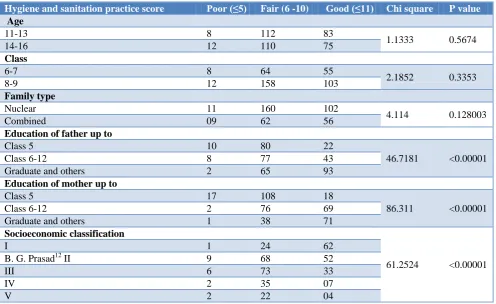
Table 3: Distribution of hygiene and sanitation practice score.
Hygiene and sanitation practice score Poor (≤5) Fair (6 -10) Good (≤11) Chi square P value
Age
11-13 8 112 83
1.1333 0.5674
14-16 12 110 75
Class
6-7 8 64 55
2.1852 0.3353
8-9 12 158 103
Family type
Nuclear 11 160 102
4.114 0.128003
Combined 09 62 56
Education of father up to
Class 5 10 80 22
46.7181 <0.00001
Class 6-12 8 77 43
Graduate and others 2 65 93
Education of mother up to
Class 5 17 108 18
86.311 <0.00001
Class 6-12 2 76 69
Graduate and others 1 38 71
Socioeconomic classification
61.2524 <0.00001
I 1 24 62
B. G. Prasad12 II 9 68 52
III 6 73 33
IV 2 35 07
V 2 22 04
In Table 3, it is shown that highly significant difference in sanitation and hygiene practices was found regarding education of father, education of mother and socioeconomic status of the family. No significant difference was found in hygiene and sanitation practices regarding age of student, class and whether he belongs to nuclear or combined family.
DISCUSSION
Similar to this study Llesanmi found that in senior secondary school students majority of the respondents (65.9%) gave positive responses for hand washing and a lesser (46.4%) of the respondents cut their nails weekly and almost (99.6%) of them were taking regular bath.13 Tamilarasi et al also reported that 31.8% students washed hands with soap before eating and 40.2% after handling garbage, whereas Sarkar found that a high percentage i.e. 94.23% of primary school children washed their hands after visiting toilet and 84.62% washed their hands before eating and 76.92% trimmed their nails but only 42.31% took daily bath.14,15 In a similar study done by Ali et al revealed that 85.17% of secondary school students were accustomed to taking their bath regularly.16
Regarding dental hygiene this study is comparable to the study conducted in Chennai by Kumar, he reported that only 14.6% college students were brushing twice daily.17 Likewise to present study, Bashiru and Anthony found that in University students only 8% brush their teeth
contractors, whereas on converse Kumar et al found that More than 90% of waste in India is believed to be dumped in an unsatisfactory manner.28,29 Unlike results were found in a study conducted by Isabel et al in rural Maharashtra which revealed that most of the people using a cup (98%) also reported that their hands got wet during drinking water removal, but only 34–55% of them washed their hands before removal, likewise Verma et al also found that in Urban slum of Rohtak Nearly two-third (64%) of family members drink water with hand, which indicates that there is a potential for drinking water recontamination.30,31 Regarding consumption of street foods Similar results were revealed by Mishra in Varanasi and he found that 61% of the students in the age group of 14-21, consume foods from the street vendors in the day at least once, also in Cotonou Van and Ottens found that 46% of the meals consumed by children was reported to be from street foods.32,33 Zafar et al conducted study in southern Punjab, Pakistan and reported that 77.7% of respondents knew that houseflies are carrier of diseases.34
CONCLUSION
It can be concluded from the study that practice of personal hygiene among students is not satisfactory and there is vast scope of improvement. Therefore, there is an urgent need for enhancement of knowledge of school children’s, where teachers and parents can play a vital role. School based health education program can be a useful effort for this and framing health education program directed to the parents with a special emphasis on their role to improve the health habits of their children may hold promise.
ACKNOWLEDGEMENTS
The authors would like to thank principal and teachers of the School for their cooperation.
Funding: No funding sources Conflict of interest: None declared
Ethical approval: The study was approved by the Institutional Ethics Committee
REFERENCES
1. WHO Information Series on School Health. Promoting Physical Activity in Schools. 2007. Available at: http://apps.who.int/iris/bitstream/ handle/10665/43733/9789241595995_eng.pdf;jsessi onid=5324849F6AB444A72280D7277CA01194?se quence=1. Accessed on 1 August 2018.
2. India age structure. Available at: http://countrymeters.info/en/India#population_2018. Accessed on 2 June 2018.
3. Keeping hands clean. Water, Sanitation & Environmentally-related hygiene. Available at: https://www.cdc.gov/healthywater/hygiene/hand/ha ndwashing.html. Accessed on 1 August 2018.
4. Whitaker EJ. Primary, Secondary and tertiary treatment of dental caries- A 20 year case report. J Am Dent Assoc. 2006;137(3):348-52.
5. Water, sanitation and hygiene (WASH) in schools. Child Friendly Schools Manual. Available at https://www.unicef.org/publications/files/CFS_WA SH_E_web.pdf. Accessed on 2 June 2018.
6. The penis and foreskin. Available at: https://www.rch.org.au/clinicalguide/guideline_inde x/The_penis_and_foreskin/. Accessed on 2 June 2018.
7. WHO. 2016. Sanitation Factsheet. Available at: http://www.who.int/mediacentre/factsheets/fs392/en /. Accessed on 2 June 2018.
8. Coffey D, Spears D. Open defecation in rural India, 2015-2016: Levels and trends in the NFHS-4. 9. Imathiu S. Street Vended foods: potential for
improving food and nutrition security or a risk factor for food borne diseases in developing countries. Current research in nutrition and food science. 2017. Available at: http://www.food andnutritionjournal.org/volume5number2/street- vended-foods-potential-for-improving-food-and- nutrition-security-or-a-risk-factor-for-foodborne-diseases-in-developing-countries/. Accessed on 2 June 2018.
10. Lucca A, Torres EAFDS. Street-food: the hygiene conditions of hot-dogs sold in São Paulo, Brazil. Food Control.2006;17(4):312-6.
11. Eight goals for 2015. India and the MDGs. Available at: http://www.in.undp.org/content/india/ en/home/post-2015/mdgoverview.html. Accessed on 1 August 2018.
12. Singh T, Sharma S, Nagesh S. Socio-economic status scales updated for 2017. Int J Res Med Sci. 2017;5(7):3264-7.
13. Llesanmi OT. Knowledge and Practices of Personal Hygiene among Senior Secondary School Students of Ambassadors College, Ile-Ife, Nigeria. Texila Int J Public Health. 2016;4(4).
14. Tamilarasi R, Arunmozhi R, Raja VK, Rajajeyakumar M. A Study to Assess the Knowledge and Practice of Hand Washing among School Going Adolescents in Chennai. Int J Health Sci Res. 2016;6(8):147-9.
15. Sarkar M. Personal hygiene among primary school children living in a slum of Kolkata, India. J Prevent Med Hygiene. 2013;54(3):153–8.
16. Ali MY, Rahman MM, Siddiqui MH. Exploring degree of awareness about healthcare and hygienic practices in Secondary School Students residing in semi- urban areas of Bangladesh. Community Based Med J. 2013;2(1):55- 62.
17. Kumar S. Oral hygiene awareness among two non professional college students in Chennai Indian- A pilot study. Adv Life Sci Technol. 2012;5:31–6. 18. Bashiru BO, Anthony IN. Oral self-care practices
19. Talianova M. Attitude to and knowledge of oral hygiene of secondary school students. School Health. 2008;21(3):199-209.
20. Satish V. Knowledge, Attitudes, and Oral Health Practices of School Children in Davangere. Int J Clin Pediatr Dentistry. 2016;9(2):172–6.
21. Blaggana A, Grover V, Anjali, Kapoor A, Blaggana V, Tanwar R, et al. Oral Health Knowledge, Attitudes and Practice Behaviour among Secondary School Children in Chandigarh. J Clin Diagnos Res. 2016;10(10):1-6.
22. Thakre SB, Thakre SS, Reddy M, Rathi N, Pathak K, Ughade S. Menstrual Hygiene: Knowledge and Practice among Adolescent School Girls of Saoner, Nagpur District. J Clin Diagnos Res. 2011;5(5):1027-33.
23. Steele MS, Bukusi E, Cohen CR, Shell-Duncan BA, Holmes KK. Male genital hygiene beliefs and practices in Nairobi, Kenya. Sex Transm Infect. 2004;80:471–6.
24. Seenivasan P, Evangeline M A, Caroline PA, Devi E, Nanthini S, Jahan NSA, et al. A cross sectional study on the health hygiene status of school children in north Chennai. Stanley Med J. 2016;3(2):8-14. 25. Sevil S, Kevser O, Aleattin U, Dilek A, Tijen N. An
Evaluation of the Relationship between Genital Hygiene Practices, Genital Infection. Gynecology Obstetrics. 2013;3(6):1-5.
26. Anuradha R, Dutta R, Raja JD, Lawrence D, Timsi J, Sivaprakasam P. Role of Community in Swachh Bharat Mission. Their Knowledge, Attitude and Practices of Sanitary Latrine Usage in Rural Areas, Tamil Nadu. Indian J Community Med. 2017;42(2):107-10.
27. Bhardwaj Aj, Surana A, Mithra P, Singh A, Panesar S, Chikkara P. A Community based cross sectional study on use of sanitary latrines in a rural setup in Maharashtra. Healthline. 2013;4(1):89-93.
28. Ramatta MY, Chirawurah D, Adongo PB. Domestic waste disposal practice and perceptions of private
sector waste management in urban Accra. BMC Public Health. 2014;14:697.
29. Kumar S, Smith SR, Fowler G, Velis C, Kumar SJ, Arya S, et al. Challenges and opportunities associated with waste management in India. Royal society open science. 2017. Available at: http://rsos.royalsocietypublishing.org/content/4/3/16 0764. Accessed on 2 June 2018
30. Isabel SD, Nesheim I, Gosh S, Dhawde R, Ghadge A, Wennberg AC. Variations of Drinking Water Quality Influenced by Seasons and Household Interventions: A Case Study from Rural Maharashtra, India. Environments. 2017;4(59):1-16. 31. Verma R, Singh A, Khurana A, Dixit P, Singh R. Practices and attitudinal behavior about drinking water in an urban slum of district Rohtak, Haryana: A community-based study. J Family Med Primary Care. 2017;6(3):554-7.
32. Mishra S. Food and Nutrition Security in Developing Countries: A Case Study of City of Varanasi in India. Paper prepared for presentation at the 84 th EAAE Seminar ‘Food Safety in a Dynamic World’ Zeist, The Netherlands, 2004. Available at: https://ageconsearch.umn.edu/bitstream/25000/1/sp0 4mi01.pdf. Accessed on 2 June 2018.
33. Van LS, Ottens L. The role of street food in the daily urban diet. A pilot study in Cotonou, Benin. Wageningen, Netherlands: Wageningen University, 1996.
34. Zafar J, Naqqash MN, Saeed S, Zaka SM, Jaleel W, Idrees N, et al. Pest status of housefly (Musca domestica L.) According to the opinion of community of southern punjab, Pakistan. Int J Agriculture and Crop Sci. 2014;7(13):1332-8.