ISSN : 2454-1311
Design and Implementation of Fuzzy Logic
Based Image Fusion Technique
Samriddhi Bhatnagar
1, Navneet Agrawal
21M.Tech Scholar, Department of ECE, College of Technology and Engineering, Udaipur, Rajasthan, India
2Assistant Professor, Department of ECE, College of Technology and Engineering, Udaipur, Rajasthan, India
Abstract—The quality of image holds importance for
both humans and machines. To fulfill the requirement of good quality images, image enhancement is needed. Application of a single contrast enhancement technique often does not produce desirable result and may lead to over enhanced images. To overcome this problem image fusion is performed so that better results with desired enhancement can be achieved. In the present paper an amalgamation of image enhancement, fusion and sharpening have been carried out in the candidate algorithm. The algorithm makes use of fuzzy logic for weight calculation. The results are compared with DACE/LIF approach and it is observed that the proposed algorithm improves the result in terms of quality parameters like PSNR (Peak Signal to Noise Ratio), AMBE (Absolute Mean Brightness Error) and SSIM (Structural Similarity Index) by 0.5 dB, 3 and 0.1 respectively from the existing technique.
Keywords— Fuzzy Image Fusion, Image Enhancement, Image Sharpening, Magnitude Gradient, Standard Deviation
I. INTRODUCTION
Poor contrast of images makes them unsuitable to be used for further processing and also for human perception. The purpose of image enhancement is to improve the image quality in a manner such that it has better visual appearance for humans as well as it is better suited for machine interpretation. Images taken under non uniform illumination conditions have poor contrast. For some areas of image, contrast needs to be increased, for some areas contrast needs to be decreased and for some areas contrast needs no manipulation. There are various techniques available for image contrast enhancement. The choice of a particular contrast enhancement technique depends on the purpose for which it is to be applied. Improvement of overall perception or quality can hardly be achieved by one single enhancement. So, in order to improve the overall perception image fusion is carried out. By fusing the images the desired characteristics or the best features of the source images can be retained.
For removal of blur and making the image look crisper, image sharpening is carried out, so that image looks sharper and better.
Histogram equalization is a common contrast
enhancement technique which increases the global contrast of image. It suffers from problem of shifting of mean intensity to middle gray level [1] thereby causing change in brightness of the image. To preserve brightness, brightness preserving bi-histogram equalization (BBHE) has been proposed [2]. BBHE method partitions histogram of image on the basis of its mean and then the two histograms are equalized independently. The generalization of BBHE, namely, Recursive Mean Separate Histogram Equalization (RMSHE) [1], has been proposed which perform the separation recursively. As the number of recursive mean separation increases the output image's mean brightness converges to the input image's mean brightness.
ISSN : 2454-1311 II. IMAGE ENHANCEMENT, FUSION
AND SHARPENING 2.1 Image Enhancement
Image enhancement is performed to improve the contrast of images. Image enhancement means emphasizing features of image (boundaries, edges etc.) or contrast in order to make images more suitable for display and analysis [8]. A wide variety of techniques are available for enhancing the images. One of the most widely employed techniques is histogram equalization.
Histogram equalization is a spatial domain contrast enhancement technique which usually increases the global contrast of the image. The Histogram Equalization enhances the contrast of images by transforming the values in an intensity image so that the histogram of the output image is approximately flat.
2.2 Image Fusion
Image fusion is the process of combining information present in different images to form a new image that contains desired information. The information present in a set of source images is combined in a manner such that the resultant or the fused image is much more informative and of better quality than the source images. The fusion of the information can take place on different levels [9]. The main levels are:
Data-level fusion (Pixel-level fusion): In data level fusion information combination is performed at the level of pixels or intensity values of the images. For pixel level fusion to take place the source images should contain complementary information and also, the pixels must represent the same physical properties of the field of view.
Feature level fusion: In feature level fusion information combination is performed at the level of features of the images. For feature level fusion to take place features from the source images should have been extracted prior to the fusion operation.
Decision level fusion (Symbol-level fusion): In decision level fusion information combination is performed at the level of symbols. The symbolic information is obtained from feature extraction and classification from source images. After obtaining symbolic information fusion is performed.
For our algorithm, we have used pixel based fuzzy fusion. Fused image can be obtained using the general expression given as [3]:
If = f(I1,I2) (1)
In our work, I1 is original image and I2 is histogram
equalized image. The equation used for fusion is:
If = W * I1 + (1-W) * I2 (2)
where, 0 ≤ W ≤ 1
2.2.1. Fuzzy Image Fusion
To find appropriate weight for fusion, fuzzy logic with ‘Mamdani’ FIS is used. Fuzzy inference system (FIS) [10] consists of a fuzzification interface, a rule base, a database, a decision-making unit, and finally a defuzzification interface. The function of each block is as follows:
Rule base: Rule base contains a number of fuzzy if – then rules.
Database: Database defines membership functions of the fuzzy sets of inputs and outputs.
Decision making unit: Decision making unit performs the inference operations on the formulated rules.
Fuzzification interface: Fuzzification interface transforms the crisp input into degrees of match with linguistic values.
Defuzzification interface: Defuzzification interface transforms the results of inference from fuzzy to crisp output.
Fig 1: Fuzzy inference system
For both images magnitude gradient using Sobel operator and local standard deviation are calculated.
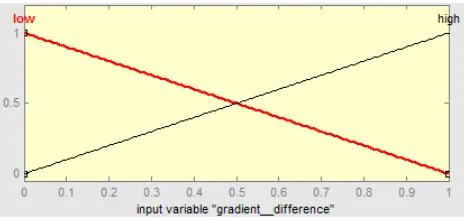
The inputs to the fuzzy system are – a). Difference of magnitude gradient of the two images and b). Difference of standard deviation of the two images, calculated as:
X = X1 – X2 (3) Where, X1 = gradient / standard deviation of original image, and X2 = gradient / standard deviation of histogram equalized image
ISSN : 2454-1311
Fig 2: Membership functions for inputs to FIS
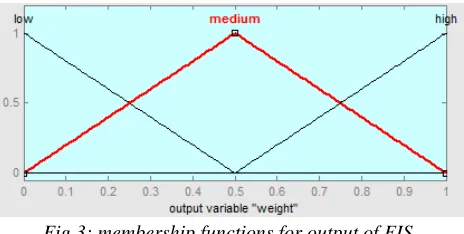
The output of the fuzzy system is weight. Three membership functions- ‘low, medium and high’ are defined for output.
Fig 3: membership functions for output of FIS
Rules for calculating weight are:
1. if input1 is ‘low’ and input2 is ‘low’ then output is ‘low’
2. if input1 is ‘low’ and input2 is ‘high’ then output is ‘medium’
3. if input1 is ‘high’ and input2 is ‘low’ then output is ‘medium’
4. if input1 is ‘high’ and input2 is ‘high’ then output is ‘high’
If the difference of the quantities is low, it means that the original image has lower edge strength than enhanced image. Also, if the difference of the quantities is high, it means that the original image has higher edge strength than enhanced image. So, ‘low’ weight is assigned to original image if both the inputs are ‘low’ and ‘high’ weight is assigned if both inputs are ‘high’. For rest of the cases weight is ‘medium’.
2.3. Image Sharpening
Image Sharpening highlights the fine details of an image. It removes blur and enhances transitions in image intensities i.e., highlights edges. In order to make the edges sharp and remove blur image sharpening is done using unsharp masking. In unsharp masking, to make an image sharp an unsharp or smoothed version of the original image is subtracted from the original image.
III. METHODOLOGY
Fig 4:Flowchart of proposed approach
Steps of proposed approach are as follows: 1). Read the image.
2). Convert the image to grayscale if it is RGB. 3). Perform histogram equalization.
4). Calculate the magnitude gradient using Sobel operator and local standard deviation of both the original and histogram equalized image.
5). Calculate the difference of magnitude gradient of the two images and also the difference of standard deviation. These will serve as the two inputs to the fuzzy system. 6). fuzzify the inputs.
7). Create a Mamdani FIS and define membership functions for the inputs and output.
8). Define rules for obtaining the output.
9). Apply centroid defuzzification to obtain the crisp output - weight.
10). Obtain the fused image using equation (2).
11). Apply unsharp masking to get the sharp output image.
IV. PERFORMANCE PARAMETERS
For evaluating the performance of the algorithm of proposed method following parameters are used
4.1. PSNR
PSNR indicates the quality of reconstructed image. A higher PSNR indicates reconstruction of higher quality. Peak Signal to Noise Ratio is calculated as:
Input
(Original Image and Histogram Equalized Image)
Fuzzification and Weight Calculation
Image Fusion
Image Sharpening and Output Image Extraction
ISSN : 2454-1311
= 10 log 255 × 255
(4)
= MN1 , − , !"
# $
(5) where,
X and Y are input and processed images respectively of size M×N.
4.2. Absolute Mean Brightness Error
Absolute mean brightness error (AMBE) is used to evaluate brightness preservation in processed image. AMBE is calculated as:
% & = | (− (|
(6)
Where, Xm is mean of image X and Ym is mean of image
Y
Less brightness error implies better brightness
preservation.
4.3. Structural Similarity Index
The structural similarity index (SSIM) is a method for measuring the similarity between two images. The SSIM quality assessment index is based on three characteristics of an image: luminance, contrast and structure and can be calculated as:
) =*+,-"*+2,-,.+ ,."+ 0 1*2-"+ 0 1*22-.+ 2+ 0"+1
."+ 0"+1 (7)
Where, μx, μy, σx,σy, and σxy are the local means, standard
deviations and cross-covariance for images x and y. C1
and C2 are constants.
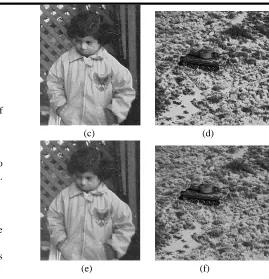
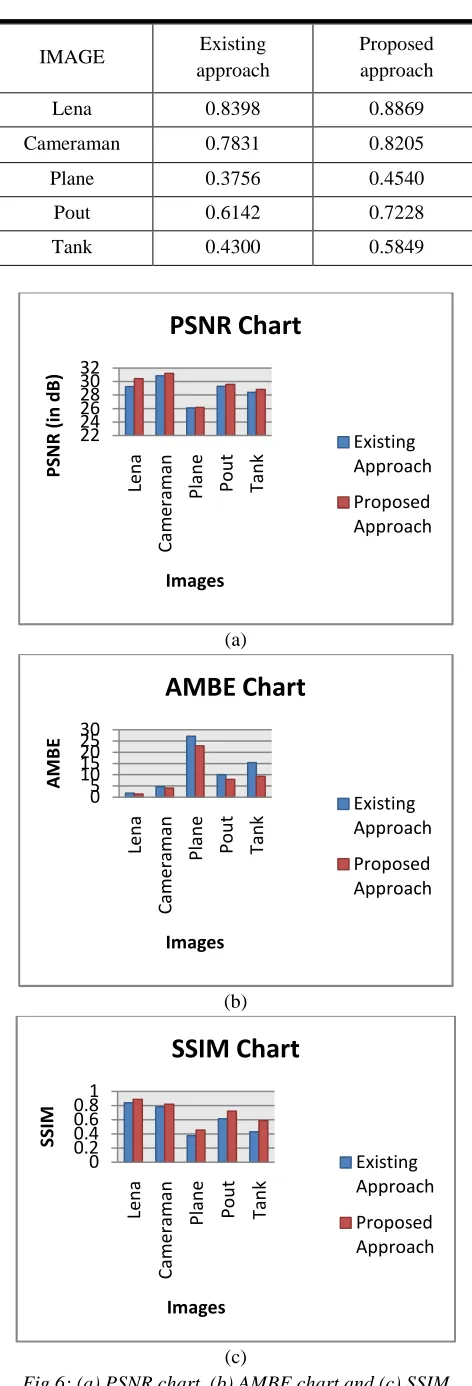
V. RESULTS AND DISCUSSION The algorithm is tested using MATLAB 2013a. The performance of proposed method is analyzed on the basis of visual appearance and performance metrics mentioned above. The results of simulation for PSNR, AMBE and SSIM are tabulated and compared with the existing approach of DACE/LIF. The results of visual appearance for two images (pout and plane) are shown below.
(a) (b)
(c) (d)
(e) (f)
Fig 5: (a), (b) original images, (c), (d) results of existing approach and (e), (f) results of proposed approach
The results of proposed approach appear to be enhanced with brightness closer to the brightness of original image. The results of existing approach have more brightness deviation than brightness deviation of proposed method’s results from original image and also produce over enhancement in some regions of images.
Table 1: Comparison on the basis of PSNR
IMAGE Existing
approach(dB)
Proposed approach (dB)
Lena 29.2598 30.4388
Cameraman 30.8488 31.2185
Plane 26.0836 26.1800
Pout 29.2816 29.5693
Tank 28.4148 28.8253
Table 2: Comparison on the basis of AMBE
IMAGE Existing
approach
Proposed approach
Lena 1.8126 1.4275
Cameraman 4.6894 4.0362
Plane 27.1376 22.8236
Pout 10.0687 7.8783
Tank 15.3997 9.2514
ISSN : 2454-1311
IMAGE Existing
approach
Proposed approach
Lena 0.8398 0.8869
Cameraman 0.7831 0.8205
Plane 0.3756 0.4540
Pout 0.6142 0.7228
Tank 0.4300 0.5849
(a)
(b)
(c)
Fig 6: (a) PSNR chart, (b) AMBE chart and (c) SSIM chart for different images
Results of proposed approach have lesser value of AMBE and higher value of PSNR and SSIM than results of existing approach.
VI. CONCLUSION
This paper presents an approach to image enhancement by image fusion. Fuzzy logic is used to calculate the weight required for fusing the images. Finally, sharpening is performed using unsharp masking to remove blur. Simulation results shows that the proposed approach is better than the existing approach in terms of PSNR, AMBE and SSIM. This implies that the proposed approach has better reconstruction quality, brightness preservation and structural similarity to original image. Also, the results of proposed approach do not show over enhancement in terms of visual appearance thereby enhancing the images in a more balanced manner preserving the similarity with original image.
REFERENCES
[1] S.-D. Chen and A. Ramli, “Contrast enhancement
using recursive mean-separate histogram equalization for scalable brightness preservation,” IEEE Trans. on Consumer Electronics, vol. 49, no. 4, pp. 1301-1309, Nov.2003.
[2] Y.-T. Kim, “Contrast enhancement using brightness
preserving bi - histogram equalization,” IEEE Trans. On Consumer electronics, vol. 43, no. 1, pp. 1-8, Feb. 1997.
[3] C.-H. Hsieh, B.-C. Chen, C.-M. Lin and Q. Zhao,
“Detail aware contrast enhancement with linear image fusion”, International Symposium on Aware Computing, 2010, pp. 1-5.
[4] X. Fang, J. Liu, W. Gu and Y. Tang, “A Method to
Improve the Image Enhancement Result based on
Image Fusion”, International Conference on
Multimedia Technology, 2011, pp. 55-58.
[5] V. Saini, and T. Gulati, “A comparative study on
image enhancement using image fusion”,
International Journal of Advanced Research in Computer Science and Software Engineering , 2012, vol. 2, no. 10, pp. 141-145.
[6] A. Nelikanti,. “Image enhancement using image
fusion and image processing techniques”,
COMPUSOFT, An international journal of advanced computer technology, 2014, vol. 3, no. 10, pp. 1193-1197.
[7] W. Barkhoda, , F.A. Tab, and O.-K. Shahryari,
“Fuzzy edge detection based on pixel's
ISSN : 2454-1311
[8] A.K. Jain, Fundamentals of Digital Image
Processing. Prentice Hall, 1989.
[9] Image Fusion. 2011. InTech.
http://www.intechopen.com.
[10]S. N. Sivanandam, S. Sumathi and S. N. Deepa,
Introduction to Fuzzy Logic using MATLAB, Springer, 2007.
[11]R.C. Gonzalez, and R.E. Woods, Digital Image