ADVANCED PROOF THE RIEMANN HYPOTHESIS Mazurkin P.M.
Mari State Technical University, Yoshkar-Ola, e-mail: [email protected]
In the proof of the correctness of the Riemann hypothesis held strong Godel’s incompleteness theorem. In keeping with the ideas of Polya and Hadamard’s mathematical inventions, we decided to go beyond the modern achievements of the Gauss law of prime numbers and Riemann transformations in the complex numbers, knowing that at equipotent prime natural numbers will be suffi cient mathematical transformations in real numbers. In simple numbers on the top left corner of the incidence matrix blocks are of the frame. When they move, a jump of the prime rate. Capacity of a number of prime numbers can be controlled by a frame, and they will be more reliable digits. In the column i = 1 there is only one non-trivial zero on j = (0, ∞). By the implicit Gaussian «normal» distribution , where Pj – a number of prime numbers with the order-rank j. On the critical line
of the formula for prime numbers . By «the
famous Riemann hypothesis is that the real part of the root is always exactly equal to 1/2» is obtained – the vibration frequency of a series of prime numbers is equal π/2, and the shift of the wave – π/4. Montgomery and Dyson gave the average frequency of occurrences of zeros. But it turns out, it is different and functionally related to the number of spaces π = 3,14159... In 1972, Montgomery showed oscillatory nature of the arrangement of zeros on the critical line. We saw that they (and 1) really varies.
Keywords: prime numbers, the full range, critical line, the equation
While working on the proof of the correct-ness of the Riemann hypothesis held strong Godel’s incompleteness theorem: «The logical completeness (or incompleteness) of any system of axioms cannot be proved within this system. For its proof or refutation of the required addi-tional axioms (strengthening of the system)».
In keeping with the ideas of mathemati-cians Polya and Hadamar about mathematical inventions, we decided to go beyond the mod-ern achievements of the Gauss law of prime numbers and Riemann transformations in the complex numbers, realizing that at equipotent prime natural numbers will be suffi cient math-ematical transformations in real numbers.
Full range, methods and data. Prime number – this is a natural number N = {0, 1, 2,
3, 4, 5, 6, ...} with a natural divider 1 (division by himself – is redundantly).
Of prime numbers P = {0, 1, 2, 3, 4, 5, 7, ...} «ladder of Gauss-Riemann» separated «step» increase with the parameter of prime numbers , where j = 0, 1, 2, 3, 4, ... – is the rank order. Rejection of the sys-tem with base e = 2,71828... led to the trans-lation of the binary system. Understand that mathematics, fascinated by the factorization of prime numbers, forget about the benefi ts of the decomposition of numbers.
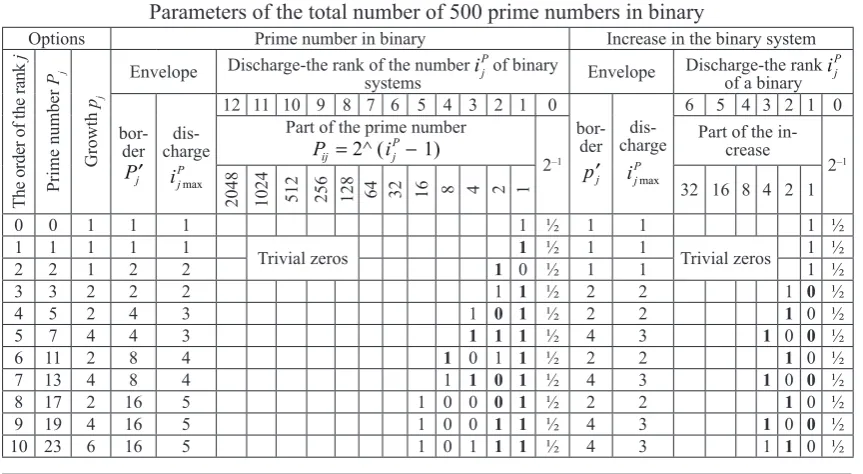
Table 1 shows the conversion of 500 prime numbers from decimal to binary. The decom-position of primes is known by the simple rules on the discharge rank i = 0, 1, 2, 3, 4, ....
Table 1
Parameters of the total number of 500 prime numbers in binary
Options Prime number in binary Increase in the binary system
The order of the rank
j
Prime number
Pj
Growth
pj
Envelope Discharge-the rank of the number of binary systems Envelope Discharge-the rank of a binary
bor-der charge
dis-12 11 10 9 8 7 6 5 4 3 2 1 0
bor-der charge
dis-6 5 4 3 2 1 0
Part of the prime number
2–1
Part of the in-crease
2–1
2048 1024 512 256 128 64 32 16 8 4 2 1 32 16 8 4 2 1
0 0 1 1 1 1 ½ 1 1 1 ½
1 1 1 1 1
Trivial zeros 1 ½ 1 1 Trivial zeros 1 ½
2 2 1 2 2 1 0 ½ 1 1 1 ½
3 3 2 2 2 1 1 ½ 2 2 1 0 ½
4 5 2 4 3 1 0 1 ½ 2 2 1 0 ½
5 7 4 4 3 1 1 1 ½ 4 3 1 0 0 ½
6 11 2 8 4 1 0 1 1 ½ 2 2 1 0 ½
7 13 4 8 4 1 1 0 1 ½ 4 3 1 0 0 ½
8 17 2 16 5 1 0 0 0 1 ½ 2 2 1 0 ½
9 19 4 16 5 1 0 0 1 1 ½ 4 3 1 0 0 ½
Table 1 shows the symmetrical geometric patterns, but their analysis we did not. It is seen that any prime number before itself has a ratio of 1/2. But it is a sum of terms is not included. Complex mathematical expressions, the pa-rameters of the series has the form:
ij = (1, m); j = (0, n); m = 6; n = 500; Pj+1 = Pj + pj, pj = Pj+1 – Pj;
(1)
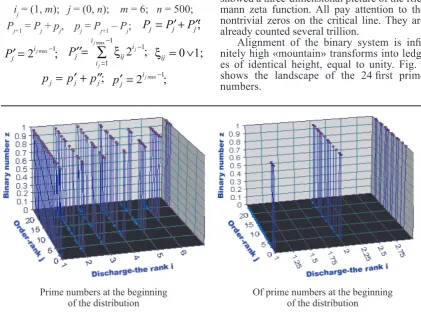
Mathematical «landscape». In the fi lm «De Code» (19.07; 26.07 and 02.08.2011) showed a three-dimensional picture of the Rie-mann zeta function. All pay attention to the nontrivial zeros on the critical line. They are already counted several trillion.
Alignment of the binary system is infi -nitely high «mountain» transforms into ledg-es of identical height, equal to unity. Fig. 1 shows the landscape of the 24 fi rst prime numbers.
Prime numbers at the beginning
of the distribution Оf prime numbers at the beginning of the distribution
Benchmarks. They are on the upper left corner blocks of prime numbers. It was during the transition to them occurs a jump increase in prime. Therefore, power series of prime
num-bers is quite possible to manage with the help of a benchmarks, they will be safer decimal digits.
From table 1, we write the nodal values NR (tab. 2) and other parameters of benchmarks.
Fig. 1. Mathematical «landscape» binary distribution of the 24 fi rst prime numbers
Table 2
Asymptotic benchmarks a number of 500 primes
i 1 2 3 4 5 6 7 8 9 10 11 12
j 0 2 4 6 8 13 20 33 56 99 174 311
Pij 0 2 5 11 17 37 67 131 257 521 1031 2053 NR 1 2 4 8 16 32 64 128 256 512 1024 2048
Pij – NR -1 0 1 3 1 5 3 3 1 9 7 5
Infl uence of prime numbers. At i = 0 there is z0 = 1/2.
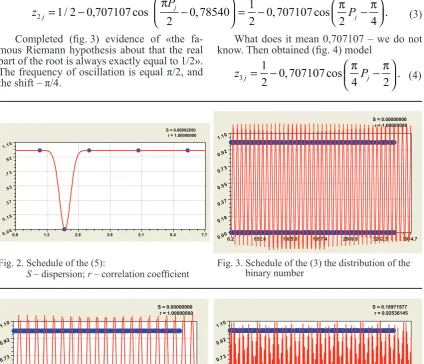
And in the column i = 1 (fi g. 2) there is only one nontrivial zero throughout j = (0, n), i.e. before j = (0, ∞). By implicitly given
us the law of Gauss «normal» distribution have
On the critical line is the formula
(3)
Completed (fi g. 3) evidence of «the fa-mous Riemann hypothesis about that the real part of the root is always exactly equal to 1/2». The frequency of oscillation is equal π/2, and the shift – π/4.
What does it mean 0,707107 – we do not know. Then obtained (fi g. 4) model
(4)
Fig. 2. Schedule of the (5):
S – dispersion; r – correlation coeffi cient Fig. 3. Schedule of the (3) the distribution of the binary number
Fig. 4. Graphs of the distribution of the binary components of prime numbers
The statistical model (4) for the third rank The statistical model (5) at the fourth digit
Montgomery and Dyson applied statistical physical methods of the analysis of distribu-tions with respect to a number of primes and determined the average frequency of occur-rences of zeros.
From the remains of up to 0,25 for the fourth level was obtained (fi g. 4) model
(5)
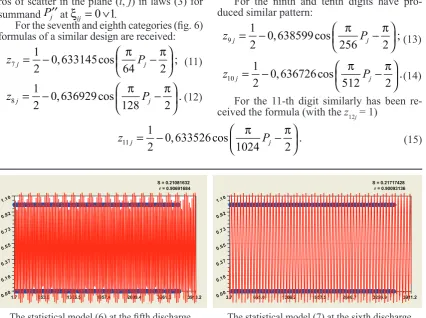
For the fi fth and sixth digits (fi g. 5) were obtained regularities:
(6)
(7)
ze-ros of scatter in the plane (i, j) in laws (3) for summand at .
For the seventh and eighth categories (fi g. 6) formulas of a similar design are received:
(11)
(12)
For the ninth and tenth digits have pro-duced similar pattern:
(13)
(14)
For the 11-th digit similarly has been re-ceived the formula (with the z12j = 1)
The statistical model (6) at the fi fth discharge The statistical model (7) at the sixth discharge
The statistical model (11) for the seventh digit The statistical model (12) for the eighth digit
(15)
Fig. 5. Graphs of the distribution of the binary components of prime numbers
Fig. 6. Graphs of the distribution of the binary components of prime numbers
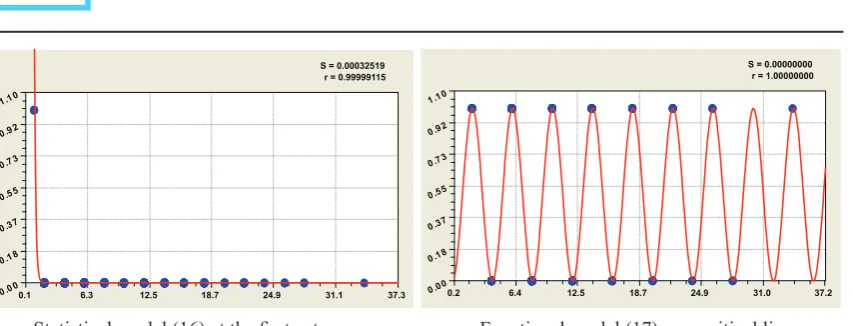
Effect of growth in charges. Bernhard Riemann in 1859, according to the analysis of the zeta function asserted that the zeros are on the same line. Now believe it as critical line crosses the mathematical landscape of the zeta function.
For 1 and 2 categories (fi g. 7) on unbroken trivial zeros of the verticals are:
– the law of the Laplace (in physics – Man-delbrot);
; (16)
Statistical model (16) at the fi rst category Functional model (17) on a critical line Fig. 7. Schedules of distribution of binary number at components of a gain of simple numbers
The critical line has received the un-equivocal formula, and without wave shift.
Conclusions
The famous Riemann hypothesis is proved. For this was accomplished the trans-formation of a number of prime numbers from decimal notation to binary. We obtain four new criteria. There were geometric patterns.
Became visible «on the fl oor» non-trivial zeros and appeared units «on the ceiling» of the distribution of 0 and 1 instead of abrupt «hills» of zeta-function.
References
1. Don Zagier. The fi rst 50 million prime numbers. – URL: http://www.ega-math.narod.ru/Liv/Zagier.htm.