Original Research Article
The style of mothering and its determinants: a study among mothers of
lower primary school children
Mohamed Hasin, C. R. Saju*, Jenyz M. Mundodan, M. P. Jini
INTRODUCTION
The first teacher and everlasting support for a child is his/her mother. Mothering uniquely contributes to the development of their children. Mother–child bonds remain so strongly throughout one’s life in spite of the changing times and complexities of life. But their child-rearing ideologies may vary in different settings. How to behave in the optimum way in different circumstances to a child is more or less a trial and test method for the parents. Its awareness and impacts help them the way of approach towards the child.
Mothering style, in fact parenting style as a whole has two important elements–responsiveness and demanding-ness. Parental responsiveness (also referred to as parental warmth or supportiveness) refers to the extent to which parents intentionally foster individuality, self-regulation, and self-assertion by being attuned, supportive and acquiescent to children’s special needs and demands. Parental demandingness (referred to as behavioural control) refers to the claims parents make on children to become integrated into the family whole, by their maturity demands, supervision, disciplinary efforts and willingness to confront the child who disobeys. Both responsiveness and demandingness of every parent
ABSTRACT
Background: The first teacher and everlasting support for a child is his/her mother. Mother–child bonds remain so
strongly throughout one’s life in spite of the changing times and complexities of life. Literature suggests that elements of warmth and control from parents, especially mothers positively correlated with achievement and intellectual orientation in children. Objectives were to assess the various styles of mothering and its determinants in mothers of children studying in lower primary schools and residing in Adat panchayat, Thrissur, Kerala.
Methods: A community based descriptive study was conducted among 315 mothers of lower primary school children
residing in Adat panchayat, Thrissur. Data was collected using Parental Authority Questionnaire.
Results: Mean age of mothers was 31.9 years. 73% mothers were practicing predominantly authoritative parenting style, 24% were authoritarian and only 3% were permissive style. The type of family and current age of mothers were significantly associated with the style of mothering. Mothering style did not differ with the gender of children. Occupation of mothers had a significant difference in proportion of parenting styles. The working status of either or both parents significantly influenced the mothering styles.
Conclusions: Most mothers followed predominantly authoritative style. Responsive and demanding behaviour of
mothers vary significantly with respect to type of family, current age and employment status.
Keywords: Determinants, Lower primary school children, Mothering style, Parental authority questionnaire
Department ofCommunity Medicine, Amala Institute of Medical Sciences, Thrissur, Kerala, India
Received: 06 December 2018
Revised: 11 January 2019
Accepted: 12 January 2019
*Correspondence:
Dr. C. R. Saju,
E-mail: [email protected]
Copyright: © the author(s), publisher and licensee Medip Academy. This is an open-access article distributed under
the terms of the Creative Commons Attribution Non-Commercial License, which permits unrestricted non-commercial use, distribution, and reproduction in any medium, provided the original work is properly cited.
towards their child are very well determinant of good parenting.1
Parenting styles are considered to be the most significant dimension of parenting and are the overall emotional aspect in which a parent interacts with his/her child. Parenting impacts children from early years. And from when a child starts to go to school, his/her behaviour and social development get a major push which gradually shapes the child’s adult characteristics. Middle childhood is a crucial stage from age 6 years to 11 years of the child, at which significant cognitive, social and personal changes that influence child development happen. During this period, children develop foundational skills for building healthy social connections and learn roles that shall prepare them for adolescence and adulthood.2 Therefore parental concerns about children’s problems should be attended at their onset otherwise they may result in impairment in character building of the child, family functioning and relationships.
Many literatures suggest that beyond the relation, the quality of the relationship is important with the elements of warmth and control from parents, especially from mothers.3,4 It is the home environment the parents create that positively influences the achievement and intellectual orientation in children.5 Children spend most time at home and parents’ attitudes, behaviours, life standards and communication with children has great impact on child’s future life. If parents are too much strict or too much submissive, that has worse impact on their life. But supportive, caring and flexible attitude of parents produce mentally healthy children.6 Recently, there is a good number of female population including mothers have started to work along the course of modernisation & urbanisation. Nuclear families, working couples, changing lifestyles and several other factors are putting enormous pressure on parents. These factors have made parenting a herculean task.
Generally, the pattern of parenting that parents employ depends partly on how they themselves were brought up, what they consider good parenting, the child’s disposition, their current environmental situations, and whether they place more value on their own needs or are struggling for the child’s future success. What morals, behaviours and standards parents value for themselves and want to convey, will be reflected in their child as they grow, both in the positive and negative ways, and make the child’s future brighter.7
It is the home environment parents create that decipher the child a good immunity and wellbeing which are mutually benefitting the family specifically and the community as a whole. Parenting style was studied with different child outcome variables in different contexts; but the patterning of parenting style and its influencing factors were not discussed. Parenting is not given much importance for research in various Indian habitats, especially in a well-developed state like
Kerala. Hence this study aims to identify different styles of mothering and its determinants in a community.
METHODS
A community based descriptive study was conducted among the mothers of lower primary school children residing in Adat panchayat of Thrissur district. The study period was from November 2016 to October 2018. Mothers who were available and gave consent, from each house of a child studying in lower primary division were included, barring those having children with any diagnosed disease which cause developmental delay such as Down’s syndrome, cerebral palsy, Turner’s syndrome, etc. Sample size was calculated to be 315 based on a previous study in U.S by Noor A. Rosli.8 Also, two-stage cluster sampling method was used. For sampling purpose, 18 wards in Adat panchayat were considered as 18 clusters and 8 wards (clusters) were selected by lottery method.9 In order to get total sample size of 315 from 8 clusters, 39-40 participants were taken from each cluster. From a central point in each ward, one street was selected randomly. The first household with study subjects was selected and from there every consecutive household with study subjects was surveyed until the required sample size of 39-40 was obtained from each ward.
Study tools included pre-tested and semi-structured questionnaires with socio-demographic characteristics and Parental Authority Questionnaire–Revised (PAQ-R). PAQ-R is a parental self-report version of the original PAQ by Buri in 1988, which was later modified by Rittman et al in 1997 to be used in parents of children 3– 8 years old.10 The PAQ-R consists of 30 items, 10 items each for three scales representing Authoritarian, Authoritative and Permissive parenting styles. Items are rated on a 5 point Likert type scale ranging from 1-strongly disagree to 5-1-strongly agree. Higher scores denoted greater appraised levels of the parental authority prototype. The maximumscore obtained for a particular parent after summing up the specific items for each subscale indicated the predominant practice of the parent in that style of parenting. The questionnaires were translated into local language (Malayalam) and were back-translated; these procedures were evaluated by an expert in behavioural sciences. Ethical clearance was obtained for conducting the study. Data was collected in a self-administered manner and analyzed using the statistical software Statistical Package for Social Sciences (SPSS Version-23).The level of significance was estimated with 95% confidence intervals and p<0.05.
RESULTS
315, 263 mothers were married at the age below 25 years i.e.; 84% (Table 1).
Table 1: Socio-demographic profile of the responded mothers.
Socio demographic features
Respondent mother
N=315 %
Current age (in years)
<30 110 34.9 ≥30 205 65.1
Age at marriage (in years)
<25 263 83.5 ≥25 52 16.5
Type of family
Nuclear family 130 41.3 3 generation
family 58 18.4 Extended family 127 40.3
Number of Children
1 80 25.4
2 203 64.4
3 32 10.2
Sons 224 71.1 Daughters 213 67.6
Education <degree ≥degree 140 44.4
175 55.6
Occupation Not working 256 81.3
Working 59 18.7
Child managing difficulty
Yes 184 58.4 No 131 41.6
Employment status of both parents
At least one
spouse employed 252 80.0 Both spouses
employed 56 17.8 Both spouses
unemployed 7 2.2
Figure 1: Distribution of various styles of mothering.
The mothering was predominantly of authoritative style (Figure 1). There was higher proportion of authoritarian style of parenting when mothers were aged below 30 years. But authoritative style was predominant mothering style in mothers of all age groups, ie; 64.5% mothers in below 30 age group and 77.6% in the other group (Table 2). There was significant difference in proportion of age groups in showing predominance in the style of mothering. Most mothers were married below 25 years of
age and there was higher proportion of authoritative mothering compared to authoritarian style. But these differences were not statistically significant with those mothers married at an age equal to or above 25 years.
Among 130 nuclear families, 76% respondent mothers from such families were practicing authoritative parenting style predominantly.72.4% respondents from extended families and 70% respondents from 3 generation families were practicing predominantly authoritative style. These differences were statistically significant (Table 3).
Regarding mothering and gender differences, in single gender families, 111 out of 152 single son families and 105 out of 150 single daughter families showed predominantly authoritative parenting style of mothering. There was higher proportion of families which favours authoritative style than authoritarian style when total number of child exceeds two (Table 4). But there were no significant difference in proportion in the parenting style of mother respondents among or between the number of their sons and daughters.
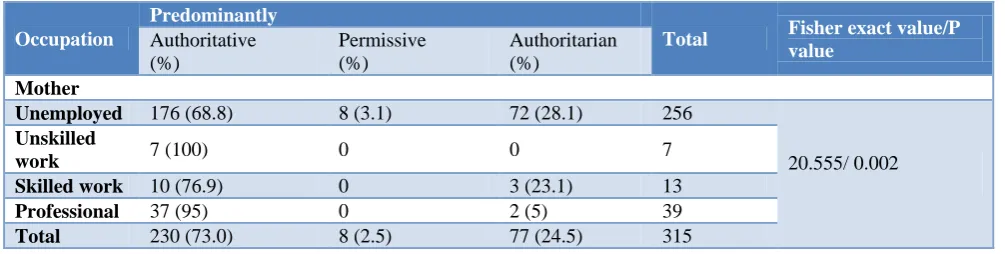
Among 230 mother respondents practicing authoritative parenting style, 24 were studied upto secondary level only whereas 135 were having degree or above education. But both their proportional differences found not significant. But in mothers out of 256 unemployed 69% were showing authoritative parenting style. As skillness level of work increases, there was significant difference in proportion of predominant parenting styles statistically at p<0.05 level (Table 5).
In the case of employment status of the respondent parents, the working status of at least one parent or both parents showed a significant difference in proportion of predominant parenting styles with p<0.05. The proportion of predominantly authoritative style in those families where at least one spouse is taking care of the children was significantly different when both parents were employed or both were unemployed.70% from both spouses unemployed families and 87% both spouses employed families were favouring authoritative parenting style (Figure 2).
Figure 2: Predominant style of mothering and employment status of parents.
230, 73% 8, 3%
77, 24%
MOTHERING STYLES
Authoritative Permissive Authoritarian
173
51
6
8 0 0
71
5 1
0 50 100 150 200
At least one spouse employed
Both spouse employed
Both spouse unemployed
N
um
ber
o
f
M
o
thers
Table 2: Association between mothering style and current age of the responded mother.
Current age in years
Predominantly
Total Fisher exact value/P value
Authoritative (%)
Permissive (%)
Authoritarian (%)
<30 71 (64.5) 3 (2.7) 36 (32.7) 110
6.272/ 0.043
≥30 159 (77.6) 5 (2.4) 41 (20) 205
Total 230 (73) 8 (2.5) 77 (24.5) 315
Table 3: Association between mothering styles and family structure of the mother.
Type of family
Predominantly
Total Fisher exact value/P value
Authoritative (%)
Permissive (%)
Authoritarian (%)
Nuclear
family 99 (76.2) 2 (1.5) 29 (22.3) 130
10.3/ 0.036
Extended
family 42 (72.4) 5 (8.6) 11 (19) 58
3 generation
family 89 (70.1) 1 (0.8) 37 (29.1) 127
Total 230 (73) 8 (2.5) 77 (24.5) 315
Table 4: Association between mothering styles and gender of their children.
No.
Predominantly
Total Fisher exact value/P value
Authoritative (%)
Permissive (%)
Authoritarian (%)
Sons
Nil 66 (72.5) 2 (2.2) 23 (25.3) 91
0.694 /0.995 1 111 (73) 4 (2.6) 37 (24.4) 152
2 48 (72.7) 2 (3) 16 (24.2) 66
3 5 (83.3) 0 1 (16.7) 6
Daughters
Nil 77 (75.5) 3 (2.9) 22 (21.6) 102
2.484/ 0.87 1 105 (70) 4 (2.7) 41 (27.3) 150
2 47 (77) 1 (1.6) 13 (21.3) 61
3 1 (50) 0 (0.0) 1 (50) 2
Table 5: Association between mothering styles and their occupation.
Occupation
Predominantly
Total Fisher exact value/P value
Authoritative (%)
Permissive (%)
Authoritarian (%)
Mother
Unemployed 176 (68.8) 8 (3.1) 72 (28.1) 256
20.555/ 0.002
Unskilled
work 7 (100) 0 0 7
Skilled work 10 (76.9) 0 3 (23.1) 13
Professional 37 (95) 0 2 (5) 39
Total 230 (73.0) 8 (2.5) 77 (24.5) 315
DISCUSSION
This cross-sectional study makes an attempt to explore the various mothering styles and its related factors in the defined population. Authoritative parenting was the most preferred parenting style in the study population (73%).
be attributed to this difference. The Asian mothers’ study was done in U.S and the study population only included muslim communities there. But the present study was done in more or less a rural area and included parents from all communities. Muslim population was very less compared to hindu and christian communities due to the geographical characteristics of the study region. Also, in this study participants were the mothers themselves and they filled the PAQ-R themselves after getting informed and explained. A localised study in Nellore district, Andhra Pradesh using another standard parenting style questionnaire developed by Robinson done among 60 mothers reported that 49 (81.7%) mothers followed Authoritative parenting style, 10 (16.6%) followed Authoritarian parenting style.11
Predominant parenting style varies with the age of the mother. As the parent proceeds from the birth of a child, the style of parenting moves from more protective and controlling to more accepting and responsive. The findings in a Saudi Arabian study was that the relationship between parents and children in Arab countries remains fixed even after the child becomes an adult.12
As the number of members in the family increases, more resources are available, chances of getting social support rise, and most importantly the parental pressure on fulfilling dreams and ambitions gets divided among children.7 But this study shows no significant association between number of siblings and mothering style. Studies have shown that parents have different styles of behavioural pattern towards sons and daughters. There is institutionalization of gender difference in every sphere right from childhood. A study conducted in Ludhiana reported significant gender differences existed in all the dimensions of family environment. Authoritarian mothering style was prominent towards girls than boys.13 A study by Nair et al in Kerala reported that girls, whether kids or adolescents are believed to be treated as being inferior to males.14 The difference in the parental attitudes is there because parents in general believed that girls should not be treated the same way as boys, as they have to be trained for their different adult roles as wife and mother. However the present study could not be able to find out much significance in mothering styles between and among different genders in a family.
As level of education increased, authoritative parenting dominated in mothers, but found not significant. However the level of occupation had significant positive influence on the predominant parenting style in mothers. As skillness level of work increased, mothers were more predominantly authoritative in parenting. These findings were somewhat similar to the study of Kang and Jaswal in Amritsar reports that better educated parents generally feel more relaxed and have acceptance towards the child.13 Another observation in this study was that there was a higher chance of authoritative mothering in those families where at least one spouse is taking care of the
children. There was significant difference in the proportion of mothering styles according to the employment status of the parent couples. Any one of the spouse employed promote more relaxed, flexible attitude of the mother towards the child.
The study observed that there was a trend towards authoritarian parenting style in those mothers who felt much difficulty in managing their child compared to those felt less. But this association is not statistically significant in this study. In one of the studies by Hunt JC regarding parenting of ADHD children, authoritative parenting was the most effective style for managing ADHD symptoms in children even though there was not much variance between parenting scores on the authoritarian and permissive scales.15
There were some limitations of the study. Different mothers might have different perspectives when comprehending the same queries in the parental authority questionnaire although prior explanation was given clearly. Some study mothers might have been apprehensive in responding to questions in undesirable way. That would have resulted in social desirability bias. Since diverse regional and socio-demographic differences in life styles and belief systems likely influence parenting, the present findings can’t be generalised.
However, the purpose of the parenting should be providing a comfortable, lively environment to the children where the child’s feelings and wants are taken care of. It is obvious that too much parenting or parental pollution results in adverse events in the family.
CONCLUSION
The study highlights the diverseness in mothering and the various styles practiced to rear their children. Authoritative parenting has been found to be the highly predominant parenting style in the study, compared to authoritarian and permissive parenting styles. Responsive and demanding behaviour of mothers vary significantly in different types of families. Age and occupation of mothers had a significant association with the mothering styles. Also, employment status of either or both spouses was found significant in influencing the attitude of the mothers towards the child.
ACKNOWLEDGEMENTS
The authors wish to express their thanks to the mothers who participated in this study.
Funding: No funding sources Conflict of interest: None declared
Ethical approval: The study was approved by the Institutional Ethics Committee
REFERENCES
1. Kopko K, Styles P, Baumrind PD. Parenting Styles and Adolescents. Available at http://www.parenting. cit.cornell.edu. Accessed 10 November 2018. 2. Ruiz-ortiz R. Differential Effects of Mother’s and
father’s parenting on prosocial and antisocial behavior: Child Sex Moderating. J Child Fam Stud. 2017;26(8):2182-90.
3. Lerner RM, Rothbaum F, Boulos S, Castellino DR. Developmental systems perspective on parenting. In: Bornstein MH ed. Handbook of parenting: Biology and ecology of parenting. Mahwah, NJ, US: Lawrence Erlbaum Associates Publishers; 2002: 315-44.
4. Coleman JC. The parenting of adolescents in Britain today. Child Soc. 1997;11(1):44–52.
5. Chandola A, Bhanot S. Role of parenting style in adjustment of high school children. J Hum Ecol. 2008;24(1):27–30.
6. Bibi F, Chaudhry AG, Awan EA, Tariq B. Contribution of parenting style in life domain of children. IOSR J Humanit Soc Sci. 2013;12(2):91– 5.
7. Adolescent's academic performance and Kerala parenting style, 1966. Available at shodhganga.inflibnet.ac.in/bitstream/. Accessed 21 November 2018.
8. Rosli NA. Effect of Parenting Styles on Children’s Emotional and Behavioral Problems Among Different Ethnicities of Muslim Children in the US. Marquette University, Milwaukee, Wisconsin. 2009. 9. Adat Grama Panchayat-an Overview Writeshop on
Local Planning Ministry of Panchayat Raj Profile of Adat Grama Panchayat, Thrissur. 2015.
10. Reitman D, Rhode PC, Hupp SDA, Altobello C. Development and Validation of the Parental Authority Questionnaire–Revised. J Psychopathol Behav Assess. 2002.
11. Radhika M, Joseph R. A Study to Assess the Parenting Styles and Academic Performance of School Children. Int J Sci Res. 2015;4(4):2013–6. 12. Alkhalaf AM. Measurement of Parenting Styles and
their Relationship to Well- Being in Saudi Arabia. 2015;17(2):523–9.
13. Kang T, Jaswal S. Gender Bias as Correlate of Parenting. Stud Home Com Sci. 2011;5(2):131–3. 14. Nair SS, Menon A, For C, Science H. Association
between perceived parenting style and positive mental health among college students in the age group 18 to 24 years . Sree Chitra Tirunal Institute for Medical Sciences and Technology, Thiruvananthapuram, Kerala. 2014.
15. Hunt JC. Associations between different parenting styles and child behavior. Philadelphia College of Osteopathic Medicine, 2013. Available at https://digitalcommons.pcom.edu/cgi/ Accessed 18 November 2018.
Cite this article as: Hasin M, Saju CR, Mundodan