COMPARISON BETWEEN QABC AND FGCHS TECHNIQUE IN
WIRELESS SENSOR NETWORK
Kawaljit Kaur1 & Amarpreet Singh2
1. INTRODUCTION
The uses of WSN have been increasing gradually without any kind of limitations. The different types of applications use different types of networking topology which further follows the variable constraints and characteristics. Apart from this some of the issues are common that make them homogenous. The deployment of the nodes at the appropriate location is also a quiet difficult task to perform. The applications of WSN are listed as below [3]:
Wireless sensor networks can be utilized in various fields like environmental tracking. For example: forest discovery, tracking of animals, detection of flood and prediction of next day weather. WSNs are also used in commercial fields. For example: forecasting of seismic activities.
In defense field, like tracking and environment examining supervision applications require these types of networks. In sensor network the nodes are operated at remote locations and perform as per the requirements of user. Opponent tracking, safety detections these operations are able to perform by implementing these types of networks.
Applications related to health issues, like monitoring of patients and these types of WSN are used by the doctors.
Wireless sensor networks are usually used in transport system related application like supervising traffic flow, controlling dynamic routing techniques, control and direct the vehicle parking area etc.
Quick action at the time of emergency, controlling the industrial activities, automatic controls the temperature of building, ecological unit and surroundings monitoring etc.
As the clustering is the major task to perform in wireless sensor network. The cluster head selection relies on various factors such as energy consumption of the nodes, distance, delay etc. Hence, the way of cluster head selection highly influences the performance of the network.
In previous study a problem was extracted which defines that traditionally QABC optimization algorithm was used to optimize the cluster head selection process but it lacks at the process of fitness function evaluation. Hence a new mechanism was suggested in previous study which was based on optimization of the fitness function for electing the cluster heads in the network. In order to optimize the fitness function, fuzzy inference system has been suggested [4].
2. OPTIMIZATION TECHNIQUES
This section of the paper describes several optimization algorithms which highlights their merits and demerits along with noble features. The algorithms involved are ABC (Artificial Bee Colony) algorithm and FIS.
2.1 Artificial Bee Colony Algorithm
This algorithm was initially proposed by Dervis Karaboga in the year of 2005. It has three stages of adopted bee, spectator bee, scout Bee. At the adopted bee and spectator bee stage, the bees utilize the source by local search near selected solutions based on deterministic selection. At the adopted bee stage and at the viewer bee stage, we make stochastic choices. In the Scout Bee Phased, analogy of abandoning tired sources of food in the search process, solutions that are not beneficial to the
1
M.Tech Research Scholar, ACET Amritsar, IKG PTU Jalandhar
2
Associate Professor, ACET Amritsar, IKG PTU Jalandhar
Abstract-Wireless network is a communication network which is comprised of multiple small sensors that creates a communication link from source node to destination node. The performance of the wireless network depends upon the energy factor. The more energy consumed by the nodes, the network is less efficient and if the energy consumption of the node is lower, the network will be quite effective and efficient and have a long lifetime. This work provides a contrast between FGCHS (Fuzzy Genetic based Cluster Head Selection technique) based CH selection mechanism (proposed technique) and QABC (Quantum Artificial Bee Colony) optimization methods for selecting the optimized cluster head. After conducting the results it is observed that the proposed technique is much suitable in comparison to the traditional technique in terms of increasing network reliability, number of surviving node in the network, reducing level of energy consumption and simulation time respectively.
Keywords—Wireless Sensor Network, Ant Bee Colony optimization, Quantum Artificial Bee Colony optimization, Fuzzy Inference System, Energy Consumption.
progress of the search are abandoned and new solutions are inserted to explore new areas within the search space. This algorithm has well-balanced exploration and exploitation capabilities.
2.2 Fuzzy Logics
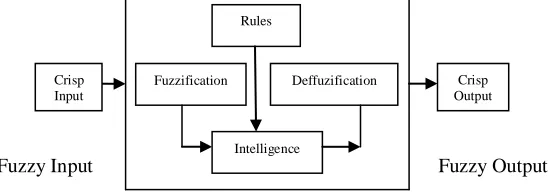
Fuzzy is applied in various fields such as engineering, studies, medical etc in order to derive a decision. Fuzzy system is easy as well as simple to understand and implements. Fuzzy system is a logical system which is in the form of many-valued logic. The truth table of these values lies between the range of 0 and 1, since Boolean logic supports the 0 and 1 only and considers the result either 0 or 1. It also supports the elements which are surrounded by the set may either have partial degree of membership means either element belongs to a set or not. These degrees are managed by any particular functions when applied with the linguistic variables. Fuzzy use linguistic variables in addition to quantitative variables in order to present vague concept. Membership function defines mapping of a membership value between 0 and 1 in the given input space. Universe of discourse is another term used for input space. Then defined rules are applied to the fuzzy input set driven by applying fuzzification. On the basis of rules an intelligent decision is taken and then the fuzzy sets are converted to the crisp values back by applying the Deffuzification.
Fuzzy Input Fuzzy Output
Figure 1. Working of Fuzzy Logic Based System Fuzzy Rules
Fuzzy logics have dual core nature on one hand it act as a rule based system and on other side it is also a non lin ear mapping. In order to understand the transformation of IF-THEN rules into non linear mapping
3. PROBLEM FORMULATION
Energy Efficient routing protocols are specifically used for WSN so that a qualitative communication can be established among the nodes and sink station. While performing random selection of cluster heads in LEACH protocol various parameters like remaining energy of the sensors, location and density of the nodes are not considered. Therefore, Quantum Artificial Bee Colony algorithm is introduced for routing in WSN. The advantage of QABC algorithm is that it considers the remaining energy, location and density of the nodes and energy consumption. The experiments done by using QABC proves that the algorithm outperforms other techniques by decreasing the amount of energy consumption. But after having a review to the related work it was extracted as a conclusion that by considering the other factors for WSN performance enhancement, the optimization algorithm that was QABC, not that much effective and the fitness function used for the optimization algorithm was only considering distance not the rest considered factors as leftover energy, node location and density along with the energy consumption. Hence there is a requirement to perform some advancement on optimization module of the current WSN protocol.
4.PROPOSEDWORK
As it was analyzed the consideration of the load energy etc. done in the traditional QABC has no role in the CH selection. This approach was dependent on only distance for the CH selection but there is need to develop an approach which will not only work for the QoS also make the network dependent of the variations in these parameters. Also QABC algorithm used for the optimization is complex and not capable to provide effective solutions as its updation strategy is quite normal. So in the proposed work a new approach using a Hybrid of Fuzzy-GA will be used for the CH selection with the dependency of all factors used in traditional protocol in the fitness function for CH selection. This will lead the proposed model efficient enough to choose CH and make network dependent on the all QoS factor considered in traditional approach.
Crisp Input
Crisp Output Rules
Deffuzification Fuzzification
Figure 2 Proposed Flowcharts 5.RESULTS
The proposed work implements the fuzzy inference system for selecting the CH. In FIS the whole processing starts by defining the input membership functions.
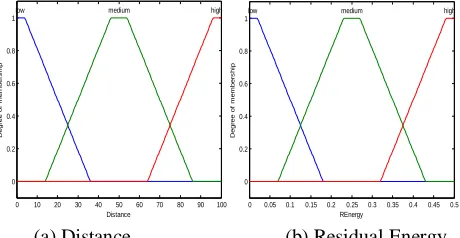
The graphs in figure 3 depict the input membership functions of the proposed work. The degree of all defined membership function is considered between 0 and 1. In 3 (a) graph represents the distance membership function which ranges from 0 to 100. In 3 (b) the graph portrays the residual energy which starts from 0 and ends at 0.5 joule. In 3 (c) the hop counts is depicted and in 3 (d) membership function of election rate is illustrated.
0 10 20 30 40 50 60 70 80 90 100 0
0.2 0.4 0.6 0.8 1
Distance
D
e
g
re
e
o
f
m
e
m
b
e
rs
h
ip
low medium high
0 0.05 0.1 0.15 0.2 0.25 0.3 0.35 0.4 0.45 0.5 0
0.2 0.4 0.6 0.8 1
REnergy
D
e
g
re
e
o
f
m
e
m
b
e
rs
h
ip
low medium high
(a) Distance (b) Residual Energy Initialize the network
parameters as Area, Node Location etc
Calculate the QoS parameters as load, energy,
distance, density
Apply Fuzzy Evaluated GA approach for CH selection
Communication between node and sink for the Data
Transmission
Final Analysis and the Comparison of proposed and
traditional Start
0 5 10 15 20 25 30 35 40 45 50 0
0.2 0.4 0.6 0.8 1
HopCount
D
e
g
re
e
o
f
m
e
m
b
e
rs
h
ip
short medium long
0 20 40 60 80 100 120 0
0.2 0.4 0.6 0.8 1
ElectionRate
D
e
g
re
e
o
f
m
e
m
b
e
rs
h
ip
very low low medium high very high
(c) Hop Count (d) Election Rate Figure 3 Membership Function of proposed work
System ElectionRate: 3 inputs, 1 outputs, 27 rules Distance (3)
REnergy (3)
HopCount (3)
ElectionRate (5) ElectionRate
(mamdani)
27 rules
Figure 4 Proposed fuzzy inference system
The fuzzy inference system works upon the basis of the input membership functions and generates the output by evaluating the input by using defined set of rules. The figure 4 shows the proposed fuzzy inference system which is comprised of 3 input membership functions and 27 rules are used for generating the output i.e. election rate. For this purpose Mamdani fuzzy inference system is used.
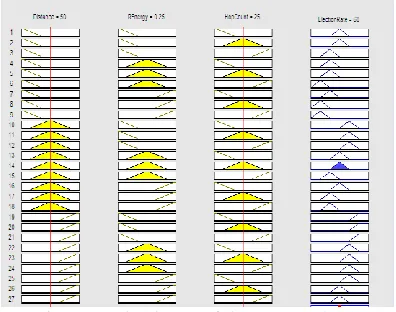
The image 5 shows the rule viewer of the proposed work. In this there are total 27 rules which are used for generating the output. The figure represent that when the distance is considered as 50, residual energy is considered as 0.25 and hop count is 25 then the election rate is evaluated to be 60.
0 500 1000 1500 2000 2500 3000 0
10 20 30 40 50 60 70 80 90 100
Number Of Surviving Nodes
Rounds
N
u
m
b
e
r
O
f
S
u
rv
iv
in
g
n
o
d
e
s
Proposed QABC
Figure 6 Number of surviving nodes in the network
The graph in figure 6 portrays the comparison of proposed work and QABC on the basis of the number of survival nodes in the network. The surviving nodes refer to the alive nodes in the network which have the efficient amount of energy to survive in the network. In graph the y axis represents the number of surviving nodes that starts from 0 and ends at 120 and x axis shows the number of communication round from 0 to 3000. The graph makes it clear that the number of surviving node is high in proposed work as compare to the QABC. In traditional techniques a fall can be seen in the number of the survival nodes when the network has completed 99.56 rounds of communication but in case of the proposed work the number of survival nodes is evaluated to 79 even after the completion of the 3000 communication rounds. The network reliability is evaluated on the basis of the output generated by the system.
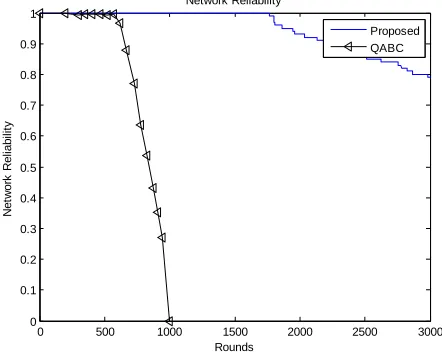
The graph in figure 7 shows the comparison of the proposed work and traditional work on the basis of the reliability of the network. The y axis represents the value of reliability that ranges from 0 to 1.4 and x axis shows the number of communication rounds. The reliability of the system decreases gradually after completing the 570 communication rounds in case of traditional techniques and in case of proposed work the reliability is evaluated to be higher in comparison to the QABC.
0 500 1000 1500 2000 2500 3000 0
0.1 0.2 0.3 0.4 0.5 0.6 0.7 0.8 0.9 1
Network Reliability
Rounds
N
e
tw
o
rk
R
e
lia
b
ili
ty
Proposed QABC
0 500 1000 1500 2000 2500 3000 0
10 20 30 40 50 60 70 80 90 100
Network Energy Consumption
Rounds
T
o
ta
l
E
n
e
rg
y
C
o
n
s
u
m
p
ti
o
n
(
J
)
Proposed QABC
Figure 8 Energy Consumption in network
The figure 8 represents the comparison of proposed and traditional work with respect to the energy consumption level of the nodes. The x axis in graph below shows the number of communication rounds and y axis shows the amount of energy consumption which varies from 0 to 100 joule. The graph proves that the energy consumption in case of proposed technique is lower in comparison to the traditional techniques. As per the values observed from the graph, it can be said that the higher energy consumption of the noticed in proposed work is near by 56.2 joule whereas in case of traditional work it is evaluated to be 98.98 joule till the end of 998 communication rounds.
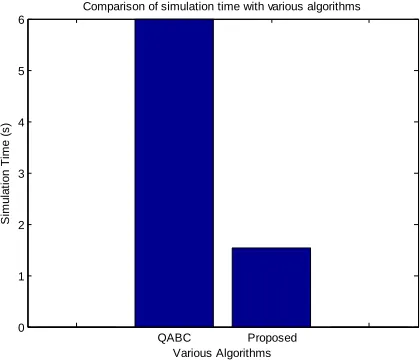
The graph in figure 9 represents the graph that portrays the comparison of proposed and traditional technique in terms of simulation time taken to produce the qualitative output. The x axis in graph shows the QABC algorithms and proposed algorithm for cluster head selection. The y axis depicts the simulation time which varies from 0 second to 6 seconds. The graph shows that the QABC algorithm takes the highest simulation time which is near by 6 seconds and proposed work takes lesser time for the simulation which is near by 1.54 seconds.
QABC Proposed 0
1 2 3 4 5 6
Comparison of simulation time with various algorithms
Various Algorithms
S
im
u
la
ti
o
n
T
im
e
(
s
)
Figure 9 Simulation time taken by the proposed work and traditional work
Table 1: Comparative Analysis
Table 2 Simulation Time
Techniques Simulation Time (sec)
QABC 6
Proposed Technique 1.54
6.CONCLUSION
After having a review to the previous work that has been conducted by various authors in the field of cluster head selection in WSN it is concluded that the evaluation of the fitness function was not efficient. Thus an initiative of using fuzzy inference system to optimize the fitness function was mentioned in the previously generated research along with the results that represents the effects of the proposed method on the performance of the network. The table 1 calibrates the data in the form of comparison of proposed and traditional schemes with respect to four different parameters as number of Surviving nodes, network reliability, energy consumption, and simulation time. As it can be observed that the number of surviving nodes in the case of proposed work is 85 whereas in case of QABC it is 0 respectively. The network reliability of proposed work is 0.86 which is quite high in comparison to the rest of the techniques. The energy consumption of a network should be low so that the network can remain alive and operational for long time. The energy consumption level of proposed work is 49.68 joule and for other techniques it is 100 joule respectively. It is proved that the energy consumption level of the proposed work is lower than the QABC algorithm which makes the proposed work more efficient. The simulation time is another parameter that is considered for performance evaluation in proposed work. The numbers that are represented corresponding to simulation time in table 2 proves that the proposed work consumes less time for simulation i.e. 1.54 sec which is quite much lower than the 6 sec in case of QABC respectively. From this it can be said that the proposed work is better than the QABC algorithm in terms of network reliability, number of surviving nodes, simulation time and energy consumption. In this work it is concluded that the optimization of fitness function for CH selection with FGCHS (based FIS) proves advantageous in the terms of energy consumption, simulation time, reliability of the network and number of alive nodes in the network.
In future more advancement can be done by enhancing the QoS parameters for routing approach such as delay etc and further the work can be done by considering the mobility of the sink node.
7. REFERENCES
[1] Hongwei Chen, “ LEACH-G: an Optimal Cluster-heads Selection Algorithm based on LEACH”, Journal of software, pp 2661-2667, Vol- 8, 2013
[2] V. Loscrì , “A Two-Level Hierarchy for Low-Energy Adaptive Clustering Hierarchy (TL-LEACH)” IEEE, 2005
[3] Sharma Nishi et al , “Heterogeneous LEACH Protocol for Wireless Sensor Networks”, Int. .J. Advanced Networking and Applications, pp 1825-1829,
Vol: 5, Issue : 01, 2013
[4] Liu Jenn-Long et al, “ LEACH-GA: Genetic Algorithm-Based Energy-Efficient Adaptive Clustering Protocol for Wireless Sensor Networks” IEEE, pp
79-85 Vol – 1, No- 1, 2011
[5] Bakaraniya Parul et al, “ K-LEACH: An improved LEACH Protocol for Lifetime Improvement in WSN”, IJETT, pp 1521-1526 Vol-4, Issue-5, 2013
[6] Otgonchimeg Buyanjargal, “Adaptive and Energy Efficient Clustering Algorithm for Event-Driven Application in Wireless Sensor Networks
(AEEC)”, Journal of Networks, August,2010, VOL. 5, NO. 8, pp 904-911
[7] Amandeep Kaur et al, “Event Driven Clustering Scheme and Energy Efficient Routing for Wireless Sensor Network - A Review” (IJCSIT)
International Journal of Computer Science and Information Technologies, Vol. 5 (4), 2014, 4949-4951
[8] Zahra Rezaei, “Energy Saving in Wireless Sensor Networks”, IJCSES, February 2012, Vol.3, No.1, pp 23-37
[9] Ping Yang, “An Energy Effective Routing Algorithm for Event-driven Wireless Sensor Networks”, IEEE, DOI 10.1109, pp 96-99, 2015
[10] Chu-Fu Wang, “A Network Lifetime Enhancement Method for Sink Relocation and Its Analysis in Wireless Sensor Networks”, IEEE SENSO RS
JOURNAL, VOL. 14, NO. 6, JUNE 2014, pp 1932-1943
[11] Arun K. Kumar, “Energy-Efficient Mobile Data Collection in Wireless Sensor Networks with Delay Reduction using Wireless Communication”,
IEEE, 2010
[12] Asis Nasipuri, Robert Cox, “Design Considerations for a Large-Scale Wireless Sensor Network for Substation Monitoring”, 5th IEEE International
Workshop on Practical Issues in Building Sensor Network Application, Pp 866-873,2010
[13] B. Manzoor, N. Javaid, “Q-LEACH: A New Routing Protocol for WSNs”, ELSEVIER, Pp 1-6,2013
[14] Buyanjargal, “An Energy Efficient Clustering Algorithm for Event-Driven Wireless Sensor Networks (EECED)”, IEEE, pp 1758 – 1763, August, 2009
Parameters Techniques Rounds
250 500 750 1000 2000 2500
Number of
Surviving Nodes
QABC 100 99 75 0 0 0
Proposed Work 100 100 100 100 93 86
Network Reliability QABC 1 0.9956 0.75 0 0 0
Proposed Work 1 1 1 1 0.93 0.86
Energy
Consumption (joule)
QABC 11 49.85 85 98.98 98.98 98.98
[15] Ramandeep Kaur, Er. Amarpreet Singh “A review on energy efficient clustering protocols based on LEACH in wireless sensor network” Australian Journal of Information Technology and Communication, Volume II Issue III September 2015 ISSN 2203-2843
[16] Chu-Fu Wang, “A Network Lifetime Enhancement Method for Sink Relocation and Its Analysis in Wireless Sensor Networks”, IEEE Sensors Journal,
Vol. 14, No. 6, pp 1932-1943, June 2014
[17] Dhanashri V, Ambekar Amol D. Bhoi, R. D Kharadkar, “A Survey on Sensors Lifetime Enhancement Techniques in Wireless Sensor Networks”,
International Journal of Computer Applications, Vol 107, 2014
[18] EZ-ZAIDI Asmaa, “Efficient data collection in wireless sensor networks using mobile sink”, IEEE, 978-1-4799-7391-0, Vol:14, 2014
[19] Georgios Smaragdakis Ibrahim Matta Azer Bestavros, “SEP: A Stable Election Protocol for clustered heterogeneous wireless sensor networks”, Pp
1-11
[20] Guillermo Molin, Enrique Alba ,El-Ghazali Talbi, “Optimal Sensor Network Layout Using Multi-Objective Metaheuristics”, Journal of Universal
Computer Science, vol. 14, no. 15, pp. 2549-2565, 2008
[21] Haitao Zhang and Cuiping Liu, “A Review on Node Deployment of Wireless Sensor Network”, I International Journal of Computer Science Issues,