A Conceptual Model for Ontology Based Intelligence
1
Fatemeh Yousefian, 2 Hayedeh Saberi, 3 Touraj Banirostam
1
Department of Computer Engineering, Islamic Azad University, Central Tehran Branch Tehran, Iran
2 Department of Psychology, Islamic Azad University, Roudehen Branch
Roudehen, Iran
3
Department of Computer Engineering, Islamic Azad University, Central Tehran Branch Tehran, Iran
Abstract - Different definitions of the concept of intelligence have been expressed in diverse sciences. In this paper, the concept of intelligence will be described by means of philosophy, psychology and artificial intelligence. Based on the definitions offered, the main components of intelligence will be extracted and then the relationship between elements and components will be explained. According to the extracted elements and the relationship of them, an ontology of intelligence will be proposed. It is formed three parts of interactive signals, memory and mental activity. Interactive signals interpret five sensory signals and also process of perception in which a model is offered for the process of perception. Kinds of memory and their hierarchy as well as activities that are performed by the mind will be described in parts of memory and mental activities, respectively. Based on the proposed ontology, a new conceptual model for mental activity will be suggested. According to the suggested model, autonomous agent behaviors would be described.
Keywords - Intelligence, Conceptual Model, Ontologies, Perception Model.
1. Introduction
The concept of intelligence has been stated in different sciences such as computer, psychology and philosophy. Researchers of each area have described it, which led to various definitions of intelligence. So far, an unique definition involving concepts of different areas has not been yet stated. Intelligence derived from the Latin word “Intelligere” means perception. Firstly, Galton in 1883, described intelligent as a combination of various mental abilities [1]. Spearman measured intelligence and stated it as general intelligence in 1904 [2]. The first time in 1916, IQ test (intelligence quotient) was introduced by Binet
and Simon to measure intelligence [1]. In 1970 Kronbakh suggested "subjective test as an important role in the practical guide of human beings" [2]. Finally, the first multi- dimensional intelligence theory was suggested by Harvard Gardner in 1983. By considering variety of intelligence capabilities, he classified it to the seven levels including mathematical, linguistic, musical, spatial, bodily-kinetic, natural and interpersonal intelligence. Sternberg stated three- dimensional intelligence theory in 1985 involving analytical intelligence, creative intelligence and practical intelligence [3]. He sought to understand the relation among structure of fundamental processes of intelligent behavior, function of this structure to achieve the objectives and role of experience in modeling intelligence and its application [1]. According to Sternberg's theory, people's ability is not necessarily the same in all three aspects of mentioned abilities, but it should be found a way to detect it. This theory covers both concepts of intelligence and IQ test theory. Based on these evidences, it can be said that the recognition of intelligence has been one of the most important research topics among researchers and scholars of philosophy and psychology.
an object, there should be a single definition and a certain structure and framework to express something being understandable by human and machine. By ontology, it can be shown components of an object and kind of their relation.
In this paper, an ontology proposed for intelligence and based on proposed ontology, components of intelligence, the functionality of each one and relation among them will be stated. According to proposed ontology, a model for doing mental activities will be suggested. Then in the second part, different definitions of intelligence derived from the dictionary, definitions outlined in the field of artificial intelligence, psychology and philosophy are describe. In the third one, ontology of intelligence, at first, and its parts are explained and then based on stated definitions, an ontology will be proposed. As a result, there should be a model for doing mental activities. A method for doing mental activities and result found by studies are described in the fourth and fifth parts respectively.
2. Definition of Intelligence
Regarding the importance of intelligence, philosophers, psychologists, computer engineers and researchers have focused on the definition of intelligence. In 1921, the Journal of Educational Psychology hold the first symposium of "Intelligence and its Measurement" and asked audiences to answer two basic questions: 1. what is their idea about intelligence and how it can be measured in a test group? 2. What are important in next step of research [4]? Some definitions proposed include: the power of good responses from the point of view of truth or facts (Thorndike) - the ability to carry on abstract thinking (Terman)-having learned or ability to learn to adjust one self to the environment (Colvin)-the capacity for knowledge (Henmon); the capacity to acquire capacity (Woodrow) [4].
For recognizing a conception in the first step, it is essential to be identified constituent components. So different definitions in various fields will be examined to derive basic components of intelligence. In this section, some of the definitions provided in any area are stated.
2.1 General Definitions
Definition 1: (Random House Unabridged Dictionary, 2006): “Capacity for learning, reasoning, understanding, and similar forms of mental activity; aptitude in grasping truths, relationships, facts, meanings, etc”.
Definition 2: (American Psychological Association): “Individuals differ from one another in their ability to understand complex ideas, to adapt effectively to the environment, to learn from experience, to engage in various forms of reasoning, to overcome obstacles by taking thought” [3].
Definition 3: (Columbia Encyclopedia, sixth edition, 2006): the general mental ability involved in calculating, reasoning, perceiving relationships and analogies, learning quickly, storing and retrieving information, using language fluently classifying, generalizing, and adjusting to new situations” [5].
Definition 4: (Common statement with 52 expert signatories): “Intelligence is a very general mental capability that, among other things, involves the ability to reason, plan, solve problems, think abstractly, comprehend complex ideas, learn quickly and learn from experience” [6].
Definition 5: (Peter Lanz): “Intelligence is the efficient use of cognitive, rational, mental resources, something which involves thinking, deliberation, reasoning, pondering, remembering, weighing alternative courses of actions and, therefore, the use of mental representations” [7].
2.2 Artificial Intelligence Definitions
Definition 1: (Marvin Minsky) ( " ... ‘Intelligence’ is our name for those processes (we don't yet understand) that enable us to solve problems we consider difficult" [8].
Definition 2: (Capeland 1983):"Artificial intelligence is the science of making machines do things that would require intelligence if done by man".
Definition 3: (N. E. Haggerty): “Sensation, perception, association, memory, imagination, discrimination, judgment and reasoning” [9].
Definition 4: (A. Anastasi): “Intelligence is not a single, unitary ability, but rather a composite of several functions. The term denotes that combination of abilities required for survival and advancement within a particular culture” [10].
Definition 6: (P. Voss): “. . . the essential, domain-independent skills necessary for acquiring a wide range of domain-specific knowledge – the ability to learn anything. Achieving this with ‘artificial general intelligence’ (AGI) requires a highly adaptive, general-purpose system that can autonomously acquire an extremely wide range of specific knowledge and skills and can improve its own cognitive ability through self-directed learning” [5].
2.3 Psychology Definitions
Definition 1: (Neisser et al., 1996, p. 77): Individuals differ from one to another in their ability to understand complex ideas, to adapt effectively to the environment, to learn from experience, to engage in various forms of reasoning, to overcome obstacles by taking thought [11].
Definition 2: (Gottfredson, 1997): “a very general mental capability that, among other things, involves the ability to reason, plan, solve problems, think abstractly, comprehend complex ideas, learn quickly and learn from experience. It is not merely book learning, a narrow academic skill, or test-taking smarts. Rather, it reflects a broader and deeper capability for comprehending our surroundings—“catching on”, “making sense” of things, or “figuring out” what to do” [2].
Definition 3: (cf. Sparfeldt, Schilling, & Rost, 2006): intelligence is the broad cognitive potential to learn and to solve problems in various settings which does not necessarily result in performance [11].
Definition 4: (Harting & kliem, 2006): classified intelligence from 3 aspect, structure internal is determined by fundamental cognitive process and contextualization is General ability to solve new problem and learnability is stable over time and determined by biological factors to a significant extent [12].
Definition 5: (Harward Gardner, 1983): present concept multiple intelligence, he emphasis on type intelligence that involve mathematical. Musical intelligence, linguistic, spatial intelligence, bodily-kinesthetic intelligence, naturalist intelligence, interpersonal intelligence .Gardner views attractive in domain education [13].
Definition 6: (Robert Sternberg’s, 1985): trihedral theory present. It involve 3 aspect of intelligence, analytic, creative, and practical [4]. It seeks to understand the interconnections between: 1) the structures and processes underlying intelligent behavior, 2) the application of these structures to the problem of attaining goals in the external
world, and 3) the role of experience in molding intelligence and its application [1].
2.4 Philosophy Definitions
Definition 1: (Dennett, 1979): "that makes no ultimate appeals to unexplained intelligence, and that condition can be reformulated as the condition that whatever functional parts a psychology breaks its subjects into, the smallest, or most fundamental, or least sophisticated parts must not be supposed to perform tasks or follow procedures requiring intelligence" [4].
Definition 2: (Pylyshyn, 1981): "The ultimate goal of AI & cognitive psychology is a better understanding of intelligence. Though the meaning of intelligence and the canons of evidence may drift as the science progresses, the notion of intelligence will nevertheless continue to have meaning only in relation to human behavior and purpose" [4].
Definition 3: (v. Inwagen, 1993): "Rationality marks a great divide, a discontinuity between humanity and the beasts. It is wrong to suppose that there is something that apes and elephants and beavers have a little of and we have more of and that, as a consequence, we are rational and they are not" [4].
Definition 4: (Block 1981): Intelligence can be simulated without being instantiated or realized [4].
Definition 5: (William James): “After the pre-existing conditions, and with inorganic materials you bring forth each time a different apparent end. But with intelligent agents, altering the conditions changes the activity displayed, but not the end reached; for here the idea of the yet unrealized end cooperates with the conditions to determine what the activities shall be" [4].
3. Proposed Ontology of Intelligence
knowledge in ontology should be accepted by a group. And “concept” points an abstract model including concepts and relations, which can be seen in special conditions [4].
The advantages of using ontologies include sharing of knowledge, access to a single structure for representation of understandable knowledge by machine, common language for understanding concepts by man and machine, reusable, offering knowledge in form of standard and modeling. The accuracy and authenticity of a system offered knowledge require the accuracy of designed ontology. It is essential to be careful in designing ontology so that, system functions properly.
Essential elements of intelligence were derived based on the definition given in section two, which include interactive signals, memory and mental activities. In the following, these three sections will be described. Finally, an ontology is proposed in order to create a mental picture of intelligence. The ontology provides a mental representation of intelligence and processes related to it.
3.1 Signal Interaction Section
Perception is the first activity done in the brain. In short, perception is a low-level processing of information received by the senses. In this section, the process of perceiving is expressed.
At first, the input data (it can be an image of the retina or an odor smelt or anything felt through the senses) come into the thalamus. It performs pre-processing on the input data, and then they are changed into information and enter into the cortex. It performs both feature extraction and feature selection. Thus the volume of information received; maintaining important features, decreases by cortex and then this information will be sent to orbital of frontal and amygdalae. These two parts are two processors connecting together by means of self- organized and exchange information. It repeats so much to reach a common idea about received information and finally output is achieved in form of recognition by amygdalae. All this process is called perception.
Fig. 2 Process of perception.
3.2 Memory Section
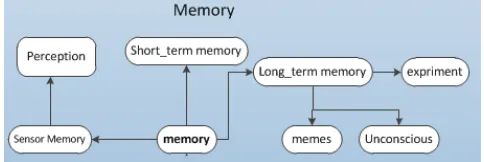
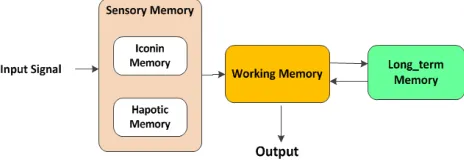
Memory is one of the most important topics of discussion in recognition including three types such as long-term memory, working memory or average-term and sensory memory. Most mental processes such as learning, problem solving, reasoning, planning, visualization and other mental and cognitive activities connect directly or indirectly to this part. Generally speaking, it can be said that memory has a significant effect on function of all mental processes. For example, if the long-term memory damages, human’s experience and knowledge will be lost. As a result, it can have a negative impact on the proper functioning of thinking, reasoning and any activity that is associated with this sector. Below, types of memory shown in the Figure 3, are described.
Fig. 3 Parts of memory.
memory. Olfactory memory is closer physically to memory than other senses. Therefore, smell remains in memory more than others. Sensory memory is very short term and it quickly loses its data. This memory is in the first step of perception process [14].
Short-term memory: This type of memory is also called working memory. Upon receiving data from sensory memory and processing them, they are stored in a special form and decoded by this part to be used for doing cognitive processes. This memory has limited capacity than Iconic, but keeps information for long time. Based on researches done on people by Miller, 7±2 items are stored in working memory [14].
Long-term memory: This type of memory stores data for long term. Some information like childhood memories, experiences and learnings are, if necessary, recalled. Two types of recalls are done in memory, unconscious and conscious recall.
There are different parts in long-term memory such as procedural memory and the skill. Procedural memory has procedural knowledge. Skill memory involves some skills done by unconscious recall like driving. Declarative memory is one for holding events and facts. The recall of memory is done consciously such as using the experiences and learnings. Overall, hierarchy of the use of the memory has been shown in Figure 4.
Fig. 4 Function of memory.
3.3 Mental Activity Section
According to definition stated in section two, it can be said that intelligence includes ability for doing cognitive and mental activities, by which critical mind activities can be named such as planning, decision-making, problem-solving, reasoning, thinking, judgment, imagination, learning, conceptualization, adaptation, use of experience and beliefs and other cognitive activities.
− “Reasoning” means conclusions based on what has be seen and experienced before [20]. Matching and mapping are two processors that occur when reasoning is done. Adaptation to what happened before and mapping on
something that has already happened and finally reasoning is done. Reasoning is along with some concepts such as logic, recognition and thinking. So that sometimes the reasoning is called selection or logical thinking.
− “Learning” as defined by "Minsky": It can be said that learning is a process of using experience and optimizing oncoming performance.
− “Planning”: It consists of a series of acts and hierarchy done routinely in order to reach the goal.
− “Decision- making”: It is a selection process of action among the options available with regard to the conditions of the environment. Decision- making may be complex based on the complexity and conditions of the environment. It is a cognitive process which has been integrated to analysis [17].
− “Thinking”: It is one of the fundamental activities of the mind and the result of unconscious processing of the brain. Thinking is a prerequisite for activities such as decision making, problem solving, planning, reasoning, and many mental and cognitive activities [18].
− “Conceptualization”: The learning process of concepts is called conceptualization. Learning of concepts means integration, forming and understanding, which can then be retrieved by the perception [19].
− “Compatibility”: It is an ability to communicate and create a consistent and flexible behavior in dynamic environment. This feature is a biological factor of human and other creatures. Compatibility has always been with flexibility.
− “Imagination”: It means an image visualization in mind, which has not been understood by the senses. In other words, it is not physically palpable (or not be seen). It is used in the process of problem solving and learning [20-22].
− “Judgment” means consideration and analysis of a decision that has been made or an action taken. In other words, it is expression of some ideas about something like decisions, actions and behavior [23-25].
Fig. 5 Part of mental activities of proposed ontology.
The proposed ontology can be seen in Figure 6. It shows overall outlook of intelligence ontology including three parts (interactive signals, memory, mental activities) and also a method for communicating these parts with each other.
As seen in Figure 6, the first step is perception done by senses. This part states kind of relation to the environment. The second part describes kinds of memory as well as its contents. Furthermore, the part of mental activity shows types of mental and cognitive activities.
Fig. 6 The model of proposed ontology
4. The method of Processing Mental Activities
An important issue in intelligence is how to implement an intelligent behavior. In other words, some questions are made such as how can an agent have an intelligent behavior? How can be risen amount of intelligence and what criteria are essential for intelligence? The process of reaction arisen by the mental activity, from receiving
information through the senses to create the behavior, can be considered as follows:
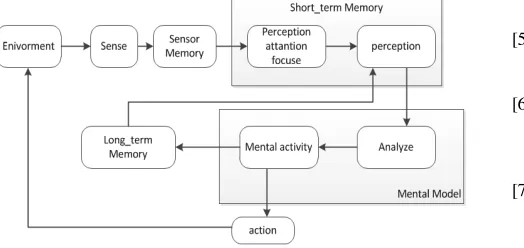
1. At first, input is received by five senses. Then, it comes into sensory memory and after low- level processing, perception takes place.
carried out such as learning, reasoning, thinking, decision making, planning, conceptualization, problem solving. The output of these processes is stored in form of experience and mental information in long-term memory.
3. The output resulted from mental activities causes occurrence of an action. Feedback of this action passes all the above processes and is stored in long-term memory.
As shown in Figure 7, senses input is received signal from the environment and consequently comes into their sensory memory.
Input data is processed in this memory being in the form of attention, concentration and perception. After the agent leave input data, it will be analyzed. At this stage, analysis identifies an activity done. This activity can be one or more mental and cognitive activity. As a result, it does given mental activity and creates a behavior. The resulted output is stored in terms of knowledge, skills and experience in long-term memory.
Fig. 7 process of mental activities based on proposed ontology.
5. Conclusion
Different definitions of intelligence as well as related parts for doing mental activities such as interactive signals, memory and mental activities were described. In part of interactive signals, method of perception process was stated and following that, a model was suggested. In part of memory, different kinds of memory and role of their hierarchy in mind were considered. Moreover, important mental activities of intelligence were expressed such as decision-making, reasoning, thinking, planning, conceptualization, imagination, compatibility, judgment and learning (activities which have been noted in most of definitions). Accordingly, a new ontology was proposed. In proposed ontology, relation of parts (interactive signals,
memory and mental activity), important elements in each part and kind of their relation with each other are mentioned. According to studies, method of doing mental activities was hierarchically described from the first step (perception) to create a behavior. Based on this definition, a model of mental activities was presented. The hierarchical structure of mental activities leads to display the order of doing tasks and location of each component.
References
[1] G. Ben, The Structure of Intelligence A New Mathematical Model of Mind, Springer, 1993. [2] L. David, ”Introduction to the Special Section on
Cognitive Abilities: 100 Years After Spearman’s (1904) “‘General Intelligence,’ Objectively Determined and Measured”, Journal of Personality and Psychology, Vol. 86, No. 1, 2004, pp. 96-111. [3] U. Neisser, G. Boodoo, J.B. Thomas, A.W. Boykin,
D.F. Halpern, J.C. Loehlin, R. Perloff, R. Sternberg and S. Urbina, ”intelligence: Known and Unknown”, American Psychologist, Vol. 51, No. 2, 1996, pp. 77-101.
[4] P. Lanz,”The concept of intelligence in Psychology and Philosophy”, Adaptive Behavior and Intelligent Systems without Symbols and Logic, Vol. 1, 2000, pp. 19-30.
[5] S. Legg and M. Hutter, ’’A Collection of Definitions of Intelligence”, Frontiers in Artificial Intelligence and applications, Vol. 157, 2007, pp. 17-24.
[6] L. S. Gottfredson, “Mainstream science on intelligence: An editorial with 52 signatories, history, and bibliography”, Intelligence, Vol. 24, No. 1, 1997, pp.13–23.
[7] H. Cruse, his book Metaphors of Mind Conceptions of the Nature of Intelligence. In this book Stemberg tries to explain the variety of theories about the nature of intelligence by invoking the hypothesis that metaphors, of which there are many, serve as the foundations for theories of intelligence. The upshot is rather discouraging: There are theories, but they lack empirical support, Prerational Intelligence: Adaptive Behavior and Intelligent Systems Without Symbols and Logic, Volume 1, Volume 2 Prerational Intelligence: Interdisciplinary Perspectives on the Behavior of Natural and Artificial Systems, Springer Science & Business Media, 2013.
[8] M. Minsky, "The society of mind", In The Personalist Forum, 1987, pp. 19-32.
[9] R. J. Sternberg, Handbook of Intelligence. Cambridge University Press, 2000.
[10] A. Anastasi. “What counselors should know about the use and interpretation of psychological tests”, Journal of Counseling and Development, Vol. 70, No. 5, 1992, pp.610–615.
Educational Research, Vol. 7, No. 1, 2015, pp. 198-218.
[12] Zh. Zhao and F. Rauner, areas of vocational Eduction research, springer, 2014.
[13] R. Sternberg, “Intelligence”, Dialogues in Clinical Neuroscience, Vol. 14, No. 1, 2012, pp. 19-27. [14] J. Friedenberg and G. Silverman, Cognitive
Science-An Introduction study of mind, SAGE, 2006. [15] https://en.wikipedia.org/wiki/Reason#
Reason_compared_to_related_concepts,Accessed Nov, 2015.
[16] T. Banirostam, K. Mirzai and M. Fesharaki, ”a conceptual model for ontology based learning”, International Journal of Research in Computer Science, Vol. 2, No. 6, 2012, pp. 1-6.
[17] https://en.wikipedia.org/wiki/Decision-making, 2015/11
[18] https://en.wikipedia.org/wiki/Thought, Accessed Nov, 2015.
[19] J. Zhou, L. Jin and SH. Han, ”undefined hierarchical iterate model of human conceptualization and cognition”, 8th IEEE conference on cognitive Informatics, 2009, Vol. 9, pp. 44-51.
[20] http://www.merriamwebster.com/dictionary/imagination, Accessed Nov, 2015.
[21] http://dictionary.reference.com/browse/imagination, Accessed Nov, 2015.
[22] https://en.wikipedia.org/wiki/Imagination, Accessed Nov, 2015.
[23] http://dictionary.cambridge.org/dictionary/english/ judgment, Accessed Nov, 2015.
[24] https://en.wikipedia.org/wiki/Judgement, Accessed Nov, 2015.