A Novel Method for Rotational and Pose Invariant Child
orAdult Age Classification based on Morphological
Pattern Representation Schemes
1Dr. Pullela S V V S R Kumar,
2Ms. A V Lakshmi Dhanisetty,
3Dr, U Ravi Babu
1 Professor of CSE, Sri Aditya Engineering College, Surampalem, [email protected] *2
Computer Science & Engineering, Sri Aditya Engineering College, Email ID : [email protected]
3, Professor, Dept. of CSE,MREC(A), India, [email protected]
Abstract-- The present paper proposes an approach for classify the facial images either child or adult based on local texture features extracted on facial images. The local texture features used in this paper are Morphological-prehistoric Patterns with grain components (MP-g). these patterns are extracted on a Local Directional Pattern (LDP) values. Edge response values in all eight directions from a 3×3 local window are used to calculate the LDP values. The local descriptor LDP is more constant in the incidence of noise and lighting changes, since edge response level is more stable than pixel intensity. The proposed method is rotationally& poses invariant when compared to pattern trends that represents a shape. The proposed method is tested on large set of images from different databases like FgNet, Morph, Google and scanned images. The present paper proves the efficiency of the proposed method.
Indexed Term— Morphological Prehistoric Patterns, Local Directional Pattern, invariant, pose invariant.
1. INTRODUCTION
Computer vision and psychophysics researchers faced so many challenges by face recognition of human and representation the typical features of human faces. Human faces be in the right place to a 3-D objects. Therefore, to develop an accurate representation for description that consider for lighting; face variations, facial expressions, etc.; of facial images. In face recognition system, large database maintained and search an image in that database. Day to day increase the size of the database and also increase the computational cost for the classification of human face into two categories i.e. either child or adult.
To address this problem some procedures that highlights the important of facial development over a period of instance and considered a representation to minimize the dissimilarity between testdatabasesand images which are used at the time of method development. In appearance-based method, a face image is usually considered as a point in the high-dimensional space. Many linear subspace learning methods, such as LDA/FKT (linear discriminant analysis/Fukunaga–Koontz transform) [6], Eigenface [1, 2], C-LDA (complete LDA) [4], Fisherface [3], MMSD (multiple maximum scatter difference) [5], and Laplacian face [7] are typical dimensionality reduction methods to find a low-dimensional feature space. First,Local Binary Pattern LBP operator was introduced by Ojala et al. [8] for texture categorization and texture analysis.
The LBP given good results especially in texture analysis so that LBP mostly suitable in texture examination and its applications. The LBP operator has hugeacceptance against lighting changes. The main advantage of LBP is, It was obtained with sample calculations. From the above properties, it is well suitable for real-world applications like image texture analysis. The concept of LBP was also extended in applications such as face recognition and age classification [9, 10,11].
In above proposed methodsareapplied on small set images and get comparative results but those methods are not suitable for all kinds of databases. The proposed method is applied on large set of images and different kinds of databases. No such method is available to classify the facial images into two categories i.e. either child or adult in effective and efficient manner of different database like FgNet, Morph Google and scanned image databases.
The paper is organized as follows: Section 2 explains the proposed method and result analysis, experimental details and discussions are explained in Section 3. Conclusion part are given in the section 4.
2.THE PROPOSED MORPHOLOGY PREHISTORIC PATTERNS WITH GRAIN COMPONENTS ON LDP FOR CHILD AND ADULT
AGE CLASSIFICATION
Fig. 1. Block diagram of the child and adult classification system
Step 1: Cropping: In this proposed method cropping is necessary because of identifying the facial skin edges. The proposed method based on the skin area of the human face. The given database, each facial image consist not only skin area but also hair, neck, and other areas also included. So to remove the unwanted area from the facial image cropping is necessary for effective results. The input facial image is cropped to cover the entire skin area of the face based on the location of two eyes in the first step as shown in figure 2.
(a) (b)
Fig. 2.Crop operation a) Input image b) Output image after cropping
Step 2: RGB to Gray scale conversion:
So many color models are available in color image processing. The facial image is converted to gray scale image for identifying the morphological patterns on the facial color image. The present paper uses HSV color model for converting the facial color image into gray scale, because the present study is aimed to classify the human age into four groups with a gap of 15 years based on changes on facial skin are identified on gray scale image.HSV color space separates the color into three categories i.e. hue, saturation, and value. Separation means variations of color are observed individually. The convertingequations for RGB to grey level conversion are given below.
( ) (1)
S = ( ) (2)
(3)
(4)
(5)
In this work, the color component Hue (H) is considered as grey information for the classification of facial images. And this value is lies between 0 and255.
Step 3: Local Directional Pattern
Local Directional Pattern (LDP) [12] concept is used in this present study because it has more advantages compare toLBP approach. The LDP approach is more suitable for age group classification because this approach considers the edge response values in all different directions instead of surrounding neighboring pixel intensities like LBP. This provides more consistency in the presence of noise, and illumination changes since edge response magnitude is more stable than pixel intensity. The LDP is based on LBP. In the LBP operator, a gray-scale invariant texture prehistoric, has gained significant popularity for describing the texture [13]. It labels each pixel of an image by thresholding its P-neighboring values with the center value by converting the result into a binary number by using Equation 6.
,
2
)
(
)
,
(
1 0 , p p p c c RP
x
y
s
ESP
CP
LBP
0
0
0
1
)
(
x
x
x
s
(6)Where CP denotes the gray value of the center pixel (xc, yc) and ESP corresponds to the gray values of P equally spaced pixels on the circumference of a circle with radius R.
Local Directional Pattern with Robin Compass Masks Response
The LDP generates eight-bit binary code assigned to each 3×3 sub window of an input image. These patterns are calculated by comparing the relative edge response value of a pixel in different directions by using Robin compass masks. The Robin compass masks in eight distinct orientations (r0~r7) centered on its own position. The Robin compass masks are shown in the Fig.3.
Original Facial image Convert RGB to Gray Cropping Cropped Image LDP with RobinCompass MAsk Binary facial Image
Identify MP-1g to
Fig. 3.Robin Compass masks in eight directions.
Applying Robin masks on 3×3 masks, eight mask values V0, V1, …,V7 are obtained, each representing the edge significance in its respective direction. The mask values are not equally important in all directions. In robin mask values corner or edge pixels show higher values because those pixels are more important in particular direction.
The LDP code produces the more firm pattern in the presence of noise, illumination changes and various
conversion schemes of color facial images into gray images. For example, Fig. 4 shows an original image and the corresponding image with illumination changes. After illumination change, 5th bit of LBP changed from 1 to 0, Thus LBP pattern changed from uniform to a non-uniform code. Since gradients are more stable than gray value, LDP pattern provides the same-pattern value even in the presence of noise and non-monotonic illumination changes.
26 38 85 26 38 85
10 50 53
LBP=00111000 10 50 49 LBP=00101000
48 32 60
LDP=00010011 48 32 6 LDP=00010011
(a) (b)
Fig.4.Calculating the LDP and LBP values in two different situations (a) Original Image (b) Image with Noise Step 4: Evaluation of Morphological-prehistoric Patterns
with Grain Components (MP-g) on LDP
On the binary LDP facial texture images of the previous step, the present study evaluated the incidence of MP-g on a 3×3 mask. The present study classify the facial images into either Child or adult based on the number of grains incidence on a 3×3 sub-window LDP facial image in any orientation. Thismakes the present method as rotationally and poses invariant. The present method countsfrequency incidence of MP-g if and only if the central pixel of the 3×3 window is 1 and it is treated as a grain. If the central pixel is zero (0) then 3×3 window is treated as not-a-grain,In the following figures „0‟ indicates no grain and „1‟ indicates a grain. There can be eight combinations of MP-1g, which are shown in the Fig. 5. By any rotation, the MP-1g may change its position in 8 ways
on a 3×3 mask as shown in Fig.5. The present method counts the frequency incidence of MP-1g on a 3×3 mask irrespective of its position. Therefore, the present method is rotationally invariant. There will be seven different formations of MP‟s with 2pixel-grain components (MP-2g) by fixing one of the grains at pixel location (0,0) on a 33 mask as shown in Fig. 6. In a similar way, there will be six formations of MP-2g by locating one of the grains at the pixel location (0,1) as shown in Fig. 7. Thus, there will be 7! ways of forming MP-2g for a 3x3 window. In the same way, there will be 6!, 5!, 4!, 3!, 2! and 1! ways of forming MP-g of 3, 4, 5, 6, 7 and 8 respectively, on a 3x3 mask irrespective of their rotational positions.
0
0
0
0
0
0
0
0
0
0
0
0
0
1
1
0
1
0
0
1
0
0
1
0
0
0
0
0
0
1
0
1
0
1
0
0
(a)
(b)
( c)
(d)
0
0
0
1
0
0
0
1
0
0
0
1
1
1
0
0
1
0
0
1
0
0
1
0
0
0
0
0
0
0
0
0
0
0
0
0
(e) (f) (g) (h)
1
0
0
1
0
0
1
0
0
1
0
0
0
1
1
0
1
0
0
1
0
0
1
0
0
0
0
0
0
1
0
1
0
1
0
0
(a) (b) ( c) (d)
1
0
0
1
1
0
1
0
1
1
1
0
0
1
0
0
1
0
0
0
0
0
0
0
0
0
0
(e) (f) (g)
Fig. 6. Representation of MP-2g by fixing grain at (0,1)
0
1
0
0
1
0
0
1
0
0
1
1
0
1
0
0
1
0
0
0
0
0
0
1
0
1
0
(a)
(b)
( c)
0
1
0
0
1
0
0
1
1
0
1
0
1
1
0
0
1
0
1
0
0
0
0
0
0
0
0
(d) (e) (f)
Fig. 7. Representation of MP-2g by fixing one of the grain component at (0,1).
The frequency incidence of MP-1g to MP-8g are computed by the proposed Algorithm 1 on a 33 non-overlapped mask of LDP facial texture images, and stored in the facial database.
The pseudo code entire method is illustrated below Step 1: Read input image
Step 2: Crop the facial image
Step 3: if the input image is RGB then covert the image into gray level image as described by the step2 in section2 with the size of N×N
Step 4: Define the RobinMasks(r0, r1, r2, r3, r4, r5, r6, r7 ) based on masks given in the figure 3.
Step 5: Convert the Gray image into Binary by using LDP Robin Masks
(a) Apply 2-D convolution of image G(i,j) and mask MN(i,j) with size 3×3 F(i,j)= G(i,j)*Mn(i,j)
(b) Calculate the threshold, th= F(i+1,j+1)
(c) Initialize the variables p=0 and q=0
(d) ifF(p,q)>=thenBW(p,q)= 1 otherwise BW(p,q)= 0
(e) Initialize the variables l=0 and m=0
(f) for a = l to l+2 and b = m to m+2 do the following procedure
(i) if BW(l+1,m+1)==1 then Count the frequencies of incidence of Grain Features from 1,2,…,8 otherwise update m = m+3
(ii) ifm< N then go to step (f) otherwise update l = l+3 and m = 0
(iii) if l< N then go to step (f) otherwise Store the Grain features in the face recognition database and stop the procedure
3.RESULTS AND DISCUSSION
To find the consequence of the present method, the present study has evaluated MP-1g to MP-8g on facial LDP images of child and adults from different poses of 1002 FgNet ageing databaseimages, 12000Morph data base images, 1500 scanned images and 750 Google imagestotally, its leads of 15252 images. Some of the child and adult images in different databases are shown in figure8 and Figure9. The present study considered that the childhood agesbetween 0 and 15 years and adulthood is over30 years.
Even by rotation with different angles, the Algorithm 1 based on MP-1g and MP-4g classifies the child and adult. This proves that the present method is rotationally invariant. Thus,
based and also previous methods that are rotational and pose variant.
Fig. 8. Sample facial images of adults with different poses of FgNet aging database.
Table I
Frequency incidence of child facial images using MP-g.
Table II
Frequency incidence of adult facial images using MP-g.
Adult images MP-1 MP-2 MP-3 MP-4 MP-5 MP-6 MP-7 MP-8 027A41 13658 1075 865 1364 1123 1450 1211 384 062A41 15638 1349 913 1268 1235 3623 1466 295 071A42 17698 1745 1035 1495 1465 2359 1355 406 033A44 18486 2146 1583 2037 2140 2855 923 406 047A45 22360 1140 924 1273 1088 1400 514 281 028A46 20731 861 760 1182 1368 2120 1011 647 045A48 18649 1948 964 2018 2013 1365 1217 594 003A49 20134 1956 813 2134 2348 1433 1175 712 048A50 23498 896 854 1204 1065 1637 885 337 039A52 16538 2313 2169 2406 2635 3013 1143 359 004A53 18649 2013 979 1769 1645 1956 1259 535 005A61 16498 2146 1237 1649 2156 1765 1567 478 006A61 15253 1594 1477 2057 2424 3758 1534 783 Sci-img-101 22308 1374 981 1437 1105 1233 251 191 Sci-img-102 20125 2237 1165 1548 1652 2016 1468 776 Sci-img-103 21237 2379 1179 1788 1847 2347 1346 649 Sci-img-104 19858 1290 1067 1621 1569 2188 852 435 Sci-img-105 14628 1643 1629 1936 2414 4082 2934 1310 mor-img-501 19556 1065 910 1278 1395 2373 1587 716 mor-img-502 14390 2159 1912 2513 3067 4187 1770 578 mor-img-503 19679 2140 1204 1499 1769 2246 1646 662 mor-img-504 20860 1351 952 1771 1637 2585 998 522 mor-img-505 23198 1298 1076 1254 1286 1654 586 224
Algorithm 1: Rotational and pose invariant child and adult age classification using MP-g on LDP. if (MP-1g<=13700)
print (facial image is of Child)
elseif (((MP-1g >14000) && (MP-1g <22300)) && ( MP-4g<=1200)) print (facial image is of Child)
elseif (((MP-1g >14000) && (MP-1g <23500)) && ((MP-4g >1300) && (MP-4g < 2350))) print (facial image is of the Adult)
else
print (facial image is not of the child and the adult) end
The Algorithm 1 classifies child from adult, based only on the frequency incidence of MP-1g and MP-4g values. If a MP-1g value is less than 13700 then the facial image is treated as child, else they form group 2 entries. By considering both MP-1g and MP-4g values if a MP-1g count is inbetween
Child images MP-1 MP-2 MP-3 MP-4 MP-5 MP-6 MP-7 MP-8 002A03 10346 613 634 1064 1348 2216 2349 16494 008A13 9768 718 728 978 1346 2575 2659 13462 009A03 10769 834 531 867 927 1567 1946 12346 011A11 15722 794 562 637 774 799 520 18924 012A12 16014 1268 888 938 889 914 574 20005 015A01 7568 513 1365 846 1035 936 694 19864 016A08 8316 648 1230 813 778 1365 1346 23156 019A07 9769 716 1065 679 684 1364 1864 23458 022A11 10325 839 943 681 1235 2346 1964 22467 023A09 12356 746 1032 1035 1365 2867 2034 19467 073A09 6106 1029 1094 1138 2230 2255 3884 22269 069A03 14389 911 785 932 1199 1224 2624 31622 066A06a 6139 685 734 1010 1349 1374 2439 17932 065A09 7024 539 517 617 756 781 1371 30261 053A06 11737 480 471 743 982 1007 2062 24097 Sci-img-01 13645 943 978 1094 1649 3121 2264 18631 Sci-img-02 16819 852 662 842 994 1019 527 20343 Sci-img-03 13971 1431 1085 1169 1196 1221 717 19158 Sci-img-04 11261 984 788 999 1179 1204 1038 17023 Sci-img-05 11455 585 876 1113 1869 2348 2019 17345 mor-img-01 8301 1149 1227 1004 2370 2395 2722 21617 mor-img-02 14290 950 751 992 1268 1293 1123 20056 mor-img-03 9658 579 528 663 673 698 364 12336 mor-img-04 8923 732 567 703 765 790 295 11841 mor-img-05 13257 1595 1287 1145 2333 2358 2002 25244
Table IV
Frequency incidenceof aMP-g with 300 rotation on LDP for adult facial images.
Table V
Frequency incidence of a MP-g with 450 rotation on LDP for child facial images.
Child images MP-1 MP-2 MP-3 MP-4 MP-5 MP-6 MP-7 MP-8 002A03 12649 815 1344 611 1214 1458 1127 18188 008A13 7510 1243 1294 1035 2210 2766 2771 22845 009A03 13432 946 826 1065 1115 1169 1174 21530 011A11 9468 798 1037 864 1679 1864 1095 18465 012A12 12466 1638 1397 1183 2153 2008 2013 27594 015A01 15160 1270 873 914 864 731 736 21532 016A08 9846 575 613 865 894 1649 1465 24683 019A07 11235 1035 1175 599 2133 2213 845 20316 022A11 8697 661 535 579 601 274 279 13086 023A09 10356 897 1239 798 2041 1946 799 17645 073A09 5228 1067 1183 1194 2169 3836 3841 24038 069A03 8764 596 915 1403 1035 1764 1564 23446 066A06a 13568 929 837 981 1176 2537 2542 34117 065A09 14665 1123 1094 764 1449 2103 911 19465 053A06 12356 946 1211 849 1365 2317 1094 23157 Sci-img-01 13091 1475 1121 1181 1126 881 886 20495 Sci-img-02 8091 714 630 735 642 403 408 12142 Sci-img-03 7264 613 846 943 1863 2031 1346 26491 Sci-img-04 6497 678 769 1097 1486 1946 1294 19485 Sci-img-05 14763 784 609 665 742 451 456 20094 mor-img-01 15992 865 691 813 933 673 678 21366 mor-img-02 10398 1030 829 1013 1062 1039 1044 17735 mor-img-03 5298 660 740 1035 1347 2394 2399 18580 mor-img-04 6109 592 554 618 736 1344 1349 32259 mor-img-05 10904 485 526 757 901 2153 2158 25795
Table VI
Frequency incidence of a MP-g with 450 rotation on LDP for adult facial images.
Child images MP-1 MP-2 MP-3 MP-4 MP-5 MP-6 MP-7 MP-8 002A03 16908 857 758 940 889 1108 574 22910 008A13 14038 1642 1104 1144 1129 1426 595 22186 009A03 11282 1149 856 956 1061 1651 1056 19238 011A11 9605 665 550 613 582 962 327 14585 012A12 9022 757 651 693 644 788 369 13645 015A01 13230 1650 1475 700 2120 3777 2491 29253 016A08 14458 1012 832 948 1177 2483 2532 35607 019A07 6239 744 744 1014 1435 2865 2362 19941 022A11 15688 1292 894 873 900 1173 652 23040 023A09 16120 1098 1201 1175 2164 4652 3839 25542 073A09 6154 1259 1315 1058 2254 4164 2819 24337 069A03 8419 1259 1315 1058 2254 4164 2819 24337 066A06a 14332 1020 787 1017 1146 2058 1140 23021 065A09 7009 639 570 613 723 1543 1367 33761 053A06 11791 554 529 721 917 2219 2208 27286 Sci-img-01 10395 1037 594 894 1013 966 1345 23456 Sci-img-02 14656 1123 913 931 1216 2034 1649 22151 Sci-img-03 12349 978 795 1027 1324 2246 1864 19457 Sci-img-04 11256 981 981 1346 1525 3156 1447 16485 Sci-img-05 10356 1035 596 1294 1646 4023 1552 14863 mor-img-01 9468 1210 637 1246 2112 3947 1336 13498 mor-img-02 8864 971 779 1495 2001 3129 1649 32467 mor-img-03 9862 968 891 1221 1940 798 975 23622 mor-img-04 10354 811 730 1323 899 1039 869 19468 mor-img-05 11349 722 616 1424 905 1164 713 17644
Table VIII
Frequency incidence of a MP-g with 1350 rotation on LDP for adult facial images.
Adult images MP-1 MP-2 MP-3 MP-4 MP-5 MP-6 MP-7 MP-8 003A49 13954 1178 849 846 916 2167 775 22156 005A61 10580 1353 1035 1273 1124 1672 599 18462 006A61 9467 1532 741 943 761 2011 1038 23141 027A41 8879 711 951 694 696 1036 1465 19468 028A46 14446 942 812 1933 982 1752 626 22165 033A44 9846 917 756 862 851 853 1094 20946 039A52 15052 2492 2354 2335 2356 2800 1036 30865 045A48 1465 1265 1094 946 813 2034 669 20134 047A45 16654 886 692 1839 759 1082 504 22529 048A50 10902 635 551 1649 763 1474 1013 17023 071A42 12649 937 963 864 945 1943 913 27895 062A41 11128 1824 1655 1946 2186 3201 1711 26079 004A53 10317 943 753 953 762 1864 1311 23498 Sci-img-101 10686 1405 1425 1771 2017 3750 2917 27607 Sci-img-102 17147 552 488 1639 633 1070 745 22240 Sci-img-103 13495 1399 794 1067 1034 1846 844 23145 Sci-img-104 18619 1361 1052 1282 990 1005 240 26201 Sci-img-105 10346 1434 852 824 848 1765 966 26499 mor-img-501 17969 1154 873 1227 935 1182 399 25279 mor-img-502 8649 1034 355 761 515 1946 1132 21346 mor-img-503 13542 1273 1012 1317 1223 1595 600 22196 mor-img-504 13500 808 711 1991 1031 2035 948 22209 mor-img-505 8233 1795 1686 2114 2305 3420 1414 22547
3.1 Comparison of Results with othersProposedmethods results:
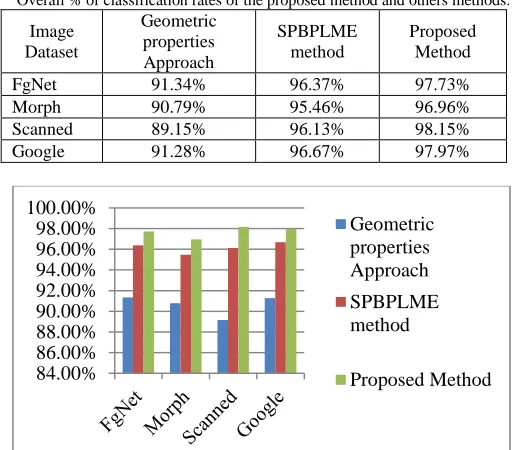
The efficiency of the present method is compared with others proposed methods like“geometric properties” approach [14] and SPBPLME[15] methods. Geometric properties approach
about 96.13. The proportion of classification in each group of the proposed method and others methods are listed out in Table 9. The graphical representation of the classification results is shown in figure9. The Table 9 clearly indicates that the proposed method yields better performance rate when compared with the existing methods.
Table IX
Overall % of classification rates of the proposed method and others methods.
Image Dataset
Geometric properties Approach
SPBPLME method
Proposed Method FgNet 91.34% 96.37% 97.73% Morph 90.79% 95.46% 96.96% Scanned 89.15% 96.13% 98.15% Google 91.28% 96.67% 97.97%
Fig. 9. Comparison graph of proposed method with others methods
4. CONCLUSIONS
The present paperproposed a novel method for age classification of child and adults based on the MP-gSon LDPfacial skin. The novelty of the present method is, it is rotationally, pose, noise, illumination invariant due to basic principles of LDP and the proposed MP-g. The present approach outlines that one need not necessarily evaluate the frequency of incidence of 2g, 3g and 5g to MP-8g for the age classification. The MP-1g and MP-4g contains more textural and topological information of the facial skin, that is the reason these two texture features are classifying the child and adult.
REFERENCE
[ 1 ] Turk M. and Pentland A. “Eigenfaces for recognition,” Int. J. Cognitive Neurosci. 3(1) (1991) 71–86.
[ 2 ] Turk M. and PentlandA.“Pattern Recognition Learning and Thought,” pp.486, Pretice Hall, New Jersey, 1973.
[ 3 ] Belhumer P. N., Hespanha J.P. and Kriegman D.J. ” “Eigenfaces vs. Fisherfaces: recognition using class specific linear projection,” IEEE Trans. Pattern Anal. Mach. Intell. 19 (7) (1997) 711–720. [ 4 ] Yang J. and Yang J.Y. “Why can LDA be performed in PCA
transformed space,” Pattern Recognition 36 (2) (2003) 563–566. [ 5 ] Song F., Zhang D., Mei D. and Guo Z., “A multiple maximum
scatter difference discriminant criterion for facial feature extraction,” IEEE Trans. Syst. Man Cybern. Part B Cybern. 37 (6) (2007) 1599–1606.
[ 6 ] Zhang S. and Sim T., “Discriminant subspace analysis: a Fukunaga–Koontz approach,” IEEE Trans. Pattern Anal. Mach. Intell. 29 (10) (2007) 1732–1745
[ 7 ] He X., Yan S., Hu Y., Niyogi P. and Zhang H, “Face recognition using Laplacianfaces,” IEEE Trans. Pattern Anal. Mach. Intell. 27 (3) (2005) 328–340.
[ 8 ] T Ojala, M PietikaÈinen, and D Harwood published a paper entitled “A Comparative Study of Texture Measures with Classification Based on Feature Distributions” in the Journal of Pattern Recognition, Year: 1996 volume: no : 29 Pages 51 to 59.
[ 9 ] M Chandra Mohan, V Vijaya Kumar and B Sujatha published a paper entitled "Classification of child and adult based on geometric features of face using linear wavelets," in the Journal of Signal and Image Processing, volume no: 1 and issue no:3, yeAr : 2010 Pages:211 to 220.
[ 10 ] "Texton Based Shape Features on Local Binary Pattern for Age Classification", Chandra Sekhar Reddy et al.; ,IJIGSP 2012, 7, 54-60
[ 11 ] Novel method of adult age classification using linear wavelet transforms", Chandra Mohan, VijayaKumar V., Venkata Krishna V., IJCSNS, pp:1-8, 2010.
[ 12 ] Abdel-Mottaleb M. and Elgammal A., “Face Detection in Complex Environments from Color Images,” IEEE International Conference Image Processing, pp. 622-626, 1999.
[ 13 ] Pantic M. and RothkrantzL.J.M.“Automatic analysis of facial expressions: the state of the art,” IEEE Trans. Pattern Analysis and Machine Intelligence, 22(12) (2000) 1424-1445
[ 14 ] "Classification of child and adult based on geometric features of face using linear wavelets", Chandra Mohan M., Vijaya Kumar V., Sujatha B., IJSIP, vol.1, Iss.3, pp:211-220, 2010.
[ 15 ] “Novel Approach for Child and Adulthood Classification based on Significant Prominent Binary Patterns of Local Maximum Edge (SPBPLME)”Rajendra Babu .Ch, DrSreenivasa Reddy. E and DrPrabhakara Rao. B, I.J. Information Technology and Computer Science, 2015, 06, 30-37
84.00% 86.00% 88.00% 90.00% 92.00% 94.00% 96.00% 98.00% 100.00%
Geometric properties Approach SPBPLME method