© 2019, IRJET | Impact Factor value: 7.34 | ISO 9001:2008 Certified Journal
| Page 2062
SMART POLY-HOUSE IRRIGATION SYSTEM
Yashraj Oswal
1, Aarati Khamakar
2, Madhura Jadhav
3, Vaishnavi Nigade
4,
Prof. Kamlesh Jetha
51,2,3,4
BE Student, Department Information Technology, Anantrao Pawar College of Engineering and Research,
Pune, Maharashtra, India
5
Assistant Professor, Department Information Technology, Anantrao Pawar College of Engineering and Research,
Pune, Maharashtra, India
---***---ABSTRACT
-
Irrigation is an important task when comes tofarming. India is also known for its farming outputs, so based on several methods used while irrigating a farm field involves manpower, water resource and most importantly availability of water. So to save these efforts also the water, we are proposing a system where the manual work will be exchanged with automated system which is capable enough to irrigate field automatically without human interventions. Automated system here is designed for poly-house which consist of Soil-moisture sensor which will sense the soil-Soil-moisture content of the soil and based on that the system will operate the pumps and irrigation process is carried out. Another parameter is temperature within poly-house so using temperature sensor we will sense the temperature in poly-house and the temperature cooling mechanism will get operated. Android will act as a user inter-face where the user can manipulate system using the device also gets the information related to its farm field.
Key Words:
IoT (Internet of Things), Android, WSU (wireless sensor unit), WIU (wireless information unit), Temperature sensor, Soil-Moisture sensor, Water-flow sensor.1. INTRODUCTION
Agriculture is one of the important business sector which is been practiced in India. Talking about the pros, More than 50% of Indians having their income source as farming, also agriculture and allied sectors contributes 24% of the total GDP and some two-thirds of Indian population depends on rural agro-related employment [11].So with the increasing need of modernization the method used for irrigation must also be modernized. Talking about cons involves availability of water. Water is one of the important factor which is required in agriculture sector, as its requirement in agriculture starts from initial stage like at the time of cultivating crops until the crops are ready for harvesting. So while manually irrigating the fields, sometimes water is irrigated more than required amount or less water can also be irrigated, which is a concern while irrigation which leads to poor quality and quantity of farm output. Smart poly-house irrigation system can be the solution, which involves automated irrigation, Temperature monitoring within poly-house, which will generate the report about the water irrigated also temperature within poly-house is automatically adjusted based on the threshold values
provided to it. This will reduce the human efforts. And water can be carefully utilized and also saved for our future needs. Why poly-house? So answer for it is Poly-house is being constructed by keeping the parameter which involves climatic condition like rainfall, heat, cold does not hamper the process of cultivation. It is been protected from harmful insects, and other factors likeVirtual values of temperature is been assumed within the poly-house and the crops can be grown in any climatic condition as poly-house as setup their own virtual climatic condition inside it.
1.1 LITERATURE SURVEY
© 2019, IRJET | Impact Factor value: 7.34 | ISO 9001:2008 Certified Journal
| Page 2063
control the water require-ment in the farm, the system willreduce the human intervention [8]. I It gives the idea to monitor the soil moisture content and temperature in a farming area and the user can control watering system using Android device provided with Wi-Fi facility [9]. Agriculture is base for all the industries for raw material and cultivation requires different water levels at different periods, so for minimizing and maintaining water level [10].
2. PROPOSED OUTCOME
The poly-house will get irrigated automatically with minimal human interventions.
Proper poly-house related information will be generated so that it can be utilized for required purpose.
With the help of temperature sensor the temperature within poly-house can be monitored. Moisture sensor will help to sense the moisture
level of soil.
3. HARDWARE USED
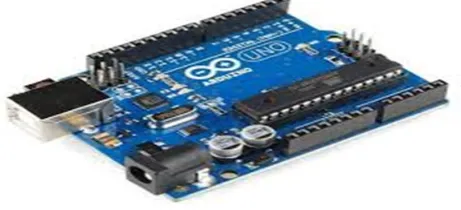
3.1. Arduino UNO Micro-controller
Arduino is the center hardware where the other component are connected. Arduino board designs use a variety of microprocessors and controllers. The boards are equipped with sets of digital and analog input/output (I/O) pins that may be interfaced to various expansion boards or breadboards and other circuits.
Fig 3.1 Arduino Board [12]
3.1.1 FEATURES OF Arduino UNO:
Microcontroller: ATmega328 Operating Voltage: 5V
Input Voltage (recommended): 7-12V Input Voltage (limits): 6-20V
Digital I/O Pins: 14 (of which 6 provide PWM output)
Analog Input Pins: 6
DC Current per I/O Pin: 40 mA DC Current for 3.3V Pin: 50 mA
Flash Memory: 32 KB of which 0.5 KB used by boot loader
SRAM: 2 KB (ATmega328) EEPROM: 1 KB (ATmega328) Clock Speed: 16 MHz [13]
3.2. Soil-Moisture Sensor
[image:2.595.339.532.366.524.2]Senses the moisture of soils and sends the details to Arduino kit, where the details are stored and manipulator based on Threshold values.
Fig.3.2 Soil-Moisture Sensor [12]
3.2.1 FEATURES OF SOIL-MOISTURE SENSOR:
This is an easy to use digital soil moisture sensor. Just insert the sensor in the soil and it can measure
moisture or water level content in it.
It gives a digital output of 5V when moisture level is high and 0V when the moisture level is low in the soil.
The sensor includes a potentiometer to set the desired moisture threshold. [13]
© 2019, IRJET | Impact Factor value: 7.34 | ISO 9001:2008 Certified Journal
| Page 2064
3.3. Temperature Sensor
[image:3.595.76.248.167.290.2]Senses the temperature around the field and stored in cloudDB.
Fig.3.3.Temperature sensor [12]
3.3.1 Features of temperature sensor:
Minimum and Maximum Input Voltage is 35V and
-2V respectively. Typically 5V.
Can measure temperature ranging from -55°C to
150°C
Drain current is less than 60uA
Low cost temperature sensor
Small and hence suitable for remote applications
[13]
3.4. Water-Flow sensor
[image:3.595.331.528.197.372.2]Water Flow sensor is basically used to take a note of how much water has been transferred from one area to the other.
Fig.3.4.Water Flow sensor [12]
3.4.1 FEATURES OF WATER-FLOW SENSOR:
Water Flow sensor is basically used to take a note of how much water has been transferred from one area to the other.
Water flow sensor consists of a plastic valve body, a water rotor and a hall-effect sensor.
When water flows through the rotor, the rotor start rolling after feeling the pressure [13]
4. SYSTEM DESIGN
4.1 Methodology
Fig 4.1.Methology
Figure 4.1 represent the working of system explained below:
a. Arduino: Arduino is the center hardware where the other component are connected.
b. Router: It is used to collect the data through Arduino kit and sends to the remote devices e.g: Smart phone, Tablet, PC etc.
c. Smart phone: It is used to access the details and get the feedback through system and also can give permission to the system to work.
d. Relay switch: Through Relay switch the Water pump is connected to Arduino kit and it switches the pump on and off while irrigating farm land. e. Temperature sensor: Senses Farm temperature
and regulate the temperature adjusting mechanism. f. Soil-Moisture sensor: Senses the Moisture content of soil bases on threshold values and regulates the water pumps for irrigation.
g. Water-Flow sensor: To keep on track on amount of water is transferred in the field.
4.2. Data Flow Diagram (DFD)
[image:3.595.94.221.581.676.2]© 2019, IRJET | Impact Factor value: 7.34 | ISO 9001:2008 Certified Journal
| Page 2065
application is the important entity to handle the system alsoget updates about the system process.
Fig 4.2. Data Flow Diagram
5. COMPARATIVE SYSTEM TECHNOLOGY:
5.1 Comparison between Arduino, raspberry pi,
ESP-8266:
The arduino board [14] is a freely available open source development microcontroller capable to cope up with a variety of communication protocols that is a must to be usable for any kind of IoT device. This board is cheap and feature rich with availability of a variety of daughter boards that have an amazing stacking feature to the main mother board. The availability of Wi-Fi and Ethernet shield along with the low power BLE-4 arduino shield makes it suitable for rapid prototyping and programming with ease.
Fig5.1Arduino UNO
easy to use and abundant example programs in the arduino IDE makes it simple for the user to get started pretty quickly in the process of making IoT device work seamlessly in all kind of environments.
5.2 Raspberry pi:
[image:4.595.323.543.277.398.2]The Raspberry pi Development Board [15] is small sized Broadcom BCM 2835 SoC based ARM11 power minicomputer. The raspberry pi can be easily plugged into monitor because of its inbuilt GPU and audio-visual capabilities. Also it uses standard mouse and keyboard. This is easily programmable by powerful languages like C, python etc, giving it a capability to store and analyze the data. The inbuilt Wi-Fi, BLE, storage capability of this board and the available RAM being very huge in comparison to other boards enables it to act as an IoT server in most of the IoT network configurations.
Fig 5.2 Raspberry pi
5.3 ESP-8266:
The ESP-8266 module [16] little beast is an extremely capable wireless programmable microcontroller board. The ESP8266 Wi-Fi board is a SOC with integrated TCP/IP protocol stack that can give any secondary microcontroller access to your Wi-Fi network. The ESP8266 board is capable of either hosting an application or offloading all Wi-Fi networking functions from another application processor and therefore this is more suitable to be used as a sensing node that is capable to sense the data from various wirelessly connected IoT sensor nodes and send data to the central server like
[image:4.595.48.279.559.664.2]© 2019, IRJET | Impact Factor value: 7.34 | ISO 9001:2008 Certified Journal
| Page 2066
5.4 Conclusion:
There have several initiatives to realize IoT applications using Arduino. The comparative study shows how these platforms are promoting the growth of IoT by utilizing the specific board as per the intended application. The detailed analysis show that higher end development boards such as Raspberry Pi-3 have higher performance in comparison with other boards like arduino and ESP8266 in terms of its storage and computing speeds but at the cost of higher price. Raspberry Pi equipped with inbuilt Wi-Fi and Bluetooth serves as an easy means to connect to internet and push the data to the cloud servers if required for further processing. Whereas it is clearly visibe from the comparison that boards like Arduino being equipped with inbuilt analog to digital conversion has a better means of sensing the analog data readily when there is a need to sense some continuous analog signals coming out of analog sensors. Based on the specs and performance analysis Raspberry Pi definitely emerges as a winner when it comes to satisfying most of functional requirements of an IoT systems’ basic blocks. ESP-8266 on the other hand stands out strongly when it comes to device level sensor networking abilities due to its small form factor and wireless connectivity. ESP-8266 beinga low cost device is a first choice for implementing sensor networks in an IoT scenario.
6. CONCLUSIONS AND FUTURE SCOPE OF SYSTEM:
The system can provide the better and convenient way of farming so that farmers can work with proper knowledge and can cultivate crops also keeping the quality and quantity of crops, with that they can save adequate amount of water and can reduce the human efforts. The observations and results tell us that this solution can be implemented for reduction of water loss and reduce the man power required for a field.in future we can make use of cameras which can capture images of crops also we can move the cameras remotely through the app in front and backward direction just to see each and every crops condition. Use of solar panels for energy conservation.
REFERENCES
[1] Manjunath Deshpande1, Shraddha Patil2, Priyanka Kanaka3, Diksha V M4 “Automatic Plant Irrigation Based on Soil Moisture and Monitoring Over IOT” International Journal of Innovative Research in Computer and Communication Engineering An ISO 3297: 2007 Certified Organization Vol.5, Special Issue 4, June 2017
[2] Pavankumar Naik, Arun Kumbi, Vishwanath Hiregoudar, Chaitra N K , Pavitra H K , Sushma B S, Sushmita J H , Praveen Kuntanahal “Arduino Based Automatic Irrigation System Using IoT ”
International Journal of Scientific Research in Computer Science, Engineering and Information Technology © 2017 IJSRCSEIT | Volume 2 | Issue 3 | ISSN : 2456-3307
[3] Dr. N. K. Choudhari1, Mayuri Harde2 “Automated Plant Irrigation System Based on Soil Moisture and Monitoring
Over IOT” Volume 5 Issue VI, June 2017 ICValue:45.98 ISSN: 2321-9653
[4] Nikhil Agrawal Engineeing Manager, Siemens, Noida , Smita Singhal ASET, Amity University, Noida “Smart Drip Irrigation System using Raspberry pi and Arduino” International Conference on Computing, Communication and Automation (ICCCA2015)
[5] Abhinav Rajpal, Sumit Jain, Nistha Khare and Anil Kumar Shukla “Microcontroller based Automatic Irrigation System with Moisture Sensors” Volume 5 Issue VI, June 2015 [6] Lorvanleuang, S. and Zhao, Y.D. “Automatic Irrigation System Using Android” Open Access Library Journal 2015, Volume 5, e4503 ISSN Online: 9721 ISSN Print: 2333-9705
[7] Mayuri R. Harde, Dr. N. K. Choudhari “A Review Paper On Wireless Sensor Network And Gprs Module For Automated Irrigation”, International Research Journal of Engineering and Technology (IRJET), Volume: 04 Issue: 01 Jan -2017 [8] Souvanxay Lorvanleuang*, Yandong Zhao, ” Automatic Irrigation System Using Android 2018, Volume 5, e4503 [ 9] N Seenu, Manju Mohan, Jeevanath V S,“Android Based Intelligent Irrigation System”, International Journal of Pure and Applied Mathematics, Volume 119 No. 7 2018, 67-71 [10] Anand Dhore1, Arti Sanganwar2, Kapil Chalkhure3, Shivani Jijankar4, Prof. Vikramsingh R. Parihar5, ―Automatic Irrigation System Using Android Mobile , International Journal of Advanced Research in Computer and Communication Engineering ISO 3297:2007 Certified Vol. 6, Issue 9, September 2017
[11]Wikipedia search “Agriculture in India”.
[12] Google Search “Arduino Uno, Temperature sensor, Soil-moisture sensor, Water-flow sensor
[13]Google search “Features of Soil-moisture, Temperature, Water-flow sensor”
![Fig.3.2 Soil-Moisture Sensor [12]](https://thumb-us.123doks.com/thumbv2/123dok_us/9303283.430766/2.595.339.532.366.524/fig-soil-moisture-sensor.webp)
![Fig.3.3.Temperature sensor [12]](https://thumb-us.123doks.com/thumbv2/123dok_us/9303283.430766/3.595.76.248.167.290/fig-temperature-sensor.webp)