OPTIMIZATION
MODEL
FOR
DEGREE
CONSTRAINED
MINIMUM SPANNING TREE PROBLEM ON FIBER OPTIC
NETWORKS DESIGN
Firman MND Tarigan1, Herman Mawengkang2, Syahril Efendi3
1.INTRODUCTION
The development of the internet in Indonesia lately tends to increase sharply, this is influenced by the rapid development of computer network technology. The growing number of new networks created in line with the ever-evolving development of information over the internet has demanded a network system with greater bandwidth and better connectivity quality. New services will continue to grow so that a reliable network system is important and crucial.
Fiber optic technology (optical fiber) is one of the findings that can answer the problem. This media is able to provide large bandwidth, not influenced by the wave of electromagnetic interference and corrosion free. However, most internet service providers in Indonesia still use copper cable as the last link connection to homes. One reason is because the cost of fiber optic installation is still quite expensive and difficult to be developed.
As one of the example case that we can see is the internet installation cost to homes are still relatively high, in this case for example FTTH (Fiber To The Home) technology. One way to suppress the price of this FTTH technology is to design an optimal fiber optic network from the shortest path side, time travel, and cost.
In the design of fiber optic networks, a problem that is often considered is connecting n nodes with the minimum number of cables. The length of the MST connecting the nodes is the length of the required cable. However, sometimes the number of such nodes from cable to terminal "i" can not be greater than " " (where i = 1, ..., n). The solution of this problem may not be length of the MST. The solution of such problems is the length of the Degree Constrained Minimum Spanning Tree (DCMST).
However, from all the methods presented there are no agreements as the standards reference in solving MST problems, therefore this research will try to optimize the problems of DCMST on fiber optic network design.
The shortest path can be obtained by modeling using graph. One of it is in the finding of the minimum spanning tree. By using the graph itcan be obtained a path with certain advantages, such as the least expensive path, the fastest path, the shortest path, and the highest efficiency path. So, with the concept of this graph theory can be obtainedwork efficiency and optimum results.
Optimum design of FO network is one of Minimum Spanning Tree (MST) issue. Several studies have been done in solving MST problems, such as Prim algorithm and Kruskal algorithm which ever conducted by some researchers, among others: Gloor, et al. (1993), validating an algorithm by visualizing. VitalyOsipov (2012) who modified the Kruskal algorithm to obtain the Kruskal Filter-algorithm. Greenberg (1998) compares the Prim algorithm and the Kruskal algorithm in searching for MST by using a graph connected with non-negative weights on the sides. Pop and Zelina (2004) conducted a research by presenting exponential time studies for non-directional graphs with n nodes which are Kruskal-based heuristic algorithms, Prim-based heuristic algorithms, and global-local approach-based heuristic algorithms. However, practically as in fiber optic network design, there is a variant of MST which is a difficult problem for NPs. One of these variants is DCMST, where the searching ofMST on vertices that have degrees ≥ 2. These kindsof application appear in telecommunication networks [12, 14]
1 Faculty of Computer Science and Information Technology, Universitas Sumatera Utara, Medan, Indonesia 2 Faculty of Computer Science and Information Technology, Universitas Sumatera Utara, Medan, Indonesia 3 Faculty of Computer Science and Information Technology, Universitas Sumatera Utara, Medan, Indonesia
Abstract- The development of internet technology in Indonesia at this time has been increased. The growing number of new networks created in line with the ever-evolving development of information over the internet has demanded a network system with greater bandwidth and better quality of connectivity. Fiber optic technology (optical fiber) is one of the findings that can answer the problem. However, the application of fiber optic network in Indonesia is still quite expensive. This problem which makesfiber optic network is difficult to be developed. In the design of fiber optic networks, the common problem that is often considered is connecting n nodes with the minimum number of cables. The length of the MST connecting the nodes is the length of the required cables. This research will create an optimization model for the problem of Degree Constrained Minimum Spanning Tree on fiber optic network design, where the algorithm to be used is Modified Prim algorithm.
Keywords –network, fiber optic, Degree Constrained Minimum Spanning Tree, Modified Prim algorithm
2.RESEARCHMETODOLOGY
2.1. Degree Constrained Minimum Spanning Tree –
In the design of electrical circuits, the problems that are often considered are for example, connecting n terminals with minimum number of wires. The minimum spanning tree (MST) length that connects the terminals is the required wire length. However, sometimes the terminal size is such that the number of cable events to terminal I can not be more than bi, i = 1, ..., n. The solution to this problem may not be the length of the MST. The solution to such a problem is the length of a degree-constrained minimum spanning tree (DCMST).
The problem of finding DCMST also appears in many other areas such as transportation, communications, plumbing, waste, and others. The DCMST issue includes a number of well-known and interesting issues. For example, if bi = n - 1, i = 1, ..., n, the degree - constrained becomes excessive and the problem is reduced to MST problems. If the rate at each node equals to 2, the problem will be reduced to a traveling salesman problem (TSP). Furthermore, in the planning of some telecommunication systems, the goal is to set up transmission lines to connect users in different places to the same computer center. The number of direct paths to the computer center which exactly the same as the number of users is obviously a special case of DCMST problems. The problem is known as the order-constrained minimum spanning tree.
The constraint level on DCMST is for example a spanning tree of a graph G (V, E) which is a cycle free sub-graph T (V, ), ∈ E, such that all vertices in V are connected. We should note that a spanning tree always consists of | V | - 1 edge and a complete graph G has spanning tree. (A. Cayley, 1889). When ≥0 is attached to each edge (i, j) ∈ E; i, j ∈ V, then an MST is a spanning tree with a minimum cost of the edges number.
In DCMST problem, we consider the addition of constraint that degree (i) from each point i∈V, for example the number of edges adjacent to each point must be less than or equal to the upper limit d given. Thus, we look for all spanning trees that meet the constraint boundary (d-STs) which minimize the total edge cost (a d-MST).
2.2. Degree Constrained Minimum Spanning Tree Problem
The degree-constrained minimum spanning tree can be expressed as follows. Given a complete non-directional graph of G (V, E), with cost (length, time) cij; related to eij edge; for each eij∈ E, forming a minimum cost spanning tree so that the level
at node i for every I ∈ U, less than or equal to bi;
This problem can be formulated as a 0-1 linear programming problem. Let Xij = 1 if an edge of eij∈ E is in the tree and also
0. Hereinafter the problem can be minimized as follows:
With condition:
2.3. Modified Prim Method
To produce optimization model on DCMST problem on fiber optic network design, the writer will propose the use of Modified Prim algorithm as the solution. Modified Prim algorithm is a modification of Prim algorithm which is the simplest algorithm in solving Minimum Spanning Tree (MST) problem. In the Prim algorithm the first step that we have to do is to choose one point randomly which will then be used as root. After the root is selected, the next step is to select the next point associated with the root that has the smallest distance or edge value. Next, re-select the next point that has the smallest edge value associated with the two previously selected points. Perform this step until n-1 until a Minimum Spanning Tree solution is established [11]. The weakness of this Prim algorithm is the selection of its initial point (root) which randomly allows the selected point is not the point with the least weight. Referring to these weaknesses, the Modified Prim algorithm is created by modifying the Prim algorithm where the root node selection is no longer random, but the root node is selected based on the smallest edge value. So, only the edge with the minimum weight is included. The method using the Modified Prim algorithm begins with a decent degree constraint spanning tree (DCST) and moves toward optimizing to maintain the feasibility of each step.
1. The first principle of P1 states that an isolated node can be connected to the "nearest neighbor" j of i and
2. The second principle of P2 states that every fragment Vs ⊂ V can be connected to the “nearest neighbor" j of the fragment. Repeated use of these two principles produces MST.
To produce a decent DCST, we modify the second principle of P2 'as follows: every "fragment" Vs ⊂ V can be connected to the "nearest neighbor" by the shortest edge included will not violate any degree constraint. Using P1 and then repeatedly using P2 will generate DCST.
The modified Prim algorithm can be summarized as follows: Let the entry i component of table F [11] become: F1 (i) - a node that is not present in the fragment,
F3 (i) - the node in the fragment, and
F2 (i) - the length of the edge joining the nodes in F1 (i) and F3 (i).
3.RESEARCHRESULTANDANALYSIS
3.1.Initial Iteration of Fiber Optic Backbone Design With Modified Prim Method
Design of backbone fiber optic network design in Citra Garden residential area, with the data obtained from Huawei office. Matrix of distance between nodes as shown in table 3.1 below:
Figure 3.1. Matrix of distance between nodes in Citra Garden housing
For the purposes of computations we start from the node that has the smallest distance (edge B-C) with weight value 44. Here is an iteration table done to get DCMST from the distance matrix in table 3.1. The steps are:
1. First is sorting the value of weight from the smallest to the largest. 2. We start from the edge of B-C with the smallest value, enter into V.
3. Determine the minimum side connected to the root, then select it and insert it into T. The endpoints are inserted into V 4. Select the minimum side connected with the points in V and check whether form a circuit/loop when added to T?, if yes = remove the side and select the next minimum side again. If not = we put the side in T and the point in V.
5. We check whether T = n - 1? If yes, it means the iteration is complete and we already get the DCMST. If not then we repeat step 3 and so on until we get T = n - 1
Note: keep in mind, if we determine the maximum number of degrees that can be accommodated by a node then this should also be our concern, if at the time of iteration we find one node that has reached the upper limit of the degree, then for the next iteration on the node side we must remove it (not included).
3.2.Initial Iteration Table Design of Fiber Optic Backbone With Modified Prim Method
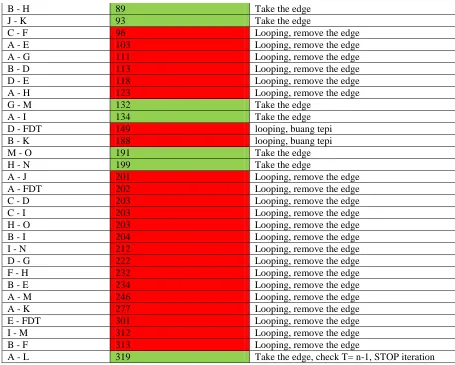
The following is an iterative table of the matrix distances between nodes found in the table 3.1: Table 3.1 Iteration Table
Node yg terhubung jarak node yg terhubung (m) Keterangan
B - C 44 Take the edge
A - B 50 Take the edge
A - C 63 looping, remove the edge
C - FDT 64 Take the edge
D - J 66 Take the edge
E - J 69 Take the edge
A - D 75 Take the edge
B - G 77 Take the edge
B - H 89 Take the edge
J - K 93 Take the edge
C - F 96 Looping, remove the edge
A - E 103 Looping, remove the edge
A - G 111 Looping, remove the edge
B - D 113 Looping, remove the edge
D - E 118 Looping, remove the edge
A - H 123 Looping, remove the edge
G - M 132 Take the edge
A - I 134 Take the edge
D - FDT 149 looping, buang tepi
B - K 188 looping, buang tepi
M - O 191 Take the edge
H - N 199 Take the edge
A - J 201 Looping, remove the edge
A - FDT 202 Looping, remove the edge
C - D 203 Looping, remove the edge
C - I 203 Looping, remove the edge
H - O 203 Looping, remove the edge
B - I 204 Looping, remove the edge
I - N 212 Looping, remove the edge
D - G 222 Looping, remove the edge
F - H 232 Looping, remove the edge
B - E 234 Looping, remove the edge
A - M 246 Looping, remove the edge
A - K 277 Looping, remove the edge
E - FDT 301 Looping, remove the edge
I - M 312 Looping, remove the edge
B - F 313 Looping, remove the edge
A - L 319 Take the edge, check T= n-1, STOP iteration
3.3.Graph Degree Constrained Minimum Spanning Tree on Fiber Optic Network Design
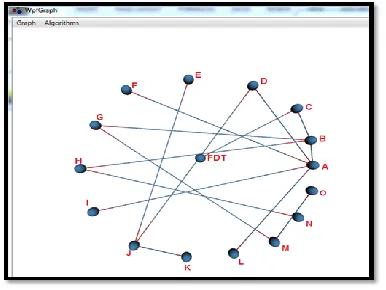
After we do iterations like Table 3.1above, then we get the edges which we take as follows: Table 3.2 Connected Nodes
Node yg
terhubung
jarak node yg
terhubung (m)
B - C 44
A - B 50
C - FDT 64
D - J 66
E - J 69
A - D 75
B - G 77
A - F 88
B - H 89
J - K 93
G - M 132
A - I 134
M - O 191
H - N 199
Figure 3.2 DCMST Graph of Fiber Optic Network
From the graph above we can see that the 16 nodes have been connected to each other with no looping/circuit that formed. The above graph also shows that the degree ≤ 5 (found on node A). The graph is DCMST of fiber optic network found in the Citra Garden residence.
4.CONCLUSION
Based on the results of modification of Prim algorithm and iteration done to distance matrix table on fiber optic network design that has been done in the previous chapter there are some ideas that we can conclude, they are:
1. The Degree Constrained Minimum Spanning Tree model with the heuristic method can be used to modify the Prim method.
2. The Degree Constrained Minimum Spanning Tree model with modified Prim algorithm is able to run well to produce a graph in fiber optic network design.
3. Testing of the Degree Constrained Minimum Spanning Tree model with Modified Prim algorithm has been successfully implemented by using fiber optic network design in Citra Garden residential area
5.REFERENCES
[1] Andrade, R.C & de Freitas, A,T (2013). Disjunctive combinatorial branch in a subgradient tree algorithm for the DCMST problem with VNS-Lagrangian bounds. Electronic Notes in Discrete Mathematics Vol 41: 5-12
[2] Darties, B., Gastineau, N&Togni, O. (2017). Completely independent spanning trees in some regular graphs. Discrete Applied Mathematics, Vol 217: 163-174.
[3] Dijkstra, E.W. (1959). A Note on two problems in connexion with graphs. Numerische Mathematik 1, 269-271
[4] Degirmenci, G & Azizoglu M . (2013) Branch and bound based solution algorithms for the budget constrained discrete time/cost trade-offproblem. J Oper Res Soc 2013;64:1474–84 .
[5] Held, M., & Karp, R.M. (1971). The travelling-salesman problem and minimum spanning trees: Part II. Mathematical Programming 1, 6-25 [6] Hong, X & Liu, Q (2016). Degree condition for completely independent spanning trees. Information Processing Letters. Vol 116: 644-648. [7] Kataoka, S & Yamada, T. (2016). Algorithms for the minimum spanning tree problem with resource allocation. Ops Res 3 (2016) 5–13. [8] Narula, S. C., & Ho, C.A. (1980). Degree-Constrained Minimum Spanning Tree. Comput & Ops Res. Vol.7, pp.239-249.
[9] Obruca, A. K. (1968). Spanning tree manipulation and the travelling-salesman problem. Comp. J. 10, 374-377. [10] Prim, R.C. (1957). Shortest connection networks and some generalizations. Bell Systems Tech. J. 36, 1389-1401
[11] Raidl, G. R., (2000). “An Efficient Evolutionary Algorithm for the Degree-Constrained Minimum Spanning Tree Problem” Proc. IEEE CEC, 2000,, pp.104-111.
[12] Shi, L & Yu, B. (2017). Characterizing rules in minimum cost spanning tree problems. Operations Research Letters, Vol 45 (6): 675-678.
[13] Subiza, B., Gomez, J.M.G. & Peris, J.E (2016). Folk solution for simple minimum cost spanning tree problems. Operations Research Letters. Vol 44: 598-601.