An Improved Method for Data Hiding and Secure
Dissemination of Multispectral Images
Arya Divakaran
Dept. of Electronics and Communication, College of Engineering Cherthala, Alapuzha, India
Abstract
The acquisition and preprocessing of multispectral images are manpower-intensive tasks and costly. Multispectral images are used in various applications including defense, which are related to national security. This makes multispectral images highly sensitive and its security needs urgent attention Therefore, it is very important to protect the ownership rights of these images. Digital watermarking serves as a solution over the above problem. The paper proposes a novel and improved method for data hiding and secure dissemination of multispectral images using crypto-watermarking. Digital watermarking and encryption are used to achieve copyright protection and security of multispectral images at dissemination level. Haar based 2D DWT at three level is developed for copyright protection. Simple and strongly secure encryption based on multiplicative and two-stage transposition cipher is used to provide security at the transmission level. Arnold transformation is used to enhance the robustness and security of the watermarking scheme. PSNR and SSIM are the two parameters used to check the quality of the decrypted image and watermark image in this paper.
Keywords
Classification, crypto-watermarking, Discrete Wavelet Transform,
Encryption, Multispectral Image.
I. Introduction
Remote sensing information is highly sensitive. With the development of spatial technology, information technology and communication technology, , it becomes easy to digitize text, images, videos, etc.Also digital data can be accessed and shared easily with the help of Internet. But this leads to rampant misuse of digital data.While it brings great convenience for the communication and sharing of remote sensing information, and contributes to the further application of remote sensing images, it also causes the uncontrollable duplication and spread of remote sensing images, making remote sensing images much easier to leak. The acquisition of multispectral images as well as preprocessing of multispectral images are cost- and manpower-intensive tasks. Therefore, it is important to protect the ownership rights of the data owner.Digital watermarking serves as a solution over the above said problem. Multispectral images are used in various applications including defense, which are related to national security. This makes multispectral images highly sensitive and its security needs urgent attention. Moreover, the dissemination of such sensitive images over the publicly accessed Internet is prone to information leakage.Therefore, a content security protection method should be adopted to guarantee the security of remote sensing information during its transmission and usage so that
the information’s flow direction can be strictly controlled and the
leakage of secret information can be prevented.
Security of multispectral images contains two aspects: security at storage and security at usage. These aspects can be very well handled by technologies like watermarking and encryption.There is plenty of literature available for watermarking of multispectral
images both in spatial and frequency domain . However, none of them have considered security aspect of watermarked multispectral images at dissemination. Although standard encryption algorithms like AES, DES, and RSA are available, they cannot be utilized for multispectral images due to high-volume data and nature of multispectral images. A single key is not feasible for encryption of multispectral images. For multiple keys, key management for such a high-volume data is critical. Moreover, these algorithms take more time for encryption as well as decryption. Crypto-watermarking, a combination of encryption and watermarking can be the best solution to provide total security for multispectral images. In all existing systems, complete security analysis as well as watermark robustness analysis are not done.
This paper focuses on complete security protection for sensitive multispectral images by combining robust wavelet based
watermarking and encryption based on simple and efficient cipher. The proposed watermarking system satisfies all multispectral
image watermarking requirements. This approach is suitable for secure dissemination and protection of large size multispectral images by ensuring security as well as the robustness of the whole crypto-watermarking technique.
This paper is structured as follows. Section II gives brief overview of digital watermarking and discrete wavelet transform. Proposed work is presented in Section III. Section IV describes experimental results Conclusion. are discussed in Section V. Acknowledgment is drawn in Section VI.
II. A Brief Overview About A. Digital Watermarking
Digital image watermarking is a method of embedding information in an image in such a manner that it cannot be removed. This watermark can be used for ownership protection, copy control and authentication. Any sort of copyright infringement forms a legal basis for prosecution.An effective watermarking technique for satellite images should have the following features:
Imperceptible:
1. The watermark should be imperceptible to
the naked eye.
Undeletable:
2. The watermark must be undeletable, at least
without visibly degrading the original image.
Statistically Undetectable:
3. A pirate should not be able to
detect the watermark by comparing several watermarked signals belonging to the same author.
Unambiguous:
4. Retrieval of the watermark should
unambiguously identify the owner.
Easy Decodable:
5. The watermark should be readily detectable
by the proper authorities.
Selective:
6. The watermarking technique should not distort
certain specific areas in the image. Blind:
7. The watermark extraction should not require the
original image
The image watermarking algorithms can be classified into two
domain techniques directly modify the intensities or color values of some selected pixels while the frequency domain techniques
modify the values of some transformed coefficients. The simplest
spatial-domain image watermarking technique is to embed a
watermark in the Least Significant Bits (LSB) of some randomly
selected pixels. The watermark is invisible to human eyes but the watermark can be easily destroyed if the watermarked image is
low-pass filtered or JPEG compressed.
B. Discrete Wavelet Transform
The wavelet transform is based on wavelets. Wavelets are mathematical function representing scaled and translated copies
of a finite-length waveform called mother wavelet. It helps to
analyze the given image in different frequency components at different resolution levels. Discrete Wavelet Transform (DWT) is a multiresolution description of an image.
DWT splits the signal into high- and low-frequency coefficients. The high-frequency coefficients contain information about the edge components, while the low-frequency coefficient is split again into high and low-frequency coefficients [11]. The 2-D
wavelet transform decomposes an image into lower resolution
approximation coefficients (LL) and detail coefficients such as horizontal (HL), vertical (LH), and diagonal (HH) coefficients.
Watermark embedding in low frequency (LL) increases robustness
against compression, Gaussian noise, scaling, and cropping while
watermarking in high frequency (HH) is robust to histogram equalization and intensity adjustments.
III. Proposed Method
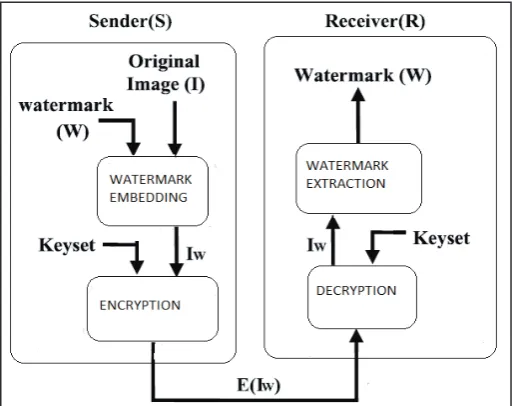
In this paper proposed a Crypto-Watermarking Scheme. Digital watermarking and encryption are used to achieve copyright protection and security of multispectral images at dissemination level. A wavelet-based algorithm is developed for copyright protection. Simple and strongly secure encryption based on multiplicative and two-stage transposition cipher is used to provide
security at the transmission level. Fig. 1 depicts the flowchart of
the proposed scheme.
Fig. 1: Proposed Framework for Secure Dissemination and
Protection of Multispectral Images
A. Wavelet-Based Watermarking
Although, general purpose image watermarking schemes can be
applied to multispectral image, these schemes have to fullfill all the specific requirements for multispectral image watermarking.
The requirements are:
The watermarking technique should not distort certain specific 1.
areas in the image Less distortion 2.
Good robustness against attacks
3.
Invisible watermarking scheme 4.
Retention of classification accuracy.
5.
B.Watermark Preprocessing
To enhance the robustness and security of the watermarking scheme, it is always desirable to apply some transformation on watermark before embedding it into host data. Arnold transform is a simple, easy to implement, and iterative permutation method .In case of an attack on image, Arnold transform maximally disperses the damaged bits into different parts of the watermarks resulting into good robustness. Arnold transformation and its inverse for 2-D image are given by
(1)
(2)
where N is the size of the image. When Arnold transform is applied on image, it randomizes original organization of pixels. On enough iterations (Arnold key), it generates the original image.
B. Watermark Embedding Process
The embedding algorithm uses a binary image as watermark and color multispectral image as a host image. Host multispectral image is decomposed up to third level for watermark embedding. Low-frequency and high-frequency sub-bands are selected for watermark embedding to achieve acceptable performance of
C. Multiplicative and Transposition Cipher-Based Encryption (MTC)
For encryption and decryption of multispectral images,proposing
,MTC based on symmetric key multiplicative affine cipher
and twostage transposition cipher. Individually, they are vulnerable to brute force, statistical and cipher text-only attacks. However,combination and proper cascading of these ciphers provide more secure and strong cipher than the individual. The
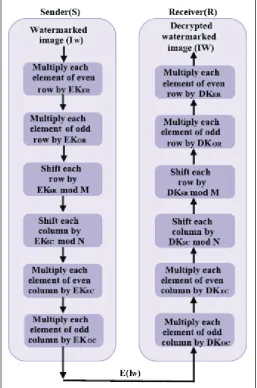
final cipher generated using such cascading approach is so strong that it is very difficult to break it. The detail flowchart depicting
sequence of operations and correct arrangement of keys at each
operation is shown in fig. 2. We are applying MTCon multispectral
image (red, green, and blue channel) of size M × N and gray
levels G. Even and odd row elements are multiplied by EKER and EKOR. Each row and column are shifted by EKSR and EKSC. Even and odd column elements are multiplied by EKEC and EKOC. Multiplier parameters EKER, EKOR,EKEC, and EKOC are relatively prime to G, whereas 0 < EKSR <M and 0 < EKSC < N. Inverse MTC has keys DKEC,DKOC,DKSR,DKSC, DKER and SKOR for even columns, odd columns, shifting rows,
shifting column, even rows, and odd rows, respectively, satisfying
the conditions: EKER * DKER = 1(mod G); EKOR *DKOR = 1(mod G); EKEC * DKEC = 1(mod G); and EKOC * DKOC = 1(mod G). For RGB multispectral image, we have (3 × 6)!
options for key arrangement. At decoder side, both the correct sequence of operations and correct keys should be available to
get the correct decryption; otherwise decoder cannot recover the
original image.
D. Watermark Extraction Process
Watermark extraction is the inverse procedure of embedding.A watermark is extracted by applying DWT on both original data
and watermarked data.Low-frequency coefficients of both are
compared to detect watermark W (Algorithm 2). Fig. 2: MTC-based Encryption Scheme
IV. Experimental Result
Have tested the performance of the proposed system on different multispectral images of varying sizes. All the experiments are
conducted on MATLAB on a machine with 2.27 GHz Core 2 Duo processor and 4 GB RAM. The watermark of size 25 × 50 pixels is used for watermarking. To improve the robustness
of the watermarking scheme, original watermark is scrambled with Arnold’s transformation. In the experiment, we have taken
27 as an Arnold’s key for the watermark of size 25 × 50 which
produces the scrambled watermark. The extracted watermark with
NC = 1.We have considered “Haar” wavelet in our experiment.
For encryption, MTC is proposed which combines multiplicative
cipher with two-stage transposition cipher. Total 36 keys are used
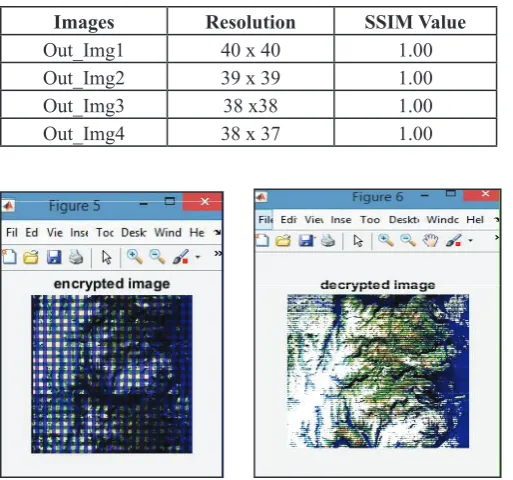
in encryption and decryption procedure.The result is shown in
figs. 3-6.
A. PSNR Result
PSNR is one of the most important objective evaluation indexes for image quality. The smaller value of PSNR means worse image quality and better perceptual security. The proposed scheme gives good encryption perceptual security as it has very less value of PSNR between original and encrypted as well as watermarked and
encrypted multispectral image. The result is shown in Table 1.
Table 1: PSNR Result
Multispectral Images Resolution PSNR Values Sat_Img1 1280 x 1280 68.5848
Sat_Img2 1160 x 1160 65.235
Sat_Img3 1150 x 1145 60.235
Sat_Img4 1148 x 1130 59.884
B. SSIM
SSIM is the Structural Similarity Index for measuring image quality .Using SSIM the structural similarity of input watermark and output watermark image can be analysed.Also the error analysing can be done using SSIM.The similarity between the encrypted and decrypted image can also done using this. The result is shown in Table 2.
Table 2: SSIM Result
Images Resolution SSIM Value
Out_Img1 40 x 40 1.00
Out_Img2 39 x 39 1.00
Out_Img3 38 x38 1.00
Out_Img4 38 x 37 1.00
Fig. 5: Encrypted and Decrypted Image
Fig. 6: Output Image
V. Conclusion
In this paper, we have proposed crypto-watermarking, a combination of watermarking and encryption to provide copyright protection for multispectral images and secure delivery of copyrighted multispectral images. During transmission, encryption can be used to prevent information leakage and protocol attacks. Ownership can be proved later as invisible watermark is retained in the multispectral image. Ownership cannot be proved until and unless the original multispectral image is made available. It is observed that the proposed crypto-watermarking approach
satisfies the security of encryption, the invisibility, robustness, and classification accuracy retention of watermarking. Moreover, this
algorithm survives all the attacks having low-frequency as well as high-frequency characteristics as we have utilized both low- and high-frequency bands for watermarking. The same algorithm can further be used for hyperspectral images security at storage as well as at dissemination.
References
[1] M. Barni, F. Bartolini, V. Cappellini, E. Magli, G. Olmo, “Nearlossless digital watermarking for copyright protection of remote sensing images”, In Proc. IEEE Int. Geosci. Remote Sens. Symp., pp. 1447–1449, 2002.
[2] Y. Chauhan, P. Gupta, K. Majumder,“Digital watermarking of satellite images,” In Proc. 3rd India Conf. Comput. Vis. Graph. Image Process., pp. 235–240, 2002.
[3] T. Hemalatha, V. Joevivek, K. Sukumar, K. Soman, “Robust
watermarking of remote sensing images without the loss of
spatial information”, In Proc. 10th ESRI India User Conf., Vol. 1, No. 2, pp. 1–8, 2009.
[4] B. Kumari, V. Rallabandi,“Modified patchwork-based watermarking scheme for satellite imagery,” Signal Process., Vol. 88, No. 4, pp. 891–904, 2008.
[5] P. Zhu, C. Chen,“A copyright protection watermarking
algorithm for remote sensing image based on binary image
watermark,” Int. J. Light Electron Opt., Vol. 124, No. 20, pp. 4177–4181, 2013.
[6] B. Ziegeler, H. Tamhankar, J. Fowler, L.
Bruce,“Wavelet-Based watermarking of remotely sensed imagery tailored to
classification performance,” In Proc. IEEE Workshop Adv. Techn. Anal. Remotely Sensed Data, pp. 259–262, 2003. [7] Y. Xu, Z. Xu, Y. Zhang,“Content security protection for remote
sensing images integrating selective content encryption and
digital fingerprint,” J. Appl. Remote Sens., Vol. 6, No. 1, pp. 063505, 2012.
[8] L. Jiang, Z. Xu,“Commutative encryption and watermarking for remote sensing image,” Int. J. Digital Content Technol. Appl., Vol. 6, No. 4, pp. 197–205, 2012.
[9] L. Jiang, Z. Xu, Y. Xu,“A new comprehensive security
protection for remote sensing image based on the integration
Arya Divakaran received her B.Tech degree in Electronics and Communi-cation Engineering from College, College of Engineering Cherthala,
Kerala, India in 2014 under CUSAT
university. She completed her M.Tech degree in Signal Processing from College, College of Engineering