O R I G I N A L R E S E A R C H
Improved perioperative quality of life in
endoscopic sinus surgery by application of
enhanced recovery after surgery
This article was published in the following Dove Press journal: Therapeutics and Clinical Risk Management
Xifu Wu1,*
Weifeng Kong1,*
Qiong Zhu2,*
Weihao Wang1
Huiqing Xu1
Shaoli Zhou3
Qintai Yang1
1Department of Otolaryngology Head
and Neck Surgery, The Third Affiliated
Hospital of Sun Yat-sen University;
2Department of Examination Center of
Lingnan Hospital, The Third Affiliated Hospital of Sun Yat-sen University;
3Department of Anesthesiology, The
Third Affiliated Hospital of Sun Yat-sen
University, Guangzhou, 510630, People’s
Republic of China
*These authors contributed equally to this work
Background:Endoscopic sinus surgery (ESS) has been the definitive treatment for chronic
rhinosinusitis (CRS), but the complications caused perioperatively may affect patients’
quality of life (QoL). This study aims to evaluate the effects of enhanced recovery after surgery (ERAS) on improving perioperative QoL in ESS.
Materials and methods:Seventy-four patients with chronic rhinosinusitis with nasal polyps (CRSwNP) met the criteria for inclusion. Participants undergoing ESS were randomly divided into an ERAS group and a control group, and QoL assessment was performed using the Chinese version of the 22-item Sinonasal Outcomes Test (SNOT-22). Measurements were administered at baseline, and on postoperative day 1 (POD1), POD3 and POD6. Complications such as nausea/ emesis, hemorrhage, aspiration and dizziness were also recorded.
Results: The preoperative global SNOT-22 scores (mean ± SD) were 39.89±4.86 in the
ERAS group and 40.52±3.61 in the control group (t=0.643,P=0.522). On POD1, the global
SNOT-22 scores increased significantly to 51.77±5.59 and 62.02±3.86 (t=9.218, P<0.01),
and on POD3 they increased to 48.22±6.22 and 51.11±5.14, respectively (t=2.179,P<0.05).
However, the scores recovered to 39.39±4.73 and 40.13±3.31 in the respective groups on
POD6, which were lower than but not statistically significant different from the baseline
(t=0.786,P=0.434). There were statistically significant improvements across all subdomains
of SNOT-22 for patients in the two groups only in POD1 (allP<0.05). The ERAS group did
not have an increased incidence of complications such as nausea/emesis (χ2=0.223,P>0.05),
hemorrhage, aspiration and dizziness compared to the control group.
Conclusion:ERAS could improve perioperative QoL in patients with CRSwNP undergoing
ESS, and SNOT-22 can be used for ERAS evaluation as a patients’outcome report.
Keywords:chronic rhinosinusitis, enhanced recovery after surgery, quality of life, SNOT-22
Introduction
Chronic rhinosinusitis (CRS) is one of the most common diseases encountered by otolaryngologists and is estimated to affect 5–12% of the global population and 2–8% of Chinese people.1,2 At present, CRS is diagnosed based on the presence of the symptoms of nasal obstruction/congestion, facial pain/pressure, anterior/posterior dis-charge and/or olfactory loss for a duration greater than 12 weeks,3which are persistent although not fatal, but result in negative influences on quality of life (QoL).4
Despite the extensive studies on CRS, many uncertainties remain regarding its optimal treatment. Endoscopic sinus surgery (ESS) has been proven to be an effective method for improvement of QoL in patients with CRS.5,6 However, Correspondence: Qintai Yang
Department of Otolaryngology Head and
Neck Surgery, The Third Affiliated
Hospital of Sun Yat-sen University, 600 Tianhe Road, Tianhe District, Guangzhou,
510630, People’s Republic of China
Tel +86 208 525 2252 Fax +86 208 525 3045 Email [email protected]
Therapeutics and Clinical Risk Management
Dove
press
open access to scientific and medical research
Open Access Full Text Article
Therapeutics and Clinical Risk Management downloaded from https://www.dovepress.com/ by 118.70.13.36 on 27-Aug-2020
treatment for CRS with ESS can cause perioperative com-plications, such as cerebrospinal fluid (CSF) leak, orbital complications, sinonasal adhesions, infection, anxiety and bleeding.7The use of nasalfillings such as Merocel after ESS can cause serious pain and sleeplessness in patients, and removing the stuffing tends to cause further pain and bleeding, all of which affect patients’perioperative QoL.
Enhanced recovery after surgery (ERAS) is a series of optimized protocols adopted in the perioperative phase to reduce medical costs, shorten hospital stay, prevent perio-perative complications and improve QoL. ERAS was pio-neered by Kehlet8 and has been extended in many disciplines, for instance in thefield of otolaryngology, such as head and neck oncological surgery.9–12 In our previous study, the application of ERAS in ESS improved postopera-tive pain and sleep, while reducing hospital costs and length of hospital stay,13which may be beneficial in improving the patients' QoL. Therefore, the aim of this study was to assess the improvement in QoL in the perioperative period in ESS by the application of ERAS, using the Chinese version of the 22-item Sinonasal Outcomes Test (SNOT-22).
Materials and methods
Subjects
From January 2018 to May 2018, patients diagnosed with chronic rhinosinusitis with nasal polyps (CRSwNP) and undergoing ESS in the Department of Otolaryngology at The Third Affiliated Hospital of Sun Yat-sen University were selected. Participants who met the inclusion criteria, and were not excluded based on the exclusion criteria, were randomly into an ERAS group and a control group for this prospective controlled clinical trial. This study was approved by the Ethics Committee of the hospital (number [2018]02-011-01) and was conducted in accordance with the Declaration of Helsinki. Informed consent forms were obtained from all participants, and the data on the SNOT-22 scores will be available from the web of the Chinese Clinical Trial Registry (number ChiCTR1800015791).
Inclusion criteria
Patients with CRSwNP confirmed by endoscopy, imaging and pathology according to the European Position Paper on Rhinosinusitis and Nasal Polyps 2012 (EPOS2012),3 without improvement of symptoms following conservative treatment, and patients diagnosed with sinusitis of full house, who underwent the same type of ESS by the same surgeon, were included in the study.
Exclusion criteria
Patients were excluded if they had chronic diseases includ-ing hypertension, tuberculosis, heart disease and asthma, or psychological disorders, and were unsuitable for surgery; or diseases such as Samter's triad, cystic fibrosis, primary ciliary dyskinesia, fungal sinusitis, systemic vasculitis, gran-ulomatous disease and immunodeficiency. Patients who had undergone previous sinus surgery, ESS with septoplasty or turbinate surgery, or other surgery such as a modified Lothrop (DRAF-III) procedure were also excluded.
In addition, patients were excluded if the required data were not completely collected or the treatment failed to progress during the study.
Protocol for ERAS group
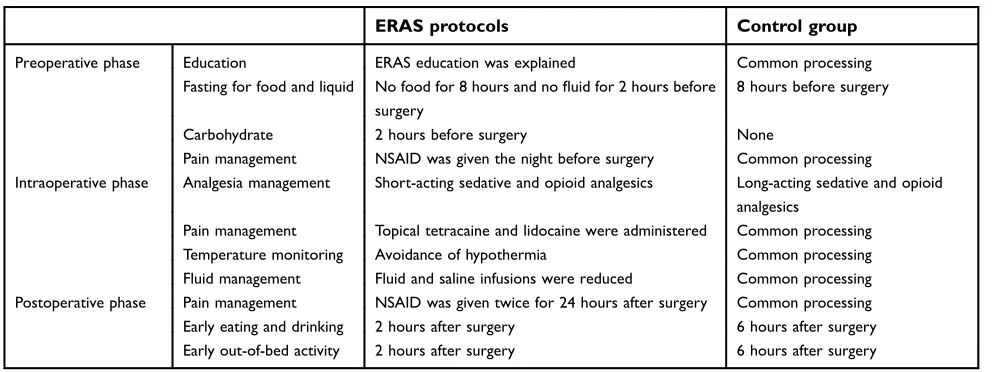
Patients followed the ERAS protocol during their hospital stay, as described previously.13 During the perioperative period, information on ERAS and a non-steroidal anti-inflammatory drug (NSAID) were given to patients. Patients fasted for 8 hours from solids and 2 hours from fluids, and consumed a carbohydrate drink 2 hours before surgery. In the intraoperative period, short-acting sedatives and short-acting opioid analgesics were given, and the body temperature andfluid volume were monitored during surgery. Topical tetracaine anesthesia and local lidocaine infiltration anesthesia were applied to the nasal mucosa, and degradable hemostatic material was used for nasal packing. In the postoperative period, patients were encour-aged to undertake out-of-bed activities, and to consume food and drink according to their recovery condition after 2 hours. NSAIDs were given twice a day on postoperative day 1 (POD1) and POD2 (Table 1).
Protocol for control group
Patients followed a traditional protocol during their hospi-tal stay, as described previously.13 During the periopera-tive period, traditional perioperaperiopera-tive information was given to patients, but without NSAIDs. Patients fasted for 8 hours from solids and fluids before surgery. In the intraoperative period, long-acting sedatives and long-act-ing opioid analgesics were given, and the body tempera-ture and fluid volume were monitored as common procedures. No topical tetracaine anesthesia or local lido-caine infiltration anesthesia was applied to the nasal mucosa, and non-degradable hemostatic material was used for nasal packing according to the traditional proto-col. In the postoperative period, patients were encouraged to perform out-of-bed activities, and to take food and drink
Therapeutics and Clinical Risk Management downloaded from https://www.dovepress.com/ by 118.70.13.36 on 27-Aug-2020
according to their recovery condition after 6 hours. NSAIDs were given as needed (Table 1).
Chinese version of SNOT-22 assessment
The SNOT-22 is a validated, disease-specific QoL ques-tionnaire used for CRS.14 This questionnaire provides a symptom score for 22 parameters (range 0–5) relating to sinonasal function, with the minimum score being 0 points and the maximum score being 110. It can be categorized intofive domains: domains 1, 2 and 3 (rhinological symp-toms, extranasal rhinological symptoms and ear/facial symptoms, respectively) relate to sinus-specific symptoms; and domains 4 and 5 (psychological dysfunction and sleep dysfunction, respectively) cover general health-related QoL. In this trial, we used the Chinese version of SNOT-22.15The higher the score, the worse the QoL.Data collection
The SNOT-22 was explained to patients, usually 1 or 2 days before surgery. The questionnaire was completed by the patients to determine their preoperative baseline health status. The SNOT-22 was repeated and collected by the same researcher on POD1, 3 and 6 in the hospital. Postoperative complications, such as nausea/emesis, hemorrhage, aspiration and dizziness, were also recorded.
Statistical analysis
All statistical analyses were performed using the IBM-SPSS version 20 software program (IBM Corp., Armonk, NY, USA). Measurement data (such as scores on Lund–Mackay, Lund–Kennedy and SNOT-22) are presented as mean ± SD,
and an two-tailed independent samplest-test was used for comparison between the two groups. Enumeration data (such as postoperative complications) are presented as N (%), and Fisher’s exact test or the chi-squared test was used. A value of P<0.05 was considered to be statistically significant.
Results
Case series
In total, 74 patients met the inclusion criteria and were included in the study. Patients were divided at random into the ERAS group (n=36) and control group (n=38). The ERAS group consisted of 26 males and 10 females with an average age of 37.9 years, while the control group con-sisted of 29 males and 9 females with an average age of 39.4 years (t=0.677, P>0.05). All of the patients success-fully completed the study and were followed up.
The Lund–Mackay staging scores for the ERAS group and the control group were 18.28±3.77 and 18.89±2.62 (t=0.8126, P>0.05), and the Lund–Kennedy staging scores were 5.39±1.57 and 5.16±1.44 (t=0.961, P>0.05) respectively.
SNOT-22 assessment
The preoperative global SNOT-22 scores, as shown in
Table 2, indicating the baseline health status, were 39.89
±4.86 in the ERAS group and 40.52±3.61 in the control group (t=0.643,P=0.522). On POD1, the global SNOT-22 scores increased significantly to 51.77±5.59 and 62.02 ±3.86 (t=9.218,P<0.01), and on POD3 they increased to 48.22±6.22 and 51.11±5.14 (t=2.179, P<0.05), respec-tively, in the ERAS and control groups. On POD6, the
Table 1Implementation programs of the ERAS group and control group in the perioperative period
ERAS protocols Control group
Preoperative phase Education ERAS education was explained Common processing
Fasting for food and liquid No food for 8 hours and nofluid for 2 hours before
surgery
8 hours before surgery
Carbohydrate 2 hours before surgery None
Pain management NSAID was given the night before surgery Common processing
Intraoperative phase Analgesia management Short-acting sedative and opioid analgesics Long-acting sedative and opioid
analgesics
Pain management Topical tetracaine and lidocaine were administered Common processing
Temperature monitoring Avoidance of hypothermia Common processing
Fluid management Fluid and saline infusions were reduced Common processing
Postoperative phase Pain management NSAID was given twice for 24 hours after surgery Common processing
Early eating and drinking 2 hours after surgery 6 hours after surgery
Early out-of-bed activity 2 hours after surgery 6 hours after surgery
Abbreviations:ERAS, endoscopic sinus surgery; NSAID, non-steroidal anti-inflammatory drug.
Therapeutics and Clinical Risk Management downloaded from https://www.dovepress.com/ by 118.70.13.36 on 27-Aug-2020
scores recovered to 39.39±4.73 and 40.13±3.31, which were lower than but not statistically significantly different from baseline (t=0.786,P=0.434).
There were statistically significant improvements across all subdomains of the SNOT-22 questionnaire for patients in the both the ERAS group and control group on POD1 (all P<0.05). Among the subdomains, the rhinolo-gical and sleep components appeared to account for a large improvement in QoL. The mean rhinological subdomain score for the ERAS group was 14.14 at baseline and 16.67 on POD1, while the mean rhinological subdomain score for the control group was 14.16 at baseline and 20.34 on POD1 (t=8.756, P<0.01). The mean sleep subdomain score for the ERAS group was 11.41 at baseline and 14.11 on POD1, while the mean sleep subdomain score for the control group was 11.81 at baseline and 17.13 on POD1 (t=5.266,P<0.01).
Postoperative complications
Four patients in the ERAS group and three patients in the control group experienced nausea/emesis 2 hours after sur-gery (χ2=0.223, P>0.05), and they were not encouraged to engage in early out-of-bed activities or early eating and drinking. However, the symptoms were soon alleviated with conservative treatment. No other complications, such as hemorrhage, aspiration or dizziness, were observed.
Discussion
Based on the collected data, in the ERAS protocol for ESS, pain management with effective pain control based on preventive and multimodal analgesia enabled the patients to consume food and fluids and engage in out-of-bed activities in the early stages. We also found that ERAS in ESS can improve postoperative pain, sleep, comfort levels and postoperative systemic inflammatory reactions, while reducing hospital charges and length of hospital stay.13 All of these factors contribute to the improvement of QoL in patients with CRS.13
CRS-associated QoL research has gained significant importance and many disease-specific QoL instruments have been used in the evaluation and treatment of ESS.16–18 Although we have previously compared the differences between the two groups using the Self-rating Anxiety Scale (SAS), visual analog scale (VAS), Medical Outcomes Study Sleep Scale (MOS-SS) and Kolcaba General Comfort Questionnaire (GCQ),13 SNOT-22 has emerged as a commonly used CRS-specific QoL metric
T able 2 SNO T-22 assessment of the ERAS gr oup and contr ol gr oup in the perioperativ e period Pr eoperative POD1* POD3 POD6 ERAS Contr ol ERAS Contr ol ERAS Contr ol ERAS Contr ol Rhinolo gical symptoms 14.14±2.87 14.16±1.92 16.67±2.33 20.34±1.10 15.52±2.25 16.15±1.42 13.70±1.77 13.82±1.23 Extranasal rhinolog ical symptoms 6.03±2.38 6.29±1.49 8.03±2.31 9.10±2.20 7.56±2.30 8.03±2.01 6.11±1.89 6.34±1.56 Ear/facial symptoms 5.14±2.21 5.08±2.02 7.42±2.13 8.63±2.62 6.67±2.39 6.92±2.56 4.92±1.89 4.92±2.16 Psycholo gical dysfunction 3.16±1.36 3.18±1.18 5.56±1.70 6.81±1.04 5.52±2.13 5.84±2.30 4.14±1.66 4.32±1.10 Sleep dysfunction 11.41±3.06 11.81±2.94 14.11±3.16 17.13±1.54 12.94±3.04 14.16±2.44 10.53±2.05 10.73±2.49 SNO T -22 total scor e 39.89±4.86 40.52±3.61 51.77±5.59 62.02±3.86 48.22±6.22 51.11±5.14 39.39±4.73 40.13±3.31 Note: Data ar e shown as mean ± SD; *p<0.05. Abbre viations: ERAS, enhanced re cov ery after surger y; POD , postoperativ e da y; SNO T-22, 22-item Sinonasal Outcomes Test.
Therapeutics and Clinical Risk Management downloaded from https://www.dovepress.com/ by 118.70.13.36 on 27-Aug-2020
and has been evaluated as the primary outcome in pro-spective studies.19,20
Baseline SNOT-22 scores can be used to predict treat-ment selection for CRS, and the baseline SNOT-22 scores can be used to inform patients about their expected QoL outcomes after ESS.21Also, studies have shown that patients with preoperative SNOT-22 scores between 10 and 19 reported a worsening of their QoL 14 months after ESS compared with patients with preoperative SNOT-22 scores greater than 30.22,23A meta-analysis of SNOT-22 outcomes after ESS showed a statistically significant change in mean SNOT-22 scores ranging from 12.7 to 44.8 between baseline and postoperative time-points, with an average follow-up of 10.6 months.24However, all those studies concentrated on the improvement of QoL from baseline to a long time after ESS using SNOT-22. Few reports, especially random con-trolled clinical trials, have been published on the periopera-tive QoL in ESS using SNOT-22 scores.
In this study, SNOT-22 scores correlated with the perio-perative QoL. On POD1, the global SNOT-22 scores in the ERAS and control groups increased significantly to 51.77 ±5.59 and 62.02±3.86, respectively (t=9.218,P<0.01), and on POD3 they increased to 48.22±6.22 and 51.11±5.14 (t=2.179,P<0.05), respectively. However, the scores recov-ered to 39.39±4.73 and 40.13±3.31, respectively, on POD6, which were lower than but not statistically significant differ-ent from the baseline (t=0.786, P=0.434). The rhinological and sleep components appeared to account for a large improvement in SNOT-22. All of these results indicated that patients with CRSwNP who underwent ESS with the application of ERAS had an improved perioperative QoL compared with patients under the traditional protocol.
AVAS of each index (nasal obstruction, sleep disturbance and head/facial pain) at 3 was set as a discharge criterion for ERAS in septoplasty in our previous study.25However, ESS for CRS is day surgery in the USA and other developed countries. Patients require several days of hospitalization for ESS in China because of bed occupancy. Usually, patients are discharged after thefirst postoperative endoscopic clean-ing of the nasal cavities. Here, we also used SNOT-22 as a patient-reported outcome in discharge criteria in ESS. As shown in Table 2, the scores on the SNOT-22 decreased significantly on POD3 in the ERAS group compared to the control group (t=2.179,P<0.05), and the scores recovered on POD6, which were lower, but not statistically significant, compared to the baseline (t=0.786,P=0.434). All of these findings indicated that the QoL was improved with discharge around POD3 for patients undergoing ESS.
It must not be forgotten that medical treatment, such as ERAS, carries a risk of complications. Major complica-tions of ESS include CSF leak and orbital complicacomplica-tions including orbital ecchymosis, diplopia or reduction of visual acuity, and significant intraoperative or immediate postoperative hemorrhage. Minor complications include adhesions, infection, bleeding and postoperative pain.26 However, none of these complications was observed in either group in this study, and the ERAS group did not experience increased complications, such as nausea/ emesis, hemorrhage, aspiration and dizziness, compared with the control group.
There are several limitations to this study. One limita-tion is that this investigalimita-tion represents the experience of a single institution with a relatively small series. It calls for a multicenter randomized controlled study with a large sample to gain a more complete picture of QoL in ESS under ERAS. Another limitation is that the SNOT-22 questionnaire scores only reflect a subjective assessment of patients’QoL. Objective evaluations such as C-reactive protein and interleukin-6 may be used in future investiga-tions to capture aspects of QoL not evaluated by the questionnaire.27,28
Conclusion
This study clearly demonstrated that ERAS could improve perioperative QoL in patients with CRSwNP undergoing ESS, with significant improvements in scores on rhinological symptoms, extranasal rhinological symptoms, ear/facial symptoms, psychological dysfunction and sleep dysfunction.
Acknowledgments
This work was supported by grants from the National Natural Science Foundation of China (numbers 81670912, 81870704) and the Industry-Academic Cooperation Foundation of Guangzhou (number 201704030046).
Disclosure
The authors report no conflicts of interest in this work.
References
1. Bachert C, Zhang L, Gevaert P. Current and future treatment options for adult chronic rhinosinusitis: focus on nasal polyposis.J Allergy Clin Immunol.2015;136:1431–1440. doi:10.1016/j.jaci.2015.04.010 2. Shi JB, Fu QL, Zhang H, et al. Epidemiology of chronic rhinosinusitis:
results from a cross- sectional survey in seven Chinese cities.Allergy. 2015;70:533–539. doi:10.1111/all.12577
3. Fokkens WJ, Lund VJ, Mullol J, et al. European position paper on rhinosinusitis and nasal polyps 2012.Rhinol Suppl.2012;23:1–298.
Therapeutics and Clinical Risk Management downloaded from https://www.dovepress.com/ by 118.70.13.36 on 27-Aug-2020
4. Slovick A, Cornet M, Surda P, Tomazic PV. Chronic rhinosinusitis: new understanding of specific and general quality of life scores. Rhinology.2016;54(4):289–291. doi:10.4193/Rhin16.404
5. Rahman T, Alam MM, Ahmed S, Karim MA, Rahman M, Wahiduzzaman M. Outcome of endoscopic sinus surgery in the treatment of chronic rhinosinusitis. Mymensingh Med J. 2016;25 (2):261–270.
6. Lind H, Joergensen G, Lange B, Svendstrup F, Kjeldsen AD. Efficacy of ESS in chronic rhinosinusitis with and without nasal polyposis: a Danish cohort study.Eur Arch Otorhinolaryngol.2016;273(4):911– 919. doi:10.1007/s00405-015-3667-9
7. Daramola OO, Chandra RK. Chronic rhinosinusitis and endoscopic sinus surgery. World J Otorhinolaryngol Head Neck Surg. 2018;4 (1):29–32. doi:10.1016/j.wjorl.2018.03.005
8. Kehlet H. Multimodal approach to control postoperative pathophy-siology and rehabilitation.Br J Anaesth.1997;78:606–617. 9. Coyle MJ, Main B, Hughes C, et al. Enhanced recovery after surgery
(ERAS) for head and neck oncology patients. Clin Otolaryngol. 2015;41:118–126. doi:10.1111/coa.12482
10. Gemma M, Toma S, Luce FL, Beretta L, Braga M, Bussi M. Enhanced recovery program (ERP) in major laryngeal surgery: build-ing a protocol and testbuild-ing its feasibility.Acta Otorhinolaryngol Ital. 2017;37:475–478. doi:10.14639/0392-100X-1091
11. Dort JC, Farwell DG, Findlay M, et al. Optimal perioperative care in major head and neck cancer surgery with freeflap reconstruction: A consensus review and recommendations from the enhanced recovery after surgery society. JAMA Otolaryngol Head Neck Surg. 2017;143:292–303. doi:10.1001/jamaoto.2016.2981
12. McMahon J, Handley TPB, Bobinskas A, et al. Postoperative com-plications after head and neck operations that require free tissue transfer - prevalent, morbid, and costly.Br J Oral Maxillofac Surg. 2017;55:809–814. doi:10.1016/j.bjoms.2017.07.015
13. Wu XF, Kong WF, Wang WH, et al. Enhanced recovery after surgery protocols in functional endoscopic sinus surgery for patients with chronic rhinosinusitis with nasal polyps: a randomized clinical trial.
Chin Med J. 2009;132(2):253–258. doi:10.1097/
CM9.0000000000000060
14. Hopkins C, Gillett S, Slack R, Lund VJ, Browne JP. Psychometric validity of the 22-item sinonasal outcome test. Cin Otolaryngol. 2009;34(5):447–454. doi:10.1111/coa.2009.34.issue-5
15. Lü W, Qi F, Gao ZQ, et al. Quality of life survey on patients with chronic rhinosinusitis by using Chinese version of the 22-item sino-nasal outcome test (SNOT-22).Zhonghua Er Bi Yan Hou Tou Jing Wai Ke Za Zhi.2008;43(1):18–21.
16. Quintanilla-Dieck L, Litvack JR, Mace JC, Smith TL. Comparison of disease-specific quality-of-life instruments in the assessment of chronic rhinosinusitis. Int Forum Allergy Rhinol. 2012;2(6):437– 443. doi:10.1002/alr.21057
17. DeConde AS, Bodner TE, Mace JC, Smith TL. Response shift in quality of life after endoscopic sinus surgery for chronic rhinosinu-sitis. JAMA Otolaryngol Head Neck Surg. 2014;140(8):712–719. doi:10.1001/jamaoto.2014.1045
18. Ference EH, Stubbs V, Lidder AK, et al. Measurement and comparison of health utility assessments in chronic rhinosinusitis. Int Forum Allergy Rhinol. 2015;5(10):929–936. doi:10.1002/ alr.21556
19. DeConde AS, Mace JC, Bodner TE, et al. SNOT-22 quality of life domains differentially predict treatment modality selection in chronic rhinosinusitis. Int Forum Allergy Rhinol. 2014;4(12):972–979. doi:10.1002/alr.21408
20. Levy JM, Mace JC, Sansoni ER, Soler ZM, Smith TL. Longitudinal improvement and stability of the SNOT-22 survey in the evaluation of surgical management of chronic rhinosinusitis.Int Forum Allergy Rhinol.2016;6(11):1188–1195. doi:10.1002/alr.21800
21. Hopkins C, Rudmik L, Lund VJ, et al. The predictive value of the preoperative sinonasal outcome test-22 score in patients undergoing endoscopic sinus surgery for chronic rhinosinusitis. Laryngoscope. 2015;125(8):1779–1784. doi:10.1002/lary.25318
22. Rudmik L, Soler ZM, Mace JC, DeConde AS, Schlosser RJ, Smith TL. Using preoperative SNOT-22 score to inform patient decision for endoscopic sinus surgery. Laryngoscope. 2015;125(7):1517–1522. doi:10.1002/lary.25108
23. Levy JM, Mace JC, Rudmik L, Soler ZM, Smith TL. Low 22-item sinonasal outcome test scores in chronic rhinosinusitis: why do patients seek treatment? Laryngoscope. 2017;127(1):22–28. doi:10.1002/lary.26157
24. Soler ZM, Jones R, Le P, et al. Sino-nasal outcome test-22 outcomes after sinus surgery: A systematic review and meta-analysis. Laryngoscope.2018;128(3):581–592. doi:10.1002/lary.27008 25. Liao Z, Liao W, Tan KS, et al. Decreased hospital charges and
postoperative pain in septoplasty by application of enhanced recovery after surgery. Ther Clin Risk Manag. 2018;4(14):1871–1877. doi:10.2147/TCRM.S173687
26. Eviatar E, Pitaro K, Gavriel H, Krakovsky D. Complications follow-ing powered endoscopic sinus surgery: an 11 year study on 1190 patients in a single institute in Israel. Isr Med Assoc J. 2014;16 (6):338–340.
27. Cabellos OM, Martinez ML, Torralba M, et al. C-reactive protein as a marker of the surgical stress reduction within an ERAS protocol (enhanced recovery after surgery) in colorectal surgery: A prospec-tive cohort study.J Surg Oncol.2018;117(4):717–724. doi:10.1002/ jso.24909
28. Mari G, Crippa J, Costanzi A, et al. ERAS protocol reduces IL-6 secretion in colorectal Laparoscopic surgery: results from a rando-mized clinical trial.Surg Laparosc Endosc Percutan Tech.2016;26 (6):444–448. doi:10.1097/SLE.0000000000000324
Therapeutics and Clinical Risk Management
Dove
press
Publish your work in this journal
Therapeutics and Clinical Risk Management is an international, peer-reviewed journal of clinical therapeutics and risk management, focusing on concise rapid reporting of clinical studies in all therapeutic areas, outcomes, safety, and programs for the effective, safe, and sustained use of medicines. This journal is indexed on PubMed Central, CAS,
EMBase, Scopus and the Elsevier Bibliographic databases. The manuscript management system is completely online and includes a very quick and fair peer-review system, which is all easy to use. Visit http://www.dovepress.com/testimonials.php to read real quotes from published authors.
Submit your manuscript here:https://www.dovepress.com/therapeutics-and-clinical-risk-management-journal
Therapeutics and Clinical Risk Management downloaded from https://www.dovepress.com/ by 118.70.13.36 on 27-Aug-2020