
QUINAZOLINONE: AN OVERVIEW
7
0
0
Full text
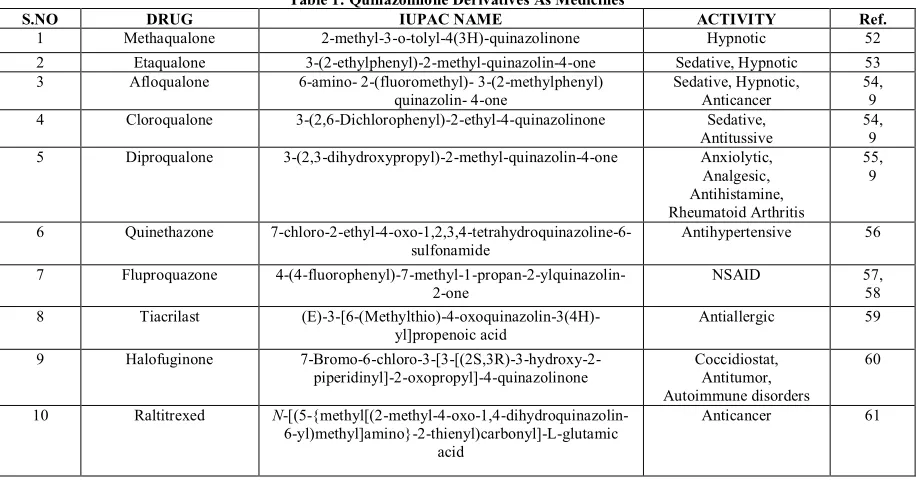
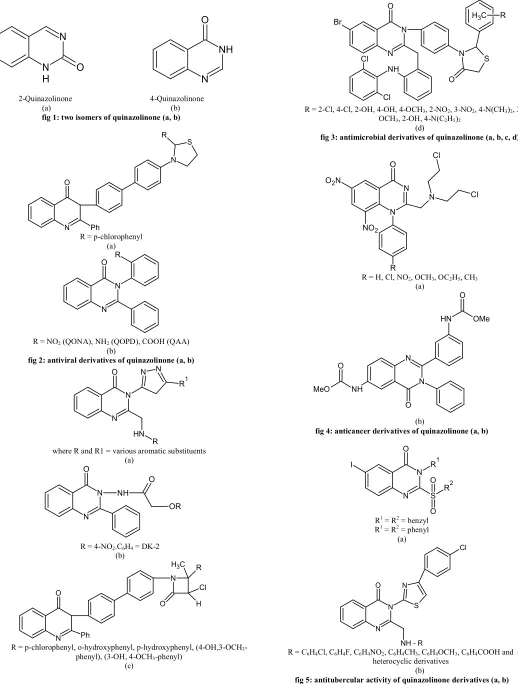
(2) Arora Rashmi et al. IRJP 2011, 2 (12), 22-28 coli (NCTC 10418), Bacillus subtilis (ATCC 6633), Staphylococcus aureus (ATCC 29737). They were also screened for anti-fungal activity showing maximal activity against Aspergillus niger (NCIM 596), Candida albicans (NCIM 3102)21. Ø 2-(4-nitrophenoxy)-n-(4-oxo-2-phenylquinazolin-3(4h)yl)acetamide (fig 3b): 2-(4-nitrophenoxy)-N-(4-oxo-2phenylquinazolin-3(4H)-yl)acetamide (DK-2) showed maximum zone of inhibition (18 mm) against S.aureus as well as against E. coli (17 mm) which is higher than the standard drug ampicillin22. Ø b-lactam-quinazolinone derivatives (fig 3c): They show antibacterial activity against Escherichia coli and Basillus subtilis in vitro involving the two fold serial dilution technique as recommended by the National Committee for Clinical Laboratory Standards (NCCLS)23. Ø 4-oxo-thiazolidinyl quinazolin-4(3H)ones (fig 3d): Antimicrobial evaluation of this compound was done. They showed antibacterial and antifungal activity when compared with the standard drugs drugs penicillin-G, ampicillin, and amoxicillin24. Anticancer Activity Quinazolin-4-(3H)-One is a versatile lead molecule for the design of potential bioactive agents. Anti-cancer activity were studied for 2,3disbstituted quinazolinones derivatives and they showed promising anticancer potential25-27. Ø 2-{[bis-(2-chloroethyl) amino] methyl}- 6, 8-dinitro-1- (4substituted ethyl)-1h-quinazolin-4-one derivatives (fig 4a): The 1, 6, 8- trisubstituted quinazolinones with a nitrogen mustard moiety connected through a methylene group at position 2 are effective in mice bearing Dalton’s Lymphoma Ascites. Further, it is concluded that the quinazolinon-2-methyl nitrogen mustard with either a nitro or chloro group at para phenyl position is a most potent anticancer compound, which can be further developed. The synthesized compounds were screened for their anticancerous activity by short-term in-vitro antitumor activity and in-vivo anticancer activity by body weight analysis, mean survival time and percentage increase in life span methods in Swiss albino mice bearing DLA 1x10⁶ cells/ml28. Ø diphenyl quinazolinone (fig 4b): The related diphenyl quinazolinone is also a potent antimitotic agent, and is highly active in vivo29. The compound is highly insoluble, though incorporation of the compound into liposomes (several concentric layers of lipid bilayers) imparts water solubility to the drug, allowing transport into the cell. Once inside the cell, the liposome shell dissipates, leaving the drug free to exert its effects30. Antitubercular Activity It was also reported that 2 or 4-substituted thioquinazolinone derivatives were identified as a possible pharmacophore for antitubercular activity. In the quest for biologically potent antitubercular agents, as pharmaceutical chemists designed, synthesized and screened some 2-alkylthio-6-iodo-3- substituted-quinazolin-4one derivatives to mimic those reported as potential antitubercular agents31-34. Ø 2-alkylthio-6-iodo-3-substituted-quinazolin-4-one (fig 5a): This derivative was screened for their in vitro antitubercular activity against Mycobacterium tuberculosis strain H Rv, using the 37 radiometric BACTEC 460-TB methodology and they showed good antitubercular activity35. Ø N-3[4-(4-chlorophenyl thiazole-2-yl)-2-aminomethyl] quinazoline-4(3h)-one derivatives (fig 5b): A new series N3[4-(4-chlorophenyl thiazole-2-yl)-2-aminomethyl] quinazoline4(3H)-one derivatives are synthesized. The compounds are. screened for their antitubercular activitiy using H37Rv stain. All the compounds have showed moderate to promising antitubercular activity36. Anti-Inflammatory and Analgesic Activity Discovery of new safer anti‐inflammatory drugs represents a challenging goal in research area37-38. Quinazolinone derivatives with 2,3‐substitution are reported to possess significant analgesic and anti‐inflammatory activity. Looking at the biological significance of quinazolinone nucleus, it was thought to synthesize new quinazolinone derivatives and screen them for their analgesic and anti‐inflammatory activity39-40. Ø 2,3-disubstituted quinazolinone derivatives (fig 6a): A series of some novel 2,3‐disubstituted quinazolinone derivatives were synthesized by condensing 2‐methyl/ 2‐phenyl/6‐bromo‐2‐methyl/6‐ bromo‐2‐phenyl/6, 8‐dibromo‐2‐methyl/ 6, 8‐dibromo‐2‐phenyl benzoxazines with compounds containing amino group. Derivatives showed good analgesic and anti‐inflammatory activities41. Ø novel 6,8-dibromo-4(3h)-quinazolinone derivatives (fig 6b): Monobromoquinazolinone derivatives, that both mono and dibromoquinazolinone derivatives have significant antiinflammatory and analgesic effect42. Ø novel 3-(p-substituted phenyl)-6-bromo-4(3h)-quinazolinone derivatives (fig 6c): Besides the diverse biological activity ascribed to quinazolinone derivatives and enzyme inhibitory effect of several 6-bromoquinazolinones and based on continuation of our drug research program on the development of safe quinazolinone anti-inflammatory agents, it was of interest to synthesize a novel series of 6-bromoquinazolin4(3H)-ones incorporated into other heterocyclic moieties such as pyridine, pyran, pyrazoline, pyrimidone and/or pyrimidinethione ring systems to be evaluated for their antiinflammatory and analgesic activities. They showed promising anti-inflammatory and analgesic properties43. Sedative – Hypnotic The 4(3H)-quinazolinone nucleus containing well known sedativehypnotic activity. Methaqualone (2-methyl-3-o-tolyl-4(3H)quinazolinone) is example of this case. The results and interpretations of past study on CNS activity of 2,3-disubstituted 4(3H)-quinazolinones reveal that it is more potent sedative – hypnotic44. Ø 1-(4-substituted-phenyl)-3-(4-oxo-2-propyl-4H-quinazolin-3yl)-urea (H1-H12) derivatives (fig 7a): All the quinazolinone analogs showed potent sedative-hypnotic and CNS depressant activity. In the behavioral study using actophotometer scoring technique, the entire synthesized compounds showed decrease in locomotor activity where 37% was the lowest and 52% was the maximal decrease in locomotor activity when compared to phenytoin45. Anticoccidial Activity The potent anticoccidial activity of febrifugine in poultry was discovered in the 1960’s. Because of side effects, such as diarrhea, vomiting46 and liver toxicity47. It has been precluded as an anticoccidial drug. Halofuginone is a broad-spectrum anticoccidial medicine with low toxicity and no cross-resistance48. The quinazoline ring might play a vital role in the anticoccidial activity; (1) the introduction of halogen groups might change the anticoccidial activity; (2) the anticoccidial activity of these compounds probably have a relationship with the 2´-carbonyl and 3″-hydroxyl or 2″-methoxy. Ø 4-(2-methoxyphenyl)-2-oxo-butyl-quinazolinones (fig 8a): A series of 4-(2-methoxyphenyl)-2-oxo-butyl-quinazolinones were designed and synthesized based on the structure of febrifugine. The biological activity test results indicated that they exhibited. INTERNATIONAL RESEARCH JOURNAL OF PHARMACY, 2(12), 2011.
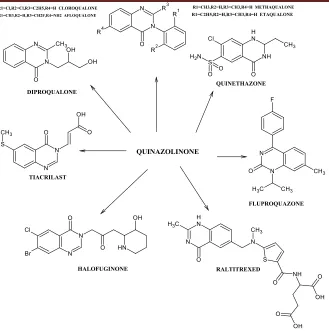
(3) Arora Rashmi et al. IRJP 2011, 2 (12), 22-28 anticoccidial activities against Eimeria tenella in the chicken diet with a dose of 9 mg/kg. Compared with halofuginone, these compounds have the advantages of shorter synthetic routes and lower cost49. Antihyperlipidemic Activity The 4(3H)-quinazolinone derivatives (a derivative of the parent compound quinazoline) have been shown as a group of compounds of broad medical interest. The antihyperlipidemic and antihypercholesterolemic activities of quinazolinone derivatives are reported and the activities of the tested compounds were almost equal to that of β-sitosterol (a plant sterol of hypolipidemic activity)50. Ø 6, 8-dibromo-2-methy-4 (3H) quinazolinone (fig 9a): The effects of subchronic treatments (4 weeks) of hypercholesterolemic (single) and diabetichypercholesterolemic (combined) rats with 4 (3H) quinazolinone and 2 halogenated derivatives (6,8-dibromo-2methy-4(3H) quinazolinone and 6-iodo-2-methyl-4(3H) quinazolinone) at a sublethal dose level (2 mg/Kg) on cholesterol metabolism were investigated. Bezafibrate, a hypolipidemic drug was used as a reference compound for data comparison51. Antihypertensive Novel substituted quinazolinones possessing angiotensin II (AII) antagonistic activity and useful as antihypertensive agents are disclosed. The compounds are also useful for treating congestive heart failure and in the treatment of elevated intraocular pressure. Ø 2-butyl-6-methyl-3-[(2′-(tetrazol-5-yl)biphenyl-4yl)methyl]quinazolin-4(3H)-one (fig 10a): It is one of the quinazolinone having antihypertensive activity and show cardiovascular activity also. Application of Quinazolinone in Drug Discovery (fig 11) Quinazolinone are considered as a privileged scaffold in drug discovery and drug development. Among the two isomers of quinazolinone, 4-(3H)-Quinazolinone being more common show various biological activities and prove its major application in the field of medicine. Quinazolinone derivatives were proved to be useful in diuretic, anticancer, antihypertensive, NSAID, cardiovascular, hypnotic and antifolate drug discovery.(fig 11) (table 1) CONCLUSION This review give an outlook on the research developments regarding quinazolinone moiety. This heterocyclic moiety has great biological and medicinal significance. A large array of quniazolinone derivatives possess a variety of medicinal properties. These properties include antimicrobial, anti-inflammatory, anticonvulsant, analgesic, antihypertensive, antihyperlipidemic, diuretic, sedative, anticoccidial activity, antitubercular, antiviral, and anticancer activity. Quinazolinone is considered as an important lead compound in drug discovery and drug development. Quinazolinone occupy a distinct and unique place in the field of medicine. This article also provide a base for the future research work regarding possible modifications in quinazolinone moiety and its implementation in drug discovery. REFERENCES 1. Cao SL, Feng YP, Jiang YY. Synthesis and in vitro antitumor activity of 4(3H)quinazolinone derivatives with dithiocarbamate side chains. Bio Org Med Chem 2005; 15:1915-1917. Giri RS, Thaker HM, Giordano T, Williams J. Design, synthesis and 2. characterization of novel 2-(2,4-disubstituted-thiazole-5-yl)-3-aryl-3Hquinazoline-4-one derivatives as inhibitors of NF-kappaB and AP-1 mediated transcription activation and as potential anti-inflammatory agents. European J Med Chem 2009; 44:2184–2189. 3. Helby, Abdel MH. Design and synthesis of some new derivatives of 3Hquinazolin-4-one with promising anticonvulsant activity. Acta Pharma 2003; 53:127–138.. 4. 5. 6. 7. 8. 9. 10. 11. 12. 13. 14. 15. 16.. 17.. 18. 19. 20. 21. 22. 23. 24. 25.. 26. 27. 28.. Kadi AA, Azab AS, Alafeefy AM, Abdel SG. Synthesis and biological screening of some new substituted 2-mercapto-4(3H)quinazolinone analogues as anticonvulsant agents. J. Pharma. Sci. 2006; 34:147-158. Jatav V, Mishra P, Kashaw S. CNS depressant and anticonvulsant activities of some novel 3-[5-substituted 1,3,4-thiadiazole-2-yl]-2-styryl quinazoline-4(3H)ones. European J Med Chem 2008; 43:1945-1951. Xia Y, Yang ZY, Hour MJ, Kuo SC. Antitumour agents.Part 204: Synthesis and biological evaluation of substituted 2-aryl quinazolinones. Bioorg Med Chem Lett 2001; 11:1193–1196. Jessy EM, Sambanthan AT, Alex J, Sridevi CH, Srinivasan KK. Synthesis and biological evaluation of some novel quinazolones. Indian J Pharm Sci 2007; 69:476-478. Alagarsamy V, Thangathiruppathy A, Mandal SC, Rajasekaran S. Pharmacological evaluation of 2-substituted (1,3,4) thiadiazolo quinazolines. Indian J Pharm Sci 2006; 68:108-111 Chen K, Wang K, Kirichian AM et al. In silico design, synthesis, and biological evaluation of radioiodinated quinazolinone derivatives for alkaline phosphatasemediated cancer diagnosis and therapy. Mol Cancer Ther 2006; 5:3001–13. Hosakere, Revanasiddappa D, Prasad KS, Kumar LS. Synthesis and biological activity of new Schiff bases containing 4(3H)-Quinazolinone ring system. Pure Appl Chem 2010; 2:1344-1349. Tiwari AK, Singh VK, Bajpai A, Shukla G, Singh S, Mishra AK. Synthesis and biological properties of 4(3H)-quinazolone derivatives. European J Med Chem 2007; 42:1234-1238. Grover G, Kini SG. Synthesis and evaluation of new quinazolone derivatives of nalidixic acid as potential antibacterial and antifungal agents. European J Med Chem 2006; 41:256–262. Shah BR, Bhatt JJ, Patel HH, Undavia NK, Trivedi PB, Desai NC. Synthesis of 2,3-disubstituted-3,1-quinazolin-4(4H)-ones as potential anticancer and antiHIV agents. Indian J Chem 1995; 34:201-208. Alagarsamy V, Pathak US, Pandaya SN, Sriram D, De Clercq E. Anti-HIV and antibacterial activities of some disubstituted quinazolones and their bio-isoster disubstituted thienopyrimidones. Indian J Pharm Sci 2000; 66:433-437. Desai NC, Undavia NK, Trivedi PB, Dipika Dave, Vyas GD. Synthesized and screened anti-HIV activity of some non-nucleoside 2,3-disubstitutedquinazoline derivatives Indian J Exp Biol 1998; 36:1280-1283. Manoj K, Srivastava S, Bharati M, Nizamuddin N. Pharmacological studies of some 2-methyl-3-(arylthiocarbamido) quinazol-4(3H)-ones and antibacterial activity against Bacillus cereus, S. aureus, S. lutae and antiviral activity against Gomphrena mosaic. Indian J Chem 2001; 40:342-344. Selvam P, Vijayalakshimi P, Smee DF, Gowen BB, Julander JG, Day CW, Barnard DL. Novel 3-sulphonamido-quinazolin-4(3H)-one derivatives: microwave-assisted synthesis and evaluation of antiviral activities against respiratory and biodefense viruses. Antivir Chem Chemother 2007; 18:301-305. Pandey VK. Synthesized 7-(2’phenyl-3’-ethyl-4’-oxoquinazolinyl)-3,4diphenylisoquinolines and screened for antiviral activity against vaccinia virus. Indian Drugs 1996; 26:168-171. Krishna Srivastava. Synthesis of thiazolyl quinazolones for studying their antiviral activity against Japanese encephalitis virus (JEV), a RNA virus of high pathogenicity. International Journal of Parasitology Research 2009; 1:19-23. Selvam P, Babu1 K, Padamraj R, Persoons L, Clercq ED. Synthesis, antiviral and cytotoxic activities of novel 2-phenyl-3-disubstituted quinazolin-4(3h)ones. African Journal of Pharmacy and Pharmacology 2008; 2:110-115. Pattan JS, Pattan SR, Dighe NS, Hariprasad CK, Nirmal SA, Hiremath SN. Synthesis and evaluation of some new quinazolone derivatives for their antimicrobial activity. IJPRD 2009; 1:1-8. Kohli D, Hashim SR, Vishal S, Sharma M, Singh AK. Synthesis and antibacterial activity of quinazolinone derivatives. International Journal of Pharmacy and Pharmaceutical Sciences 2009; 1:163-169. Srivastava K. Designing and synthesis of some b-lactam- quinazolone compounds for studying their activity against Escherichia coli and Bascillus subtilis. International Journal of Systems Biology 2009; 1:15-19. Patel NB, Patel VN. Synthesis and antimicrobial evaluation of new (4-Oxothiazolidinyl)quinazolin-4(3H)ones of 2-[(2,6-Dichlorophenyl)amino] phenyl acetic acid. Iranian Journal of Pharmaceutical Research 2007; 6:251-258. Raffa D, Daidone G, Maggio B, Schillaci D, Plescia F. Synthesisand antiproliferative activity of novel 3-(indazol-3-yl)-quinazolin-4(3H) one and 3(indazol-3-yl)-benzotriazin-4(3H)one derivatives. Pharmazie 1999; 332:317320. Murugan V, Padmavathy NP, Ramasarma GVS, Sharma SV, Suresh B. Synthesis of some quinazolinone derivatives as possible anticancer agent. Indian J Heterocyclic Chem 2003; 13:143-146. Girija K, Selvam P, Nagarajan R. Synthesis anticancer activity of 3-[5-Amino6-(2,3-dichlorophenyl)-[1,2,4]triazin-3-yl]-6,8-dibromo-2-substituted-3Hquinazolin-4-one, Asian J Chem 2005; 17:1111-1115. Govindaraj Y, Sathyamoorthy, Karthikeyan V, Melanaphuru V, Agrahari V, Gupta S et al. Synthesis and In-vivo Anticancer Screening of 2-{[Bis-(2Chloroethyl) Amino] Methyl}-6,8-Dinitro-1- (4-Substituted Ethyl)-1hquinazolin-4-one Derivatives. Academic Journal of Cancer Research 2009; 2:73-77.. INTERNATIONAL RESEARCH JOURNAL OF PHARMACY, 2(12), 2011.
(4) Arora Rashmi et al. IRJP 2011, 2 (12), 22-28 29. Duanmu C, Shahrik LK, Hamel E. Tubulin-dependent hydrolysis of guanosine triphosphate as a screening test to identify new antitubulin compounds with potential as antimitotic agents: application to carbamates of aromatic amines. Cancer Res 1989; 49:1344. 30. Brassinne C, Atassi G, Frühling J, Penasse W, Coune A, Hildbrand J et al. Antitumor activity of a water-insoluble compound entrapped in liposomes on L1210 leukemia in mice. J Natl Cancer Inst 1983; 70:1081. 31. Kunes J, Bazant J, Pour M, Waisser K, Slosarek M, J Janota. Quinazoline derivatives with antitubercular activity. Farmaco 2000; 55:725-729. 32. Waisser K, Bures O, Holy P, Kunes J, Oswald R, Jiraskova, Pour M, Klimesova V, Palat K, Kaustova J et al. Antimycobacterial 3-aryl-2H-1,3benzoxazine-2,4(3H)-diones. Pharmazie 2003; 58:83-94. 33. Waisser K, Perina M, Kunes J, Klimesova V, Kaustova J. 3-benzyl-2(H)-1,3benzoxazine-2,4(3H)-diones, a new group of antimycobacterial compounds against potentially pathogenic strains. Farmaco 2003; 58:1137-1149. 34. Waisser K, Matyk J, Divisova H, Husakova P, Kunes J, Klimesova V, Palat K, Kaustova J. The oriented development of antituberculotics (part 2): halogenated 3-(4-alkylphenyl)-1,3-benzoxazine-2,4-(3H)-diones. Arch Pharm (weinheim) 2007; 340:264-267. 35. Omar AD, Ahmed M. Alafeefy. Synthesis of some new 3h-quinazolin-4-one derivatives as potential antitubercular agents. World Applied Sciences Journal 2008; 5:94-99. 36. Pattan SR, Reddy VVK, Manvi FV, Desai BG, Bhat AR. Synthesis of N-3(4-(4chlorophenyl thiazole-2-yl)-(2-(amino)methyl)-quiazoline-4(3H)-one and their derivatives for antitubercular activity. Indian journal of chemistry 2006; 45B:1771-1781. 37. Ryn JV, Botting RM. New insights into the mode of action of anti‐inflammatory drugs. Inflamm Res 1995; 44:1‐10. 38. Ryn JV, Trummlitz G, Pairet M. COX‐2 selectivity and inflammatory processes. Curr Med Chem 2000; 7:1145‐1161. 39. Abdel-Rahman AE, Bakhite EA, Al-Taifi EA. Synthesis and antimicrobial testing of some new S-substituted-thiopyridines, thienopyridines, pyridothienopyrimidines and pyridothienotriazines. Pharmazie 2003; 58:372-7. 40. Chambhare RV, Khadse BG, Bobde AS, Bahekar RH. Synthesis and preliminary evaluation of some N‐[5‐(2‐furanyl)‐2‐methyl‐4‐oxo‐4H‐thieno[2,3‐d]-pyrimidin‐3‐yl]‐carboxamide and 3‐substituted‐5‐(2‐furanyl)‐2‐methyl‐3Hthieno[2, 3‐d] pyrimidin‐4‐ones as anti‐microbial agents. Eur J Med Chem 2003; 38:89‐100. 41. Hemalatha K, Girija K. Synthesis of some novel 2,3-disubstituted quinazolinone derivatives as analgesic and antiinflammatory agents. International Journal of Pharmacy and Pharmaceutical Sciences 2011; 3:103-106. 42. Mohamed SM, Kamel MM, Kassem MME, Nageh A, Nofal MS, Ahmed F. Novel 6,8-dibromo-4(3h)-quinazolinone derivatives of promising antiinflammatory and analgesic properties. Acta Poloniae Pharmaceutica and Drug Research 2010; 67:159-171. 43. Mohamed MS, Kamel MM, Kassem EMM, Nageh A, Nofal SM, Marwa FA. Novel 3-(p-substituted phenyl)-6-bromo-4(3h)-quinazolinone derivatives of promising antiinflammatory and analgesic properties. Acta Poloniae Pharmaceutica - Drug Research 2009; 66:487,500. 44. Jatav V, Mishra P, Kashaw S, Stables JP. Synthesis and CNS Depressant Activity of Some Novel 3-[5-Substituted 1,3,4-thiadiazole-2-yl]-2-styryl quinazolin-4(3H)-ones. Eur J Med Chem 2008, 43, 135-141.. 45. Kashaw SK, Kashaw V, Mishra P, Jai NK. Design, synthesis and potential CNS activity of some novel 1-(4-substituted-phenyl)-3-(4-oxo-2-propyl-4Hquinazolin-3-yl)-urea. ARKIVOC 2008; 16:17-26. 46. Chien PL, Cheng CC. Structural modification of febrifugine. Some methylenedioxy analogs. J Med Chem 1970; 13:867. 47. De Smet PA. The role of plant-derived drugs and herbal medicines in healthcare. Dru. 1997; 54:801. 48. Norton CC, Wise DR. Anticoccidial drugs for preventive therapy in intensively reared pheasants. The Veter Rec 1981; 109:554. 49. Junhui You, Changwen Ye, Yabiao Weng, Xihao Mo, Yuliang Wang. Synthesis and anticoccidial activity of 4-(2-methoxyphenyl)-2-oxobutylquinazolinone derivatives . ARKIVOC 2008; 17:1-11. 50. Kurogi Y, Inoue Y, Tsutsumi K, Nakamura S, Nagao K, Yoshitsugu H, Tsuda Y. Synthesis and hypolipidemic activities of novel 2-(4-[(diethoxyphosphoryl) methyl]phenyl) quinazolines and 4(3H)- quinazolinones. J Med Chem 1996; 39:1433-37. 51. Refaie FM, Esmat AY, Gawad SMA, Ibrahim AM, Mohamed MA. The antihyperlipidemic activities of 4(3H) quinazolinone and two halogenated derivatives in rats. Lipids in Health and Disease 2005; 4:22. 52. Smyth RD, Lee JK, Polk A, Chemburkar PB, Savacool AM. Bioavailability of methaqualone. J Clin Pharmacol 1973; 13:391–400. 53. Parmar SS, Kishor K, Seth PK, Arora RC. Role of alkyl substitution in 2,3disubstituted and 3-substituted 4-quinazolones on the inhibition of pyruvic acid oxidation. Journal of medicinal chemistry 1969; 12:138–41. 54. Ochiai T, Ishida R. Pharmacological studies on 6-amino- 2-fluoromethyl- 3-(Otolyl)- 4(3H)- quinazolinone (afloqualone), a new centrally acting muscle relaxant. (II) Effects on the spinal reflex potential and the rigidity. Japanese Journal of Pharmacology 1982; 32:427-38. 55. Audeval B, Bouchacourt P, Rondier J. Comparative study of diproqualoneethenzamide versus glafenine for the treatment of rheumatic pain of gonarthrosis and coxarthrosis. (French) Gazette médicale de France 1988; 95:70-72. 56. Cohen E, Klarberg B, Vaughan, James R. Journal of the American Chemical Society 1960; 82:2731. Available from ijpbs.net/volume2/issue1/pharma/_83.pdf. 57. Mohing W, Suckert R, Lataste X. Comparative study of fluproquazone in the management of post-operative pain. Arzneimittelforschung 1981; 31:918-20. 58. Wheatley D. Analgesic properties of fluproquazone. Rheumatology and Rehabilitation 1982; 21:98-100. 59. Welton AF, Dunton AW, McGhee B. The pharmacological profile and initial clinical evaluation of tiacrilast (ro 22-3747): a new antiallergic agent. Agents Actions. 1986 ; 18:313-7. 60. Sundrud MS, Koralov SB, Feuerer M, Calado DP, Kozhaya AE, Rhule-Smith A et al. Halofuginone Inhibits TH17 Cell Differentiation by Activating the Amino Acid Starvation Response. Science 2009; 324:1334–8. 61. Widemann BC, Balis FM, Godwin KS, McCully C, Adamson PC. The plasma pharmacokinetics and cerebrospinal fluid penetration of the thymidylate synthase inhibitor raltitrexed (Tomudex) in a nonhuman primate model. Cancer Chemother Pharmacol 1999; 44:439–43 .. Table 1: Quinazolinone Derivatives As Medicines IUPAC NAME 2-methyl-3-o-tolyl-4(3H)-quinazolinone. S.NO 1. DRUG Methaqualone. 2 3. Etaqualone Afloqualone. 4. Cloroqualone. 3-(2-ethylphenyl)-2-methyl-quinazolin-4-one 6-amino- 2-(fluoromethyl)- 3-(2-methylphenyl) quinazolin- 4-one 3-(2,6-Dichlorophenyl)-2-ethyl-4-quinazolinone. 5. Diproqualone. 3-(2,3-dihydroxypropyl)-2-methyl-quinazolin-4-one. 6. Quinethazone. 7-chloro-2-ethyl-4-oxo-1,2,3,4-tetrahydroquinazoline-6sulfonamide. 7. Fluproquazone. 8. Tiacrilast. 4-(4-fluorophenyl)-7-methyl-1-propan-2-ylquinazolin2-one (E)-3-[6-(Methylthio)-4-oxoquinazolin-3(4H)yl]propenoic acid. 9. Halofuginone. 7-Bromo-6-chloro-3-[3-[(2S,3R)-3-hydroxy-2piperidinyl]-2-oxopropyl]-4-quinazolinone. 10. Raltitrexed. N-[(5-{methyl[(2-methyl-4-oxo-1,4-dihydroquinazolin6-yl)methyl]amino}-2-thienyl)carbonyl]-L-glutamic acid. ACTIVITY Hypnotic. Ref. 52. Sedative, Hypnotic Sedative, Hypnotic, Anticancer Sedative, Antitussive Anxiolytic, Analgesic, Antihistamine, Rheumatoid Arthritis Antihypertensive. 53 54, 9 54, 9 55, 9. NSAID. 57, 58 59. Antiallergic Coccidiostat, Antitumor, Autoimmune disorders Anticancer. INTERNATIONAL RESEARCH JOURNAL OF PHARMACY, 2(12), 2011. 56. 60 61.
(5) Arora Rashmi et al. IRJP 2011, 2 (12), 22-28 O. O. H 3C. Br. N. N NH. N H. N. Cl. O. R. S. N. S. NH. N. 2-Quinazolinone 4-Quinazolinone (a) (b) fig 1: two isomers of quinazolinone (a, b). R. O Cl R = 2-Cl, 4-Cl, 2-OH, 4-OH, 4-OCH3, 2-NO2, 3-NO2, 4-N(CH3)2, 3,4,5OCH3, 2-OH, 4-N(C2H5)2 (d) fig 3: antimicrobial derivatives of quinazolinone (a, b, c, d). Cl. N. O O 2N. O. N. Cl. N. N N. NO2. Ph R = p-chlorophenyl (a) R O. R R = H, Cl, NO2, OCH3, OC2H5, CH3 (a) O. N N. HN R = NO2 (QONA), NH2 (QOPD), COOH (QAA) (b) fig 2: antiviral derivatives of quinazolinone (a, b) O N N R. N. O. 1. MeO. N. OMe. N. NH O. N. (b) fig 4: anticancer derivatives of quinazolinone (a, b). HN. R where R and R1 = various aromatic substituents (a) O O. N. O I. N. NH. N. R1 = R2 = benzyl R1 = R2 = phenyl (a). R = 4-NO2.C6H4 = DK-2 (b). O S. OR N. R. 1. R. 2. O. Cl. H3C. R. N Cl. O O. O. H. Ph N R = p-chlorophenyl, o-hydroxyphenyl, p-hydroxyphenyl, (4-OH,3-OCH3phenyl), (3-OH, 4-OCH3 -phenyl) (c). N S. N N. NH - R. R = C6H4Cl, C6H4F, C6H4NO2, C6H4CH3, C6H4OCH3, C6H4COOH and other heterocyclic derivatives (b) fig 5: antitubercular activity of quinazolinone derivatives (a, b). INTERNATIONAL RESEARCH JOURNAL OF PHARMACY, 2(12), 2011.
(6) Arora Rashmi et al. IRJP 2011, 2 (12), 22-28 O X. 1. N N. R. O. 1. N. R. X X1, X2 = H, Br; R = CH3, C6H5; R1 = -NHCOC6H5, -N(COC6H5)2 (a) CN. N. N H. O. H3CO. O R1. N. N. Br. R. R2 R1=H,R2=H; R1=Br,R2=H; R1=Br,R2=Br; R1=I,R2=H; R1=I,R2=Br; R1=Cl,R2 =H; R1=H,R2=Cl; R1=Cl,R2=Br (a) fig 8: anticoccidial derivatives of quinazolinone (a). CN. O. O. N. (b). Br. N H. R. CH3 Where, R = H, F, Cl, Br, I, NO2, o-CH3, m-CH3, p-CH3, C2H5, OCH3, OC2H5 (a) fig 7: sedative – hypnotic derivatives of quinazolinone. Ph. Br. CH3. NH O. N. 2. O. NH. O. O. N. Br. NH. N. N. R = various aromatic substituents (c) fig 6: anti-inflammatory and analgesic derivatives of quinazolinone (a, b, c). Br. (a) fig 9: antihyperlipidemic derivatives of quinazolinone (a). N H3 C. CH3. O. N. H N HN N H. N H. (a) fig 10: antihypertensive derivatives of quinazolinone (a). INTERNATIONAL RESEARCH JOURNAL OF PHARMACY, 2(12), 2011.
(7) Arora Rashmi et al. IRJP 2011, 2 (12), 22-28 R. N. R1=Cl,R2=Cl,R3=C2H5,R4=H CLOROQUALONE R1=CH3,R2=H,R3=CH2F,R4=NH2 AFLOQUALONE. R. O. N. R. R1=CH3,R2=H,R3=CH3,R4=H METHAQUALONE. 1. R1=C2H5,R2=H,R3=CH3,R4=H ETAQUALONE. N. 4. CH3 OH. N. 3. H N. Cl R. CH3. 2. H 2N. OH. S O. O. NH O. O. QUINETHAZONE. DIPROQUALONE F OH CH3. O. O. S. N. QUINAZOLINONE. N. N O. TIACRILAST. N. CH3. H 3C. CH3. FLUPROQUAZONE OH. O Cl. Br. N N. O. HN. H N. H 3C N. CH3 N S. O HALOFUGINONE. RALTITREXED. NH O. O OH. O OH. fig 11: application of quinazolinone in drug discovery. INTERNATIONAL RESEARCH JOURNAL OF PHARMACY, 2(12), 2011.
(8)
Figure

Related documents
The regulatory framework for CSR in India in form of section 135 of the Companies Act, 2013 read together with the Companies (Corporate Social Responsibility Policy)
1) Transformational leadership has a positive and significant effect on Organizational Citizenship Behavior (OCB) of the employees at the Directorate of Primary
ARI: Acute respiratory infections; CrI: Credible interval; EVI: Enhanced vegetation index; FAO: Food and Agriculture Organization; FSNAU: Food security and nutrition analysis
The ENDORSE study in Egypt is part of a global initiative to uncover the incidence of high-risk surgical and medical patients and determine what proportion of these patients
This section provides an overview on the application of WSNs in marine environment monitoring, including different application areas, a common architecture of WSN-
The Subjects of this study were students of class VIII SMP Negeri 2 Sipahutar in academic year 2013/2014, while the object in this study is the activity and learning
Successful empiric therapy was defined as: survival for 7 days after completion of IV azole therapy, resolution of all symptoms and signs (such as fever); absence of
All particle and light (p+He) component energy spectra of primary CR measured by ARGO-YBJ and compared to different experimental results. ARGO-YBJ/WFCTA hybrid measurement
