180
Improved Palmprint Identification System
Harshala C. Salave, Dr. Sachin D. Pable
Abstract: Generally private information is provided by using passwords or Personal Identification Numbers, which is easy to implement but it is very easily stolen or forgotten or hack. In Biometrics, for individuals identification uses human physiological (which are constant throughout life like palm, face, DNA, iris etc.) or behavioral characteristics(which is not constant in life like voice, signature, keystroke, etc.). But mostly gain more attention to palmprint identification and is becoming more popular technique using for identification and promising alternatives to the traditional password or PIN based authentication techniques. In this paper propose palmprint identification using veins on the palm and fingers. Here use fusion of techniques such as Discrete Wavelet transform(DWT), Canny Edge Detector, Gaussian Filter, Principle Component Analysis(PCA).
Keywords: PCA, DWT, Gaussian Filter, Canny Edge Detector, texture.
————————————————————
1 INTRODUCTION
Identification of person is always essential for bank, offices, security or any other area where its required. So, there is some traditional method also present in the beginning like, ID number, password, PIN(Personal Identification Number), etc. This method easily implemented and most of the time its manual, so due to this stolen the information, hack the data easily. also this method are not reliable , not stable, do not secured at all. Because of this drawbacks people face a lot of problems. From some last decades implement the biometric method. Meaning of biometric is, "Bio" means biological data and "metric" means measurement. In short biometric means to measure the biological trait. Biometric trait has two classes, physiological and behavioral. behavioral trait depends upon mood of the person and not constant throughout the life like signature, voice, keystroke, gait, etc. So, this behavioral traits are not constant, not stable, does not reliable, easily copied. Due to this drawback, behavioral traits face number problems especially security related to security issues. Hence, now a days behavioral traits generally not used. Physiological traits are constant throughout the life such as face, iris, DNA, etc. It is automatic individual recognition system. These traits are reliable, more stable than behavioral traits, so it gain more secured. But there also some drawbacks in certain system such as, DNA(Deoxyribonuclic Acid) is unique for every person except identical twins. But major drawback of this system is sample of DNA is easily stolen, verification is very complex of the individual, easily lost the information, may be hidden diseases of the person will be disclosed. So, this trait also not secured and may be dangerous if information is copied. About face identification, it is widely use in last decades because image is easily captured even person not co-operate with the system.
But it has some major limitations like changing the facial expression shape of the face will be changed, due to hairs looks will change, with the image capture the environment, changing shape of the face with rise the age. Due to this major limitations this trait is not reliable and stable. In case of fingerprint recognition system, this is more popular, user friendly and mature. From so many centuries widely use of this system because it is very identical and unique. In DNA also identical twins have same DNA pattern but unique fingerprints. The fingerprint scanners is inexpensive and very small, so can embedded in laptops, in mobile or in personal small gazette. Due to these all advantages this system is popular and largely used. But after this system is not perfect because of some population can not provide proper fingerprint pattern due to changing age and genetically problems. In Iris identification method, Iris gives very stable and constant features throughout the life. Colour of the eye, pupil, sclera, limb are highly informative part of the body. Its really reliable, stable, constant system throughout the life but at the time of taking image if person can not co-operate or can't take good image bye camera, in that case system can not support and may be get wrong output. So it is not good for reliability so decrease the accuracy. In palmprint identification, palm surface of the human is rich with large number of biological characteristics like veins, ridges, minutiae points, singular points, wrinkles and texture. recognize individual using this features is easy and accurate. Currently, there are two types of research, highly resolution system which is suitable for military and forensic science and low resolution is suitable to commercial application. Now a days, palmprint is recently added technology in the biometric traits. Palmprint has some unique characteristics, actually vein is covered/hidden under the skin of the palm, so cant see by eye directly. Vein is very state in throughout the life, different and unique in different body part. Hence it can not copy easily as compare to other biometric technique. Also it is impossible to fake. So, now a days, palmprint identification has gain more attention to recognize individual.
2 PROPOSE TECHNOLOGY
In case of security, now a days, authentication of individual is very very important with facing number of problems practical application. due to this advanced biometric identification technique growing rapidly and give more accuracy, efficiency and stability. In the propose system, recognition of individual using specially palm vein and palmprint of the palm of person. Automatic personal __________________________
Author Ms. Harshsla Salave is currently pursuing masters degree program in electronics & Telecommunication engineering in MCOERC, Pune University, Maharashtra, India, PH- +919970632008. E-mail: [email protected]
identification is a significant component of security systems with many challenges and practical applications. The biometric technology become advanced and led to the very rapid growth in identity authentication. palmprint based biometric systems especially palm vein are gaining acceptance in low medium to high medium security applications because of their stable, reliable, cant copy easily, impossible to fake, etc features.
2.1 Overall Data Flow of System
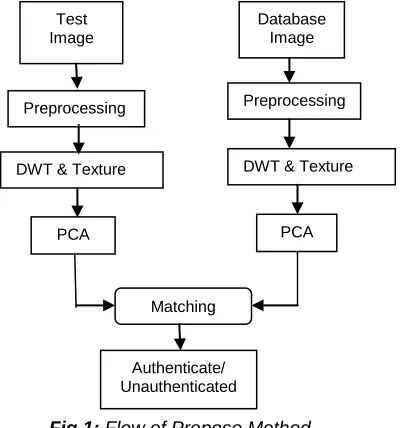
In propose method first take an image from digital camera. From this image find out RGB(Red, Green, Blue). Then RGB pattern is converted into gray scale image. With the help of Gabor filter and Canny Edge detector preprocess image. Then apply ROI(Region Of Interest) or segmentation on the gray scale. After ROI extract the features for identification of individual using DWT(Discrete Wavelet transform) and texture. Then PCA(Principal Component analysis) is use and get. extracted features to create a template.
Fig 1: Flow of Propose Method
Template means give name of person to the extracted feature to create frame of that individual. Number of templates create a database. Last stage is matching, if features of person is match with database template then it shows that individual is authorized and if not its indicates that person does not belongs to that particular group means unauthorized person.
2.2 Algorithm
Take a snapshot using webcam or digital camera.
Pre-processing of an image.
ROI/Segmentation of that Pre-processed image.
Feature Extraction of that image.
Creation of template
Authentication
i. Biometric Snapshot
In the palmprint identification for image acquisition, placed his/her palm and captured an image from a webcam or digital camera. In the image, the fingers should be clearly separated from each other in order to obtain complete palm of the individual. background should be clean. Ideally, the
placement of the palm on the surface at verification and enrollment should be identical one, special marking provide on the surface for the finger where palm should be placed. Capturing good image which increase the accuracy. So, take snapshot of image its first and very important step in this method.
ii. Pre-processing
A lot of translation and rotational information variation observed in contactless images ofpam The palm-vein of the palmprint. So, more stringent pre-processing steps are required to extract a features for stable and aligned ROI. For observing more clearly ROI images a nonlinear enhancement pattern should be obtain and its get from pre-processing steps which is recover a fixed size ROI from the acquired images, It normalized to minimize the rotational, translational, and scale changes[24]. Preprocessing is used different palmprint images and to segment the for the feature extraction. in this for extract the vein and features on palm of the palmprint use Gabor filter and canny edge detector. With the help of these extract vein features, some key point on the palm edges of the palm for ROI. Canny edge detector used the calculate of variation to satisfy above requirements to give histogram equalization.
3. ROI(Region of Interest)
With the help of ROI, now extract the feature using line detection and hand geometry.
3.1 Line detection
Palmprint features are consider in contactless biometric trait. Palm prints refer to the smoothly flowing pattern formed by alternating creases and and troughs on the palm surface of the hand. Three types of line patterns are clearly visible on the palm[6]. In case of hand vein refers to the vascular pattern or blood vein patterns recorded from hidden under the human skin.
Fig. 2: Illustrations of palm vein ROI extraction (from (a) to (h)): (a) original hand image, (b) binary hand image, (c) reference point and centroid, (d) RDF, (e) description of five
fingertips and four finger valleys, (f) the angle θ between line p1 p2 and vertical line L, (g) normalized palm vein
image, and (h) palm vein ROI.
Test Image
Preprocessing
DWT & Texture
PCA
Database Image
Preprocessing
DWT & Texture
PCA
Matching
182
Veins pattern is unique for every person and constant throughout the life. Even identical twins also give different pattern. In fact right and left hand also shows different lines.
3.2 Hand Geometry
Fig 3: Lines on Palm
Hand geometry features are extracted from the binarized intensity images of the hand. The hand geometry features utilized finger lengths and widths, finger perimeter, finger area and palm width. Measurements taken form a feature vector. The computation of matching score between two feature vectors from a pair of hands being matched is based upon the Euclidean distance.
4 Feature Extraction
With the help of ROI, now extract the feature using DWT & PCA. A contactless palmprint biometric system to consider the palm print features[14,15,16]. Palm prints refer to the smoothly flowing pattern formed by alternating creases and troughs on the palm surface of the hand. Three types of line patterns are clearly visible on the palm such as the principal lines, wrinkles, and ridges which is shown in the fig.3.
4.1 Texture
Texture is one of the technique to extract more feature from ROI of palm vein to increase accuracy and efficiency. It has some properties as follows,
Angular Second Moment(ASM)
ASM = P i, j, d, θ 2 i,j
Contrast
Con = i − j 2. P(i, j, d, θ) i,j
Correlation.
Corr = r P i, j, d, θ .i,j (i-µi). ( j-µj) / (σi.σj) Entropy
Ent = - P i, j, d, θ . log(P i, j, d, θ )i,j
Energy
Enr = P i, j 2
5 Authonticatin(Matching)
This last step of method. In this, at the end of feature extraction create extracted feature template, that template match with database template to determine whether that individual is authorized or not with help of Euclidian distance.
5.1 Euclidian Distance
Euclidian distance between two quaternion p & q are defined as,
d(p,q) = p − q
After feature extraction, one multispectral palmrpint sample has two different features, one QPCA feature fQPCA and one
QDWT feature fQDWT. Thus, two different distances, one
QPCA distance and one QDWT distance are gotten. The QPCA distance dQPCA is the Euclidean distance between
two QPCA features fuQPCA and f v
QPCA of two given samples:
su and sv, while the QDWT distance dQDWT is the Euclidean
distance between two fvQDWT & f u
QDWT.
6 RESULT
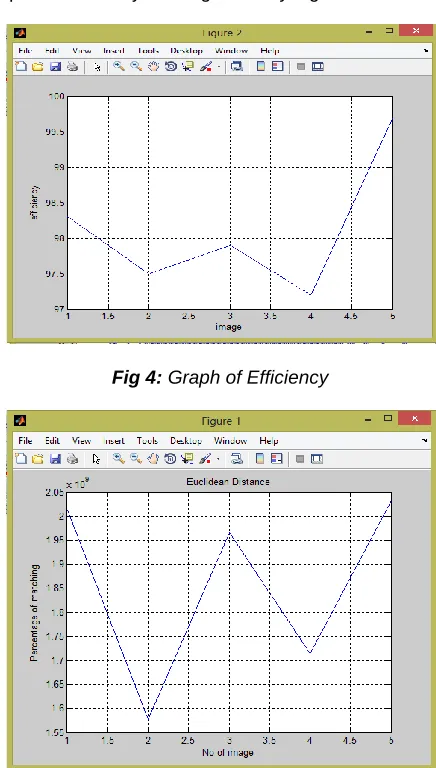
In below fig 5 shows graph of efficiency. Here, can see that got efficiency above 99%. One of the aim of this method is to improve efficiency which got at very high level.
Fig 4: Graph of Efficiency
Fig 5: Graph of Euclidian Distance.
Fig 6: Graph of Percentage Energy, Entropy Can see in fig. 6, get about to 99% energy and entropy between 25% to 50%. So, increase the energy at maximum level and got entropy in between range. In fig. 6.2 plot graph FAR & FRR versus no. of image. Observed FAR in range of 0.1 and FRR about 0.35. Percentage of graph shows in fig 6.3, can observed that got FAR in between 80% to 90%and FRR about 100%. So, in this way get lowest FAR and FRR.
Fig 7: Graph of FAR & FAR of Standard Dataset. In fig 7 shows graph of another dataset of FAR & FRR. It is observed that when compared two different dataset also got near about same ranges of FAR & FRR value and it is very low. So, can say that proposed system is accurate and efficient. If FAR & FRR are low then automatically ERR will be less with increase with threshold value. Above all results, this method is more accurate than previous methods.
Fig 8: Graph of FAR & FAR of Another Dataset In fig 8 shows another dataset of FAR &FRR. Also, it gives same result as standard dataset.
Screenshots of GUI
Screenshot of GUI shows how run program and get output.
Fig 9: Screenshot of Process Window.
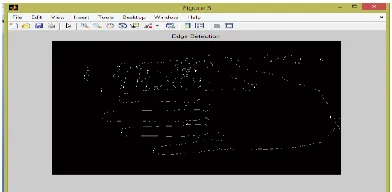
Its running program, window having certain keys like preprocess, ROI, feature extraction etc. to run program. First select image using select image key. Then press preprocess button to get Thresholding of image, Edges of image, histogram, filtering image which is shown in following figures.
Fig 10: Screenshot of Histigram of Image
Fig 12: Screenshot of Filter Out Image
Fig 13: Screenshot of Threshold Image 0%
50% 100%
1 3 5 7 9
%
Va
lue o
f
E
nerg
y
&
E
ntr
o
py
Number of Images
Energy & Entropy
Energy
Entropy
0 0.05
1 3 5 7 9
Va
lues
o
f
F
AR
&
FRR
Number of Images
FAR & FRR
FAR
FRR
0 0.05
1 2 3 4 5 6 7 8 9 10
Va
lues
o
f
F
AR
&
FRR
Number of Images
184
Fig 14: Screenshot of Detected Edge of Image
Fig 15: Screenshot of ROI
Fig 16: Screenshot of extracted Feature of Image
Fig 17: Screenshot of Created Feature Template of Image
7 CONCLUSION
This project investigated a novel approach for human identification using palm-vein images. Propose a novel preprocessing, enhancement and feature extraction techniques that can effectively accommodate the potential image deformations, translational, and rotational variations. This approach performs very well even with the minimum number of enrollment images (one sample for training). The palm vein identification method shows its robustness and superiority. In this proposed method can display output thoroughly at the end of each module or stage, so it help to understand method easily. Here, decrease FAR upto 0.01 and FRR about 0.03, can say that decrease these value at very low it about negligible. FAR & FRR decreases ERR automatically decreases upto 0.02%. Decrease ERR to increase accuracy about 98% as with decease value of
ERR. Also raise efficiency above 99%. In this way, increase accuracy and efficiency is more than existing method.
ACKNOWLEDGMENT
I would like to thanks my guide Dr. S.D. Pable, Prof. D.D. Dighe (Head of E&TC dept.) and the honorable principal Dr. G.K.Kharate for their valuable time and dedicated support. Without which it was impossible to complete my paper. Once again I would like to thank you all staff members (E&TC dept.) for their timely support.
REFERENCES
[1] A.K. Jain and J. Feng, ―Latent palmprint matching,‖ IEEE Trans. Pattern Analysis and Machine Intelligence, vol. 31, no. 6, pp. 1032- 1047, Jun. 2009.
[2] D.R. Ashbaugh, Quantitative-Qualitative Friction Ridge Analysis: Introduction to Basic Ridgeology, CRC Press, 1999.
[3] H. Cummins and M. Midlo, Finger Prints, Palms and Soles: An Introduction to Dermatoglyphics. Dover Publications, 1961.
[4] D. Zhang, W.K. Kong, J. You, and M. Wong, ―Online palmprint identification,‖ IEEE Trans. Pattern Analysis and Machine Intelli- gence, vol. 25, no. 9, pp. 1041-1050, Sep. 2003.
[5] PolyU-Palmprint-Database,
www.comp.polyu.edu.hk/~bio-metrics/, Accessed on Jun. 30, 2014.
[6] W. Jia, D. Huang, and D. Zhang, ―Palmprint verification based on principal lines,‖ Pattern Recognition, vol. 41, no. 4, pp. 1316- 1328, Apr. 2008.
[7] L. Shang, D. Huang, J. Du, and C. Zheng, ―Pamlprint recogni- tion using FastICA algorithm and radial basis probabilistic neu- ral network,― Neurocomputing, vol. 69, no. 13, pp. 1782-1786, Aug. 2006.
[8] X. Wu, D. Zhang, and K. Wang, ―Fisherpalms based palmprint recognition,― Pattern Recognition Letters, vol. 24, no. 15, pp. 2829- 2838, Nov. 2003.
[9] L. Zhang and D. Zhang, ―Characterization of palmprints by wavelet signatures via directional context modeling,‖ IEEE Trans. Systems, Man and Cybernetics, Part B, vol. 34, no. 3, pp. 1335–1347, Jun. 2004.
[10]A. Kong and D. Zhang, ―Competitive coding scheme for palm- print verification,‖ Proc. Int’l Conf. Pattern Recognition, pp. 520- 523, 2004.
[12]―Data format for the interchange of fingerprint facial, & other biometric information,‖ ANSI/NIST-ITL, 1-2007, http://www. nist.gov/customcf/get_pdf.cfm?pub_id=51174, 2012.
[13]M. Liu and L. Li, ―Cross-correlation based binary image regis- tration for 3D palmprint recognition,‖ Proc. Int’l Conf. Signal Processing, pp. 1597-1600, 2012. [27] J. Cui, ―2D and 3D palmprint fusion and recognition using PCA plus TPTSR method,‖ Neural Comput. Applic., vol. 24, no. 3, pp. 497-502, Mar. 2014.
[14]J. Funada, N. Ohta, M. Mizoguchi, T. Temma, K. Nakanishi, A. Murai, T. Sugiuchi, T. of Wakabayashi, and Y. Yamada, ―Feature Extraction Method for Palmprint Considering Elimination Creases,‖ Proc. 14th Int’l Conf. Pattern Recognition, vol. 2, pp. 1849-1854, 1998
[15]A. Jain and J. Feng, ―Latent Palmprint Matching,‖ IEEE Trans. Pattern Analysis and Machine Intelligence, vol. 31, no. 6, pp. 1032- 1047, June 2009.
[16]J. Dai and J. Zhou, ―Multifeature-Based High-Resolution Palm- print Recognition,‖ IEEE Trans. Pattern Analysis and Machine Intelligence, vol. 33, no. 5, pp. 945-957, May 2011.
[17]J. Dai, J. Feng, and J. Zhou, ―Robust and Efficient Ridge-Based Palmprint Matching,‖ IEEE Trans. Pattern Analysis and Machine Intelligence, vol. 34, no. 8, pp. 1618-1632, Aug. 2012, doi:10.1109/ TPAMI.2011.237.
[18]A. Jain and M. Demirkus, ―On Latent Palmprint Matching,‖ technical report, Michigan state., http://biometrics.cse.msu.edu/Publications/Palmpri nts/JainDemirkusOnLatent
PalmprintMatching08.pdf, 2008.
[19]J. Wang, W. Yau, A. Suwandy, and E. Sung, ―Fusion of palmprint and palm vein images for person recognition based on laplacianpalm feature,‖ in CVPR, 2007, pp. 1–8.
[20]G. Lu, D. Zhang, and K. Wang, ―Palmprint recognition using eigen- palms features,‖ Pattern Recognition Letters, vol. 24, no. 9-10, pp. 1463– 1467, 2003.
[21]X. Wu, D. Zhang, and K. Wang, ―Fisherpalms based palmprint recognition,‖ Patt. Recog. Lett., vol. 24, no. 15, pp. 2829–2838, 2003.
[22]X. Xu and Z. Guo, ―Multispectral palmprint recognition us- ing quaternion principal component analysis,‖ IEEE Workshop on Emerging Techniques and Challenges for Hand-Based Biometrics, pp. 1–5, 2010.
[23]A. Kong and D. Zhang, ―Competitive coding scheme for palmprint verification,‖ in ICPR, 2004, pp. 520–523.
[24]Z. Sun, T. Tan, Y. Wang, and S. Z. Li, ―Ordinal palmprint representation for personal identification‖ in CVPR, 2005, pp. 279–284.
[25]Y. Hao, Z. Sun, T. Tan, and C. Ren, ―Multispectral palm image fusion for accurate contact-free palmprint recognition,‖ in Proc. ICIP, 2008, pp. 281–284.
[26]D. Kisku, P. Gupta, J. Sing, and C. Hwang, ―Multispectral palm image fusion for person authentication using ant colony optimiza- tion,‖ in IEEE Workshop on Emerging Techniques and Challenges for Hand-Based Biometrics, 2010, pp. 1–
[27]Z. Guo, D. Zhang, L. Zhang, and W. Zuo, ―Palmprint verification using binary orientation co-occurrence vector,‖ Pattern Recognition Letters, vol. 30, no. 13, pp. 1219–1227, 2009.
[28]D. Han, Z. Guo, and D. Zhang, ―Multispectral palmprint recognition using wavelet-based image fusion,‖ in ICSP, 2008, pp. 2074–2077.
[29]D. Zhang, Z. Guo, G. Lu, L. Zhang, and W. Zuo, ―An online system of multispectral palmprint verification,‖ IEEE Transactions on In- strumentation and Measurement, vol. 59, no. 2, pp. 480–490, 2010.