580
PRELIMINARY STUDY FOR EXPLORING THE MAJOR
PROBLEMS AND ACTIVITIES OF MOBILE LEARNING
SYSTEM: A CASE STUDY OF JORDAN
¹MOHAMMED AMIN ALMAIAH, ¹MASITA ABDUL JALIL, ¹MUSTAFA MAN
¹ PhD Student,Department of Computer Science
¹Assistant Professor, Department of Computer Science
¹Associate Professor, Department of Computer Science
School of Informatics and Applied Mathematics, Universiti Malaysia Terengganu, Terengganu, Malaysia
E-mail: [email protected], [email protected], [email protected]
ABSTRACT
Acceptance of new system or technology has been become a prior step for a successful implementation of any system. Previous studies revealed that the acceptance of mobile learning system among students in Jordan is still very low. Few studies have investigated what the actual challenges influencing acceptance of mobile learning system in Jordanian universities. The current study investigates the main challenges that impede acceptance of mobile learning in Jordanian universities. This study also determines the activities and services of mobile learning system based on potential needs of students. In this study, we employed the questionnaire and interview approaches, targeting students from five universities across Jordan. This paper presents two portions of the findings; qualitative findings identified four main challenges that include the quality of services, availability of learning content, design and technical issues and students' requirements. In contrast, quantitative findings presented the most important services that students would like to perform on mobile learning system.
Keywords: Mobile learning system, Acceptance, Qualitative, Quantitative, Students’ perceptions.
1. INTRODUCTION
In the recent years, the great advances in mobile technologies have allowed the mobile devices are not only as a tool for voice communication but also support many features such as store and transfer multimedia contents, camera to capture, browsing internet and emails. These advances in mobile technologies as well as increasing ownership of mobile devices have motivated many universities to move towards employing mobile applications as learning aids which known as mobile learning. Mobile learning is defined as the integration of mobile handheld devices together with wireless network technologies to enhance the learning and education through facilitates students’ access to the learning contents anywhere and anytime [1]. Basically, mobile learning is based on the use of mobile devices at any time and in any place [2]. In this research, mobile learning refers to a new
581 this technology because of flexible access regardless of time and place, easily online collaborative learning, and assists teachers to deliver information in anytime and anywhere. In contrast, Jaradat [8], indicated that majority of students in Jordan have some concerns about using mobile learning and that the percentage of students' acceptance of mobile learning is (39%), and the barriers and problems that impede students' acceptance of mobile learning are still unclear [9], still the need for further research on the actual problems affecting mobile learning acceptance [10, 11, 9, 12]. This study is focused on Jordan as one of the developing countries in the Arab world, which registers a large penetration rate of mobile phones over 140% in 2013, ranking Jordan second in the Arab world in terms of mobile Internet users aged 18-29 according to [13]. Therefore, this study aims to improve mobile learning acceptance by achieving two objectives namely:
1. To investigate the main challenges that impede students' acceptance of mobile learning system.
2. To improve and expand the activities and services of mobile learning system based on students' perceptions and needs.
The structure of this paper is organized as follows: section 2 presents the literature of mobile learning. In section 3 the contribution of the study to the literature in the area of mobile learning is presented. Sections 4 and 5 describe the methodology of research and data analysis. Findings from quantitative and qualitative data analysis are presented in section 6 and section 7 presents the discussion. Finally, the conclusion in section 8 summarizes this paper.
2. LITERATURE REVIEW
2.1 MOBILE LEARNING
In the literature, mobile learning has many definitions from different perspectives: learners’ mobility, handheld devices and the relationship between mobile learning and electronic learning. By broad definition, mobile learning in terms of its technologies is the integration of mobile handheld devices together with wireless network technologies to enhance the learning and education [14]. In terms of learners' mobility, Huang, Lin and Chuang [15] fined mobile learning as a kind of learning tools that allows users to access learning material anytime and
anywhere. Mobile learning is the technology that facilitates students’ access to the learning materials anywhere and anytime [16]. From these definitions, there is one obvious advantage of mobile learning that is the mobility of contents that enables learning to take place in any location, at any time. Whereas, Trifonova and Ronchetti [17], stated mobile learning as a new technology that complements electronic learning by allowing learners' to interact with learning materials. Mobile learning is the next generation of electronic learning that uses mobile technologies [18]. Through these definitions, we can realize there is new era of learning which will start through moving from electronic learning to mobile learning. Other viewpoints in the literature have defined mobile learning based on handheld devices. Mcconatha, Praul, and Lynch [19] expressed that mobile learning is the accessing of educational materials by the use of small mobile handheld devices. Mobile learning is often confined in the literature to the descriptions of learning applications through the use of small mobile devices such as smart phones, PDAs, iPods and MP3 players [20, 21].
582 Despite unique advantages of mobile learning, there are some limitations to the success of mobile learning implementation, which should be taken into consideration. Past studies have identified some challenges of mobile learning in the advanced countries such as United Kingdom, USA, Australia, Malaysia and Japan. For example, the technological aspects are the main challenge of mobile learning in USA and Europe. In Malaysia, the higher education is working very hard to integrate mobile learning in their learning programs as well as to motivate their students to use mobile learning due to the cultural barriers to accept mobile learning [26]. In Middle East, majority of countries are still facing many of problems in mobile learning acceptance [27]. For example, in Jordan, the students’ acceptance of mobile learning system is still very low in universities [9]. But, seldom research has been conducted to determine the main challenges of mobile learning acceptance in the universities in Jordan.
2.2 MOBILE LEARNING IN JORDAN
To date, Jordan already has witnessed a very excellent development and significantly booming in mobile telecommunication infrastructures, due to the strong commitment of the Jordan government [28]. With highly developed information and communication technologies, as well as, mobile telecommunication, the mobile technologies find its way into the field of education in Jordan as well, and thus; Jordanian universities are exploiting mobile learning for enhancing learning and educational setting [29]. Besides, with the development of new generations of mobile devices, mobile learning has emerged as a new trend in Jordanian universities [29]. In addition, mobile phone devices are the most widely used in Jordan, because Jordan has registered the penetration rate of mobile phones over 140% in 2013, according
to statistics issued by the Telecommunications Regulatory Commission (TRC). Also, Jordan scored a second rank in terms of mobile Internet users aged 18-29 in the Arab world, which approximately 95% [13]. Furthermore, the mobile learning applications have the promising potential to provide learning activities to Jordanian students [9].
583 Table1. Mobile Learning In Jordan
Literature Results for the current state of mobile learning in Jordan
Althunibat (2015) The researcher confirmed that the mobile learning is still lack in acceptance
among students in Jordanian universities.
Al-Debei and Al-Lozi,
(2014) The study presented clear evidence that the adoption of full capabilities of mobile services were yet to be realized in higher education institutions of Jordan.
Jaradat (2014) The results indicated that the percentage of students' acceptance and use of
mobile learning in Jordanian universities was 39 %.
Al-Zoubi et al., (2010) The study revealed that there was an unsatisfactory indication about the
future implementation of mobile learning in Jordan.
Khwaileh and AlJarrah
(2010) The study indicated that the mobile learning in all the Jordanian universities had not been implemented successfully yet.
3. THE PROPOSED CONTRIBUTION OF STUDY
Based on Table 1 which presents the comparison between different studies for the current state of mobile learning in Jordan. We notice that all of the above studies agreed that the acceptance of mobile learning among students in Jordanian universities is still very limited. But, the researcher found that these studies have ignored the reasons that causes to low level of acceptance of mobile learning by students. Based on these facts, this study provides two types of findings that contribute to improve the acceptance of mobile learning:
1. Qualitative findings that help Jordanian universities for understanding the main challenges that affect students' to accept and use mobile learning system.
2. Quantitative findings that helps designers in making better decisions regarding mobile learning services that meets students' needs.
4.RESEARCH METHODOLOGY
In this section will present the pilot test, participants, data collection, measurement, final research instrument, and analysis methods used in this study.
4.1 Research Instrument
In this paper, a mixed instrument of questionnaire and interview questions was
584 ranging from useful to not useful. This scale was applied in several studies in this area [10, 38]. In contrast, the second part of the survey instrument contains the interview questions which were developed and discussed by the faculty members of Computer Science Department, University Malaysia Terengganu and by the faculty members of Computer Science Department, University of Jordan with the researcher in order to identify the main problems that impede the acceptance of mobile learning in Jordanian universities.
4.2 Pilot Test
Pilot test is an important step to ensure and obtain initial indications about the content validity, face validity and reliability of the instrument [39]. The term pilot test can refer to a small scale version or feasibility study which is done in preparation for the main and final instrument. In this study, the purpose of pilot test was to evaluate reliability of the instrument before accomplishing the final instrument.
4.3 Participant
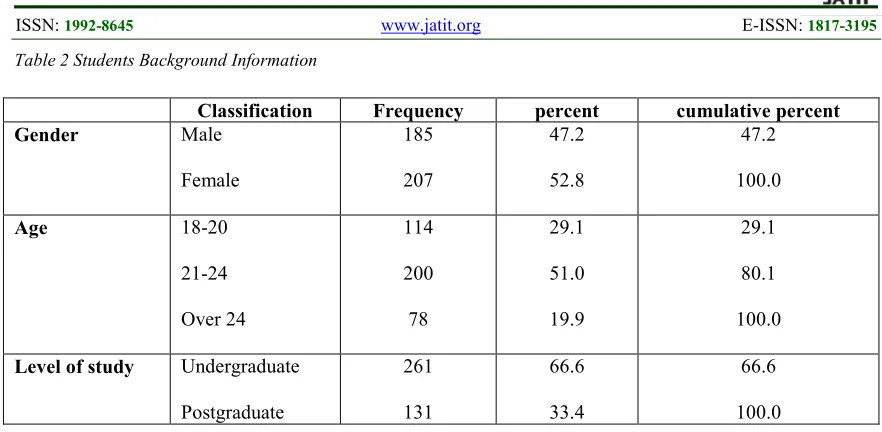
This study was conducted at five universities in Jordan: Yarmouk University (YU), University of Science and Technology (JUST), University of Jordan (UJ), Hashemite University (HU), and Mutah University (MU), in June 2015. According to Sekaran and Bougie [40], the sample size is determined by the target population. From a total population size of 112797 students from five Jordanian universities; 392 students from different subjects participated in filling the questionnaire. According to Hunt, Sparkman, and Wilcox [41], a minimum sample size for conducting a pilot test is 30 participants. For the qualitative data, the sample size of qualitative data is usually small; the minimum acceptable sample size is 5 participants [42]. Based on that, the researcher chose 25 participants for the interview questions, and they were among the students who were involved in filling of the questionnaire. Table 2 presents background information of students; where 47.2% of students were male and 52.8% were female; and 50.1% were between the ages 21-24. The respondents' study level was reported as follows: 66.6% undergraduate and 33.4% postgraduate.
4.4 Measurement
[image:6.612.83.524.69.285.2]
585 Table 2 Students Background Information
5. DATA ANALYSIS
In this study, the questionnaire analysis was performed using descriptive statistics approach by applying SPSS 18. In contrast, thematic analysis method was used to analyze the interview questions.
6. STUDY FINDINGS
This section presents two portions of the findings; quantitative findings on students' preferences of learning activities and services that they would like to perform on mobile learning application, and qualitative findings on students' perceptions about the main challenges that might impede the acceptance of mobile learning.
6.1 Quantitive Findings
This research provides two types of quantitative findings based on the type of questions that included in the questionnaire.
●Findings From Closed Format Questions
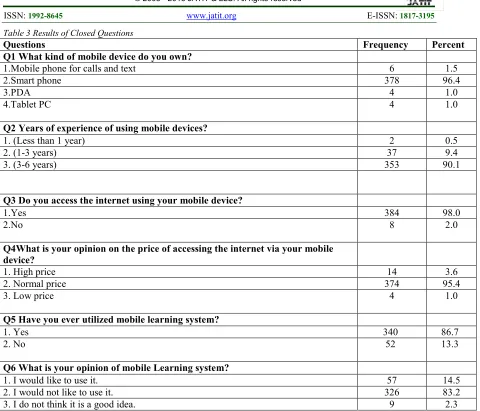
Table 3 shows the results of the responses of Jordanian students for six closed questions. The first question asked students about the mobile device ownership. Based on Table 3, mobile devices ownership statistics revealed that, 96.4% of Jordanian students owned smart phones. This indicates that the availability of mobile devices among Jordanian students is high. In addition,
this indicates that students are most likely preferring this type of mobile devices. The second question was focused on experience of using mobile devices. A majority of Jordanian students (90.1%) reported having more than three years of experience using mobile devices, which is indicative of prevalence of using mobile devices among students. Also, 98.0% of the students chose to access internet using mobile devices, as asked in the third question. This may indicate that students have preferences for accessing the internet using their mobile devices. In terms of prices of accessing the internet via mobile devices in the fourth question, a large number of students (95.4%) reported that the cost of accessing the internet via mobile devices is reasonable. This gives an indicative that the cost is not an influence on Jordanian students’ acceptance of mobile learning. Students also asked if they utilized mobile learning application before, and their opinions of mobile learning application provided by their universities. As shown in Table 3, the percentage of Jordanian students who utilized mobile learning application was (86.7%). However, (83.2%) of them would not like to use mobile learning application in the future. Based on this finding, a qualitative study was conducted in order to explore the problems and challenges that impede Jordanian students to use mobile learning, and their influence on students' acceptance of mobile learning.
Classification Frequency percent cumulative percent
Gender Male
Female
185
207
47.2
52.8
47.2
100.0
Age 18-20
21-24
Over 24
114
200
78
29.1
51.0
19.9
29.1
80.1
100.0
Level of study Undergraduate
Postgraduate
261
131
66.6
33.4
66.6
[image:7.612.87.567.66.477.2]
586 Table 3 Results of Closed Questions
Questions Frequency Percent
Q1 What kind of mobile device do you own?
1.Mobile phone for calls and text 6 1.5
2.Smart phone 378 96.4
3.PDA 4 1.0
4.Tablet PC 4 1.0
Q2 Years of experience of using mobile devices?
1. (Less than 1 year) 2 0.5
2. (1-3 years) 37 9.4
3. (3-6 years) 353 90.1
Q3 Do you access the internet using your mobile device?
1.Yes 384 98.0
2.No 8 2.0
Q4What is your opinion on the price of accessing the internet via your mobile device?
1. High price 14 3.6
2. Normal price 374 95.4
3. Low price 4 1.0
Q5 Have you ever utilized mobile learning system?
1. Yes 340 86.7
2. No 52 13.3
Q6 What is your opinion of mobile Learning system?
1. I would like to use it. 57 14.5
2. I would not like to use it. 326 83.2
3. I do not think it is a good idea. 9 2.3
●Findings From Students’ Prefernces For Mobile Learning Activities And Services
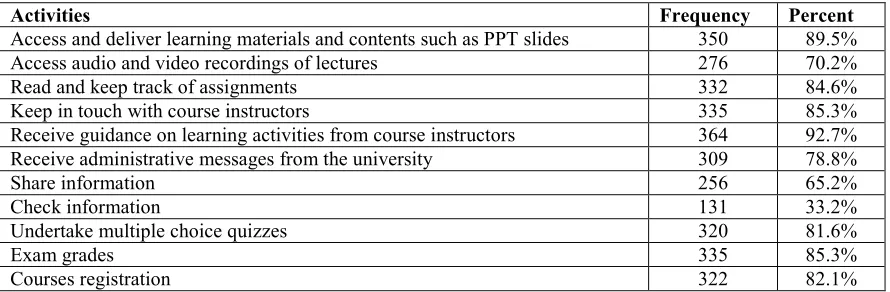
To explore learning activities and services that Jordanian students' would like to perform on mobile learning application, students were asked to select which the services are useful for learning by giving them a list of services of mobile learning. Table 4 shows that a large number of students (92.7%) chose for receiving guidance on learning activities from course instructors, followed by (89.5%) for accessing
[image:8.612.85.530.113.259.2]
587
Table 4 Results of students’ preferences for mobile learning activities and services
Activities Frequency Percent
Access and deliver learning materials and contents such as PPT slides 350 89.5%
Access audio and video recordings of lectures 276 70.2%
Read and keep track of assignments 332 84.6%
Keep in touch with course instructors 335 85.3%
Receive guidance on learning activities from course instructors 364 92.7%
Receive administrative messages from the university 309 78.8%
Share information 256 65.2%
Check information 131 33.2%
Undertake multiple choice quizzes 320 81.6%
Exam grades 335 85.3%
Courses registration 322 82.1%
6.2 Qualitative Findings
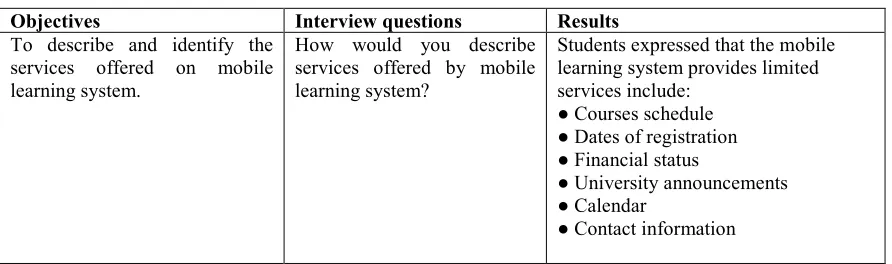
A follow-up interview was conducted in order to provide more understanding on students’ perceptions on mobile learning and to explore the main challenges influencing acceptance of mobile learning in Jordanian universities. This study used thematic analysis method to analyze the data obtained from the interview questions by twenty-five respondents. According to Braun and Clarke [44] identified six steps for conducting thematic analysis; these steps are: familiarization with data, generating initial codes, searching for themes, defining and naming themes, and producing the final report. The researchers used the same steps to analyze the data. This style of analysis method was used in several studies in this area [e.g. 10]. Table 5 summarizes the responses given to the questions in the interview.
Based on above, students were asked four questions. The first question asked students 'how would you describe services offered by mobile learning system?’. Majority of students expressed according to their comments that the ‘mobile learning system provides limited services’. Students indicated that they used the mobile learning system ‘only for some administrative services such as courses schedule, dates of registration, university announcements, and calendar’. Some students commented the 'the mobile learning is still new’ and ‘unfamiliar system’.
The second question was focused on investigating their level of satisfaction with the current services offered by the mobile learning system. The students' comments indicated that the level of services was very low such as
'services not enough', 'quality of services not
good', and ‘services do not meet their
requirements'. In addition, students also expressed the reasons behind their negative responses, which could be summarized as follows:
1. Lack of learning contents and materials. A
high percentage of the students thought that the availability of learning contents and activities is the critical aspect of the acceptance of mobile learning system. Their comments were as
following 'not contain the learning materials
such as PPT slides', 'not support the access and download courses items like e-learning system'.
2. Lack of learning activities. Students reported
that the mobile learning system does not support online learning activities; based on their
responses 'not contain learning activities', 'the
system only for viewing information'.
3. Lack of communication with course instructor. Three students stated that the nature of mobile devices as an effective communication tool between users. In contrast, they indicated that the
mobile learning system 'not offer contact with
instructors for some questions', and 'not contain discussion board to share learning content like blackboard'.
588 1. Design and technical issues of mobile learning system. A lot of the students thought that the design and technical issues are the main challenges and barriers that impede the acceptance of mobile learning. Students reported that there are some obstacles concerning to the design and technical issues such as 'the pages are not designed for small screens of mobile devices',
'difficult to use', 'lack of multimedia features',
'security and privacy aspects', and 'not contain
the learning content items like courses content, lecture notes and assignments'.
2. Lack of Compatibility. Some students stated
that they will not be able to use mobile learning
application because 'not compatible with their
mobile devices' and ‘do not have suitable devices with the application (e.g. Android, iPhone etc.)’, ‘students do not have the same type of mobile devices’.
3. Lack of availability learning contents and
activities by the mobile learning system. A lot of the students confirmed that the availability of learning contents is the primary factor to encourage students for accepting this new system.
4. Mobile learning system is a new tool for
learning, and it is still unfamiliar for students like e-learning system.
5. Lack in meeting students' requirements and needs.
In the last question, students were asked on how mobile learning system could better address their learning needs; 'how does mobile learning system address your learning needs?'. The responses reflect different viewpoints of students
on their needs and requirements, which could be summarized as follows:
1. Providing more specialized mobile learning
applications that related to learning materials and activities. Students provided their comments
as follows: one student stated 'I think mobile
learning would be best for students through easy access to course contents such as PPT slides by mobile learning application'. Some students described an interesting view of mobile learning
application, they commented 'Allowing students
to download course content items to be available on their mobile devices and this would enable them to study anytime and anywhere they want for example on planes and trains and etc'.
2. Improving services that offered by mobile
learning applications. An interesting view point provided by two students, their comments was 'Students do want just mobile devices; they want high quality services which satisfies their needs'.
Another students expressed that 'A very high
percentage of students have mobile devices such as smart phones and they use it continuously; services of mobile learning application can may encourage them to use it for learning via their mobile devices.
3. Some opinions of students from software
[image:9.612.85.531.595.727.2]engineering department indicate that 'Students' requirements of mobile learning applications should be fully determined before being implemented'. Also, they stated 'It is better to be tested on a small prototype before it is considered as an application to use by students'.
Table 5 Summary Results of Interview Questions
Objectives Interview questions Results
To describe and identify the services offered on mobile learning system.
How would you describe services offered by mobile learning system?
Students expressed that the mobile learning system provides limited services include:
● Courses schedule ● Dates of registration ● Financial status
● University announcements ● Calendar
589 To investigate the students'
satisfaction of mobile learning system offered by the university.
Are you satisfied with the level of mobile learning system offered by your university? Why?
All students stated that their
satisfaction of mobile learning system was very low.
● Lack of learning contents and materials
● Lack of learning activities
● Lack of communication with course instructor
● Lack of personalized services, and learning contents and activities ● Lack of multimedia features ● Lack of system functionalities
To explore the challenges and barriers faced students' while using mobile learning system.
Did you encounter any challenges and problem while
using mobile learning
system?
● Difficult of use ●Low of service quality ●Design of system interface ● Access speed
●Does not support all mobile application platforms
● Network accessibility ● Lack of security and privacy
To identify students’ needs for
improving mobile learning
system.
How does mobile learning system address your learning needs?
● providing more specialized academic applications related to learning
materials and activities
● Providing personalized contents and activities (e.g., student profile) ● Providing quick communication with course instructor
● Improved multimedia features ● Improved access speed ● Improved security
●Support multiple mobile application platforms (e.g., Android, and IOS) ● More services offered on mobile learning system
7. DISCUSSION
This study represents two portions of the findings. Firstly, the findings obtained from the quantitative indicate that very high percentage of Jordanian students own smart phones (96.4%). A majority of Jordanian students have more than three years of experience in using mobile devices (90.1%), which is indicative of prevalence of using mobile devices among students. 98.0% of Jordanian students prefer to access the internet using mobile devices continuously and their perceptions about the price of accessing the internet; a large number of students (95.4%) indicate that the cost of accessing the internet via mobile devices is reasonable and not expensive.
The findings also show that (86.7%) of Jordanian students who used mobile learning application before; they have negative attitudes towards the usage and acceptance of mobile learning. Furthermore, these negative attitudes indicate that Jordanian students are facing several challenges and barriers that impede to accept this new technology.
Secondly, the findings obtained from the qualitative study can be summarized as follows:
590 2. Four main challenges that prevent the acceptance of mobile learning in Jordanian universities that include the quality of services, availability of learning content, design and technical issues and students' requirements. Some of the results confirm with previous studies [45, 46].
3. A high percentage of students suggest that Jordanian universities should pay extra attention to improve mobile learning system in terms of services, learning contents, design and technical aspects to enhance the acceptance of mobile learning system. These results agree with past studies that conducted by [47, 48].
8. CONCLUSIONS
This study investigates and explores main challenges faced by the students’ universities precisely in Jordan in acceptance of mobile learning system. There are a number of challenges that still exist today that impede the students' acceptance of mobile learning. With determining these challenges can help the universities in Jordan to overcome all problems that face them in implementing mobile learning system in order to avoid possibility of failure in post-implementation in the future. Services of mobile learning are also another important issue that should also be highlighted and considered. Using and implementing services of mobile learning may be possible but uncertainties may arise to success this technology because it may not meet students' needs and requirements. Thus, comprehensive research is essential to determine the most important services that students would like to use on mobile learning system. With identifying these services can help designers in making better decisions regarding mobile learning services that meet students' needs.
REFERENCES
[1] O'bannon, B. W., & Thomas, K. (2014). Teacher perceptions of using mobile phones in the classroom: Age matters!. Computers & Education, 74, 15-25.
[2] Abachi, H. R., & Muhammad, G. (2014). The impact of m-learning technology on students and educators. Computers in Human Behavior, 30, 491-496.
[3] Almaiah, M. A., & Jalil, M. A. (2014). Investigating Students' Perceptions on Mobile Learning Services. iJIM, 8(4), 31-36.
[4] Bidin, S., & Ziden, A. A. (2013). Adoption and application of mobile learning in the education industry. Procedia-Social and Behavioral Sciences, 90, 720-729.
[5] Ozdamli, F., & Cavus, N. (2011). Basic elements and characteristics of mobile learning. Procedia-Social and Behavioral Sciences, 28, 937-942.
[6] Al-Emran, M., Elsherif, H. M., & Shaalan, K. (2016). Investigating attitudes towards the use of mobile learning in higher education. Computers in Human Behavior, 56, 93-102.
[7] Dahlstrom, E., Walker, J. D., & Dziuban, C. (2013). ECAR study of undergraduate students and information technology. 2013. [8] Jaradat, M. I. R. M. (2014). Understanding
individuals' perceptions, determinants and the moderating effects of age and gender on the adoption of mobile learning: developing country perspective. International Journal of Mobile Learning and Organisation, 8(3-4), 253-275.
[9] Althunibat, A. (2015). Determining the factors influencing students’ intention to use m-learning in Jordan higher education. Computers in Human Behavior, 52, 65-71. [10] Abu-Al-Aish, A., & Love, S. (2013). Factors
influencing students’ acceptance of m-learning: An investigation in higher education. The International Review of Research in Open and Distributed Learning, 14(5).
[11] Almaiah, M. A., & Man, M. (2016). Empirical investigation to explore factors that achieve high quality of mobile learning
system based on students’
perspectives. Engineering Science and
Technology, an International Journal. [12] Chen, B., & Denoyelles, A. (2013).
Exploring students' mobile learning
practices in higher education. Educause
Review. Retrieved from http://www.
educause. edu/ero/article/exploring-students-mobile-learning-practices-higher-education. [13] The Jordan Times. (2014). 95% of Jordanians
own mobiles; 47% use the Internet.
Retrieved 21 April, 2016 from
http://jordantimes.com/95-of-jordanians-own-mobiles-47-use-the-internet.
[14] M-leanring.org (2012). What is mobile learning? Retrieved Mar. 20th, 2016, from http://www.m-learning.org/
591 learning: A perspective of the extended
technology acceptance model. The
Electronic Library, 25(5), 585-598.
[16] Lan, Y. F., &Sie, Y. S. (2010). Using RSS to support mobile learning based on media richness theory. Computers & Education, 55(2), 723-732.
[17] Trifonova, A. N. N. A., Georgieva, E. V. G. E. N. I. Y. A., & Ronchetti, M. A. R. C. O. (2006, November). Determining students’
readiness for mobile learning. In
Proceedings of the 5th WSEAS International Conference on E-ACTIVITIES (pp. 84-89). [18] El-Hussein, M. O. M., & Cronje, J. C.
(2010). Defining Mobile Learning in the Higher Education Landscape. Educational Technology & Society, 13(3), 12-21. [19] Mcconatha, D., Praul, M., & Lynch, M. J.
(2008). Mobile learning in higher education: An empirical assessment of a new educational tool. TOJET: the Turkish online journal of educational technology, 7(3). [20] Caudill, J. G. (2007). The growth of
m-learning and the growth of mobile computing: Parallel developments. The International Review of Research in Open and Distributed Learning, 8(2).
[21] Rekkedal, T., & Dye, A. (2007). Mobile Distance Learning with PDAs: Development and testing of pedagogical and system
solutions supporting mobile distance
learners. The International Review of Research in Open and Distributed Learning, 8(2).
[22] Liu, Y., Han, S., & Li, H. (2010). Understanding the factors driving m-learning adoption: a literature review. Campus-Wide Information Systems, 27(4), 210-226.
[23] Ally, M., & Prieto-Blázquez, J. (2014). What is the future of mobile learning in
education?.Revista de Universidad y
SociedaddelConocimiento, 11(1), 142-151. [24] Cobcroft, R. S., Towers, S. J., Smith, J. E.,
&Bruns, A. (2006). Mobile learning in review: Opportunities and challenges for learners, teachers, and institutions.
[25] Sarrab, M., Elgamel, L., &Aldabbas, H. (2012). Mobile learning (m-learning) and educational environments. International journal of distributed and parallel systems, 3(4), 31.
[26] Ariffin, S. A. (2011). Mobile learning in the institution of higher learning for Malaysia students: Culture perspectives. International Journal on Advanced Science, Engineering and Information Technology, 1(3), 283-288. [27] Khan, A. I., Al-Shihi, H., Al-Khanjari, Z. A.,
&Sarrab, M. (2015). Mobile Learning (M-Learning) adoption in the Middle East: Lessons learned from the educationally
advanced countries. Telematics and
Informatics, 32(4), 909-920.
[28] Al-Shboul, M., Rababah, O., Al-Saideh, M., Betawi, I., & Jabbar, S. (2013). A Vision to Improve E-Learning at the University of Jordan. World Applied Sciences Journal, 21(6), 902-914.
[29] Hassan, M. H., Alhosban, F., & Hourani, M. A. (2016). Using Mobile Technologies for Enhancing Student Academic Experience:
University of Jordan Case Study.
International Journal of Interactive Mobile Technologies (iJIM), 10(1), 13-18.
[30] Almaiah, M. A., Jalil, M. A., & Man, M. Extending the TAM to examine the effects of quality features on mobile learning
acceptance. Journal of Computers in
Education, 1-33.
[31] Al-Debei, M. M. (2014). The quality and acceptance of websites: an empirical investigation in the context of higher education. International Journal of Business Information Systems, 15(2), 170-188. [32] Al-Zoubi, A. Y., Jeschke, S., & Pfeiffer, O.
(2010). Mobile learning in engineering education: The Jordan example. In International Conference on E-Learning in the Workplace.
[33] Khwaileh, F. M., & AlJarrah, A. A. (2010). Graduate students’ perceptions toward
mobile-learning (m-Learning) at the
University of Jordan. Instr. Technol, 7, 15-24.
[34] Johnson, B., & Christensen, L. (2008).
Educational research: Quantitative,
qualitative, and mixed approaches. Sage. [35] Anderson, T., & Shattuck, J. (2012).
Design-based research a decade of progress in education research?. Educational researcher, 41(1), 16-25.
[36] Trifonova, A., & Ronchetti, M. (2003). Where is mobile learning going. In Proceedings of World Conference on
E-Learning in Corporate, Government,
592 [37] Akour, H. (2009). Determinants of mobile
learning acceptance: an empirical
investigation in higher education (Doctoral dissertation, Oklahoma State University). [38] Alzaza, N. S., & Yaakub, A. R. (2011).
Students' awareness and requirements of mobile learning services in the higher education environment. American Journal of Economics and Business Administration, 3(1), 95.
[39] Uma Sekaran. (2000). Research methods for business: A skill-building approach. John Wiley & Sons.
[40] Sekaran, U. (2009). Bougie. M,“Research Methods for Business: A Skill Building Approach”. UK: John Wiley & Sons. [41] Hunt, S. D., Sparkman Jr, R. D., & Wilcox, J.
B. (1982). The pretest in survey research: Issues and preliminary findings. Journal of Marketing Research, 269-273.
[42] Merriam, S. B. (2009). Qualitative research: A guide to design and implementation: Revised and expanded from qualitative research and case study applications in education. San Franscisco: Jossey-Bass. [43] Hair, J. F., Black, W. C., Babin, B. J.,
Anderson, R. E., & Tatham, R. L. (2010). Multivariate data analysis (7th Eds.). NY: Pearson.
[44] Braun, V., & Clarke, V. (2006). Using thematic analysis in psychology.Qualitative research in psychology, 3(2), 77-101. [45] Mehdipour, Y., & Zerehkafi, H. (2013).
Mobile learning for education: Benefits and
challenges. International Journal of
Computational Engineering Research, 3(6), 93-101.
[46] Osang, F. B., Ngole, J., & Tsuma, C. (2013, February). Prospects and challenges of mobile learning implementation in Nigeria: Case study National Open University of
Nigeria (NOUN). In International
Conference on ICT for Africa (pp. 20-23). [47] Economides, A. A., & Grousopoulou, A.
(2009). Students’ thoughts about the importance and costs of their mobile devices’ features and services. Telematics and Informatics, 26(1), 57-84.
[48] Lam, P., Wong, K., Cheng, R., Ho, E., & Yuen, S. (2011). Changes in Students‟ Mobile Learning Readiness-Comparison of survey data collected over a nine-month
593 APPENDIX A. INSTRUMENT SURVEY
A.1 Survey Questionnaire
Section One. Background Information
Please answer to the following options by marking (√) in a box:
1. Age □18-20 □21-24 □ over 24
2. Gender □ Male □ Female
3. Level of Study □ Undergraduate □ Postgraduate
Section Two. Multiple-choice questions
Please answer to the following questions by marking (√) in a box:
1. What kind of mobile device do you own?
Mobile phone for calls and text Smart phone
PDA Tablet PC
2. Years of experience of using mobile devices?
0-1 year 2-3 years 4-6 years
More than 6 years
3. Do you access the internet using your mobile devices?
Yes No
4. What do you use mobile devices for?
Searching for information Education
Shopping Entertainment
5. What is your opinion on the price of accessing the internet via your mobile device?
High price Normal price Low price
594 Yes
No
7. What is your opinion of m-Learning system?
Good idea and I would like to use it. Good idea but I would not like to use it. I do not think it is a good idea.
Section Three. Students’ preferences for mobile learning services.
Direction: Please respond to the following statements by marking (×) on options from [(1) useful to (3) not
useful].
Mobile learning services Useful Neutral Not useful
1. Access and deliver learning materials and contents such as PPT slides
2. Access audio and video recordings of lectures 3. Read and keep track of assignments
4. Keep in touch with course instructors
5.Receive guidance on learning activities from course instructors 6. Receive administrative messages from the university
7. Share information
8. Check information
9. Undertake multiple choice quizzes
10 Exam grades
11. Courses registration
A.2 Interview Questions
The below are face to face interview questions:
1. How would you describe services offered by mobile learning system?