Advanced Coating Technology A.C.T.TM
MORE EFFECTIVE USE OF THE PLATINUM METALS
WILL
BENEFIT THE GLASS MANUFACTURING INDUSTRY
By D.
R.
Coupland
Johnson Matthey Technology Centre
The glass industry manufactures a multitude of products ranging fiom domestic glass table- ware to “high tech” optical glass. In its most basic form, such glass is a combination of soda lime and silica with additions of modifiers and refin- ers, and when molten it is a very aggressive sub- stance. During product manufacture much of the process equipment is subjected to severe envi- ronments, which may involve high temperatures, or corrosive chemicals, or both, and equipment
will be in contact with both liquid glass and the glass vapour. In view of this, difficulties are encountered in the containment, handling and processing of glass. A need therefore exists for materials which have excellent corrosion resis- tance and good stability at high temperatures; such properties are typical of the platinum group metals.
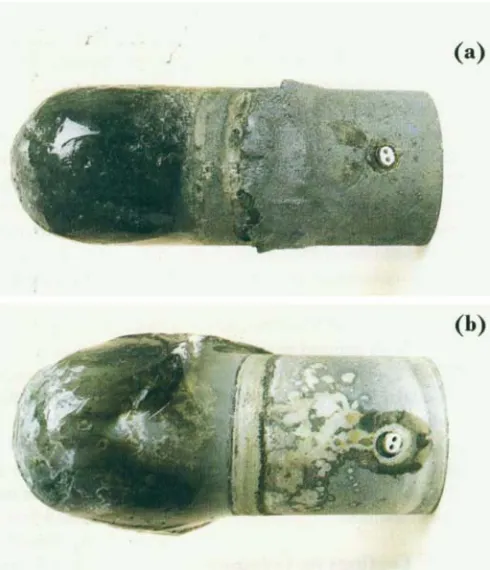
At first sight, transition metals, such as nick- el and iron, and the refkactory metals molybde- num and tungsten, with their excellent mechan- ical properties and modest cost, make ideal candidates for use in the glass industry. The rehctory metals, notably molybdenum, are very useful in the molten glass environment, but only under strictly controlled conditions. The poor resistance to oxidation of transition metals and their alloys, however, results in apparatus having only a limited service life, leading to premature failure and colouring of the glass, see Figure 1.
By comparison, the rehctory oxides (ceram- ics) have high temperature stability but they suf- fer fiom relatively poor mechanical properties, notably brittleness and poor thermal shock resis- tance, and moderate resistance to corrosion by molten glass. The intrinsic disadvantages of lim-
A.C.TTM is a trade mark of Johnson Matthey PLC.
ited thermal shock resistance, combined with spallation and dissolution in the glass melt, resmct their use.
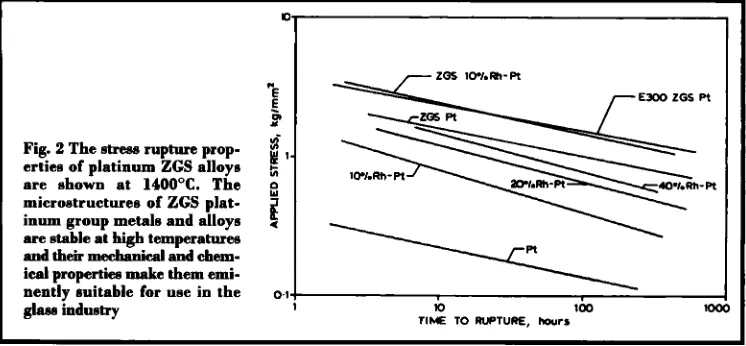
The best combination of properties for use in the molten glass environment are provided by the platinum group metals and their alloys, which are characterised by high melting points and excellent chemical nobility. Platinum is one of the most inert of the group, and it is relatively non-reactive with most glass melts up to approx- imately 1450°C; however, the service life of con- ventional platinum alloys may be limited at high- er temperatures by grain growth. Over many years, a range of zirconia grain stabilised (ZGS) alloys, which contain very fine, uniform disper- sions of oxide particulates, has been developed by Johnson Matthey (1). Such dispersions restrict mimstructural degradation and &ectively mend the operating life at these higher temperatures. The manufacturing process for ZGS alloys pro- motes the formation of a high aspect ratio grain structure. This elongated structure is extremely stable even at very high temperatures and results in alloys which exhibit the highest tensile strengths, creep properties and general durabil- ity levels of all comparable platinum group met- als and alloys, see Figure 2; thus they are emi- nently suitable for use in the glass industry (2).
The use of ZGS platinum group metals and alloys has enabled cost effective solutions to be achieved for a wide range of industrial problems. There are, however, a number of other applica- tions for which the platinum group metals would provide the ideal technical solution, but where, because of their intrinsic value, the advantage gained would be insufficient to just@ their use in bulk.
In some instances, alloying platinum group metals with base metals can be used to obtain
Fig. 1 Two examples of nickel- chromium alloys shown after
partial immersion glass testing at 1200°C for 100 hours. The use
of unprotected nickel can result in the early failure of equipment and discoloration of the glass being p r d
(a) shm eorroBive attack at the air/sulmtrate/glaaa interfa- and (b) shows build-up of oxide resulting from gross oxidation of the nickel alloy in the glass
vapour
improved mechanical properties and decreased costs, but there is a related reduction in resis- tance to the harsh conditions encountered in service.
For components of relatively simple shape one solution has proved to be the use of platinum group metal claddings on ceramic or base metal
substrates in place of bulk platinum group met- als. This has resulted in reduced cost compo- nents with appropriate properties.
Now, new Advanced Coating Technology (A.C.T.TM) (3), which is being introduced by Johnson Matthey, will allow the advantageous properties of platinum group metal claddings,
Fig. 2 The stre%e rupture prop- erties of platinum ZGS alloys are shown at 140O0C. The microstructures of ZCS plat- inum group metals and alloys
are stable at high temperatures i d propertiea make them emi- nently suitable for use in the glass industry
and th& mechanical end &em-
I
10 too moo
TIME TO RUPTURE, hours
currently available for only a small mnge of prod- ucts, to be used in both traditional and new areas of application, especially on more complex shapes. This A.C.T.TM platinum group metals coating technology will extend the existing fused salt and aqueous Q-salt plating (4) capability of Johnson Matthey,
Coating
Technology
The prime objective of a coating is to achieve a combination of the best properties of the sub- strate and the coating, while diminishing their less favourable characteristics. In the case of plat- inum coatings, the
aim
is to retain the mechan- ical properties of the substrate and confer on it the beneficial environmental resistance provided by platinum. By coating with platinum, the poor corrosion resistance of the substrate is improved, while the high density and the cost are lowered relative to those of bulk platinum. Mechanically cladding a substrate with platinum goes part way towards this ideal, but the lack of an integral bond between the substrate and the cladding means that the two materials act independent- ly. However, the intimate nature of A.C.T.TM coatings enables them to develop synergistic char-acteristics with the substrate.
At high temperatures the use of coatings or claddings is potentially limited by their interac- tion with the substrate. This interaction is pre- dominantly controlled by dif€usion and can lead to rapid degradation of the coating, with signif- icant loss ofproperties (5). The whole A.C.T.TM process has been modelled by computer using available diffusion data (6) and standard equations. This enables predictions to be made of the likely behaviour of various combinations of materials, over chosen temperature ranges and times, although these can only serve as a gener- al guide to the actual performance of the mate- rials under service conditions.
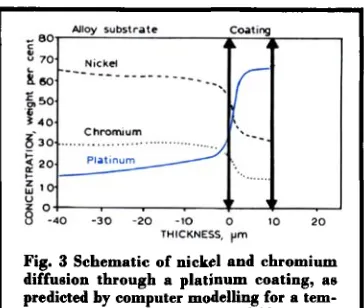
One example of a computer modelled predic- tion of how nickel and chromium could be expected to diffuse through a platinum coating is shown in Figure 3. The prediction indicates that after only 24 hours at 120OOC there would be extensive diffusion of both base elements into a 10 pn platinum layer. Actual nickel-chromium
A k y substrate
THICKNESS, PIT
Fig. 3 Schematic of nickel and chromium diffusion through a platinum coating, ae predicted by computer modelling for a tem- perature of 1200OC and a time of 5 hours
substrates, plated with 15 and 25 pm of plat- inum, are shown in Figure 4 after partial immer- sion for 24 hours in molten glass at 1200°C. The platinum coatings have been degraded by the outward diffusion of nickel (indicated by the green coloration) and also by the effects of ther- mal stress, leading to total disruption in the case of the thinner coating. Thus experimental behav- iour was comparable with the predictions of the model, which was subsequently used to develop more complex coating systems able to overcome the problem of diffusion. Following extensive laboratory experiments and trials of systems selected on the basis of predictions h m the mod- els, a complex coating system designed to over- come the effects both of diffusion and differen- tial thermal expansion between substrate and coating has been developed.
The make-up of the coating system is depen- dant upon the substrate to be protected and the intended service environment. For example, to protect nickel-chromium type substrates the coat- ing consists of several distinct layers, each of which has one or more functions:
(i) To o s e t any mismatch between substrate and protective outer layer, which results from variations in thermal expansion characteristics. The strains arising fiom such differences can be large and must be accommodated by the ductil- ities of the interlayers together with their ther- mal expansivities.
(ii) To slow interdiffusion between t h e
Fig. 4 The effects of 24 hours partial immersion in molten glass, at 12OO0C, on a nickel alloy coated directly with plat-
inum; (a) shows glass line dis- ruption of a 15 pm platinum
canting and
(a)
shows *ion a 25 pm coating of platinum ofnickeldchromiumthmughconstituents of the outer protective coating and or a platinum group metal, although this could the underlying substrate material. Such inter- be varied significantly depending on the W s i o n is usually deleterious. specific service requirements.
(iii) To key the other layers together in order
to improve mechanical integrity. Testing the Coatings
The total coating thickness may be as low as The A.C.T?' coating system was designed to 250 pm, but it can be substantially greater. Of enhance the surface properties of substrates with this thickness, 150 to 200 pn is usually platinum inherently good mechanical properties andor
Fig 5 The working end of a platinum A.C.T.I" coated tri- level thermocouple assembly after 2800 hours of forehearth
service at 1200OC
thermal stabilities at high temperatures. Considerable laboratory testing of such coatings was undertaken before the work was extended to include field trials of protected nickel-chromi- um alloys.
This
work was performed in fore- hearths of major glass container companies in theU.K.
and in Australia. With typical molten glass temperatures of between 1 100 and 12OO0C, substrate protection was achieved for up to the maximum test time of 4500 hours, Figure 5.It was recognised that this technology was lim- ited by the strength of the substrate material at high temperatures, which in the case of nickel- chromium alloys imposed an upper temperature limit of 1200 to 1250°C. This temperature max- imum would limit the applications of the coated materials to only a hction of their potential uses in the glass industry. Attention was therefore transferred to the development of protection for higher temperature substrates, namely the rehctory ceramics.
A.C.T.m Coatings
on
Ceramics
The technology developed to provide protec- tive coatings for nickel based alloys was extend- ed further to allow its application to some of the many varieties of refractory ceramic substrates
(7). Mullite tubes, closed at one end, were used as substrates in the first mals, which were per- formed at temperatures up to 135OOC. During this phase of laboratory testing the thickness of
the platinum in the protective coating system was between 150 and 400 p. Failure of the alumi- na crucibles used to contain the molten glass limited the duration of tests to about 500 hours at 1200”C, and to 100 hours at 1350°C.
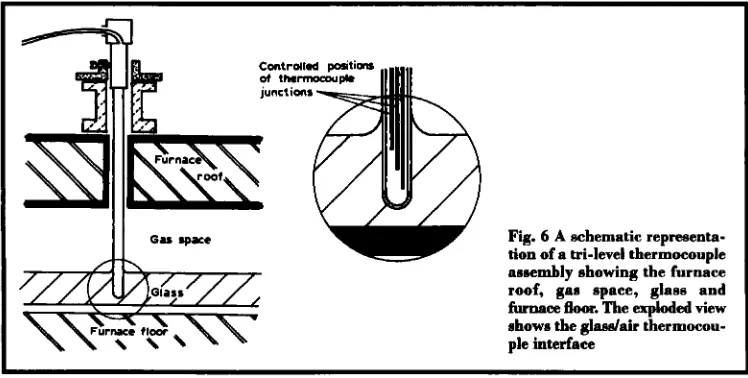
Components coated using the A.C.TJM sys- tem were subjected to extensive investigation and analysis in tested and untested conditions. Only after this were field tests undertaken using A.C.T? on tri-level thermocouple assemblies, see Figure 6. The early field tests were under- taken in a forehearth operated by a glass con- tainer manufacturer, and the first components were subjected to temperatures ofup to 1200°C in molten flint, amber and green glasses, in suc- cession. Sufficient confidence was gained in the performance of these coated tri-level thermo- couples to allow their use as part of an integrat- ed system for glass temperature control. Now in its eleventh month of use, the A.C.T.TM coated assembly is still “problem free”.
An example of a mullite substrate protected by a 10 per cent rhodium-platinum A.C.Tm sys- tem is shown in Figure 7.
Following the first field tests, further compo- nents have been tested in forehearths at various glass plants located around the world. These tri- als have involved mullite substrates, and various thicknesses and compositions of platinum group metal A.C.T.TM coatings have been used to pmvide the protection over Werent lengths of the
Fig. 6 A sehematic repreaenta- tion of a tri-level thermoeouple assembly showing the furnace roof, gaa space, glass and furnace floor. The exploaea view
shows the g l d a i r thermocou- ple interface
Fq. 7 The working end of a tri- level thermocouple assembly with part of the mullite tube A.C.T.m coated with 10 per cent rhodium-platinum, shown after lo00 hours of forehearth service
component. All have performed extremely well, and have even shown some unexpected addi- tional benefits. For example, one user has observed significant reductions in the “noise” associated with thermocouple readings, com- pared with that from conventional products hav- ing the same protected length.
Although much of the research and develop- ment work used mullite as a substrate, other rehctories have also been successfully protect- ed by A.C.TTM systems. These have ranged firom high purity alumina to almost pure silica, includ- ing materials such as zircon-mullite and alumi- na-silicates. Work to extend the variety of sub- strates which can be protected by A.C.T.TM systems is now being undertaken.
Within the glass industry this technology could be applied to the protection of a wide variety of components including the rotors for fibre glass production, bubbler tubes, electrodes, skimmer blocks, flow control devices, gobbing units, stir- rers, orifice rings and other special delivery-form- ing equipment and furnace furniture. Commercialisation has now begun, primarily for thermocouple sheathing.
The Tri-Level Thermocouple Aeeembly Design
The protection of thermocouples is the start- ing point for the commercial application of A.C.TTM technology. This is particularly direct- ed at the arduous service environments associated
with
the intrusive monitoring of glass tempera- tures either in forehearths or in melting furnaces( 8 , 9 ) . One important sub-group of thermocou- ples is the m-level thermocouple.
In
this
particular application the benefits result- ing from the use of A.C.T? on thermocouple assemblies in preference to conventional cladding include the ability to cwtomise a standardised basic assembly design with:variable assembly length variable coating length
variable coating thickness profiles
variable composition of the coating material. Thus the specific requirements of a customer can be rapidly fulfilled.
The Financial Benefits of
Using
A.C.T.mIn addition to the technical benefits resulting h m the integration of the substrate and the pro- tective metal coating, the A.C.T? system also confers the potential for significant financial ben- efits to accrue from the more effective use of the platinum group metals.
First,
protective A.C.Tm coatings can be prepared at thicknesses down to 175 p, which compares favourably with the lower limits for conventional cladding proce- dures, which are about 350 to 400 p. Secondly, platinum group metal layers of 400 p thick, or more, can easily be achieved by A.C.T?‘ over critical areas of components where enhanced durability or other specific properties a~ required for a particular application. Importantly, AC.TTMComparison of
mid
Thicknese Profilea for anA.C.T.m Coated and a Conventionally Clad Tri-Level Thermocouple Sheath
I
Length of segment for coating, cm
A 15
B 5
c
10Thickness, p n
A.C.T.TM
E 175
G 350
F 200
d Substrate diameter 1.4 cm
Clad
350 350
350
1.4cm
i I
technology enables the thickness of the platinum group metal coating, and thus the protection provided, to be matched to the various service conditions encountered at Merent parts of the same component.
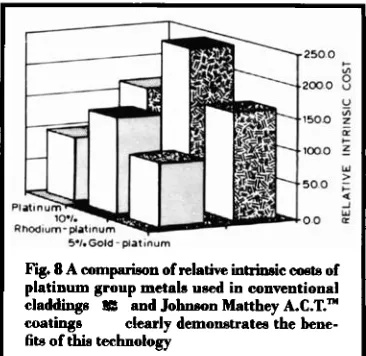
Qpical dimensions of A.C.T? and conven- tional coatings used on a traditional design of tri-level thermocouple sheath are shown in the Table, while the cost benelits, see Figure 8, which may result from the more effective use of the platinum group metals can be deduced h m the Table by a comparison of the relative weights of the metals used.
Gathering Balls
The transfer of molten glass into moulds can be accomplished by a number of techniques, with the selection being based on the volume and speed of the required transfers. At low rates a gathering or
transfer
ball is used (10); this utilis- es the rotation of the ball and the viscosity of the melt to achieve “carry over” of the glass. Traditionally iron balls were used-
a natural extension of the blowing iron, but more recent- ly ceramic balls were introduced, mainly to elim- inate problems resulting h m contamination of the glass with iron. These balls are available in aPlatinum Me& Rev., 1993,37, (2)
wide range of sizes and compositions but all have some basic disadvantages, such as being sus- ceptible to corrosion, the severity of which depends on the composition of both the ball and the glass. This corrosion may result in the pro- duction of blisters and perhaps even stones in the glass. The gathering balls also tend to be sus- ceptible to sudden failure due to thermal shock or thermal cycling, so they must be carefdly pre- heated before use and maintained hot between campaigns. The operatingregimes required, even when successful, cause considerable loss of pro- duction time.
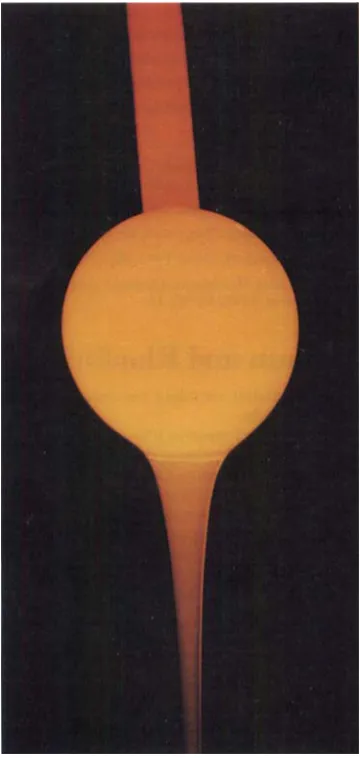
Recent trials of gathering balls made of select- ed ceramic substrates clad with A.C.T?‘ plat- inum coatings, see Figure 9, have shown that considerable progress has been made in over- coming the problems discussed above. In addi- tion to overcoming corrosion, gathering balls with coatings of 200 pm nominal thickness have demonstrated excellent glass transfer character- istics, have enabled start-up times to be min- imised and have shown tolerance to repeated stopstart cycles.
To date trials have been performed in borosil- icate glasses and in lead crystal, with operating temperatures in the range 1200 to 1400OC. To enable the gathering balls to be examined, trials have now been curtailed after several weeks of operation. An evaluation of the potential for using A.C.T? on transfer balls is still being carried
Fq. 8 A comparison of reletive mhiosic UH~S of platinum group metals used in conventional claddings #Z and Johnson Matthey A.C.T.m coatings clearly demonstrates the bene- fits of t h i s technology
Fig. 9 A platinum A.C.T."' coated ceramic gathering
ball streaming molten glass, during service trials
out, and the potential benefits of using platinum p u p metal alloys as alternatives to platinum are also being examined and assessed.
Other Components
One of the exciting aspects of the A.C.T.TM coating technology is its versatility. It can be applied to a wide range of component shapes. Indeed the major benefits of the technology to users are expected to occur &om the elimination or reduction of component failure, which other- wise d t s in major production downtime. Many of these components are complex in shape and
therefore not amenable to cladding by the tra- ditional techniques. On such shapes A.C.T.TM will allow the utilisation of platinum group met- als, and their use will be readily justified by the ensuing extension of component operating life andor improvement in product quality.
A large component coated with 10 per cent rhodium-platinum alloy by A.C.TTM has been sup- plied to a major European glass manufacturer.
Summary
and
Conclusions
Despite their inherent disadvantages, notably brittleness, poor thermal shock resistance and poor resistance to molten glass corrosion, the rehctory ceramics have for many years been the preferred materials of choice for equipment used in the glass industry. In many of their applica- tions satisfactory performance is achieved by reg- ular replacement. In other situations, platinum and its alloys, which are also accepted as essen- tial materials for the fabrication of crucial com- ponents, are used to clad the rehctory ceram- ics with a protective coating. The use of cladding is, however, limited by the complexity of the shape of the subsmte which can be satisfactori- ly clad, and by the minimum thickness which can realistically be applied.
These restrictions can be overcome by A.C.T.TM, so there will be opportunities for A.C.T.TM platinum group metal coatings on ceramics to progress into areas of glass produc- tion technology where the cost of bulk platinum group metals has inhibited their use, or where the process of cladding is too unwieldy, or indeed technically non-feasible.
Platinum group metal A.C.T.TM coatings have several advantages over cladding:
Easier and more effective protection of diB- cult-to-clad intricate shapes
Thinner platinum group metal layers, leading to lower metal costs
Thickness profiling of platinum group metals Elimination of cementing or mechanical fixing of protective layer to substrate
Elimination of welding platinum group metals Use of alloys which are not amenable to cladding.
As in any industry, the glass manufacturers
are not only looking to improve the quality of their product but also to achieve economies in production.
To these ends, the benefits which users of A.C.T.TM coatings should derive will include
improved reliability of the coated component, i m p d thermal shock mistance, reduced down times, and generally maintained or improved quality of the glass end product, with respect to both defects and to dimensional tolerances.
References 1 R B. McGrath and G. C. Badcock, Mmimm2 Metals
Rea, 1987,31, (l), 8; and the reference therein 2 J. Stokes, Platinum M e 4 Rev., 1987,31, (2),54
4 P. E. Skinner, Platinum Metals Rev., 1989,33, (3),
5 D. Ott and Ch. J. hub, PIaninUn M&als Rev., 198
6 “Metals Reference Book”, Smithells, 5th Edn.,
7 pending European Appl., 931300,823
9 D. A. Toenshoff, G h s , 1992,69, (l), 21 Butterworths, 1976, London
Johnson Matthey
pLc>
AHz. 471,505A 8 R.W. M Marshall, Glass, 1989,&, (6)102
31, W , 6 4
10 W. Lindner Maschinen, Glassmachinery Pkznts &
Accessories, 1992, V, (4), 43
Availability
of Platinum, Palladium
and
Rhodium
In view of their widespread use in the auto-motive, chemical, electronic and petroleum industries the platinum metals are regarded as strategic materials in the United States of America. For this reason the US. Bureau of
Mines collects and evaluates information relat- ing to their availability and demand. A previ- ous report from this organisation was published in 1982, based on data - from the so-called market economy countries - available up to 1980 (1). Since then major changes have occurred in the supply of these metals as the industry prepared to satisfy the increased demand expected to result from new anti-pol- lution legislation, particularly in countries of the European Community.
This earlier study has now been updated fol- lowing a complete re-evaluation of resources, industry structure and costs (2). Based on 1989 data, the new report commences with an overview of supply and industrial demand for platinum, palladium and rhodium. A further section considers the resources, cost and eco- nomic factors that affect the availability of the platinum metals, and includes pricing and price proportion analysis, and availability analyses. Data are presented in a total of thirty-four fig- ures and tables, and this main part of the report is supported by 106 references.
In an appendix, demand and uses for the plat- inum metals are summarised. Environmental uses are regarded as some of the most critical of the many industrial applications; demand for jewellery and investment are also considered. In other appendices the methodology employed in this study is explained, the major mining properties in Southern Africa and North America are described, and mining, treatment
and autocatalyst recycling processes are sum- marised briefly.
This most informative fifty-four page report is available without charge from: Chief, Branch of Minerals Availability; U.S. Bureau of Mines; 810 7th Street, Nw, Washington, DC 20241- 5202; U.S.A. For technical information, con- tact Catharine T. Fogg or Joseph
L.
Cornellisson at the Minerals Availability Field Office; U.S. Bureau of Mines; Building 53, Denver Federal Center; Denver, CO 80225; U.S.A.References
1 T. F. Anstett, D. I. Bleiwas and C. Sheng-Fogg, “Platinum Availability-Market Economy Countries”, IC 8897, U.S. Bureau of Mines, Washington, 1982,16pp
2 C. T. Fogg and J. L. Cornellisson, “Availability of Platinum and Platinum-Group Metals”, IC 9338, US. Bureau of Mines, Washington, 1993, 54PP
Ultra
Micro
Glutamate Sensor
Microbiosensors based on semiconductor fabrication technology are of the order of mil- limetres in size, but significantly smaller elec- trodes are required for insertion into the brain or nerve tissue. Now researchers in Japan have constructed an integrated ultra micro enzyme sensor with a 7 pm diameter platinised carbon fibre disc electrode and a platinum thin film counter electrode (E. Tamiya,
Y.
Sugiura, T. Takeuchi, M. Suzuki, I. Karube and A.Akiyama, Sens. Actuators B, 1993, 10, (3),
The surface of the carbon fibre electrode was platinised electrochemically, which increased the electrode activity sufficient for the sensor to be used for the determination of glutamate, an important neurotransmitter.
179-184).
Platinum Memk Rev., 1993, 31, (2) 70
1 R B. McGrath and G. C. Badcock, Mmimm2 M&
Rea, 1987,31, (l), 8; and the reference therein
2 J. Stokes, PlatinumMetrJcRev., 1987,31, (2), 54
3 Johnson Matthey PLC, European Appl. 471,505A
4 P. E. Skinner, Platinum Metals Rew., 1989,33, (3),
5 D. Ott and Ch. J. hub, FIaninun M& Reu, 1987, 102