http://dx.doi.org/10.1595/147106712X630615 http://www.platinummetalsreview.com/
Reviewed by Timothy V. Johnson
Corning Environmental Technologies, Corning Incorporated, HP-CB-2-4, Corning, NY 14831, USA
Email: [email protected]
The annual SAE Congress is the vehicle industry’s largest conference and covers all aspects of automotive engineering. The 2011 World Congress was held in Detroit, USA, from 12th–14th April 2011. There were upwards of a dozen sessions focused on vehicle emissions technology, with most of them on diesel emissions. About 60 papers were presented on the topic. In addition, there was one session on gasoline engine emissions control with about six papers presented.
This review focuses on key developments related to the platinum group metals (pgms) for both diesel and gasoline engine emissions control from the conference. Papers can be purchased and downloaded from the SAE website (1). As in earlier years, the diesel sessions were opened with a review paper of key developments in diesel emissions and their control from 2010 (2).
Lean NOx Traps
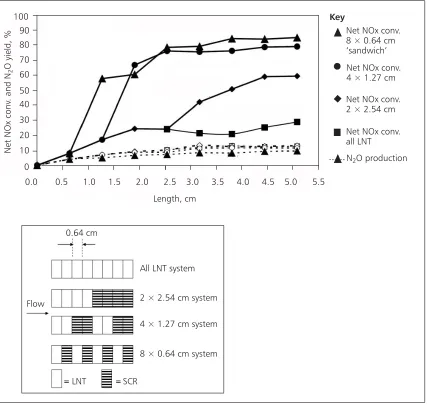
Joseph Theis (Ford Motor Co, USA) reported (3) on an interesting study in which they alternated lean NOx trap (LNT) and selective catalytic reduction (SCR) slices in one can to check the effect of NOx, ammonia and hydrocarbon (HC) distribution on deNOx performance. The total volume of the LNT and SCR was constant as was the pgm loading on the LNT, at about 3.0 g l–1. The system performance improved as the number of alternating slices of the LNT and SCR increased. As shown in Figure 1, deNOx effi ciency for the eight segment system (four pairs of LNT and SCR catalysts) was 81% in a reference test at 275ºC, vs. 78% for four segments and 60% for two segments. The reference single LNT with no SCR catalyst had only 30% deNOx effi ciency. The authors estimate that the pgm loading on the LNT-only system would need to double to reach the performance of the four- or eight-segment system. The authors also show reduced nitrous oxide (N2O), ammonia, HC
and carbon monoxide (CO) emissions with the segmented systems. Various dynamics are operative, but the segmented systems tend to better match the nitric oxide (NO) and ammonia concentrations in the
SCR, and alternating SCR slices better adsorb HCs for enhanced utility.
Ford also reported vehicle and laboratory testing on a second generation LNT + SCR system (4). The diesel oxidation catalyst (DOC) (2.2 l, 7 g pgm) + LNT (3.6 l, 10.8 g pgm) + SCR (4.9 l) + diesel particulate fi lter (DPF) (6.6 l, 1.2 g pgm) system was installed on a prototype Ford F-150 pick-up truck (2610 kg, 4.4 litre V8, turbo-diesel). The aged system (64 h, 750ºC) reduced NOx by 96% to 13.5 mg mile–1, and HC emissions were 14 mg mile–1 (reduced by 99%), bringing the vehicle to within the emerging California third generation Low Emission Vehicle (LEV III)
programme limit values (30 mg mile–1 HC + NOx) on the standard certifi cation test cycle. The laboratory work focused on HC reductions from the system. The SCR component reduced HCs by about 75%, mainly by adsorption under rich conditions and oxidation under lean conditions.
Low load (low temperature) NOx exhaust emissions control is diffi cult using urea-SCR because urea cannot be properly evaporated and decomposed to form ammonia at low temperatures. Hiroshi Hirabayashi (Hino Motors, Ltd, Japan) reported on a new HC-SCR approach using a platinum catalyst on a front DOC, and palladium/platinum catalysts on the DPF and
0.0 0.5 1.0 1.5 2.0 2.5 3.0 3.5 4.0 4.5 5.0 5.5 Length, cm
0 10 20 30 40 50 60 70 80 90
100 Key
Net NOx conv. 8 × 0.64 cm ‘sandwich’ Net NOx conv. 4 × 1.27 cm
Net NOx conv. 2 × 2.54 cm
Net NOx conv. all LNT
N2O production
Net NOx conv
. and N
2
O yield, %
0.64 cm
All LNT system
2 × 2.54 cm system
4 × 1.27 cm system
8 × 0.64 cm system Flow
LNT SCR
rear DOC, in addition to an undisclosed HC-adsorbant material (5). Fuel is dosed ahead of the front DOC to provide reductant. The combination system has a peak deNOx effi ciency at 200ºC of about 70%, but it rapidly decreases to 20% at 275ºC. The system achieved 37% deNOx effi ciency on the Japanese 2005 emission standards (‘JE05’) heavy-duty transient certifi cation test cycle. Engine methods are used at higher temperatures to reduce NOx.
Diesel Particulate Filters
Papers at the 2011 Congress were offered on DPF regeneration, and several papers were presented on next generation DPF substrates.
More than ten years ago, in the fi rst wide-scale application of DPFs for particulate control on light-duty diesels, Peugeot chose a ceria-based fuel borne catalyst (FBC) to facilitate the regeneration of the DPF. Researchers at Rhodia and Lubrizol described a new generation of FBC based on iron that improves DPF regeneration characteristics with or without pgms on the DPF (6). Compared to the original which contained 30 ppm cerium and 10 ppm Ce/Fe, the new formulation uses only 5 ppm Fe and gives similar performance, resulting in half the ash load on the DPF. The new FBC lowered the DPF regenerating start temperature of a stock pgm-catalysed DPF (also known as a catalysed soot fi lter (CSF)) from 410ºC to 360ºC, and increased the total soot burn from 12% in the baseline ramp-up test (to 500ºC) to 75% with the FBC-CSF combination. The improved regeneration
effi ciency and decreased temperature will reduce thermal exposure of the SCR catalyst in Euro 6 systems, as well as reducing the DPF regeneration fuel penalty when the SCR system is located upstream of the DPF.
Shingo Iwasaki (NGK Insulators, Ltd, Japan) updated the fi eld on their development of inorganic DPF membranes to enhance fi ltration and reduce back pressure (7). The membrane is added to the inlet cells of the DPF and keeps the soot from entering the wall, preventing rapid back pressure build up in the early stages of fi ltration. In vehicle testing, pressure drop was reduced by 30%–40% depending on speed and soot load, relative to the same fi lter without a membrane. This membrane benefi t was also demonstrated on SCR-coated DPFs in engine dynamometer testing. Alternatively, in engine tests the investigators demonstrated that the membrane can be used to increase the soot mass limit of a cordierite DPF by about 2 g l–1 without a back pressure penalty by applying it to a lower porosity substrate.
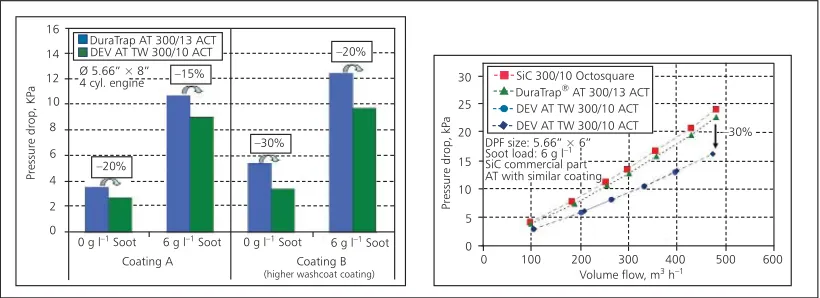
Thorsten Boger (Corning Inc, USA) and his team took a different approach to reducing back pressure in DPFs (8). They tightened the pore size distribution and decreased porosity in the next generation aluminium titanate fi lter to provide either a 2–3 g l–1 increase in soot mass limit, or a 20%–25% reduction in back pressure, depending on cell geometry. Catalysed samples of the low-pressure-drop version had 20%–30% lower back pressure with no soot on the fi lter and 15%–20% lower back pressure with 6 g l–1 soot loading shown in Figure 2. The soot mass limit
–20%
–15%
–30%
–20% Ø 5.66” × 8”
4 cyl. engine
DuraTrap AT 300/13 ACT DEV AT TW 300/10 ACT
0 g l–1 Soot 6 g l–1 Soot 0 g l–1 Soot 6 g l–1 Soot Coating A Coating B
(higher washcoat coating)
0 2 4 6 8 10 12 14 16
Pressure drop, KP
a
–30% DPF size: 5.66” × 6”
Soot load: 6 g l–1 SiC commercial part AT with similar coating
SiC 300/10 Octosquare DuraTrap® AT 300/13 ACT DEV AT TW 300/10 ACT DEV AT TW 300/10 ACT
0 100 200 300 400 500 600 0
5 10 15 20 25 30
Volume fl ow, m3 h–1
Pressure drop, kP
a
was similar to that of a silicon carbide (SiC) fi lter with the same cell geometry, but the SiC version had 50% higher back pressure. As a result of lower thermal conductivity, the regeneration effi ciency of the new fi lter in a standard drop-to-idle test at 575ºC was 6% higher than the earlier version and 16% higher than the SiC comparison.
Taking advantage of improvements in SCR technology, future heavy-duty diesel engines will be calibrated to produce higher NOx and lower particulate matter (PM) in order to save fuel. This will result in favourable conditions for passive oxidation of soot by NO2 and will dramatically decrease the
need for active regeneration of the DPF at high soot loadings. Less thermal mass will be needed in the DPF to provide a buffer against uncontrolled active regenerations. Boger and his colleagues gave a paper on their next generation thin wall cordierite fi lter to address this trend (9). Relative to the current offering, the pore size distribution was tightened and made nominally smaller, and the porosity was increased to ~55%. Wall thickness was reduced by 33% in the 200 cells per square inch (cpsi) geometry. To enable this, the inherent strength of the cordierite was increased. As with membrane technology, this redesigned porosity allows little, if any, soot penetration into the wall that causes rapid build-up of back pressure. Also, there is little difference between the back pressures of coated and uncoated fi lters. The result is that soot-laden fi lters have 40%–50% lower back pressure than their 2010 predecessors under a variety of conditions. Interestingly, because of the reduced thermal mass, skin temperatures are higher but centreline temperatures are the same during active regeneration, reducing the thermal stress in the part. Although the authors made no mention of soot mass limit impacts, the fi lter survived worst case drop-to-idle testing at 3.5 g l–1 soot. In the presentation, the authors added that the lower thermal mass of the DPF allowed faster heat-up of a downstream SCR catalyst, resulting in 10% more time for urea injection in the US certifi cation test cycle. This can result in 15% lower cumulative NOx emissions in the cold-start test (10).
The impact of catalyst washcoat on DPF performance will become more important as more functionality is added to the DPF. Koji Tsuneyoshi and Osamu Takagi (TYK Corp, Japan) and Kazuhiro Yamamoto (Nagoya University, Japan) showed how washcoat loading can affect back pressure and fi ltration effi ciency (11). They tested -alumina washcoats on SiC fi lters with 16.5 μm average pore size and 47% porosity. Doubling the washcoat loading from an undisclosed reference decreased the time to
achieve 90% particle number fi ltration effi ciency by 50%, to 20 seconds. The time to reach 99% effi ciency dropped by 40%, to 60 seconds. Back pressure increased by 28%.
Diesel Oxidation Catalysts
DOCs play two primary roles in commercial emissions control systems: (a) to oxidise HCs and CO, either to reduce emissions coming from the engine, or to create exothermic heat used to regenerate a DPF; and (b) to oxidise NO to NO2, which is used for continuously
oxidising soot on a DPF, and/or for enhancing the SCR deNOx reactions, particularly at low temperatures. Cary Henry et al. (Cummins Inc, USA) and Mario Castagnola et al. (Johnson Matthey Inc, USA) used a series of iterative reaction decoupling experiments to explain interactions between HC and NO oxidation (12). They showed that inhibition of NO oxidation in the presence of HCs on Pt/Pd is due to the reduction of NO2 during HC oxidation. Long chain alkanes had
a more adverse effect than short chain alkenes due to their slower oxidation rate with oxygen. Decreasing space velocity was shown to help NO2 formation in
the presence of HCs. Pre-storing HCs on the DOC improved NO oxidation performance up to 300ºC. At higher temperatures, coke formation from propylene, for example, inhibited NO oxidation, but stored non-coking HCs, like dodecane, maintained a positive impact at the higher temperatures. It is hypothesised that the stored HCs prevent over-oxidation of the Pt surface, thus enabling more NO adsorption and oxidation.
Researchers have been substituting Pd for Pt in DOCs for several years. However, there have been few published systematic studies on the effects of varying the Pt:Pd ratio on DOC HC and NO oxidation and durability under different conditions. Chang Hwan
Kim et al. (General Motors Co, USA) and Michelle
Schmid (Optimial, Inc, USA) investigated (13) the relationship between the Pt:Pd ratio and catalyst activity and stability by evaluating a series of catalysts with various Pt:Pd ratios (1:0, 7:1, 2:1, 1:2, 1:5 and 0:1). All bimetallic Pt-Pd catalysts showed better HC light-off activity and thermal stability than the Pt- or Pd-only catalyst. Small amounts of Pd (Pt:Pd = 7:1) reduced the propylene light-off temperature from 205ºC to 155ºC, but no further improvements were observed at higher Pd levels. However, too much Pd (more than Pt:Pd = 1:5) caused light-off to deteriorate. Hydrothermal stability improves with even small Pd additions, but further additions have minimal additional impact. NO oxidation to NO2 was found to depend
higher Pt loadings. Similar durability trends were observed as with HCs. Figure 3 shows a schematic representation of these fi ndings. High propylene concentration (1190 ppm vs. 260 ppm) increased light-off temperatures by 20ºC independently of the Pd level, but higher HC concentrations had only a small impact on the NO2 yield. The presence of CO
promoted HC oxidation, with increasing impact as Pd levels increased. There was little or no impact of CO on NO oxidation. At 300ºC, high concentrations (5000 ppm) of either light or heavy HCs (propylene or n-dodecane and m-xylene) increased HC light-off temperature by 20ºC, although there was increasing deterioration with increasing Pd content, especially for the heavy HCs. HC type or levels had no impact on NO oxidation, confi rming that Pt content is the only driver for NO oxidation found in this study.
The use of biodiesel in place of petroleum-based fuel is mandated in the US and Europe for the coming years. The transesterifi cation step of the vegetable oil, animal fat, or cooking oil feedstocks with methanol involves the use of an alkali catalyst, which can result in sodium and potassium ash in the fuel. Potential adverse effects of this ash on diesel emissions control components was described by a large collaborative research group led by Aaron Williams (National Renewable Energy Laboratory, USA) (14). Using an accelerated fuel ash loading method, with alkali components added at the maximum specifi cation, combined with extensive dynamometer testing and chemical and physical analyses, the group reported that, after a simulated 150,000 miles of durability testing, HC slip increased nominally by 20%–25% over the range of temperatures in steady-state tests (240–390ºC)
as a result of alkali exposure from the biodiesel ash. NO2 formation declined from 35% to 20%. In addition,
the thermal shock parameter of the DPF, as indicated by mechanical property measurements, declined by 69% after simulated exposure of 435,000 miles, again due to alkali attack of the cordierite substrate. NOx emissions from the SCR increased by about 50%, but more work was needed to determine whether this was due to alkali attack of the zeolite catalyst. The group concluded that operating with fuel at the maximum alkali ash specifi cation will signifi cantly deteriorate emissions control system performance.
Gasoline Emissions Control
In the last year or two, the automotive industry has become increasingly interested in gasoline emissions control technology. This is driven by two regulatory developments. The fi rst is the proposed tightening of criteria pollutant tailpipe regulations in California via the LEV III programme. Beginning in 2015 with the aim of being fully phased-in by 2025, the formal proposal is to tighten non-methane HCs (NMHCs) and NOx limits by 70% (to 30 mg mile–1 NMHCs + NOx) from the current LEV II standards, which are already the tightest in the world. Improved three-way catalyst (TWC) technology is the main approach to meeting these standards. The second regulatory development is the introduction of a particle number (PN) standard for Euro 6 gasoline engines beginning in 2014. Auto companies are moving towards direct injection gasoline engines to meet tightening CO2 standards, but
these engines have higher PN emissions than multi-port injection engines. As such, gasoline particulate fi lters (GPFs) are emerging as a possible solution to meet this regulation.
Yuki Aoki et al. (Toyota Motor Corp, Japan) and Shingo Sakagami and Masaaki Kawai (Cataler Corp, Japan) reported on complex TWC coating architectures as a way of improving performance and reducing pgm loadings (15). They showed that HC light-off time is reduced by 50% if all the Pd is concentrated in the front 20% of the catalyst substrate. Conversely, because rhodium is poisoned by phosphorus (from lubricant oil ash), the Rh should be concentrated in the back 20% of the substrate. They also show that ceria-zirconia washcoats can be formulated for different properties and distributed on the substrate accordingly. Zirconia-rich recipes (0 to 0.40 ceria:zirconia mole ratio) release oxygen fastest, and therefore should be in the front half of the catalyst, while ceria-rich formulations (0.8 to 1.2) store more oxygen, and are best located in the back half. To wrap up the study, they showed that an
Fig. 3. Conceptual impact of substituting platinum with palladium in DOCs, according to General Motors Co and Optimial, Inc (13). Moderate substitutions improve durability and HC oxidation, without signifi cant deterioration of NO oxidation
Stability after ageing
NO2 production
Light-off temperature
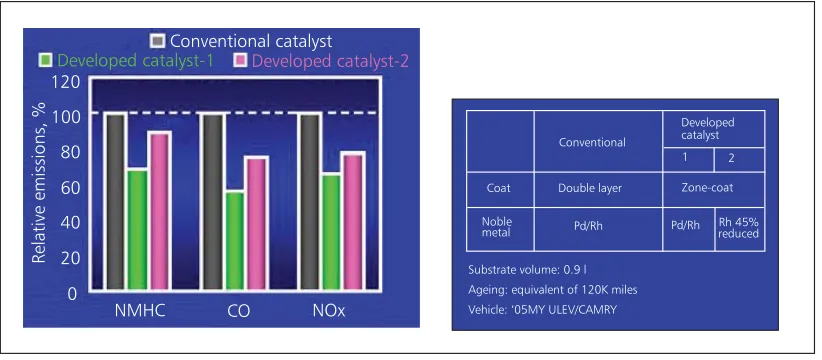
alumina addition can prevent zirconia sintering and allow better Rh dispersion, and niobia can prevent grain growth of the Rh catalyst. Figure 4 shows the improved performance of the new technologies relative to a baseline catalyst.
Douglas Ball, Carlos Buitrago (Umicore Autocat USA Inc) and Michael Zammit and Jeffery Wuttke (Chrylser Group LLC, USA) (16) reported on meeting the LEV III challenge more effi ciently by moving the under body catalyst to a position directly behind the close-coupled catalyst. HC and NOx emissions were cut by 25%. They also looked at optimising pgm loadings with the new design. Six formulations reduced pgm loading by up to 25% from the previous partial zero emission vehicle (PZEV) design, while meeting a 20 mg mile–1 NMHC + NOx limit on the federal test procedure (FTP) light-duty transient cycle. This is low enough to meet the lowest certifi cation level in the proposed LEV III regulation.
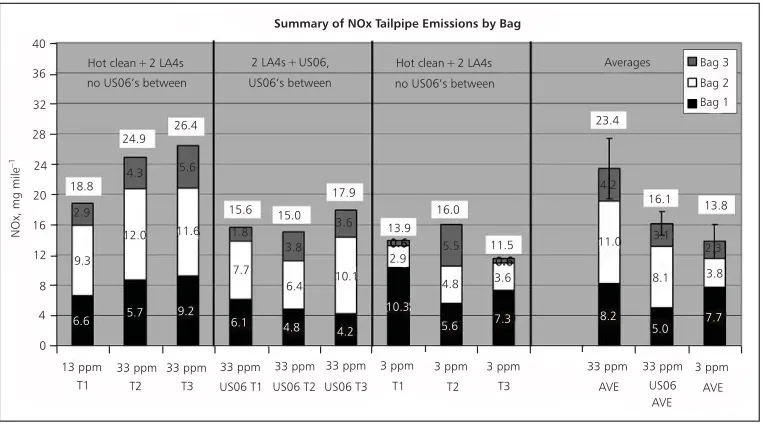
In another contribution, Douglas Ball showed why low-sulfur gasoline is an important enabler for modern catalysts to meet the LEV III regulations (17). Figure 5 shows the results. If the fuel contains 33 ppm sulfur, the poison builds up on the catalyst in back-to-back tests (T1–T3, fi rst set of data). If a hot US06 high-load test cycle is run, some of the sulfur is purged, dropping NOx emissions by 30% (second set of bars). Alternatively, and quite pertinent to urban low-load operation, if the fuel sulfur is dropped to 3 ppm, the NOx emissions are cut by 40% without the need for a high-load purge.
Lean burn direct injection engines are emerging to meet the current and upcoming CO2 regulations
in the major world automotive markets. LNTs can in some cases be used to meet the NOx regulations, but Chang Hwan Kim et al. and Orgun et al. (General Motors Co, USA) showed in two papers an alternative design (18, 19). They describe a TWC + SCR approach wherein ammonia generated from the TWC during rich tip-ins in normal operation is stored and utilised in a downstream SCR catalyst for use during lean operation. The fi rst paper (18) shows that ammonia production in the TWC is enhanced with Pd-only formulations. Rh, although benefi cial for CO oxidation and stoichiometric NOx reduction, contributes little to ammonia generation. An oxygen storage catalyst (OSC) detracts from ammonia generation, but is benefi cial for CO and HC oxidation. However, CO and HC oxidation can be promoted with higher Pd loadings (200 g ft–3 vs. 60 g ft–3 in the base formulation). The authors conclude that the system might be suitable for European applications, where the NOx regulations are not as tight, but more research is needed on optimising pgm and washcoat formulations, and improving the SCR catalyst durability and performance. In the second paper (19), the researchers used the TWC + SCR system in a stoichiometric direct injection engine adapted for lean idle and aggressive deceleration fuel cutoff (DFCO), saving 11% on fuel consumption. DFCO sends air through the system, cooling the catalyst and
Fig. 4. New TWC coating architecture decreases stoichiometric gasoline emissions relative to a conventional double-layer catalyst. The new designs can be used to decrease the rhodium loading by 45%, while still delivering a 20% NOx reduction (‘Developed Catalyst 2’), or can reduce emissions by 30 to 45% at the same pgm loadings (15)
NMHC CO NOx
0 20 40 60 80 100 120
Relative emissions, %
Developed catalyst-1Conventional catalystDeveloped catalyst-2
Conventional
Developed
1 2
Zone-coat Double layer
Coat
Noble Pd/Rh Pd/Rh Rh 45%
Substrate volume: 0.9 l Ageing: equivalent of 120K miles Vehicle: ‘05MY ULEV/CAMRY
catalyst
saturating the OSC with oxygen, adversely impacting stoichiometric deNOx functionality. The combination aftertreatment system lowers NOx levels by 95% with this engine strategy compared to a TWC only system.
Conclusions
To meet tightening of criteria pollutant emissions regulations and new fuel effi ciency demands, much effort is being placed on decreasing emissions on lean burn engines with less or better utility of pgm. Lean NOx trap – SCR systems are being optimised and are now moving onto much more vehicle testing. Ammonia generation from the LNT and fi nding optimum system confi gurations are at the forefront. Lean burn engines have high particulate emissions, and new fi lter designs (gasoline and diesel) are improving performance. DOCs have complex functionality, and even though they are decades old, work is continuing to decrease pgm costs and understand fundamental behaviour. Finally, studies on meeting the next round of tailpipe emissions tightening on stoichiometric gasoline engines show impressive pgm utilisation gains, and the adverse effects of fuel sulfur in advanced systems.
References
1 SAE International: http://www.sae.org/ (Accessed on 6th February 2012)
2 T. V. Johnson, ‘Diesel Emissions in Review’, SAE Paper 2011-01-0304
3 J. R. Theis, M. Dearth and R. McCabe, ‘LNT + SCR Catalyst Systems Optimized for NOx Conversion on Diesel Applications’, SAE Paper 2011-01-0305
4 L. Xu, R. McCabe, P. Tennison and H.-W. Jen, ‘Laboratory and Vehicle Demonstration of “2nd-Generation” LNT + in-situ SCR Diesel Emission Control Systems’, SAE Paper 2011-01-0308
5 H. Hirabayashi, T. Furukawa, W. Koizumi, W. Koyanagi, Y. Saitou and S. Tanaka, ‘Development of New Diesel Particulate Active Reduction System for Both NOx and PM Reduction’, SAE Paper 2011-01-1277
6 L. Rocher, T. Seguelong, V. Harle, M. Lallemand, M. Pudlarz and M. Macduff, ‘New Generation Fuel Borne Catalyst for Reliable DPF Operation in Globally Diverse Fuels’, SAE Paper 2011-01-0297
7 S. Iwasaki, T. Mizutani, Y. Miyairi, K. Yuuki and M. Makino, ‘New Design Concept for Diesel Particulate Filter’, SAE Paper 2011-01-0603
8 T. Boger, J. Jamison, J. Warkins, N. Golomb, C. Warren and A. Heibel, ‘Next Generation Aluminum Titanate Filter for Light Duty Diesel Applications’, SAE Paper 2011-01-0816
9 T. Boger, S. He, T. Collins, A. Heibel, D. Beall and C. Remy, ‘A Next Generation Cordierite Diesel Particle Filter with Signifi cantly Reduced Pressure Drop’, SAE Paper 2011-01-0813
10 A. Heibel, ‘Advancements in Substrate Technology’, SAE 2010 Heavy Duty Diesel Emissions Control Symposium, Gothenburg, Sweden, 21st–22nd September, 2010 18.8 24.9 2.9 26.4 4.3 5.6 9.3 12.0 11.6
6.6 5.7 9.2
Hot clean + 2 LA4s no US06’s between
15.6 15.0 17.9 1.8 7.7 6.1 3.8 6.4 4.8 3.6 10.1 4.2 2 LA4s + US06, US06’s between 13.9 2.9 10.3 16.0 5.5 4.8 5.6 11.5 3.6 7.3 Hot clean + 2 LA4s no US06’s between
23.4 4.2 11.0 8.2 16.1 3.1 8.1 5.0 2.3 13.8 3.8 7.7 Averages
13 ppm 33 ppm 33 ppm 33 ppm 33 ppm 33 ppm 3 ppm 3 ppm 3 ppm 33 ppm 33 ppm 3 ppm T1 T2 T3 US06 T1 US06 T2 US06 T3 T1 T2 T3 AVE US06
AVE AVE 0 4 8 12 16 20 24 28 32 36 40 Bag 3 Bag 2 Bag 1
NOx, mg mile
–1
Summary of NOx Tailpipe Emissions by Bag
11 K. Tsuneyoshi, O. Takagi and K. Yamamoto, ‘Effects of Washcoat on Initial PM Filtration Effi ciency and Pressure Drop in SiC DPF’, SAE Paper 2011-01-0817
12 C. Henry, N. Currier, N. Ottinger, A. Yezerets, M. Castagnola, H.-Y. Chen and H. Hess, ‘Decoupling the Interactions of Hydrocarbons and Oxides of Nitrogen over Diesel Oxidation Catalysts’, SAE Paper 2001-01-1137
13 C. H. Kim, M. Schmid, S. J. Schmieg, J. Tan and W. Li, ‘The Effect of Pt-Pd Ratio on Oxidation Catalysts under Simulated Diesel Exhaust’, SAE Paper 2011-01-1134 14 A. Williams, R. McCormick, J. Luecke, R. Brezny,
A. Geisselmann, K. Voss, K. Hallstrom, M. Leustek, J. Parsons and H. Abi-Akar, ‘Impact of Biodiesel Impurities on the Performance and Durability of DOC, DPF and SCR Technologies’, SAE Paper 2011-01-1136
15 Y. Aoki, S. Sakagami, M. Kawai, N. Takahashi, T. Tanabe and T. Sunada, ‘Development of Advanced Zone-Coated Three-Way Catalysts’, SAE Paper 2011-01-0296
16 D. Ball, M. Zammit, J. Wuttke and C. Buitrago, ‘Investigation of LEV-III Aftertreatment Designs’, SAE
Paper 2011-01-0301
17 D. Ball, D. Clark and D. Moser, ‘Effects of Fuel Sulfur on FTP NOx Emissions from a PZEV 4 Cylinder Application’, SAE Paper 2011-01-0300
18 C. H. Kim, K. Perry, M. Viola, W. Li and K. Narayanaswamy, ‘Three-Way Catalyst Design for Urealess Passive Ammonia SCR: Lean-Burn SIDI Aftertreatment System’, SAE Paper 2011-01-0306
19 O. Guralp, G. Qi, W. Li and P. Najt, ‘Experimental Study of NOx Reduction by Passive Ammonia-SCR for Stoichiometric SIDI Engines’, SAE Technical Paper 2011-01-0307
The Reviewer