Structures, inner values, hierarchies and stages:
essentials for developmental robot architectures
Andrea Kulakov
*, Georgi Stojanov
**Computer Science Institute
Faculty of Electrical Engineering
1000 Skopje, MACEDONIA
[email protected]
*, [email protected]
**Abstract
In this paper we try to locate the essential components needed for a developmental robot architecture. We take the vocabulary and the main concepts from Piaget’s genetic epistemology and Vygotsky’s activity theory. After proposing an outline for a general developmental architecture, we describe the architectures that we have been developing in the recent years - Petitagé and Vygovorotsky. According to this outline, various contemporary works in autonomous agents can be classified, in an attempt to get a glimpse into the big picture and make the advances and open problems visible.
1. Introduction
Recent years have witnessed blossoming of research in artificial intelligent systems. Recurrent themes were embodiment, situatedness, symbol grounding, social situatedness and human-artifact, as well as artifact-artifact interaction, imitation, analogy, etc. There is a considerable body of research in physically embodied human like agents (Cog (Brooks et al. 1999), Infanoid (Kozima 2001), Kismet (Brazeal 2000), Babybot (Metta 2001)). The overall impression is that most of these works stressed particular aspect of the artifact behavior without necessarily having an elaborated theoretical framework. On the other hand, there are attempts “to put it all together” (Zlatev 2001), (Prince 2001), (Ziemke 2001), as well as valuable contemplations about the “big issues in AI” (Kirsh, 1991), (Bickhard, 1995) which are not necessarily accompanied by artifacts build around those considerations. Throughout the text, we use “epigenetic” and “developmental” as synonyms.
From the beginning, in our work we took Piaget’s genetic epistemology as departing point in developing our artifacts. The notions of internal schemas, developmental stages, hierarchy of abstractions and biological motivation became central. The general idea is fairly simple: by its very embodiment, the agent imposes a point of view, a structure on the incoming sensory flux. Further structure can be introduced by the way the agent acts in the environment (a simple example is the sucking: from the nipple to the thumb, then sucking every toy and then sucking everything else). Out of this agent-environment interaction, thus, emerge new structures, which can guide
agent’s future behavior. Those structures can be organized in various ways, and one of them is to put them in hierarchies reflecting their abstractness. At the top of this organization we have the symbols (language in human agents). Again, they still use the same purpose: to put organization on the incoming flux of environmental stimuli. Going up in the hierarchy, the structures become more detached from the sensors, and are more manipulable. So the agent ends up by living in this Umwelt, seeing parts of environment as corresponding to other agents of its sort, and communicating with them during the process of socialization. Although the primary purpose of the language is not the organization of the environmental stimuli, but social interaction, through internalization and mediation, the language takes on intra-psychological functions.
Going up in the hierarchies of abstraction would correspond to going through the four developmental stages that Piaget proposed, whose order is invariant: sensory-motor stage, pre-operational stage, stage of concrete operations, stage of abstract (logical) operations. Although, to the last stage we would like to refer as the stage of socialized linguistic competence. The time frame of these stages is variable and it will not be discussed here. What’s important is that their order is invariant. These four stages roughly correspond to the four types of meaning systems that Zlatev proposed (Zlatev 2001). Cue-based meaning corresponds to the inborn reflexes (inborn schemas). Association-based corresponds to the sensorimotor stage. Icon-based meaning - corresponds to the passage from sensory-motor to the pre-operational stage. Early symbol-based meaning - to the preoperational stage. While later symbol-based meaning to the stage of concrete and abstract operations.
Various models that are proposed in the epigenetic robotics are given at some of the stages, while we believe that an architecture, which aims to be an instantiation of cognition and consciousness, should pass through the process of ontogenesis through all these epigenetic stages.
2.
Petitagé
The purpose of our first architecture Petitagé (Stojanov, 1997), (Stojanov, 2001) was to demonstrate the process of autonomous internalization of the environment. It has a primitive internal value system which can recognize when the agent is near an object that can satisfy some of its drives (e.g. food to satisfy hunger).
Figure 1.Simulation software screen snapshot The agent is equipped with several sensors and we call
a percept the collection of all sensory readings at a given
moment. The concept of inborn schemas is central during this process. An inborn schema is simply an ordered n-tuple of elementary actions that the agent is capable of performing. Thus, S = ai.ak…am would be an example.
The inborn schema S characterized by its length and the relative ordering of actions. When in learning mode the agent tries to execute S. Depending on the environment structure, only some sub-schemas of the original S will actually be executed. We call them enabled schemas. For example (if the agent is capable of performing f-go forward, l-go left, r-go right) the initial inborn scheme S=fffllffr will degenerate to Senabled=fffff when the robot is
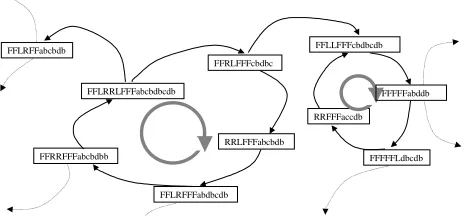
trying to perform the inborn schema in a corridor. The map is then built out of the enabled schemas, complemented with the percepts recorded on the way. In parallel with map building, there is a process, which looks for regularities (cycles) in the stream of enabled schemas. When such cycles are found, entities of higher order are introduced. If the agent is solving the navigation task, these higher order entities can be thought of as places (Figure 2). Now, the agent can have a model of the environment in terms of these interconnected abstract entities or places.
FFLRRLFFFabcbdbcdb
FFRLFFFcbdbc
RRLFFFabcbdb
FFLRFFFabdbcdb FFRRFFFabcbdbb
FFLLFFFcbdbcdb
FFFFFLdbcdb RRFFFaccdb FFLRFFabcbdb
FFFFFabddb
Figure 2.Discovering cycles in the sequences of activated enabled schemas
Petitage architecture resides on the Expectancy Theory which takes the notion of anticipation to be central for the cognitive processes, and is largely inspired by Piaget’s genetic epistemology. More details about the agent can be found in (Stojanov, 1997), (Stojanov et al. 1997), (Stojanov, 1999), (Stojanov, 2001)
Several points are worth to be pointed: while acting in the environment, the agent introduces order in the incoming sensory input by trying to repeat the actions dictated by the inborn scheme. The map of enabled scheme emerges out of the interaction of the inborn scheme structure, and the environment structure. Furthermore, the second process of finding regularities in the stream of enabled schemes provides more abstract and condensed environment representation. The process can go further on (finding regularities in the regularities in the stream of enabled schemas) which would result in a hierarchy of more and more abstract concepts. These representations are more detached from the direct sensory input and would eventually be used as manipulable proto-symbols in the processes of hypothesis generation (about unknown environments) or communication with other same type agents.
We believe that the above mentioned components a) internal structures which interact with the environment structure, b) the stages in building the hierarchies and c) the internal value system, are central for every epigenetic agent architecture. In the case of the Petitagé agent, we can relate these stages to the sensory-motor and beginnings of preoperational stage, as proposed by Piaget
3. Vygovorotsky
We have further developed the architecture of Petitagé, to include more complex inner value system, reliability of the schemas as a measurement of fit, analogy-making as a form of generalization and other cognitive phenomena such as execution of motor plans and attention explained in (Kulakov, 1998). The actor’s knowledge about the environment is represented in a pseudo-conceptual network whose parts can be activated at different levels of activation according to a mechanism for spreading activation, necessary to provide the proper context relevance for analogy-mapping. The nodes of this network are formed on the basis of the percepts, while the links are formed on the basis of the motor actions. Both nodes and links can be at different levels of abstraction. Each action schema represents a chain of several simple actions connecting nodes.
To each schema, a different reliability factor is assigned, depending on the reliability with which the expectations of the execution of that schema are met. Whenever the expectations are not met, the reliability of that schema is decreased.
Having a hierarchy of nodes and links, an analogy-making mechanism is introduced with which some superficially not-similar nodes can be judged as being similar by analogy.
3.1 General architecture
The three big blocks in Figure 3, called “Analogical Memory-Retrieval and Transfer” (AMRAT), “Problem Selection” and “Behavior”, reflect different functions that each subsystem has. They share the same knowledge structures (not depicted here) and hence the arrows ‘target’, ‘plan’ and ‘surprise’ are not some special messages that are here as interfaces between subsystems, but rather to give the reader a sense of the processes going on in our model. These arrows can be seen as the direction of the flow of activation in the underlying knowledge structures. The AMRAT part is an analogy-making subsystem and is responsible for problem-solving, while having little or no influence from the behavior going on meanwhile, that is, from the actor’s environment.
Figure 3. General architecture of Vygovorotsky
The problem solving actually takes place after a successful memory retrieval of an analogous solution (or episode) has been found (a source domain) and some part of the knowledge from the source is transferred to the problem domain (or target). The surprise line functions as an interrupt to the AMRAT subsystem and then the information coming from the environment is judged to be the current ‘problem’ on which the AMRAT subsystem works, i.e. to find out to which previous episode of actor’s experience is the current situation analogous to. We can say that in the “Problem Selection” subsystem, the environmental information (coming through the ‘sensors’ and ‘actuators’ arrows) competes with the ‘Internal Drives’ to determine which parts of the pseudo-conceptual network are the current ‘target’. In that way, the ‘problems’ that are given to the AMRAT part to be ‘solved’ are determined by the current state of the Internal Drives and by the surprises that happened during the execution of a certain behavior. The ‘satisfaction’ of these drives gives the emotional coloring of the knowledge-structures.
The environment is not depicted as a special block and should be considered as omnipresent in the figure, from where the ‘sensors’ come and where the actuators act.
3.2 The knowledge structures
The knowledge structures are organized as a kind of
conceptual network where the nodes are representing
more or less abstract entities derived from the percepts, while the links in this network are of different kinds, most significant of them are the action schemas. These kinds of links are the basis for viewing the conceptual network as a
cognitive map.
Figure 4. One segment of the cognitive map
In Figure 4, a part of the Vygovorotsky’s cognitive map is depicted. Different shades of gray of the nodes represent different attributes that are attached to the nodes, relating them with different ‘needs’ that actors have. The links between the nodes, depicted as wider or slimmer blocks, represent different motor schemas that connect the nodes in the network. In this figure the wideness of the blocks should represent the reliability of the schema, i.e. how reliable or confident is a given ‘transition’ between the nodes. Also, the width of the lines represents the pattern of activation over the network. There are also other links between nodes and between motor schemas (type-token links), which are not shown in this figure. This type of links connect nodes and links in a hierarchy of more and more abstract entities. The motor-action links, no matter how abstract, can be considered as more or less abstract relations connecting two or more pseudo-concept nodes (see also (Indurkhya, 1992)).
3.3 Modeled cognitive phenomena
In this section we will give our philosophical and psychological stance, which we tried to implement in our Vygovorotsky model. This model follows the sensori-motor theory of intelligence and the expectancy framework which are in their essence an interactionist theories: the knowledge structures present in a cognizer are a result of the mutual influence that the environment imposes to the knowledge structures and that these knowledge structures in turn structure the environment. Piaget posited mechanisms, assimilation and
accommodation, that mediate the subject’s interaction
with its environment. Assimilation is a process that reduces the subject’s sensory stimuli to some familiar concept or category, while accommodation is the process that causes the subject to modify its cognitive structures in response to some unexpected stimuli from the environment, when the existing knowledge structures can no longer explain satisfactorily the present sensory stimuli.
from the stimuli that we receive, there are no such things as objects distributed in a three-dimensional space. Babies are not born with knowledge what is figure and what is ground, except for particular stimuli like, faces. Through repetitive practicing of the learned schemas and repetitive meetings with certain stimuli, babies build more and more abstract categories, extracting the common things among different stimuli, and in that way differentiating between figure and the ground. (see for e.g. (Drescher, 1991) or (Mackay, 1952)). This gives the babies a security that they are acquainted with the world, the need of which is evolutionary implanted into them. Still, humans and many animals are capable of making bigger generalizations. Piaget and Vygotsky only mention that this is done by analogy-making, while Lakoff and Johnson state this explicitly (Lakoff and Johnson, 1980). We take the stance as in (French, 1995): “generalizations made between concepts or relations, differ only in the slippage distance and refer to different cognitive phenomena such as recognition, categorization, analogy or metaphor”.
In the beginning the baby’s thinking cannot be distinguished from its behavior – it is simple and immediate. The tendency is to learn the environment better and then less and fewer surprises happen.
3.4. Perception
Today it is widely held that human vision, for instance, cannot be explained as an entirely “data-driven” or “bottom-up” process, but needs, at the highest levels, to be supplemented with expectancy-driven constraints. (see for example (Schank and Fano, 1995), (Rybak et al., 1998), (O’Regan and Noë, 2001))
This model wants to integrate this view on perception with another proposal by Hofstadter and his colleagues (Hofstadter, 1995) that explains the process of high-level perception as an analogy-making.
What Vygovorotsky perceives in the moment, activates some structures in the pseudo-conceptual network. We call this process metaphorization or assimilation according to Piaget. That is, whatever is sensed, seems like the previously built knowledge structures that the current pattern of activation highlights. This is the passive assimilation that is done on the basis of similarity between the current percept and the activated pseudo-concepts. There is another assimilation of the current percept – by imposing some action-scheme upon it. In that sense Vygovorotsky will equate all percepts upon which it performed that action-scheme.
The similarity between pseudo-concepts is calculated as in the classical theories about similarity (Tversky and Gati, 1978) and to this similarity we will refer to as superficial similarity. Superficial similarity is necessary during the process of learning when we encounter things that we have not seen before. The resort upon which we rely mostly in these cases is the superficial similarity.
Only when we know the structure and relations among different parts of the concepts, we can judge the similarity among them in a more profound way – by their structural similarity. This similarity can be measured by comparing the relations that hold among various pseudo-concepts that play role in the comparison – their parts and
super-classes, their related pseudo-concepts (through some action-schemas), etc. Our approach to this matter is the combination of the superficial and the structural comparison between two pseudo-concepts.
3.5. Internal drives as basic motivational
force
We consider emotions as the basic driving forces, or motivational sources for the behavior, and for the living at all. Although many of the emotions need cognitive consideration about them, there are some number of emotions and bodily needs, cognitively not mediated, which can be considered as basic, primary source of motivation.
We have chosen to put three internal drives into Vygovorotsky, which have evolutionary imposed counterparts in humans: supply energy (hunger drive), avoid pain and seek pleasure (affect drive) and explore (curiosity drive). Evolution has taken care for these motivational forces to emerge because they are all connected with the survival of the species: energy supply and avoidance of pain – to keep the organism from falling apart; seeking of pleasure for the reproduction cycle; and epistemic hunger (from the curiosity drive) – because knowing the environment better, improves the chances of responding appropriately to the future occasions. We introduce these three internal drives not because we are concerned with the survival of Vygovorotsky as a specie, but because we believe that cognition is essentially connected with inner values as a primary motivational force, and that it is necessary to have at least some internal drives, according to which the subject (actor) will structure and grade the environment.
The plausibility for providing these three drives can be found in Piaget’s work. Also the adequacy for the small number of drives can be inferred from the neuro-anatomical data, since we only have several basal ganglia: for hunger and for fill, for hot and cold, for pleasure and for pain, for thirst, for fear, for affect, etc. Of course there are more needs for the body, but the main point is that we must have at least some drives. Basal ganglia are located in the thalamus where all sensory and motor pathways intersect. This topology is transferred into the model, in a way, that all percepts are accompanied by some factors denoting their desirability. And then, the world shall not become known, for the actor itself, just by the percepts and the motor actions in a senseless way. Instead, the world shall be structured and valued according to the needs of the agent. Only then, the inputs and the outputs of the actor can become meaningful to itself – meaningful for its survival.
activation is sent to this part of the network. When enough connections between the new and the rest of the nodes are made, the activation of this drive is raised, thus allowing more new things to be explored. If the curiosity drive is low, then practically new things cannot be learned, because their desirability will be low. Since more pragmatically useful things are usually more interesting, the goal nodes (as defined from the other drives) are tried first. The impact of these drives on the behavior and reasoning has a hierarchy: if hungry then search for food; if not hungry then seek pleasure, avoid pain and explore.
In Vygovorotsky every node can potentially be a goal node – depending on the activity of the three internal drives and the grades that has each node received according to the internal needs. So, the goal lists are changing as the needs change. If the actor is hungry – it tries to get to the nodes that are marked as very resourceful with food. The activation that spreads from these goal nodes to the adjacent nodes depends on their momentary desirability. The desirability of each node being part of some action-schema is calculated according to the following formula:
) PPG ( F R CD F ) HG HD ( F
D= 1 ⋅ + 2 ÿ+ 3
Where D is desirability, HD is the value of the Hunger Drive, HG is the Hunger Grade given to that schema, CD is the value of the Curiosity Drive, R is the reliability of that schema and PPG is the Pain/Pleasure Grade of that schema.
Different combinations of the inborn values (or maximum – minimum values) for these internal drives, and different functions F1, F2 and F3, lead to different
personality profiles of the Vygovorotsky specie: some actors being greedier, some more hedonistic or durable, and some more curious than others.
From this desirability value, the granularity of the node is calculated which will determine the number of details that will be remembered out of each percept. This also determines the comparison of percepts and nodes during the process of abstraction and during the matching of the percepts with the expectations.
3.6. Building abstract nodes and schemas
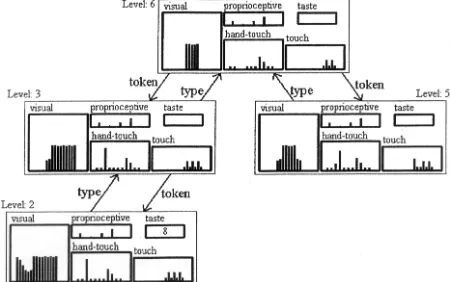
If some node becomes an expectation part of an enough reliable schema, then this node is compared with the nodes at the basic level of abstractness, and a process tries to find out the common parts between the nodes. If the absolute difference between the compared nodes is less than the determined granularity, then a new abstract node is added. This abstract node has averaged sensor readings for those that are common, while the others are left undefined. Its place in the hierarchy of abstract nodes is determined, and with type and token links, the new abstract node is added to the rest of the pseudo-conceptual network. One example of a hierarchy of nodes is shown in Figure 5.
There are two mechanisms for building abstract schemas from the assortment of concrete ones. The first principle is similar to the process of building abstract nodes. Namely, whenever some schema is added with
same condition and expectation nodes with another schema, the sequence of subschemas is compared and only the overlapping ones are added (in the same order) as a more abstract schema.
Figure 5. A hierarchy of nodes in the pseudo-conceptual network
According to the second principle, for each newly updated schema with big enough reliability, a search ‘backwards’ from its condition node is done, looking for the longest reliable chain of schemas. These schemas are then joined in one super-schema, having them as steps in the sequence of subschemas. This super-schema is added with an initial reliability equal to the minimum of the reliabilities of the subschemas.
3.7. Behavior and expectations
The mind is fundamentally an anticipator, as Dennett deduced lucidly in his quest for explaining consciousness and intelligence (Dennett, 1991), (Dennett, 1996). In every moment, in every step we anticipate something and then we expect the outcome of our actions. Wherever we have been before, the next times we go there we expect things to be just as they were. By learning the environment in a manner of connecting the current percept with some motor schema and some expectation for the next percept and so on, Vygovorotsky actor structures the environment according to its possibilities to perceive, to act and to sense. In that way it builds an expectation framework for the environment where it lives. So whenever the expectations are met, the actor does not have to bother what will do next – it does that on “auto-pilot”. The problem appears when it is surprised (as fortunately often happens in a dynamic environment).
It is not the case that we always have expectations for every detail that we are going to perceive in the near future. We build abstract expectations in which only some parts, which we claim to be relevant for the situation, are represented. These kinds of expectations are built during the process of decontextualization, i.e. during practicing them in many different contexts. If some part of the newly built expectations is repeated in several of them, then that part of the expectations will be extracted as an abstract expectation of that particular action.
3.8. Where does Vygovorotsky fit
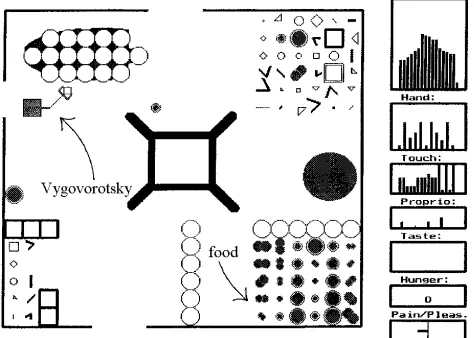
Although imitation is in its essence an analogy-making, the process that happens in Vygovorotsky agent is an analogy-making between two parts of its internal knowledge structures, not between itself and some other agent. We have built several agents in the environment (Figure 6), one of them controlled by a human (and called ‘The Mother”), but have not put some inborn mechanisms for analogy-making between their body parts. That is left for future work.
Figure 6. One room of the Vygovorotsky’s environment, together with its current sensor readings on the right
The interaction between ‘The Mother” and the Vygovorotsky agent is intensified by causing pleasure by touching. Also “The Mother” can grab the Vygovorotsky agent and bring it near food. So later when Vygovorotsky agent becomes hungry, it goes toward its mother, expecting that it will help reducing the hunger. In any time, Vygovorotsky agent tries to be near its mother as a source for joy. We consider this as an origin for a more complex social interaction.
This model, among other things, provides a psychologically plausible way of building conceptual networks used in many models of analogy-making, supplementing and unifying them with behavior. The knowledge structures are constructed in the course of actor’s behavior and in that way they are grounded in its experience.
Although the name Vygovorotsky implies that the agent should be linguistically competent, that is our goal and is left for future work.
4. Conclusions
All work done in epigenetic robotics fits into some of the developmental stages according to Piaget. These stages roughly correspond to the meaning system proposed by Zlatev. A cognitive architecture should pass through all these stages during the process of its ontogenesis. The structures should begin from simple immediate schemas built from sensory readings and motor actions, through the process of abstraction and analogy-making to more complex cognitive structures such as conceptual maps including emotional system, plans for acting and language system. These structures should be graded according to the inner value system in order for the agents to be truly autonomous.
Two similar architectures, Petitagé and Vygovorotsky, are presented which work in the sensori-motor and pre-operational stage of development. They both have inner value system and build abstraction hierarchies and relations among the knowledge structures. Vygovorotsky uses analogy-making as a higher form of manipulating with the knowledge structures and has a potential to advance into the third stage of concrete operations. Although the name is Vygovorotsky, it actually reflects the directions for our future work, namely to have a linguistically competent agents.
Acknovledgements
The authors would like to thank to the anonymous referees for their valuable comments on the first version of this paper.
References
Anderson, J. (1983). The Architecture of Cognition. Harvard University Press, Cambridge, MA
Breazeal, C. (2000). Sociable Machines: Expressive Social Exchange Between Humans and Robots. ScD. Dissertation, Department of Electrical Engineering and Computer Science, MIT
Bickhard, M. H., Terveen, L. (1995). Foundational Issues in Artificial Intelligence and Cognitive Science: Impasse and Solution, Elsevier Science Publishers Brooks, R., Breazeal, C., Marjanovic, M., Scassellati, B.
And Williamson, M. (1999). The Cog project: Building a humanoid robot, in C.L. Nehaniv (Ed.), Computation for Metaphors, Analogy, and Agents, Springer-Verlag Lecture Notes in Computer Science, 1562
Craig, I. (1997). A Cognitive Account of Reasoned Action. In Kokinov, B. (Ed.). Perspectives on Cognitive Science, Vol. 3, New Bulgarian University, Sofia
Dennett, C.D. (1991). Consciousness Explained. Penguin Books
Dennett, C.D. (1996). Kinds of Minds. Basic Books. Drescher, G.L. (1991). Made-Up Minds, A Constructivist
Approach to Artificial Intelligence. The MIT Press French, R. (1995). The Subtlety of Sameness: A Theory
and Computer Model of Analogy-Making. The MIT Press, Cambridge, MA
Hofstadter, D. (1995). Fluid Concepts and Creative Analogies. Basic Books, New York
Indurkhya, B. (1992). Metaphor and Cognition, An Interactionist Approach. Kluwer Academic Publishers Kirsh, D. (1991). Foundations of AI: the big issues.
Artificial Intelligence, 47, 161-184
Kokinov, B. (1994). A Hybrid Model of Reasoning by Analogy. In Holyoak, K, and Barnden, J. (Eds.). Advances in Connectionist and Neural Computation Theory”, Vol 2, pp 247-318, Ablex, Norwood, NJ Kozima, H. And Yano, H. (2001). A robot that learns to
Kulakov, A. (1998). Vygovorotsky - A Model of an Anticipative and Analogy-making Actor. MSc Thesis, New Bulgarian University, Sofia
Lakoff G., and Johnson, M. (1980). Metaphors We Live By. The University of Chicago Press
Mackay, D. (1952). Mindlike Behavior in Artefacts. The British Journal for the Philosophy of Science
Mataric, M., (1995). Integration of Representation Into Goal-Driven Behavior-Based Robots. In Steels, L. and Brooks, R. (Eds.). The Artificial Life Route to Artificial Intelligence. Lawrence Erlbaum Associates Inc. Hillsdale, NJ
Metta, G., Sandini, G., Natale, L. and Panerai, F. (2001). Sensorimotor interaction in a developing robot. Proceedings of the 1st International Workshop on Epigenetic Robotics, Lund University Cognitive Studies, 85
Newton, N. (1996). Foundations of Understanding. John Benjamins Publishing Company. Amsterdam
O'Regan, J. K. and Noë, A. (2001). A sensorimotor account of vision and visual consciousness, by, in Behavioral and Brain Sciences, 24(5)
Piaget, J. (1954) The Construction of Reality in the Child, Basic, New York
Piaget, J., Genetic Epistemology, Columbia, New York Prince, G.C. (2001). Theory grounding in embodied
artificially intelligence systems. Proceedings of the 1st International Workshop on Epigenetic Robotics, Lund University Cognitive Studies, 85
Rybak, I.A., Gusakova, V.I., Golovan, A.V., Podladchikova, L.N., Shevtsova, N.A. (1998). A model of attention-guided visual perception and recognition. Vision Research, Vol 38. pp. 2387-2400, Elsevier Science
Schank, R.C. and Fano, A. (1995). Memory and Expectations in Learning, Language and Visual Understanding. AI Review, Vol. 9, Nos 4-5, pp.261-271, Kluwer Academis Publishers
Stein, A. L. (1994). Imagination and Situated Cognition. JETAI, Vol. 6. pp.393-407
Stojanov, G. (1997). Expectancy Theory and Interpretation of EXG Curves in Context of Biological and Machine Intelligence. PhD Thesis, ETF, Sts. Cyril and Methodius University, Skopje
Stojanov, G., Bozinovski, S., Trajkovski G. (1997). Interactionist-Expectative View on Agency and Learning. IMACS Journal for Mathematics and Computers in Simulation, Northe-Holland Publishers, Amsterdam.
Stojanov, G., (1999). Embodiment as Metaphor: Metaphorizing-in The Environment. in C. Nehaniv (ed.) Lecture Notes in Artificial Intelligence, Vol. 1562, Springer-Verlag
Stojanov, G., Kulakov, A., Trajkovski, G. (1999). Investigating Perception in Humans Inhabiting Simple Virtual Environments: An Enactivist View. Cognitive Science Conference on Perception, Consciousness and Art, Vrije Universitaet in Bruxelles
Stojanov, G. (2001). Petitagé: A case study in developmental robotics. Proceedings of the 1st
International Workshop on Epigenetic Robotics, Lund University Cognitive Studies, 85
Tversky, A. and Gati, I. (1978). Studies of Similarity, in Rosch, E. and Lloyd, B. (Eds.). Cognition and Categorization. Erlbaum Associates, Hillsdale, NJ Vygotsky, L. (1962). Thought and Language. Cambridge,
Mass.:MIT Press
Varela, J. F., Thompson, E., Rosch, E. (1991). The embodied Mind. The MIT Press
Ziemke, T. (2001). Are robots embodied? Proceedings of the 1st International Workshop on Epigenetic Robotics, Lund University Cognitive Studies, 85 Zlatev, J. (2001). A hierarchy of meaning systems based