Learning Content Management System (LCMS) Versus
Learning management System
Dr. Walid Qassim Qwaider The Arab Academy For Banking &
Financial Sciences Faculty of Information Technology Computer Information Systems Dept.
Jordán
Dr. Ezz Hattab The Arab Academy For Banking &
Financial Sciences Faculty of Information Technology
Computer Information System Dept.
Jordán [email protected] Abstract
This paper explains the evolution of e-Learning and related concepts and tools and its connection with other concepts such as, Learning Management Systems (LMS), and Learning Content Management Systems (LCMS) enterprise applications are often found to be competing for the same organization resources. The reality is that each application has very specific strengths and abilities that may complement each other; but one often is the best fit. Organizations need to specify their business requirements and then carefully consider the functionality of each of the enterprise applications before making the investment.
The average organization can meet its e-Learning management requirements with an LMS which will also provide robust classroom and learner management functionality. An organization interested in moving to a learning object approach or one also interested in capturing intellectual capital through knowledge management should consider an LCMS which will provide the required content management and storage (data warehousing) capabilities.
Keywords: e-Learning, Learning Management Systems (LMS), Content Management Systems (CMS), Learning Content Management Systems (LCMS), BeLs.
1- Introduction
The borderless world of information technology and the need to acquire knowledge have affected trends adopted and learning styles by academic institutions of
Higher learning. More institutions have embraced the digital world to be part of their learning and teaching tools. One aspect of these technological requirements is a system for composing, editing, managing, and distributing e-learning content. Different terms have been used to describe this system such as interactive management, virtual learning environment, content management system, learning content management system (LCMS). and learning management system (LMS), LCMS has become a demand as e-learning have been implemented widely (Solemon & Sulaiman, 2006).
Finding a way to organize, present, store and efficiently update these learning experiences is what has promoted the evolution of two enterprise-wide applications:
• Learning content management systems (LCMS).
• Learning management systems (LMS).
"For contribution-based reusability to grow in an institution, specific technical tools and user interface functionalities are critical" (Collis & Strijker, 2002). The evolution of these applications has been made possible as a result of the growth of intranet and internet capabilities and has been driven by the need to efficiently sort and distribute large amounts of information for large distributed organizations (Irlbeck, & Mowat, 2006)
This paper focuses on an LCMS rather than versus on an LMS. An LMS and an LCMS are complementary but very different systems that serve different masters and address unique business challenges.
2. Related Work
Learning content management systems (LCMS) are web-based e-learning applications that allow an instructor to deliver standards-based learning content to communities of learners. Brooks,
present
the high popularity of these systems, they tend to have minimal collaborative navigation and awareness features, and students often find themselves learning in a vacuum without a sense of what the rest of the learning community is doing. This paper outlines a number of the awareness features built into our LCMS, iHelp Courses, and identifies two specific goals we have on our research agenda with respect to awareness in LCMSs (Brooks, 2006).Dourish and Bellotti perhaps first popularized the term and provide a general definition of awareness as “an understanding of the activities of others, which provides a context for your own activity” (Gutwin, 1995). Gutwin et al. refined this definition for educational groupware, and break awareness up into four different sub-types: social awareness, task awareness, concept awareness, and workspace awareness (
Gutwin, 1995)
. Of these types, workspace awareness is perhaps most relevant for learning content management systems. Defined as “up-to-the-minute knowledge about other students’ interactions with the shared workspace” (Gutwin, 1995)
, workspace awareness can be exploited to increase the social interconnections between students, motivate the exploration of material, and provide feedback to the instructor/facilitator of the course.Bergstedt, focuses on similarities of CMS-Systems and e-Learning systems and the possibility to transfer gained experiences from the field of CMS to e-Learning systems. This leads to a set of demands that can be made on e-Learning systems. The paper concludes with the thesis that transferring the principles of content management systems to the world of eLearning will result in better systems with the improved functionality we already know from current CMS (Bergstedt, 2003).
Jurubescu, explains the evolution of e-Learning and related concepts and tools and its connection with other concepts such as Knowledge Management, Human Resources Management, Enterprise Resource Planning, and Information Technology. The paper also
distinguished Learning Content Management Systems from Learning Management Systems and Content Management Systems used for general web-based content. So Jurubescu, presented The newest Learning Content Management System, very expensive and yet very little implemented is one of the best tools that helps us to cope with the realities of the 21st Century in what learning concerns. The debates over how beneficial one or another system is for an organization can be driven by costs involved, efficiency envisaged, and availability of the product on the market (Jurubescu, 2008).
2- E-Learning Revolution
Form the ‘60s e-Learning developed to cover now almost 50 percent of training. Starting with computer-based training (CBT), and computer-based instruction (CBI), the distribution in the ‘80s of learning material on CDs, the introduction in the ‘90s of World Wide Web opened new possibilities, being nowadays the primary delivery medium. Distance education has become an essential part of formal education, from elementary to postsecondary. Many conferencing has become used Web-based also an important way for organizations to collaborate, markets products and services and hold cost-effective meetings. E-learning (online learning or Web-based training) can take many forms: from a simple Web page or e-mail discussion group, to audio, video, and elaborate machine or social interaction simulations. It can be synchronous (at the same time), as in chat rooms and Web conferencing, or asynchronous (not at the same time), as in e-mail and stand-alone, self-directed learning (Jurubescu, 2008).
When the e-Learning market initially formed (David, 2003), it became a covering umbrella for a multitude of market segments well established like training managements systems, and computer-based training content providers, and new segments such as web-based training and virtual classrooms. All of these became aspects of the e-Learning market. Speaking from a technology point of view, this resulted in hundreds of mainly niche vendors selling very different kinds of products under the e-Learning banner. So over the last years, the market has changed significantly. Now vendors forgot Learning and talk about e-Learning wings. E-e-Learning wings integrate components from the principal e-Learning segments, such as learning management system, learning content management system, content authoring tool, and collaboration tools
including virtual class-room functionality (Jurubescu, 2008).
Figure 1: E-learning revolution
(Solemon & Sulaiman, 2006).
e- Learning revolution reveal the emergence of LCMSs as a platform choice for many companies seeking fast deployment of e-learning. The 4-stage revolution is depicted in figure 1 below whilst table 1 summarizes the brief descriptions of each stage.
Table 1: Descriptions of 4-stage e-learning revolutions
(Solemon & Sulaiman, 2006).
3- Learning Management Systems (LMS)
Learning Management System (LMS) is the term used to describe a server-based system that is designed to manage learning content and learner interactions. The LMS enables the learning content to be available online, allowing students to view and interact with learning materials through a web browser on essentially any computer operating system or even on a mobile device with browsing capability (Adobe, 2008).
LMS integrate tools to manage the tracking of learners and the content along with appropriate work flow processes. This combination of tools and processes allows an LMS to support the delivery and management of learning and tracking the results. As (Robbins, 2002) explains, learning management systems “enable companies to plan and track the learning needs and accomplishments of employees, customers, and partners” (p. 1). Every LMS should have the ability to display a catalogue, register learners, track learner progress, and provide reports. LMS must “be capable of handling various delivery modes – online, instructor-led, self-paced, collaborative, facilitated, no facilitated, and the like” (Singh, 2001).
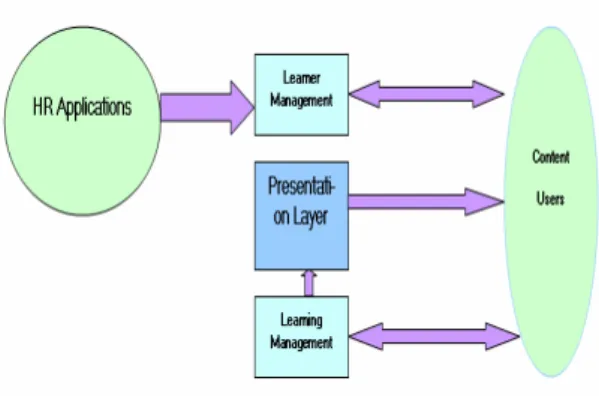
Figure 2 explain the relationship of the components that comprise a learning management system. An LMS has the capability of managing learners and their records as well as managing the learning process. Within an LMS, the users interact with their learner data and with learning management information. The learning content is not a part of this configuration.
Figure 2: LMS Components (Irlbeck, & Mowat, 2006)
Some LMS may have a degree of content management ability, but this is not their main focus. According to Rosenberg (2001), although LMS differ from vendor to vendor in their focus on one or more of their features, they all have core capabilities: online registration system; online course catalogue; competency assessment; learning assessment; ability to launch and track e-Learning; learning material management; customizable reporting; collaborative and synchronous learning tools; and ability to integrate with other enterprise applications (p. 162-164). To reinforce, the goal of LMS is to manage processes related to delivery and administration of training and education. LMS are structured around the course rather than
course content. Table 1, found later in this chapter, reinforces Rosenberg's list that LMS support many learning management functions, but do not man- age, create, or search for content for the learner. Collaborative tools within LMS include capabilities that allow learners to work simultaneously with other learners using an inter- net/intranet/extranet technology coupled with CMS. The next section describes the combination of content and learning management via the LCMS (Irlbeck, & Mowat, 2006).
Content management systems (CMS): are sometimes confused with course management systems. Course management systems are more sophisticated than CMS in that "Course- management systems integrate content delivery, communication, learner activities, collaborative work, feedback, testing, portfolio development, groupware tools, and administrative tools for the instructor" (Collis & Strijker, 2003). CMS – that is content management systems - are focused on content, with a purpose to store information and provide access to the information. Additionally, CMS are used for the broader purpose of organizational knowledge management. “While a CMS itself is not the source of knowledge, it can be a very valuable enabler in knowledge-capture processes” (Robertson, May 2003, p. 1). As a summary, Table 1 found later in this chapter reinforces the principle that a CMS is best at managing content, providing a database and capability to search for the content and a way to locate and deliver the content to the appropriate user. The CMS stores and manages the content, but does not analyze, organize, or distil content into knowledge. Those tasks are the function of a Learning Management System (LMS) and/or Learning Content Management System (LCMS), described in the next sections (Irlbeck, & Mowat, 2006).
4- Learning Content Management Systems (LCMS)
Learning Content Management System illustrate a multi-user environment where learning developers can create, reuse, store, manage and deliver digital learning content from a central object repository (Bryan, 2004) terms LMS and LCMS are not mutually exclusive. Most LCMS provide basic LMS functionality, and many LMS include some aspects of content management as well. Some vendors provide everything in a single package. The modern content management system was invented in late ‘90s by an Inter-
net news publishing company. Web publishing is a fairly complex process. First, the author has to submit an article, written using tools that are intuitive for a non-technical writer to use. Before publishing, an editor needs to review the article and make changes, possibly even sending the article back to the author for further editing. Multiple versions of the document could be flying back and forth among the author, and editor. Once the content is finalized, it needs to be put into the layout in which it will appear on the site. The editor may decide to add related links. Somebody needs to decide where on the site the article will go. And once it's all done, somebody else has to post the article to the public web site (Jurubescu, 2008).
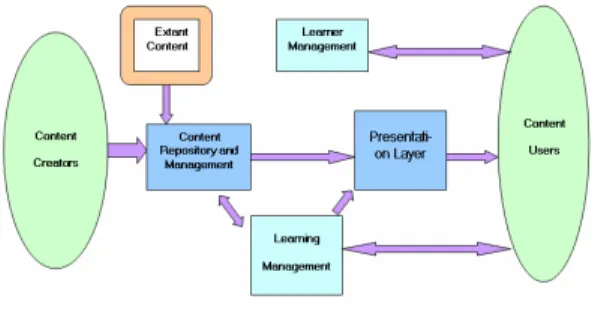
The following figure 3 depicts the elements that comprise a typical LCMS. The content is created and stored in a repository that is accessed by the learning management system and distributed to the users (i.e., learners). The individual learner data is also managed by the system and is accessible to the individual user. So one begins to comprehend the integration of content, managing the content for distribution, and managing learner data.
Figure 3: LCMS Components (Irlbeck, & Mowat, 2006)
Although 81% of the LCMS reviewed in a recent Brandon Hall report (Hall, 2003) incorporated some LMS functionality, this is not their main focus. The same study also found that 100% of LCMS reviewed were described as “interoperable with third-party learning management systems”. In other words, they purportedly can operate seamlessly with LMS created by other companies. LCMS are based on a reusable learning object model allowing content to be reused within or across courses or programs (Hall, 2003). To accomplish this, LCMS manage content separately from the media (technology interface) in which the content will be delivered. RLO are assembled into learning chunks or accessed as individual pieces of information or instruction and delivered to the learner (Irlbeck, & Mowat, 2006)
The efficient and successful deployment of an LCMS "relies largely on effective development and use of learning objects, which are reusable, media-independent chunks of information organized by a meta data classification system" (Ellis, 2001). LCMS were not created with the intention of replacing LMS. LCMS and LMS can be complementary and each solves a uniquely different challenge. Feldstein emphasized that "organizations that purchase LCMS's typically start looking at these tools because they are faced with the challenge of producing and maintaining a daunting amount of customer e-learning content" (Hall, 2002, p. 1). LCMS are particularly suited to handling large amounts of content for e-learning efforts. An effective LCMS will enable an organization to organize courseware without programming expertise. Also course management systems (CMS) which combine elements of both LCMS and LMS, but these are aimed primarily at formal education particularly post- secondary and have special features for that market. Some vendors of these systems call them LCMS (Jurubescu, 2008).
5- Overview of Existing LCMS and LMS systems
The are three categories of enterprise-wide applications increases the amount of information available to decision makers. Applications in all three categories have individual capabilities that make them appropriate for specific situations. In addition, all of the applications should strive to meet certain criteria including:
• Authoring tool neutrality, meaning that content can be authored using any tool. • Vendor neutrality, meaning that the application can manage content authored by any vendor .
• Browser neutrality, meaning that the application must appear and function the same no matter what browser is being used.
• Platform neutrality, meaning that the application can run on any platform (PC, MAC, etc.) with any operating system (Windows, Linux, etc.)
• Scalability, meaning that the application can scale larger or smaller to meet the organization’s needs; includes a firewall (hardware or software that provides security to a company’s internal systems by blocking unauthorized access) and includes an intuitive interface. (Rosenberg, 2001, p. 166).
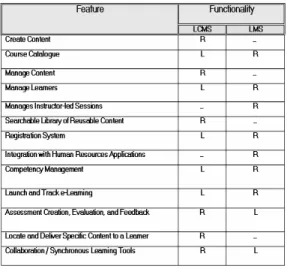
Table 2 provides a summary of key features that organizations require to fully manage their
content and learning function and indicates whether each is part of the functionality provided by a LCMS and LMS. Each feature may have greater or lesser application for each category. For example, a feature may have a robust (R) application for LCMS and a limited (L) or no functionality for LMS. The list in Table 2 is a compilation of possible features from Donello (2002) and Hall (2003) and impact learners, content presentation, competencies, delivery assessment, and integration with other applications in the organization. Use this table as a guide to the information in the following sections.
Table 2: Features of LCMS and LMS
Functionality
R = Robust Functionality L = Limited Functionality 6- LCMS vs. LMS
LCMS focus on stored online content to be managed and reused through integrated database functionality. LMS focus on making learning available and tracking learners. While there is some overlap in the functionality between a LMS and a LCMS, the two enterprise applications have a different focus.
LMSs make the process of scheduling classes, creating catalogs and registering learners more efficient. LCMSs on the other hand, focus only on delivery. In the broadest terms, the LMS helps get you to the classroom door and the LCMS man-ages the experience inside the classroom (Jones, 2001).
To put it another way, “the primary objective of a learning management system (LMS) is to manage learners By contrast, a learning content management system (LCMS) manages content or learning objects” (Hall, 2003, p. 1)
in order for learners to learn efficiently. It should be noted, however, that many LCMS have some learner management capabilities.
As mentioned earlier, a learning management system can save money by reducing learning administration costs. “The value proposition of a LMS is cost-efficient training administration” (Brennan, Funke & Anderson, 2001, p. 9). The LMS cannot, however, support content sharing and the attendant savings realized through the use of learning objects nor can it provide the same level of learning control or personalization of learning. Schelin explains that, “the initial benefits of a LMS are cost-displacement issues, whereas the LCMS space is all about focusing on the notion of what we call reducing time to performance” (2001).
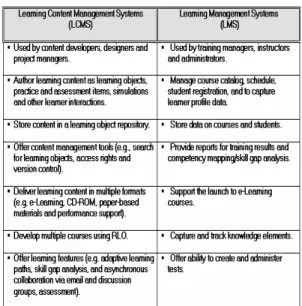
Table 3 provides a summary of Comparing between LCMS and LMS. the LCMS and LMS provide a way for organizations to inexpensively and efficiently create and reuse content, deliver that content, assess and track users, and gather important user data” (Jacobsen, 2002, p. 2). Why not create a single system to manage content and user information? Experts tend to predict that at this time with the present technological constraints, such a large robust system would require such a huge organizational effort and is still too large and complex for the requirements of most educational and training operations. However, as LCMS develop their influence on, and efficiency for e-learning, instructional design may increase to such a point that it will be beneficial for developers to explore new learning techniques to modularize and manipulate content. The following table summarizes the differences between LCMS and LMS (Irlbeck, & Mowat, 2006).
Table 3: Comparing between LCMS and LMS
7- E-Learning Requirements
The research department at Thinq believes that “Learning Management Systems (LMS) are critical to facilitating the widespread adoption of e-learning”. To manage e-Learning on an enterprise-wide basis, an application would need to be able to store, launch, track, manage embedded learner assessments, and report on progress through e-Learning topics, lessons, and modules. An instructional designer analyzed the needs of Thinq to first identify the e-Learning requirements and then match the requirements to the functionality of CMS, LMS or LCMS. The instructional designer reported possible options as shown in the following table. As can be seen, LMS had all the elements required to manage e-Learning effectively. LCMS had most of the functionality but were less robust, and CMS did not meet any of the eight requirements to manage e-Learning, Table 4 provides a summary of key e-Learning Requirements (Thinq, 2003).
Note: e-Learning requirements adapted from “Theory & practice: Learning content management systems” by Jill Donello, 2002 and from “Learning management systems and learning content management systems demystified” by Brandon Hall, 2003.
8- LCMS and LMS are Complementary
LCMSs and LMSs are different from one another, but they also complement each other well. The well tightly integration between LMS and LCMS produces an reachable, ultimately resulting in a richer learning experience for the user and a more comprehensive tool for the learning administrator. An LMS can manage communities of users, allowing each of them to launch the appropriate objects stored and managed by the LCMS (IDC, 2001). In delivering the content, the LCMS also bookmarks the individual learner’s progress; a
record test scores, and passes them back to the LMS for reporting purposes. The highlighted portion of Figure 4 explain the relationship of the two integrated LMS and LCMS in an e-learning environment.
The LMS and LCMS must be interoperable. Two of the key benefits of using learning objects, interoperability and reusability, are based on XML standards and described by standard metadata defined by learning standards bodies.
8- Integration LCMS –LMS with Blended e-learning system (BeLs)
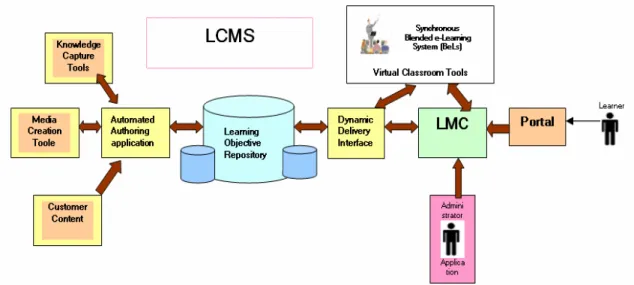
The following figure 4 depicts the major functional components in the emerging e-Learning architecture. Most companies mix and match the various components to create a customized integrated solution that meets their unique requirements (Caton, 2001).
Figure 4: LCMS –LMS Integration in a Blended e-learning system (BeLs)
Portal
A learner typically enters the e-Learning environment via a portal. The portal interface can be as simple as a login screen, or it might be something more sophisticated like a knowledge management portal.
Virtual Classrooms/Synchronous BeLs
A common training event launched by an LMS is a synchronous virtual classroom. Users with appropriate hardware gather in a virtual space (typically using the metaphor of a classroom) where an instructor leads or facilitates a
real-time discussion with a “class” over the Internet (Caton, 2001).Users have controls for asking questions and providing feedback about the pace or difficulty of the presentation. Chat functions, application sharing, and desktop sharing are often integrated into these types of solutions.
Asynchronous Learning
Recently, asynchronous learning was delivered to the user in the form of static HTML pages. Personalized delivery of content was limited by the capacity of training developers to produce the various permutations of learning content that might be demanded by the
multitude of teach audiences (Caton, 2001). Otherwise it was the responsibility of the learner or manager to decide which static course or learning event was most appropriate for each situation.
The LCMS represents an important technological development in asynchronous training. It enables dynamic content delivery, where the right amount of learning content is delivered to the learner at the time it is most needed – either to perform a task at hand or to prepare for an imminent quiz or test. Essentially, the LCMS works in tandem with the LMS, with the LMS launching asynchronous training events that are dynamically generated by the LCMS.
9- Conclusion
The Learning Content Management Systems segment allows organizations to leverage one application to educate a variety of students: employees, partners, suppliers, and customers. A Learning Content Management System is an valuable tool that compresses the time required to develop learning content.
LCMS and LMS could each be an appropriate solution depending on the needs of an organization. By clearly understanding the differences, the core functionalities of each, and the benefits of combining or keeping applications separate, training and education professionals can help guide decision makers toward the best solution for the organization. Matching the right solution to meet the needs will help organizations effectively allocate their education dollars through focused applications to manage the learning, administration, tracking, and reporting functions (Michael, 2001). The net result of this is increased organizational productivity.
References
Adobe, Adobe solutions for Learning Management Systems (LMS)",Adobe Systems Incorporated. All rights reserved. Printed in the USA, 2008.
Brennan, M., Funke, S., and Anderson, C. (2001). The learning content management system. Retrieved February 25, 2004, from
http://www.mindbranch.com/listing/product/ R104-6256.html.
Bergstedt, S. & Wiegreffe, S. &Wittmann, J. & Möller, D," Content Management Systems and e-Learning-Systems – A Symbiosis?", Proceedings of the The 3rd
IEEE International Conference on Advanced Learning Technologies (ICALT’03), 2003Bryan Chapman, “e-Learning for the En-terprise: why Learning Content Management matters most?”, from Brandon-Hal.com, Your Guide to e-Learning, 2004.
Collis, B. & Strijker, A. (2002) New Pedagogies and Re-usable Learning Objects: Toward a Different Role for an LMS. Association for the Advancement of Computing in Education (AACE). ED9MEDIA 2002 World Conference on Educational Multimedia, Hypermedia & Telecommunications. Proceedings. June 24-29, 2002.
Caton. J, "
Evaluating
Learning Content Management Systems (LCMS)" , Peer3 – All rights reserved,May 15, 2001. Drakos, N.,Votsch,V., Jones A., Müller,V.:Worldwide Web Content Management.
David Wilson , “E-Learning suites or not”, in E-Learning suites, elearnity, June 2003.
Donello J. (2002). Theory & practice: Learning content management systems. Retrieved February 25, 2004, from
http://www.elearningmag.com.
Ellis, R. K. (2001) LCMS Roundup. Retrieved May 12, 2005 fhttp://www.learningcircuits.org/2001/aug20 01/ttools.html.
IDC is the premier global provider of market intelligence, advisory services, and events for the information technology, telecommunications, and consumer technology markets. IDC helps IT professionals, business executives, and the investment community makes fact-based decisions on technology purchases and business strategy. www.idc.com
Hall, B. (2003). Learning management systems and learning content management systems demystified. Retrieved March 1, 2004, from http://www.brandonhall.com.
Hall, B. (2002). Six steps to developing a successful e-learning initiative: excerpts from the e-learning guidebook. In Allison Rossett (ED.) The ASTD E-Learning Handbook. New York: McGraw-Hill.
Irlbeck, S. & Mowat J,"Learning Content Management System (LCMS)", Capella University ([email protected]), 2006.
Jablonski, S., Meiler, C.: Web-Content Managementsysteme, Informatik Spekrum 23(6) (2002).
Jurubescu, T," Learning Content Management Systems", Revista Informatica Economică, nr. 4 (48)/2008.
Jones, C. (June, 2001). Rules of the game. Online Learning Magazine, 5 (6).
Michael Brennan, Susan Funke, and Cushing Anderson, “The Learning Content Management Systems – A new e-Learning market segment emerges”, An IDC White Paper, IDC Analyze the Future, 2001 at
www.idc.com.
Robbins, S. R. (2002). The evolution of the learning content management system. Retrieved February 25, 2004, from http://www.learningcircuits.org/2002/apr200 2/robbins.html .
Robertson, J. (June, 2003). So, what is a content management system? Retrieved November 20, 2003, from
http://www.steptwo.com.au.
Rosenberg, M. J. (2001). e-Learning. New York: McGraw-Hill.
Solemon, B.& Sulaiman, R, "Rapid E-Learning Content Management System (RE-COMS)", International Journal of Computing & Information Sciences, Pages 1 – 8. Vol. 4, No. 1, April 2006.
Singh, H. (2001). Learning content management systems. Retrieved November 20, 2003, from
http://www.internettime.com/Learning/lcms.
Subrahmanyam , J," FUTURE TRENDS OF CONTENT MANAGEMENT SYSTEMS (CMS) for e-Learning: A Tool Based Database Oriented Approach, Quantum Softech Limited, Hyderabad, India,
Schuster, E., Wilhelm, S.: Content-Management, Informatik Spekrum 23(6) (2000).
S.R. Robbins, “The Evolution of the Learning Content Management System”, http://www.learningcircuits.org/NR/exeres/4 8 3F426A-BEA4-4E32-8080-01FC7AA26DED.htm [6/17/04].
Thinq. (2003). LMS, the backbone of your training system. Retrieved February 25, 2004, from http://www.thinq.com.
Brooks. C, Hansen. C, Greer. J," Social Awareness in the Help Courses Learning Content Management System," ARIES Laboratory, Department of Computer Science, University of Saskatchewan, 176 Thorvaldson Building, Saskatoon, SK, S7N 5C9, Canada, 2006.
Dourish, P., Bellotti, V.: Awareness
and
Coordination
in
Shared
Workspaces. Computer Supported
Cooperative Work, October 31 –
November
4,
Toronto,
Canada
(1992).