Learning Integration Techniques By APOS Model
And Analysis Of Student’s Error
Hanifah
Abstract:—This research aims to determine the impact of applying APOS Model on Integration Techniques to know student learning outcome and character, as well as to determine the results of student error analysis in solving integration technique test questions. The research method used was to use ex post facto research. The research subjects were all students of class A semester 3 of Mathematics Education Study Program Faculty of Teacher Training and Education University Bengkulu on Academic Year 2018/2019, amounting to 38 students. The type of data in this research was quantitative data and qualitative data. The instruments used in this study were: Test Sheets, Likert scale questionnaires, and open questionnaires by students. After the data was collected and processed the following results were obtained: The average value of student learning outcome on integration engineering lesson was 58.91 and was quite effective. Based on the recapitulation of student answers about integration technique test questions, it can be concluded that: there were 46.38% who answered correctly; there were 12.50% did not answer; 41.12% answered wrongly. There were 72.85% of students operating wrong, there were 27.15% wrong principles; The characters formed after learning the integral calculus based on the APOS Model were: more active, more conscientious, focused, more critical, disciplined, diligent, responsible, diligent, curious, respecting others, able to work together, confident when solving problems, trusting yourself when explaining the material more clearly in front of the class.
Index Terms:—APOS Model, APOS Model Syntax, Worksheet, Integration Technique.
————————————————————
1
BACKGROUND
Calculus was a compulsory subject offered at the Bachelor’s degree in Mathematics Education Study Program, Faculty of Teacher Training and Education, University of Bengkulu. Integral Calculus contains anti derivatives, boundary integrals, transcendent functions, integrating techniques (integration techniques), and unproper integrals. Integration techniques consist of the following topics: Integration with the substitution method, trigonometric integrals, rationalized substitution, partial integration, and integration of rational functions. Expected competencies after studying Calculus were students able to use Calculus as a tool in the process of solving and solving various problems in science and technology, and could learn the next level of mathematical material based on Calculus as a tool [1] (Martono, 1999). Targets to be achieved after students learning Calculus well were to obtain basic knowledge and mathematical thinking patterns, in the form of: (1) organizing scientific thinking patterns that were critical, logical, and systematic; (2) trained reasoning and creativity after learning various strategies and tactics in solving Calculus problems; (3) trained in designing simple mathematical models; (4) skilled in standard mathematical techniques supported by concepts, reasoning, formulas, and correct methods [1] (Martono, 1999). APOS was a learning theory that was specific to mathematics learning at the college level, which integrates the use of computers, learning in small groups, and paying attention to mental constructions carried out by students in understanding a mathematical concept. These mental constructions were: action, process, object, and schema abbreviated as APOS [2] (Dubinsky, 2001). [3]
ARNAWA (2006), [4] ARNAWA (2009), [5] SURYADI
(2011) VYGOTSKY IN [6] MCLEOD (2019), [7] CHAIRANI (2015),
[8] SURYADI (2011), [9] Malik (2017 said that: "The zone of proximal development (ZPD) has been defined as the
distance between the actual developmental level as determined by independent problem solving and the level of potential development as determined through problem-solving under adult guidance, or in collaboration with more capable peers ". VYGOTSKY IN [6] MCLEOD (2019), [7] Chairani (2015), [8] Suryadi (2011), [9] Malik (2017) believed that when a student was in the zone of proximal development for a particular task, providing the appropriate assistance will give the student enough of a "boost" to achieve the task. To assist a person to move through the zone of proximal development, educators were supported to focus on three important components which aid the learning process: (1) The presence of someone with knowledge and skills beyond that of the learner (a more knowledgeable other) ; (2) Social interactions with a skillful tutor that allows the learner to observe and practice their skills; (3) Scaffolding, or supportive activities provided by the educator, or more competent peer, to support the student as he or she was led through the ZPD. APOS Model was an abbreviation of Mathematical Learning Model Based on APOS Theory [10] (Hanifah, 2016), which was a refinement of the Calculus Learning Model Based on APOS Theory (MPK-APOS) [11] (Hanifah, 2015). The APOS model has syntax consisting of phases: Orientation, Practicum, Small
Group Discussion, Class Discussion, Exercise, and
Evaluation. To implement the APOS Model, an APOS Model-based Worksheet was developed. This worksheet initially consisted of Practicum Worksheets, Manual Worksheets, Class Discussion Sheets, and Exercise Sheets. The design of the Worksheet was not in accordance with the syntax of the APOS model, which might cause confusion for those who wish to develop their own Worksheet. Further improvements were made, so that the Worksheet consisted of activities for each phase: Orientation, Practicum, Small group discussion, Class Discussion, Exercise or Evaluation.
The Worksheet has been applied in Class A Mathematics Education Study Program Faculty of Teacher Training and Education University of Bengkulu on Academic Year 2017/2018, with 4 (3-1) credits, and lectures were held on the same day and place ie Wednesday in Mathematics Education Study Program room. Worksheets were given at the beginning lectures every week, with the composition of time: 20 minutes orientation phase, 50 minutes practicum phase, ————————————————
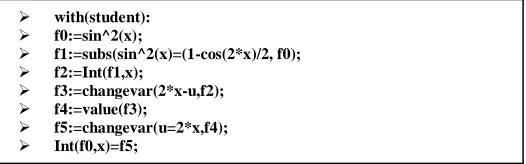
147 with(student):
f0:=sin^2(x);
f1:=subs(sin^2(x)=(1-cos(2*x)/2, f0); f2:=Int(f1,x);
f3:=changevar(2*x-u,f2); f4:=value(f3);
f5:=changevar(u=2*x,f4); Int(f0,x)=f5;
50 minutes small group discussion phase, 10 minutes break, 50 minute class discussion phase, 10 minute training or evaluation phase. In the practicum phase, students work in small groups, and each group carries a laptop. Learn from the application of the APOS Model on academic year 2017/2018, where before learning, the lecturer always prepares a Worksheet to be distributed to each group. The Worksheet was collected again at the end of the lesson. For cost savings, approaching academic year 2018/2019 all Worksheets and Maple guides were used as Textbooks with the title Integral Calculus Based on the APOS Model [12] (Hanifah, 2018). Students did not answer the teaching book, but answered on a separate paper. The learning process follows the syntax of the APOS Model which consists of phases: Orientation, Practicum, Small Group Discussion, Class Discussion, Exercise or Evaluation. Worksheet to support the APOS Model in Integration Technique lesson consists of: W-9 concerning Integration with Substitution Method; W-10 about Multiple Integral Trigonometry; W_11 about Rational Substitution; W-12 about Partial Integral; W-13 concerning Integration of Rational Functions. Successful implementation of Worksheet depends on the completeness of the Maple application program instructions which would be the source of student learning in constructing the lesson. Success could also occur if Maple was unable to provide a complete explanation, but the lecturer as a supervisor was able to provide assistance / scaffolding or students who were tenacious studying lesson from various sources. During the learning process, the lecturer acts as a supervisor who was ready to provide assistance (scaffolding) if needed by students or groups of students. Scaffolding was the provision of a number of assistance to students during the initial stages of learning, then reducing assistance and providing opportunities to take over greater responsibilities after he could do so. Scaffolding was a help given to students to learn and solve problems. The assistance could be in the form of instructions, encouragement, warnings, break down problems into solving steps, provide examples, and other actions that enable students to learn independently [6] (McLeod, 2019), [7] (Chairani, 2015 ), [8] (Suryadi, 2011), [9] (Malik. 2017). Scaffolding consists of the activities provided by the educator, or more competent peer, to support the student as he or she was led through the zone of proximal development. Support was tappered off (i.e. withdrawn) as it becomes unnecessary, much as a scaffold was removed from a building during construction. The student would then be able to complete the task again on his own [6] (McLeod, 2019). Wood et al. in [6] McLeod (2019) define scaffolding as a process "that enables a child or novice to solve a task or achieve a goal that would be beyond his unassisted efforts." Assistance (scaffolding) provided for each integration technique varies in number and shape. There were a few who depend a lot on the level of difficulty or depend on the ease of the Worksheet understood by students. The following was a form of scaffolding that lecturers give classically to students. For W-9 on Integration with the Substitution Method, the assistance provided was not much. In W-1 a command on the method of substitution has been given. The difference lies in the form of integral functions, where W-9 already contains Transcendent functions that have been discussed in W-8; Examples of Maple's commands for integration techniques with the substitution method.
Figure 1 Example of a Maple Command for Integration
Techniques with Substitution
Maple's command in Figure 1 if executed by Maple, the results would be obtained in the form of answers to questions following the steps of the integration technique with the substitution method. The advantage of using Maple over manuals was that Maple could answer different questions faster, so that many problems could be solved in a short time. But not all integration techniques could be helped by Maple properly. Figure 2 below was an example of the trigonometric function integration technique. Maple's command in Figure 2 bellow if executed by Maple, the results would be obtained in the form of answer questions according to the trigonometric function integration technique. Somewhat different from the design of the Maple command for integration with the substitution method, for other integration techniques it was rather difficult to choose the Maple command that could describe the whole process of integration as a whole.
Figure 2. Example of Maple Commands for Trigonometry Function in Integration Techniques
In this case the lecturer must provide scaffolding in the orientation phase. For the trigonometric scaffolding function given by the lecturer was to remind again by using the question and answer method about trigonometric formula that was often used in trigonometric integration, including those discussed in the transcendent function in W-8.
Figure 3 Example of a Maple Command for Rational restart; with(student):
/*was used to activate the changevar command for substitution */ f:=Int(x^3*(x^4 + 11)^(1/2),x);
/*was used to definef = ∫ x^3*(x^4 + 11)^(1/2) dx */
changevar(u=(x^4+11),f,u);
/*suppose u = (x^4+11), and replace the variable x in f to be variable u in f */
f2:=value(%);
/*Calculates integral results in variable u.*/ subs(u=x^4 + 11,f2);
/*Changes the variable u back to variable x so that the final result returns in the form of variable x */
diff(%,x);
/*command to return the integral results back to test the correctness of the results */
with(student): f:= x*(x – 4)^(1/3);
Integration Techniques
In figure 3 you could saw the Maple command chosen to solve the problem with rational integration, it looks very short steps. Even though the integration techniques that rationalize were the most difficult of the other techniques. To help these weaknesses, in the Orientation phase, the lecturer gives a briefing with the question and answer method about the relationship of a right triangle with trigonometry. Inviting students to translate into angled triangles if x function was for example in the form of trigonometry.
Figure 4 Example of Maple Commands for Partial Integration Techniques
In Figure 4 you could see the Maple command chosen to solve the problem with partial integration. The assistance provided was the question and answer method the lecturer invited students to recall the concept of partial integral integration that has been learned since from high school. The difference lies in the integral function, where when in high school the function selected was still simple. For higher education the problem was more complicated, there were even problems that must be solved repeatedly. For problems that contain trigonometry, it became a problem that was difficult for students to solve manually.
Figure 5 Example of Maple Commands for the Integration of Rational Function Techniques
In figure 5 you could saw the Maple command chosen to solve the problem by integrating rational functions, the steps were very short. Even though it took a long time to resolve the integration of rational functions. The assistance given by the lecturer was the question and answer method of the lecturer directing how to factor the denominator of a simple rational function. Then created a new integral based on the factor of the denominator, the numerator was replaced by the letters A, B, or C. The next step was to determine A, B, or C in two ways. Method I used the similarity of the left and right sides, and method II by taking several points, for example x = a, x = b, the value of A = ...., B = ... or C = ....students who master the transcendent function well, would have no trouble completing the integral problem. After students did practicum assisted by the Maple application program, in the small group discussion phase students were directed to discuss the results of Maple's execution. Then proceed with directing students armed with the results of the discussion of Maple's answers to discuss how to solve integral problems without Maple's help.
The results of the small group discussion were then presented in front of the class as the activities of the class discussion phase. After that students were asked to do the exercises individually. If needed the training phase could be used as an evaluation phase by changing the training into a quiz. In the class discussion phase, after the designated group copied the answers on the board, before they explain, the answers were checked by the lecturer first. If something went wrong, the lecturer directed by asking the question why the answer was so that they really understood and confidently explained it. This was done to save time, and no group was afraid to move forward when asked to present. After learning the Integral Calculus for one semester ended, a study was carried out aimed at finding out the impact of the application of Action, Process, Object, Schema (APOS Model) and Analysis of Student’s Error in Completing Problems on Integration Techniques.
2
R
ESEARCHM
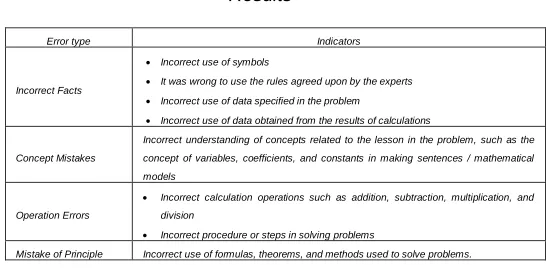
ETHODThe research method used was to use ex post facto research, according to [13] Sugiyono (2012) ex post facto was a study conducted to examine events that have occurred and then trace back to find out the factors that could cause these events. To analyze errors, error analysis guidelines were used according to [14] Soedjadi (2000). [14] Soedjadi (2000) states that the types of errors in solving mathematical problems were as follows: (1) Errors of fact were errors in writing conventions that were expressed by mathematical symbols. Examples of errors in turning problems into mathematical models, errors in writing mathematical symbols; (2) A concept error was a mistake in classifying or classifying a group of objects. The concept referred to in mathematics could be in the form of definition. Example: mistakes in defining the concept and applying the concept to the problem; (3) Errors in operation were errors in arithmetic, algebraic, and other mathematical work. Examples of errors in adding, subtracting, and errors in other mathematical operations; (4) Mistakes of principle were mistakes in relating facts or concepts. Examples of errors in using formulas or theorems and errors in using previous principles.
Table 1. Guidelines for Error Analysis of Student Answer Results
Error type Indicators
Incorrect Facts
Incorrect use of symbols
It was wrong to use the rules agreed upon by the experts
Incorrect use of data specified in the problem
Incorrect use of data obtained from the results of calculations
Concept Mistakes
Incorrect understanding of concepts related to the lesson in the problem, such as the concept of variables, coefficients, and constants in making sentences / mathematical models
Operation Errors
Incorrect calculation operations such as addition, subtraction, multiplication, and division
Incorrect procedure or steps in solving problems
Mistake of Principle Incorrect use of formulas, theorems, and methods used to solve problems.
2.1 Research Subject
The research subjects were all students class A semester 3 of Mathematics Education Study Program Faculty of Teacher Training and Education University of Bengkulu on Academic Year 2018/2019, amounting to 38 student.
2.2 Data Type
The type of data in this research was quantitative data and restart; with(student):
f := x -> x*exp(3*x); Int(f(x),x); u:=x; du:=diff(u,x); dv:=exp(3*x); v:=int(dv,x);
f1:=(u*v) – Int(v*du,x); value(f1) + c;
Int(f(x),x)=value(f1)+c;
149 qualtative data. Analysis Quantitative data were obtained
through questionnaires and test sheets. Qualitative data were obtained from open questionnaires.
2.3 Research Instrument
Research instrument that used in this research were:
1. Test sheet about Integration Techniques.
2. Questionnaire about Likert Scale
3. Open Questionnaire about Applying APOS Model on
Integration Techniques material
2.4 Data Analysis Techniques
Research instrument that used in this research were: The research data were analyzed descriptively quantitatively. Error analysis using analysis tools [14] Soedjadi (2000). The step was to separate the correct and wrong integration technique test answers for each number of questions. For the wrong analysis, what was done by a student. Then count how many students made a mistake and what mistakes were made. Then looked for the average and the percentage for each type of error. For an open questionnaire, all student answers were copied, if there was one copy at all. For answers with only two choices, the answers were ditally then each of them was added up and the percentage was searched. Value = (number of electors / number of students) x 100 For data in the form of a questionnaire using a Likert scale, data analysis techniques obtained were as follows: [15] (Riduwan, 2009).
a) Give a score for each item with answers: strongly agree
(5), agree (4), doubt (3), disagree (2), and strongly disagree (1).
b) Summing the total score of each respondent for all
indicators.
c) Grading by:
𝑆𝑐𝑜𝑟𝑒 = 𝑆𝑐𝑜𝑟𝑒 𝑂𝑏𝑡𝑎𝑖𝑛𝑒𝑑
𝑀𝑎𝑥𝑖𝑚𝑢𝑚 𝑆𝑐𝑜𝑟𝑒× 100%
3
R
ESULT ANDD
ISCUSSION3.1 Result
1. Learning Outcomes of Integration Techniques Learning outcome of Integration Techniques consisting of the following
topics: Integration with Substitution, Some Integral
Trigonometry, Substitution which Rationalizes, Partial
Integration, and Integration of Rational Functions, was taken from the results of tests on integration techniques. The test was carried out on December 5, 2019. The test questions given were as follows:
1. ∫(2x(𝑥 − 15) )dx
2. ∫ cos t sin (𝑡)𝑑𝑡
3. ∫ sin(8𝑡) sin(4𝑡) 𝑑𝑡
4. ∫ sin (8t) 𝑑𝑡
5. ∫ x e 𝑑𝑥
6. ∫√
7. ∫( )( )( ) dx
8. ∫
( ) dx
After the data was collected and processed, the average value of learning outcome of integration techniques was 58.91, and
was categorized as quite effective. Student Test Results were shown in Figure 6 below:Integration Technique Test Results
Figure 6. Integration Technique Test Results
In Figure 6 it could be seen that there were 44.74% who scored> 60, they were considered able to complete the test questions well. There were 21.05% who scored ≥ 80, this was the group that answers the test questions carefully and almost all of them were correct. They were scattered in different groups, and generally became members who explain the lesson to their small group friends, or explain the lesson in the class discussion phase. There were 23.68% scored <40. They included those who failed to answer the test questions carefully.
Recapitulation of Student Answers on Integration Technique
Tests
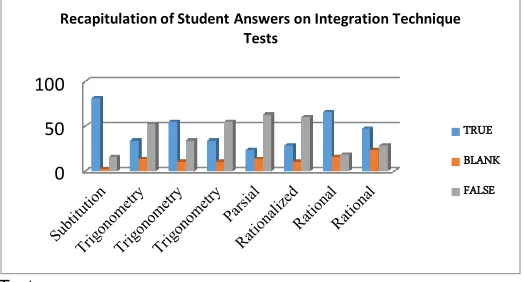
Figure 7 Recapitulation of Student Answers on Integration Technique Tests
In Figure 7 it could be seen that partial integrations, rationalized substitution integration, and trigonometric function integrals were the most frequently answered questions by students. Although the integration technique with the substitution method has often been used since W-1, there were still students who answer incorrectly. Problem number 7 regarding rational functions included questions that were answered correctly by students. Problem No. 8 included the most questions that were not answered by students. Many factors affect learning outcome. To find out why students struggle in solving integration technique test questions, here were the answers.
0 50 100
Recapitulation of Student Answers on Integration Technique Tests
TRUE
BLANK
Type of Student Answer Error on Integration Technique Test
Figure 8. Types of Student Answer Mistakes on Final Examination
In Figure 8 it could be seen that the mistakes made by students were generally operation errors, usually this happened because students were not thorough in their work. In problem number 3 about trigonometry, the most mistakes were in principle mistakes. This happens because of the many
formulas and rules that exist in trigonometric functions. The following questionnaire answers would help answer why
students have difficulty answering integration test questions correctly. 2. Questionnaire Results Ease of Understanding Integral Calculus Worksheets (Worksheet) To find out the level of ease of understanding the concept of lesson on each Worksheet for one semester, asked questions in the form of Likert scale to students. There were 37 students who returned the questionnaire. After processing the results were obtained as shown below 9.
Figure 9. Ease of Understanding the Integral Calculus Worksheet
The integration technique was in W-9, W-10, W-11, W-12, and W-13. Among the integration techniques could be seen in
Figure 9, W-9 about integration with the substitution method was the most easily understood by students. W-10 about Trigonometry Functions, and W-11 about Rational Substitution was the Worksheet that was the most difficult for students to understand.
a. Activity in Small Groups
Figure 10. Student activity in small groups
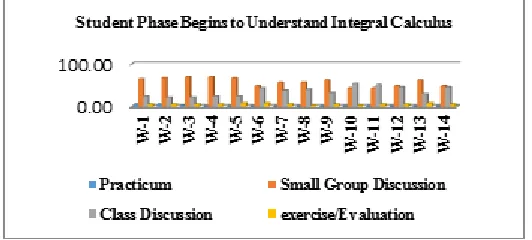
In Figure 10, it could be seen that the activeness of students decreased sharply in W-8 regarding transcendent functions, W-9 techniques of integration of substitution methods, W-10 about rationalized substitution methods, and W-12 about partial integrals. Activity again increased in W-13 regarding integration of rational functions. The Student Phase Begins to Understand the Lesson APOS Model Syntax consists of several phases, and student-centered learning, and learning in small groups raises curiosity in what phase new students understand the lesson. For this reason, the following question was asked. "In what phase did you only understand the lesson?" After the data was collected and processed, the results were as follows: Figure 11
Figure 11. Student Phase Begins to Understand Integral Calculus
In Figure 11 it could be seen that in W-9 regarding integration with the substitution method, and W-13 concerning integral rational functions, most (≥ 60%) students have understood the lesson since the small group discussion phase. In W-12 about partial integrals almost as many begin to understand in the small group discussion phase with the pleasure discussion phase. W-10 about trigonometric functions, and W-11 about substitution which rationalized the majority of new students understanding the lesson in the class discussion phase.
Difficulties in Resolving Integration Technique Test
QuestionsTo find out if students experience difficulties in completing the integration technique test, the following question was given. "Are you having trouble answering the Integrated Technique Test questions that have passed? Give
0 20 40 60 80 100
Type of Student Answer Error on Integration Technique Test
Type of Error fact
Type of Error concept
Type of Error operation
Type of Error principle
65 70 75 80
W-1
W-2
W-3
W-4
W-5
W-6
W-7
W-8
W-9
W-10
W-11
W-12
W-13
W-14
151 reasons for each of your answers, why it could happen ".
There were 68.42% said difficulties with reasons among the following. Lack of understanding how to use trigonometric integrals, it was rather able to understand some lesson but rationalizing substitution and trigonometry were rather difficult to answer, difficulty integrating partial and rational functions, lesson was deep, lesson was more difficult, hesitant to use which method in the problem, less thorough and still don't know which formula to use, confused when changed, lack of preparation and lack of understanding of the lesson, lack of understanding of the lesson and lack of learning, rather lazy to learn because it does not focus on learning, often wrong, late coming, and there was lesson that hasn't been mastered yet. There were 7.89% who have no difficulty with the following reasons Trying to master the lesson before the integration technique test was carried out; before the test I have learned and practiced solving the questions on Maple and quiz questions; The lesson that I have explained in small groups and in front of the class makes me remember the lesson so that when given similar questions, I could answer them; actually the questions I worked on in the integration technique test could be all, maybe a rather difficult number 7; Before the integration test, I studied with friends and on YouTube. Changes in Attitude After Learning Integral Calculus With the APOS Model Questions asked. "Is there a change in attitude that you feel after you follow Integral calculus learning?" Give a reason for your answer. There was 100% answer that there was a change in attitude in students for the following reasons: Be more diligent, more active in discussions, trained to work on problems, increase the sense of igin tofu after completion in Maple and then do the exercises manually and the
questions given, increase caution, become more
conscientious because itegral calculus requires high
understanding and accuracy, more diligent and confident compared to before, trying to be more critical, deeper understanding of integrals, better trained in solving calculus
problems, more willing to express opinions, better
understanding the learning lesson discussed, learning integral calculus required critical thinking was careless, less thorough, being meticulous and more often active discussions and more frequent repetition of lessons, more discipline in using the time to work on the worksheets, at the beginning of the beginning less interested but more understanding of the Worksheet there was a sense of interest and from week to week more active, initially a bit careless and not careful now were careful careful and try to be careful because it would hurt when solving problems . Other impacts due to learning in small groups were: mutual respect and acceptance of other people, trusting friends, being able to work well together, feeling curious about the questions given, even though they were a little confused but could be handled well by having friends discussing, better understanding learning integral calculus, curiosity becomes higher, more trained in working on problems e. Character Formed After Learning Integral Calculus With APOS Model Request submitted. "Write down the two characters that you get as a result of learning integral calculus." Student answers were as follows: focus, responsibility, diligence, curiosity, more active, more conscientious, respectful of others, able to work together, confident when solving problems, more critical, disciplined, diligent, and confident in explaining more clearly lesson in front of the class. Learning Model Desired Questions asked. "If you were told to choose, what kind of learning would you suggest for learning Integral Calculus in
the future? " There were 78.95% who want to learn Integral Calculus using Worksheets There were 21.05% who do not want to learn Integral calculus using worksheets but want conventional question and answer based learning, and not in groups. When in groups, students choose their friends. Learning began with the lecture method and continues with discussion.
3.2 Discussion
Learning outcome with an average value that was still below the standard, based on the results of the analysis of errors was caused by incorrect operations, inaccurate student in answering test questions. Some students were wrong in principle, this happened because they were confused about
determining the right technique for each question.
Trigonometric functions that have many rules also cause students to be confused in solving test questions When you looked at the results of the questionnaire as outlined in Figure 10, it could be seen that Worksheets for each integration technique, namely W-9, W-10, W-11, W-12, and W-13, were only W-9 that were easily digestible worksheets. The other worksheets were difficult to understand. This also affected the activities of students in learning. As shown in Figure 11, student activity in small groups has decreased from 8 to W-13. The lesson learned was generally new, even if it has been introduced in high school, the form was still simple. If you also pay attention to Figure 12, it could be seen that for Worksheet-10, Worksheet-11, Worksheet-12, most new students understand the lesson in the class discussion phase. [16]
Feerer (2016) conclude that The students’ learning difficulties
in Integral Calculus were evidently based on the weak procedural knowledge of Trigonometry of the sample one hundred (100) students. Theparticipants find difficulties whenever the given integrand was expressed in non-algebraic form,regardless of the required integration process. It was
concluded based on statistical findings thatlearners
experienced the same level of difficulties in calculating integrals applying either theintegration formulas or the integration techniques. The computed indices revealed that the difficult items identified in the use of any of the two integration process both require thestudents’ capability to operate and simplify non-algebraic functions. It was found from the learners’ solutions in the examination that many of the errors in the integration pertain more to their inability to transform a given trigonometric expression to its equivalent form that may subsequently permit integration. Supported by the results of the interview with the participants of this study, the students acknowledged their weaknesses in recalling trigonometric identities and in performing the basic
fundamental operations involving non-algebraic
that the deficiencies in Algebra and Trigonometry skills continue to impact adversely to Calculus students. Thus, the low rating of the students in Calculus could be attributed to the poor performance in the pre-requisite subjects. As documented from related investigations earlier mentioned, it was further concluded that students generally lack both conceptual and procedural understanding of Calculus because of the observed deficiency in their mathematical content knowledge in Pre-Calculus courses. Some students who like being late were also influential on their groups. Finally, several group members had to be replaced, even after mid examination was merged into two groups, so that all groups were truly heterogeneous and actively engaged in discussions. [18]Siti Fatimah and Yerizon (2019) concluded that student learning difficulties regarding the mathematics lesson in the calculus field that students meet at the high school level were: (1) In general, student difficulties were: a. Creating and analyzing elements in the graph of the function, the graphical relationship functions with limit, derivative and integral lesson; b. Doing trigononometric, such as trigononometry manipulation which was integrated with limit, derivative and integral; (2) Specifically the difficulties students have with the lesson: a. In the lesson function of students it was difficult to determine the domain and range; b. In the derivative lesson students have difficulty in determining the maximum and minimum values of the story matter; c. In the integral lesson students begin to turn back and forth to solve questions between the use of derivative or integral concepts, distinguish problem solving using substitution and partial integral techniques, and the final solution to the problem regarding the volume of rotating objects. This research describes the difficulties of students in calculus mathematics lesson that has been studied in high school. It was expected that lecturers who would teach calculus subjects, by reading this article would get a picture of students' learning difficulties on calculus lesson that students have previously studied in high school. Obtained an initial description of the student's learning difficulties, lecturers could look for specific strategies in teaching students about certain materials in accordance with the difficulties students faceThe smoothness of integral calculus was very influential with the presence of several students who were diligent, resilient, and tried to learn from various sources to understand integral calculus lesson. They did this so they could discussed in small groups and so they could present in class. The activity of explaining the lesson to his friends made them better to understand the lesson and made them more confident. This discussion has also changed some of their characteristics for the better. This could be seen from the open questionnaire answers as stated in point d above. The characters that they got becoming capital for students to fight in the work later. This was consistent with the opinion of [19] Hartono (2013) about the reasons for the development of the
K-13 curriculum in terms of future competencies:
communication skills; the ability to consider the moral aspects of a problem, the ability to think clearly and critically; the ability to be effective citizens; the ability to try to understand and tolerate different views; the ability to live in a globalized society; has a broad interest in life; have readiness to work; have intelligence according to their talents and interests
4
C
ONCLUSIONThe application of the APOS Model to the Integral Calculus course in class A semester 3 of the Mathematics Study Program Faculty of Teacher Training and Education University of Bengkulu 2018/209, as well as the results of the analysis of student errors in solving integration technique test questions have provided a lot of useful information: Average scores of student learning outcomes in integration technique lesson was 58.91 and belongs to the quite effective category. Based on the recapitulation of student answers about integration technique test questions, it could be concluded that: there were 46.38% who answered correctly; there were 12.50% did not answer; 41.12% answered wrongly. There were 72.85% of students operating wrong, there were 27.15% wrong principles; The characters formed after learning the integral calculus based on the APOS Model were: more active, more conscientious, focused, more critical, disciplined, diligent, responsible, diligent, curious, respecting others, able to work together, confident when solving problems, trusting yourself when explaining the lesson more clearly in front of the class
A
CKNOWLEDGMENTThank you to Irni Latifa, M.Pd who helped guided students when needed and we thank to the 3rd semester undergraduate students of the 2018/2019 Mathematics Education Program of University of Bengkulu for their active participation in this research.
R
EFERENCES[1] (Martono, 1999). Martono. 1999. Kalkulus. Bandung:
Erlangga.
[2] (Dubinsky, 2001). Dubinsky. 2001. Using a Theory of
Learning in College Mathematics Courses. Coventry:
University of Warwick
http://mathstore.ac.uk/newsletter/may2001/pdf/learnin g.pdf
[3] Arnawa (2006), Arnawa. 2006. Meningkatkan
Kemampuan Pembuktian Mahasiswa dalam Aljabar Abstrak Melalui Pembelajaran Berdasarkan Teori APOS. Disertasi pada Universitas Pendidikan Indonesia. Tidak diterbitkan
[4] Arnawa (2009), Arnawa. 2009. Mengembangkan
Kemampuan Mahasiswa dalam memvalidasi Bukti
pada Aljabar Abstrak melalui Pembelajaran
Berdasarka Teori APOS. Padang: FMIPA.UNAND. http://jms.fmipa.itb.ac.id/jms/article/viewFile/238/248
[5] Suryadi (2011), Suryadi. 2011. Membangun Budaya
Baru dalam Berpikir Matematika. Sekolah
Pascasarjan Universitas Pendidikan Indonesia;
http://www.scribd.com/doc/93456342/Membangun-Budaya-Baru Dalam-Berpikir diakses pada tanggal 23 Maret 2015.
[6] McLeod (2019), McLeod. 2019. The Zone of Proximal
Development and Scaffolding.
simplypsychology.org/Zone-of-Proximal-Development.html.
[7] Chairani (2015), Chairani. 2015. Scaffolding Dalam
Pembelajaran Matematika. Math Didactic: Jurnal Pendidikan Matematika. ISSN 2442 - 3041Vol. 1, No. 1, Januari - April 2015. STKIP PGRI Banjarmasin
[8] Suryadi (2011), Suryadi. 2011. Membangun Budaya
153 Pascasarjan Universitas Pendidikan
Indonesia;
http://www.scribd.com/doc/93456342/Membangun-Budaya-Baru Dalam-Berpikir diakses pada tanggal 23 Maret 2015.
[9] Malik (2017 Malik. 2017. Teacher Education &
Development | Review Article. Revisiting and re-representing scaffolding: The two gradient model.
Malik, Cogent Education(2017), 4: 1331533
https://doi.org/10.1080/2331186X.2017.1331533
[10](Hanifah, 2016). Model APOS. Inovasi Pada
Pembelajaran Matematika. FKIP. UNIB Press.
[11](Hanifah, 2015). Hanifah. 2015. Pengembangan
Model Pembelajaran Kalkulus Berdasarkan Teori APOS. Disertasi. Program Pascasarjana UNP. Tidak dipublikasikan
[12](Hanifah, 2018). Buku Ajar Kalkulus Integral Berbasis
Model APOS Berbantuan Maple. FKIP. UNIB Press.
[13]Sugiyono (2012). Metode Penelitian Kuantitatif
Kualitatif dan R&D. Bandung. Alfabeta.
[14]Soedjadi (2000). Kiat Pendidikan Matematika di
Indonesia. Konstantasi Keadaan Masa Kini Menuju harapan Masa Depan. Jakarta. DekDikBud
[15](Riduwan, 2009). Riduwan. 2009. Belajar Mudah
Penelitian. Bandung. Alpabeta
[16]Ferrer .2016. Investigating Students’ Learning
Difficulties In Integral Calculus. International Journal of Social Sciences. Special Issue Volume 2 Issue 1,
pp. 310 – 324. ISSN 2454-5899.
DOI-http://dx.doi.org/10.20319/pijss.2016.s21.310324
[17]Ferrer. 2017. The Impact of Algebra and
Trigonometry to Calculus Performance. Asian Journal of Multidisciplinary Studies, 5(8) August, 2017. ISSN: 2321-8819 (Online) 2 348-7186 (Print) Impact Factor: 1. 498 Vol. 5, Issue 8, August 2017
[18]Fatimah, Yerizon. 2019. Analysis Of Difficulty
Learning Calculus Subject For Mathematical
Education Students; International Journal Of Scientific & Technology Research Volume 8, Issue 03, March 2019 ISSN 2277-8616. IJSTR©2019. www.ijstr.org
[19]Hartono. 2013. Karakter Kurikulum 2013 Dan
Pengaruhnya.