1045
Improving The Reactivity Of Clay Nano-Partciles
In High Strength Mortars Through Indirect
Sonication Method
A.Maher El-Tair, M.S. El-Feky, Kamal G. Sharobim, Hassan Mohammedin, M. Kohail
Abstract: The major problem that faces the use of nano-clay in concrete or in cement mortars is its high-water demand. Many researchers had investigated the reason for the high water demand was due to the high agglomeration behavior of nano-clay when mixed with water. Sonication is one of the methods used to de-agglomerate nano-clay particles and to improve the dispersion of nano-clay in the cement matrix. This research aims to reach the optimum indirect sonication time and the solid to liquid ratio that enhances the dispersion of nano-clay and consequently increases its reactivity in high strength cement mortars. The particle size distribution of the sonicated nano-clay particles and the corresponding specific surface area were the main keys governing the optimization process of the studied parameters. Using the optimum solid to liquid ratio with the corresponding sonication time, cement mortars were prepared, and their compressive strength as compared to a control mix (without nano-clay addition) was measured as an indication of the reactivity of nano-clay. In addition the performed microstructural analysis, SEM and XRD helped in confirming the compressive strength results. The results revealed that the optimum solid to liquid ratio is 1:6. Moreover, for every concentration, there is an optimum indirect sonication time. The optimum sonication time found to be 10 minutes for a solid to liquid ratio 1:6. By using the optimum concentration, an improvement in compressive strength of 18.7% and 22.6% after 7 and 28 days reached as compared to the control mix.
Index Terms: Indirect Sonication – Particle Size Distribution - Compressive Strength – Microstructure Analysis – Solid to Liquid ratio
—————————— ——————————
1.
INTRODUCTION
The production of cement is one of the main sources for carbon dioxide emission [1-3]. Carbon dioxide produced from the cement industry ranges from 6 -7 % of the total carbon dioxide emission as reported by International Energy Agency (IEA) [4]. In 2050, the production of Portland cement is expected to increase by 200% [5-7]. Using supplementary cementitious materials as a partial replacement to Portland cement had been studied and investigated using materials in micro-scale; silica fume, fly ash, and ground blast furnace slag and materials in scale; silica, clay, nano-cellolous, carbon nano-tube [8-11]. There are two main benefits for using supplementary materials; an environmental benefit and a technical one. For the environmental one, is the reduction of amount of Portland cement in the construction industry. While for the technical benefit; is improving the microstructure, the mechanical and the durability properties of concrete [12-20]. Generally, Nano-materials improve the reactivity of concrete through mineralogical composition and particle size distribution [20-27]. This improvement can be achieved through enhancing the homogeneity of the cement matrix through reaction occurred between the nano-materials with calcium hydroxide Ca(OH)2 to produce addition calcium silicate hydrate C-S-H gel [12, 28-32]. Nano-clay can be added to the cement mortars and concrete to improve the microstructure through filling effect, pozzolanic effect in addition to the damming effect, which is characterized by this option than any other nano-materials, in which the structure of the nano-clay particle is platy, elongated, and thin shape [33-37].
Nano-clay contains alumina that reacts with CH to produce alumina-containing phases, including C4AH13, C2ASH8, and C3AH6 [38]. Many litterateurs investigated the effect of partially replacing cement with nano-clay. All the researchers found that nano-clay improve the compressive and flexural strength of concrete [34-36]. Nano-clay also, improve the resistance to alkali-silica reaction and the sulfate resistance due to the damming and the filling effect of nano-clay particles which enclose the nano-voids of the cement matrix and block the penetration of any chlorides or sulfates [38-43]. However, it found that increasing nano-clay replacement ratio results in an increase in the water demand due to the agglomeration occurred to nano-clay particles because of the difficulty in the dispersion of its particles in the cement matrix [43-46]. Others had worked on improving the dispersion of different nano-materials in the cement matrix and in concrete to modify its granulometric distribution and to improve its densification, especially nano-silica, carbon nano-tubes, and nano-cellulose [47-50]. Sonication is one of the effective methods to solve the agglomeration occurred and to improve the dispersion of nano-particles in the cement matrix [49, 50, 53-57]. Indirect sonication or bath sonicator was found to be the optimum method for improving the dispersion of clay nano-particles through the cement matrix [58-61]. Norhasri et al. [45] reported that nano-clay had no effect on the compressive strength of ultra-high performance concrete at early age while the effect of nano-clay was observed on the strength at later ages. In addition to, the negative impact of nano-clay on the workability of concrete. On the other hand, Morsy et al. [32] had found that the optimum replacement ratio of nano-clay to Portland cement was 8%, which improve the compressive and flexure strength by 7% and 49%, respectively. Shakir et al. [51] had reported that the optimum nano-clay percentage is 10% of the weight of cement with an improvement in the compressive and splitting tensile strength is 63.1% and 25.6%, respectively as compared to the control mix. However, Patel [52] had found that the optimum percentage of nano-clay is 1% only of the cement weight. From the above literature, it noted that there is no specific replacement ratio obtained for nano-clay as a replacing material for Portland cement. This was due to the ————————————————
A. Maher El-Tair, Assistant Professor, German University in Cairo, Egypt. [email protected]
reduction in the workability of concrete and the poor dispersion of clay nano-particles in the cement matrix [36, 37]. In this paper, improving the dispersion of clay nano-particles will be investigated in terms of particle size distribution and specific surface area through indirect sonication method. In addition microstructure analysis (XRD, SEM) will be performed to study the effect of sonicated nano-clay on the microstructure of cement mortars.
2
E
XPERIMENTALP
ROGRAMThe experimental program carried out in this research divided into two phases; the first phase objective is to optimize the liquid to solid ratio of nano-clay using indirect sonication method on different durations. Where a group of 7 different concentrations of nano-clay; 1:30, 1:10, 1:7.5, 1:6, 1:4, 1:3, and 1:2, were sonicated for 5 different durations; 0, 5, 10, 15 and 20 minutes for each. The optimum concentration was chosen based on the optimum particle size distribution, and the specific surface area of the sonicated samples. In the second phase, the effect of nano-clay dispersion on the compressive strength was studied using the optimum concentration and with the corresponding indirect sonication time. 13 mixtures were used to study the effect of clay nano-particles after subjected to sonication on the compressive strength of the cement mortars. In addition, Scanning Electron Microscopy (SEM) and X-Ray Diffraction (XRD) was carried out to study the impact of sonication on improving the microstructure of cement mortars.
2.1 Materials
Ordinary Portland cement (Type I) complying with the requirements of ASTM C150 [62] standard was used. Silica fume used was produced by the Egyptian ferro-alloys company in Aswan, Egypt. Nano-clay was produced by the physics department in the Housing and Building National Research Center (HBRC) in Egypt, with average particles size 30 nm. Chemical and physical properties of cement, silica fume, and nano-clay listed in Table 1. Transmission Electron Micrographs (TEM) and powder X-Ray Diffraction (XRD) diagrams of nano-clay particles are shown in Figures 1 and 2, respectively. Natural Silicious sand free of alkali-reactive materials from Suez quarries, in Egypt was used. The properties of sand are listed in Table 2. Sika Viscorete 3425 was used as a polycarboxylic ether additive.
2.2 Equipment used
Bath sonicator (indirect sonication method), produced by FALC instruments, Italy. The ultrasonic waves are subjected to nano-clay through the water bath and then through the thickness of the container before reaching the solution, 40 kHz frequency and 100% power of sonication [49]. Temperature is set to 20 °C and tank temperature does not exceed 40 °C.
2.3 Experiments
2.3.1 Particle size distribution
This method is used to optimize the optimum dispersion of nano-clay in water. Mastersizer 3000, is used to measure the particle size distribution through the use of a laser light scattering technique. The data acquisition rate is 10 kHz. Its typical measurement time is less than 10 s. Particle size varies from 0.01 to 3500 μm.
2.3.2 Scanning Electron Microscope (SEM)
Scanning Electron Microscope is examined through QUANTA FEG250. Through SEM the nano-particle distribution and characterization the concrete mixtures can be determined. In addition to helping in interpret the compressive strength results of the mortar samples.
2.3.3 X-Ray Diffraction (XRD)
X-Ray Diffraction (XRD) is used to detect the changes in the hydration reaction and products. The tested samples were taken from the crushed product after applying the compressive strength.
2.3.4 Compressive Strength Test
The compressive strength test of the mortar samples is determined after 7 and 28 days of moisture curing as per ASTM C39 [64]. The test is carried out using a universal testing machine SHIMADZU 1000 KN.
2.4 Samples Preparation
33 samples were chosen to study the optimum solid to liquid ratio and to determine the optimum indirect sonication time for nano-clay. The preparation process for nano-clay samples performed using bath sonicator. 7 solid to liquid ratios were examined, which are 1:30, 1:10, 1:7.5, 1:6, 1:4, 1:3, and 1:2. In which 5 gm of nano-clay were added to 150 ml of water in a glass beaker and subjected to indirect sonication times 0, 5, 10, 15 and 20 minutes for solid to liquid ratio 1:30. The same procedures were done for the other concentrations. All the cement mortar mixes cast in 7x7x7 cm cubes.
2.4.1 Mixing Procedures
The mixing procedures were done as the following: (a) Weight all constituents’ materials, as shown in Table 3. (b) For control and as receive samples, nano-clay added in a dry state to cement and silica fume and was mixed for 2 minutes, and then half of the water was added to the dry mix. (c) The remaining of the water was added to the superplasticizer and then added to the dry mix, and then mixed for 3 minutes. (d) While for the sonicated mixes, nano-clay was subjected to indirect sonication process with the corresponding solid to liquid ratio for each mix prior adding to the dry mix. (e) The dry mix of cement and silica fume was mixed together for 2 minutes, before the solution of the nano-clay added to them. (f) After adding the nano-material solution to cement and silica fume, the remaining of the water was added to the mix with the superplasticizer and then mixed for 3 minutes. (g) Finally, sand was added to the mix and mixed for 3 minutes.
1047
Figure 2: XRD Analysis of Nano-Clay
Table 1:Chemical Composition of Portland Cement, Silica fume, and Nano-Clay
Table 2: Properties of Sand
3
R
ESULTSA
NDD
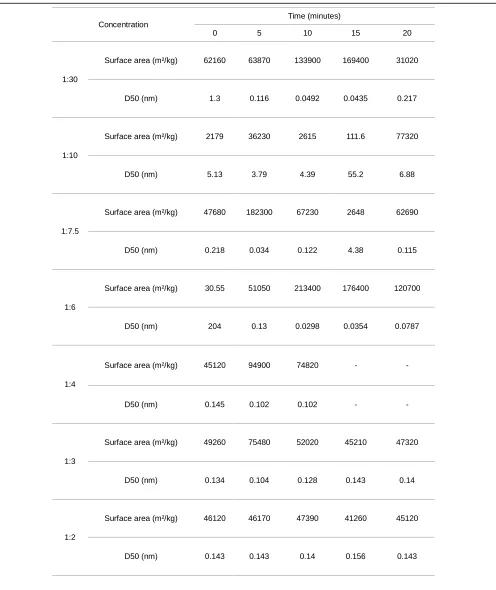
ISCUSSION3.1 Optimum sonication time for each concentration From Figure 3 and Table 4, generally increasing the sonication time the sub-nano-metric particles of nano-clay content and the specific surface area increased to reach an optimum value and then reduced again for every concentration. The optimum solid to liquid ratio obtained was 1:6, with an indirect sonication time 10 minutes. In which the specific surface area of nano-clay reached 213400 m2/kg and the sub-nano-metric particle size reduced to be 0.0298 nm. The increase of specific surface area with the increase in the sonication time to a certain limit can be attributed to increasing the electrostatic force, which makes the particle collide with each other and breaks down the Van der Waals forces in the nano-clay agglomerates. In addition, breaking the primary particles and reduce its sub-nano-metric size, as shown in Table 4. While increasing the sonication time over the optimum sonication time, the specific surface area reduced again. This can explained that by increasing the electrostatic force than a certain limit, the collision frequency reduced which leads to a reduction in the particle breakage resulting in agglomeration formation between nano-clay particles can generated. While at lower solid to liquid ratios, the results show low values of the specific surface areas, was due to the small quantity of
the suspensions for clay nano-particles to be well dispersed in the solution. This leads to a reduction in the repulsive force resulting in a re-agglomeration of nano-clay particles.
(A)
(B)
Table 3: Nano-Clay Cement Mortars Mixes Constituents (gm.
(D)
(F)
Figure 3: Particle size distribution of nano-clay samples (a) concentration at 1:30, (b) at concentration 1:10, (c) at
concentration 1:7.5, (d) at concentration 1:6, (e) at concentration 1:4, (f) at concentration 1:3, and (g) at
concentration 1:2
(E)
(G) Mix Cement Silica
Fume
Sand Water S.P. N.C% Concentration Sonication Time
C 800 200 2000 260 30 0 - Control
OC1 800 200 2000 260 30 1 powder 0
OC3 800 200 2000 260 30 3 powder 0
OC5 800 200 2000 260 30 5 powder 0
NC1 800 200 2000 260 30 1 1:6 10 mins
NC3 800 200 2000 260 30 3 1:6 10 mins
NC5 800 200 2000 260 30 5 1:6 10 mins
MC1 800 200 2000 260 30 1 1:4 5 mins
MC3 800 200 2000 260 30 3 1:4 5 mins
MC5 800 200 2000 260 30 5 1:4 5 mins
XC1 800 200 2000 260 30 1 1:2 5 mins
XC3 800 200 2000 260 30 3 1:2 5 mins
1049 Table 4: Specific Surface Area and mean particle size distribution for each sonication time and concentration by the Mastersizer
3000
Concentration
Time (minutes)
0 5 10 15 20
1:30
Surface area (m²/kg) 62160 63870 133900 169400 31020
D50 (nm) 1.3 0.116 0.0492 0.0435 0.217
1:10
Surface area (m²/kg) 2179 36230 2615 111.6 77320
D50 (nm) 5.13 3.79 4.39 55.2 6.88
1:7.5
Surface area (m²/kg) 47680 182300 67230 2648 62690
D50 (nm) 0.218 0.034 0.122 4.38 0.115
1:6
Surface area (m²/kg) 30.55 51050 213400 176400 120700
D50 (nm) 204 0.13 0.0298 0.0354 0.0787
1:4
Surface area (m²/kg) 45120 94900 74820 - -
D50 (nm) 0.145 0.102 0.102 - -
1:3
Surface area (m²/kg) 49260 75480 52020 45210 47320
D50 (nm) 0.134 0.104 0.128 0.143 0.14
1:2
Surface area (m²/kg) 46120 46170 47390 41260 45120
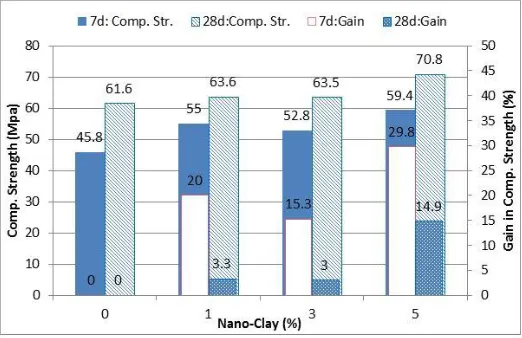
3.2 Effect of sonication on the compressive strength In this section, the impact of sonication in enhancing the reactivity of clay nano-particles and improving the compressive strength was observed through making a comparison between the optimum solid to liquid ratio obtained in the previous section, unsonicated clay particles and sonicated nano-clay was different solid to liquid ratio than the optimum obtained. Nano-clay added as an adding material to cement with a ratio of 1, 2, and 3% of the weight of cement. The solid to liquid ratios used was 1:6, 1:4, and the third one was using unsonicated nano-clay (added as a powder). The results showed that the mix using solid to liquid ratio 1:6 gives the optimum compressive strength, which is 75.56 MPa after 28 days with an improvement of 22.6% than the control mix. While for a solid to liquid ratio 1:4, the compressive strength was 70.80 MPa after 28 days with an improvement of 14.9% than the control mix. While for the unsonicated nano-clay mix the compressive strength was 63.4 MPa with an improvement 2.9% than the control mix. Using 3% nano-clay gives the highest compressive strength regardless using nano-clay a powder or in a solution, as shown in Figures 4, 5, and 6. The small impact of unsonicated nano-clay on compressive strength than the sonicated one was attributed to the presence of a relatively large number of small size clay nano-particles agglomerates in the mix. In which longer time was needed by the unsonicated nano-clay to react with the excess CH to form the additional C-S-H gel. As for the low reactivity at the early age, the agglomeration formed by the unsonicated nano-clay acted as a filler leading to a decrease in the porosity of the matrix resulting in relatively better compaction and higher compressive strength than the control mix. While for sonicated nano-clay, the improvement for 7-day compressive strength was attributed for two reasons; the first was due to the packing effect of nano-clay particles as it acts as a filler to fill into the transitional space of the microstructure of cement mortar. While the second reason, was due to the pozzolanic effect that results due to the reaction between silica and alumina elements in nano-clay with the lime element of calcium hydroxide Ca(OH)2 and oxide CaO in cement to improve the bonding strength and solid volume, this conclusion complies with Morsy et al. [14]. In addition, sonication increases the specific surface area of clay nano-particles, which leads to improving its pozzolanic reactivity and leads to increase in the strength and improving the microstructure of the nano-clay mortars, and that’s will be illustrated later in the next section.
Figure 4: 7and 28-day compressive strength of unsonicated nano-clay mortars and the gain in compressive strength as
compared to the control mix
Figure 5: 7 and 28-day compressive strength of sonicated nano-clay mortars with a solid to liquid ratio 1:6 and the gain in
compressive strength as compared to the control mi
Figure 6: 7 and 28-day compressive strength of sonicated nano-clay mortars with a solid to liquid ratio 1:4 and the gain in
7-day compressive strength as compared to the control mix
3.3 Microstructure Analysis
1051 Electron Microscopy (SEM) and X-Ray Diffraction (XRD) as
shown in Figures 7 and 8 respectively. Figure 7 shows the SEM of mortar samples without nano-clay (a), with unsonicated nano-clay (b), with sonicated nano-clay at solid to liquid ratio 1:6 (c) with age 28 days. For the SEM analysis, when comparing the control samples with the sonicated and unsonicated nano-clay were complying with the results obtained in the compressive strength. This can be attributed to the relatively high reactivity of nano-clay particles after subjected to electrostatic force through sonication than using nano-clay as a powder or without even using nano-clay. In which the ettringite needles were clearly obvious in addition to calcium silicate hydrate plates (C-S-H) in the control mix and unsonicated nano-clay specimens. However, in the sonicated nano-clay specimens a dense structure without any pores or unreacted CH plates appears. As nano-clay can absorb the Ca(OH)2 crystals and fill the voids of the C-S-H gel structure and act as a nucleus to tightly bond the C-S-H gel particles.
(a)
(b)
(c)
Figure 7: SEM pictures of (a) cement mortar without nano-clay, (b) with unsonicated nano-nano-clay, and (c) with sonicated
nano-clay
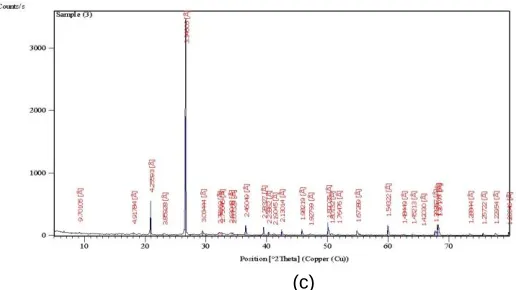
XRD analysis performed to detect changes in the hydration products due to the presence of nano-clay. From Figure 8, it can be clearly observe the impact of indirect sonication on the reactivity of nano-clay in the cement mortars. as the C-S-H content had increase, which leads to a reduction in the values of CH resulting in preventing CH crystals from growth. Also, the values of calcium carbonate had reduced in both sonicated and unsonicated samples than in the control mix.
(a)
(c)
Figure 8: XRD analysis of (a) cement mortar without nano-clay, (b) with unsonicated nano-nano-clay, and (c) with sonicated
nano-clay
4
CONCLUSION
From the presented experimental works, the following conclusions can be drawn; the optimum solid to liquid ratio of nano-clay is 1:6 and with an indirect sonication time of 10 minutes, which results in the optimum specific surface area and particle size distribution. In addition, the re-agglomeration was minimal at this ratio. The optimum ratio with indirect sonication improves the compressive strength by 18.7% and 14.9% at 7 and 28 days, respectively. Microstructure analysis reveals that nano-clay improves the microstructure of the cement paste and produces a denser and more homogeneous matrix than without nano-clay. Sonicated nano-clay improves the microstructure of the cement matrix and consumes calcium hydroxide crystals to produce more and denser C-S-H crystals. The optimum sonicated nano-clay replacement percentage is 5% of the cement weight.
REFERENCES
[1] Zhou W., Yan C., Duan P., Liu Y., Zhang Z., Qiu X. (2016) ―A Comparative study of high- and low- AL2O3 fly ash based geopolymer: the role of mix proportion factors and curing temperature‖, Materials and Design, 95: 63-74. [2] Ming T., Liu W., Caillol S. (2014) ―Fighting global warming
by climate engineering: Is the earth radiation management and the solar radiation management any option for fighting climate change?‖, Renewable Sustainable Energy Reviews, 31:792-834.
[3] Leung DY, Caramanna G, Maroto-Valer MM. (2014) ―An overview of current status of carbon dioxide capture and storage technologies‖, Renewable Sustainable Energy Reviews, 39: 426-443.
[4] Palomo A, Fernandez-Jimenez A, Lopez-Hombrados C, Llyeda JL, (2007) ―Railway sleepers made of alkali activated fly ash concrete‖, Revista Ingenieria de Construccion, 22(2):75-80.
[5] Nejat P, Morsoni AK, Jomehzadeh F, Behzad H, Vesali MS, Majid MA, (2013) ―Iran’s achievements in renewable energy during fourth development program in comparison with global trend‖, Renewable Sustainable Energy Reviews, 22:561-570.
[6] Pacheco-Torgal F, Moura D, Ding Y, Jalali S, (2011) ―Composition, strength and workability of alkali-activated metakaolin based mortars‖, Construction and Building Materials, 25: 3732-3745.
[7] Xie T, Ozbakkaloglu T, (2015) ―Behavior of low-calcium fly and bottom ash-based geopolymer concrete cured at ambient temperature‖, Ceramics International, 41(4): 5945-5958.
[8] H.M. Elkady, A.M. Yasien, M.S. El-Feky, M.I. Serag, (2019) "Assessment of mechanical strength of nano silica concrete (NSC) subjected to elevated temperatures", Journal of Structural Fire Engineering, 10(1): 90-109. [9] M.I. Serag, A.M. Yasien, M.S. El-Feky, H. Elkady, (2017)
"Effect of nano silica on concrete bond strength modes of failure. International Journal of GEOMATE, 12(29) :79-80. [10] S. Ahmed, M.S. El-Feky, and E. Hefne,(2018)
"Naphthalene–sulfonate-based super-plasticizer and ultra-sonication effects on the dispersion of CNT in cement composites subjected to cyclic loading" International Journal of Modern Trends in Engineering and Research, 5(4): 269-279.
[11] M.S. El-Feky, S.A. El-Khodary, M. Morsy, (2019) "Optimization of Hybrid Cement Composite with Carbon Nanotubes and Nano Silica using Response Surface Design", Egyptian Journal of Chemistry, 62: 57-67. [12] Wild S., Khatib J. M., Jones A. (1996), ―Relative strength,
pozzolanic activity and cement hydration in superplasticised metakaolin concrete‖, Cement and Concrete Research, pp. 1537-1544.
[13] P. Muralinathan, A. Joshua Daniel, and S. Sivakamasundari (2018), ― Study of High Strength Concrete using Metakaolin at Elevated Temperatures‖, International Journal of Pure and Applied Mathematics (IJPAM), Vol. 119, No. 14, pp. 1267-1273.
[14] N.T. Abdel-Ghani, H.A. El-Sayed, A.A. El-Habak (2018) ―Utlillization of by-pass cement kiln dust and air-cooled blast-furnace steel slag in the production of some ―green‖ cement products‖, HBRC journal.
[15] M. Abdel Wahab, I. Abdel Latif, M. Kohail, A. Almasry (2017) ―The use of wollastonite to enhance the mechanical properties of mortar mixes‖, Construction and Building Materials, 152.
[16] Y. Li, W.B. Dai (2018) ―Modifying hot slag and converting it into value-added mateirals‖, A Review Journal of Cleaner Production, 175, pp. 176-189.
[17] X. Huang, Z. Wang, Y. Liu, W. Hu, W. Ni (2016) ―On the use of blast furnace slag and steel slag in the preparation of green artificial reef concrete‖, Construction and Building Materials, 112, pp. 241-246.
[18] G.L. Golewski (2017) ―Improvement of fracture toughness of green concrete as a result of addition of coal fly ash. Characterization of fly ash microstructure‖, Material Characterization, 134, pp. 335-346.
[19] T. Miranda, R.A. Silva, D.V. Oliveria, D. Leitao, N. Cristelo, J. Oliveria, E. Soares (2017) ―ICEBs stabilized with alkali-activated fly ash as renewed approach for green building: exploitation of the masonry mechanical performance‖, Construction and Building Materials, 155, pp. 65-78.
[20] G.L. Golewski (2018) ―Green concrete composite incorporating fly ash with high strength and fracture toughness‖, Journal of Cleaner Production, 172, pp. 218-226.
1053 [22] F. Fan, Z. Liu, G. Xu, H. Peng, C.S. Cai (2018)
―Mechanical and thermal properties of fly ash based geopolymers‖, Construction and Building Materials, 160, pp. 66-81.
[23] N. Hani, O. Nawawy, K.S. Ragab, M. Kohail (2018) ―The effect of different water/binder ratio and nano-silica dosage on the fresh and hardened properties of self-compacting concrete‖, Construction and Building Materials, 165, pp. 504-513.S
[24] Changling He, Bjarne Osbaeck, Emil Makovicky (1995), ―Pozzolanic reactions of six principal clay minerals: activation, reactivity assessments and technological effects‖, Cement and Concrete Research, 25, pp. 1691-1702.
[25] B. Birgisson, A.K. Mukhopadhyay, G. Geary, M. Khan, K. Sobolev (2012) ―Nanotechnology in concrete materials‖, a synopsis, Transport Research Circular E-C170.
[26] M.S. El-Feky, A.M. El-Tair, Mohamed Kohail, and M.I. Serag. (2019) ―Nano-Fibrillated Cellulose as a Green Alternative to Carbon Nanotubes in Nano Reinforced Cement Composites‖, International Journal of Innovative Technology and Exploring Engineering (IJITEE), 8:12, pp.484-491.
[27] M. S. El-Feky, and M. El-Rayes. (2019) ―The Effect of Nano Cellulose Synthesized from Rice Straw on the Performance of Cement Composite Reinforced with Carbon Nano Tubes‖, International Journal of Scientific & Technology Research, 8:10, pp. 2401-2410.
[28] A. Nonat (2004) ―The structure and stoichiometry of C-S-H‖, Cement and Concrete Research, 34(9), pp. 1521-1528.
[29] A.M. Said, M.S. Zeidan, M.T. Bassuoni, Y. Tian (2012) ―Properties of concrete incorporating nano-silica‖, Construction and Building Materials, 36, pp. 838-844. [30] M.S. Morsy, S.H. Alsayed, M. Aqel (2011) ―Hybrid effect of
carbon nanotube ad nano-clay on physic-mechanical properties of cement mortars‖, Construction and Building Materials, 25(1), pp. 145-149.
[31] D. Kong, X. Du, S. Wei, H. Zhang, Y. Yang, S.P. Shah, (2012), ―Influence of nano-silica agglomeration on microstructure and properties of the hardened cement-based materials‖, Construction and Building Materials, 37, pp. 707-715.
[32] M.S. Morsy, S.H. Alsayed, M. Aqel (2011) ―Effect of nano-clay on mechanical properties and microstructure of ordinary portland cement mortar‖, International Journal Civil & Environmental Engineering IJCEE-IJENS, 10(1), pp. 23-27.
[33] M.S. Muhd Norhasri, M.S. Hamidah, A.M. Fadzil, A.G. Abd Halim, M.R. Zaidi, (2014) ―Fresh state behavior of cement paste containing nano kaolin‖, Advanced Material Research, 925, pp. 28-32.
[34 ]A. Hakamy, F.U.A. Sheikh, I.M. Low, (2015) ―Characteristics of nanoclay and calcined nano0clay cement nanocomposite‖ Composites Part B: Engineering, 78, pp. 174-184.
[35] M.M. Faizal, M. Hamidah, M.M. Norhasri, (2014) ―Strength and chloride content of nanoclayed ultra-high performance concrete‖, Proceeding of the 14th
Structure, Materials and Construction Engineering Conference, Turkey.
[36] P. Hosseini, A. Afshar, B. Vafaei, A. Booshehrian, E. Molaei Raisi, A. Esrafili, (2016), ―Effects of nano-clay particles on the short-term properties of self-compacting
concrete‖, European Journal of Environmental and Civil Engineering, 21 (2), pp. 127-147.
[37] M.S. Muhd Norhasri, M.S. Hamidah, A. Mohd Fadzil, O. Megawati, (2016), ―Inclusion of nano metakaolin as addidtive in ultra high performance concrete (UHPC)‖, Construction and Building Material, 127, pp. 167-175. [38] Zhang M. H., Malhotra V.M. (1995), ―Characteristics of a
thermally activated alumina-silicate pozzolanic materials and its use in concrete‖, Cement and Concrete Research, pp. 1713-1725.
[39] Khatib J. M., Wild S. (1998), ―Sulfate resistance of Metakaolin mortar‖, Cement and Concrete Research, pp. 83-92.
[40] A. E. Al-Salami, H. Shoukry, M. S. Morsy (2013), ―Thermo-Mechanical Characteristics of Blended White Cement Pastes Containing Ultrafine Clays‖, International Journal of Green Nanotechnology, pp. 516-527.
[41] Mohd Fadzil Arshad, Muhd Norhasri, Hamidah M. S. (2013), ―Alteration of Nano Metakaolin for Ultra High-Performance Concrete", International Civil and Infrastructure Engineering Conference, pp 887-894. [42] N. Hamed, M.S. El-Feky, M. Kohail, E.A.R. Nasr, (2017),
―Investigating the effect of nano clay on concrete-rebars bond strength modes‖, International Journal of Science and Engineering Research, 8, pp. 1621-1628.
[43] N. Hamed, M.S. El-Feky, M. Kohail, E.A.R. Nasr, (2019), ―Effect of nano-clay de-agglomeration on mechanical properties of concrete‖, Construction and Building Materials, 205, pp. 245-256.
[44] Aiswarya S., Prince A. G., Anand N. (2013), ―Experimental Investigation on Concrete Containing Nano-Metakaolin‖, Engineering Science and Technology: An International Journal (ESTIJ), Vol.3, pp.180-187.
[45] M. Norhasri, Hamidah, A. Mohd Fadzil, O. Megawati (2016), ―Inclusion of nano metakaolin as additive in ultra high performance concrete (UHPC)‖, Construction and Building Materials, pp. 167-175.
[46] A. Tafraoui, G. Escadeillas, S. Lebaili, T. Vidal (2009), ―Metakaolin in the formulation of UHPC‖, Construction and Building Materials, pp. 669-674.
[47] Martinez-Velandia D, Paya´ J, Monzo´ J and Borrachero M. V. (2008), ―Granulometric Activation of Densified Silica fume (CSF) by Sonication‖, Advances in Cement Research 20(3), pp: 129–135.
[48] Martínez, D., Payá, J., Monzó J. M., and Borrachero M. V. (2011), "Effect of Sonication on the Reactivity of Silica Fume in Portland Cement Mortars" Adv Cement Res, 23(1), 23-31.
[49] Serag M.I., Elkady H. and Elfeky M.S. (2013), "Effect of Nano Silica Deagglomeration, and Methods of Adding Super-plasticizer on the Compressive Strength, and Workability of Nano Silica Concrete", Civil and Environmental Research, Vol.3, No.2.
[50] M.S. El-Feky, Passant Youssef, A. Maher El-Tair, M.I. Serag (2019), ―Indirect sonication effect on the dispersion, reactivity, and microstructure of ordinary Portland cement matrix‖, AIMS Materials Science, 6(5): 781-797.
[51] Shakir A. Al-Mishhadani, Amer M. Ibrahem, Zeinab H. Naji (2013), ―The Effect of Nano Metakaolin Material on Some Properties of Concrete‖, Diyala Journal of Engineering Science, Vol. 06, pp. 50-61.
Engineering Research and Applications (IJERA), Vol.2, pp. 1382-1386.
[53] M.S. El-Feky, Passant Youssef, A. Maher El-Tair, Sara Ibrahim, M.I. Serag, (2019), ―Effect of nano-silica addition on enhancing the performance of cement composites reinforced with nano-cellulose fibers‖, AIMS Materials Science, 6(6), pp. 864-883
[54] Kamal G. Sharobim, Hassan A. Mohamadien, Nagy F. Hanna, M.S. El-Feky, E.Khattab, A. Maher El-Tair (2017), ―Optimizing sonication time and solid to liquid ratio of nano-silica in high strength concrete‖, International Journal of Scientific & Engineering Research (IJSER), 8(8): 687-693.
[55] Kamal G. Sharobim, Hassan A. Mohamadien, Nagy F. Hanna, M.S. El-Feky, E.Khattab, A. Maher El-Tair (2017), ―Optimizing sonication time and solid to liquid ratio of nano-silica in high strength mortars‖, International Journal of Current Trends in Engineering & Research (IJCTER), 3(4): 6-16.
[56] Y. Reches, K. Thomson, M. Helbing, D.S. Kosson, F. Sanchez, (2018), ―Agglomeration and reactivity of nanopartciles of sio2, tio2, al2o3, fe2o3, and clays in cement pastes and effects on compressive strength at ambient and elevated temperatures‖, Construction and Building Materials, 167:860-873.
[57] M. Liu, Z. Zhou, X. Zhang, X. Yang, X. Cheng, (2016), ―The effect of nano-sio2 dispersed methods on mechanical properties of cement mortars‖, 5th
International Conference on Durability of Concrete Structures, China [58] Passant Youssef, M.S El-Feky, M.I. Serag (2017), ―The
influence of nano silica surface area on its reactivity in cement composites‖, International Journal of Scientific & Engineering Research, 8(12): 2016-2024.
[59] H. Elkady, M.I. Serag, M.S. El-Feky, (2013), ―Effect of nano-silica de-agglomeration, and methods of adding super-plasticizer on the compressive strength and workability of nano-silica concrete‖, Civil and Environmental Research, 3(2):21-34.
[60] M.I. Serag, H. Elkady, M.S. El-Feky, (2014), ―The effect of indirect sonication on the reactivity of nano-silica concrete‖, International Journal of Scientific & Engineering Research, 5(12): 334-343.
[61] C. Schild, C. Mages-Sauter, A. Kwade, H.P. Schuchmann, (2011), ―Efficiency of different dispersing devices for dispersing nanosized silica and alumina‖, Powder Technology, 207: 353-361.
[62] ASTM C150, Standard Specification for Portland Cement. [63] ASTM C33, Standard Specification for Concrete
Aggregate.