INTRODUCTION
Nowadays, energy has always been the primary focus of mankind and it continues to drive the economy through a series of technological advances. The energy-based industr ial and scientific revolution, places a demand on researchers and industries to produce sustainable energy technologies. Hydrogen is considered as an idea for future energy carrier. It can be produced from renewable energy1. One of the most promising methods for hydrogen production is water electrolysis using various energy sources which can be obtained from solar, geother mal, hydroelectric and nuclear2. A basic water electrolysis unit consists of an anode, a cathode,
www.orientjchem.org
Est. 1984
An International Open Free Access, Peer Reviewed Research Journal CODEN: OJCHEG
2012, Vol. 28, No. (3): Pg. 1117-1121
The Effect of NaHCO
3as Catalyst via Electrolysis
S.N.B JABAR and M.Z IBRAHIM
Department Science Engineering, Faculty Sciences and Technology, Universiti Malaysia Terengganu, 21030 Kuala Terengganu, Terengganu, Malaysia.
*Corresponding author E-mail: [email protected] (Received: June 03, 2012; Accepted: June 28, 2012)
ABSTRACT
Renewable energy is energy are come from natural sources like water, sunlight, wind and so on. Water electrolysis is currently the most dominant technology used for hydrogen production from renewable sources because of high energy conversion efficiency. In this present work, the effect of NaHCO3 via electrolysis were study. Stainless steel is chosen to be as the electrode and different concentration of NaHCO3 are used as alkaline solutions in electrolysis system. The rate of hydrogen gas produced using different concentration of NaHCO3 and pH value of every sample were measured. The experimental results that the performance of water electrolysis highly effected by NaHCO3, the rate of hydrogen gas shown that 0.4 M of NaHCO3 are the best amount is 65ml/ min at pH 8.2.
Key words: Hydrogen, water electrolysis, stainless steels, NaHCO3
electrolysis is often considered as the preferred method of hydrogen production as it is the only process that need not rely on fossil fuels. It also has the high product purity, and is feasible on small and large scales5.
Currently, the studies of hydrogen via electrolysis that considering the effect of current distance between the electrode, and the temperature on efficiency of alkaline water electrolysis at a particular concentration of the solution is popular among the researchers. In previous research, catalysts are used in electrolysis as electrolyte with water or without water to produce more hydrogen gas. Catalyst that used currently are potassium hydroxide4,5, methanol6, sulphuric acid1, ammonia7 and so on. For this research, NaHCO
3 are used as catalyst via electrolysis and no one researcher are reported about NaHCO3.
The main objective in this study is to see the performance electrolysis system using NaHCO3 as catalyst and the rate of hydrogen produce using NaHCO3 as electrolyte. All this experiment doing in under room temperature.
Methodology Sample Preparation
In this research, electrolyte solutions were prepared using NaOH and NaHCO3 at different concentration and deionized water. The concentrations of the samples were listed in the Table 1. The electrodes used were stainless steel electrode8. Stainless steel 316 with geometrical area 11 cm2 were used9. The electrodes were polished before used.
Weight loss measurement
The weight loss measurement is a classical way to determine the corrosion effect of electrode after electrolysis occurred. The initial weight of electrode (w0) and the final weight of electrode after electrolysis process (w1) were weighed.
0 1
0
w -w
Weight loss (%) =
100%
w
...(1)Experiment Apparatus
The container with height 60 cm x 30 cm x
30 cm was built, to measure the hydrogen gas. After that, a beaker with volume of 1000 ml was placed upside down inside the container. Then, water was poured into the container until the 1000 ml beaker is filled with water. Before that, a tube was plastered on the beaker and attached to the electrolysis device. 12V of power supply was used during the electrolysis process. Gas that was produced during the electrolysis process was delivered through the tube into the beaker in the container. Throughout that process, the water level inside the beaker was reduced. Time reading adopt for gas production was taken when the water level inside the beaker was from 0 ml to 200 ml, 400 ml, 600 ml, 800 ml, and 1000 ml. When the level of water achieves the point of 1000ml, electrolysis process halted and the samples undergo further electrolysis process.
In order to verify the amount gas produced by stainless steel electrode, parameter as follows are control such as the gap between two electrode, the size of electrode, various the voltage input for alkaline water electrolysis model and vertically the setting of electrode. The experimental water electrolysis test model was shown in Fig. 1 and the component used in test model is listed in Table 1. Five test model based on NaHCO3 (0.2 M – 1.0 M) was produced. The components that listed in Table 1 were set up before experiment was started. The electrode in vertical position in the electrolysis container with the electrolyte and the experiment was started function. The voltage, current, weight of electrode, pH solution and the water mass before and after the test are measured and the rate of production are calculate in 1 hour for different concentration electrolyte. This experiment was repeated using NaOH and water without catalyst. Gas Hydrogen Measurement
During the process of electrolysis, gas that released from the H2 tube was recorded. From that result, the rate of gas produced was calculated. The rate of gas produced was calculated by following the equation:
2 1
2 1
y -y
The rate of gas produce (k)= 100%
x -x
...(2)
pH Measurement
pH meter was used to measure pH for each sample. In this pH’s meter, there are several probe and buffer solutions which are used in this study. When calibration was carried out, pH value of the samples were measured in different concentration. pH value was calculated by using the following the equation:
pH = -log [ H+] ...(3) 14 – pH = pOH ...(4)
RESULTS AND DISCUSSION Weight loss measurement
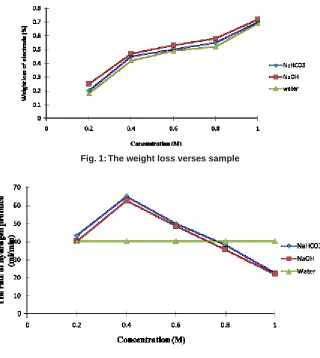
To determine the corrosion effect of electrode after electrolysis process, the loss weight measurement is needed10. The result of weight loss measurement was exposed in Fig. 1. Based on Fig 1, it shows that the weight loss of electrode increases, with respect to the increasing of concentration. The weight loss of electrodes in the samples of NaHCO3, and NaOH is approximately similar to the weight loss of electrodes in the water sample under the process of electrolysis. This result get using equation (1).
Table 1: The concentration of the NaHCO3 and NaOH respectively
Sample 1 2 3 4 5
Concentration 0.2 M 0.4 M 0.6 M 0.8 M 1.0 M
Table 1: Component used in alkaline water electrolysis test model experiment
1. DC power supplier
2. Standard resistance
3. Voltmeter
4. Separator
5. Electrode
6. Cartridge heater
7. Thermometer
8. Liquid vessel
9. Aqueous solution
10. Water vessel
11. Water
12. H2 collector
13. Electrode
Table 2: The pH value in different concentration
Electrolyte/ pH value
concentration 0.2M 0.4M 0.6M 0.8M 1.0M
H20 7.0 7.0 7.0 7.0 7.0
NaHCO3 8.4 8.2 8.7 9.0 9.1
NaOH 8.6 8.3 8.9 9.3 9.2
The difference in the weight loss had shown when the concentrations of the electrolyte increases, the weight loss also increase because the solution became more alkaline and effect electrode. Besides that, the weight loss of electrodes using NaHCO3 is lower than NaOH and we can say that the two catalysts roughly have the same value of electrodes’ weight loss with water which is without catalyst. It has been found that in some cases the corrosion was not removed entirely while in other cases some of the base metal was removed along with corrosion11.
The rate of hydrogen produce
Fig. 1: The alkaline water electrolysis test model. (Nagai et al., 2003)
Fig. 1: The weight loss verses sample
using NaHCO3 were higher than NaOH. At the concentration of 0.4 M, 65 ml/min by NaHCO3 and 63 ml/min by NaOH of hydrogen gas was produced respectively.
In this principle, the increasing amount of catalyst can increase the reaction rate of producing gas but it have optimum point to produce higher producing gas. It show that the concentration of the electrolyte is important to produce hydrogen. Besides that, according to (12), it can be seen all catalyst were used and show some reaction compared with the standard electrolyte (water). In addition, from this research we can know that NaHCO3 is a good catalyst compared than NaOH. NaHCO3 shows an optimum level of concentration as a catalyst to produce hydrogen gas.
Besides that, the performance of electrolysis via the rate of hydrogen produced are highly affected by catalyst. So, electrolysis can produce more hydrogen using NaHCO3 catalyst. pH measurement
The stainless steel electrodes exhibited pronounced using weight loss method in Figure 1, hydrogen producing rate in Figure 2 and also pH changes of the different concentration (Table 2) at all samples. The analysis of variance suggests that
types of electrode materials and pH, as well as their interactions, have significant effects on the production rate. As we can see from Table 4, the different pH level can cause different type of gas to be produced On the other hand, the weight loss of stainless steel, gas production and the pH value at 0.4 M of NaHCO3 and NaOH are good results. The results of this research show that stainless steel can be the good electrode to carry out water electrolysis process to produce hydrogen13. Therefore, NaHCO3 also can be used as electrolyte since it shows the efficient as catalyst to speed up the water electrolysis process.
CONCLUSION
From this research, it can be conclude that NaHCO3 can use as catalyst to produce hydrogen gas and the performance of electrolysis affected by catalyst are good.
ACKNOWLEDGEMENTS
The first author would like to thank Universiti Malaysia Terengganu for the scholarship as well to Department Science Engineering and Department of Physical Sciences for their help in this research.
REFERENCES
1. Graf, D. Monnerie, N., Roeb, M., Schmitz, M., & Sattler, International Journal of Hydrogen
Energy, 33: 4511-4519 (2008).
2. Hu W. International Journal of Hydrogen
Energy, 25(2): 111-8 (2000).
3. Zeng, K., Zhang, D. Progress in Energy and Combustion Science ,36 , pp. 307–32 (2010). 4. Petrik, F. L., Godongwana, Z.G. & Iwuoha, E.I. Journal of Power Sources, 185, pp. 838-845 (2008).
5. Koroneos, C., Dompros, A., Roumbas, G. & Moussiopoulos, N. International Journal of
Hydrogen Energy, 29: 1443-1450 (2004).
6. N. Nagaia; “,M. Takeuchia, T. Kimurab, T. Okaa.
International Journal of Hydrogen Energy,
28: 35-41 (2003).
7. Tetsuo Take a,”, Kazuhiko Tsurutani b, Minoru Umedab.. Journal of Power Sources, 164:
9-16 (2007).
8. Zamfiresa, C., Dincer*., I. Fuel Processing
Technology, 90: 729-737 (2009).
9. Samaranayake C. P, Sastry S.K. Journal of
Electroanalytical Chemistry. pp. 125–135
(2005).
10. Olivares-Rami’rez J.M, Campos-Cornelio M.L, Uribe Godi’nez J. International Journal
of Hydrogen Energy pp.3170-3173(2007)
11. Rihan, R.O. & Nes¡ic´ *, S.. Journal of
Corrosion Science, 48, pp. 2633–2659
(2006)
12. Stojic´, D. L., Marc¡eta, M. P., Sovilj, S. P., Miljanic´, S.S. Journal of Power Sources, 118: 315–319 (2003).