INTRODUCTION
Presently, method for dissolved organic nitrogen (DON) determination in aquatic system is based on the measurements of total dissolved nitrogen (TDN) and dissolved inorganic nitrogen (DIN). TDN determinations are made using a digestion procedure to oxidise the organic N fraction into inorganic form with all N in the inorganic forms subsequently being measured. The DON concentration is the difference between TDN and the sum of the DIN concentrations prior to sample digestion. There are three types of commonly used oxidation method i.e. UV oxidation, chemical oxidation and high temperature combustion (HTC).
www.orientjchem.org
CODEN: OJCHEG 2011, Vol. 27, No. (4): Pg. 1497-1501 Est. 1984
An International Open Free Access, Peer Reviewed Research Journal
A Comparison Study of Method for
Determination of Total Dissolved Nitrogen
SUHAIMI SURATMAN
Institute of Oceanography and Environment and Environmental Research Group, Department of Chemical Sciences, Faculty of Science & Technology, Universiti Malaysia Terengganu, 21030 Kuala Terengganu, Terengganu (Malaysia).
Corresponding author: Email: [email protected]
(Received: August 10, 2011; Accepted: September 17, 2011)
ABSTRACT
This paper describes the experiments carried out to analyse total dissolved N involving UV oxidation and high temperature catalytic oxidation (HTCO) methods. Standards of known N concentrations (i.e. ammonium and EDTA) irradiated with UV oxidation for 6 h were found to show good oxidation efficiency (72-107%). However, poor recovery was recorded for urea (2-20%). The addition of reaction initiator (H2O2) did not show any significantly difference to the oxidation efficiency of all three compounds. Based on the analysis of seawater samples, UV oxidation method was less efficient (> 90%) of converting organic N to inorganic N relative to HTCO.
Keywords: UV oxidation, High temperature catalytic oxidation, Total dissolved nitrogen.
In UV and chemical oxidations methods, which are also known as wet chemical oxidation (WCO), the final analyte of oxidised N ion is ultimately measured as NO2- after final reduction from NO
3
-. In the HTC
method, all of the TDN is converted to nitric oxide (NO) by pyrolysis and the DON concentration is then defined as the difference between TDN and the sum of the DIN concentrations.
However, there is no general agreement as to which method is best for the TDN measurements. Some studies have indicated that the HTC method gave higher TDN results compared to WCO1,2. Other study has shown that there is little
reason, a comparison study was carried out to evaluate the performance of UV oxidation and HTC methods of measuring TDN. The UV oxidation method was chosen for its simplicity, minimal sample handling and manipulation, and rapid sample throughput. HTC that is also known as high temperature catalytic oxidations (HTCO) as this technique often includes metals (e.g. Pt) as catalysts is the widely used to analyse TDN because it measures more efficiently, faster, easier and is more readily automated and required much smaller sample volumes (~100 µL)4,5.
MATERIAL AND METHODS
All glassware used in this study were soaked overnight in 10% hydrochloric acid (HCl) and rinsed with copious amounts of deionised water. Then, the glassware was covered with aluminium foil and baked for > 4 h at 550 oC. Analysis of TDN
in the standard and seawater samples by UV oxidation method was performed in duplicate. The irradiation unit used in this study contained a 1000 W UV lamp (Hanovia) protected by a quartz jacket. Temperature during the oxidation was ~40 oC. A
glass tube holder (8 tubes in total) was fitted around the lamp and held the samples 5 cm from the lamp. A fan placed at the bottom of the unit circulating air across the samples for cooling. The entire unit was placed in a fume hood that was covered with aluminium foil while in use to minimise hazards.
Previous studies have shown that appropriate condition of UV oxidation has to be chosen in order to get a complete oxidation to nitrate which depends on the intensity of the source, irradiation time, pH of sample, total N content of the sample and the presence or absence of an added chemical oxidant (as initiator)3,6. However, in
this study, only variations of time of exposure and the effect of the initiator (i.e. hydrogen peroxide, H2O2) were tested. To achieve this, different organic N standards i.e. urea, ammonium and EDTA (ethylene diamine tetraacetic acid) were prepared in artificial seawater7. A series of oxidation batches
were made using the same concentrations (25 µM) of each standard with different oxidation time (1, 2, 3, 4, 6, 12 and 24 h) and with or without addition of reaction initiator (100 µL of 30% H2O2 in 10mL standard). Based on this experiment, the optimum
condition of oxidation were no addition of H2O2 and irradiation for 6 h (see results and discussion). This same condition was used to analyse the seawater samples collected from the North Sea. Samples were filtered through precombusted (400 oC; 4 h)
Whatman GF/F glass fibre filters at <50 mm Hg vacuum and the filtrate was used for TDN measurement.
10 mL samples were irradiated for 6 h in 15 mL quartz glass tubes with glass stoppers. After irradiation, samples were analysed for nitrate using Scalar San Plus Autoanalyser following colourimetric methods according to Kirkwood8. Calibration was
achieved using KNO3. Testing of the recovery of known standards, such as Certified Reference Material (CRM) of Deep Sea (DS) from Hansell’s laboratory (University of Miami), urea, ammonium and EDTA during the oxidation were also carried out in each batch.
The same seawater samples used in UV oxidationwas measured by HTCO with a Thermalox TOC/TN analyser (Cambridge, U.K.), which was coupled to a chemiluminescence detector. The detector measured NOx gases produced by HTCO of all N species. The temperature of the combustion tube was set at 680 ± 10 oC and the catalyst was
0.5% Pt/Al2O3. Calibration of the instrument was performed with KNO3 (0-25 µM) in ultrapure water (18.2 MΩ). The system blank was estimated for each individual run by injected ultrapure water with typical values of 1.6-3.7 µM (2.3 ± 0.6 µM, n=10) and blank corrections were applied to the TDN data. DS from the Sargasso Sea obtained from the Hansell’s laboratory (University of Miami) was used during the routine analyses of water samples as recommended by Badr et al.9. The recovery of the
TDN in the DS was between 91-110% (101 ± 6%, n=10). The oxidation efficiency was also checked on each analytical day by comparing with urea and resulted in values in the range of 96-103% (100 ± 2%, n=10). The instrument used > 3 injections per analysis until a precision of ± 5% or better was achieved.
RESULTS AND DISCUSSION
Table 1: Results for quality control during TDN analysis using UV oxidation
No. of Concentration and recovery
experiment DS Urea EDTA
21.5 µM % 25 µM % 25 µM %
1 20.4 95 3.8 15 20.7 83
2 19.7 92 2.9 12 22.7 91
3 nd - 3.6 14 20.8 83
4 20.1 94 3.8 15 21.5 86
5 19.7 92 0.7 3 21.0 84
nd = not determined
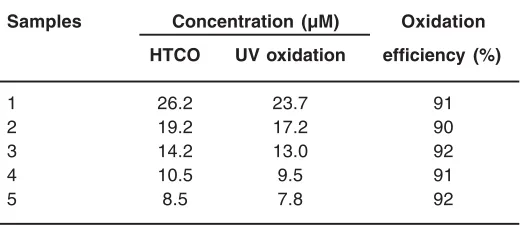
Table 2: Comparison results of seawater samples between HTCO and UV oxidation methods
Samples Concentration (µM) Oxidation
HTCO UV oxidation efficiency (%)
1 26.2 23.7 91
2 19.2 17.2 90
3 14.2 13.0 92
4 10.5 9.5 91
5 8.5 7.8 92
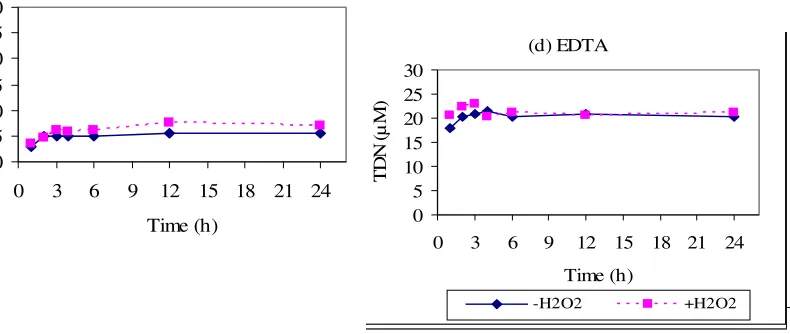
carried out using ammonium, urea and EDTA standards which were prepared in artificial seawater. Analyses were performed in duplicate using 25 µM standards which were irradiated with different oxidation times (1, 2, 3, 4, 6, 12 and 24 h). In addition, comparison was also made to address the effects of H2O2 during the oxidation. After irradiation, it was confirmed that organic N in the standards was conver ted to nitrate and nitrite so that subsequent analytical determination of the sum of nitrate and nitrite gave the TDN content of the standards with results presented in Fig. 1. For blanks (with and without addition of H2O2), the TDN concentration increased from 1 to 3 h after irradiation and then the concentrations were constant throughout the experiments. There was no significant difference (P < 0.05) for both blank concentrations, although the concentrations of the blank with H2O2 were slightly higher compared to without addition of H2O2.
(a) Blank
0 5 10 15 20 25 30
0 3 6 9 12 15 18 21 24
Time (h)
T
DN (
µ
M
) (b) Ammonium
0 5 10 15 20 25 30
0 3 6 9 12 15 18 21 24
Time (h)
TD
N
(
µ
M)
(c) Urea
0 5 10 15 20 25 30
0 3 6 9 12 15 18 21 24
Time (h)
TD
N
(
µ
M
)
(d) EDTA
0 5 10 15 20 25 30
0 3 6 9 12 15 18 21 24
Time (h)
TD
N
(µ
M
)
-H2O2 +H2O2
Fig. 1: Effect of irradiation time on the oxidation of different N standard compounds with (+) and without (-) addition of H2O2 The results of higher recovery for both
ammonium and EDTA but lower for urea by UV oxidation have also been obser ved in other studies3,5,10. For example, Walsh5 recorded
recover ies of 99.5%, 95.7% and 72.5% for ammonium, EDTA and urea in seawater respectively. However, Walsh5 irradiated the standards for 18-22
h with addition of H2O2. Higher recoveries were also found for ammonium and EDTA in freshwater samples (100% and 83% respectively) after the standards were irradiated for 4 h with the addition of H2O210. By adding H
2O2 and irradiating for 24 h,
Bronk et al.3 recorded recoveries of 96-103%
(EDTA), 50-100% (ammonium) and 64-83% (urea) in seawater. However, it is unclear why urea was poorly oxidised (2-20%) in this present study in comparison with others3,5. Most studies have
repor ted the use of H2O2 to enhance the oxidation3,5,10. However, this was not observed in this
study as the concentrations of TDN between
samples with H2O2 and without H2O2 was similar. Furthermore, some studies have found that the addition of reaction initiators (e.g. H2O2) did not increase the yield or oxidation rate but only caused higher blanks6,11,12. Thus, based on the experiments
using the standards, seawater samples were oxidised without adding the H2O2 and 6 h was selected as oxidation time.
total N oxidation efficiency. In addition, the oxidation efficiency of urea and EDTA varied from 3-15% (12 ± 5%, n=5) and 83-91% (85 ± 3%, n=5), respectively (Table 1). In addition, good oxidation efficiency of samples was obtained using the UV oxidation method relative to HTCO which ranged from 90-92% (91 ± 1%, n=5) (Table 2).
In conclusions, oxidation efficiency using the UV oxidation method was generally high but consistently less than 100% and particularly low for urea. The results reported using the UV oxidation method here likely underestimate TDN and thus the DON concentration. However, the UV oxidation
method can still provide the opportunity to evaluate changes in DON.
ACKNOWLEDGEMENTS
SS is grateful to the Malaysian Government for financially supporting this research under the scholarship awarded during his PhD study period at University of East Anglia, United Kingdom. Thanks to Prof. Tim Jickells and Dr. Keith Weston for their guidance. SS is also thanks to Prof. Norhayati Mohd Tahir (Universiti Malaysia Terengganu) for critically reading this paper.
1. Chen, W. and Wangersky, P.J., A high-temperature catalytic oxidation method for the deter mination of marine dissolved organic carbon and its comparison with the UV photo-oxidation method. Mar. Chem. 42: 95-106 (1993).
2. Williams, P.M., Bauer, J.E., Robertson, K.J., Wolgast, D.M. and Occelli, M.L., Report on DOC and DON measurements made at Scripps Institution of Oceanography, 1988-1991. Mar. Chem. 41: 271-281 (1993). 3. Bronk, D.A., Lomas, M.W., Glibert, P.M.,
Schukert, K.J. and Sanderson, M.P., Total dissolved nitrogen analysis: comparisons between the persulfate, UV and high temperature oxidation methods. Mar. Chem. 69: 163-178 (2000).
4. Suratman, S., Jickells, T., Weston, K. and Fernand, L., Seasonal variability of inorganic and organic nitrogen in the North Sea. Hydrobiol. 610: 83-98 (2008).
5. Walsh, T.W., Total dissolved nitrogen in seawater : a new high-temperature combustion method and a comparison with photo-oxidation. Mar. Chem. 26: 295-311 (1989).
6. Sanders, R. and Jickells, T., Total organic nutrients in Drake Passage. Deep-Sea Res. 47: 997-1014 (2000).
7. Grasshoff, K., Ehrhardt, M. and Kremling, K.,
REFERENCES
Methods of Seawater Analysis, 2nd, revised
and extended edition, Verlag Chemie, Weinheim, 419 pp (1983).
8. Kirkwood, D.S., Nutrients practical notes on their deter mination in seawater ICES Techniques in Mar ine Environmental Sciences, no. 17. International Council for the Exploration of the Seas, Copenhagen, 23 pp (1996).
9. Badr, E.-S.A., Achterberg, E.P., Tappin, A.D., Hill, S.J. and Braungardt, C.B., Determination of dissolved organic nitrogen in natural waters using high-temper ture catalytic oxidation. Trends in Anal. Chem. 22: 819-827 (2003).
10. Henr iksen, A., Deter mination of total nitrogen, phosphorus and iron in fresh water by photo-oxidation with ultraviolet radiation. Analyst 95: 601-608 (1970).
11. Cornell, S., Rendell, A. and Jickells, T., Atmospheric inputs of dissolved organic nitrogen to the oceans. Nature 376: 243-245 (1995).