Solid Flow Measurement & Control using
Arduino and LabVIEW
Muhammad Juwaini J Mohammed Ansar R
Student Student
Department of Instrumentation & Control Engineering Department of Instrumentation & Control Engineering Saranathan College of Engineering, Panjappur, Trichy, Tamil
Nadu, India
Saranathan College of Engineering, Panjappur, Trichy, Tamil Nadu, India
Senthil Kumar K Sivasankara Narayanan S
Student Student
Department of Instrumentation & Control Engineering Department of Instrumentation & Control Engineering Saranathan College of Engineering, Panjappur, Trichy, Tamil
Nadu, India
Saranathan College of Engineering, Panjappur, Trichy, Tamil Nadu, India
Aravind P
Assistant Professor
Department of Instrumentation & Control Engineering
Saranathan College of Engineering, Panjappur, Trichy, Tamil Nadu, India
Abstract
The Conveyor is a mechanical handling equipment which transmits material from one place to another place .It is mostly used in coal mining, paper and pulp industries, cement factories. In Western Sahara, longest conveyor belt is used for 98km from Bu craa to the coast south of EI-aaiun. These mechanical equipment used for control, storage, products and goods throughout manufacturing, distribution, consumption and disposal of materials at all shapes and sizes. Belt conveyors are mostly used in package handling, raw material handling and used for elevation change or incline/decline applications. The product of weight of the load and speed of the motor to get actual flowrate of solid. We can control the speed of the motor by using PID controller. Load carrying element is a metal or, less frequently, plastic or wood bed consisting of separate slats mounted on one or more free rollers.
Keywords: Arduino UNO board, AC motor 1/4HP, Labview, proximity sensor, load cell
________________________________________________________________________________________________________
I. INTRODUCTION
In 19th- century belt conveyors are introduced in the market. In 1892, Thomas robins started a series of inventions of conveyors
to carry coal, ores and other products. Later many of them tried the same in different models but it doesn’t give perfect output. In 1970, Intraloxan MNC Company had registered their first patterned for plastic modulated belts. Belt conveyors are most commonly used because it is most versatile and cheap. The belt is looped with free rollers and with electrical motor. In heavy usage applications, free rollers are placed more than three or more. Its end is designed with curved section (face to face) receive the material from one end and from another end it will dispatch the product to another system or it moves to final product. As far as growth conveyors are used in malls, airports, pharmaceutical industries. The next generations of conveyors are programmed and it is operated. When a material is reached, relay will turn on the motor now we can save power consumption. PLC’s are used nowadays to control speed of conveyor. In this project we had used Arduino instead of PLC, because plc’s are costlier but Arduino is cheap and best. The primary function of VFD in industries is to provide better smooth control and it gives “crawl “speed for maintenance purposes to eliminate placing of additional drives. VFD‘s are mostly used in large current applications because it reduces the insulation or winding failure. So there will be less wear and tear of belt, gear, and pulley system. Normal AC motor may have a full load power factor ranging from 0.7 to 0.8.
II. PROPOSED SYSTEM
Arduino:
Arduino is an open source and user- friendly software to implement many electronics projects .with using of C++ the user can write his own code for their regarding project. Arduino can interact with motors, button, LED’s and android phones. It has 14 digital input/output pins (6 analog pins and 6 digital pins, USB cable, power jack, AC-DC adapter or battery is required. The recommended input voltage for the board is 7-12v and maximum limit voltage is 6-20v. The clock speed of the processor is 16 MHz.
Loadcell:
Loadcell is a highly accurate passive transducer which converts force into measurable electrical output. It works on the principle of fluid pressure, elasticity, and piezo-electric effect. They are classified into many types like Strain gauge, beam type, ring type and so on. It provides a massive response for a minor change in pressure and it is mostly used in commercial appliances. We can see the weight in both digital and analog method . selection of loadcell will be depending on capacity , shape and dynamic range
.
Fig. 1: Loadcell flat type HX711:
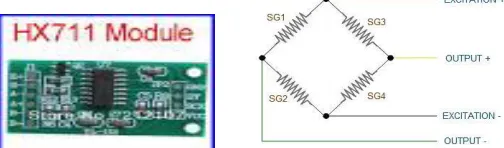
HX711 is a loadcell amplifier circuit which contains 24 bit ADC circuit designed for weighing scale and industrial purposes. When compared with other chips, HX711 only has a few specific basic functions like high integration, fast response, immunity, and other features. The input interface of the weight sensor module is used to interface with Arduino I/O ports.
Fig. 2: loadcell amplifier circuit AC motor:
Here we are using Ac induction motor in which torque is obtained by electromagnetic induction from the magnetic field of stator winding. It is also called as asynchronous motor because it runs at a speed less than its synchronous speed. According to Faraday’s laws of electromagnetic induction, current will start flows in coil of motor so flux will be generated. In case of three phase induction motor the phase shift will be 120°.
Proximity sensor:
It is a sensor which able to detect the presence of nearby objects by without any physical contacts. These sensors emit electromagnetic radiation and wait for the changes in field or return signal. And the maximum distance detects by a sensor is “nominal range”. Proximity sensors are used in mobile phones and to recognize air gestures and hover-applications.
VFD:
applied frequency and voltage are increased at a controlled rate to accelerate the load. A VFD can be adjusted to produce 150 % of steady starting torque from standstill to full speed.
Fig. 3: VFD modulation circuit Metal Detector:
It is an electronic instrument which detects a presence of metal nearby. Usually, the device gives some indication of distance. When voltage flows through the transmitter coil, it creates a magnetic field. If we sweep the detector over a metal, the magnetic field penetrates through it. Operating a metal detector is simple and Once you turn the unit on, you move slowly over the area you wish to search. In most cases, you sweep the coil back and forth over the ground in front of you. When you pass it over a target object, an audible alarm signal occurs. More advanced metal detectors provide displays that pinpoint the type of metal it has detected. Metal detectors use one of three technologies. They are (1) Very low frequency (VLF), (2) pulse indication (PI), and (3) Beat-frequency oscillation (BFO).
III. BLOCK DIAGRAM
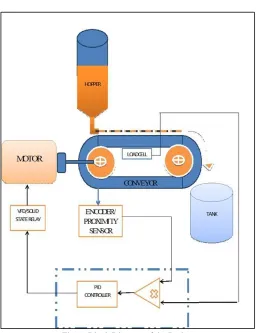
Fig. 6: Block Diagram of the Project Bluetooth Module:
Bluetooth module is -80dBm sensitivity, it can be range up to +4dBm RF transmit power and programmable Input /output controller.
Fig. 7: Screenshot of android app Circuit Description of bluetooth and Arduino:
Here we are using a Bluetooth module to control the motor with the help of two AC High Torque motors at 1440 RPM. The speed of motor is controlled by an android phone application. The controller used here is Arduino UNO R3 from the microcontroller family which contributes in a serial communication UART mode and the communication is governed on 9800bps to communicate it with the Bluetooth module. By installing the app in android mobiles, we can connect with Bluetooth module and speed is varied in mobile.
IV. LABVIEW
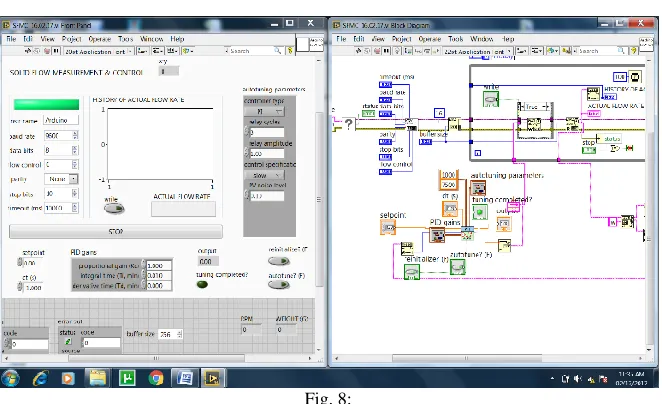
It is a graphical simulation software which integrates nonprogrammers to build programs by just clicking and dragging. It includes NI hardware platforms like compact DAQ, compact RIO. Here the graphical code is translated into executable machine code by interpreting syntax and by compiling. Labview programs-subroutines in VI’s. VI is divided into the front panel and block diagram. In front panel user can only able to view the output data and in block diagram the user can change the parameters.
V. INTERFACING LABVIEW WITH ARDUINO
Fig. 8:
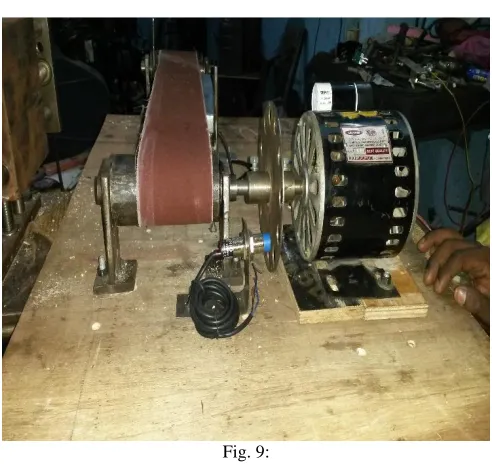
VI. OUTCOME OF PROJECT
Fig. 9: VII. CONCLUSION
We conclude the project weight of the solid measure by Loadcell and speed of the motor measured by Proximity Sensor. These two parameter programmed in Arduino to read in simulation with the help of LabVIEW Interface with Arduino (LIFA).By varying the voltage in Arduino to change of speed of the motor. The actual flowrate is displayed in VI. is plotted in graph and we can compared it with previous records.
REFERENCES
[1] (IV-A) Heidi Monson (1999) Bluetooth technology and implementations, John Wiley & Sons (Volume 2 issue 7, July 2014) [2] (IV-B) Android Application / MIT App Inventor.
[3] Speed Control of DC Motor using Capture/Compare/pulse With Madulation Module of PIC Microcontroller. Author(s) : Jyothsna, Yarlagadda Yamini [4] Published in: International Journal of Engineering Research & technology. (II-F) Research to study Variable Frequency Drive and its Energy Savings
Published in : International Journal of Science and Research (IJSR), India Online ISSN: 2319-7064
[5] (II-D) LabVIEW Based Performance Optimization of Single Phase Induction Motors(K. Nidheesh Nair, B. Umamaheswari, Member, IAENG, Vol II,October 24-26, 2012)
[6] (II-D) Controlling an AC Motor (Elias Badillo Ibarra,James Smith,December 7, 2010)