DOI:10.21276/ijprhs.2019.01.08
Y Panchamet al. CODEN (USA)-IJPRUR, e-ISSN: 2348-6465
Original Article
Development and Validation of Analytical Method for
Determination of Andrographolide in Bulk Powder
Yogesh Pancham
*, Nikita Patil
*, Girish B, Vinod Mannur
Department of Pharmaceutical Quality Assurance, KLE College of Pharmacy, Belagavi, KLE Academy of Higher Education and Research, JNMC Campus, NehruNagar, Belagavi,Karnataka, India-590010.
A R T I C L E I N F O A B S T R A C T
______
1. INTRODUCTION
Medicinal plants coming from natural & traditional background are used from thousands of years in treatment of many diseases and disorders1.These plants have many active ingredients and thus they are used in preparation of various herbal formulations to treat various disorders. Andrographis paniculata (family: Acanthaceae) is one of the important traditional herb of India and also known as Kalmegh. Chemically Kalmegh composed of active constituents like Andrographolide (Fig. 1), Neoandrographolide, deoxyandrographolide etc. Andrographolide is major active
International Journal of Pharma Research and Health Sciences
Available online at
www.pharmahealthsciences.net
Received:06 Feb 2019 Accepted:22 Feb 2019
Andrographolide is an important active constituent having potential biological activities, obtained from the herb Andrographis paniculata and it is available in the form of many ayurvedic dosage formulations. Objectives: In the present research work an attempt has been made to develop and validate a suitable analytical technique for determination of Andrographolide in its bulk powder form.Experimental Approach:UV-Spectrophotometric technique was developed employing the use of methanol: water (50:50v/v) as solvent. The analysis was performed at 321 nm. Developed technique was validated as per ICH guidelines in terms of specificity, selectivity, linearity, range, limit of detection, limit of quantification, precision, ruggedness, robustness and solution stability.Findings and Discussion:Analyte showed linear response between the concentration range of 50-250 µg/mL.The newly developed and validated technique for determination of Andrographolide in bulk powder was found to be simple, economical, specific, selective, linear, precise, rugged, robust and stable with % RSD values less than 2%. Conclusion:The technique can be used for the quality control testing of Andrographolide in bulk powder.
Key words: Andrographolide, Andrographis paniculata, Ayurvedic, Spectrophotometric, quality control.
Corresponding author *
Yogesh pancham and Nikita Patil
KLE College of Pharmacy, Belagavi, KLE Academy of Higher Education and Research, JNMC Campus, NehruNagar, Belagavi,Karnataka, India-590010
constituents having many pharmacological actions. Chemically Andrographolide have bicyclic diterpenoid lactone ring2. It is mainly used as antibacterial, antioxidant, hepatoprotective, anti-fungal, anti-inflammatory. Due to wide variety of biological activities it is used in the treatment of many diseases and available in the form of many ayurvedic formulations. Hence the quality control of formulation containing Andrographolide plays an important role in the ayurvedic industries3.
Literature survey revealed that Andrographolide was analyzed by chromatographic methods such as HPLC4, 5and HPTLC6,7 in various pharmaceutical and ayurvedic dosage forms to treat various disorders single and in combination with other drugs. No UV-spectrophotometric technique was reported for determination of Andrographolide in its bulk powder form. In the present analytical research work, new UV-Spectrophotometric technique was developed, optimized and validated for determination of Andrographolide in its bulk powder form8.
Fig1: Chemical Structure of Andrographolide
2. MATERIAL AND METHODS
Instruments and apparatus: UV-Spectrophotometer of 1900 with Lab solutions software& Shimadzu-1800 with UV probe software was used for determination of Andrographolide.
Reagents and chemicals: All the chemicals and reagents used for the experiment were pure and analytical grade and obtained from the store of KLE College of Pharmacy, Belagavi. Methanol was obtained from Molychem, Mumbai. Drug samples: Andrographolide was obtained as gift sample from Natural remedies Bangalore.
Development of UV-Spectrophotometric technique: Development of UV-Spectrophotometric method involves the two steps, mainly selection of solvent system and selection of wavelength of detection for determination of Andrographolide. Solubility profile of Andrographolide in different solvents was obtained by literature review and by practical analysis. Literature survey revealed that Andrographolide is soluble in mixture of methanol & water, mixture of Hexane, DCM & Methanol. Several trials were made to obtain suitable wavelength of detection by utilizing various mixtures of solvents. Mixture of Methanol: Water (50: 50v/v) was chosen as the best solvent. In order to obtain
UV-spectrum of the analyte, solution containing Andrographolide in solvent was scanned in UV-spectrophotometer between the ranges of 400-200 nm, showed maximum absorbance wavelength at 321 nm. Validation of UV-Spectrophotometric technique:
According to ICH guidelines the newly developed UV-Spectrophotometric method was validated. Andrographolide was validated in terms of specificity, selectivity, linearity, range, limit of detection, limit of quantification, precision, ruggedness, robustness and solution stability9,10,11.
Specificity and selectivity:
UV-spectrum of blank solvent (Methanol: Water 50:50v/v) and solution containing Andrographolide was scanned between the range of 400-200 nm and observed for interference of any absorbance at 321 nm.
Linearity and range:
100mg of Andrographolide was weighed and transferred into 100 mL of volumetric flask and volume was made up to the mark using solventsystem composed of methanol: water (50:50v/v) to obtain 1000 µ g/mL of Andrographolide. From this stock solution, serial dilutions were made to obtain 50, 100, 150, 200, 250µ g/mLsolutions of Andrographolide. The resulted solution was prepared in triplicates and absorbance was measured at 321 nm.
Limit of Detection and Limit of Quantification12:
Limit of detection and quantification was calculated by using statistical calculations using following formulas:
Precision:
Precision was performed by using system precision, intraday precision and interday precision.
System Precision: Six replicates of solution containing 150 µ g/mL of Andrographolide were prepared and absorbance of each was measured at 321 nm and %RSD was calculated. Intraday Precision: solutions containing 200µ g/mL of Andrographolide were analyzed in six replicates and %RSD for absorbance obtained was calculated at different time intervals on same day.
Interday Precision: solutions containing100µ g/mL of
Andrographolide were analyzed in six replicates and %RSD for absorbance obtained was calculated on three different days.
Ruggedness:
Robustness:
Stock solutions of analyte were prepared using solvent system composed of Methanol: Water (51:49v/v) and Methanol: Water (49:51 v/v) separately. Using the above solvent systems six replicates of solutions containing Andrographolide were prepared. The absorbance was measured at 321 nm &%RSD was calculated.
Solvent and standard stock solution stability:
Stability of solvent and stock solution was determined by comparing the absorbance between fresh stock dilutions and old stock dilutions. Stock solution of Andrographolide and solvent system was prepared and stored at room temperature for 5 days. On 5thday dilutions in triplicates were prepared from old stock solution and fresh stock solution. %RSD was calculated for the absorbance obtained.
3. RESULTS AND DISCUSSION Development:
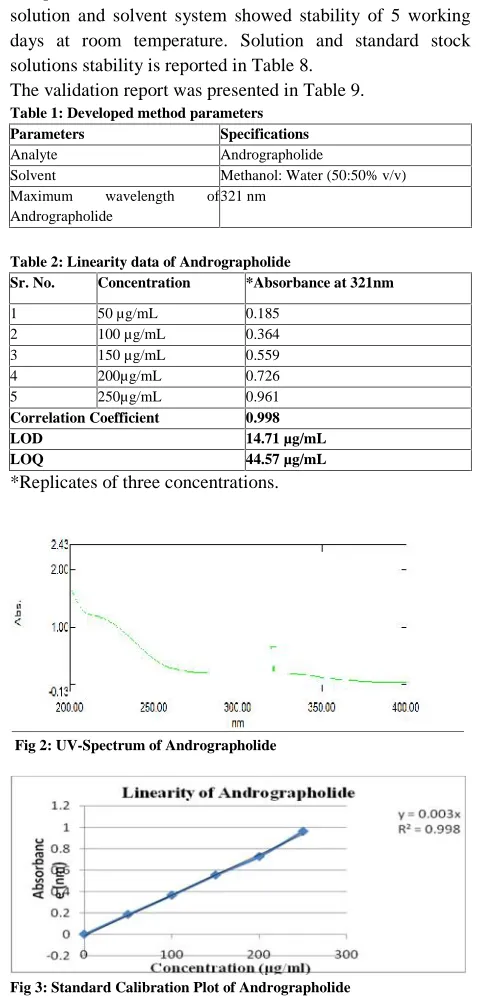
The UV-spectrum of Andrographolide in Methanol: Water (50:50v/v) solvent showed maximum absorbance at 321 nm and hence it was selected as wavelength of detection. Developed method parameters are reported in Table 1. Validation
Specificity and selectivity:
No interference was showed by the solvent spectrum at the maximum wavelength of absorbance of Andrographolide. Maximum wavelength was selectively exhibited by the analyte at 321 nm. Thus specificity and selectivity of the method was validated. UV spectrum of Andrographolide is presented in Fig.2.
Linearity and range:
Standard calibration curve was plotted using concentration vs absorbance obtained by Andrographolide. Analyte showed linear response between the concentration range of 50, 100, 150, 200, 250 µ g/mL with regression equation of 0.998. Linearity data is reported in Table 2 and standard calibration curve is presented in Fig.3.
Limit of Detection and Limit of Quantification:
LOD value of Andrographolide was found to be14.71 µ g/mL and LOQ value was found to be 44.57 µ g/mL respectively. LOD & LOQ values are presented in Table 2.
Precision:
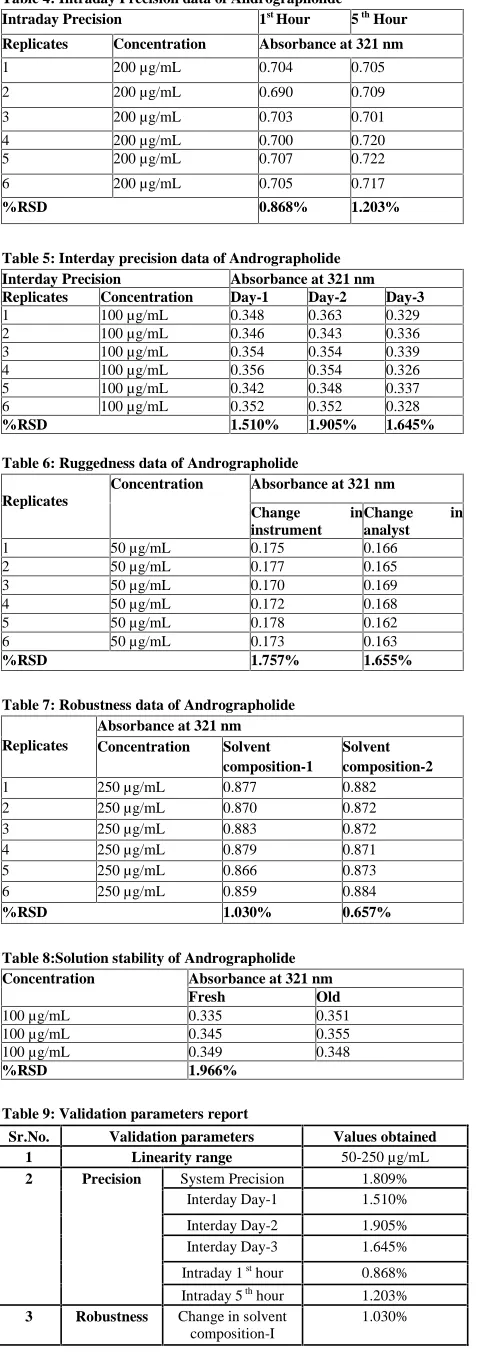
The %RSD values calculated for all six replicates of the respective solution of Andrographolide at each level of precision was found to be less than 2%, proving the precision of method. Data of system precision study is reported in Table3.
Ruggedness and Robustness:
Method was found to be rugged with respect to change in the analyst and change in the instrument with %RSD less than 2% also it was found to be robust with slight change in the percent composition of solvent system with %RSD less than 2%. Ruggedness and robustness is reported in Table 6 and Table 7 respectively.
Solvent and standard stock solution stability:
%RSD for absorbance obtained by fresh and old dilutions containing Andrographolide was found to be within the acceptance and data obtained showed the standard stock solution and solvent system showed stability of 5 working days at room temperature. Solution and standard stock solutions stability is reported in Table 8.
The validation report was presented in Table 9. Table 1: Developed method parameters
Parameters Specifications
Analyte Andrographolide
Solvent Methanol: Water (50:50% v/v) Maximum wavelength of
Andrographolide
321 nm
Table 2: Linearity data of Andrographolide
Sr. No. Concentration *Absorbance at 321nm
1 50 µg/mL 0.185
2 100 µg/mL 0.364
3 150 µg/mL 0.559
4 200µg/mL 0.726
5 250µg/mL 0.961
Correlation Coefficient 0.998
LOD 14.71 µg/mL
LOQ 44.57 µg/mL
*Replicates of three concentrations.
Fig 2: UV-Spectrum of Andrographolide
Fig 3: Standard Calibration Plot of Andrographolide
Table 3: System precision data of Andrographolide
Replicates Concentration Absorbance at 321 nm
1 150 µg/mL 0.512
2 150 µg/mL 0.508
3 150 µg/mL 0.528
4 150 µg/mL 0.525
5 150 µg/mL 0.518
6 150 µg/mL 0.532
Table 4: Intraday Precision data of Andrographolide Intraday Precision 1st
Hour 5th
Hour Replicates Concentration Absorbance at 321 nm
1 200 µg/mL 0.704 0.705
2 200 µg/mL 0.690 0.709
3 200 µg/mL 0.703 0.701
4 200 µg/mL 0.700 0.720
5 200 µg/mL 0.707 0.722
6 200 µg/mL 0.705 0.717
%RSD 0.868% 1.203%
Table 5: Interday precision data of Andrographolide Interday Precision Absorbance at 321 nm Replicates Concentration Day-1 Day-2 Day-3
1 100 µg/mL 0.348 0.363 0.329
2 100 µg/mL 0.346 0.343 0.336
3 100 µg/mL 0.354 0.354 0.339
4 100 µg/mL 0.356 0.354 0.326
5 100 µg/mL 0.342 0.348 0.337
6 100 µg/mL 0.352 0.352 0.328
%RSD 1.510% 1.905% 1.645%
Table 6: Ruggedness data of Andrographolide
Replicates
Concentration Absorbance at 321 nm
Change in instrument
Change in analyst
1 50 µg/mL 0.175 0.166
2 50 µg/mL 0.177 0.165
3 50 µg/mL 0.170 0.169
4 50 µg/mL 0.172 0.168
5 50 µg/mL 0.178 0.162
6 50 µg/mL 0.173 0.163
%RSD 1.757% 1.655%
Table 7: Robustness data of Andrographolide
Replicates
Absorbance at 321 nm Concentration Solvent
composition-1
Solvent composition-2
1 250 µg/mL 0.877 0.882
2 250 µg/mL 0.870 0.872
3 250 µg/mL 0.883 0.872
4 250 µg/mL 0.879 0.871
5 250 µg/mL 0.866 0.873
6 250 µg/mL 0.859 0.884
%RSD 1.030% 0.657%
Table 8:Solution stability of Andrographolide Concentration Absorbance at 321 nm
Fresh Old
100 µg/mL 0.335 0.351
100 µg/mL 0.345 0.355
100 µg/mL 0.349 0.348
%RSD 1.966%
Table 9: Validation parameters report
Sr.No. Validation parameters Values obtained 1 Linearity range 50-250 µg/mL
2 Precision System Precision 1.809% Interday Day-1 1.510% Interday Day-2 1.905% Interday Day-3 1.645% Intraday 1st
hour 0.868%
Intraday 5th
hour 1.203%
3 Robustness Change in solvent composition-I
1.030%
Change in solvent composition-II
0.657%
4 Ruggedness By change in analyst
1.655% By change
ininstrument
1.757%
5 LOD 14.71 µg/mL
6 LOQ 44.57 µg/mL
7 Solution Stability 5 days at room temperature (1.966%)
4. CONCLUSION
The newly developed UV-Spectrophotometric analytical method is specific and selective for the determination of Andrographolide in bulk. The developed method is subjected for the validation as per ICH Guidelines. The developed method was found to be linear, simple, precise, robust, rugged, stable and economic for routine use in the herbal drug industry.
5. AKNOWLEDGMENT
The authors are thankful to Principal Dr. B. M. Patil and Vice Principal Dr. M.B. Patil for their support and guidance. Mr. Shailendra Suryawanshi, Assistant Professor KLE College of Pharmacy, Belagavi for helping in handling the UV-Spectrophotometer during the research work, and also to KLE College of Pharmacy, Belagavi for providing necessary facility to carry out research work.
6. REFERENCES
1. Sajeeb B, Kumar U, Halder S, Bachar S. Identification and Quantification of Andrographolide from Andrographis paniculata (Burm. f.) Wall. ex Nees by RP-HPLC Method and Standardization of its Market Preparations. Dhaka Univ J Pharm. Sci 2015;14(1):71-78.
2. Siddhartha M, Neelam S, Sangwan S, Rajender S. Phcog rev: Plant Review Andrographis paniculata (Kalmegh): A Review. Phacog Rev 2007;1(2):283-298. 3. Li W, Fitzloff J. Determination of andrographolide in
commercial andrographis (andrographis paniculata) products using hplc with evaporative light scattering detection. J Liq Chromatogr Relat Techno 2002;25(9):1335-1343.
4. Das P, Srivastav A. Phytochemical Extraction and Characterization of the Leaves of Andrographis Paniculata for Its Bacterial, Oxidant, Anti-Pyretic and Anti-Diabetic Activity. Int J Innov Res Sci Eng Technol 2014;03(08):15176-15184.
6. Bandhopadhay K, Datta SK, Sukul NC. A spectrophotometric estimation of Andrographolide and estimation of nematicidal activity of the crude extract of Andrographis paniculata. Indian Drugs 1986;23:510-512.
7. Chen D, Shao A, Cai Y, Wang G. Determination of Andrographolide, deoxy-andrographolide and neo-andrographolide in Andrographis paniculata. Yaowu, Fenxi Zazhi. 1986;6:232-234.
8. Sharma A, Krishna L, Handa SS. Standardization of the Indian crude drug Kalmegh by high pressure liquid chromatographic determination of Andrographolide. J of Phytochem Anal 1992;3:129-131.
9. ICH guidance, validation of analytical method: definition and terminology. International conference on Harmonization, Q2A:Geneva.
10. ICH guidance, validation of analytical Procedures: Methodology. International conference on Harmonization, Q2B:Geneva.
11. https://www.pharmaguideline.com/2010/12/analytical-method-validation.html.22/01/2019.
12. Chavan R, Bhinge S, Bhutkar M, Randive D. Development and Validation of Spectrophotometric Methods for Simultaneous Estimation of Furosemide
and Spironolactone by Vierordt’s Method in Bulk and
Combined Tablet Dosage Form. Acta Chemica Iasi 2018;26(1):74-90.