IOSR Journal of Engineering (IOSRJEN)
www.iosrjen.org
ISSN (e): 2250-3021, ISSN (p): 2278-8719
Vol. 08, Issue 4 (April. 2018), ||VIII|| PP 98-105
A Comprehensive Review on LVRT Capability for DFIG System
Naresh Kumar Yadav
Electrical Engineering Department, Deenbandhu Chhotu Ram University of Science & Technology, Murthal (Sonepat)
Abstract— In this paper, a detailed analysis, as well as introduction on the research category and
industrialization circumstances of recent LVRT Technology in DFIGs system, is presented. In average as well as high power applications, DFIG is commonly exploited for variable speed drives. By symmetrical and asymmetrical grid faults, the Grid-connected DFIG based WTs are focused on the unexpected voltage dips occurrence. Based on new grid codes, DFIG based WT must ride-through voltage dips with no disrupting their operation. Therefore, to sustain secure and stable operation of power system, they need to capable of LVRT. The significant problem with DFIG-WT is LVRT performance. In order to resolve this issue, various methods are introduced. This paper describes some of the most commonly exploited parameters for LVRT of WT generators. Also, it is the most significant feature that needs to obtain based on the grid codes. In recent years, research of grid-connected WTs has gained huge interest. This guides to initiate guidelines (i.e., LVRT) and regulations with respect to the connection of large WF to the electrical network.Keywords— LVRT; DFIG; wind farms; wind turbine; photovoltaic
Acronym Description
LVRT Low-Voltage Ride Through WT Wind Turbine
DFIGs Doubly-Fed Induction Generators PSCAD Power System Computer Aided Design NBFCL New Bridge Type Fault Current Limiter MLI Multi-Level Inverter
RCL Rotor Current Limiter WF Wind Farms
CDRFCL Capacitive DC Reactor-Type Fault Current Limiter DRFCL DC reactor type fault current limiter
SVC Static Var Compensator SDBR Series Dynamic Braking Resistor STATCOM Static Synchronous Compensator SDBR Series Dynamic Braking Resistor FCC Fault Current Contribution ANN Artificial Neural Network
R-type SSFCL Inductive-Resistive Type Solid-State Fault Current Limiter IPSO Improved Particle Swarm Optimization
ADRC Active Disturbance Rejection Control PV Photovoltaic
EMTDC Electromagnetic Transient Including DC FCS-MPC Finite Control Set-Model Predictive Control IC Incremental Conductance
STATCOM Static Synchronous Compensator
SDCFCL Stator Dynamic Composite Fault Current Limiter SDR Stator Damping Resistor
SEG Solar Energy Generation
N-SSFCL New Solid-State Fault Current Limiter SCIG Squirrel cage induction generator WPG Wind Power Generation
FACTS Flexible AC Transmission System TSOs Transmission System Operators IPPO Independent Power Plant Operators
I.
INTRODUCTION
untimely tripping may lead to instabilities for wind generators [28] [29]. At this time, three kinds of WT generator are positioned, which are different with respect to the overall cost, control potential, complexity, etc. By being directly linked to the grid, the SCIG is characterized. Consequently, the rotation speed is varied between 1 and 2% vaguely. This idea is the easiest and primary method to be developed in the world [21]. In addition, it is incessantly enhanced, for control of the output power the blade-pitch regulation, as well as braking, is exploited.
On the basis of the wound rotor the induction generator, DFIGS is considered as a speed-variable generation system [22]. Among the rotor and the grid, a consecutive voltage source converter is introduced to control excitation of the rotor windings [23]. For that reason, the electrical frequency and mechanical speed are decoupled as well as the speed of the variable can be comprehended [27]. Among the stator as well as the grid, the Direct-drive synchronous generator is a full-scale frequency converter, which is installed thus that generator is entirely decoupled from the grid [30]. As a result, active control and a wider operating speed range are realized. Nevertheless, by including the converter, it sustains high cost, as well as complicated control, is required [24]. LVRT ability determinant based on the category for the WT generator. Mostly, the SCIG subjected to the requirements of the LVRT. Meanwhile, the SCIG indicates regarding 30% of the production of wind power [25]. In many developing countries, due to their robustness, ease, and minimum cost, they are still exhibiting their benefit. As a result, it is vital to develop the LVRT ability for the SCIG. Enhancement on both the generator and the turbine side is used to develop the ability of LVRT for the SCIG. For voltage control over a voltage dip, current or voltage source inverter-based FACTS devices namely a SVC, as well as a STATCOM, are exploited. For LVRT support of wind farms, other solutions similar to synchronous condensers are introduced. In contrast, to control the mechanical input power, for the turbine side the blade-pitch regulation is exploited [26]. Nevertheless, due the time constant of the pitch control, an effectual pitch control may be restricted to the time span for the voltage dip.
II.
Related Works
In 2016, Abdelrahem et al. [1]presented a framework predictive control by capability improvement for LVRT in variable speed WTS of DFIGs. In addition, an FCS-MPC system for the capability of LVRT improvement of DFIGs in variable-speed WT systems was presented. For each sampling period, the FCS-MPC system presents the discrete states of the converter was considered as well as the performance of the future converter was forecasted. The best switching action reduces a cost function, which is predefined in the subsequently sampling instantaneous, was chosen to be applied. During the grid voltage, proposed LVRT scheme exploits the DFIG-rotor inertia to store excess energy. In serious voltage dips, the proposed scheme improves the capability of the DFIG to insert reactive as well as the active power to the grid.
In 2017, Okedu [2] have developed an increasing DFIG performance of the WT transient. This was performed by means of the alternative voltage source T-type grid side converter. The switching, as well as the analysis scheme, was performed for the T-type converter. The experimental analysis was tested in PSCAD and EMTDC as well as the performance of the developed approach was compared by means of the novel T-type converter topology. By exploiting the parallel interleaved of the dual level converters for the rotor, DC-chopper, existing crowbar, with cases as well as grid side converters of the DFIG was protected, whereas the wind generator. Finally, the outcomes exhibit the enhanced performance of the wind generator on transient. Hence, the external expensive circuitry cost was saved.
In 2017, Falehi and Rafiee [3] presented an enhancement in DFIG on the basis of the WTs LVRT ability based on the asymmetric MLI. Here, the MLI was developed so as to present a staircase sinusoidal voltage in maximum level numbers over minimum switch numbers. The capacitors of sub-MLI, as well as bi-directional switches and number of DC sources, were added. Finally, the performance of the proposed method was been systematically examined against shallow and deep balanced and unbalanced voltage droops, therefore, capability of the LVRT selected cleared up.
In 2017, Saeed et al. [4] worked on several LVRT methods, which were exploited in the precedent. In addition, the effects of eradicating the effects of the grid faults were stated. A novel approach was presented that exploits the hybrid amalgamation of the crowbar as well as the series dynamic resistance that was controlled by the enhanced control strategies. The exploit of DFIG was quickly augmented because of its exclusive qualities among different kinds of Wind Generators. While utilities were defined, their possess grid codes needs during any low voltage event, and the WT may stay connected to the grid, and that grid codes describe the criterion for LVRT techniques.
In 2016, Adouni et al. [6] developed an FDI on the basis of the ANN method for minimum voltage ride by DFIG based WT. During grid fault, the ANN approach was exploited to attain enhanced decision and improved FDI, the proposed process was on the basis of the voltage indicators analysis. Additionally, two features such as angle and amplitude features were extracted. Here, they were classified into two steps. Initially, six ANNs was consists that were enthusiastic to portray the three stages of the grid. In a subsequent step, it was comprised of a one ANN in that produces and indicators was analyzed, and the decision signal explained the function mode.
In 2018, Beltran-Pulido et al. [7] present the improvement of an approach to augment the LVRT of DFIG-based WTs. The improved control approach presents a route generation system as well as a maximum-performance of rotor current controller. Initially, along with the grid codes needs the rotor current trajectories were attained. For the electromagnetic torque, it initiates appropriate values. Consequently, a complete examine for the requisite rotor current trajectories was developed to improve the LVRT ability. Next, the rotor current controller was designed on the basis of the ADRC method. At last, the simulation analysis for the proposed method as well as the theoretical analysis was examined.
In 2016, Saad et al. [8] presented an IPSO for PV system, which was associated with the grid to LVRT capability. The non-linear control approach exploited IPSO for PV system associated with the grid by remote maximum frequency DCeDC. Here, the limit performance, as well as the transient behavior for LVRT, was examined by exploiting DC-Chopper circuit. The proposed control attains the requirements of the LVRT as well as enhances DC link voltage quality. Through MPPT mode of PV system, the proposed method exhibits the advantage of proposed IPSO than IC technique.
In 2016, Gayen et al. [9] presented an improved LVRT; the grid performance was linked with the DFIG to the practice of SDCFCL. However, the circuit includes of an appropriate parallel bidirectional semiconductors and series resistor–inductor combination witch. Because of the enhanced value of stator total inductance as well as concurrent augments of rotor impedance, the SDCFCL make easy double advantages namely minimization of the induced rotor that open circuit voltage. During any fault circumstances, both effects can restrict rotor circuit against present as well as voltage circumstances in a protected method in contrast to the traditional method similar to the dynamic RCL. The simulation of the grid integrated 2.0MWDFIG examined the proposed method.
In 2014, Mali et al. [10] presented the LVRT needs that were offered by Wind Grid Codes. During healthy and fault circumstances, the quality of interconnection for wind generators to the local grid was discussed. Through dip circumstance, the wind power generation plant needs stay linked to the grid as well as, which needs to distribute reactive power into the grid to assist usefulness to embrace the grid voltage as per LVRT needs. The result of voltage droop on diverse topologies of wind generator was examined, and the voltage droop shows to the majority well-known power quality problem. Various approaches for LVRT accomplishment was discovered as well as the LVRT method was examined on the basis of the SIMULINK simulation.
In 2014, Rahimi and Parniani [11] worked on a capability of LVRT enhancement for DFIG based WT in unstable voltage dips. In addition, it proposes a capable and effectual method to improve the ride-by ability of DFIG on the basis of the WT in unstable voltage dip circumstances. The proposed approach was comprehended by the joint employ of the three-phase SDR localized rotor-side as well as converter control with the stator windings in series. Through the unstable voltage dip, an asymmetrical SDR idea was exploited; the SDR resistors were operated in phase’s occurrence minimum voltage. Subsequently, on the stator voltage, the rotor current was controlled where no unbalance voltage emerges. The peak values of the electromagnetic torque, rotor inrush current, as well as DFIG transient response, where limited by the proposed ride-through method. Through unstable voltage dips, because of the negative order component, it represses variation of the electromagnetic torque along with DFIG response transient shows.
In 2018, Hahriari et al. [12] worked on a novel method for state estimation regarding enhancing LVRT ability of doubly fed induction producer WT. By exploiting state calculation method, the proposed control method input signals were attained. In this approach, the rotating speed of the dynamic behavior was contemplated for the stator flux. During and after clearing fault, it can low transient rotor current. In addition, the employ of state calculation approach, which can reduce the outcome of the possible noise level in metering devices that was a new benefit of this approach. The experimental studies were performed to examine the benefits of this method in a numerical case study.
In 2017, Hossain [14] developed an enhancement capability of LVRT approaches for DFIG by the WF. It was attained exploiting the capable series devices such as the NBFCL, R-type SSFCL, N-SSFCL, SDBR, and SSFCL-LR. Regarding LVRT ability enhancement performances, implementation viability, as well as the cost, the analysis of LVRT, was performed between the series devices. To reveal the performance of the LVRT amid the series devices, an impermanent stable, as well as the unstable fault, was tested for the DFIG on the basis of the test model system. From simulation analysis, during a fault, it can mention the stated series devices have the capability to improve the LVRT.
In 2018, Al-Shetwi et al. [15] developed an LVRT ability control for one stage inverter on the basis of the grid-connected PV power plant. The proposed method conquers issues of DC-link against-voltage as well as AC against-current, which can create extrication or harm to the inverter. In this case, current limiter and dc-chopper brake controller were exploited to soak up the extreme dc-voltage as well as restrict extreme AC. Based on the standard needs, the control approach assures the reactive power that holds by the injection of reactive current once the voltage droop was detected. In addition, PV array will produce the probable amount of active power so as to remain the balance of power among both sides of the inverter through the operating in various modes along with the evaluation of grid inverter as well as voltage droop depth. Finally, outcomes demonstrate that the proposed control scheme was effectual, not merely to get better the ability of ride-through fault securely as well as remain the inverter linked.
III.
Detail Survey on LVRT
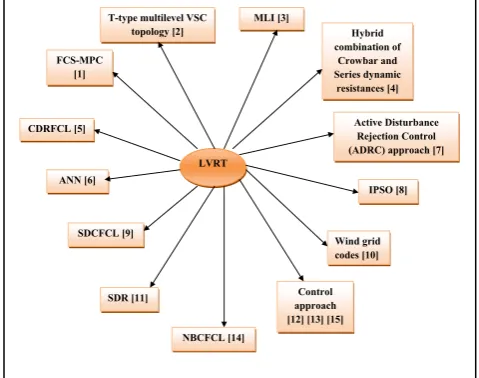
A. Classified methods used in LVRTThe classification of different methods exploited in LVRT is shown in Fig. 1. Numerous methods are used in LVRT such as FCS-MPC [1], T-type multilevel VSC topology [2], MLI [3], Hybrid combination of Crowbar and Series dynamic resistances [4], Active Disturbance Rejection Control (ADRC) approach [7], IPSO [8], Wind grid codes [10], Control approach [12] [13] [15], CDRFCL [5], ANN [6], SDCFCL [9] and NBCFCL [14].
Fig. 1. Fig. 2. Fig. 3.
Fig. 4. Taxonomy classification of methods in LVRT
Fig.1: Taxonomy classification of methods in LVRT
B. Review on different measures applied in LVRT
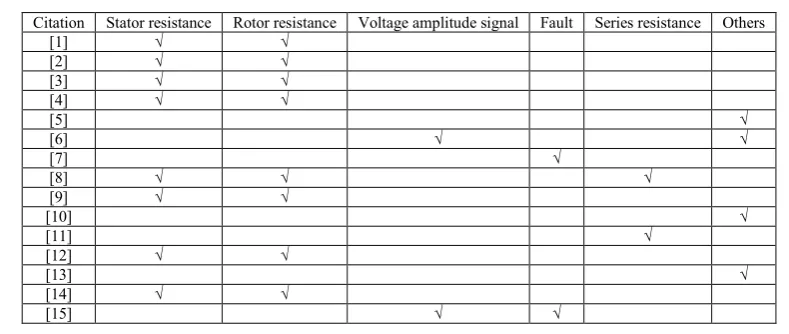
Table I summarizes the review on different performance measures in LVRT. Here, the metrics such as Stator resistance, Rotor resistance, Voltage amplitude signal, Fault, Series resistance, of the LVRT are exploited. Among the measures, the stator resistance, and rotor resistance are exploited by 53% of researchers. The voltage amplitude signal, fault, and series resistance are exploited by the 13% of researchers. The other metrics are exploited by 26% of researchers.
LVRT FCS-MPC
[1]
Hybrid combination of
Crowbar and Series dynamic resistances [4]
CDRFCL [5]
T-type multilevel VSC topology [2]
ANN [6]
IPSO [8] Active Disturbance
Rejection Control (ADRC) approach [7] MLI [3]
SDCFCL [9]
SDR [11]
Wind grid codes [10]
TABLE I. DIFFERENT MEASURES REPORTED IN THE LITERATURE REGARDING LVRT
Citation Stator resistance Rotor resistance Voltage amplitude signal Fault Series resistance Others
[1] √ √
[2] √ √
[3] √ √
[4] √ √
[5] √
[6] √ √
[7] √
[8] √ √ √
[9] √ √
[10] √
[11] √
[12] √ √
[13] √
[14] √ √
[15] √ √
C. Performance Analysis of LVRT
The results for the maximum performance value for different metrics of LVRT are summarized in Table II. Among the performance measures, the stator and rotor resistance is considered as most widely exploited measures in LVRT. Here, the stator and rotor resistance exploited in [1] [2] [3] [4] [5] [8] [9] [12] and [14] attained maximum value of 0.022. The system Voltage amplitude signal in [6] and [15], which attained 0.1 maximum value. The Fault used in [7] and [15] attained 0.00168. The load demand exploited in [7] [14] obtained maximum value of 73.5. The Series resistance used in [6] and [12] attained the maximum value of 0.290000. The other metrics such as Absorbed reactive power [5], Doubly fed induction machine [6], Parallel resistance [8], Nominal wind speed,Nominal generation [10], Maximum power voltage [10], Maximum power current [13] are -2.880, 0.8, 431.406051, 12, 29.49 and 8.31.
TABLE II. MAXIMUM PERFORMANCE OF THE DIFFERENT MEASURES IN LVRT
Citation Measures Maximum value [1] [2] [3] [4] [9] [12] [14] Stator resistance 0.022
[1] [2] [3] [4] [9] [12] [14] Rotor resistance 0.026 [6] [15] Voltage amplitude signal 0.1 [7] [15] Fault 0.00168 [8] [11] Series resistance 0.290000 [5] Absorbed reactive power -2.8 [6] Doubly fed induction machine 0.8 [13] Maximum power voltage 29.49 [8] Parallel resistance 431.406051 [10] Nominal wind speed 12 [10] Nominal generation 5 [13] Maximum power current 8.31
D. Analysis of renewable resource in LVRT
Fig 2 states the categorization of renewable sources in LVRT. Here, various renewable sources are exploited such as wind power, WT generator, wind farms, solar panels, and PV system and wind energy.
Fig. 2: Categorization of renewable sources in LVRT
IV.
Research gaps and challenges
Renewablesource Wind power [1] [9]
[15]
Photovoltaic system [13]
Wind farms [5] [14]
Solar panels [8]
Wind energy [12]
To assure the security of the grid, LVRT is very important capability for wind turbines.On the basis of the requirement of TSOs, the grid code for LVRT deviates with each country. However, to attain these grid codes in the wind turbines, the real time challenges in real implementation of solutions are frequently left imprecise. In India, the current strategy for obligatory capability of LVRT requirement for wind turbines is focussed to reinstate the imperilling the security of the grid, which brought in various problems. As a result, the aim of this review is to understand these challenges in implementation of LVRT capability to arise with suitable solutions in India. The unexpected issues in the implementation of the LVRT capability pertaining to the policy issues, the burden state on the manufacturers stability analysis specific to the turbine type required, the extra cost acquires for LVRT increase methods installed, with respect to investments as well as the monotonous LVRT testing procedure essential after installation are usually not persistent.Generally, the wind power plants are under the private control of IPPO further than the extent of profit with respect to commercial advantages, which does not provide more on the technical needs. In those circumstances, the industries and investors chiefly endeavor to recognize inventive ways to reduce the investment costs.Also, implementing the LVRT capability with such constraints in WTs that are already installed and nearing the end of their lifespan becomes challenging. For the manufacturers, the implementation of LVRT does not guarantee profitability. Thus, the implementation without the assistance of subsidies proves to be challenging. In creating collaboration between the system operators, the operation and necessitate of LVRT requirement is essential.The IPPOs involves the industries, investors and the energy traders.It mainly depends on the laws, which is forced by the country on the power sector.
V.
Conclusion
In this paper, a detailed analysis of the LVRT control scheme was discussed. Researchers have investigated the LVRT control schemes to apply them to WPG and SEG systems in the past. With respect to the energy source, by exploiting the grid-side inverter, the main reason of the LVRT control schemes was to insert reactive power into the grid that depends on the grid-code regulations. The objective of WT systems development was to augment the output power incessantly over the recent years. The DFIG was famous to be the present choice for WT. Generally, the DFIG system contemplated needs to operate over a broad wind speed range by tracking the best speed ratio to attain the best effectiveness. A broad review of the conventional literature available on LVRT was described in this paper. The literature review summarizes work done related to LVRT.
REFERENCES
[1] M. Abdelrahem, M. H. Mobarak and R. Kennel, "Model predictive control for low-voltage ride through capability enhancement of DFIGs in variable-speed wind turbine systems," 2016 9th International Conference on Electrical and Computer Engineering (ICECE), Dhaka, pp. 70-73, 2016.
[2] Kenneth E. Okedu, "Augmenting DFIG wind turbine transient performance using alternative voltage source T-type grid side converter," Renewable Energy Focus, vol. 18, pp. 1-10, April 2017.
[3] A. D. Falehi and M. Rafiee, "Enhancement of DFIG-Wind Turbine’s LVRT capability using novel DVR based Odd-nary Cascaded Asymmetric Multi-Level Inverter," Engineering Science and Technology, an International Journal, vol. 20, no. 3, pp. 805-824, June 2017.
[4] M. Amer Saeed, Hafiz Mehroz Khan, Arslan Ashraf and Suhail Aftab Qureshi, "Analyzing effectiveness of LVRT techniques for DFIG wind turbine system and implementation of hybrid combination with control schemes," Renewable and Sustainable Energy Reviews, vol. 81, Part 2, pp. 2487-2501, January 2018.
[5] Hossein Shahbabaei Kartijkolaie, Masoud Radmehr and Mehdi Firouzi, "LVRT capability enhancement of DFIG-based wind farms by using capacitive DC reactor-type fault current limiter," International Journal of Electrical Power & Energy Systems, vol. 102, pp. 287-295, November 2018.
[6] Amel Adouni, Dhia Chariag, Demba Diallo, Mouna Ben Hamed and Lassaâd Sbita, "FDI based on Artificial Neural Network for Low-Voltage-Ride-Through in DFIG-based Wind Turbine," ISA Transactions, vol. 64, pp. 353-364, September 2016.
[7] Andres Beltran-Pulido, John Cortes-Romero and Horacio Coral-Enriquez, "Robust Active Disturbance Rejection Control for LVRT capability enhancement of DFIG-based wind turbines," Control Engineering Practice, vol. 77, pp. 174-189, August 2018.
[8] Naggar H. Saad, Ahmed A. El-Sattar and Abd El-Aziz M. Mansour, "Improved particle swarm optimization for photovoltaic system connected to the grid with low voltage ride through capability," Renewable Energy, vol. 85, pp. 181-194, January 2016.
[10] Shrikant Mali, Steffy James and Ishwari Tank, "Improving Low Voltage Ride-through Capabilities for Grid Connected Wind Turbine Generator," Energy Procedia, vol. 54, pp. 530-540, 2014.
[11] Mohsen Rahimi and Mostafa Parniani, "Low voltage ride-through capability improvement of DFIG-based wind turbines under unbalanced voltage dips," International Journal of Electrical Power & Energy Systems, vol. 60, pp. 82-95, September 2014.
[12] Sayyed Ali Akbar Shahriari, Mohammad Mohammadi and Mahdi Raoofat, "A new method based on state-estimation technique to enhance low-voltage ride-through capability of doubly-fed induction generator wind turbines," International Journal of Electrical Power & Energy Systems, vol. 95, pp. 118-127, February 2018.
[13] Fang Yang, Lihui Yang and Xikui Ma, "An advanced control strategy of PV system for low-voltage ride-through capability enhancement," Solar Energy, vol. 109, pp. 24-35, November 2014.
[14] Md Emrad Hossain, "Low voltage ride-through capability improvement methods for DFIG based wind farm," Journal of Electrical Systems and Information Technology, In press, corrected proof, Available online 11 February 2018.
[15] Ali Q. Al-Shetwi, Muhamad Zahim Sujod and Frede Blaabjerg, "Low voltage ride-through capability control for single-stage inverter-based grid-connected photovoltaic power plant," Solar Energy, vol. 159, pp. 665-681, 1 January 2018.
[16] J. Hu, Q. Hu, B. Wang, H. Tang and Y. Chi, "Small Signal Instability of PLL-Synchronized Type-4 Wind Turbines Connected to High-Impedance AC Grid During LVRT," in IEEE Transactions on Energy Conversion, vol. 31, no. 4, pp. 1676-1687, Dec. 2016.
[17] D. Xiang, J. C. Turu, S. M. Muratel and T. Wang, "On-Site LVRT Testing Method for Full-Power Converter Wind Turbines," in IEEE Transactions on Sustainable Energy, vol. 8, no. 1, pp. 395-403, Jan. 2017.
[18] G. Rashid and M. H. Ali, "Nonlinear Control-Based Modified BFCL for LVRT Capacity Enhancement of DFIG-Based Wind Farm," in IEEE Transactions on Energy Conversion, vol. 32, no. 1, pp. 284-295, March 2017.
[19] L. Chen et al., "Comparison of Superconducting Fault Current Limiter and Dynamic Voltage Restorer for LVRT Improvement of High Penetration Microgrid," in IEEE Transactions on Applied Superconductivity, vol. 27, no. 4, pp. 1-7, June 2017.
[20] N. Espinoza, M. Bongiorno and O. Carlson, "Novel LVRT Testing Method for Wind Turbines Using Flexible VSC Technology," in IEEE Transactions on Sustainable Energy, vol. 6, no. 3, pp. 1140-1149, July 2015.
[21] M. Firouzi, G. B. Gharehpetian and S. B. Mozafari, "Application of UIPC to improve power system stability and LVRT capability of SCIG-based wind farms," in IET Generation, Transmission & Distribution, vol. 11, no. 9, pp. 2314-2322, 6 22 2017.
[22] X. M. Li, X. Y. Zhang, Z. W. Lin and Y. G. Niu, "An Improved Flux Magnitude and Angle Control With LVRT Capability for DFIGs," in IEEE Transactions on Power Systems, vol. 33, no. 4, pp. 3845-3853, July 2018.
[23] W. Guo et al., "Development of a 1-MVA/1-MJ Superconducting Fault Current Limiter–Magnetic Energy Storage System for LVRT Capability Enhancement and Wind Power Smoothing," in IEEE Transactions on Applied Superconductivity, vol. 28, no. 4, pp. 1-5, June 2018.
[24] J. He, Q. Li, J. Ma, W. Zhang and Y. Zhao, "Research on capacity configuration method of concentrated reactive power compensator for wind farm LVRT capability," in The Journal of Engineering, vol. 2017, no. 13, pp. 2428-2432, 2017.
[25] Y. Chang and X. Kong, "Linear demagnetizing strategy of DFIG-based WTs for improving LVRT responses," in The Journal of Engineering, vol. 2017, no. 13, pp. 2287-2291, 2017.
[26] D. Xie, Z. Xu, L. Yang, J. Østergaard, Y. Xue and K. P. Wong, "A Comprehensive LVRT Control Strategy for DFIG Wind Turbines With Enhanced Reactive Power Support," in IEEE Transactions on Power Systems, vol. 28, no. 3, pp. 3302-3310, Aug. 2013.
[27] F. Rehman, B. Azeem, C. A. Mehmood, S. M. Ali, B. Khan and F. Rehman, "Control of Grid Interfaced Doubly Fed Induction Generator (DFIG) Using Adaptive SMC Improved with LVRT Enhancement," 2016 International Conference on Frontiers of Information Technology (FIT), Islamabad, 2016, pp. 336-341.
[28] D Sharma, NK Yadav, A Bala,"Impact of distributed generation on voltage profile using different optimization techniques",Control, Computing, Communication and Materials (ICCCCM), 2016.
[30] D Sharma, NK Yadav, “AGC of FLC based Single Area Power System with Multi-Source Power Generation including Thermal, Hydro and Wind-Diesel System”, Journal of Advanced Research in Dynamical and Control Systems, issue 12, pp. 91-109, 2017.
IOSR Journal of Engineering (IOSRJEN) is UGC approved Journal with Sl. No. 3240, Journal no. 48995.