Building Design Optimization Using Sequential
Linear Programming
Rekha Bhowmik
Sam Houston State University, Department of Computing Science, Huntsville, TX, USA Email: [email protected]
Abstract---In this paper a nonlinear programming approach is used for the minimization of total communication cost to determine the optimum room dimensions for each room. The nonlinear programming problem is solved by the Improved Move Limit Method of Sequential Linear Programming. In this method, the objective function and all the constraints are linearised in the neighborhood of the design point and an optimum obtained through simplex algorithm. To ensure that the movement is not large, appropriate move limits are imposed as constraints. The linearization and LP solution are repeated until the exact optimum is located.
Index Terms---Optimization, Move Limit Method, Sequential Linear Programming, Layout
I. INTRODUCTION
Several algorithms are available which can be used for the method of nonlinear programming problems. These can be classified into : i) Penalty function methods involving the transformation of constrained problem in sequential unconstrained minimization problems, ii) Direct methods which handle the minimization of the objective function and satisfaction of constraints simultaneously. Some of the important algorithms are: i) Zontendijk’s method of feasible direction, ii) Rose’s gradient projection method, iii) Sequential Linear Programming. Sequential Linear Programming was originally proposed by Griffith and Stewart[11]. The method uses linear programming as a search technique. A starting point is selected, and the nonlinear model and constraints are linearized about this point to obtain a linear problem which can be solved by the Simplex Method. The point from the linear programming solution can be used as a new point to linearize the nonlinear problem, and this can be continued until a criterion is met. According to Reklaitis [6] it is necessary to bound the steps in the iterations to assure that the model improves, the values of the variables remain in the feasible region and the procedure converges to the optimum. The bounds are additional constraint equations. If the bounds are set too small, the procedure will move slowly towards the optimum. If the bounds are set too large, infeasible solutions will be generated. Bhavikatti[12] suggested several improvements to the method to ensure that the method can be used almost as a black box for practical problems. A good discussion of
the earlier developments can be found in Himmelblaue[3] who calls the method as Approximate programming. When constraints become active then Sequential Linear Programming’s “ progress becomes quite slow” [3]. Mathematical methods have been widely used in building design. Building design is described in Radford[1]. Their optimal solution does not satisfy all the constaints. The problem is as follows. Given a two-dimensional building layout in which the topology is fixed but the geometry, represented by wall lengths is flexible. The problem is to minimize the total area of the building, subject to the constraints that the room areas, length/width ratios for rooms, wall lengths are within specified limits. Mashford[8] used Constraint Logic Programming to solve this problem. This building design model is faster than the model decribed in [1] but includes more constraints since it translates upper bounds for optimization much more effectively. This problem is similar to the floor plan optimization as described in [5, 13]. Van Camp[2] introduced Nonlinear Optimization Layout Technique(NLT) where all the rooms and the layout have fixed areas and rectangular shapes, but for every rectangle the height and width are optimized by the mathematical model. Anjos[8] presented a new framework for facility layout problem. The framework is based on two mathematical programming models. The first model is a relaxation of the layout problem and is intended to find starting points for the iterative algorithm used to solve the second model. The second model is an exact formulation of the facility layout problem as a mathematical program with equilibrium constraints.
of architectural plans presented as dimensionless layouts. The dimensionless layout is usually produced using heuristic algorithm. Once a dimensionless layout is available the constraints on wall lengths, room areas and room aspect ratios must be stated so that the resultant dimensions produce values which satisfy them without violating the prescribed architectural constraints while minimizing the capital cost. The variation in area of rooms does not alter the layout pattern but affects the total communication cost.
In the next section we introduce the building design optimization problem. In section III we discuss the Move Limit Method of Sequential Linear Programming and describe an example. In section IV we describe results. Finally we conclude in section V.
II. BUILDING DESIGNOPTIMIZATION PROBLEM
Plan of a building with rectangular rooms is available. Each room has restriction on minimum and maximum length, width, and area of a room. The objective function is to minimize the area. Consider the case of a building consisting of a single room with wall lengths w1 and w2, where we only specify minimum length, width and area. Thus, the problem can be defined as:
min(w1, w2) such that w1, w2> 0 w1, w2 ≥ A1 where A1>0.
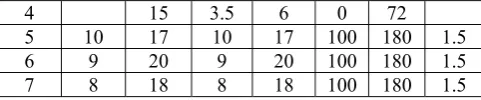
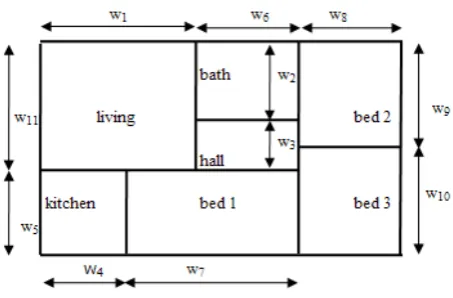
Radford[1]suggested the following building design optimization problem. Consider the house plan as in Fig. 1. The objective is to minimize the area of the house, while satisfying certain constraints. The constraints for each room[8, 10] are shown in Table I. For example the constraints on bed 1 are
10 ≤ w7and w7 ≤17 (length of room) 10 ≤ w5and w5 ≤ 17 (width of room) 100 ≤ w7 w5and w7 w5 ≤ 180 (area of room) w7 ≤ 1.5 w5 (aspect ratio) Other constraints are based on the layout are:
w1+ w6 = w4 + w7 w11+ w5= w9 + w10 w11 = w2 + w3
The other practical constraints based on the fact that the doors to bed 2 and bed 3 must be via the hall are:
w9 = w2 + 3 w10 = w5 + 3
TABLE I.
DIMENSIONLESSCONSTRAINTSONROOMS room Length(units) Width(units) Area(sq
units) ratio min max min max min max Max
1 8 20 8 20 120 300 1.5
2 6 18 6 18 50 120
3 5.5 5.5 8.5 8.5
4 15 3.5 6 0 72
5 10 17 10 17 100 180 1.5
6 9 20 9 20 100 180 1.5
7 8 18 8 18 100 180 1.5
Let C be the set of constraints. The objective function is:
minimize (w1+ w6 + w8) (w11 + w5) subject to the constraints C
The objective function is redefined based on the cost of kitchen and bath, Radford[1]:
minimize ((w1+ w6 + w8) (w11 + w5) + w4w5 + w6w2 ) subject to C
The problem is a nonlinear optimization problem with nonlinear constraints and cannot be solved using standard optimization methods such as linear programming or quadratic programming.
III. IMPROVED MOVE LIMIT METHOD OF SEQUENTIAL
LINEAR PROGRAMMING
A. Problem Formulation
The simplex method for solving LP problems is very powerful, therefore, a number of techniques for solving nonlinear programming problems are based on converting them to LP problems. An initial solution is to be selected to provide a base for the determination of the tangents of the constraints and of the objective.
Consider a finite set of variables x1, x2 , …, xn The unit cost coefficients for the main constructional elements, namely, floor and walls are assumed and the construction cost function, f(x) is to be minimized. This is generally a nonlinear function of the variables. The upper and lower limits on the length/width, ratios of the rooms, and the minimum area for each room constitute the constraints.
Thus, the problem is: minimize f (x)
subject to g j( x ) ≤ 0 j = 1,2, … , n
where x is the vector of design variables which constitute the optimum layout problem, n is a set of inequality constraints of the form g j( x ) ≤ 0 (j=1, 2, …., n), and xi ≤ 0 (i=1,2, .., k), where k is a set of decision variables.
B. Objective Function
Consider the dimensionless layout shown in Fig 4a. The problem is to determine the optimum values of the variables (w1, w2, w3,… ,wn) which minimize the overall construction cost while satisfying the planning constraints, given the construction costs of the walls and floors. The values of the variables provide the room dimensions.
The total cost for i rooms is given by: n n n
Figure 1. Dimensionless Layout from Radford and Gero[1]
This is the objective function to be minimized. Here li and wiare the length and width of a room i, and K1and K2 are constants depending upon the cost of floor/roof, cost of wall, and K3, K4 depend on the geometry of the layout.
It can be estimated easily that the values of K3 and K4 range from 1.5 to 2.0, depending upon the common wall between adjacent rooms. Initially a value of 1.5 is taken. C. Constraints
The planning constraints take the form:
i) minimum area, amini , minimum length/width, lmini ,and maximum length/width, lmaxi , can be set for each room .
lmini –li ≤ 0 minimum length li - lmaxi ≤ 0 maximum length lmini –wi ≤ 0 minimum width wi - lmaxi ≤ 0 maximum width
ii) minimum and maximum area for different rooms(amini , amaxi) can be set for each room
amini - li * wi ≥ 0 minimum area li * wi - amaxi ≤ 0 maximum area
iii) room length-to-width ratio can be set. The minimum ratio constraint consists of two constraints: the minimum width-to-length ratio and the minimum length-to-width ratio.
rmini li - wi≤ 0 minimum length-to-width ratio rmini wi -l i ≤ 0 minimum width-to-length ratio wi - rmaxi li≤ 0 maximum width-to-length ratio li - rmaxi wi - ≤ 0 maximum length-to-width ratio iv) geometric constraints
D. Improved Move Limit Method of Sequential Linear Programming
The problem, as formulated, is a nonlinear programming optimization problem. The optimization method used here is Sequential Linear Programming. This method can adequately handle this problem and has
the advantage that it is simple to program. An outline of the formulation is given below.
A general nonlinear programming problem can be defined as:
minimize Z = F(x) subject to
Gj (x) ≤ 0, j =1, 2, …,m
where x is a design vector on n dimensions, F(x) is the objective function and Gj‘s are constraints. A problem falls under the category of nonlinear programming if either F(x) or any one of Gj‘s is a nonlinear function of the variables. In the neighborhood of the design vector xk using Taylor’s series expansion and retaining only up to linear terms, the objective function and constraints are approximated as
F(xk+1) = F(xk) + ∇ FT(xk) (xk+1 - xk) Gj (xk+1) = G(xk ) + ∇ GT(xk) (xk+1 - xk)
With these approximations, the problem reduces to a linear programming problem. The linear programming problem is solved with the following additional constraints on the movement of design variables
| (xik+1–xik) | ≤ Mi k
where xi k+1, xi kand Mi kare the ith components of xk+1, x kand Mk. The vector Mk sets the move limits on the design variables.
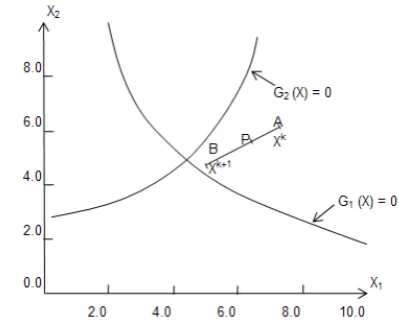
If xk+1 is a feasible point, the objective function is checked for improvement [F(xk+1)< F(xk)]. The sequence of linear programming is continued from xk+1 if improvement is found in objective function. Otherwise, the new design point is selected by quadratic interpolation between the design points xk and xk+1. In Fig. 2a, A represents the design point xkand B represents the design point xk+1. Assuming the objective function to vary in a quadratic way along AB, the objective function at any point P, along AB, can be written as
F(x) = F(x k + S) = F(α) = a + bα + c α2 where α=AP/AB
and S = xk+1 - xk hence, F(0) = F(xk) = a
F(1) = F(xk+1) = a + b + c and F’(0)= ∇ FT(x k+1) = b
The point x+corresponding to the minimum F(α) along the line is obtained by dF/dα=0. The corresponding value of α is:
b 1 ∇ FT(xk)S α+ = - = -
2c 2 F(xk+1) -F(xk) - ∇ FT (xk) S Hence, the new design point is given by
x+= xk + α+(xk+1 - xk)
The move limit is also reduced to M+ = α+ Mk
direction of most violated constraint. At any point, distance β from xk+1along the gradient direction, the most violated constraint(say jth) can be linearized as
Gj(xk+1+ β∇Gj(xk+1))=Gj (xk+1)
+ β∇GjT(xk+1) ∇Gj (xk+1) (1) Since a point which just satisfies the constraint is
sufficient, equating (1) to zero, the value of β is obtained as:
Gj(xk+1)
β = - (2)
∇GjT(xk+1) ∇Gj (xk+1) and such a point is given by
x* = xk+1 +β∇G
j(xk+1) (3)
Since the evaluation of constraint derivatives at a point is expensive in the optimum shape design of continua, it is preferable to use the gradient direction of previous point. Thus (2) and (3) can be modified as:
Thus,
Gj(xk+1)
β = - ∇GjT(xk) ∇Gj (xk)
and
x* = xk+1 +β∇Gj(xk)
In some problems the technique of steering to feasible region is to be used repeatedly to reach feasible region. If the number of repetitions required is large, recalculation of constraint derivatives is performed after predefined repetitions.
After steering the design vector to feasible region, if no improvement is found in the objective function, the usability of the direction S* = x* - xk is checked. The quadratic interpolation is resorted only if the direction is usable. Otherwise, quadratic interpolation leads to xkas optimum erroneously. In such cases quadratic interpolation is to be done between xk and xk+1(Fig. 2b) and then optimization is continued.
Economy and success of optimization depends to a large extent on the choice of move limits. If move limits are small the progress of optimization is slow, if large the design vector is likely to enter the infeasible region and it may take considerable time to reenter the feasible region.
E. Example
Consider the dimensionless floor plan as shown in Fig. 4(a). This layout was obtained by Iterative Heuristic Technique as described in [10]. Here, cluster analysis technique is used to group closely related rooms. The layout procedure is carried based on iterative heuristic technique. The dimensions are in 300 mm (1 ft) units. A program is developed to optimize nonlinear programming problems using Move Limit Method of SLP. The optimization proceeds as shown in Figure 3. Nonlinear
Figure 2a. Quadratic interpolation along a line
programming is used in conjunction with dimensional representations of floor plans to generate optimum layouts subject to cost criterion and functional constraints.
Improved Move Limit of SLP has been used to obtain optimum dimension of the house. Fig. 4a shows the dimensionless plan showing the variables. The objective is to determine the values of the dimensions represented by w1, w2 … w11 in order to minimize the overall cost, subject to the constraints on room dimensions, areas and aspect ratios. 50 to 250% variations are set for the room areas and dimensions.
The problem can be formulated as:
min Z = 100 [w10 w8 + w10 w9 + w3 w4 + w3 w5 + w2 w6 + w1 w6 + w11 (w8+ w9) + w1w7 + w2w7] + 825 [4w1 + 4w2 + 3w3+ w10 + 2w7 + 2w8 + 2w9 + 3w6 + 2w4 + 2 w5]
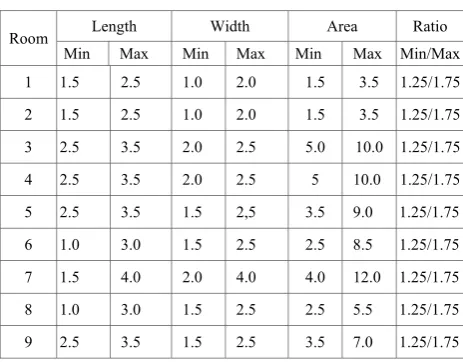
The first part of this formulation is the cost of floor and the second part is the cost of walls subject to the constraints on area, aspect ratio and dimensions of rooms(Table II)
Figure 4a. Layout obtained before optimization
The constraint for room 9 as shown in Table II can be written as:
2.5 ≤ w2 and w2≤3.5 (length of room) 1.5 ≤ w7 and w7≤2.5 (width of room) 3.5 ≤ w2 w7 and w2 w7 ≤ 7.0 (area of room) 1.25≤ w2 and w2≤ 1.75 (aspect ratio of room)
E. Program
The program developed involves the following steps: 1. Checks whether the initial values are feasible 2. Generates Simplex Table with the Move Limits 3. Determines the most violated constraint and its
value
4. Determines the derivatives of the objective function and the constraint equations
5. Determines alpha with respect to the most violated constraint to steer to the feasible domain
6. Checks the usability of the direction and if it is not usable, then adopts quadratic interpolation to get a usable direction
Figure 4b. Layout after optimization
7. Determines alpha by conventional method and steers the feasible domain
8. Checks for optimum, if not, uses quadratic interpolation and go back to Simplex Table
9. Conventional method of averaging the variables— displays the number of function evaluations, number of derivative evaluations.
10. Method for simplex table
11. Method to calculate the derivatives of the objective function and the constraints
12. Method to read the objective function and the constraints for optimization
IV. RESULTS
The determination of the dimensions which minimizes the construction cost may be determined using the optimization problem. It is not sufficient to know the specific optimal dimensions, the designer may want to know the near optimal results, and if there is more than one set of dimensions which produces the optimal results. Fig. 4(b) presents the optimum result for the optimum point.
STEPL = 0.00001
NUMBER OF VARIABLES = 11 NUMBER OF CONSTAINTS = 40
LOWER BOUND VALUES
1.00 2.50 2.50 2.00 2.00 1.50 1.50 1.00 1.00 1.50 1.50
UPPER BOUND VALUES
3.00 3.50 3.50 2.50 2.50
2.50 2.50 2.00 2.00 2.50 4.00
THE STARTING POINT IS:
w1 = 2.13 w2 = 2.97 w3 = 2.97 w4 = 2.05 w5 = 2.20 w6 = 1.70 w7 = 1.70 w8 = 1.22 w9 = 1.22 w10= 2.05 w11 = 3.20
OBJECTIVE FUNCTION = 47939.1700
TABLEII.
CONSTRAINTSONLENGTH,WIDTH,AREA,ANDASPECT RATIOROOM
ITERATION 1
MOVE LIMIT FACTOR = 0.5
POINT IS IN INFEASIBLE REGION
MOST VIOLATED CONSTRAINT 25
MAXIMUM CONSTRAINT VIOLATION 0.001031
VIOLATED CONSTRAINTS ALPHA 23 -0.000181
24 -0.000181
VALUES OF VARIABLES
2.11 2.96 2.96 2.03 2.20
1.69 1.69 1.9 1.20 2.09 3.04
OBJECTIVE FUNCTION = 47639.5125
ITERATION 2
MOVE LIMIT FACTOR = 0.5 OBJECTIVE FUNCTION = 47639.47
ITERATION 3
MOVE LIMIT FACTOR = 0.5
OBJECTIVE FUNCTION = 47639.4759
OPTIMUM POINT(VALUES OF VARIABLES) w1=2.11 w2=2.96 w3 =2.96 w4 =2.03 w5 =2.20 w6 =1.69 w7 =1.69 w8 =1.20 w9 =1.20 w10= 2.09 w11 =2.99
OBJECTIVE FUNCTION = 47639.4758
G(I) VALUES
0.0000 -0.5975 0.0000 -0.5975 -0.5917 -0.4225 -0.8874 -0.2113 0. 0000 -0.0452 -0.8452 0.0000 -1.1952 0.0000 -0.0452 0.0000 0.0000 -0.8452 0.0000 -0.0452 -1.0000 0.0000 -1.0000 0.0000 -2.0000 0.0000 -1.5000 0.0000 -2.0000 0.0000 -1.9286 -1.0714 -2.9492 -2.0508 -1.9286 -1.0714 -2.0000 0.0000 -2.0000 0.0000
NUMBER OF FUNCTION EVALUATIONS 0 NUMBER OF DERIVATIVE EVALUATIONS 3
Thus, the number of variables are 11 and the number of constraints are 40. The costs of the rooms are derived from the costs of the walls and floors plus the costs of their finishes. Cost of the wall is assumed to be 850/sq unit and the cost of floor/roof is set as 100/sq unit. This includes the cost of finishing. Once all the constraints are specified, they are in the form of inequalities, it is possible to determine the optimal value of the dimensions. Improved Move Limit method of SLP is used for design optimization.
V. CONCLUSION
With the procedure described in the previous sections, the problem of generating the geometry has been solved. Thus, given a topology, the dimensions of a layout can be obtained which satisfies a number of constraints while minimizing the construction cost. Improved Move Limit method of Sequential Linear Programming provides a convenient and efficient method to solve dimensioning problems which are nonlinear programming problems. It provides not only the optimal solution but also near optimal solutions so that performance analysis may be done.
REFERENCES
[1] A. D. Radford, and J. S. Gero, Design by Optimization in Architecture, Building and Construction, Van Nostrand Reinhold Company, pp. 84-90, 1988.
[2] D.J. Van Camp, M.W. Carter, and A. Vannelli “A nonlinear optimization approach for solving facility layout problems”, European Journal of Operational Research, 57, pp. 174-189, 1991.
[3] D. M. Himmelblaue, Applied Nonlinear Programming, McGraw Hill, New York, 1972.
[4] G. Carpentieri, and J. L. Tooren, “Improving the efficiency of Aerodynamic Shape Optimization on Unstructured Meshes”, 44th AIAA Aerospace Sciences Meeting and Exhibit, Reno, NV, 2006. [5] G. Vijayan, and R. S. Tsay, “A new method for floor
planning using topological constraint reduction”, IEEE Transactions on Computer-Aided Design of Integrated Circuiits and Systems, Vol 10(12), pp. 1494-1501, 1991.
[6] G. V. Reklaitis, A. Ravindran, and K. M. Ragsdell, Engineering Optimization, Methods and Applications, John Wiley and Sons, New York , 1983.
[7] J. J. Michalek, R. Choudhary, and P. Y. Papalambros, “Architectural Layout Design Optimization”, Engineering Optimization, Vol 34(5), pp. 461-484, 2002.
[8] J. S. Mashford, R. M. Drogemuller, and P. J. Stuckey, “Building Design Optimization using Constraint Logic Programming”, INAP/ WLP Proc. of the International Conference on the Applications of Prolog, Potsdam, Germany, 2004.
[9] M. F. Anjos, and A. Vannelli, “A new mathematical programming framework for facility layout design”, Informs Journal on Computing, Vol 18(1), pp. 111-118, 2006.
[11] R. E. Griffith, and R. A. Steward, A nonlinear programming technique for the optimization of continuous processing systems, Journal of Management Science, 7, pp. 379-392.
[12] S. S. Bhavikatti, “Computational efficiency of Improved Move Limit Method of Sequential Linear Programming for structural optimization”, Computers and Structures, Vol 11(3), pp. 191-196, 1980. Published by Elsevier Science
Rekha Bhowmik is currently an Assistant Professor
in the Department of Computer Science at Sam Houston State University, Huntsville, Texas. She has a PhD from Indian Institute of Technology, India. Her research interests include Optimization Techniques, Crime Data Mining, Text Mining, Crime Mapping, and Database Security.