International Journal of Pharmaceutical Research & Allied Sciences, 2016, 5(3):108-112
Research Article
ISSN : 2277-3657
CODEN(USA) : IJPRPM
The Relationship between Some Perceived Aspects of Information
and Communication Technology with Sport Community Training of
Khuzestan Province
Seyed Hamid Reza Ashrafi
*, Hossein Poursoltani and Mohammad Ali Ghareh
Department of Physical Education, Payam Noor University (PNU) *Email: [email protected]
_____________________________________________________________________________________________
ABSTRACT
The current study has been conducted in order to determine the relationship between some perceived aspects of ICT (Information and Communication Technology) with sport community of Khuzestan province. This study is descriptive in type and its method is correlation. So, 265 trainers from sport community of Khuzestan province who were active and qualified were selected in a random sampling method and filled out the questionnaires such as Teo perceived ease of use (2007), Teo perceived usefulness (2007), Teo attitude of using ICT (2007), Lee (2003) and Park (2004) applicability and experiences, and Fagon actual use of ICT (2004). The gathered information was studied by using multivariate regression analysis and Pierson correlation coefficient. The results showed that, some of effective factors on technology extension and acceptance can predict the actual use of technology in training of sport trainers in Khuzestan province (P≤0.05). Also, the results showed that, there is a significant relationship between the variables, perceived ease of use, perceived usefulness, applied technology, attitude of using technology and experiences with actual use of technology in sport community training of Khuzestan province. Eventually, by considering this point that applied technology and attitude toward technology have the highest share in predicting the actual use of technology among the study variables, it is recommended that significantly consider these two issues.
Key words: Perceived ease of use and usefulness, Applied technology, Attitude toward technology, Actual use of technology
_____________________________________________________________________________________________
INTRODUCTION
______________________________________________________________________________
systems in exchange of knowledge, and even the trainers are used in these systems to get familiar with their application to adopt their education systems with these tools such as information technology and internet.4
In recent two decades, information and communication technology has been extended in different fields. The global information technology acceptance in education mostly depends on economic and human needs in context of national development in different countries. Also, Harvy considered the effectiveness of computer application in education as the determinant fundamental factor for countries to achieve their long term goals. While, using technology in education seems a very difficult plan. Byliver and Rechy reminded that, regardless of technology level and its difficulty, information technology extension is impossible without considering skills, knowledge and the trainer attitude toward information and communication technology for using technology in education beneficially.16 One of the distinguished technology acceptance models is "Davis technology acceptance model" which examines the factors in individual level.16 In this study, Davis technology acceptance model would be used. This model is such a strong tool to measure technology acceptance and application by users.
Recent studies show that, the successful implementation of information technology of education mostly depends on the trainers who determine how this technology works in their classes. Developing positive attitude of trainers toward information and communication technology is the main factor in improving the computer application teaching-learning process and would decrease the resistance of trainers in using computer.8
Mohammadi (1391) studied the attitude of Iran national trainers toward using information and communication technology and knowledge in sport. The results of survey which studied 132 subjects showed that, genius trainers have a positive attitude toward using sport technologies especially in education, but this positive attitude necessarily does not mean that they always use information technology for other activities and taking them to competitive sport arenas. But eventually we can say that, the attitude of trainers toward technology is very positive, so finding certain strategies to encourage the trainers is necessary.9
However today, development in various fields especially in sport and training sport issues is impossible without technology, in a way that investigating the related factors with the actual using of different technology is one of the favorite topics for current researchers, to improve the using of such these technologies by identifying these factors. Therefore, this survey tries to study the relationship between some perceived aspects of information and communication technology with sport community training of Fars province by using other previous studies and tries to make an effective move in order to use such these technologies.
MATERIALS AND METHODS
The current study method is descriptive and correlation in type. The statistical society of this study is active sport communities in Khuzestan province which 265 people of them were randomly selected as statistical subjects and filled out the study questionnaires. The gathering information tools in this study were the questionnaires such as Teo perceived ease of use (2007), Teo perceived usefulness (2007), Teo attitude of using ICT (2007), Lee (2003) and Park (2004) applicability and experiences, and Fagan actual use of ICT (2004).5,10,17 To analyze data, first Kolmogorov-Smirnov (K-S) test was used to determine the normality and Levene test was used to determine the homogeneity of variances, then multi regression analysis was used. It should be mentioned that, for analyzing data, SPSS software, V.19 was used in a significant level (0.05).
RESULTS
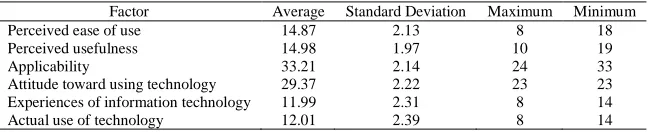
Table 6-4: The Information of Effective Factors on Using Technology
Factor Average Standard Deviation Maximum Minimum Perceived ease of use 14.87 2.13 8 18 Perceived usefulness 14.98 1.97 10 19
Applicability 33.21 2.14 24 33
Attitude toward using technology 29.37 2.22 23 23 Experiences of information technology 11.99 2.31 8 14 Actual use of technology 12.01 2.39 8 14
The results of variance analysis and statistical regression between the effective factors on technology acceptance and application and using technology for training sport trainers are presented in table 2. According to these results, 62% of related variances to using technology in education, are determined by trainers with the effective factors on technology acceptance and application (R²=0.62). That means 62% changes of using technology in training sport trainers are predicted through the effective factors on technology acceptance and application. By analyzing the table of multivariate simultaneous regression analysis, it determines that, the effective factors on technology acceptance and application can predict the changes related to using technology in training sport trainers by considering the significance level (P=0.001).
Table 2: Statistical Regression Features, Effective Factors on Technology Acceptance and Application and Using Technology in Education
Index R R² F P Regression 0.79 0.62 159.089 0.001
The simultaneous regression analysis is shown in table 3. According to significance level, perceived ease of use, perceived usefulness, tech applicability, the attitude toward using technology, the experiences of information technology can predict the changes related to using technology in education by trainers (P≤0.05). Also, this table shows that applicability and then the attitude have the highest share in prediction of using technology in education.
Table 3: The Summary of Regression Table the Effective Factors on Technology Acceptance and Application and Using Technology in Education
Index Variable
B Beta F P
Perceived ease of use 0.722 0.119 2.879 0.004
Perceived usefulness 0.633 0.165 4.092 0.001
Applicability 0.282 0.509 14.852 0.001
Attitude toward using technology 0.168 0.335 9.584 0.001
Experiences of information technology 0.109 0.102 2.827 0.005
DISCUSSION AND CONCLUSION
Generally the current study showed that, some aspects of information and communication technology can predict their application in sport community training of Khuzestan province. This result is consistent with the results of Roudaki (1389), Lopez (1997), Ruth (2000), Young (2003), Fagan (2004), Porter (2006), Shiue (2007), Yousef (2009), Deliese (2009) and Mayorga (2010).1,2,6,7,11,12,13,15,18,19 Actually one can concludes, whenever using the technology is easy and without much effort, the trainers are more eager to use it and also its performance will be improved. In such circumstances, the trainers find the technology useful. In this research, the effect of perceived ease of use is direct on perceived usefulness. It means, whatever the trainers believe that, using a system or a technology does not need much effort, it would be easy to use. So, their attitude toward using the system or technology will be increased, on the contrary, if the learning time of using a technology is too long and boring, they found the technology not only useful but also a time-consuming and boring process, and eventually they go far from the technology.
______________________________________________________________________________
eventually they resist against information and communication technology and using it in teaching-learning, so they pass up information and communication technology and keep studying traditionally. Meanwhile, perceived usefulness has a relationship with users’ beliefs about performance, effectiveness and usefulness, and it is reasonable whatever the trainers believe that using technology improves their performance, effectiveness and usefulness, they would have a more desirable feeling about using information and communication technology.
Eventually the current study showed that, applicability is the most effective factor among the factors which can be effective in actual using of technology and then the attitude is the second most effective factor. So, according to the importance of information technology in teaching-learning of various sport issues, we should give more credit to these two issues; applicability and attitude toward using information technology.
The first hypothesis: there is a relationship between the effective factors on technology acceptance and application, and using technology in sport community of Khuzestan province.
Finally, because of importance of the issue, it is recommended to the trainers that encourage all athletes and beginners to use technology in the entire stages of teaching-learning process.
REFERENCES
[1] Delice, M., Explanation of Police Officers` Information Technology Acceptance Using the Technology Acceptance Model and Social Cognitive Theory, Unpublished Doctoral Dissertation, University of Louisville, 2009. [2] Fagan, M.H., Neill, S., An Empirical Investigation into the Relationship between Computer Self-efficacy, Anxiety, Experience, Support and Usage, Journal of Computer Information Systems., 2004, 44(2): 95-104.
[3] Haj Foroush, A., Orangi, A.M., Studying the Results of ICT Application in Tehran High Schools, Educational Innovation Quarterly., 2004, 3(9): 100-105.
[4] Kargard Far, M., Studying the Influencing Organizational Factors Attitude Toward the Use of ICT in Secondary Schools in the City of Shiraz, Master's Thesis of Payam Nour Shiraz, Iran, 2010.
[5] Lee, Y.K., Factors Affecting Leaner Behavioral Intentions to Adopt Web based Learning Technology in Adult and Higher Education, Doctoral Dissertation Research, The University of South Dakota, 2001.
[6] Lopez, D., Manson, D., A Study of Individual Computer Self-efficacy and Perceived Usefulness of the Empowered Desktop Information System, LOPEZ AND MANSON, 1997.
[7] Mayorga, R., The Professional User: Technology Acceptance in a Technology Driven Profession, Unpublished doctoral Dissertation, 2010.
[8] Moghali, A.R., The Related Factors with Attitudes of Students of Management Faculty of Shiraz Medical Science University about Using ICT, Journal of Development Steps in Medical Training., 2011, 8(1): 25-31. [9] Mohammadi, S., The Attitudes of National Team Coaches Toward the Use of Science and Technology in Sports, Journal of Sport Management., 2012, 15: 123-141.
[10] Park, B., Faculty Adoption and Utilization of Web-Assisted Instruction (WAI) in Higher Education: Structural Equation Modeling (SEM), Unpublished Doctoral Dissertation, 2003.
[11] Porter, C., Donthu, N., Using the Technology Acceptance Model to Explain How Attitudes Determine Internet Usage: The Role of Perceived Access Barriers and Demographics, Journal of Business Research., 2006, 59(9): 999-1007.
[12] Rodaki, M., Studying the Effect of Technological Changes on the Behavior of Secondary School Teachers in Four Regions of Education of Shiraz, MS Thesis of Payam Nour Shiraz, Iran, 2010.
[13] Ruth, C.J., Appling a Modified Technology Acceptance Model to Determine Factors Affecting Behavioral Intentions to Adopt Electronic Shopping on the World Wide Web: A Structural Equation Modeling Approach, Unpublished Doctoral Dissertation, 2000.
[14] Sen, S., The Effect of Technology Acceptance on Postsecondary Student Achievement in Mathematics. Dissertation Submitted in Partial Fulfillment in Educational Research, University of California, 2005.
[15] Shiue, Y.M., Investigating the Sources of Teachers’ Instructional Technology Use Through the Decomposed Theory of Planned Behavior, Journal of Educational Computing Research., 2007, 36(4): 425-453.
[16] Talebi, S., Causal Model of the Role of Psychological Variables (Computer Experience, Subjective Norms, Anxiety and Computer Self-Efficacy) in the Actual Use of ICT with an Emphasis on Davis Model, Ph.D. Thesis. University of Payam Nour Shiraz, Iran, 2012.
[18] Yang, S.K., Teachers’ Perception of Use of Student Performance Information: Technology Acceptance Model, Unpublished Doctoral Dissertation, 2003.