
Comparative Study of IP Trace back Techniques
Jigneshkumar V Madhad Piyush Patel
Department of Computer Engineering Department of Computer Engineering
Narnarayan Shastri Institute of Technology, Jetalpur, Narnarayan Shastri Institute of Technology, Jetalpur,
Ahmedabad, GTU-Gujarat, India Ahmedabad, GTU-Gujarat, India
Abstract
because so many decades World Wide Web has been used broadly in numerous fields, network safety problems include the main matter. IP traceback is just the actual method to understand the actual purpose, it reconstructs IP packets traversed path inside the World Wide Web to determine their own roots. IP Traceback may be an important ability for characteristics sources of attacks and Starting protection measures for the Internet. This paper discovers different IP Traceback approaches. This comparative paper provides as well as extends many technologies to prevent the secured information from the network issues by using different IP traceback techniques.
Keywords: IP Traceback, Link testing, Packet Marking, ICMP Traceback
_______________________________________________________________________________________________________
I. INTRODUCTION
Internet facilities are generally as well as widely used now-a-days to finish and do each and every task or activity. As Internet is utilized for several tasks, attackers find a method to interrupt the services provided by it. For this reason, right now network safety may be a necessary requirement of Internet World. Even though many security measures are adapted by the security people to ensure security for the customers, still Internet is open for many attacks. The attacks have become so prevalent that no security measure can prevent all of them.
So as to fortify the matter of organizations, they require systems, for example, IP Traceback procedures which will at last decrease the possibilities of misfortunes. IP Traceback is an endeavour to follow the genuine beginning of a packet or a stream of packets. As a result of IP Spoofing, just accepting that the packet was sent by the node indicated as the source address in its IP header is not generally compelling, so different strategies for following packets to their root are required. Thus effective IP Traceback methods must be utilized to discover the genuine source of attacks, with a specific end goal to take any preventive or legitimate activities against the attackers.
IP Traceback is used to find the origins and attacking paths of malicious traffic. The task of identifying the original source of a packet is complex as the source IP address can be fake or spoofed. So IP Traceback techniques neither prevent nor stop the attack, they are used only to identify the source of the packets.
II. EXISTING IP TRACEBACK TECHNIQUES
Existing IP Traceback approaches can be classified into five main categories: [1]
- Link Testing
- Packet marking
- ICMP Traceback
- Logging
- Hybrid tracing.
Link Testing [2,3]:
Link testing is an approach which determines the upstream of attacking traffic hop-by-hop while the attack is in progress. The majority of active traceback strategies begin as the router best for the target and interactively test their upstream hyperlinks till they will decide which one is used to carry the attacker's traffic. In a perfect world, this method is rehashed recursively on the upstream router until the source is reached. Below we summarize two varieties of link testing schemes:
Input Debugging:
packets have arrived. This procedure is applied to the next upstream router until the origin of attack is reached. This kind of traceback by itself floods the network. Controlled flooding is also poorly suited for tracing distributed denial-of-service attacks because the link-testing mechanism is inherently noisy and it can be difficult to discern the set of paths being exploited when multiple upstream links are contributing to the attack. Finally, like all link-testing schemes, controlled flooding is only effective at tracing an on-going attack and cannot be used “post-mortem”.
Packet Marking
Packet marking methods relies on the routers in the network to send their identities to the destinations either by encoding this information directly in rarely used bits of the IP Header, or by generating new packet to the same destination. They have the drawback in that they require large number of attack packets to be collected by the victim to infer the attack paths. [5]
Packet marking methods require routers modify the header of the packet to contain the information of the router and forwarding decision. Hence the receiver of the packet can then reconstruct the path of a packet (or an attacking flow) from the received packets. [1]
As Packet marking methods do not cost storage resource on routers and the link bandwidth resource, they are generally considered to be lightweight. Because however, packet marking is not a widely supported function on routers; thus, it is difficult to enable packet marking traceback in the network.
There are two approaches of packet marking schemes:
- Probabilistic Packet Marking
- Deterministic Packet Marking Probabilistic Packet Marking [3]
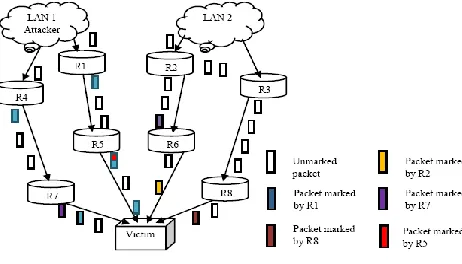
Probabilistic packet marking makes use of the Identification field as the marking space and stores the link information. It divides the IP address into eight fragments, 4 bits for each. This IP address fragment and the same offset fragment of the next router compose the edge fragment with 8 bits. The offset flag needs 3 bits for eight fragments, and the last 5 bits are enough to show the hop number. It is reported that few packets exceed 25 hops in the forwarding network [9]. When a router decides to mark a packet, it chooses a random fragment of its IP address, and records the fragment offset with the distance field set to 0. The advantage of PPM is that it needs no storage overhead for each router. But the drawbacks are also apparent. Victim needs a large number of packets to reconstruct the attack path, and PPM does not have the ability to trace a single packet.
Fig. 1: Probabilistic Packet Marking Method
Probabilistic Packet Marking Method [2,9] is shown in Fig. 1. In this techniques, each router marks the packet with some probability say p for example p = 1/100 which implies marking one packet for every 100 packets received. The marking field uses 16 bits identification field in the header, of which 5 bits are used for marking hop count, which would be a useful information during reconstruction of attack path, and the remaining bits are used by the router to send its information.
Deterministic Packet Marking [3]
Fig. 2: Deterministic Packet Marking Method
Deterministic Packet Marking scheme (DPM) is shown in Fig. 2. This technique overcomes the disadvantages of PPM. Every packet passing through the first ingress edge router is only marked with the IP address of the router. The IP address is divided into two fragments (16 bits each) and each fragment is randomly recorded into each inflowing packet. The entire IP address is recovered by the victim when the victim obtains both the fragments of the same ingress router. This scheme fails when the source address is spoofed and is also false positive. The enhanced schemes [7,8] are proposed where the IP address is split into more fragments, and a hash function is used to contain the identity of the ingress router to decrease the false positive. Deterministic packet marking based on redundant decomposition is proposed in [10]. The knowledge of topology plays a significant role in DPM scheme’s traceback. Consider the DPM scheme suggested in [11] where, it is assumed that the topology of the network is known in advance. The packet marking method involves hash of ingress router’s IP address. The hash value is split into chunks and each chunk is marked into the packet randomly. With the topology known, the victim performs traceback of the marked routers. Large numbers of packets are not required for traceback in this scheme but it consumes a longer search time to identify the origin. The traceback scheme is challenged, if the topology is modified.
When an intermediate router goes off, the traceback can be carried out with the topology but might turn to be false positive. If the attacker modifies the mark field, this scheme will fail to traceback. Instead of IP address respective bit fields were marked in [12]. In Flexible Deterministic Packet Marking (FDPM) scheme [13, 14], the marking field length is varied according to the requirement. The length of the marking field is flexible and can be adjusted. Further, the marking rate can also be adaptivel y changed according to the incoming traffic load on the participating router. FDPM is capable of tracing a large number of real sources with low false positive rate and low resource requirement on routers.
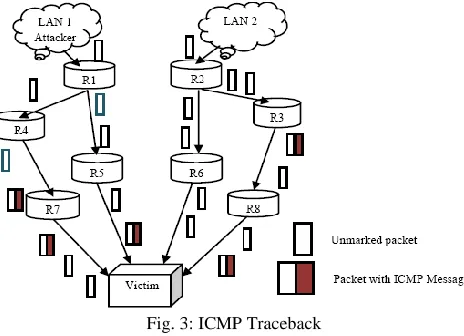
ICMP Traceback[3]
packet. Traceback packet also includes an authentication field which guards against spoofed traceback packets sent from attackers. This field can be null authentication, random strings or even HMACs. TTL is set to 255 for computing distance at the receiving end. During DDoS flooding attack, these ICMP traceback messages are used by the victim to reconstruct the path taken by the attacker. The schematic representation of the scheme is shown in Figure 5. The updated version of the previous iTrace (ICMP Traceback) scheme was proposed in [16]. iTrace scheme is considered as an industry standard by IETF. The time taken for path reconstruction by iTrace is minimized in ICMP Traceback with cumulative path (iTrace CP) [17]. This scheme is independent of the attack length. This scheme encodes the entire attack path information (i.e. contains the addresses of all the routers on the attack path) into minimal number of packets, thus minimizing the attack path construction time. This is achieved at the expense of minimal additional overhead in computation, storage and bandwidth. An enhancement to this scheme is suggested in Enhanced ICMP Traceback with Cumulative Path [18], which suggests the exponential increase in the probability of message generation with the distance in hops from the victim. The effectiveness of the scheme relies on selecting the appropriate value for the probability exponent which influences the traceback time for attack paths of different length. The iTrace scheme suffers a serious problem on the resource spent on generating the number of traceback packets which turns out to be neither useful nor informative during traceback and this issue is addressed in Intention-driven ICMP traceback [19] which enhances the probability of the router to generate useful trace messages. This is achieved by adding an additional intention bit to the iTrace message. A modification to Intention driven traceback is provided in [20] to create more effective iTrace packets to detect the origin of attack more accurately.
Logging [3]
This solution involves storing packet digests or signatures at intermediate routers. The drawbacks of this technique include significant amount of resources have to be reserved at intermediate routers and hence large overhead on the network, complexity, centralized management.
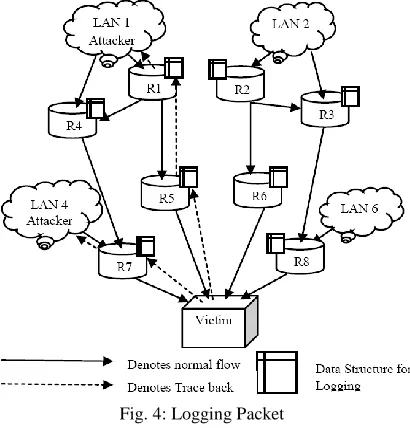
Fig. 4: Logging Packet
Logging is suggested to log packets at key routers and so use data-mining techniques to see the trail that the packets traversed. It has the valuable property that it will trace an attack long once the attack has completed. This system has drawbacks, and probably huge resource needs and large scale interprovider information integration tough.
Logging scheme for IP traceback stores the information like packet’s digest, signature, and fields of IP header on all or few routers which forward packets within the domain. It is shown in Figure 6. When an attack is detected, the victim requests the upstream router to gather information about attack packet. If the information is found, then the router is counted as a hop in the attack path and the process is repeated.
Hybrid Traceback [3]
This solution achieves the best of both the worlds: small number of attack packets to conduct the traceback process and small number of resources to be allocated at intermediate routers for packet logging purposes.
identified with the help of restrictions imposed on TTL field. When compared to IP logging schemes, processing and storage overhead at the routers are significantly minimized using this Hybrid Scheme.
III. PASSIVE IP TRACEBACK
Here natural Internet-scale Passive IP traceback (PIT) approach that requires no ISP deployment. PIT analyzes packets collected from network telescopes, and infers the locations of spoofed traffic. The intuition behind PIT is that spoofing flows may trigger ICMP error messages at routers on the path to victim. These ICMP messages are sent to the spoofed nodes. Under the assumption that attackers use randomly forged addresses, some of these ICMP messages will be received by the network telescopes. The addresses of routers sending the message can be combined with an Internet route model to re-construct the attack path and find the locations of the spoofers.
Fig. 5: Passive IP traceback
IV. COMPARISON OF VARIOUS IP TRACEBACK TECHNIQUES
Table – 1
Various IP Traceback Techniques [3] Link
Testing Packet Marking
Packet Logging ICMP
Traceback Hybrid
PPM DPM
Deployability Fair Fair Fair
Poor. Huge memory requiremet
Good
Fair
Scalability Poor Poor Fair Fair Good Fair
Memory Requirement (Network) Not Required Not Required Not Required
Very High Not
Required Low Memory Requirement (Victim) Not Required
Very High Medium Not
Required
Medium Not
Required
Router Processing
overhead
High Medium Medium High Low Low
Reliability Good Good Good Poor
Good and Practically feasible Poor Parameter needed for traceback Attack pattern and large number of packets Large No. of packet Minimum number of packets compared to PPM One Packet No.of ICMP messages and huge number of attack packets. One Packet Applicability on different types of
attacks
DoS DoS/ DDoS
Post Attack Analysis
Not
Possible Possible Possible Possible Possible Possible
Attacker challenge vs.
Scheme’s survival
Poor Poor Poor Poor Poor Poor
Router Involvement during Traceback
High Nil Nil High Nil High
V. CONCLUSION
The comparing traceback mechanism by considering different categories like Deployability, Router Involvement during Traceback, Parameter needed for traceback, Router Processing overhead, Memory Requirement (Network), Memory Requirement(Victim), Reliability. the advantages and disadvantages of the all mechanisms are described.
REFERENCES
[1] Guang Yao; Jun Bi; Vasilakos, A.V., "Passive IP Traceback: Disclosing the Locations of IP Spoofers From Path Backscatter," in Information Forensics and Security, IEEE Transactions on , vol.10, no.3, pp.471-484, March 2015 doi: 10.1109/TIFS.2014.2381873
[2] S. Savage, D. Wetherall, A. Karlin, and T. Anderson, “Practical network support for ip traceback,” in Proceedings of the Conference on Applications, Technologies, Architectures, and Protocols for Computer Communication, ser. SIGCOMM ’00. New York, NY, USA: ACM, 2000, pp. 295–306. [3] Vijayalakshmi Murugesan, Mercy Shalinie, and Nithya Neethimani, “A Brief Survey of IP Traceback Methodologies”, Department of Computer Science
and Engineering, Thigarajar College of Engineering, Thiruparankundram, Madurai – 625015, Tamilnadu, India
[4] DONG YAN, YULONG WANG, SEN SU and FANGCHUN YANG A Precise and Practical IP Traceback Technique Based on Packet Marking and Logging State Key Laboratory of Networking and Switching Technology Beijing University of Posts and Telecommunications Beijing, 100876 P.R. China [5] B. Sai Priyanka, N. Srihari Rao, “IP Traceback Techniques – A Selective Survey” Department of Computer Science & Engineering, CMR Institute of Technology, Hyderabad, A.P International Journal of Computer Science and Mobile Applications, Vol.1 Issue. 3, September- 2013, pg. 40-44 ISSN: 2321-8363
[6] K. Arun Kumar, K. Sai Ashritha, “Analysis of Various IP Traceback Techniques - A Survey” Department of Computer Science & Engineering, CMR Institute of Technology, Hyderabad, A.P International Journal of Computer Science and Mobile Applications (0975 – 8887), Volume 77– No.13, September 2013ISSN: 2321-8363
[7] A. Belenky and N. Ansari, “Ip traceback with deterministic packet marking,” IEEE Communications Letters, vol. 7, no. 4, pp. 162–164, 2003. [8] Belenky and N. Ansari: On Deterministic Packet Marking, Computer Networks, Vol. 51, No. 10, 2007, pp. 2677-2700
[9] S. Savage, D. Wetherall, A. R. Karlin, T. E. Anderson: Network Support for IP Traceback, IEEE/ACM Transactions on Networking, Vol. 9, No. 3, 2001, pp. 226-237
[10] G. Jin and J. Yang: Deterministic Packet Marking Based on Redundant Decomposition for IP Traceback, IEEE Comm. Letters, Vol. 10, No. 3, 2006, pp. 204-206
[11] Wang Xiao-jing, Wang Xiao-yin: Topology Assisted Deterministic Packet Marking for IP Traceback, The Journal of China Universities of Posts and Telecommunications, Vol. 17, No. 2, April 2010, pp. 116-121
[12] Y. Kim, J. Y. Jo, and F. L. Merat: Defeating Distributed Denial-of-Service Attack with Deterministic Bit Marking, Proc. IEEE Global Telecomm. Conf. (GLOBECOM ’03), 2003, pp. 1363-1367
[13] Y. Xiang, W. Zhou, and J. Rough: Trace IP Packets by Flexible Deterministic Packet Marking (FDPM), Proc. IEEE Int’l Workshop IP Operations and Management (IPOM ’04), 2004, pp. 246-252
[14] Y.Xiang, W.Zhou and M.Gu: Flexible Deterministic Packet Marking: An IP Traceback System to Find the Real Source of Attacks, IEEE Trans. Parallel and Distributed System, Vol. 20, No. 4, April 2009, pp. 567- 580
[15] S. M. Bellovin: ICMP Traceback Messages, Internet Draft: draft-bellovin-itrace-00.txt, 2000
[16] S. M. Bellovin, M. D. Leech, and T. Taylor: ICMP Traceback Messages, Internet Draft: Draft-Ietf-Itrace-04.Txt, Feb. 2003
[17] Henry C. J. Lee, Vrizlynn L. L. Thing, Yi Xu, Miao Ma: ICMP Traceback with Cumulative Path, an Efficient Solution for IP Traceback, International Conference on Information and Communications Security, Oct. 2003
[18] V. L. L. Thing , H. C. J. Lee , M. Sloman and J. Zhou: Enhanced ICMP Traceback with Cumulative Path, 61st IEEE Veh. Technol. Conf., 2005
[19] Felix, W. (2001): On Design and Evaluation of Intention-Driven ICMP traceback, Proc. IEEE Int'l Conf. Computer Comm. and Networks, IEEE CS Press, 2001, pp. 159-165
[20] Izaddoost, M. Othman, and M. F. A. Rasid: Accurate ICMP Traceback Model under DoS/DDoS Attack, in Proceedings of the 15th International Conference on Advanced Computing and Communications, 2007
![Table – 1 Various IP Traceback Techniques [3]](https://thumb-us.123doks.com/thumbv2/123dok_us/7805420.1661407/5.612.210.407.177.282/table-various-ip-traceback-techniques.webp)
