Original Research Article
Epidemiology and Pattern of Spinal Cord Injury and Risk Factors
Associated with Complete Cord Injuries
Satish Kumar Bansal
1*, Vikas Yadav
2, Vikram Singh
2, Pawan Kumar Goyal
3,
Gopal Singal
3,
Yudhvir Singh
41*Professor & Consultant Neurosurgery, 2Junior Resident, 3Professor, 4Senior Resident,
Department of General Surgery, Maharaja Agrasen Medical College, Agroha, Hisar, Haryana, India.
ABSTRACT
Background: Traumatic spinal cord injuries are the common cause of disability and death among young people, and their influence on the social and financial well-being of the patient is often more significant than that of other injuries. The aim of present study is to assess the epidemiology and pattern of spinal cord injury and risk factors associated with complete cord injuries.
Materials and Methods: In this retrospective study,
questionnaires were used to review the medical records and to obtain relevant data. In the questionnaire we included patients age, gender, residential address, ethnic group, occupation, marital status, time of injury, etiology of injury, level and severity of injury, duration of hospital admission, condition on discharge, rehabilitation therapy and so on. All the patients were grouped into 4 groups based on their age. The age groups were, < 20, 21-40, 41-60, and >61 years. All the data obtained were compiled and recorded.
Results: The medical records of 200 patients with spinal cord injuries were incorporated in the study. Out of 200 patients, 144 patients (72%) belonged to male group whereas 56 patients (28%) belonged to female group and the male to female ratio was approx. 2.5:1. The age of patients ranged from 8-90 years with mean age being 52.3 years. Maximum
patients belonged to the age group 41-60 years, followed by 21-40 years.
Conclusion: The most common age at the time of injury was
young and middle age adults and the proportion of males was higher. The main causes were traffic accidents and being struck by falling objects. Preventive measures should be based on the characteristics of different groups, and public policies aimed at preventing injuries should focus on high-risk populations, such as young and middle age males.
Keywords: Spinal Cord Injuries, Spinal Injury, Traumatic.
*Correspondence to:
Dr. Satish Kumar Bansal,
Professor, General Surgery & Consultant Neurosurgery, Maharaja Agrasen Medical College, Agroha, Haryana, India.
Article History:
Received: 08-02-2017, Revised: 09-03-2017, Accepted: 29-03-2017
Access this article online
Website:
www.ijmrp.com
Quick Response code
DOI:
10.21276/ijmrp.2017.3.2.084
INTRODUCTION
Traumatic spinal cord injuries (TSCIs) are the common cause of disability and death among young people, and their influence on the social and financial well-being of the patient is often more significant than that of other injuries.1,2 A constant increase in the incidence of TSCIs was observed in many studies conducted. Transportation injuries were the leading cause of TSCIs in many developed countries, such as the USA, Canada, Australia, New Zealand and some of the West European countries.3-5 However, falling was the primary injury cause of TSCIs in developing countries, such as Russia, Pakistan, Nepal and some portions of southern Asia.6,7 Epidemiological studies from Canada included patients from 15 years of age, and studies from Sweden and Finland included patients from 16 years of age, whereas a study from Western Norway included all ages. Direct comparison between studies can therefore be difficult because of the different inclusion criteria and differences in data collection.8-10
The aim of present study was to assess the epidemiology and pattern of spinal cord injury and risk factors associated with complete cord injuries.
MATERIALS AND METHODS
selected patients. Questionnaires were used to review the medical records and to obtain relevant data. In the questionnaire we included patients age, gender, residential address, ethnic group, occupation, marital status, time of injury, date of hospital admission and discharge, etiology of injury, level and severity of injury, rehabilitation therapy and so on. All the patients were grouped into 4 groups based on their age. The age groups were, < 20, 21-40, 41-60, and >61 years. The main causes of injury were classified as non-traumatic or traumatic. Traumatic causes included traffic accidents, high falls, low falls, being hit by falling objects, crushing injuries, violence and sports injuries. For the classification of level of injury, injuries were classified based on region of spinal cord: cervical, thoracic, and lumbar segments.
The neurological deficits caused by the injury were classified based on their severity as either complete or incomplete based on the international standards set forth by the American Spinal Injury Association (ASIA).
If complete absence of sensory and motor functions were observed, the injury was defined as complete SCI. Similarly, if sensory and/or motor functions were partially or completely preserved below the level of injury including lower sacral segment, the injury was defined as incomplete SCI.
The statistical analysis of the data was done using SPSS software for windows. Chi-square test was done for the assessment of collected data. P value <0.05 was considered statistically significant.
Table 1: Distribution of patients based on etiology of SCI
Variables Gender Age (years) Total no. of
accidents, N (%)
Male Female <20 21-40 41-60 >61
Traffic accidents 36 (25) 6 (10.7) 7 (35) 21 (30) 20 (27) 1 (2.7) 44 (22)
Struck 30 (20.8) 8 (14.2) 2 (10) 7 (10) 16 (21.7) 6 (6) 38 (19)
Crushing injuries 23 (15.9) 7 (12.5) 3 (15) 5 (7.2) 8 (10.8) 7 (19.4) 30 (15)
High-falls 12 (8.3) 8 (14.2) 2 (10) 4 (5.8) 7 (9.5) 5 (13.8) 20 (10)
Others 13 (9.1) 2 (3.5) 1(5) 9 (12.8) 9 (12.2) 6 (16.6) 14 (7)
Non-traumatic 17 (11.8) 4 (7.1) 2(10) 8 (11.4) 8 (10.8) 2 (5.5) 36 (18)
Unknown 13 (9.1) 21 (37.5) 3 (15) 16 (22.8) 6 (16.2) 9 (25) 18 (9)
Total, N (%) 144 (72) 56 (28) 20 (10) 70 (35) 74 (37) 36 (18) 200 (100)
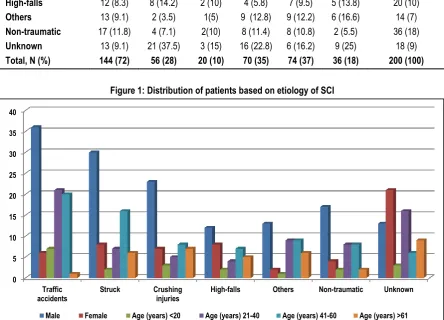
Figure 1: Distribution of patients based on etiology of SCI
RESULTS
The medical records of 200 patients with spinal cord injuries were incorporated in the study. Out of 200 patients, 144 patients (72%) belonged to male group whereas 56 patients (28%) belonged to female group and the male to female ratio was approx. 2.5:1. The age of patients ranged from 8- 90 years with mean age being 52.3 years. Maximum patients belonged to the age group 41-60 years, followed by 21-40 years.
Based on the etiologies of injuries, they were classified into traumatic and non-traumatic. Traumatic injuries included traffic
accidents (22%), being struck by falling objects (19%), crushing injuries (15%), and high falls (10%). Non-traumatic injuries included inflammation, tumors, infections, degenerative damage and vascular damage. Non-traumatic injuries accounted for 18% of SCI. It was revealed from the above results that traffic accidents were the leading cause of the SCIs and this result is statistically significant (P<0.05) [table 1]. The leading cause of SCIs in case of males was traffic accidents, in contrast to high falls in case of females. There was statistically significant data in gender distribution etiology (P<0.05). The rates of traffic accidents, high
0 5 10 15 20 25 30 35 40
Traffic
accidents Struck Crushinginjuries High-falls Others Non-traumatic Unknown
falls, and being struck by falling objects were high among the patients between the ages of 21 and 60 years. Among those older than 60 years, low falls were the most common cause of SCIs. Statistically significant differences were noted among the age groups with regard to etiology (P<0.001) [Table 1, Figure 1]. The patients admitted for SCIs were grouped as cervical, thoracic and lumbar based on the level of injury as shown in Table 2.
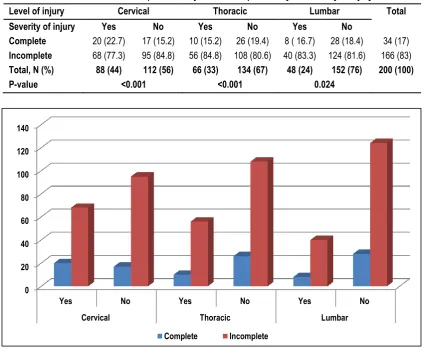
Cervical injuries were the most common segment affected with 88 patients, followed by thoracic segment (66 patients, 33 %) and then lumbar segment (48 patients, 20%). Based on the severity of injury, there were more cases of incomplete injuries (166 patients, 83%) as compared to complete injuries (34 patients, 17%). The distribution of severity of spinal cord injuries was statistically significant as shown in Table 2.
Table 2:Distribution of spine level injuries for SCI patients by the severity of injury
Level of injury Cervical Thoracic Lumbar Total
Severity of injury Yes No Yes No Yes No
Complete 20 (22.7) 17 (15.2) 10 (15.2) 26 (19.4) 8 ( 16.7) 28 (18.4) 34 (17)
Incomplete 68 (77.3) 95 (84.8) 56 (84.8) 108 (80.6) 40 (83.3) 124 (81.6) 166 (83)
Total, N (%) 88 (44) 112 (56) 66 (33) 134 (67) 48 (24) 152 (76) 200 (100)
P-value <0.001 <0.001 0.024
Figure 2: Distribution of spine level injuries for SCI patients by the severity of injury
DISCUSSION
It is well known that SCI imposes a substantial burden on individuals, their families and society because of the cost of healthcare treatments, rehabilitation and lost productivity. Therefore, the results of this research can support the reasonable allocation of medical resources and the implementation of preventive measures. In the present study, it was observed that traumatic spinal injury is the most common spinal injury followed by struck from falling objects. Also, young population is more prone to spinal injuries as shown by statistically significant results with p<0.05. These results are consistent with other studies conducted by researchers.
Wang H et al performed a study to analyze the epidemiological data obtained from patients with traumatic spinal fracture at two university-affiliated hospitals in Chongqing, China. The authors retrospectively reviewed the hospital records of all patients who suffered traumatic spinal fracture and were treated at Xinqiao Hospital and Southwest Hospital (both affiliated with The Third Military Medical University) between January 2001 and December 2010. The demographic characteristics, injury characteristics, and
clinical outcomes of patients over this 10-year period were compared. A total of 3142 patients (mean age 45.7 years, range 1-92 years) with traumatic spinal fractures were identified; 65.5% of the patients were male. The peak frequency of these injuries occurred in the 31- to 40-year-old age group. Accidental falls and traffic accidents were the most common causes of spinal fractures (58.9% and 20.9%, respectively). Traffic accidents tended to occur in younger patients, whereas accidental falls tended to occur in older patients. The most common area of fracture was the thoracolumbar spine (54.9%). Cervical spinal fractures were significantly more common in patients injured in traffic accidents, while lumbar spinal fractures were more common in accidental fall patients. Using the American Spinal Injury Association (ASIA) classification, 479 (15.3%) patients were classified as having ASIA grade A injuries; 913 (29.1%), ASIA grade B, ASIA grade C, or ASIA grade D; and 1750 (55.7%), ASIA grade E. ASIA grade A injuries were more common in patients who suffered thoracic spinal fractures (15.09%) than in those with fractures in other areas of the spine. Out of total 954 (30.4%) patients had associated nonspinal injuries. Of these patients, 389 (40.78%)
0 20 40 60 80 100 120 140
Yes No Yes No Yes No
Cervical Thoracic Lumbar
suffered a thoracic injury, and 191 (20.02%) sustained a head and neck injury. The length of hospitalization differed significantly between the accidental falls from high heights and falls from low heights, as did the mean cost of hospitalization (p < 0.05), but no significant difference was found between accidental falls from high heights and traffic accidents (p > 0.05). The length of hospitalization differed significantly among the 3 groups according to the ASIA classification, as did the mean cost of hospitalization (p < 0.05). Of patients with incomplete lesions, 39.3% improved one or more grades in ASIA classification during hospitalization. Accidental falls emerged as the leading cause of traumatic spinal fracture in this study, and the numbers of fall-induced and sports-related injuries increased steadily with age. These results indicate that there should be increased concern for the consequences of fall- and sports-related injuries among the elderly.11 Yang R et al. performed a study to describe the demographics and the injury characteristics for both traumatic and non-traumatic spinal cord injuries and to explore the risk factors for complete spinal cord injuries. A retrospective study was performed by reviewing the medical records of 3,832 patients with spinal cord injuries who were first admitted to the sampled hospitals in Guangdong, China. The demographics and injury characteristics of the patients were described and compared between the different groups using the chi-square test. Logistic regression was conducted to analyze the risk factors for complete spinal cord injuries. The proportion of patients increased from 7.0% to 14.0% from 2003 to 2011. The male-to-female ratio was 3.0∶1. The major cause of spinal cord injuries was traffic accidents (21.7%). Many of the injured were workers (36.2%), peasants (22.8%), and unemployed people (13.9%); these occupations accounted for 72.9% of the total sample. A multivariate logistic regression model revealed that the OR (95% CI) for male gender compared to female gender was 1.25 (1.07–1.89), the OR (95%CI) for having a spinal fracture was 1.56 (1.35–2.60), the OR (95%CI) for having a thoracic injury was 1.23 (1.10–2.00), and the OR (95%CI) for having complications was 2.47 (1.96–3.13). The proportion of males was higher than the proportion of females. Workers, peasants and the unemployed comprised the high-risk occupational categories. Male gender were the major risk factors for a complete injury.12
Zhou Y conducted a study to describe the epidemiological profile of traumatic spinal cord injury (TSCI) in Tianjin Medical University General Hospital, China, from 2009 to 2014. Hospital medical records of patients with TSCI admitted to hospital from 1 January 2009 to 31 December 2014 were reviewed. Collected variables included gender, age, marital status, ethnic group, occupation, etiology, neurological level of injury, American Spinal Injury Association (ASIA)-ISCoS impairment scale at admission, the severity, death and its cause, concomitant injuries and treatment choice. During the study period, 354 cases were identified. Male-to-female ratio was 2.34:1, with a mean age of 50.1±15.5 years. Falls (55.1%), comprising low falls and high falls (33.6% and 21.5%, respectively), were the leading cause, followed by motor vehicle collisions (MVCs) (35.9%). The most common injury site was the cervical spinal cord, especially C4-C6, accounting for 59.3%. Surgery was the major treatment choice (57.6%). The number of TSCI patients increased annually in our center. The mean age at the time of injury was older, and the proportion of males was higher. The leading two causes were falls and MVCs. The SCIs caused by MVCs were increasing. Peasants, workers
and unemployed individuals were those at higher risk. Surgery was the major treatment choice. These data may be useful to implement those preventive strategies focused on the characteristics of different groups and pay more attention to high-risk populations.13 Wang H et al conducted study to describe the epidemiological characteristics of TCSF and risk factors for TCSCI in adults in Chongqing, China. There were so many studies about the characteristics of spinal fractures and spinal cord injury, but the study about the traumatic spinal fracture and spinal cord injury among the cervical region and the relationship between the TCSF and cervical spinal cord injury is rare. A total of 643 patients with TCSF were included in the study. The mean age was 42.5±13.8 years, with a range of 18-86 years, and the male/female ratio was 4.3:1. The mean annual incidence of TCSF was 65 cases per 100,000 hospital admissions. The leading cause of TCSF was motor vehicle accidents (MVA) (n = 213, 33.1%), followed by falls from a high height (n = 211, 32.8%). The most common injury site was C5, which accounted for 22.7% of cases. In all, 37 (5.8%) patients had complications, 204 patients (31.7%) had ASOIs, and 417 patients (64.9%) had TCSCI. There were significant differences in the etiology and distribution of fracture location between the patients with and without TCSCI. Young age (31-45
age group), male sex, high falls (≥2 m), and traumatic C5, C6
vertebra fractures were risk factors for TCSCI. MVA and falls from a high height were the leading causes of TCSCI, especially young male patients with lower cervical spinal fractures. Therefore, establishing public policies aimed at preventing injuries should focus on MVA and falls from a high height, and more attention should be paid to the young male population.14
CONCLUSION
The most common age at the time of injury was young and middle age adults and the proportion of males was higher. The main causes were traffic accidents and being struck by falling objects. All these data indicated that preventive measures should be based on the characteristics of different groups, and public policies aimed at preventing injuries should focus on high-risk populations, such as young and middle age males.
REFERENCES
1. Pickett GE, Campos-Benitez M, Keller JL, et al. Epidemiology of traumatic spinal cord injury in Canada. Spine (Phila Pa 1976) 2006; 31:799–805.
2. Kattail D, Furlan JC, Fehlings MG. Epidemiology and clinical outcomes of acute spine trauma and spinal cord injury: experience from a specialized spine trauma center in Canada in comparison with a large national registry. J Trauma 2009; 67:936–943. 3. National Spinal Cord Injury Statistical Center. Spinal cord injury. Facts and figures at a glance. J Spinal Cord Med 2005; 28: 379–
380.
4. Pickett GE, Campos-Benitez M, Keller JL, Duggal N. Epidemiology of traumatic spinal cord injury in Canada. Spine 2006; 31: 799–805.
5. Silberstein B, Rabinovich S. Epidemiology of spinal cord injuries in Novosibirsk, Russia.. Paraplegia 1995; 33: 322–325.
6. Raja IA, Viohr AH, Ahmed M. Neurotrauma in Pakistan. World J Surgery 2001; 25: 1230–1237.
population of eastern Nepal: a 10 years’ analysis. Indian J Orthop
2007; 41: 286–289.
8. Divangoglou A, Levi R. Incidence of traumatic spinal cord injury in Thessaloniki, Greece and Stockholm, Sweden: a prospective population-based study. Spinal Cord 2009; 47: 796–801. Ahoniemi E, ALaranta H, Hokkinen EM, Valtonen K, Kautiainen H. Incidence of traumatic spinal cord injuries in Finland over a 30-year period. Spinal Cord 2008; 46: 781–784.
9. Hagen EM, Eide GE, Rekand T, Gilhus NE, Gronning M. A 50-year follow-up of the incidence of traumatic spinal cord injuries in West Norway. Spinal Cord 2010; Apr; 48(4):313-8. doi: 10.1038/sc.2009.133. Epub 2009 Oct 13.
10. Statistics Iceland, Borgartun 21a, 150 Reykjavı´k, Iceland.
Population overview – key figures 1703-2011. Latest updated February 2011.
11. Wang H, Zhang Y, Xiang Q, Wang X, Li C, Xiong H, Zhou Y. Epidemiology of traumatic spinal fractures: experience from medical university-affiliated hospitals in Chongqing, China, 2001-2010. J Neurosurg Spine. 2012 Nov; 17(5):459-68.
12. Yang R, Guo L, Wang P, et al. Epidemiology of Spinal Cord Injuries and Risk Factors for Complete Injuries in Guangdong, China: A Retrospective Study. Ai J, ed. PLoS ONE. 2014;9(1):e84733. doi:10.1371/journal.pone.0084733.
13. Zhou Y, Wang XB, Kan S, Ning GZ, Li YL, Yang B1, Li Y, Sun JC, Feng SQ. Traumatic spinal cord injury in Tianjin, China: a single-center report of 354 cases. Spinal Cord. 2016 Sep;54(9):670-4.
14. Wang H, Xiang Q, Li C, Zhou Y. Epidemiology of traumatic cervical spinal fractures and risk factors for traumatic cervical spinal cord injury in China. J Spinal Disord Tech. 2013 Dec; 26(8):E306-13. doi: 10.1097/BSD.0b013e3182886db9.
[
Source of Support: Nil. Conflict of Interest: None Declared.
Copyright: © the author(s) and publisher. IJMRP is an official publication of Ibn Sina Academy of Medieval Medicine & Sciences, registered in 2001 under Indian Trusts Act, 1882. This is an open access article distributed under the terms of the Creative Commons Attribution Non-commercial License, which permits unrestricted non-commercial use, distribution, and reproduction in any medium, provided the original work is properly cited.