Copyright © 2003, American Society for Microbiology. All Rights Reserved.
Conservation of RNase III Processing Pathways and Specificity
in Hemiascomycetes
Guillaume Chanfreau*
Department of Chemistry and Biochemistry and the Molecular Biology Institute, University of California Los Angeles, Los Angeles, California 90095-1569
Received 13 May 2003/Accepted 3 July 2003
Rnt1p, the only knownSaccharomyces cerevisiaeRNase III endonuclease, plays important functions in the processing of precursors of rRNAs (pre-rRNAs) and of a large number of small nuclear RNAs (snRNAs) and small nucleolar RNAs (snoRNAs). While most eukaryotic RNases III, including theSchizosaccharomyces pombe
enzyme Pac1p, cleave double-stranded RNA without sequence specificity, Rnt1p cleavage relies on the presence of terminal tetraloop structures that carry the consensus sequence AGNN. To search for the conservation of these processing signals, I have systematically analyzed predicted secondary structures of the 3ⴕ external transcribed spacer (ETS) sequences of the pre-rRNAs and of flanking sequences of snRNAs and snoRNAs from sequences available in 13 other Hemiascomycetes species. In most of these species, except inYarrowia lipolytica, double-stranded RNA regions capped by terminal AGNN tetraloops can be found in the 3ⴕETS sequences of rRNA, in the 5ⴕ- or 3ⴕ-end flanking sequences of sn(o)RNAs, or in the intergenic spacers of polycistronic snoRNA transcription units. This analysis shows that RNase III processing signals and RNase III cleavage specificity are conserved in most Hemiascomycetes species but probably not in the evolutionarily more distant speciesY. lipolytica.
RNases III form a family of double-stranded RNA (dsRNA) endonucleases found in both prokaryotes and eukaryotes. These enzymes are involved in the processing of a large num-ber of stable RNAs. Prokaryotic and eukaryotic RNase III-like proteins participate in the maturation of the precursors of rRNAs (pre-rRNAs). In eukaryotes, RNases III are required for processing of the 35S pre-rRNA; in both Saccharomyces cerevisiaeandSchizosaccharomyces pombe, RNases III cleave the 3⬘ external transcribed spacer (ETS) found in the 35S pre-rRNA (2, 3, 13, 23, 25). This processing event is one of the earliest steps in pre-rRNA processing. In addition to having a role in pre-rRNA processing, eukaryotic RNases III play im-portant roles in the processing of several families of stable small RNAs. InS. cerevisiae, spliceosomal small nuclear RNAs (snRNAs) are processed by Rnt1p cleavage in the 3⬘extension found in the precursors of U1, U2, U4, and U5 snRNAs (1, 5, 15, 21, 24). This function is conserved in fungi, at least for the U2 snRNA fromS. pombe, whose 3⬘-end processing requires Pac1p, theS. pombeortholog of RNase III (28). Earlier genetic data suggest that the role of Pac1p is not restricted to the U2 snRNAs but that it is also involved in the processing of other
S. pombesnRNAs (20). In addition to the processing of snR-NAs, Rnt1p has also been shown to have a major function in the processing of small nucleolar RNAs (snoRNAs). Some of these snoRNAs are synthesized with a 5⬘extension, and Rnt1p cleavage provides an entry site for final trimming to the mature 5⬘end by the 5⬘33⬘exonucleases Xrn1p and Rat1p (6; C. Y. Lee et al., in press). A few other snoRNAs are synthesized as polycistronic precursors, from which Rnt1p cleavage produces
monocistronic intermediates that are further trimmed to the mature end by exonuclease digestion (6, 7, 17). It is not clear whether the function of RNase III in snRNA and snoRNA processing is conserved in multicellular eukaryotes. However, plant and metazoan RNases III belonging to the Dicer family are essential for processing a large number of microRNAs (10–12, 16, 18).
The identification of a large number of Rnt1p processing signals in rRNAs, snRNAs, and snoRNAs points to conserved structural features of Rnt1p substrates. Most Rnt1p dsRNA substrates are capped by tetraloop sequences carrying the weak consensus sequence AGNN (4, 6). These tetraloops are essential for cleavage activity, and the cleavage site is posi-tioned 14 to 16 bp away from the AGNN tetraloop, suggesting that the enzyme acts as an RNA helical ruler (4). Structural analysis of these tetraloops showed that the enzyme probably recognizes a specific tetraloop conformation and that the strongest sequence requirement resides in the universal G2 position, which must be in thesynconformation (26). In con-trast to Rnt1p, most other RNase III-like enzymes cleave dsRNA with only very limited or no sequence specificity. Esch-erichia coliRNase III specificity relies on antideterminants in the dsRNA region (27), andS. pombePac1p as well as human Dicer does not seem to exhibit sequence specificity. These observations raise the question of when the specificity for AGNN tetraloops arose during the evolution of RNase III enzymes.
I took advantage of the sequencing effort of the Ge´nolevures genomic program (22), which selected a set of species repre-sentative of the Hemiascomycetes class, and performed the sequencing of a large number of random sequence tags (RSTs) to answer two questions. First, it is not known whether the function of RNase III in processing pre-rRNAs, snRNAs, and snoRNAs is conserved in Hemiascomycetes. Second, the
dif-* Mailing address: Department of Chemistry and Biochemistry, Uni-versity of California Los Angeles, 607 Charles E. Young Dr. East, Box 951569, Los Angeles, CA 90095. Phone: (310) 825-4399. Fax: (310) 206-4038. E-mail: guillom @chem.ucla.edu.
901
on September 8, 2020 by guest
http://ec.asm.org/
ference in cleavage specificity between S. cerevisiae Rnt1p, which requires AGNN tetraloops, andS. pombePac1p, which does not seem to require this type of terminal loop, suggests that the Rnt1p specificity for AGNN tetraloops may have been acquired after the divergence ofS. cerevisiaeandS. pombe. The analysis of a large number of predicted RNase III substrates in Hemiascomycetes may provide an answer to these questions and help determine when this RNA structure specificity was adopted during evolution. In this study, I show that predicted Rnt1p-type cleavage sites are present in most Hemiascomyce-tes sequences analyzed and that most of these predicted siHemiascomyce-tes exhibit terminal AGNN tetraloops that are compatible with Rnt1p cleavage specificity. These results demonstrate that RNase III processing pathways, as well as RNase III cleavage specificity, are conserved among most Hemiascomycetes, with the exception of the evolutionarily distant species Yarrowia lipolytica.
MATERIALS AND METHODS
Sequences and secondary-structure analysis.Sequences for rRNA 3⬘ETSs and snRNAs were retrieved from the Ge´nolevures website by using a BLAST analysis of theS. cerevisiaeRSTs (http://cbi.labri.fr/Genolevures/advanced_blast .php3). For identification of the 3⬘ETS sequences, the last 250 nucleotides (nt) of the 25S rRNA were used for the BLAST search, and RSTs containing more than 300 nt of sequence downstream from the 25S rRNA were selected. For sn(o)RNAs, the entire mature sn(o)RNA sequence was used. In the case of modification guide C and D box-containing (box C/D) snoRNAs, many hits were obtained; these sequences in some cases included short regions of complemen-tarity with the rRNAs corresponding to the guide sequences. Most of the un-covered sequences whose BLASTEvalue was above 1.0 were discarded. For other sequences with highEvalues (0.1 to 0.9), the presence of the box C and box D sequences was manually verified, and sequences that did not show both of these conserved boxes were discarded. RSTs that did not contain more than 120 nt of the flanking region were also discarded. RNA secondary-structure predic-tion with Mfold (14) was performed by using M. Zuker’s Mfold web server (29) (http://www.bioinfo.rpi.edu/applications/mfold/old/rna/). For most sn(o)RNA se-quences, only one RST was found in the Ge´nolevures database and analyzed. For most 3⬘ETS sequences, several hits were obtained for each species. In this case, two to three sequences obtained from independent RSTs were analyzed, and in all cases, the sequences and the secondary structures were found to be identical. Secondary-structure prediction was performed on 120 to 300 nt of regions flank-ing the 5⬘ end, 3⬘ end, or intergenic sequences. One of the 5%-suboptimal structures is shown in the figures.
Statistical evaluation of the presence of AGNN stem-loops in rRNA and sn(o)RNA flanking sequences. To evaluate the statistical significance of the presence of predicted stem-loops capped by AGNN tetraloops, 111 sequences flanking random genes were selected from the Ge´nolevures database. Two-hundred-nucleotide segments of these flanking sequences were folded using Mfold (14, 29) to detect the presence of predicted stem-loops of at least 4 bp capped by AGNN or XGNN (AGNN, UGNN, CGNN, or GGNN but not YNCG or GNRA) sequences. Four AGNN and 11 XGNN stem-loops were detected in these random sequences. This random sample was used for statistical evaluation with a binomial proportions test. Comparing the frequency of the presence of AGNN stem-loops in the RSTs containing flanking sequences of rRNA and sn(o)RNA to that in the random sample showed a highly significant enrichment of AGNN stem-loops in these sequences (Pⱕ1.25⫻10⫺22). The presence of
XGNN stem-loops in the RSTs containing flanking sequences of rRNA and sn(o)RNA was also highly significant (Pⱕ9.2⫻10⫺21).
RESULTS
Rationale of sequence analysis. To analyze the putative presence of RNase III processing sites in a large number of substrates and Hemiascomycetes species, I searched the Ge´nolevures sequence database for orthologs of rRNA and sn(o)RNA sequences (see Materials and Methods). Because Rnt1p processing sites are usually present less than 300 nt from
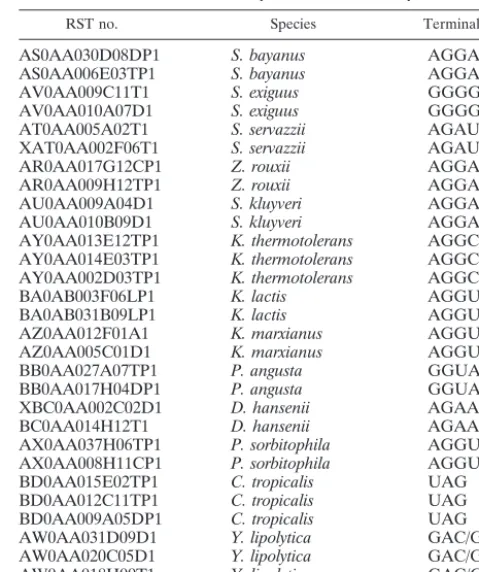
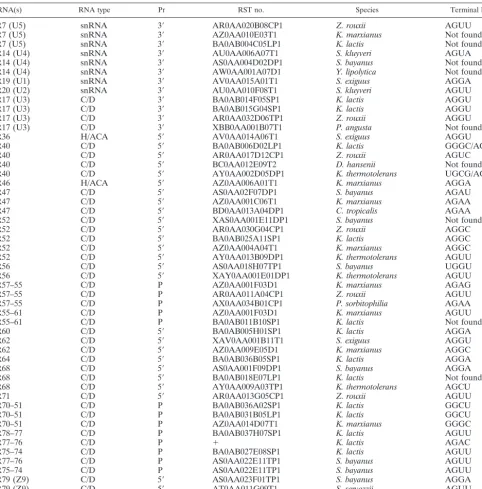
the mature sn(o)RNA sequences, I restricted the subsequent secondary-structure analysis to RSTs that contained only suf-ficient (⬎120 nt) 5⬘- or 3⬘-end-flanking sequences. I also searched the Ge´nolevures sequence database for the presence of sequences downstream from the 25S rRNA to obtain puta-tive 3⬘ETS sequences. After these sequences were retrieved, predicted RNA secondary structures were obtained by using the Mfold algorithm (14, 29). The list of RSTs analyzed for the presence of predicted secondary structures is shown in Tables 1 and 2. Table 1 shows the RSTs used to analyze the predicted secondary structures in the 3⬘ ETS sequences downstream from the 25S rRNA from all 13 Hemiascomycetes species. Table 2 shows the list of RSTs used to analyze processing signals upstream (5⬘) or downstream (3⬘) from snRNAs and snoRNAs or located in the spacer of polycistronic arrays. For these sn(o)RNAs, I searched for ortholog sequences of all known Rnt1p processing substrates. Some known substrates could not be retrieved from the RSTs, or the corresponding RSTs did not contain enough flanking sequence information. Therefore, these sn(o)RNAs are not included in Table 2.
Conservation of RNase III processing sites in the 3ⴕ ETS sequences of the pre-rRNAs. Ribosomal DNA (rDNA) is present in a large number of copies per haploid genome for all the Hemiascomycetes species analyzed (22). Because the Ge´nolevures sequencing program was based on the random sequencing of genomic fragments, rDNA sequences are rep-resented in multiple copies in the RSTs of the Ge´nolevures database for all of these species. This feature allowed the retrieval of several copies of 3⬘ETS sequences for all 13 Hemi-ascomycetes species (Table 1). For all of these species, exten-sive secondary structures could be predicted immediately
TABLE 1. RSTs used to analyze 3⬘ETS secondary structures
RST no. Species Terminal loop
AS0AA030D08DP1 S. bayanus AGGA
AS0AA006E03TP1 S. bayanus AGGA
AV0AA009C11T1 S. exiguus GGGG
AV0AA010A07D1 S. exiguus GGGG
AT0AA005A02T1 S. servazzii AGAU
XAT0AA002F06T1 S. servazzii AGAU
AR0AA017G12CP1 Z. rouxii AGGA
AR0AA009H12TP1 Z. rouxii AGGA
AU0AA009A04D1 S. kluyveri AGGA
AU0AA010B09D1 S. kluyveri AGGA
AY0AA013E12TP1 K. thermotolerans AGGC AY0AA014E03TP1 K. thermotolerans AGGC AY0AA002D03TP1 K. thermotolerans AGGC
BA0AB003F06LP1 K. lactis AGGU
BA0AB031B09LP1 K. lactis AGGU
AZ0AA012F01A1 K. marxianus AGGU
AZ0AA005C01D1 K. marxianus AGGU
BB0AA027A07TP1 P. angusta GGUA
BB0AA017H04DP1 P. angusta GGUA
XBC0AA002C02D1 D. hansenii AGAA
BC0AA014H12T1 D. hansenii AGAA
AX0AA037H06TP1 P. sorbitophila AGGU
AX0AA008H11CP1 P. sorbitophila AGGU
BD0AA015E02TP1 C. tropicalis UAG
BD0AA012C11TP1 C. tropicalis UAG
BD0AA009A05DP1 C. tropicalis UAG
AW0AA031D09D1 Y. lipolytica GAC/GCA
AW0AA020C05D1 Y. lipolytica GAC/GCA
AW0AA018H09T1 Y. lipolytica GAC/GCA
on September 8, 2020 by guest
http://ec.asm.org/
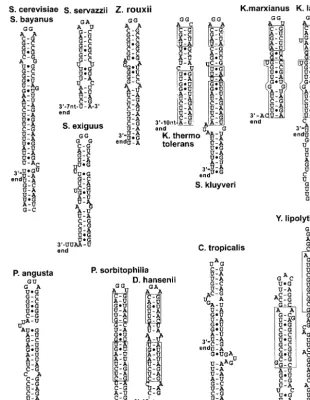
downstream from the mature 3⬘end of the 25S rRNA (Fig. 1). For most Hemiascomycetes species, the predicted secondary structures are capped by terminal AGNN tetraloops (Table 1; Fig. 1). The occurrence of the stems capped by AGNN tetra-loops is highly significant compared to their occurrence in a random sequence population extracted from the Ge´nolevure database (P ⱕ 1.25⫻ 10⫺22) (see Materials and Methods).
The predicted structures suggest that the 3⬘ETS sequence is cleaved by an RNase III-like activity in these species and that
the Rnt1p orthologs have retained the specificity for AGNN tetraloops. Closely related species have conserved several base pairs in their 3⬘ ETS secondary structures (compare Saccha-romyces kluyveriand Kluveromyces thermotolerans, Kluveromy-ces marxianusandKluveromyces lactis, andPichia sorbitophilia
andDebaryomyces hansenii), and the sequences and therefore the secondary structures are identical inS. cerevisiaeand Sac-charomyces bayanus. For Saccharomyces exiguus and Pichia angusta, the terminal loops exhibit a G at the first position.
TABLE 2. RSTs used to analyze processing signals in sn(o) RNAsa
RNA(s) RNA type Pr RST no. Species Terminal loop
snR7 (U5) snRNA 3⬘ AR0AA020B08CP1 Z. rouxii AGUU
snR7 (U5) snRNA 3⬘ AZ0AA010E03T1 K. marxianus Not found
snR7 (U5) snRNA 3⬘ BA0AB004C05LP1 K. lactis Not found
snR14 (U4) snRNA 3⬘ AU0AA006A07T1 S. kluyveri AGUA
snR14 (U4) snRNA 3⬘ AS0AA004D02DP1 S. bayanus Not found
snR14 (U4) snRNA 3⬘ AW0AA001A07D1 Y. lipolytica Not found
snR19 (U1) snRNA 3⬘ AV0AA015A01T1 S. exiguus AGGA
snR20 (U2) snRNA 3⬘ AU0AA010F08T1 S. kluyveri AGUU
snR17 (U3) C/D 3⬘ BA0AB014F05SP1 K. lactis AGGU
snR17 (U3) C/D 3⬘ BA0AB015G04SP1 K. lactis AGGU
snR17 (U3) C/D 3⬘ AR0AA032D06TP1 Z. rouxii AGGU
snR17 (U3) C/D 3⬘ XBB0AA001B07T1 P. angusta Not found
snR36 H/ACA 5⬘ AV0AA014A06T1 S. exiguus AGGU
snR40 C/D 5⬘ BA0AB006D02LP1 K. lactis GGGC/AGUA
snR40 C/D 5⬘ AR0AA017D12CP1 Z. rouxii AGUC
snR40 C/D 5⬘ BC0AA012E09T2 D. hansenii Not foundb
snR40 C/D 5⬘ AY0AA002D05DP1 K. thermotolerans UGCG/AGCG
snR46 H/ACA 5⬘ AZ0AA006A01T1 K. marxianus AGGA
snR47 C/D 5⬘ AS0AA02F07DP1 S. bayanus AGAU
snR47 C/D 5⬘ AZ0AA001C06T1 K. marxianus AGAA
snR47 C/D 5⬘ BD0AA013A04DP1 C. tropicalis AGAA
snR52 C/D 5⬘ XAS0AA001E11DP1 S. bayanus Not found
snR52 C/D 5⬘ AR0AA030G04CP1 Z. rouxii AGGC
snR52 C/D 5⬘ BA0AB025A11SP1 K. lactis AGGC
snR52 C/D 5⬘ AZ0AA004A04T1 K. marxianus AGGC
snR52 C/D 5⬘ AY0AA013B09DP1 K. thermotolerans AGUU
snR56 C/D 5⬘ AS0AA018H07TP1 S. bayanus UGGU
snR56 C/D 5⬘ XAY0AA001E01DP1 K. thermotolerans AGUU
snR57–55 C/D P AZ0AA001F03D1 K. marxianus AGAG
snR57–55 C/D P AR0AA011A04CP1 Z. rouxii AGUU
snR57–55 C/D P AX0AA034B01CP1 P. sorbitophilia AGAA
snR55–61 C/D P AZ0AA001F03D1 K. marxianus AGUU
snR55–61 C/D P BA0AB011B10SP1 K. lactis Not found
snR60 C/D 5⬘ BA0AB005H01SP1 K. lactis AGGA
snR62 C/D 5⬘ XAV0AA001B11T1 S. exiguus AGGU
snR62 C/D 5⬘ AZ0AA009E05D1 K. marxianus AGGC
snR64 C/D 5⬘ BA0AB036B05SP1 K. lactis AGGA
snR68 C/D 5⬘ AS0AA001F09DP1 S. bayanus AGGA
snR68 C/D 5⬘ BA0AB018E07LP1 K. lactis Not found
snR68 C/D 5⬘ AY0AA009A03TP1 K. thermotolerans AGCU
snR71 C/D 5⬘ AR0AA013G05CP1 Z. rouxii AGUU
snR70–51 C/D P BA0AB036A02SP1 K. lactis GGCU
snR70–51 C/D P BA0AB031B05LP1 K. lactis GGCU
snR70–51 C/D P AZ0AA014D07T1 K. marxianus GGGC
snR78–77 C/D P BA0AB037H07SP1 K. lactis AGUU
snR77–76 C/D P ⫹ K. lactis AGAC
snR75–74 C/D P BA0AB027E08SP1 K. lactis AGUU
snR77–76 C/D P AS0AA022E11TP1 S. bayanus AGUU
snR75–74 C/D P AS0AA022E11TP1 S. bayanus AGUU
snR79 (Z9) C/D 5⬘ AS0AA023F01TP1 S. bayanus AGGA
snR79 (Z9) C/D 5⬘ AT0AA011G09T1 S. servazzii AGUU
snR79 (Z9) C/D 5⬘ AR0AA022C07CP1 Z. rouxii AGAU
asn(o)RNA type is given according toS. cerevisiae nomenclature. In the case of the snR78–72 operon, a contig was obtained from twoK. lactis RSTs
(BA0AB037H07SP1 and BA0AB027E08SP1) (⫹). Pr, processing signal; P, polycistronic.
bOnly 120 nt of flanking sequence was available.
on September 8, 2020 by guest
http://ec.asm.org/
However, it is known that Rnt1p can tolerate a G at the first position of the tetraloop, as long as the tetraloop does not adopt a GNRA fold (8). The other exceptions were found in
Candida tropicalis and in Y. lipolytica, for which the 3⬘ ETS sequences did not exhibit this type of terminal tetraloop struc-ture in any of the RST sequences analyzed. Interestingly, two predicted stem-loops structures were found in the 3⬘ETS ofY. lipolytica. These two stem-loops may correspond to genuine processing signals, as a particular sequence has been conserved in both of these stems (Fig. 1). Thus, these two stems may correspond to duplicated processing signals. The stems are not capped by AGNN tetraloops but rather by trinucleotide loops. Overall, analysis of the 3⬘ETS sequences suggests that RNase III processing in the 3⬘ETS occurs in most Hemiascomycetes species and that the RNase III activities involved have a spec-ificity for dsRNA capped by AGNN tetraloops, with the ex-ception ofY. lipolyticaand possibly C. tropicalis(see below).
Not surprisingly,Y. lipolyticais the most distant species fromS. cerevisiaeon the evolutionary scale (22).
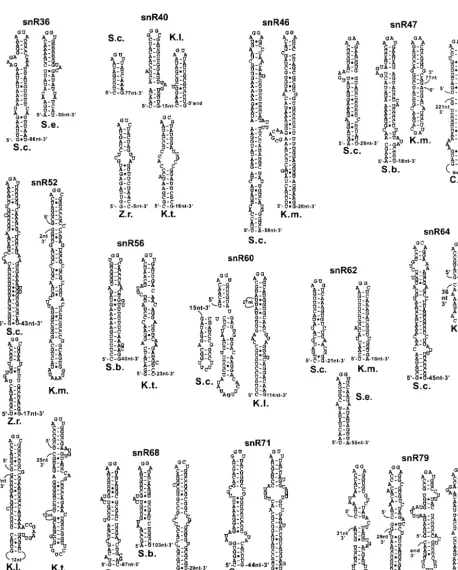
Conservation of 5ⴕ-end processing signals.A large number of independently transcribed box H/ACA and box C/D snoR-NAs are processed by RNase III cleavage in the 5⬘extension of the precursor, followed by exonucleolytic digestion (6; Lee et al., in press). I searched for orthologs of these snoRNAs and analyzed the 5⬘-end-flanking sequences for the presence of predicted secondary structures. A total of 27 orthologous se-quences flanked by sufficient 5⬘-end-flanking sequences were found for a total number of 12 different snoRNAs (two box H/ACA snoRNAs, snR36, and snR46, and 10 box C/D snoRNAs) (Table 2; Fig. 2). In most cases, extensive secondary structures could be predicted at a short distance upstream from the mature snoRNA sequences, and these stems were capped by AGNN tetraloops. Interestingly, the distances be-tween the last nucleotide of the stem and the 5⬘ end of the
FIG. 1. Predicted secondary structures in the 3⬘ETS sequences of the pre-rRNAs in various Hemiascomycetes. Distances in nucleotides to the 3⬘ends of the 25S rRNAs are indicated. Distances are only approximate, since the exact 3⬘ends have not been experimentally mapped but are estimated from theS. cerevisiaesequence. The sequences of the 3⬘ETSs are identical inS. cerevisiaeandS. bayanus. Base pairs that have been conserved in closely related species (S. kluyveriandK. thermotolerans,K. marxianusandK. lactis, andP. sorbitophiliaandD. hansenii) are boxed. The boxed sequence shown forY. lipolyticacorresponds to a sequence conserved in both stems.
on September 8, 2020 by guest
http://ec.asm.org/
FIG. 2. Predicted secondary structures in the 5⬘-end processing signals of Hemiascomycetes snoRNAs. The distances in nucleotides are from the last nucleotides of the stems to the predicted 5⬘ends of the mature snoRNAs. Distances are only approximate, since the exact 5⬘ends have not been experimentally mapped but are estimated from theS. cerevisiaesequence. S.c., S. cerevisiae; S.b.,S.bayanus; S.e.,S.exiguus; S.s.,
Saccharomyces servazzii; K.l.,K.lactis; K.t.,K.thermotolerans; K.m.,K.marxianus; Z.r.,Z.rouxii.
on September 8, 2020 by guest
http://ec.asm.org/
snoRNA are often comparable forS. cerevisiaeand the other species. In some cases, the predicted processing signals seem to have diverged from a single stem to two stems which poten-tially stack onto each other to reconstitute a processing signal, as described previously for the snR40 5⬘-end processing signal inS. cerevisiae(6). This is the case for snR47 inK. marxianus
and for snR52 in allKluyveromycesspecies. For some very close species, for example,S. cerevisiaeandS. bayanus, the sequence of the stems has diverged, but compensatory mutations have maintained the overall architecture of the stem-loop (e.g., in snR47). In some other cases, the upper part of the stem near the tetraloop has conserved some sequence similarities be-tween S. cerevisiae and other species (e.g., in snR47, snR62, snR71, and snR79).
This analysis did not reveal any ortholog of snoRNA se-quences from the Pichia genus or from D. hansenii and Y. lipolytica. Since these organisms are the most evolutionarily distant fromS. cerevisiae, the sequences of these snoRNAs may have diverged enough so that orthologous sequences can hardly be found with standard BLAST procedures. Several matches of very short sequences with highPvalues were ob-tained for some snoRNAs in some of these species, but they were not analyzed further. However, some of the matches may represent true orthologous sequences. Interestingly, a true or-tholog of the snR47 snoRNA was identified inC. tropicalis, and a predicted AGAA stem-loop was found in the 5⬘-end-flanking sequence of this snoRNA. This finding suggests that even though AGNN stem-loops are absent from the 3⬘ETS of the rDNA, an RNase III activity that recognizes AGNN tetraloops is present in C. tropicalis. It is unknown whether the same activity processes the rRNA on the 3⬘ ETS or whether a du-plicated RNase III activity specialized in processing the rRNA
3⬘ETS exists without specificity for dsRNA capped by AGNN tetraloops.
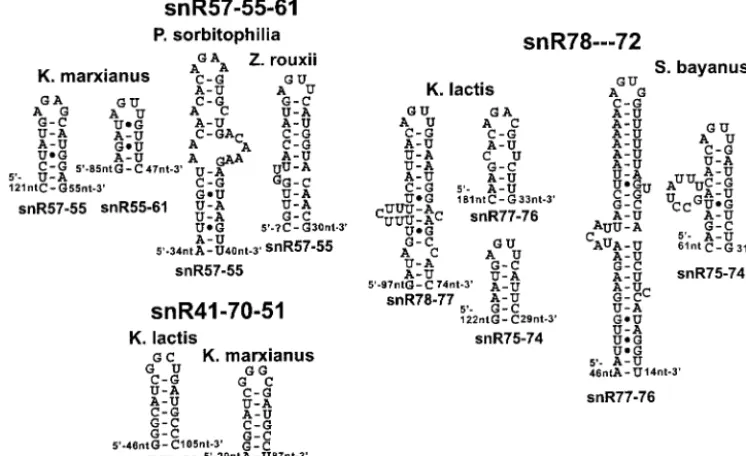
Conservation of polycistronic box C/D snoRNA processing signals. In S. cerevisiae, several box C/D snoRNAs are ex-pressed as polycistronic transcription units and processed by Rnt1p cleavage followed by exonuclease processing (6, 7, 17). In these cases, the Rnt1p cleavage sites are often made of short stems capped by AGNN tetraloops, which stack onto longer stems where cleavage occurs (17). Partial orthologous se-quences were found for the operon expressing seven snoRNAs (snR78 to -72 [snR78–72]) in S. bayanus, K. lactis, and P. sorbitophilia(Table 2; Fig. 3). TheS. bayanusRST contained all snoRNAs but snR78, the K. lactis sequences contained snR78–75, andP. sorbitophiliacontained snR75–73. Since the distances between the mature snoRNAs in these RSTs are usually 120 nt or less, these species have probably conserved the polycistronic mode of expression of these snoRNAs. ForS. bayanusandK. lactis, RNase III processing signals similar to those observed inS. cerevisiaecould be predicted (Fig. 3). For simplicity, the longer stems onto which the AGNN short stem-loops potentially stack were not represented in Fig. 3. No secondary structures capped by AGNN tetraloops could be identified for theP. sorbitophiliasequences.
Orthologous sequences for the tricistronic snR57-snR55-snR61 snoRNA transcription unit were identified inK. marx-ianus,Zygosaccharomyces rouxii, andP. sorbitophilia. Although no AGNN stem-loop can be predicted from the S. cerevisiae
sequence (unpublished data), polycistronic processing sites could be predicted in all of these three species (Fig. 3), either between snR57 and snR55 or between snR55 and snR61, strongly suggesting that these three snoRNAs are also ex-pressed from a polycistronic precursor. Orthologs of the
FIG. 3. Predicted secondary structures in intergenic spacers of polycistronic precursors of box C/D snoRNAs. The names of the polycistronic transcription units are indicated in large print above the names of the species. The locations of the stem-loops between snoRNAs as well as the distances in nucleotides to each of the neighboring snoRNAs are indicated.
on September 8, 2020 by guest
http://ec.asm.org/
snR41-snR70-snR51 tricistronic expression unit were identi-fied inK. lactisandK. marxianus(Table 2; Fig. 3), with short GGNN stem-loops between each species. While this sequence diverges from the AGNN consensus, it is known that Rnt1p can tolerate a G at the first position (8). Overall, these results suggest that the polycistronic mode of expression of some of the box C/D snoRNAs has been conserved in Hemiascomyce-tes and that the corresponding orthologs of RNase III play a role in the processing of these species. For some of the snoRNAs, no processing signal could be identified (e.g., be-tween snR55 and snR61 for K. lactis and P. sorbitophilia). Despite the absence of processing signals between snR55 and snR61, it is possible that a single processing signal between snR57 and snR55 is sufficient to separate the three snoRNAs; that is, if the AGNN stem-loop located between snR57 and snR55 coaxially stacks onto a downstream stem that loops out the second snoRNA (snR55), dsRNA cleavage on both sides of snR55 may be sufficient to separate the three snoRNAs from each other, as was observed for snR75 (17). For the other snoRNA species, the absence of the predicted AGNN tetra-loop does not necessarily mean that these structures do not exist; previous computer searches for secondary structures in the polycistronic arrays revealed that the processing signals are usually harder to predict than are rRNA or 5⬘-end processing signals, even if they have been identified in vivo (4). Therefore, the absence of predicted sites does not necessarily mean that they do not exist in vivo.
Conservation of 3ⴕ-end processing signals.The 3⬘-end pro-cessing of snRNAs and snoRNAs by RNase III is clearly a dispensable processing pathway. This conclusion is suggested by the fact that the 3⬘ends of most sn(o)RNAs that are pro-cessed by Rnt1p can be generated by exonucleases or by the polyadenylation machinery in the absence of Rnt1p (1, 5, 15, 21, 24). For example, the U5 snRNA is present inS. cerevisiae
with two forms; the longer one is processed through a Rnt1p-dependent pathway, while the shorter form is processed through a Rnt1p-independent pathway (5).S. exiguusalso ex-hibits these two forms, whileS. kluyveri,K. lactis, andY. lipo-lytica exhibit only one form (19). These observations suggest that for these three species, the dependence on RNase III for processing has been lost. Eleven RSTs were obtained with
sufficient 3⬘-end-flanking sequences for spliceosomal snRNAs or the U3 snoRNA. The conservation of stem-loop structures capped by AGNN tetraloops was not as strong for these 3⬘-end processing signals as those described previously for 5⬘-end pro-cessing signals (Table 2; Fig. 4). Only one AGUU stem-loop was found forZ. rouxiiU5 snRNA, while no AGNN stem-loop could be predicted in RSTs from K. marxianusand K. lactis. This negative result is consistent with the observation that only one form of U5 is present in K. lactis, probably processed through an RNase III-independent pathway. Similarly, only one species out of three showed an AGNN stem-loop for the
FIG. 4. Predicted secondary structures in the 3⬘extensions of snRNAs and of the U3 snoRNA. The estimated distances in nucleotides to the mature 3⬘ends of the sn(o)RNAs are indicated.
FIG. 5. Phylogenetic distribution of AGNN stem-loop processing signals in Hemiascomycetes. The cladogram of Hemiascomycetes was constructed from rDNA sequences of the 25S rRNAs by using phylo-genetic distances obtained from reference 22 and withS. pombeas an outgroup. Asterisks indicate the presence of at least one predicted AGNN stem-loop processing signal. Open squares indicate that no RST was found for this category of processing signal in the particular species. Open circles indicate that while at least one RST was avail-able, no AGNN stem-loop could be detected.
on September 8, 2020 by guest
http://ec.asm.org/
U4 snRNA (Table 2; Fig. 4). The conservation of the stem-loop structure seems stronger for the U3 snoRNA, for which bothK. lactisandZ. rouxiiexhibited AGNN stem-loops (Fig. 4). Overall, these phylogenetic observations strengthen previ-ous biochemical data suggesting that 3⬘-end processing of snRNAs by RNase III is a redundant pathway that may have been lost during the recent evolution of yeast species.
DISCUSSION
In this study, I show that RNA processing signals obeyingS. cerevisiaeRNase III specificity rules are present in most Hemi-ascomycetes species analyzed in the Ge´nolevures program. Predicted RNase III cleavage sites are present in all four cat-egories of processing signals described so far: 3⬘ETS, 5⬘end, 3⬘ end, and polycistronic (Fig. 5). The most complete phylo-genetic picture was obtained for the rRNA 3⬘ETS sequences, since they were found in abundance in the Ge´nolevures RSTs and since they are easily identified with a standard BLAST analysis due to the strong conservation of the 25S rRNA se-quence. Strikingly, Rnt1p-type stem-loops were present in all species butC. tropicalisandY. lipolytica(Table 1; Fig. 1). In the case of snoRNAs, orthologous sequences were harder to ob-tain for evolutionarily distant species such as Pichia spp.,D. hansenii,C.tropicalis, andY.lipolytica, because these noncod-ing RNAs are small and because their sequences may have diverged significantly. Therefore, standard BLAST analysis re-vealed only a limited number of substrates for these species. Nevertheless, the purpose of this study was not to identify the full set of snoRNAs orthologs for all these species but rather to identify examples that would reveal the conservation of Rnt1p-type processing sites. Data obtained on the 3⬘ETS sequences ofD. hanseniiandP. sorbitophilia, on the polycistronic signal between snR57 and snR55 inP. sorbitophilia, and on snR47 in
C. tropicalis, however, suggest that an Rnt1p-like activity may exist inPichia,D. hansenii, andC. tropicalis, since some of the predicted RNA processing signals identified from these species show AGNN-type secondary structures. In C. tropicalis, only one snoRNA substrate could be found, and it obeys the AGNN rule (snR47). The other predicted substrate, the 3⬘ETS, does not show any AGNN tetraloop. One possible explanation is that the same activity processes the snoRNAs and the rRNA on the 3⬘ETS sequences but that the 3⬘ETS activity does not require AGNN tetraloops. This activity has been shown forS. cerevisiae’s U18 snoRNA (9), where Rnt1p cleavage occurs without the presence of AGNN tetraloops. Alternatively, it is possible that a duplicated RNase III activity that is specialized for the processing of the rRNA 3⬘ETS exists but has lost the specificity for dsRNA capped by AGNN tetraloops.
The presence of the processing signals suggests that most Hemiascomycetes species have conserved the mode of expres-sion and processing of these noncoding RNAs. While the con-servation of RNase III cleavage in the 3⬘ETS sequence was expected, given the functional conservation described for S. pombe (23), the conservation of RNase III processing sites upstream from mature snoRNA sequences and in intergenic snoRNA sequences suggests that these snoRNAs have con-served their mode of expression and processing from mono-cistronic or polymono-cistronic precursors. In most cases, the se-quences of the flanking sese-quences have more or less strongly
diverged, but the secondary structures have been conserved due to the selection pressure to maintain the RNase III cleav-age sites. While this prediction has not been tested experimen-tally, the phylogenetic argument is probably strong enough to support the prediction that the RNase III orthologs cleave the 5⬘extensions of the precursors, or the intergenic spacers in the polycistronic precursors, and that cleavage is followed by exo-nucleolytic processing.
Overall, the sum of data obtained from this phylogenetic analysis suggests that Rnt1p-type processing exists, at least for one category of the substrates for each Hemiascomycetes spe-cies analyzed by the Ge´nolevures program, with the exception ofY. lipolytica(Fig. 5). Interestingly, this species is the most evolutionarily distant species from S. cerevisiae when a cla-dogram is established by using rDNA sequences (Fig. 5) and seems to have diverged early from other Hemiascomycetes species. Based on these observations, two scenarios are possi-ble. It is possible that the specificity of RNase III for dsRNA capped by AGNN tetraloops was present in the common an-cestor of all these Hemiascomycetes but that theY. lipolytica
RNase III somehow evolved and lost the specificity for the tetraloops even though this specificity was conserved in all other species. Alternatively, it is possible that the specificity for AGNN tetraloops was acquired after the divergence between
Y. lipolyticaand all other Hemiascomycetes species analyzed. In both cases, the events require a rapid coevolution of the enzyme specificity and the substrate sequences. While the sec-ond scenario seems more parsimonious sinceS. pombePac1p does not rely on AGNN tetraloop recognition, further analysis of RNase III processing signals in more distant Ascomycetes species will possibly reveal which is the more likely evolution-ary scenario.
ACKNOWLEDGMENTS
I thank the Ge´nolevures program for their sequencing effort and C. Coffinier for critical reading of the manuscript.
This work was supported by NIGMS grant R01 GM-61518 from the NIH.
REFERENCES
1. Abou Elela, S., and M. Ares, Jr.1998. Depletion of yeast RNase III blocks correct U2 3⬘end formation and results in polyadenylated but functional U2 snRNA. EMBO J.17:3738–3746.
2. Abou Elela, S., H. Igel, and M. Ares, Jr.1996. RNase III cleaves eukaryotic preribosomal RNA at a U3 snoRNP-dependent site. Cell85:115–124. 3. Allmang, C., and D. Tollervey.1998. The role of the 3⬘external transcribed
spacer in yeast pre-rRNA processing. J. Mol. Biol.278:67–78.
4. Chanfreau, G., M. Buckle, and A. Jacquier.2000. Recognition of a conserved class of RNA tetraloops bySaccharomyces cerevisiaeRNase III. Proc. Natl. Acad. Sci. USA97:3142–3147.
5. Chanfreau, G., S. A. Elela, M. Ares, Jr., and C. Guthrie.1997. Alternative 3⬘-end processing of U5 snRNA by RNase III. Genes Dev.11:2741–2751. 6. Chanfreau, G., P. Legrain, and A. Jacquier.1998. Yeast RNase III as a key
processing enzyme in small nucleolar RNAs metabolism. J. Mol. Biol.284:
975–988.
7. Chanfreau, G., G. Rotondo, P. Legrain, and A. Jacquier.1998. Processing of a dicistronic small nucleolar RNA precursor by the RNA endonuclease Rnt1. EMBO J.17:3726–3737.
8. Danin-Kreiselman, M., C. Y. Lee, and G. Chanfreau.2003. RNase III-mediated degradation of unspliced pre-mRNAs and lariat introns. Mol. Cell
11:1279–1289.
9. Giorgi, C., A. Fatica, R. Nagel, and I. Bozzoni. 2001. Release of U18 snoRNA from its host intron requires interaction of Nop1p with the Rnt1p endonuclease. EMBO J.20:6856–6865.
10. Grishok, A., A. E. Pasquinelli, D. Conte, N. Li, S. Parrish, I. Ha, D. L. Baillie, A. Fire, G. Ruvkun, and C. C. Mello.2001. Genes and mechanisms related to RNA interference regulate expression of the small temporal RNAs that controlC. elegansdevelopmental timing. Cell106:23–34.
on September 8, 2020 by guest
http://ec.asm.org/
11. Hutvagner, G., J. McLachlan, A. E. Pasquinelli, E. Balint, T. Tuschl, and P. D. Zamore.2001. A cellular function for the RNA-interference enzyme Dicer in the maturation of the let-7 small temporal RNA. Science293:834– 838.
12. Ketting, R. F., S. E. Fischer, E. Bernstein, T. Sijen, G. J. Hannon, and R. H. Plasterk.2001. Dicer functions in RNA interference and in synthesis of small RNA involved in developmental timing inC. elegans. Genes Dev.15:2654– 2659.
13. Kufel, J., B. Dichtl, and D. Tollervey.1999. Yeast Rnt1p is required for cleavage of the pre-ribosomal RNA in the 3⬘ETS but not the 5⬘ETS. RNA
5:909–917.
14. Mathews, D. H., J. Sabina, M. Zuker, and D. H. Turner.1999. Expanded sequence dependence of thermodynamic parameters improves prediction of RNA secondary structure. J. Mol. Biol.288:911–940.
15. Morlando, M., P. Greco, B. Dichtl, A. Fatica, W. Keller, and I. Bozzoni.2002. Functional analysis of yeast snoRNA and snRNA 3⬘-end formation mediated by uncoupling of cleavage and polyadenylation. Mol. Cell. Biol.22:1379– 1389.
16. Park, W., J. Li, R. Song, J. Messing, and X. Chen.2002. CARPEL FAC-TORY, a Dicer homolog, and HEN1, a novel protein, act in microRNA metabolism inArabidopsis thaliana. Curr. Biol.12:1484.
17. Qu, L.-H., A. Henras, Y.-J. Lu, H. Zhou, W.-X. Zhou, Y.-Q. Zhu, J. Zhao, Y. Henry, M. Caizergues-Ferrer, and J.-P. Bachellerie.1999. Seven novel meth-ylation guide small nucleolar RNAs are processed from a common polycis-tronic transcript by Rat1p and RNase III in yeast. Mol. Cell. Biol.19:1144– 1158.
18. Reinhart, B. J., E. G. Weinstein, M. W. Rhoades, B. Bartel, and D. P. Bartel.
2002. MicroRNAs in plants. Genes Dev.16:1616–1626.
19. Roiha, H., E. O. Shuster, D. A. Brow, and C. Guthrie.1989. Small nuclear RNAs from budding yeasts: phylogenetic comparisons reveal extensive size variation. Gene82:137–144.
20. Rotondo, G., M. Gillespie, and D. Frendewey.1995. Rescue of the fission
yeast snRNA synthesis mutant snm1 by overexpression of the double-strand-specificPacI ribonuclease. Mol. Gen. Genet.247:698–708.
21. Seipelt, R. L., B. Zheng, A. Asuru, and B. C. Rymond.1999. U1 snRNA is cleaved by RNase III and processed through an Sm site-dependent pathway. Nucleic Acids Res.27:587–595.
22. Souciet, J.-L., M. Aigle, F. Artiguenave, G. Blandin, M. Bolotin-Fukuhara, E. Bon, P. Brottier, S. Casaregola, J. de Montigny, B. Dujon, P. Durrens, C. Gaillardin, A. Le´pingle, B. Llorente, A. Malpertuy, C. Neuve´glise, O. Ozier-Kaloge´ropoulos, S. Potier, W. Saurin, F. Tekaia, C. Toffano-Nioche, M. We´solowski-Louvel, P. Wincker, and J. Weissenbach.2000. Genomic explo-ration of the hemiascomycetous yeasts: 1. A set of yeast species for molecular evolution studies. FEBS Lett.487:3–12.
23. Spasov, K., L. I. Perdomo, E. Evakine, and R. N. Nazar.2002. RAC protein directs the complete removal of the 3⬘external transcribed spacer by the
PacI nuclease. Mol. Cell9:433–437.
24. van Hoof, A., P. Lennertz, and R. Parker.2000. Yeast exosome mutants accumulate 3⬘-extended polyadenylated forms of U4 small nuclear RNA and small nucleolar RNAs. Mol. Cell. Biol.20:441–452.
25. Wu, H., H. Xu, L. J. Miraglia, and S. T. Crooke.2000. Human RNase III is a 160-kDa protein involved in preribosomal RNA processing. J. Biol. Chem.
275:36957–36965.
26. Wu, H., P. K. Yang, S. E. Butcher, S. Kang, G. Chanfreau, and J. Feigon.
2001. A novel family of RNA tetraloop structure forms the recognition site forSaccharomyces cerevisiaeRNase III. EMBO J.20:7240–7249. 27. Zhang, K., and A. W. Nicholson.1997. Regulation of ribonuclease III
pro-cessing by double-helical sequence antideterminants. Proc. Natl. Acad. Sci. USA94:13437–13441.
28. Zhou, D., D. Frendewey, and S. M. Lobo Ruppert.1999. Pac1p, an RNase III homolog, is required for formation of the 3⬘end of U2 snRNA in Schizo-saccharomyces pombe. RNA5:1083–1098.
29. Zuker, M.2003. Mfold web server for nucleic acid folding and hybridization prediction. Nucleic Acids Res.31:3406–3415.