1535-9778/05/$08.00⫹0 doi:10.1128/EC.4.8.1403–1409.2005
Copyright © 2005, American Society for Microbiology. All Rights Reserved.
Clonality and Recombination in Genetically Differentiated Subgroups
of
Cryptococcus gattii
†
Leona T. Campbell,
1Bart J. Currie,
2Mark Krockenberger,
3Richard Malik,
4Wieland Meyer,
5Joseph Heitman,
6and Dee Carter
1*
Discipline of Microbiology, School of Molecular and Microbial Biosciences, University of Sydney, New South Wales, Australia1;
Tropical and Emerging Infectious Diseases Division, Menzies School of Health Research, Charles Darwin University and
Northern Territory Clinical School, Royal Darwin Hospital, Northern Territory, Australia2; Faculty of Veterinary Science,
University of Sydney, New South Wales, Australia3; Postgraduate Foundation in Veterinary Science, The
University of Sydney, New South Wales, Australia4; Molecular Mycology Research Laboratory,
Centre for Infectious Diseases and Microbiology, ICPMR, Westmead Hospital,
Sydney, Australia5; and Department of Molecular Genetics and Microbiology,
Howard Hughes Medical Institute, Duke University,
Durham, North Carolina 277106
Received 7 April 2005/Accepted 23 May 2005
Cryptococcus gattiiis a pathogenic yeast that together withCryptococcus neoformanscauses cryptococcosis in humans and animals. High numbers of viableC. gattiipropagules can be obtained from certain species of AustralianEucalyptus camaldulensistrees, and an epidemiological link betweenEucalyptus colonization and human exposure has been proposed. However, the highest prevalence ofC. gattiicryptococcosis occurs in Papua New Guinea and in regions of Australia where the eucalypt species implicated to date are not endemic. This study investigated the population structure of three geographically distinct clinical and veterinary populations ofC. gattiifrom Australia and Papua New Guinea. All populations that consisted of a genotype found frequently in Australia (VGI) were strongly clonal and were highly differentiated from one another. Two populations of the less common VGII genotype from Sydney and the Northern Territory had population structures inferring recombination. In addition, there was some evidence of reduced genetic differentiation between these geo-graphically remote regions. In a companion study presented in this issue, VGII isolates were overwhelmingly more fertile than those of the VGI genotype, giving biological support to the indirect assessment of sexual exchange. It appears that the VGI genotype propagates clonally on eucalypts in Australia and on an unknown substrate in Papua New Guinea, with infection initiated by an unidentified infectious propagule. VGII isolates are completing their life cycles and may be dispersed via sexually produced basidiospores, which are also likely to initiate respiratory infection.
Fungal organisms employ a diverse array of mechanisms in sexual reproduction. In about 20% of known fungal species, however, a sexual stage has never been documented (18). Phy-logenetic analysis has found these apparently asexual fungi to frequently have their closest relatives among the sexual fungi, which implies a recent loss of sexual functions (27). In addition, molecular studies reveal some purportedly asexual species to pos-sess a recombining population structure, indicating that cryptic sex occurs via an unknown mechanism (5, 13, 39, 47). Some fungal species do appear to be genuinely asexual, but as most fungi can release asexual propagules, often in large numbers, under favorable conditions, the possibility remains that clonality is restricted to the population under study, and a sexual population of the same species occurs elsewhere (11, 48).
Sex is considered important for maintaining eukaryotic spe-cies in the long term. Experimental studies of yeasts have found sexual strains to have a significantly increased rate of adaptation to harsh environmental conditions compared to
asexual strains (14). Completion of the fungal life cycle is therefore likely to be a fundamental part of growth in a stable ecological system. Finding clonal behavior in sexually compe-tent species often points to recent disturbances such as habitat fragmentation or importation of foreign species into favorable, naı¨ve areas. Conversely, finding recombination may help de-fine the natural ecological niche of the organism. In pathogenic eukaryotes, an understanding of whether or not sexual recom-bination occurs is important for the development of successful diagnostic and treatment procedures (41, 42). In recombining organisms, genetic material governing virulence or antimicro-bial resistance traits can be passed between strains and reas-sorted to produce novel combinations. A necessary assumption in a recombining population is that any strain could acquire virulence factors and become pathogenic.
Cryptococcus gattiiand the closely relatedCryptococcus
neo-formansare emerging yeast pathogens causing cryptococcosis,
a disease which varies in severity from essentially asymptom-atic to severe, life-threatening meningoencephalitis. WhileC.
neoformansis a major AIDS pathogen,C.gattiiis uncommon
in AIDS patients, and most cases occur in otherwise apparently healthy people.C. gattiiis more geographically restricted than
C. neoformansand is largely confined to tropical and
subtrop-ical regions. An association between this yeast and certain
* Corresponding author. Mailing address: Discipline of Microbiol-ogy (G08), School of Molecular and Microbial Biosciences, University of Sydney, New South Wales 2006, Australia. Phone: 61-2-9351-5383. Fax: 61-2-9351-4571. E-mail: [email protected].
† Supplemental material for this article may be found at http://ec .asm.org/.
1403
on September 8, 2020 by guest
http://ec.asm.org/
mon in South America, the northwestern United States, and Canada, in particular, Vancouver Island (28, 45). VGIII (AFLP 4) appears to be common in Colombia and has been found in India and the United States, while VGIV has been reported in Africa and Central America (8, 28). Diversity between each mo-lecular type is high, and it is likely that gene flow between these types is infrequent or absent.
An analysis of mating type and recombination in aC. gattii
VGI population collected fromEucalyptus camaldulensistrees within a limited geographic region in Australia found that although both mating types could be recovered in an approx-imately 1:1 ratio (17), strong linkage disequilibria occurred between genetic loci, and it was concluded that this population was clonal (17). In addition, an analysis of the relationship between isolate genotype and host tree indicated that dispersal and genetic exchange between host trees was negligible. This, together with the finding of high levels ofC. gattii cryptococ-cosis in Papua New Guinea (PNG) (24), where the normal host eucalypts are not found, has challenged the assumption that
Eucalyptusis the only environmental niche forC. gattii.
The current study set out to examine further populations of
C. gattiifor evidence of genetic exchange. Clinical populations
were targeted, with the assumption that infections are likely to have been initiated by sexually produced basidiospores (37). The two human clinical populations were obtained from pa-tients living in Papua New Guinea and the Northern Territory of Australia. Both regions do not harbor the usualEucalyptus
host trees, therefore eliminating the possibility of clonal prop-agation on these tree species. The third population included veterinary isolates from the Sydney region. As animals are far more limited in their geographic range than humans, this pop-ulation was considered less likely to contain isolates from ge-netically isolated regions, which might skew the analysis. Mo-lecular type, mating type, and recombination were assayed in all populations. We report evidence of both clonality and sex-ual recombination in separateC. gattiipopulations.
MATERIALS AND METHODS
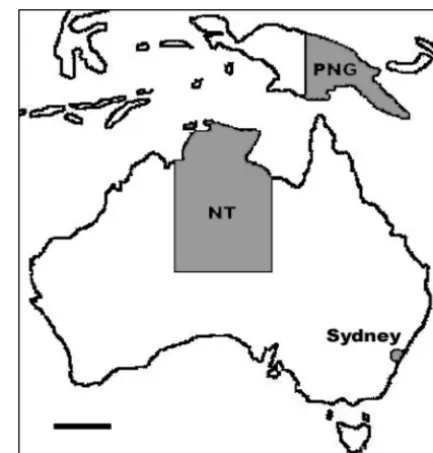
Strains and media.All strains used in this study are listed in the supplemental material (see Table S1 in the supplemental material). Isolates from PNG and the NT were from human clinical infections (Fig. 1). The majority of the NT isolates were from indigenous patients. The Sydney isolates were from a variety of veterinary sources including domestic cats and dogs and some native wildlife (30). Mating type reference strains CBS5757 (serotype B, MAT␣) and CBS6998 (serotype B, MATa) were obtained from the Centraalbureau voor Schimmelcultures culture collection, and molecular type standard reference strains WM179 (VGI/AFLP 4), Ram2 (VGII/AFLP 6), WM161 (VGIII/AFLP 5), and WM779 (VGIV/AFLP 7) were from the Molecular Mycology Research Laboratory culture collection at Westmead Hos-pital. Isolates were obtained from source laboratories as either freeze-dried cells or on plates and were cultured on Sabouraud dextrose agar.
DNA extraction.Chromosomal DNA extraction was based on the Novozyme 234 dodecyltrimethylammonium bromide and hexadecyltrimethylammonium bromide method described previously by Wen et al. (44), with the following modifications: approximately 0.75 g of cells (wet weight) grown on Sabouraud dextrose agar was collected, the protoplasting solution was made with 10 mg/ml of Novozyme 234 in SCE buffer (100 mM sodium citrate, 1 M sorbitol, 10 mM EDTA), and all centrifugation steps were performed at 13,000⫻g. The DNA pellet was resuspended in 100l of Tris-EDTA buffer (100 mM Tris-HCl, 0.1 mM EDTA [pH 8]). DNA was diluted 1:10 for PCR amplification.
Mating type analysis.Mating type analysis was carried out by PCR amplifi-cation using MF␣primers (upper and lower sets) and the STE20SFaprimer sets
(15, 17) which are specific to the mating type regions of␣andamating type cells, respectively. PCR amplifications were performed in 50-l reaction mixtures containing 1⫻PCR buffer (10 mM Tris-HCl [pH 8.3], 50 mM KCl, 1.5 mM MgCl2, 0.001% gelatin), 5% glycerol, 6.25 M concentrations of each
de-oxynucleoside triphosphate, 0.2M concentrations of each primer, 2.5 U ofTaq DNA polymerase, and 1l of diluted template DNA. Amplification conditions for PCR were 94°C for 5 min followed by 30 cycles of 94°C for 1 min, 40°C for 1 min, and 72°C for 1 min and a final extension step at 72°C for 7 min. All amplifications were carried out in a Perkin-Elmer 2400 thermal cycler. Ten microliters of each amplification product was electrophoresed at 10 V/cm in 2% agarose gels containing 0.5 ng/ml ethidium bromide. The gels were visualized by UV transillumination and photographed. Culture collection strains of known mating type were used as controls (see Table S1 in the supplemental material). Molecular type analysis.Molecular type was determined by DNA fingerprint-ing and restriction fragment length polymorphism (RFLP) analysis. Ffingerprint-ingerprint- Fingerprint-ing was performed usFingerprint-ing the simple repetitive sequence primer (GACA)4(2, 29).
Amplification conditions were 94°C for 5 min followed by 35 cycles of 94°C for 20 seconds, 50°C for 30 seconds, and 72°C for 20 seconds and a final extension step at 72°C for 7 min. Ten microliters of each amplification product was electrophoresed on 2% agarose Tris-acetate-EDTA gels and visualized by UV transillumination. The protocol used to determine molecular type via RFLP was modified from a method described previously by Meyer et al. (28). TheURA5gene was amplified in 50l containing 50 ng DNA, 1⫻PCR buffer (10 mM Tris-HCl, [pH 8.3], 50 mM KCl, 1.5 mM MgCl2), 0.2 mM of deoxynucleoside triphosphate, 3 mM MgAc, 1.5 units
AmpliTaq DNA polymerase, and 50 ng of each of the primers URA5 and SJO1. PCR amplification was 1 cycle of 94°C for 3 min and 35 cycles of 94°C for 45 s, 61°C for 1 min, and 72°C for 2 min followed by 1 cycle of 72°C for 10 min. PCR products were digested with Sau96I and HhaI for 3 h and separated on 3% agarose gels by electrophoresis at 10 V/cm for 2 h. Standard strains of known molecular type were used as controls (see Table S1 in the supplemental material).
AFLP.The AFLP fingerprinting protocol was based on the technique de-scribed previously by Vos et al. (43) AFLP primers EcoRI-TG–MseI-CA and
FIG. 1. Regional map showing areas from which isolates were ob-tained. Scale bar, 1,000 km.
on September 8, 2020 by guest
http://ec.asm.org/
EcoRI-CA–MseI-GT were used with minor modifications to the procedure de-scribed previously by Halliday and Carter (16). All amplifications were carried out in a Perkin-Elmer 2400 thermal cycler.
AFLP fragment detection and analysis.A total of 0.5l of Genescan-400HD ROX standard size marker (Applied Biosystems) was mixed with 10l of Hi-Di Formamide (Applied Biosystems) and aliquoted into 0.5-ml Eppendorf tubes. Selective amplification products were diluted 100-fold in distilled H2O, and 1l of
this was added to the ROX standard. Samples were then denatured at 94°C for 5 min and placed on ice for 5 min before being loaded onto an ABI 3700 analyzer. Samples were autoanalyzed using the GS400HD analysis module. Data collection, fragment sizing, and pattern analyses were done with GeneScan, version 3.1, analysis software (Applied Biosystems). Polymorphic loci were defined as bands of the same mobility present in some isolates and absent in others. For each polymorphic locus, there were two possible alleles, which were scored as 1 when the amplified fragment was present and 0 when the fragment was absent. Data matrices were produced using LecPCR (40). A polymorphic locus was included in the analysis only if it was present or absent in at least five of the isolates, was strongly amplified, and was greater than 40 bp and less than 500 bp in size.
Data analysis.The index of association (IA) (32), RbarD (1), and tree length
(TL) tests (5) were used to distinguish between recombining and clonal modes of
reproduction.IAand RbarD are statistical tests that measure the degree of
nonrandom association between alleles at different loci (linkage disequilibrium), with the RbarD algorithm adjusting for limited numbers of loci, and were calculated by using the Multilocus, version 1.0b, software (1). TheTLtest uses
the permutation test in PAUP* (version 4.0b4a) to calculate the length of phylogenetic trees by treating the isolates as taxa and the alleles at each locus as phylogenetic characters with two character states. Both analyses involved com-paring the values for the observed data set with the values for 1,000 artificially recombining data sets. Artificially recombining data sets were constructed by randomly shuffling the alleles for each locus between members of the population while keeping the proportions of alleles at each locus constant. The inability to distinguish between the observed data set and the artificially recombined data sets supports the null hypothesis of sexual recombination, whereas a significant difference between the data sets supports clonality (5, 6, 16). Genetic differen-tiation between populations, assessed as theta (), which is an estimate of Wright’sFst, the standard measure of population subdivision, was also calculated
using the Multilocus, version 1.0b, software (1). This compares loci present in different populations to give a measure of the amount of gene flow between populations. If different populations have the same allele frequencies at all loci, then will be zero, indicating no genetic differentiation. Conversely, if the populations are fixed for different alleles at all loci, thenwill be 1, indicating total genetic differentiation. The significance ofis again assessed by comparing the observed data set with 1,000 artificially produced data sets in which the alleles are randomized among populations.
RESULTS
Molecular type analysis and distribution.DNA fingerprint-ing usfingerprint-ing (GACA)4primers and RFLP analysis of theURA5
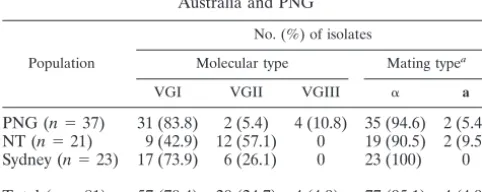
gene were used to generate digestion profiles for the 81 iso-lates which were compared with those produced for each mo-lecular type standard (Fig. 2). Of the 81 isolates, 70% were molecular type VGI, 25% were VGII, and 5% were VGIII. Within the PNG population, the vast majority of isolates (84%) were molecular type VGI, 5% were VGII, and 11% were VGIII. In the NT population, VGI isolates were outnum-bered by VGII by 43% to 57%. The Sydney population con-tained 74% VGI and 26% VGII isolates (Table 1). No VGIII isolates were found in the Australian populations.
Mating type analysis.MF␣primers amplified a 109-bp frag-ment in the culture collection strain of a known␣mating type (CBS5757) but failed to amplify any fragment in the controla
mating type strain (CBS6998). The STE20aSF primers were
similarly used to amplify a 219-bp fragment from theamating type only. Mating type analysis of the 81 isolates indicated a significant bias towards the␣mating type, with a 77:4 MAT␣: MATa ratio. Within population groups, the ratio of MAT␣: MATavaried. In the PNG population, this was 35:2; in the NT population, the ratio was 19:2; and the Sydney veterinary popu-lation did not include any MATaisolates among the 23 isolates tested (Table 1). All MATastrains were molecular type VGI.
AFLP data analysis. A total of 55 polymorphic loci were identified across the isolates from the three populations with allele frequencies varying in each population (see Table S2 in the supplemental material). Seventy-six percent of loci were polymorphic in all populations. Five loci were polymorphic in the PNG and NT populations but were fixed in the Sydney population, four were restricted to the NT and Sydney popu-lations, and two were restricted to the PNG and Sydney pop-ulations. The PNG and NT populations each had a single
FIG. 2. Molecular typing profiles generated via RFLP analysis ofURA5. Lane M, 1Kb Plus DNA ladder (Invitrogen); lanes 1 to 24, sample strains from PNG; lanes I to IV, molecular type standard strains WM179 (VGI), Ram2 (VGII), WM161 (VGIII), and WM779 (VGIV). All samples shown are molecular type VGI except lane 9, which is VGII, and lane 19, which is VGIII.
TABLE 1. Molecular and mating types ofC. gattiiisolates from Australia and PNG
Population
No. (%) of isolates
Molecular type Mating typea
VGI VGII VGIII ␣ a
PNG (n⫽37) 31 (83.8) 2 (5.4) 4 (10.8) 35 (94.6) 2 (5.4) NT (n⫽21) 9 (42.9) 12 (57.1) 0 19 (90.5) 2 (9.5) Sydney (n⫽23) 17 (73.9) 6 (26.1) 0 23 (100) 0 Total (n⫽81) 57 (70.4) 20 (24.7) 4 (4.9) 77 (95.1) 4 (4.9)
aAllamating type strains were the VGI molecular type.
on September 8, 2020 by guest
http://ec.asm.org/
according to geographic location. Three PNG VGI isolates and one VGII isolate from the NT branched with the two VGII and four VGIII isolates from PNG (Fig. 3). All these isolates had relatively distinct genetic profiles, and long-branch attraction may be responsible for this apparent clustering.
(ii) Index of association data for the three geographically isolated populations.IA, RbarD, andTLvalues were generated
for each molecular type containing five or more isolates within each of the three populations. The analysis was confined to molecular type groups, as the significant level of genetic vari-ation between molecular types would skew the results in favor of clonality (13).IA, RbarD, andTLvalues for all VGI isolates
and for each geographically separate VGI population were significantly different from their associated recombining data sets, indicating clonality (Table 2). Tests of subgroups, evident on the phylogram (indicated by branches labeled C1 to C4 in Fig. 3), also gave strongly clonal results. In contrast, the Sydney VGII veterinary population returned values for each test that lay well within the range of values obtained for the recombined data sets, and the null hypothesis of recombination could not be rejected (P ⫽ 0.428 to 0.488). When isolate V21, which grouped more closely with two NT isolates (NT14 and H16), was removed from the analysis, thePvalue increased signifi-cantly (P⫽0.974 to 0.999). Analysis of the complete NT VGII population gave a significant difference between the observed and the randomly generated data sets indicating clonality. Analysis was then conducted on subgroups evident on the phylogram (NT1 and NT2) within this population. The eight NT VGII isolates grouping on branch NT1 (Fig. 3) still indi-cated clonality (P⫽0.001); however, five isolates within this group, on branch NT2 (Fig. 3), gave values that strongly sug-gested recombination (P⫽0.849 to 0.989) (Table 2).
(iii) Genetic differentiation between populations.The val-ues obtained for VGI groups in Sydney, the NT, and PNG were all highly significant, indicating strong genetic differentiation between each of these regions (Table 3). When Sydney veter-inary VGII isolates were compared with all VGII isolates from the NT, significant differentiation was also seen. However, when the comparison was confined to NT isolates that branched with the veterinary isolates on the phylogram (Fig. 3), significance dropped to aPvalue of 0.039, indicating the possibility of allele sharing between these populations.
DISCUSSION
Recombination occurs inC. gattiipopulations belonging to molecular type VGII.We report here evidence of recombina-tion occurring in two VGII popularecombina-tions ofC. gattiifrom dis-tinct geographic regions of Australia. In Australia, VGII is a
were fertile in mating studies, where typeable, all were of the␣ mating type and genetic diversity was extremely restricted, sug-gesting a clonal epidemic structure (12, 23).
VGI isolates from Australia and PNG have a clonal popu-lation structure.In contrast to VGII, all VGI populations had highly clonal structures. Clonality was particularly strong in the largest VGI group from Papua New Guinea. PNG has a rela-tively high prevalence of cryptococcal disease. This, coupled with the absence of the usualEucalyptushost (24), made it a promising candidate as a center of origin ofC. gattiiin which the fungus might complete its life cycle in connection with its true ecological niche. Instead, the appearance of the PNG VGI cluster on the phylogram (Fig. 3) is more suggestive of a clonal bloom with all isolates very closely related and appearing to stem from a recent common ancestor.C. gattiihas never been isolated from the environment in PNG despite concerted at-tempts and targeting of likely environmental niches (24). Our data suggest, as with Eucalyptus species in Australia, that a favorable substrate on which extensive clonal propagation oc-curs might exist. Interestingly, two amating type strains oc-curred within the PNG cluster, and it is possible that some inbreeding occurs but with such closely related strains that clonality is not disrupted.
Indirect assessment of recombination is linked to biological mating inC. gattii.Analyzed as a whole, the NT VGII popu-lation returned a clonal popupopu-lation structure, and it was not until subgroups on the phylogram were identified that evidence of recombination was found. This shows the value of an initial phylogenetic analysis in which substructure within populations can be identified. Assessing recombination in a population that is genetically subdivided will skew results in favor of clonality, as any alleles that are fixed across the division will appear linked (13). Clonality can also be erroneously concluded when loci are physically linked or when clone mates are oversampled from a population (32). It is more difficult to incorrectly con-clude that recombination has occurred, although this can hap-pen if high levels of homoplasy, due, for example, to hyper-mutation, occur (20).
Our major concern in the current study was that the recom-bining populations found were small, which in turn reduced the number of polymorphic loci.IAand RbarD values were
gen-erated for several small (n ⫽ 5) randomly chosen groups of VGI isolates selected from clonal populations; these consis-tently remained clonal, indicating that population size was not affecting our results (data not shown). Homoplasy was also considered unlikely, as the level of genetic diversity observed in the recombining populations was not particularly high, with conserved loci outnumbering polymorphic loci by 28 to 6 in the NT population and 40 to 10 in the Sydney population.
on September 8, 2020 by guest
http://ec.asm.org/
FIG. 3. Unweighted-pair group method using average linkages (UPGMA) phylogram of clinical populations ofC. gattiifrom Australia and Papua New Guinea. The phylogenetic tree was generated with PAUP*, version 4.0b4a, software (D. L. Swofford, Sinauer Associates, Inc., Sunderland, Mass.). Isolate names are at branch tips, and the first column (from left) indicates geographic sources P (PNG isolates), N (Northern Territory isolates), and V (Sydney [veterinary] isolates). The second column denotes molecular or VG type I, II, or III. The third column denotes isolates tested for fertility indicated by I (infertile), F (fertile), or Fⴱ(robustly fertile). NT subgroup and veterinary (Vet) subgroup brackets indicate recombining populations.aindicates MATaisolate. Labels above branches indicate clonal subgroups (C1 to C4), PNG clonal bloom (CB), long-branch attraction cluster (LB), NT VGII subgroups (NT1 and NT2), and genetically undifferentiated subgroup (GD). Numbers above lines are bootstrap values (only values of⬎60 are shown). Most isolates segregated according to molecular type and geographic location.
on September 8, 2020 by guest
http://ec.asm.org/
The most significant evidence supporting recombination in these populations comes from the concurrent study by us and colleagues investigating mating in AustralianC. gattiistrains (5a). That study identified 27 fertile Australian isolates capable of mating, and of these isolates, 18 have been included in the current analysis. The overwhelming majority of strains showing any sign of fertility and all “robust maters” were of molecular type VGII. When superimposed on the results of the indirect analysis used in this study, the recombining populations and the isolates shown to be capable of mating in the laboratory were strongly correlated (Fig. 3). However, several NT isolates outside the recombining group were also fertile. It is possible that these were sampled from separate, genetically uncon-nected populations in which recombination occurs. The North-ern Territory is a very large region (almost twice the size of the state of Texas), and individual infections might be acquired from very geographically separate areas or even outside this region, given the propensity of humans to travel.
Genetic differentiation between populations.Previous stud-ies have indicated widespread homogeneity of C. gattii
throughout Australia (34, 35). The development of more highly discriminating molecular techniques, combined with powerful statistical analyses, revealed significant genetic differ-entiation between VGI isolates from Sydney, NT, and PNG. This result was not surprising considering the geographic dis-tance between these populations. Genetic differentiation be-tween the VGII populations was considerably lower, and only borderline differentiation was seen between the Sydney popu-lation and NT isolates that branched with it on the phylogram (Fig. 3) (P⫽0.039). Again, the number of isolates in this group is small, and further analysis with additional isolates will help clarify whether any genetic exchange is occurring. Aerial dis-persal over hundreds of kilometers is presumed to have oc-curred with some plant pathogens (4), and it is possible that sexual spores could allow long-distance dispersal ofC. gattii.
Mating type, recombination, and clonality: implications for cryptococcosis. C. gattii populations in Australia appear to
reproduce clonally or sexually, and in the current study, to-gether with data in the accompanying paper on mating, this segregates strongly with molecular type. These two different reproductive modes influence the ecology of C. gattiiin the environment, which may in turn have implications for the ac-quisition of cryptococcal disease. First, our recombination analysis together with studies of C. neoformanssuggest that although the pathogenic cryptococci are sexual species, exten-sive clonal propagation occurs on certain favorable substrates: pigeon guano forC. neoformans, decaying eucalyptus detritus in tree hollows forC. gattii VGI in Australia, and unknown substrates forC. gattiiVGI in PNG and VGII on Vancouver Island. The outbreak on Vancouver Island and the high inci-dence ofC. gattiicryptococcosis in PNG indicate that asexually reproducing C. gattiiisolates can be an important source of cryptococcal infection. A pertinent question remains regarding the nature of the infective propagule, which is considered un-likely to be a vegetatively produced encapsulated yeast cell (45). Basidiospores are produced via monokaryotic fruiting from someC. neoformans var.neoformansstrains, and inter-estingly, this process has recently been shown to involve dip-loidization of cells of the same mating type (␣) and the devel-opment of recombinant progeny (26); however, basidiospore development via monokaryotic fruiting has never been seen in
C. gattii(46), but it is possible that particular environmental
conditions are required to initiate this process.
Second, our study has identified two recombining popula-tions, and given the data on fertility, it is likely that all of the Australian VGII isolates in this study have a sexual origin. The two geographic VGII populations appear quite different in their association with cryptococcosis. In Sydney, VGII isolates have rarely been reported from human infections (34), yet this molecular type was relatively common among the veterinary isolates. This might reflect a difference in host habits, as ani-mals generally spend more time outdoors and in closer prox-imity to vegetation than humans. In contrast, the NT has one of the highest incidences ofC. gattiicryptococcosis in the world (10, 21). It is tempting to speculate that this might be related to the presence of fertile and sexually active VGII isolates and the associated production of infectious basidiospores. IfC. gattiiVGII appears to be adapting and migrating into more temperate areas, such as Vancouver Island, this could have implications for the further emergence ofC. gattiicryptococcosis.
ACKNOWLEDGMENTS
We thank David Ellis and Sharon Chen for supplying strain infor-mation. Tien Bui, Denise Wigney, and Patricia Martin are gratefully acknowledged for their valuable technical assistance and advice. TABLE 3. Genetic differentiation between populations
Population
value (Pvalue)
VGI VGII
NT Sydney Sydney GD
a
(Sydney) PNG 0.394 (0.001) 0.289 (0.001)
NT 0.399 (0.001) 0.257 (0.002)
GDa
(NT) 0.270 (0.039)
aGD, genetically undifferentiated cluster (Fig. 3).
on September 8, 2020 by guest
http://ec.asm.org/
This work was supported by a grant to D.C. from the Howard Hughes Medical Institute under the International Scholars Program (no. 55000640). The Valentine Charlton Bequest of the Post Graduate Foundation in Veterinary Science supported R.M.
REFERENCES
1.Agapow, P.-M., and A. Burt.2001. Indices of multilocus linkage disequilib-rium. Mol. Ecol. Notes1:101–102.
2.Ali, S., C. R. Muller, and J. T. Epplen. 1986. DNA finger printing by oligonucleotide probes specific for simple repeats. Hum. Genet.74:239–243. 3.Boekhout, T., B. Theelen, M. Diaz, J. W. Fell, W. C. J. Hop, E. C. A. Abeln, F. Dromer, and W. Meyer.2001. Hybrid genotypes in the pathogenic yeast Cryptococcus neoformans. Microbiology147:891–907.
4.Brown, J. K. M., and M. S. Hovmoller.2002. Aerial dispersal of pathogens on the global and continental scales and its impact on plant disease. Science 297:537–541.
5.Burt, A. C., D. A. Carter, G. L. Koenig, T. J. White, and J. W. Taylor.1996. Molecular markers reveal cryptic sex in the human pathogenCoccidioides immitis. Proc. Natl. Acad. Sci. USA93:770–773.
5a.Campbell, L. T., J. A. Fraser, C. B. Nichols, F. S. Dietrich, D. Carter, and J. Heitman.2005. Clinical and environmental isolates ofCryptococcus gattii from Australia that retain sexual fecundity.4:1410–1419.
6.Carter, D. A., A. Burt, G. L. Koenig, J. W. Taylor, and T. J. White.1996. Clinical isolates ofHistoplasma capsulatumhave a recombining population structure. J. Clin. Microbiol.34:2577–2584.
7.Chen, S. C., B. J. Currie, H. M. Campbell, D. A. Fisher, T. J. Pfeiffer, D. H. Ellis, and T. C. Sorrell.1997.Cryptococcus neoformansvar.gattiiinfection in northern Australia: existence of an environmental source other than known host eucalypts. Trans. R. Soc. Trop. Med. Hyg.91:547–550.
8.Ellis, D., D. Marriott, R. A. Hajjeh, D. Warnock, W. Meyer, and R. Barton. 2000. Epidemiology: surveillance of fungal infections. Med. Mycol.38:173– 182.
9.Ellis, D. H., and T. J. Pfeiffer.1990. Natural habitat ofCryptococcus neofor-mansvar.gattii. J. Clin. Microbiol.28:1642–1644.
10.Fisher, D., J. Burrow, D. Lo, and B. Currie.1993.Cryptococcus neoformans in tropical northern Australia: predominantly variantgattiiwith good out-comes. Aust. N. Z. J. Med.23:678–682.
11.Fisher, M. C., G. L. Koenig, T. J. White, G. San-Blas, R. Negroni, I. G. Alvarez, B. Wanke, and J. T. Taylor.2001. Biogeographic range expansion into South America byCoccidioides immitismirrors New World patterns of human migration. Proc. Natl. Acad. Sci. USA98:4558–4562.
12.Fraser, J. A., R. L. Subaran, C. B. Nichols, and J. Heitman.2003. Recapit-ulation of the sexual cycle of the primary fungal pathogenCryptococcus neoformansvar.gattii: implications for an outbreak on Vancouver Island, Canada. Eukaryot. Cell2:1036–1045.
13.Geiser, D. M., J. I. Pitt, and J. W. Taylor.1998. Cryptic speciation and recombination in the aflatoxin-producing fungusAspergillus flavus. Proc. Natl. Acad. Sci. USA95:388–393.
14.Goddard, M. R., H. Charles, J. Godfray, and A. Burt.2005. Sex increases the efficacy of natural selection in experimental yeast populations. Nature434: 636–640.
15.Halliday, C. L.2000. A moleular study of mating type and recombination in Cryptococcus neoformansvar.gattii. Ph.D. thesis. University of Sydney, Syd-ney, Australia.
16.Halliday, C. L., and D. A. Carter.2003. Clonal reproduction and limited dispersal in an environmental population ofCryptococcus neoformansvar. gattiiisolates from Australia. J. Clin. Microbiol.41:703–711.
17.Halliday, C. L., T. Bui, M. Krockenberger, R. Malik, D. H. Ellis, and D. A. Carter.1999. Presence of␣andamating types in environmental and clinical collections of Cryptococcus neoformans var.gattii strains from Australia. J. Clin. Microbiol.37:2920–2926.
18.Hawksworth, D. L., P. M. Kirk, B. C. Sutton, and D. N. Pegler.1995. Ainsworth & Bisby’s dictionary of the fungi, 8th ed. CAB International, Wallingford, U.K.
19.Hoang, L. M. N., J. A. Maguire, P. Doyle, M. Fyfe, and D. L. Roscoe.2004. Cryptococcus neoformansinfections at Vancouver Hospital and Health Sci-ences Centre (1997–2002): epidemiology, microbiology and histopathology. J. Med. Microbiol.53:935–940.
20.Innan, H., and M. Nordborg.2002. Recombination or mutational hot spots in human mtDNA? Mol. Biol. Evol.19:1122–1127.
21.Jenny, A., K. Pandithage, D. A. Fisher, and B. Currie.2004.Cryptococcus infection in tropical Australia. J. Clin. Microbiol.42:3865–3868.
22.Kidd, S. E.2003. Molecular epidemiology and characterisation of genetic structure to assess speciation within the Cryptococcus neoformans complex. Ph.D. thesis. University of Sydney, Sydney, Australia.
23.Kidd, S. E., F. Hagen, R. L. Tscharke, M. Huynh, K. H. Bartlett, M. Fyfe, L. MacDougall, T. Boekhout, K. J. Kwon-Chung, and W. Meyer.2004. A rare genotype ofC. gattiicaused the cryptococcosis outbreak on Vancouver
Is-land (British Columbia, Canada). Proc. Natl. Acad. Sci. USA101:17258– 17263.
24.Laurenson, I. F., D. G. Lalloo, S. Naraqi, R. A. Seaton, A. J. Trevett, A. Matuka, and I. H. Kevau.1997.Cryptococcus neoformansin Papua New Guinea: a common pathogen but an elusive source. J. Med. Vet. Mycol. 35:437–440.
25.Lester, S. J., N. J. Kowalewich, K. H. Bartlett, M. B. Krockenberger, T. M. Fairfax, and R. Malik.2004. Clinicopathologic features of an unusual out-break of cryptococcosis in dogs, cats, ferrets, and a bird: 38 cases (January to July 2003). J. Am. Vet. Med. Assoc.225:1716–1722.
26.Lin, X., C. M. Hull, and J. Heitman.2005. Sexual reproduction between partners of the same mating type inCryptococcus neoformans. Nature434: 1017–1021.
27.Lobuglio, K. F., J. I. Pitt, and J. W. Taylor.1993. Phylogenetic analysis of two ribosomal DNA regions indicates multiple independent losses of a sexual Talaromyces state among asexualPenicilliumspecies in subgenus Biverticil-lium. Mycologia85:592–604.
28.Meyer, W., A. Castaneda, S. Jackson, M. Huynh, E. Castaneda, et al.2003. Molecular typing of IberoAmerican Cryptococcus neoformans isolates. Emerg. Infect. Dis.9:189–195.
29.Meyer, W., K. Marszewska, M. Amirmostofian, R. P. Igreja, C. Hardtke, K. Methling, M. A. Viviani, A. Chindamporn, S. Sukroongreung, M. A. John, D. H. Ellis, and T. C. Sorrell.1999. Molecular typing of global isolates of Cryptococcus neoformansvar.neoformansby polymerase chain reaction fin-gerprinting and randomly amplified polymorphic DNA—a pilot study to standardize techniques on which to base a detailed epidemiological survey. Electrophoresis20:1790–1799.
30.O’Brien, C. R., M. B. Krockenberger, D. I. Wigney, P. Martin, and R. Malik. 2004. Retrospective study of feline and canine cryptococcosis in Australia from 1981 to 2001: 195 cases. Med. Mycol.42:449–460.
31.Pfeiffer, T. J., and D. Ellis.1996. Presented at the International Meeting of the Australian and New Zealand Societies of Microbiology, Christchurch, New Zealand.
32.Smith, J. M., N. H. Smith, M. O’Rourke, and B. G. Spratt.1993. How clonal are bacteria? Proc. Natl. Acad. Sci. USA90:4384–4388.
33.Sorrell, T. C.2001.Cryptococcus neoformans varietygattii. Med. Mycol. 39:155–168.
34.Sorrell, T. C., A. G. Brownlee, P. Ruma, R. Malik, T. J. Pfeiffer, and D. H. Ellis.1996. Natural environmental sources ofCryptococcus neoformans va-rietygattii. J. Clin. Microbiol.34:1261–1263.
35.Sorrell, T. C., S. Chen, P. Ruma, W. Meyer, T. J. Pfeiffer, D. H. Ellis, and A. G. Brownlee.1996. Concordance of clinical and environmental isolates of Cryptococcus neoformansvar.gattiiby random amplification of polymorphic DNA and PCR fingerprinting. J. Clin. Microbiol.34:1253–1260.
36.Stephen, C., S. Lester, W. Black, M. Fyfe, and S. Raverty.2002. Multispecies outbreak of cryptococcosis on southern Vancouver Island, British Columbia. Can. Vet. J.43:792–794.
37.Sukroongreung, S., K. Kitiniyom, C. Nilakul, and S. Tantimavanich.1998. Pathogenicity of basidiospores ofFilobasidiella neoformansvar.neoformans. Med. Mycol.36:419–424.
38.Swofford, D. L.2002. PAUP, version 4.0b4a. Sinauer Associates, Inc., Sun-derland, Mass.
39.Taylor, J. W., D. J. Jacobson, and M. C. Fisher.1999. The evolution of asexual fungi: reproduction, speciation and classification. Annu. Rev. Phy-topathol.37:197–246.
40.Thioulouse, D., S. Chessel, and S. Doledec.2001. LecPCR ADE-4, 2001 ed. 41.Tibayrenc, M., F. Kjellberg, and F. J. Alaya. 1990. A clonal theory of parasitic protozoa: the population structures ofEntamoeba,Giardia, Leish-mania,Naegleria,Plasmodium,Trichomonas, andTrypanosoma and their medical and taxonomical consequences. Proc. Natl. Acad. Sci. USA87:2414– 2418.
42.Tibayrenc, M., F. Kjellberg, J. Arnaud, B. Oury, S. F. Breniere, M. L. Darde, and F. J. Ayala.1991. Are eukaryotic microorganisms clonal or sexual? A population genetics vantage. Proc. Natl. Acad. Sci. USA88:5129–5133. 43.Vos, P., R. Hogers, M. Bleeker, M. Reijans, T. van de Lee, M. Hornes, A.
Frijters, J. Pot, J. Peleman, and M. Kuiper.1995. AFLP: a new technique for DNA fingerprinting. Nucleic Acids Res.23:4407–4414.
44.Wen, H., R. Caldarelli-Stefano, A. M. Tortorano, P. Ferrante, and M. A. Viviani.1996. A simplified method to extract high-quality DNA from Cryp-tococcus neoformans. J. Mycol. Med.6:136–138.
45.Wickes, B. L.2002. The role of mating type and morphology inCryptococcus neoformanspathogenesis. Int. J. Med. Microbiol.292:313–329.
46.Wickes, B. L., M. E. Mayorga, U. Edman, and J. C. Edman.1996. Dimor-phism and haploid fruiting inCryptococcus neoformans: association with the
␣-mating type. Proc. Natl. Acad. Sci. USA93:7327–7331.
47.Xu, J., T. G. Mitchell, and R. Vigalys.1999. PCR-restriction fragment length polymorphism (RFLP) analyses reveal both extensive clonality and local genetic differences inCandida albicans. Mol. Ecol.8:59–73.
48.Zeigler, R. S.1998. Recombination inMagnaporthe grisea. Annu. Rev. Phy-topathol.36:249–275.