The Role of Preparedness, Return Motives and Family Expectations for Returned Migrants in Morocco
Masja van Meeteren, Godfried Engbersen, Erik Snel & Marije Faber
CMS2(3):335–360
DOI:10.5117/CMS2014.3.MEET
Abstract
Studies aimed at understanding different post-return experiences point at various factors that are involved. In this article, we show the importance of striving for a contextualized understanding of post-return experiences as
different factors appear to be important in different cases. Our study sets out to seek the value of the theory of preparedness proposed by Cassarino and simultaneously contribute to further contextualization of this theory through a qualitative study conducted in Morocco. Drawing on 44 qualitative
inter-views with a diverse set of returned migrants we scrutinize how mechanisms related to intersections between factors commonly found to be important in the literature take shape to make different factors important in different cases. For example, we show how the ability to keep transnational contacts with the
destination country after return adds to positive post-return experiences, but only for migrants with specific return motives. In doing so, this article contributes to theory specification and contextualization.
Keywords:return migration, Morocco, transnationalism, return motivations, preparedness, transnational obligations, post-return experiences, immigration, family expectations, the Netherlands
1
Introduction
countries has also been receiving a lot of attention in recent years (Sinatti, 2011). There is not so much research on how to explain different post-return experiences, however. This is an important lacuna as, ultimately, in order to have potential for development, return migration must largely be a positive experience for the individual returnee (see Van Houte and Davids, 2008).
The few studies that have been conducted on the matter of explaining different post-return experiences point at different factors such as human capital, transnational contacts, social networks, socio-economic integration in the destination country, legal status, and gender (see Cassarino, 2004 for an overview). However, so far we still know too little about which factors are important in which cases, let alone how such factors intersect to shape different outcomes. This is important, as Van Houte and Davids (2008) found that post-return experiences have several dimensions“which are inter-related and reinforce each other.”To build a theory that allows us to under-stand different post-return experiences, we need to gain an underunder-standing of such intersections and must hence develop contextualised theory.
To date, however, mostly single case studies have been conducted that focus on a specific type of migrant such as labour migrants (Carling, 2004; De Bree et al., 2010; Sinatti, 2011), migrants of the second generation (Rey-nolds, 2010), or refugees (Al-Ali et al., 2001; Jansen, 2011), and in a specific national or local context that offers little scope for theory-building beyond these contexts. The opportunities that these contexts offer are likely to affect the experiences of returned migrants and are variable through time, as policies affecting the lives of returned migrants are subject to change (Bhatt and Roberts, 2012; Carling, 2004; Cerase, 1974). Furthermore, because of the growing diversity of migratory categories it is necessary to differenti-ate between migrants who return for different reasons, as their post-return experiences have been found to vary accordingly (Van Houte and Davids, 2008). Since the phenomenon of return migration is so multifaceted and contextual, and researchers have largely focused on single case studies, it has proved difficult to build theory from the available empirical work that can reach beyond the specific national or local contexts it is embedded in.
and refinement through a qualitative study conducted among returned migrants in Morocco. We do so on the basis of 44 qualitative interviews with a diverse set of returned migrants in Morocco: labour migrants, family migrants, students, adventurers, illegal migrants and marriage migrants.
2
Explaining different post-return experiences
Return migrants may be defined as people who move“back to their home-lands to resettle” (Gmelch, 1980: 136). This means we do not consider migrants who return for a vacation or an extended visit as return migrants. Return migration is not always a matter of free choice: some return mi-grants were forced to leave by public authorities or because of some perso-nal or natural disaster. Therefore, return migration is not always the nat-ural outcome of a migration cycle or the equivalent of‘going home’. In addition, while return is meant to be permanent for some, others may have the intention to re-migrate one day (Van Houte and Davids, 2008).
A large body of research seeks to explainwhymigrants return, focusing on the individual and contextual factors that contribute to return migra-tion (e.g. Bastia, 2011; Hunter, 2010). Another strand of literature explores how returned migrants contribute to the development of the country of origin (Sinatti, 2011). In this paper, we focus on yet another aspect of return migration: understanding different post-return experiences. Various pre-vious studies have found that there are different types of post-return ex-periences. In a qualitative study of returned migrants in Cape Verde, for example, Carling (2004: 121) finds two types of return migrants: ‘classic returnees’ who return with economic success, and‘empty-handed retur-nees’who return no better off than when they left.
migrants. The second perspective focuses on explaining differences in mi-grant´s own subjective perceptions. Most studies have analysed along the lines of the latter perspective (De Bree et al., 2010; Gmelch, 1980, Van Houte and Davids, 2008), and in this study we will do the same.
Both types of studies offer explanations for differences in post-return experiences. In our study, we try to build on their research findings, theories and hypotheses. For example, Constant and Massey (2002) find that whether return is an expression of success or failure depends on the original migration motives of migrants:‘some migrants are short-term earners seek-ing to reach an earnseek-ing target while others are permanent migrants seekseek-ing to maximise lifetime earnings’(Constant and Massey, 2002: 27). In a seminal study on Italian returnees from the United States, Cerase (1974) developed one of the first typologies of return migrants. His typology of returnees shows that situational and contextual factors in both the destination coun-try and the origin councoun-try need to be taken into account when understand-ing differences in post-return experiences. Many other factors can be dis-tilled from the literature that have been found to affect post-return experi-ences, such as‘return expectations’and the opportunities that migrants find in their origin countries and host countries (Gmelch 1980). Van Houte and Davids (2008) argue for a‘holistic approach’by asserting that returned mi-grants’ post-return experiences can only be understood by taking experi-ences during previous migration phases into account, especially with regard to their living conditions in the country from which they returned.
Classic explanations centre on human capital approaches or emphasise migrants´ socio-economic position in the destination country (Cassarino, 2004). The degree of agency that migrants are able to exert in their return decision is also believed to make a substantial difference (Bhatt and Ro-berts, 2012; De Bree, 2010). In addition, generational differences are often pointed at (Jansen, 2011; Jeffery and Murison, 2011, Van Houte and Davids, 2008), and return is found to be undertaken strategically at different stages of the life cycle (Ley and Kobayashi, 2005). Moreover, many scholars have underlined the gendered nature of return experiences (Gmelch, 1980; Rey-nolds, 2010; Van Houte and Davids, 2008).
shows that social capital resources generated through the family can be instrumental in facilitating return migration. In addition, recent research finds that it is not just transnational practices that take place before return that are crucial, but that transnational practices after return shape differ-ent post-return experiences as well. De Bree et al. (2010), for example, find that feelings of belonging have to be renegotiated upon return and that this is done in different ways. For some, transnational practices are fundamen-tal to establishing post-return belonging, while this is less important for others. Like the transnational approach to return migration, social network theory views returned migrants as bearers of tangible and intangible re-sources (e.g. social capital, human capital) (Cassarino, 2004: 265). However, within this approach the networks from which these resources can be mobilised do not have to be linked to the diasporas (Cassarino 2004). As such, access to material and institutional resources from a variety of sources has been found to make a difference (Whatt and Roberts, 2012).
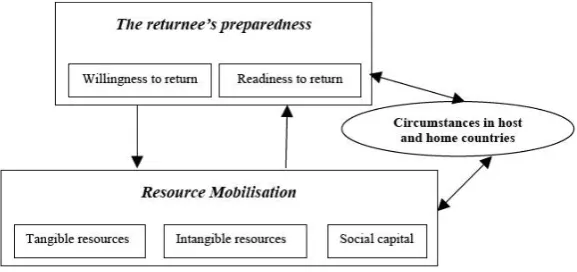
In an attempt to combine and build on the insights of previous studies as briefly outlined above, Cassarino (2004; 2008) introduces the concept of ‘preparedness’to explain different post-return experiences. Preparedness pertains to both the willingness and the readiness of migrants to return. The first aspect relates to the extent to which return is a voluntary1act, the latter to the extent to which the returnee is able to mobilise adequate resources to facilitate a successful return. In a large-scale survey among returned migrants in Tunisia, Algiers and Morocco, Cassarino (2008) finds that how migrants perceive their return is thus clearly related to their willingness to return. The returnee’s preparedness is also related to his or her readiness to return, which in turn depends on the tangible (financial capital) and intangible (social capital, human capital in terms of skills and education) resources the returnee is able to mobilise (see Figure 1).
Cassarino (2004) hypothesises three levels of preparedness that lead to different post-return experiences. The first category of migrants is highly prepared which allows them to organise their return more or less autono-mously while mobilising the resources needed. According to Cassarino (2004: 274), this group most likely consists of migrants who resided in the destination country for between four and fifteen years, on average. The second group has low levels of preparedness and pertains to migrants
‘whose length of stay abroad was too short to allow tangible and intangible resources to be mobilised.’On average, this group is hypothesised to have remained between 6 months and 3 years in the destination country. The third category of returned migrants has little to no preparedness. These are migrants who were for example subjected to forced repatriation. These migrants face difficult conditions after return and may contemplate re-emigrating. According to Cassarino, their average stay abroad was less than 6 months.
In a later study, Cassarino (2008) indeed found that the returnee’s pre-paredness is related to the duration of stay abroad, at least for some return migrants. For example, if return migrants have been away too long (for more than 10 years), they have less chance of becoming an entrepreneur after return. On the other hand, if their duration of stay is too short (less than 2 years), returnees will have gained little expertise or experience to use to their benefit in the origin country (Cassarino, 2008: 24).
3
Data and methods
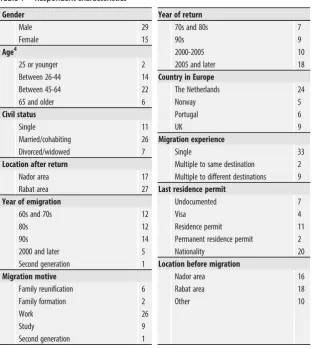
We conducted 44 in-depth sestructured interviews with returned mi-grants in Morocco, more specifically in the urban and suburban areas of Rabat and Nador. The interviews were conducted under the auspices of THEMIS (Theorizing the Evolution of European Migration Systems), a NORFACE research project designed to address gaps in contemporary the-ory on migration processes. Data on 12 different migration corridors was collected, connecting regions in three origin countries (Brazil, Morocco, Ukraine) to specific locations in four popular Western European destina-tion countries (The Netherlands, Norway, Portugal and the United King-dom). In this article we focus solely on return migration to Morocco. The interviewed returned migrants have all resided in Western Europe, more specifically in the Netherlands, Norway, Portugal or the UK, for at least three months. Respondents were selected via key informants, community organisations, schools and mosques, and through the networks of our in-terviewers. We used purposive snowball sampling to locate our respon-dents while aiming for diversity among them. Our sample of responrespon-dents is not representative for the population of return migrants in Morocco. However, by using purposive sampling methods we have tried to capture a varied set of respondents in terms of length of stay abroad, time period of stay abroad, time of return, age, and gender (see Table 1).
The interviews were semi-structured and conducted in 2011 and 2012, lasted around one hour and were held at people’s homes or in cafés. The interviews were held in Moroccan Arabic, Berber or English. The inter-views were gathered through a local partnership: we appointed a fieldwork coordinator in Morocco. Research assistants and students with interview experience conducted the interviews together with the coordinator, which they recorded and transcribed into English.
Table 1 Respondent characteristics
Gender Year of return
Male 29 70s and 80s 7
Female 15 90s 9
Age4 2000-2005 10
25 or younger 2 2005 and later 18
Between 26-44 14 Country in Europe
Between 45-64 22 The Netherlands 24
65 and older 6 Norway 5
Civil status Portugal 6
Single 11 UK 9
Married/cohabiting 26 Migration experience
Divorced/widowed 7 Single 33
Location after return Multiple to same destination 2 Nador area 17 Multiple to different destinations 9 Rabat area 27 Last residence permit
Year of emigration Undocumented 7
60s and 70s 12 Visa 4
80s 12 Residence permit 11
90s 14 Permanent residence permit 2
2000 and later 5 Nationality 20
Second generation 1 Location before migration
Migration motive Nador area 16
Family reunification 6 Rabat area 18
Family formation 2 Other 10
Work 26
Study 9
Second generation 1
4
Three types of post-return experiences
coun-try. A third category in our analysis consists of migrants who are outspo-kenly negative about their post-return experiences. As we shall see, respon-dents in this category all returned involuntarily after their illegal residence was ended by the destination country. In the next sections we will analyse how these three types of post-return experiences can be understood.
4.1 Positive post-return experiences
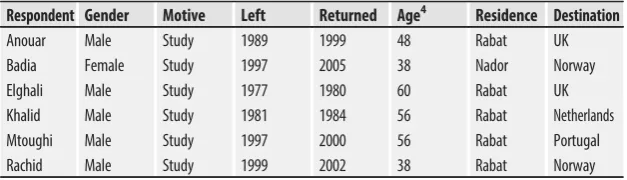
The first category of respondents consists of 19 returned migrants who assess their return positively. These migrants report three types of return motives. The first motive concerns those who left for a specific goal and who are now happy to return because they have achieved what they wanted to achieve. For these respondents, it had generally never been the intention to stay in the destination country. Return to Morocco was always on their minds, they only waited until the right time to return, like Anouar2who says:
I decided I got what I wanted, a lot of experiences, mainly professional ones. As I went there just for study and work, I think that I reached my purposes as I developed the study of motor car engineering that I teach right now. (...) I decided to come back because I did not plan to stay there from the beginning. (...) My objective was to work, get expertise and develop research and return to develop these things here.
They feel that they return as different persons, or with a relevant degree or experience that has added value in Morocco. As a result, they look back on their migration experiences in a positive way. They also do not report any problems with their reintegration. On the contrary, they usually emphasise how their lives have become better as a result of migration. As Elghali explains:‘I think that I benefitted well and I got promoted in my job (...) I have a big villa and a nice car and I live among the rich people in Morocco.’Interestingly, all respondents in this category initially migrated to Europe in order to study (see Table 2).
Table 2 Characteristics of migrants who returned because they had achieved their objective
Respondent Gender Motive Left Returned Age4 Residence Destination
Anouar Male Study 1989 1999 48 Rabat UK
Badia Female Study 1997 2005 38 Nador Norway
Elghali Male Study 1977 1980 60 Rabat UK
Khalid Male Study 1981 1984 56 Rabat Netherlands
Mtoughi Male Study 1997 2000 56 Rabat Portugal
We should add that migrants in this category are not so-called‘target earn-ers’, as observed by Massey et al. (1987)–that is, migrants who return after having earned a certain amount of money. We did not encounter any
‘target earners’in our small sample. What we did capture are the accounts of labour migrants who returned to Morocco, not after having achieved their target but after retirement (see also Cerase, 1974; De Bree et al., 2010). Migrants with this second type of return motive generally live peaceful lives. In most cases, they had always known that they would return some day. As Adil says:‘I reached my retirement so I decided to return. (...) I was always thinking of return. I have my house and I am happy.’Given that they were all labour migrants, they look on their return to Morocco as a well-deserved rest after a life of hard work. As Helima recalled about her working life in the UK:
I worked very hard from six in the morning to four in the afternoon and some-times I did the double shift to earn more money. When I got married I worked and I looked after my children. It was really very hard.
As Table 3 shows, some respondents who returned to Morocco because of retirement actually retired relatively early. Because of the often physically demanding work that Moroccan labour migrants in Europe are generally involved in, quite a few received disability benefits because they were no longer able to do the hard work. Migrants regard this as retirement although they had not reached the official retirement age yet.
Table 3 Characteristics of respondents who returned to retire
Respondent Gender Motive Left Returned Age4 Residence Destination
Adil Male Work 1970 2002 62 Nador UK
Haj Male Work 1964 1981 70 Nador Netherlands
Hakima Female Work 1969 2009 66 Rabat UK
Helima Female Work 1970 2007 66 Nador UK
Mourad Male Work 1969 1999 65 Nador UK
I used to bring a lot of gifts and give money and call by phone and visit them every year. Now I am among them but they do not consult me or visit me, even phone calls are very rare.
Just one retired returnee is unsure whether it was the right decision to return. As he did not acquire Dutch citizenship or a permanent residence permit, he cannot make use of the Dutch medical system anymore. Some-times he thinks that it would have been better to stay longer, in order to obtain the Dutch nationality.
The third type of return motive among those who express positive post-return experiences concerns migrants who post-returned because of a specific business opportunity. Like migrants who had achieved their target and those who returned to retire, these migrants usually return well-prepared. Outhmane for example explains:
I rented a small shop Sale and started to bring products, furniture and clothes to Morocco and sell them and return to the UK. (...) I decided to return because I earned a lot of money from my retailing between Morocco and the UK; I did not work many hours but I earned much. (...) I was fed up with working like a slave [in the UK]. So I got the idea for this project so I decided to return. (...)
Although their migration motives are inspired by the idea to set up some business, there are also other push or pull factors that inspired them to get this idea in the first place. Abderahim elaborates:
I decided to return because I wanted to invest in my native city and because living in the Netherlands became difficult. I started to feel that life became very expensive and I was afraid that my children will not be well educated according to the Moroccan way of life. I decided to return because they are still young and they can reintegrate easily.
Table 4 Characteristics of respondents who returned because of business opportunities
Respon-dent
Gender Motive Left Returned Age4 Resi-dence
Destination
Abderahim Male Family reunification 1980 2002 58 Nador Netherlands
Fouad Male Work 1999 2007 50 Rabat Portugal
Ghobri Male Work 1970 1977 71 Nador Netherlands Hassan Male Work 1973 2002 55 Rabat Netherlands Houssam Male Family reunification 1983 2008 28 Nador Netherlands
Mouloud Male Study 1988 2008 55 Rabat UK
Outhmane Male Work 1970 2002 61 Rabat UK
Sellam Male Work 1980 2006 43 Nador Netherlands
Although the 19 respondents with positive post-return experiences have different return motives, they have in common that they were prepared and willing to return to Morocco. It was a conscious choice to return and before they did so, they made proper preparations. Those who returned because of business opportunities made sure they had enough money to invest in a specific project and they already had their projects figured out before they left. Their projects vary, but they generally thought well about the feasibility of their project before returning. As Mouloud explains:‘I had also conducted a market study about the possibilities of success and fail-ure’, while Outhmane had already set up his business while still living in the UK. Only when the business started to thrive did he venture to return. Migrants who returned to retire had generally bought a house before re-turning to have a place to live in. They had maintained contact with family and friends in order to have a social circle after their return. Respondents who returned after having achieved their target joined the family they had left behind, who had always been prepared for their return.
Migrants in this category usually maintain transnational contacts with the destination country after their return and take pride and comfort in that, which adds to their positive post-return experiences (see also De Bree et al., 2010). Khalid returned after obtaining his diploma in hairstyling in the Netherlands. He still has a lot of contact with the Netherlands:
Respondents who returned to retire and those who returned for business opportunities usually still have close relatives in the destination country. Like Sellam who says:
Yes, I am still in touch with Holland. I go there from time to time to see my family and to run my business. I am still having my Dutch citizenship and my kids are in Amsterdam with their mother. I preferred that they take their education in Holland rather than in Morocco. They came to visit me on their vacations and I can travel to stay for a short time with them.
All in all, what migrants with these three different return motives (target achieved, retirement or business opportunities) have in common is that their return was voluntary and that they returned well-prepared and more or less autonomously (cf. Cassarino, 2004, 2008). Because they were well-prepared, their reintegration was relatively smooth and they are generally very positive about their return, expressing few to no complaints. In addi-tion, for those who achieved their target, their migration experiences have added value to their lives. For respondents with all three motives, the transnational contacts they maintain today add to their sense of happi-ness. In addition, having a passport or a permanent residence permit of the country where they returned from enables them to travel and visit the destination country, further contributing to their positive post-return ex-periences.
4.2 Mixed post-return experiences
A second category of 19 respondents consists of those who have mixed feelings about their return. Closer analysis reveals that these feelings gen-erally relate to their specific return motives. They have two types of return motives, the first consisting of family reasons. These respondents were often not very willing to return. Especially women sometimes do not have a choice as they had to follow their husbands, as was the case with Myriam:
In contrast to the others, the latter were initially rather happy to move to Morocco.
Table 5 Characteristics of respondents who returned because of family reasons
Respon-dent
Gender Motive Left Returned Age4 Residence Destination
Ahmed Male Work 1976 2008 58 Rabat Netherlands
Fatima Female Family reunification 1986* 2009 25 Rabat Netherlands Fatiha Female Family reunification 1990 2008 38 Rabat Netherlands Hadda Female Family reunification 1987 1992 57 Rabat Netherlands Kamar Female Study 1992 1999 41 Rabat Netherlands Nordin Male Work 1981 2011 59 Nador Netherlands Mahacine Female Study 1999 2011 38 Rabat UK Myriam Female Family formation 1989 1994 58 Rabat Netherlands *Respondent was born in the Netherlands
Whether their return was voluntary or not, respondents who returned for family reasons generally felt homesick at the beginning of their return. Hadda for example says:
I had no choice in the decision to return to Morocco. (...) At that time I wished I could have stayed there. I liked the country and the people. At the beginning of my return to Morocco I was very sad because I missed the life and friends I have in Holland.
In addition, it usually takes time to readapt in a more general sense, and to feel at home again socially and culturally. Mahacine, for example, still struggles with readapting culturally:
I came back and I’m happy to be with my family. I’m happy to see that my
daughters are going to grow up in more or less the same environment I grew up
in, but I’m sorry to see that Morocco is not the same anymore. There is no
respect, no organisation; it’s a total chaos and even my 7-year-old daughter
makes remarks about people (...) how they look, how they are grumpy, how the streets are dirty, and how people shout.
makes it difficult to get used to the lifestyle and to find a job. Fatiha for example says:
My problem now is that I cannot find a stable job here in Rabat. I am just doing an internship for free and I am looking for a job. I am really stuck now, I do not know what to do. Rabat is a big city and to find a job is so difficult.
Other returnees with mixed post-return experiences are those who re-turned because of negative push factors in the destination country, for instance because they became unemployed, because of personal reasons or because they were unhappy with the societal climate towards immi-grants in their destination country. Especially miimmi-grants from the Nether-lands report the latter reason. Jamal for example says:‘I think Holland is not the same as it used to be. There is a lot of racism; people consider you as being an alien.’Aziz recalls how he and his wife were in a supermarket and a Dutch man said angrily that the Taliban have invaded Holland because his wife was wearing a veil.
Although some of the migrants we discussed in the previous section also mentioned such negative push factors in the destination country as an additional factor in their decision to return, they first prepared their return in terms of looking for specific business opportunities. By contrast, the respondents in this category reacted more spontaneously to these negative push factors. Aziz says:‘Once I felt that everything is pushing me to go back home I acted instantaneously.’ Nevertheless, they sometimes did make some preparations. Aziz elaborates:
My return was not haphazard and abrupt; I had been planning for return dur-ing all the 30 years that I had spent in Holland. (...) Then I said to myself that migration has a price; meaning either I make more money or I go back to Morocco and live peacefully.
When the boss told me I should no longer work with them and gave me all my money, the first thing I thought of is where shall I go and what shall I do? I knew nobody in Portugal who could have been an excuse for my stay, nothing really to cling to. So I returned but with the idea to have my own restaurant.
Table 6 Characteristics of respondents who returned because of negative push factors in the country of destination
Respon-dent
Gender Motive Left Returned Age4 Residence Destination
Aziz Male Work 1980 2010 55 Nador Netherlands
Bahija Female Work 2008 2010 29 Rabat Netherlands Farida Female Family reunification 2001 2011 25 Nador Netherlands
Hayat Female Work 1992 1993 45 Rabat Portugal
Hmidou Male Work 1995 1996 45 Rabat Norway
Jamal Male Work 1989 2000 49 Rabat Netherlands
Karim Male Work 1991 1994 41 Rabat Netherlands
Malika Female Family formation 1997 2008 42 Rabat Portugal
Moulay Male Work 1966 1970 67 Nador Netherlands
Nabil Male Work 1984 1985 50 Rabat Portugal
Zoubida Female Work 1997 2009 40 Rabat Portugal
Table 7 Characteristics of respondents who returned because of reasons connected to their illegal status in the destination country
Respon-dent
Gender Motive Left Returned Age4 Residence Destination
Farid Male Work 2001 2006 34 Rabat Netherlands
Hamid Male Work 1990 1991 62 Nador Netherlands
Houda Female Family reunification 1997 2002 50 Rabat Netherlands
Jalil Male Work 1972 1973 51 Nador Netherlands
Moham-med
Male Work 2000 2004 37 Nador Norway
Samir Male Work 2001 2004 39 Nador Norway
much happy because of their current lives, but because they think that their lives as migrants would have been less good than their lives as re-turned migrants. Farida for example says:‘I think I have no problems now; I have made a good decision to return if you see now the situation in Europe.’And Moulay, who returned to run away from the Dutch girlfriend he was dating when he found out she was pregnant, says:
I returned with nothing from the Netherlands; I spent all the money on women and fun; when I returned I started from zero. I was very young so I used to do all things the youth did. I think it is better that I returned.
Whereas the first category of migrants report outspokenly positive post-return experiences, the second category expresses mixed feelings or mod-erately positive views, especially when comparing their current lives to their lives in the destination country. Although respondents in this cate-gory may have different return motives, they have in common that they returned moderately prepared. They were less prepared than those of the first category as they usually had not planned the exact moment of their return, but were instead forced to return suddenly after something hap-pened (for those who returned because of negative push factors). In other cases, migrants were not very willing to return (the majority of who re-turned because of family reasons). The reintegration of these second-cate-gory respondents therefore proceeded less smoothly than in case of the better prepared respondents discussed previously. Although most respon-dents who returned for family reasons or due to negative push factors in the destination country report difficulties in the beginning of their return, those who returned long ago mostly say that their initial difficulties have now disappeared.
Some respondents report difficulties that are not likely to be resolved soon, however. The main difference between those whose difficulties dis-appear and those whose difficulties are likely to persist is the extent to which they managed to live up to their family’s expectations (sending remittances, calling, making visits to Morocco, bringing gifts) prior to their return. Hmidou explains:
country. The gifts included mainly clothes, perfumes, tea, coffee, chocolate and other kitchen gadgets.
While Hmidou managed to fulfil his family’s expectations, the significance of these moral obligations becomes especially clear through the stories of migrants who were unable to fulfil them and still suffer on account of that today. Migrants who live up to their family’s expectations can generally rely on the support of family members or friends they gave money or presents to after their return. But those who were unable to do so cannot count on any support today (see also Komter, 1996). As Malika recounts:
When we visited our families during our summer vacation (...) the gifts we used to bring were for our families something cheap and trivial. Then our families understood that our migration project is not really beneficial for them. And I still remember that our neighbours used to call my children the poor Portuguese.
After Malika refused to put up with her husband’s beating any longer, she took her children and went to see her family in Morocco to talk about a divorce, which her family members advised against. Malika went back to Portugal feeling disappointed but eventually divorced and returned to Morocco a few years later:
I am really shocked about the way my family treats me (...) My family told me I
should have been patient and I should not return with“empty hands”. Now I
am living in a house rented for my children away from my family and their
problems.3
for their reintegration. It may even be the case that they never completely overcome such difficulties.
4.3 Negative post-return experiences
The third and final category of respondents have outspokenly negative post-return experiences. This is particularly the experience of 6 migrants who returned because of reasons related to their illegal residence in the destination country. With one exception, all respondents in this category report difficulties and unhappiness. Characteristic for these six respon-dents is that they were all unwilling to return and had made little or no preparations. Due to their low economic status in the destination country, they were usually unable to make financial preparations, and they had been unable to fulfil their family’s expectations. As a result, upon return, they experience that people are not interested in them and they feel like they have to start all over again. Hamid describes how unhappy he is with his return:
[My boss] knew that I did not have legal residence papers but only an expired visa. If I did not leave the place myself, he would feel obliged to tell the police about my illegal stay. If only I had not returned to Morocco and stayed in Holland. (...) I felt that I was strong in Holland, but I lost that feeling as soon as I arrived in Morocco. I felt a strange sensation of weakness as if I am nothing because of a failed migration experience.
Likewise, Samir talks about his heavy burden of failure:‘Failure makes you very destabilised as a person.’ Houda, a divorced woman who was de-ported from the Netherlands and forbidden to return for ten years after she had tried to arrange a bogus marriage in order to live with her daughter and take care of her grandson, says: ‘I was shocked when I returned to Morocco because I have nothing here’. Like Houda, most respondents in this category want to migrate again. Mohammed for example says:‘I am always thinking of migrating again.’And Jalil, a 51-year-old farmer says:
One respondent who returned because of reasons connected to his illegal status does not feel the burden of stigma attached to his failed migration experiences. Farid, who is originally from Al Hoceima but returned to another place in Morocco (Rabat), describes the thoughts that led to the decision to return:
[I thought] I cannot stay illegal the whole of my life; I must legalise my situa-tion to live peacefully and not in a constant fear of the police. I tried to look for a Dutch lady to get married to but I failed. (...) The idea emerged when I became friends with my Dutch teacher who proposed to me to go back and set up a touristic project and a school to teach the Dutch language here in Mor-occo. I calculated all the options available. If I stayed in the Netherlands, I would not have a stable life until I reach the age of 40 after a long battle, and I would face very difficult circumstances.
Farid returned to Rabat‘because of the decision to set a project here in Rabat, job availability and opportunities, and in Alhociema I had nothing to do there.’Although Farid’s original project failed, he now has a job at the Dutch embassy in Rabat. Because of his illegal status in the Netherlands he had not been able to meet his family’s expectations, but that did not matter as he did not return to the place where he could be condemned for not having done so. As he is not among his family members and friends from Alhoceima, he is not bothered by the stigma of a failed migration experience. In fact, the position he secured for himself in Rabat is probably regarded as a successful form of internal migration. It only follows logically then that he does not have the desire to migrate again, like the others in this category have. Farid was a lot better prepared for his return than the others in this category. Returning to Rabat instead of Al Hoceima was part of this preparation. As a result he does not suffer from failed migration experiences as he did not return to his original home, where people could consider him a failure.
5
Conclusions and discussion
important in the literature cause different factors to become prominent in different cases. For example, we have shown that the ability to maintain transnational contacts with the destination country after return adds to positive post-return experiences (see also De Bree et al., 2010)–but only for migrants with specific return motives.
With this paper, we have empirically demonstrated the value of the concept of‘preparedness’, introduced by Cassarino (2004). While the first group was well-prepared and generally reported no difficulties, the second group was moderately prepared and reported some difficulties, especially in the beginning of their return. The third group reported a lot of difficul-ties, especially in coping with failed migration experiences and because they had made practically no preparations for their return. The only person who did not report difficulties returned well-prepared and to a different location, and therefore does not suffer from the stigma of being a failed migrant.
We have also shown that for the group of respondents who reported mixed post-return experiences, it was due to their moderate preparedness that they faced difficulties in the beginning that they managed to over-come later on. However, this was not the case for those who had been unable to meet their family’s expectations prior to return. They continued to report mixed experiences. Our research moreover shows that if migrants are well-prepared, the extent to which they were able to fulfil family ex-pectations does not matter as these migrants can arrange their return autonomously. The family’s expectations only become relevant if migrants are less well-prepared for their return, making them dependent on their family’s and friends’support. For those who returned because of reasons connected to their illegal status, preparations were crucial in combination with settling in a different location, as this offered the only escape from having to deal with the stigma of failed migration experiences.
networks do appear to contribute to positive post-return experiences, but mainly in social and cultural respects. For respondents with positive post-return experiences, the contacts they maintained in the home country while in the destination country facilitated their reintegration socio-cultu-rally. In addition, the transnational contacts they maintain with people in Europe add to their sense of happiness today (see also De Bree et al., 2010). Furthermore, for those with mixed or negative post-return experiences, our respondents’transnational networks became especially important in a ne-gative sense; namely, when they were shut out for having failed to fulfil their family’s expectations. This means that, in the context of understand-ing post-return experiences, transnational social networks should not only be seen as a source of support – as Cassarino (2004) does– but should instead be conceptualised more broadly to incorporate transnational ob-ligationsas well.
It is well-documented that many migrants are involved in transnational activities such as supporting their relatives back home (Snel et al., 2006). However, previous research also shows that not all migrants are in a posi-tion to support the family back home. Transnaposi-tional activities can be limited because of the low socio-economic or weak legal position of mi-grants in the destination countries (Bloch, 2008; Itzigsohn and Saucedo, 2002; Portes, 2001; Van Meeteren, 2012). We found that it had been more difficult for returned migrants from Portugal to fulfil family’s expectations as wages in Portugal are not very high, giving them an unfavourable socio-economic position. This research therefore indicates that circumstances in the destination country are important to understanding different post-re-turn experiences (see also Cassarino, 2008; Van Houte and Davids, 2008). Furthermore, Cassarino (2008) shows that post-return experiences also relate to economic and institutional circumstances in the country of origin. For example, in his comparative study (2008: 24) he observes that the chances that a returnee becomes an entrepreneur are significantly higher in Tunisia with its more liberalised economy than in Morocco, where we conducted our research. Research in other countries than Morocco might therefore yield different results in terms of the distribution of respondents over the three types of post-return experiences and the related return motivations.
of the existing literature can never fully do justice to its richness in detail. In our small-scale qualitative study we have not been able to systematically study how factors such as gender, age, and educational level affect out-comes or intersect with other factors to shape outout-comes, while other re-search has already pointed to their importance (see for example Cassarino, 2008; Gmelch, 1980; Reynolds, 2010; Van Houte and Davids, 2008). Future research can benefit from these insights and strive to further contextualise theoretical explanations by means of more systematic comparative re-search designs.
Acknowledgements
We would like to thank the two anonymous reviewers for their construc-tive comments. In addition, we thank the editors of this special issue for their helpful comments on earlier versions of this article. This paper draws on the theoretical research and empirical work undertaken within the project ‘Theorizing the Evolution of European Migration Systems’ (THE-MIS). Financial support for THEMIS from the NORFACE research pro-gramme on Migration in Europe, Social, Economic, Cultural and Policy Dynamics is acknowledged.
Notes
1. Drawing on Cassarino’s theory on return preparedness,“voluntary return”should be understood only as resulting from the migrant’s autonomous and independent decision to return to his or her country of origin.
2. All respondents have been given a fictitious name.
3. This excerpt also shows how gender and gendered family relations are important in understanding post-return experiences. The gendered nature of post-return experiences has been mentioned in the literature before. Our analysis did not yield enough valuable insights that could further contribute to this literature.
References
Al-Ali, N., Black, R. & Koser, K. (2001) The limits of transnationalism: Bosnian and Eritrean refugees in Europe as emerging transnational communities.Ethnic and Racial Studies, 24
(4): 578-600. DOI:10.1080/01419870120049798
Bastia, T. (2011) Should I stay or should I go? Return migration in times of crises.Journal of International Development, 23(4): 583-595. DOI:10.1002/jid.1794
Bath, W. & Roberts, B.R. (2012)‘Forbidden return’: return migration in the age of restriction.
Journal of Immigrant and Refugee Studies, 10(2): 162-183. DOI:10.1080/15562948.2012.674325 Bloch, A. (2008) Zimbabweans in Britain: transnational activities and capabilities.Journal of
Ethnic and Migration Studies, 34(2): 287-305. DOI:10.1080/13691830701823822
Carling, J. (2004) Emigration, return and development in Cape Verde: the impact of closing borders.Population, Space and Place, 10(2): 113-132. DOI:10.1002/psp.322
Cassarino, J.P. (2004) Theorising return migration: the conceptual approach to return migrants revisited.International Journal on Multicultural Societies, 6(2): 253-279.
Cassarino, J.P. (2008) Conditions of modern return migrants–Editorial introduction. Interna-tionalJournal on Multicultural Societies, 10(2): 95-105.
Cerase, F.P. (1974) Expectations and reality: a case study of return migration from the Unites States to southern Italy.International Migration Review, 8(2): 245-262. http://www.jstor.org/ stable/3002783 (geen DOI, wel“stable link”)
Constant, A. & Massey, D. (2002) Return migration by German guestworkers: Neoclassical versus new economic theories.International Migration, 40(4): 5-38. DOI:10.1111/1468-2435.00204 De Bree, J., Davids, T. & De Haas, H. (2010) Post-return experiences and transnational belonging
of returned migrants: a Dutch-Moroccan case study. Global Networks, 10(4): 489-509. DOI:10.1111/j.1471-0374.2010.00299.x
Gmelch,‚G. (1980) Return migration.Annual review of Anthropology, 9: 135-159. DOI:10.1146/ annurev.an.09.100180.001031
Fokkema, T. (2011)‘Return’migration intentions among second-generation Turks in Europe: the effect of integration and transnationalism in a cross-national perspective.Journal of Mediter-ranean Studies, 20(2): 365-388.
Hunter, A. (2010) Theory and practice of return migration at retirement: the case of migrant worker hostel residents in France.Population, Space and Place, 17(2): 179-192. DOI:10.1002/ psp.610
Itzigsohn, J. & S.G. Saucedo (2002) Immigrant incorporation and sociocultural transnationalism.
International Migration Review,766-798. http://www.jstor.org/stable/4149563 (Article first published online: 23 FEB 2006DOI: 10.1111/j.1747-7379.2002.tb00104.x.)
Jansen, S. (2011). Refuchess: locating Bosniac repatriates after the war in Bosnia-Herzegovina.
Population, Space and Place, 17(2): 140-152. DOI:10.1002/psp.607
Jeffery, L. & Murison, J. (2011) Guest editorial: the temporal, social, spatial and legal dimensions of return and onward migration.Population, Space and Place, 17(2): 131-139. DOI:10.1002/psp.606 Komter, A. (1996) Reciprocity as a principle of exclusion: Gift giving in the Netherlands.Sociology,
30(2): 299-316. DOI:10.1177/0038038596030002006
Ley, D. & Kobayashi, A. (2005) Back to Hong Kong: return migration or transnational sojourn?
Global Networks, 5(2): 111-127. DOI:10.1111/j.1471-0374.2005.00110.x
Portes, A. (2001) Introduction: the debates and significance of immigrant transnationalism. Glo-bal Networks, 1(3): 181-93. DOI:10.1111/1471-0374.00012
Reynolds, T. (2010) Transnational family relationships, social networks and return migration among British-Caribbean young people. Ethnic and Racial Studies, 33(5): 797-815. DOI:10.1080/01419870903307931
Sinatti, G. (2011) Mobile transmigrants or unsettled returnees? Myth of return and permanent resettlement among Senegalese migrants. Population, Space and Place, 17(2): 153-166. DOI:10.1002/psp.608
Snel, E., G. Engbersen & A. Leerkes (2006) Transnational involvement and social Integration.
Global Networks, 6(3): 285-308. DOI: 10.1111/j.1471-0374.2006.00145.x
Van Houte, M. & Davids, T. (2008) Development and return migration: from policy panacea to migrant perspective sustainability.Third World Quarterly, 29(7): 1411-1429. DOI: 10.1080/ 01436590802386658
Van Meeteren, M. (2012) Transnational activities and aspirations of irregular migrants in Belgium and the Netherlands.Global Networks, 12(3): 314-332. DOI: 10.1111/j.1471-0374.2012.00354.x
About the authors
Dr. Masja van Meeterenis Assistant Professor in the Department of
Crim-inology at Leiden University. Her research interests include intersections of migration, migration policy, informal social structures, crime and crimina-lization. She has conducted research on irregular (‘illegal’) migration, in-tended and uninin-tended consequences of migration policies, migrant lega-lization, informal labor, immigrant integration and transnationalism, re-turn migration, and the role of social networks in facilitating different forms of migration and immigrant integration.
E-mail: [email protected]
Prof. Dr. Godfried Engbersen is professor of Sociology at the Erasmus
University of Rotterdam, the Netherlands, and an elected member of the Royal Netherlands Academy of Sciences (KNAW). He is an expert on social inequality, immigration and urban social problems. Currently he is work-ing on the relationship between restrictive migration regimes and crime, local and transnational citizenship, and liquid migration from Central and Eastern Europe. E-mail: [email protected]
Dr. Erik Snelworks as Assistant Professor in the Department of Sociology
inte-gration policies, poverty, anti-poverty policies, and miinte-gration and integra-tion related issues. E-mail: [email protected]
Marije Faber(MA), corresponding author, studied Sociology at the
Rad-boud University Nijmegen. In 2012 she received her Master’s degree in
‘Urban Problems and Policy’ at the Erasmus University of Rotterdam. Marije is currently working as a researcher at the Department of Sociology of the Erasmus University of Rotterdam, and is a member of the research group‘Citizenship, Migration and the City’(CIMIC).