3689
Downloaded from: http://sure.sunderland.ac.uk/8837/
Usage guidelines
Please refer to the usage guidelines at http://sure.sunderland.ac.uk/policies.html or alternatively
contact [email protected].
1
Abstract—One of the significant issues facing web users is the
amount of noise in web data which hinders the process of finding useful information in relation to their dynamic interests. Current research works consider noise as any data that does not form part of the main web page and propose noise web data reduction tools which mainly focus on eliminating noise in relation to the content and layout of web data. This paper argues that not all data that form part of the main web page is of a user interest and not all noise data is actually noise to a given user. Therefore, learning of noise web data allocated to the user requests ensures not only reduction of noisiness level in a web user profile, but also a decrease in the loss of useful information hence improves the quality of a web user profile. Noise Web Data Learning (NWDL) tool/algorithm capable of learning noise web data in web user profile is proposed. The proposed work considers elimination of noise data in relation to dynamic user interest. In order to validate the performance of the proposed work, an experimental design setup is presented. The results obtained are compared with the current algorithms applied in noise web data reduction process. The experimental results show that the proposed work considers the dynamic change of user interest prior to elimination of noise data. The proposed work contributes towards improving the quality of a web user profile by reducing the amount of useful information eliminated as noise.
Keywords—Web log data, web user profile, user interest, noise
web data learning, machine learning.
I. INTRODUCTION
OWADAYS the web is widely used in every aspect of day to day life, a daily use of web means that users are searching for useful information [1]-[3]. However, ensuring useful information is available to a specific user has become a challenging issue due to the amount of noise data present on the web [4]. Noise in web data is defined as any data that is not part of the main content of a web page [5], [6]. For example, advertisements banners, graphics, web page links from external web sites etc. Noise web data elimination is a concept which involves detection of web data that needs to be eliminated because it either does not form part of the main web page content or is not useful to a given user [7]. It is recognised in the current research work [8] that the noise web data reduction process is site-specific, i.e. it involves removal of external web pages that do not form part of the main web page content. However, this work does not focus on the structure and layout of web data to identify and eliminate noise but instead, a key focus is on extracted web log data that defines a web user profile. In view of this research, noise is
J. Onyancha is with the Faculty of Computer Science, University of Sunderland, Edinburgh Building, Chester Road, Sunderland SR1 3SD (e-mail: [email protected]).
not necessarily advertisements from external web pages, duplicate links and dead URLs or any data that does not form a part of the main content of a web page, but also useful information that does not reflect dynamic changes in user interests.
Various machine learning tools/algorithms are used to discover useful information from web data, this process is referred to as web usage/data mining process [1], [2]. It finds user interest patterns from web log data. Web log data contains a list of actions that have occurred on the web based on a user [9]. These log files give an idea about what a user is interested in available web data. Web log data contain basic information such as IP address, user visit duration and visiting path, web page visited by the user, time spent on each web page visit etc. In this work, web log file and web data are used interchangeably because a log file contains web data, therefore elimination of noise web data is based on extracted web user log file.
In a real world, it is practically impossible to extract web log data and create a web user profile free from noise data. A web user profile is defined as a description of user interests,
characteristics, and preferences on a given website [10]-[12]. User interests can be implicit or explicit [13]. Explicit interests are where a user tell the system what his/her interests are and what they think about available web data while implicit interest is where the system automatically finds interests of a user through various means such as time and frequency of web page visits [14], [15]. Many users may not be willing to tell the system what their true intentions are on available web data, therefore, this work will focus on implicit user interests.
Current research efforts in noise web data reduction have worked with the assumption that the web data is static [16]. For example, [17], [18] proposed a mechanism where noise detected from web pages is matched by stored noise data for classification and subsequent elimination. Therefore, it shows that elimination of noise in web data is based on pre-existing noise data patterns. In evolving web data, existing noise data patterns used to identify and eliminate noise from web data may become out of date.For this reason, the dynamic aspects of user interest have recently become important [19], [20]. Moreover, web access patterns are dynamic not only due to evolving web data but also due to changes in user interests [21]. For example, web users are likely to be interested in data derived from events such as Weddings, Christmas, Birthdays etc. Therefore, it is necessary to discover where such dynamic tendencies impact the process of eliminating noise from web data.
To address dynamic issues in noise web data reduction, this
Noise Reduction in Web Data: A Learning Approach
Based on Dynamic User Interests
Julius Onyancha, Valentina Plekhanova
N
research proposes a machine learning algorithm capable of learning noise in web data prior to elimination. The proposed algorithm considers the dynamic change in user interests and evolving web data to identify and learn noise data. The main novelties of this research are:
To demonstrate how dynamic user interests and evolving
web data impact noise web data reduction process. This takes into account contribution made by current research works and their limitations in relation to the current state of the art.
To propose a machine learning algorithm capable of learning noise in a web user profile prior to elimination. Elimination of noise from a web user profile does not only depend on pre-existing noise data patterns, but it learns noise levels based on dynamic changes in user interest as well as evolving web data.
The outcome of the practical application of the proposed tool will reduce the amount of useful information eliminated as noise from a web user profile. This may significantly improve the quality of a web user profile. The rest of this paper is organised into the following sections; Section II positions the proposed work based on current research work. Section III discusses the proposed NWDL process. Section IV is experimental results and analysis. Finally, section V is the conclusion of this paper.
II. CURRENT RESEARCH WORK
Current tools developed to identify and eliminate noise from web pages are mainly based on the visual layout of web pages. For example, [5] proposed Site Style Tree (SST) to detect and eliminate noise data from web pages. SST is based on an observation that the main web page content usually shares the same presentation style and any other page with different presentation style is considered as noise. To eliminate noise from web pages, SST simply maps the page to the main web page to determine if the page is useful or noise based on its presentation style. Another noise web data reduction tool that focuses on web page layout is Pattern Tree algorithm [22], it is based on Document Object Model (DOM) tree concept with an assumption that data present on the web can be considered noise if its pattern is dissimilar from the main content of web page. Least Recently Used paging algorithm (LRU) [23] is also used to detect and remove noise from web pages. LRU takes into account visual and non-visual characteristics of a web page and is able to remove noise web data for example news, blogs and discussions. LRU algorithm determines pages that have been frequently visited and those pages that have not been visited over a long period of time. However, this work does not focus on structure and layout of web data to identify and eliminate noise but instead, a key focus is on extracted web log data that defines a web user profile. Based on issues addressed in the previous section, noise in web data should be identified and eliminated taking into account user interest levels on web data. Current research works have applied existing machine learning tools/algorithms to find user interest data and eliminate noise data from extracted web data logs. For example, [17] used Case based
reasoning (CBR) and Neural Network to eliminate noise from web log data. CBR is a machine learning approach which makes use of past experiences to solve future problems, i.e. it detects noise from web pages using existing stored noise data. Different noise patterns in websites are stored in form of DOM tree, the case base is then searched for similar existing noise patterns. Artificial Neural Network is used to match existing noise patterns stored in Case-Based. Even though this approach is based on the idea of case based reasoning to identify noise data by matching existing noise patterns stored in case-based, it is difficult to determine if such information is relevant or noise to a user despite the fact that it matches with existing patterns. This is because web data is dynamic and so is expected user interest, if the usefulness of data is determined using case based approach then the output will be misleading. kNN applied by [24] also used existing noise data to identify and eliminate noise in web pages. Their main focus was on local noise for example advertisements, banners, navigational links etc. Web log data was extracted and surveyed to which server they belong. If the address belongs to a list of already defined advertisement server, then the link is removed.
Due to the dynamic nature of user interests as well as evolving web data, existing noise data patterns may become out of date and hence difficult to identify and eliminate noise from a web user profile. To determine user interest levels on extracted web log data, [25] used the Naïve Bayesian classification algorithm. Their main objective was to classify extracted web data logs and study its usefulness based on user interests. The initial phase involved removing noise data such as advertisement banners, images and screen savers from extracted web data logs. They used Naïve Bayesian classification model to classify useful and noise data based on a number of pages viewed and time taken on a specific page. However, spending more time on a web page may not necessarily mean a user is interested. If a user is struggling to find information of interest, he/she may spend more time searching. Weighted Association Rule Mining was also used by [26] to extract useful information from web log data. Their objective was to find web pages visited by a user and assign weights based on interest level. The weight of a web page to a user interest is estimated with the frequency of page visit and a number of pages visited. Where pages visited only once by only one user, they will be assigned low weights and subsequently considered noise.
While the authors discussed in this section aimed at finding useful information from web log data, they concentrated on eliminating noise data based on existing noise data patterns and page visit duration to determine interest level of a user. Despite efforts from current research work to address problems with noise in extracted web log data, this work observes some critical issues not fully addressed by current research work. For example, 1) The Web is dynamic where a high volume of data is posted and updated every minute. The majority of web data only remains useful for a very short period of time. 2) User interests on available web data tend to change as web data evolves. In essence, web users express
interest in a broad range of information based on time and what is happening around the world. Therefore, user interests can be dynamic as the web evolves. Our justification for this claim is that if noise in web data is not clearly defined and analysed through learning, the purpose and use of data extracted will be compromised. Learning of noise in web data is influenced by the activities of a user on web data which is determined by measures such as time duration, the frequency of visits and the depth of a user visit on a given web page. These measures will influence usefulness of a web page to a user rather than the relationship among web data on a given website.
III.PROPOSED NOISE WEB DATA LEARNING (NWDL)
In this section, a machine learning algorithm capable of learning noise in a web user profile prior to elimination is proposed. A key focus is to learn, identify and eliminate noise, taking into account the dynamic interest of a user and the evolving web data. Eliminating noise in extracted web log data is determined based on what a user is interested and not interested in. It is widely discussed in current research work, [5], [8], [27], [28] that the interest of a user on a web page is measured by how often they visit that page, how long they
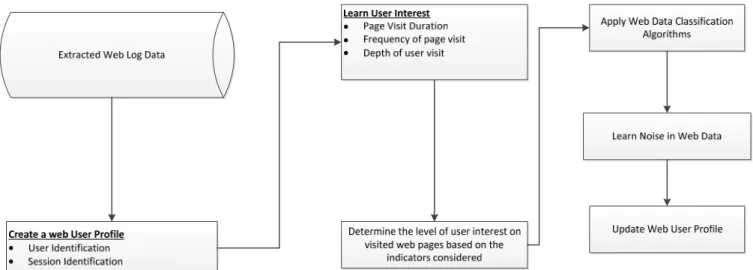
spend on the page, how recently they visited the page and the number of links on the page that they visit. To some extent, current research works measure user interest in extracted web data logs but there is inadequate evidence to demonstrate how noise in a web user profile is determined prior to elimination. A summary of the proposed work is shown in Fig. 1.
A.Web User Profile
A user profile has a set of URLs that represent a user interest. Creating a user profile is based on a set web pages accessed by a user taking into account relevance of his/her interest. User profile denoted by contains a number of sessions i.e. = ( ) where are a number of user sessions. The user session is defined as a sequence of accessed pages for the user, i.e. =
( ) where is the number of web
pages for the user.
After creating a user profile, this work learns user interest levels on visited web pages so as to determine useful information from noise data. Various measures are considered, i.e. time, frequency and depth of visit of user visit to a web page.
Fig. 1 Proposed NWDL process flow B.Learning of User Interest
The current research work [29] recognises that it is important to learn user interest level to find useful information. This can be done by collecting user log data, analyzing it and storing the results in a user profile. User interest relies on the basis that the visiting time of a web page is an indicator of a user’s interest level [30]. The amount of time spent in a set of web pages requested by the user within a single session reflects the interest of that user. In addition, [31] states that web pages with higher frequency are of stronger interest to a user. Even though this paper considers page visit duration and frequency of visit to learn user interest on visited web pages, it is difficult to measure user interest levels based on page visit duration and frequency of visit alone. For example, high frequency of visit to a web page may either
reflect a user struggling to find useful information or based on website layout, he/she is forced to visit some pages before accessing interested ones. Therefore, the proposed work considers additional measures such as depth of visit and frequency of visit to a web page category to learn user interest prior to elimination of noise data.
1.Page Visit Duration
Page visit duration is one of the metrics widely used by current research work to measure user interest level on a web page [32]. Page visit duration is the amount of time a user spent viewing a web page, it reflects the relative importance of each page to the user. Generally, a user spends more time on a more useful page, if a user is not interested in a page, he/she will exit or move to another page. Therefore, page visit
duration defines the length of user interest on a web page. [33] argue that calculation of page visit duration is a bit skewed because it is not possible to determine the time a user exits a web page as it is always 0. Therefore, the last page visited is not counted as a part of page visit duration, but in the number of pages visited/viewed. The number of page views ( represents the number of times a user views a specific web page in session.
Definition 1. Length of user interest on web page is determined by the time taken by the user on web page taking into account number of page views and the time duration on the page. Length of the user visit on a web page is presented in the following equation:
(1) where T= Length of visit on kthweb page by j user, i i
user session for the j user profile, I = Total number of sessions for j user profile, T Total time duration on k
web page by j user in i session, NPV = Total number of
page views by the j user in i session. 2.Frequency of a User Visit
Definition 2. Frequency of a user visit to a web page is determined by the number of times web page appears in
session for the user. Frequency of the user on a web page is presented in the following equation:
(2) where Freq frequency of visit for the j user on k web page, Url = the number of times k web page appears
in the j user profile and I = total number of sessions for the
j user profile.
3.Determine Weight of Web Page
Definition 3. The weights signify the importance of the web page in user profile. The weight of web pageis the interest degree of the user on web page, it is denoted as which is determined by the length and frequency of the user visit using the following equation:
(3)
where W= weight of k web page for the j user, T= Length of visit on k web page by j user and Freq = frequency of visit for the j user on the k web page.
4.Depth of User Visit
Page visit depth is defined as the average number of pages viewed by visitors during a single browser session [34]. The depth of the user visit on web page is an indicator of a user interest level. The proposed tool considers the depth of the user visit not only in terms of a number of page views but the route a user takes to navigate through a website. The user creates a path of page views when searching for information on a specific website. For example, a user may enter a website from home page but only interested in finding delivery charges for a specific item under accessories. Even though the user is likely to visit other web pages to get to the information of interest, it is difficult to assume that every page visit is of a user interest unless measures such as time duration and frequency to visit over a number of sessions are considered. Therefore, the path taken by the user from entry to exit page and the weights associated with each web page is considered in this paper to learn interest levels for the user.
Algorithm: Depth of user visit
Input: Extracted web user logs
Output: A set of links associated with the user profile 1. Define the user profile; // see definition 1
2. for each web page in the j user profile 3. find the web page category
4. if two web page from the same category are both included in session
5. flag_Link = 1; //a link between two web page from the same category is found
6. else
7. flag_Link = 0; //no link between the two web pages 8. if (flag_Link = =1)
9. out_List.put (url : url ); // web pages visited by the user profile are connected
10. end if 11. end if 12. end
5.Web Page Category Weight
In this work, web page category is defined as a set of related web pages. The weight of a web page category is determined based on the frequency of user visits to a particular web page category. The more frequent a user visits the same category the higher the level of interest. Unlike frequency of visit to web page discussed in (2), the frequency of visit to
a web page category determines if a user is interested in information from a given category of web data. For example, a high number of visits to footwear web pages under men category depict interest on information regarding men shoes. Based on this concept, the weight of a web page category is presented for the purposes of learning user interest level to a particular web page category.
Definition 4. The weight of a web page category is defined by taking into account the number of times a particular category of a web page denoted as appears in session for the user, where is an indicator of a web page category. The proposed tool determines:
Number of times web page of appears in user profile
Average length of time spent on by the user profile Let us now consider frequency of the j user to URL category using the following equation:
(4)
where = frequency of access for the j user to URL category, = number of web page of category for the user and = total number of sessions for the j user profile.
C.Learning Noise Web Data
In this paper, learning of noise data in the user profile involves classification of the weighted web page presented in (1)-(4). Web page classification is the process of assigning a label to a web page [35]. A class is a representation of a data object while an object is an instance of a class. For example, web page in the user profile is assigned to a class based on the level of interest. = { } is a set of predefined classes. For illustrative purposes, let us consider the following classes as Interest class, as Potential noise class and as Noise class.
Algorithm: Learn noise web data
Input: Weighted url for the user profile Output: A set of web pages assigned to a class ( 1. Define the user profile
2. for each web page in j user profile do 3. Determine the weight of web page using (3) 4. if url weight > threshold set then
5. assign to 6. else 7. assign to 8. for do
9. Create a simple page link of the user profile
10. Determine frequency to web page category using
11. if Freq < threshold set then
12. assign to 13. else 14. update 15. end if 16. end if 17. end
IV. EXPERIMENT AND ANALYSIS OF RESULTS
This paper demonstrates the performance of the proposed tool over well-known algorithms applied in noise web data reduction process. The experimental design aims to demonstrate how noise in web data is identified and eliminated by existing algorithms and the proposed algorithm taking into account changes in user interests. Firstly, the choice of the dataset and various tasks carried out in this experiment are presented and discussed. Secondly, the performance of the proposed algorithm is demonstrated by the results obtained from experiments carried out. Finally, the results from existing algorithms and the proposed algorithms are compared. This is to validate the performance of the proposed algorithm over the existing algorithms.
A. Experimental Design Scheme
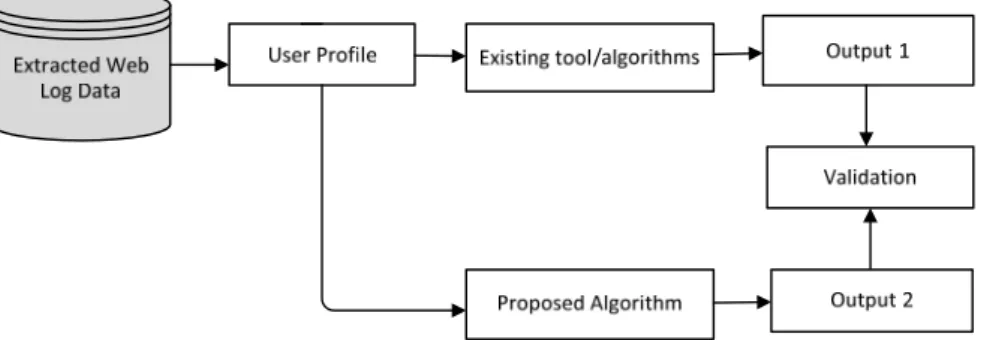
The dataset used to carry out the experiments are user web log data extracted from an e-commerce site for a period of one month. The proposed algorithm identifies user activities on the website to determine dynamic changes over the specified period. A number of current machine learning algorithms are considered in this work to validate the performance of the proposed algorithm. The objective of this experimental direction is to demonstrate if existing tools identify and classify extracted web log data in relation to varying user interest on web pages visited. We validate the performance of the proposed tool by comparing its output against the output from existing algorithms considered in this paper. Summary of the experimental design setup scheme is presented in Fig. 2.
Fig. 2 Experimental design setup scheme
To evaluate the proposed algorithms in terms of classification performance, we divide the dataset into training and test data. We perform ten-fold cross validation and report the classification performance in terms of Precision and Recall. The choice of cross-validation is to iterate separations
into a training set and test set in order to get more reliable results in terms of classification accuracy.
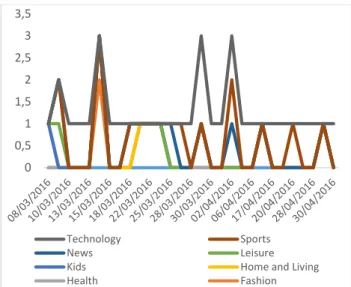
Fig. 3 Dynamic interests of a user to a web page category
Fig. 4 Classification performance using existing machine learning algorithms
B. Experimental Results
The proposed tool aims to demonstrate how dynamic change in user interest affects the elimination of noise in a web user profile. As shown in Fig. 3, dynamic changes in user
interests to a specific web page category are obtained using (3). Unlike current algorithms, eliminating noise from web data in a user profile is determined based on changes in user interest over time and not existing noise data patterns. For example in week one, the user visit to sports category was none, which means it is considered as not useful. But over time a user has visited the category if existing noise data patterns will be used to eliminate noise in web data, then useful information is likely to be eliminated. Frequency and duration of a user visit to a web page alone cannot determine the level of a user interest. There is a possibility that a user will only be interested in a given time period. Therefore, frequency and duration of visit will not provide a clear picture of a user interest when eliminating noise web data.
1.Baseline Selection
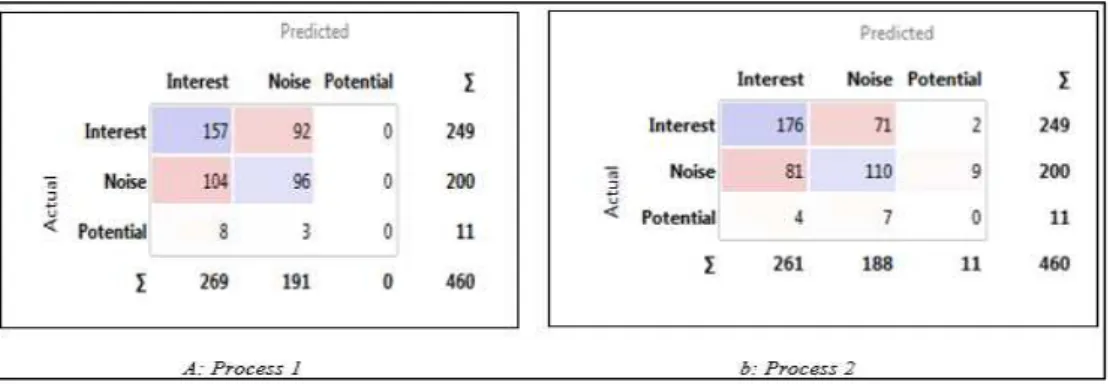
The objective of applying a number of well-known machine learning algorithms, as shown in Fig. 4, was to establish a baseline among them for the given data set. A baseline is a method that uses machine learning to create predictions for a dataset. The results obtained are then used to measure the baseline's performance in terms of Precision and Recall. The best performing algorithm is used to validate the performance of the proposed algorithms using confusion matrix as shown in Fig. 5.
C. Evaluation of Results
In this section, we analyse the experimental results of the proposed algorithm in terms of classification accuracy. Accuracy is the fraction of correct classification out of total possible data classification in a web user profile. Although it is common in experimental studies to iterate separations into a training set and test set and to use cross-validation in order to get more reliable results, this paper also considered a random split of the original data set because of the size of the dataset used. The training data set used is randomly split from the original dataset i.e. we have considered 70% training data and 30% test data. However, the results presented in Fig. 4 do not show much difference despite the size of the dataset used. The proposed algorithm/tool is compared against a baseline
machine learning algorithm as shown in Fig. 5. Confusion matrix shows different results when comparing the performance of the proposed algorithm against currently available tools. Process 1 shows the results from existing tools
while process 2 shows results obtained from the proposed algorithm. Results from process 2 show increase in potential
noise but decrease in noise, given the fact that web pages with no known user interest but whose category are known have been considered as potential noise. The accuracy is the sum of all the numbers on the diagonal divided by the sum of all numbers. The larger the number on the diagonal line, the better the classification performance.
T S
N L
K H L
H F
Fig. 5 Comparing performance of the proposed algorithm over current algorithms using confusion matrix
V. CONCLUSION
A machine learning algorithm capable of learning noise in web data prior to elimination is proposed. The starting point of this paper defines and identifies challenges with current research work in the noise web data reduction process. For example, elimination of noise in web data is based on pre-existing noise data patterns and when user interests change, the stored noise data patterns can longer be relied, and hence not relevant. Moreover, current research works consider noise as any data that does not form part of the main web page. Therefore, it is difficult to identify and eliminate noise in web data without taking into dynamic interests of a web user.
This paper undertakes various steps to address the identified problems. Firstly, a machine learning algorithm that considers dynamic changes in user interests by learning the depth of a user visit in a specific web page is presented. Secondly, an algorithm that learns noise web data taking into account changes in user interests and evolving web data. The proposed algorithm is able to identify what users are interested in a given time, how they are searching and if they are interested in what they searching prior to elimination. Finally, the proposed tool contributes towards improving the quality of a web user profile.
ACKNOWLEDGMENTS
Special thanks to the University of Sunderland, Faculty of Computer Science for the continued support in my research work.
REFERENCES
[1] J. Srivastava, R. Cooley, M. Deshpande, and P.-N. Tan, ‘Web Usage Mining: Discovery and Applications of Usage Patterns from Web Data’, SIGKDD Explor Newsl, vol. 1, no. 2, pp. 12–23, Jan. 2000.
[2] M. Jafari, F. SoleymaniSabzchi, and S. Jamali, ‘Extracting Users’Navigational Behavior from Web Log Data: a Survey’, J. Comput. Sci. Appl. J. Comput. Sci. Appl., vol. 1, no. 3, pp. 39–45, Jan. 2013.
[3] N. Soni and P. K. Verma, ‘A Survey On Web Log Mining And Pattern Prediction’, Int. J. Adv. Technol. Eng. Sci.-2348-7550.
[4] T. R. Ramesh and C. Kavitha, ‘Web user interest prediction framework based on user behavior for dynamic websites’, Life Sci. J., vol. 10, no. 2, pp. 1736–1739, 2013.
[5] L. Yi, B. Liu, and X. Li, ‘Eliminating Noisy Information in Web Pages for Data Mining’, in Proceedings of the Ninth ACM SIGKDD International Conference on Knowledge Discovery and Data Mining, New York, NY, USA, 2003, pp. 296–305.
[6] A. Dutta, S. Paria, T. Golui, and D. K. Kole, ‘Structural analysis and
regular expressions based noise elimination from web pages for web content mining’, in 2014 International Conference on Advances in Computing, Communications and Informatics (ICACCI), 2014, pp. 1445–1451.
[7] G. D. S. Jayakumar and B. J. Thomas, ‘A new procedure of clustering based on multivariate outlier detection’, J. Data Sci., vol. 11, no. 1, pp. 69–84, 2013.
[8] V. Chitraa and A. S. Thanamani, ‘Web Log Data Analysis by Enhanced Fuzzy C Means Clustering’, Int. J. Comput. Sci. Appl., vol. 4, no. 2, pp. 81–95, Apr. 2014.
[9] L. K. Joshila Grace, V. Maheswari, and D. Nagamalai, ‘Analysis of Web Logs And Web User In Web Mining’, Int. J. Netw. Secur. Its Appl., vol. 3, no. 1, pp. 99–110, Jan. 2011.
[10] S. Gauch, M. Speretta, A. Chandramouli, and A. Micarelli, ‘User profiles for personalized information access’, in The adaptive web, Springer, 2007, pp. 54–89.
[11] P. Peñas, R. del Hoyo, J. Vea-Murguía, C. González, and S. Mayo, ‘Collective Knowledge Ontology User Profiling for Twitter – Automatic User Profiling’, in 2013 IEEE/WIC/ACM International Joint Conferences on Web Intelligence (WI) and Intelligent Agent Technologies (IAT), 2013, vol. 1, pp. 439–444.
[12] S. Kanoje, S. Girase, and D. Mukhopadhyay, ‘User profiling trends, techniques and applications’, ArXiv Prepr. ArXiv150307474, 2015. [13] H. Kim and P. K. Chan, ‘Implicit indicators for interesting web pages’,
2005.
[14] J. Xiao, Y. Zhang, X. Jia, and T. Li, ‘Measuring similarity of interests for clustering Web-users’, in Proceedings 12th Australasian Database Conference. ADC 2001, 2001, pp. 107–114.
[15] H. Liu and V. Kešelj, ‘Combined Mining of Web Server Logs and Web Contents for Classifying User Navigation Patterns and Predicting Users’ Future Requests’, Data Knowl Eng, vol. 61, no. 2, pp. 304–330, May 2007.
[16] O. Nasraoui, M. Soliman, E. Saka, A. Badia, and R. Germain, ‘A Web Usage Mining Framework for Mining Evolving User Profiles in Dynamic Web Sites’, IEEE Trans. Knowl. Data Eng., vol. 20, no. 2, pp. 202–215, Feb. 2008.
[17] T. Htwe and N. S. M. Kham, ‘Extracting data region in web page by removing noise using DOM and neural network’, in 3rd International Conference on Information and Financial Engineering, 2011.
[18] R. P. Velloso and C. F. Dorneles, ‘Automatic Web Page Segmentation and Noise Removal for Structured Extraction using Tag Path Sequences’, J. Inf. Data Manag., vol. 4, no. 3, p. 173, Sep. 2013. [19] Y. L. Sulastri, A. B. Ek, and L. L. Hakim, ‘Developing Students’
Interest by Using Weblog Learning’, GSTF Int. J. Educ. Vol1 No2, vol. 1, no. 2, Nov. 2013.
[20] A. Nanda, R. Omanwar, and B. Deshpande, ‘Implicitly Learning a User Interest Profile for Personalization of Web Search Using Collaborative Filtering’, in 2014 IEEE/WIC/ACM International Joint Conferences on Web Intelligence (WI) and Intelligent Agent Technologies (IAT), 2014, vol. 2, pp. 54–62.
[21] J. Onyancha, V. Plekhanova, and D. Nelson, ‘Noise Web Data Learning from a Web User Profile: Position Paper’, in Proceedings of the World Congress on Engineering, 2017, vol. 2.
[22] N. Narwal, ‘Improving web data extraction by noise removal’, in Fifth International Conference on Advances in Recent Technologies in Communication and Computing (ARTCom 2013), 2013, pp. 388–395. [23] A. Garg and B. Kaur, ‘Enhancing Performance of Web Page by
Removing Noises using LRU’, Int. J. Comput. Appl., vol. 103, no. 6, 2014.
[24] H. K. Azad, R. Raj, R. Kumar, H. Ranjan, K. Abhishek, and M. P. Singh, ‘Removal of Noisy Information in Web Pages’, 2014, pp. 1–5. [25] A. K. Santra and S. Jayasudha, ‘Classification of web log data to
identify interested users using Naïve Bayesian classification’, Int. J. Comput. Sci. Issues, vol. 9, no. 1, pp. 381–387, 2012.
[26] S. P. Malarvizhi and B. Sathiyabhama, ‘Frequent Pagesets from Web Log by Enhanced Weighted Association Rule Mining’, Clust. Comput., vol. 19, no. 1, pp. 269–277, Mar. 2016.
[27] C. Ramya, G. Kavitha, and D. K. Shreedhara, ‘Preprocessing: A Prerequisite for Discovering Patterns in Web Usage Mining Process’, ArXiv Prepr. ArXiv11050350, 2011.
[28] J. Chand, A. S. Chauhan, and A. K. Shrivastava, ‘Review on Classification of Web Log Data using CART Algorithm’, Int. J. Comput. Appl., vol. 80, no. 17, pp. 41–43, Oct. 2013.
[29] W. Zhu, K. Niu, G. Hu, and J. Xia, ‘Predict user interest with respect to global interest popularity’, in Fuzzy Systems and Knowledge Discovery (FSKD), 2014 11th International Conference on, 2014, pp. 898–902. [30] A. Ahmed, Y. Low, M. Aly, V. Josifovski, and A. J. Smola, ‘Scalable
Distributed Inference of Dynamic User Interests for Behavioral Targeting’, in Proceedings of the 17th ACM SIGKDD International Conference on Knowledge Discovery and Data Mining, New York, NY, USA, 2011, pp. 114–122.
[31] X. Wei, Y. Wang, Z. Li, T. Zou, and G. Yang, ‘Mining Users Interest Navigation Patterns Using Improved Ant Colony Optimization’, Intell. Autom. Soft Comput., vol. 21, no. 3, pp. 445–454, Jul. 2015.
[32] M. Azimpour-Kivi and R. Azmi, ‘A webpage similarity measure for web sessions clustering using sequence alignment’, in 2011 International Symposium on Artificial Intelligence and Signal Processing (AISP), 2011, pp. 20–24.
[33] G. Sreedhar, Design Solutions for Improving Website Quality and Effectiveness. IGI Global, 2016.
[34] B. J. Jansen, D. L. Booth, and A. Spink, ‘Patterns of query reformulation during Web searching’, J. Am. Soc. Inf. Sci. Technol., vol. 60, no. 7, pp. 1358–1371, Jul. 2009.
[35] X. Qi and B. D. Davison, ‘Web page classification: Features and algorithms’, ACM Comput. Surv., vol. 41, no. 2, pp. 1–31, Feb. 2009.