Abstract
To ensure the secure transmission of data, cryptography is treated as the most effective solution. Cryptographic key is an important entity in this process. In general, randomly generated cryptographic key (of 256 bits) is difficult to remember. However, such a key needs to be stored in a protected place or transported through a shared
communication line which, in fact, poses another threat to security. As an alternative to this, researchers advocate the generation of cryptographic key using the biometric traits of both sender and receiver during the sessions of
communication, thus avoiding key storing and at the same time without compromising the strength in security. Nevertheless, the biometric-based cryptographic key generation has some difficulties: privacy of biometrics, sharing of biometric data between both communicating parties (i.e., sender and receiver), and generating revocable key from irrevocable biometric. This work addresses the above-mentioned concerns. We propose an approach to generate cryptographic key from cancelable fingerprint template of both communicating parties. Cancelable fingerprint templates of both sender and receiver are securely transmitted to each other using a key-based steganography. Both templates are combined with concatenation based feature level fusion technique and generate a combined
template. Elements of combined template are shuffled using shuffle key and hash of the shuffled template generates a unique session key. In this approach, revocable key for symmetric cryptography is generated from irrevocable fingerprint and privacy of the fingerprints is protected by the cancelable transformation of fingerprint template. Our experimental results show that minimum, average, and maximum Hamming distances between genuine key and impostor’s key are 80, 128, and 168 bits, respectively, with 256-bit cryptographic key. This fingerprint-based cryptographic key can be applied in symmetric cryptography where session based unique key is required.
Keywords: Symmetric cryptography; Cryptographic key generation; Biometric security; Crypto-biometric system; Network security
1 Introduction
Information security and a secure transmission of data become very important in information and communi-cation technology. A third party can trap data or steal important data stored in a computer. To prevent this, it is advocated to encrypt the messages to provide informa-tion security. This type of protecinforma-tion is usually provided using cryptography. In cryptography, a key (K1) is used to encrypt a message (called plaintext P) with encryp-tion algorithm (E) into ciphertext (C). The ciphertext is converted into plaintext using a key (K2) and decryp-tion algorithm (D). There are two types of cryptography:
*Correspondence: [email protected]
2School of Information Technology, Indian Institute of Technology Kharagpur, Kharagpur-721302, West Bengal, India
Full list of author information is available at the end of the article
symmetric cryptography and asymmetric cryptography. In symmetric cryptography (e.g., Data Encryption Stan-dard (DES) [1], Advanced Encryption StanStan-dard (AES) [2]), same key (i.e.,K1 = K2 =K) is used in encryption (C= EK(P)) and decryption algorithm (P= DK(C)). In asym-metric cryptography (e.g., Rivest-Shamir-Adleman (RSA) algorithm [1]), two different keys are used (i.e.,K1=K2), the public key is used to encrypt a message (C=EK1(P)), and private key is used to decrypt the ciphertext into plaintext (P=DK2(C)) [1].
Strength of cryptography in respect to security depends on the strength of keys used in encryption and decryp-tion algorithms. A key is said to be strong if it is not easily guessed and not feasible to break within a real time. So, the issue that arises is the selection of cryptographic key. If the key is simple or very short in length, then for the
attacker it is easy to guess the key. If the key is very long (128, 192, or 256 bits, for example, in AES algorithm [2]), then it is very difficult to memorize the key by a user. As a consequence, user should store it in a smart card or hard-ware token which can be misplaced or stolen out by an attacker. Moreover, the token or smart card is protected by password-based authentication mechanism to control the access of cryptographic key. Nevertheless, password can be forgotten or guessed by social engineering [3] and dictionary attack [4]. Both knowledge-based (e.g., pass-word) and possession based (e.g., token) authentication systems are unable to assure non-repudiation property in traditional cryptography.
Of late, biometric is being integrated with cryptog-raphy (called crypto-biometric system) to alleviate the limitations of the above-mentioned systems [5,6]. Bio-metric is the unique measure of the identity of individ-uals with their behavioral and physiological traits like face, fingerprint, iris, retina, palm-print, speech, etc. [7]. Many researchers are trying to use biometric traits in the authentication component of cryptography to remove the requirement of password-based authentication. The integration of biometric with cryptography, deals with either cryptographic key release [8-10] or cryptographic key generation [6,11-17], is promising in many aspects. As biometric is directly linked with the owner, it removes the problem to memorize the cryptographic key and confirms the non-repudiation of users.
Crypto-biometric system, however, has some issues. Any biometric system needs to provide biometric tem-plate protection which confirms the privacy and security of biometric data [18]. The biometric data used in a bio-metric system should not leak any information about the biometric features. It is also required to provide revocabil-ity to the irrevocable biometric data. In password-based authentication systems or token-based authentication sys-tems, passwords or tokens are easy to change while it is compromised. But, biometric traits are inherent and fixed forever, that is, the biometric data is irrevocable [7]. The owner of biometric traits is not able to revoke her bio-metric when it is compromised. As a result, the biobio-metric data become useless forever [6]. To overcome this prob-lem, it demands a cancelable transformation [18,19] of biometric template to provide revocability to the irrevoca-ble biometric. Simultaneously, it would ensure the privacy of biometric data [5], so that the transformed template does not leak any information about the original template. Moreover, biometric data is required to be transmitted over non-secure communication channels for remote use. Therefore, there is a need to generate cryptographic key, which is revocable and non-invertible from the biometrics of two different users without compromising the privacy and security of the biometrics involved in key generation process.
This work aims to address the above-mentioned con-cerns and proposes a solution to develop a crypto-biometric system. Our proposed solution includes the following: 1) how to generate cancelable fingerprint tem-plate so that biometric features of neither communicators are never disclosed to anyone, 2) how to generate a unique cryptographic key for encryption (decryption) of mes-sages using the cancelable fingerprint templates of both sender and receiver, and 3) how to generate revocable ses-sion key from irrevocable biometric traits prior to each session. In this paper, we propose an approach to generate, share, and update cryptographic key for symmetric cryp-tography from the fingerprints of sender and receiver at their sites for encryption and decryption, respectively. Ini-tially, sender shares two secret keys namely stego key (Kg) and shuffle key (Kshuf) with receiver. Stego key is gener-ated from a password (pwd) by sender and receiver using pseudo random number generator (PRNG) [1]. Shuffle key (Kshuf) is generated randomly, which is a binary stream of bits and stored in token. In this work, sender shares Kshufandpwdwith receiver using public key cryptogra-phy. With our proposed approach, asymmetric cryptog-raphy is proposed to exchange an initial shuffle keyKshuf and a password pwd between sender and receiver. For session keys, we propose biometric-based cryptographic key generation to establish a link of users biometric with cryptographic key. In our approach, biometrics of both communicating parties are integrated to generate crypto-graphic keys so that we can avoid the complex random number generation and alleviate the issue of storing the random cryptographic keys in the custody of sender and receiver. Moreover, revocable key generation in every ses-sion and protecting the privacy of biometric templates are the challenge which has been addressed in this work. Both sender and receiver exchange their cancelable fingerprint template with each other using key-based steganography. Both cancelable templates are then merged together using concatenation-based feature level fusion technique [20] to generate a combined template. Shuffle key is used to ran-domize the elements of the combined template. Finally, cryptographic key is generated from this shuffled tem-plate using a hash function. In our approach, fingerprint identity of sender is not disclosed to receiver and vice versa as cancelable template is exchanged between them to derive cryptographic key. Moreover, in our approach, cryptographic key or fingerprint template or both can be revoked easily if required. The revocability is provided to the cryptographic key with cancelable template and or with updated shuffle key.
Biometric systems require a transformation of biomet-ric template to ensure privacy, security, and revocability of biometric data. The technique which can meet this requirement is called cancelable or revocable biometric. This privacy enhancement problem is identified, and con-ceptual frameworks of biometric templates are presented in [21,22]. Ratha et al. [23] formally defined the problem of cancelable biometric. Uludag et al. [6] provides a compre-hensive review on privacy and revocability of biometrics with some corrective measures. Recently, Ratha et al. [19] proposed three practical solutions to cancelable biomet-rics and generate cancelable fingerprint templates. These three template transformation approaches are Cartesian, polar, and functional transformations on feature domain. In Cartesian transformation approach, the minutiae space is divided into rectangular cells which are numbered with sequence. A user-specific transformation key (i.e., matrix) is used to shift the cells to a new location, and the minutiae points are relocated to the new cells. In polar transforma-tion, coordinate space is divided into polar sectors that are numbered in sequence. The sector position is changed with the help of translation key, and it changes the minu-tiae location also. In functional transformation, Ratha et al. [19] model the translation using a vector-valued function−→F(x,y) which is an electric potential field param-eterized by a random distribution of charges. The phase angle of the resulting vector decides the direction of trans-lation and the magnitude |−→F| of this vector function parameterizes the extent of movement. In an alternate formulation, Ratha et al. [19] use the gradient of a mix-ture of Gaussian kernels to determine the direction of movement and the extent of movement is determined by the scaled value of the mixture. Some researchers pro-posed shuffling-based transformation to generate cance-lable templates using a user-specified random key [24,25]. In these works, the iris code is divided into blocks and then the blocks are shuffled with a user-specified random shuffling key to generate cancelable iris template.
Jain et al. [18] reviewed the existing work of fingerprint template protection such as encryption, template trans-formation, and crypto-biometric systems. They analyzed the practical issues involved in applying these techniques
ing technique. Different types of data hiding techniques are used for secure transmission of biometric data using steganography. Minutiae points of fingerprint are hidden within face or synthetic fingerprint using watermarking technique and sent to other user via insecure communi-cation channel [26]. Similarly, fingerprint is also used as cover media to hide other biometric data (i.e., face) in watermarking technology and used as carrier image for secure transmission of biometric data [27]. Note that in the data hiding concept, use of real biometric as cover media is risky as it reveals sender’s biometric identity to receiver. Agrawal and Savvides [29] propose a biometric data hiding approach where a biometric (iris and finger-print) data is encrypted with a key and the encrypted biometric data is encoded with error correcting code. The encoded biometric data is embedded bit by bit using the sign of discrete cosine transform (DCT) coefficients of a random cover image.
2.3 Crypto-biometric systems
vault where both(x,y)coordinates and orientation (θ) of minutiae points are used. On the other side, in fuzzy com-mitment scheme, biometric data is represented in a binary vector bE and the vector is locked by a random secret key of less or equal bits of bE with XOR operation. In [24,25], iris code is combined with a random key using XOR operation and using the query iris code, the secret key is extracted from the combined iris code.
Few approaches have been proposed to generate cryp-tographic key from the biometric traits [14-16,31,32]. Monrose et al. [14] propose an approach to generate cryptographic key from user’s voice while speaking a passphrase. Feng et al. [15] propose a cryptosystem, that is, BioPKI, where user’s online signature is used to gen-erate a private key. In [16,32], face biometric is used to extract a suitable length cryptographic key. Iris is also used for cryptographic key generation from iris texture [12,13,31]. Rathgeb et al. [31] analyze the iris feature vec-tor and detected the most stable or reliable bits in the binary iris code to construct cryptographic key. Finger-print, the most universal and acceptable biometric, is also used to derive a cryptographic key from cancelable finger-print template [17,33,34]. Main problem of the approaches [17,33,34] is that it is not able to generate revocable key for session based communication.
In recent research, multimodal or multiple biomet-rics are used in crypto-biometric systems [11-13]. A Jagadeesan et al. proposed a method [12] where multi-modal biometrics (fingerprint and iris) are used. They applied the feature level fusion of minutiae points and texture properties of iris to generate the multimodal bio-metric templates and the key is generated from this tem-plate. In another work [13], Jagadeesan et al. use the same biometrics (fingerprint and iris) but different method to generate the transformed template. The exponentiation operation is performed where iris texture values are used as base numbers and minutiae coordinates are used as exponent. Then, the next prime number is calculated for each exponentiation result and multimodal template is generated using multiplication of two resultants prime numbers to generate a key of 256 bits. This approach is, however, not free from key sharing problem of traditional symmetric cryptography.
Dutta et al. reported a method of fingerprint-based cryptography and network security [11]. In this method, they work with the fingerprints of sender and receiver. The fingerprint of receiver is transmitted to sender, and it is merged with sender’s fingerprint to generate cryp-tographic key (of 128 bits) using standard hash function (MD5). In their approach, cryptographic key along with a random vector are watermarked into the genuine fin-gerprint and watermarked image is sent to the recipient. This method is not secure as genuine biometric is used as the cover image for data hiding. As the key and random
sequence vector are transmitted over insecure channel with data hiding technique, it causes security threats to the message transmission if the fingerprint of the user is compromised to a third party, anyway. In this approach, fingerprint of receiver is sent to sender and fingerprint of sender is used as cover image and the watermarked image containing the master key and random vector is sent to receiver. Thus, fingerprint of sender is known to receiver and vice versa. A third party (man-in-middle) can generate the key using cryptographic hash function and with the knowledge of fingerprints of sender and receiver. Further, this approach is silent about the revocability issue.
3 Proposed methodology
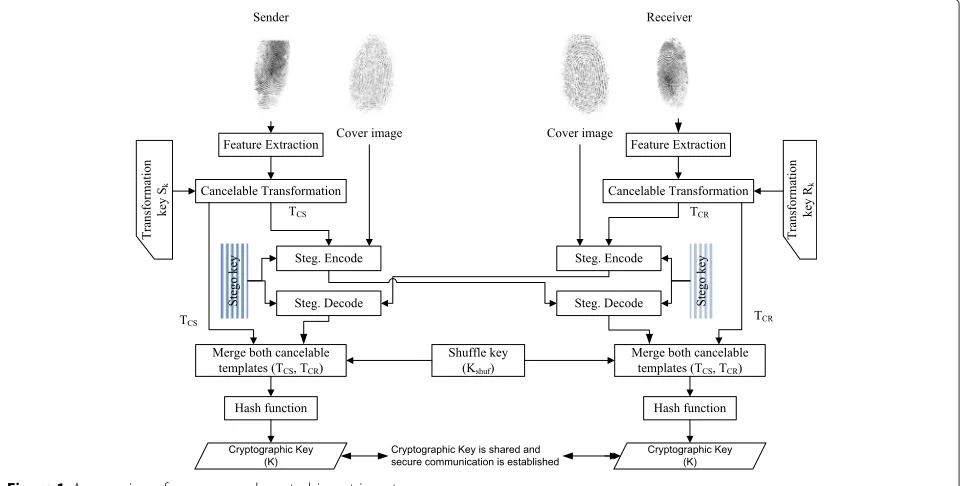
In this section, we discuss our proposed approach in details. An overview of our approach is shown in Figure 1. In our approach, both sender and receiver extract minu-tiae points from their own fingerprints. The minuminu-tiae points are transformed into a cancelable form called can-celable template. The cancan-celable templates are exchanged between them using steganography. The stego key (Kg) is used by both parties for secure steganographic use. The stego key is generated from a password (pwd) using PRNG. Both cancelable templates are combined together and shuffled using shuffle key (Kshuf) and finally the cryp-tographic key is generated from it following a hash func-tion. In this scheme, initial shuffle keyKshufand password pwdboth are selected by sender. Sender uses asymmetric cryptography to share the concatenated shuffle key and password, that is,Kshuf||pwd to receiver. Sender uses the public keyKpubof receiver to encrypt the (Kshuf||pwd) and sendsEKpub(Kshuf||pwd)to receiver. Receiver can decrypt the shuffle key and password using his own private key Kprv, and they are used for key generation and template sharing, respectively. The above-mentioned steps in our approach are stated in details in the following.
3.1 Feature extraction from fingerprint image
Figure 1An overview of our proposed crypto-biometric system.
• FS= Set of minutiae points extracted from sender’s fingerprint.
=ms1,ms2,. . .,msNs
; wheremsi =(xi,yi),msiis the ith minutiae points of sender’s fingerprint,i=1 toNs andNsis the size ofFS
• FR= Set of minutiae points extracted from receiver’s fingerprint.
=mr1,mr2,. . .,mrNr; wheremri =(xi,yi),mri is the ith minutiae points of receiver’s fingerprint,i=1 to NrandNris the size ofFR.
Note that, for all fingerprint images, it is a general obser-vation that number of minutiae points for a person lies within 50. However, in case, if there are more than 50 minutiae points (i.e.,Ns,Nr ≥ 50), then first 50 minutiae points according to their quality value would be selected and the rest be discarded.
3.2 Cancelable template generation
The fingerprint templates of both sender and receiver are transformed into a non-invertible forms, called cancelable templates, to provide revocability as well as privacy to the fingerprint data of both users before transmitting them to their counter partners. The position of minutiae features are changed using Cartesian transformation with the help of a user-specified transformation key (i.e.,Sk for sender andRkfor receiver). The overall process of transformation is discussed below.
1. The coordinate system is divided intoNcells of same sizeh×w, wherehis the height andwis the width of
the cells. The total number of cellsNcan be calculated with equation given below
N= (H×W)
(h×w) (1)
whereHandWare the height and width of the fingerprint image.
2. Each cell is denoted byCi,jwherei=1 ton(ncells in each row) andj=1 tom(mcells in each column). The cells can be represented in a one-dimensional vector, and cellCi,jcan be represented byctand the value oftcan be computed in the following way.
t= {(j−1)×n} +i (2)
where for any value ofi(1≤i≤n) andj (1≤j≤m), there will be a uniquetsuch as 1≤t≤Ncell. Each cell contains either no minutiae
or a set of minutiae points. It depends on the cell size, distribution of minutiae points in fingerprint image. For sender’s fingerprint, if thetth cellctcontainsnmt
number of minutiae then theith minutiae point of tth cell of senders fingerprint can be represented as msti and the value ofiis defined as1≤i≤nmt.
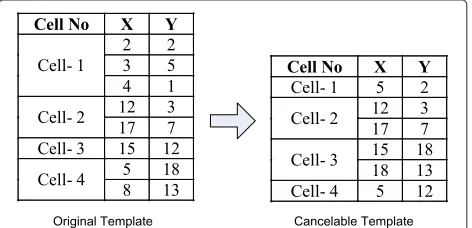
For an illustration, we divide the image space inton vertical cells andmhorizontal cells, and the cells are shown in Figure 2 where the two-dimensional cells are shown in left and the sequence number is shown in right side table.
Figure 2(x,y) coordinate space is divided into cells, and the equivalent cell numbers are shown in right.
Cij =Ci,jM (3)
whereCi,jis the original cell which is replaced by cell Ci,j. Here, one cell can replace zero or multiple cells.
The number of minutiae points (saynmt) in the new
cell can be the same or different.
4. Modify the (x,y) coordinates according to their new cell locations, and cancelable templateTCis generated as follows.
TC =F
Ci,j,Ci,j
(4)
The (x,y) coordinate values of all minutiae points belong toCi,jwill be placed to the cellCi,jaccording to the mapping function (F).
For the replacement of cellCi,jbyCi,j(i.e.,
Ci,j←Ci,j), the (x,y) coordinate value of minutiae
point of cellCi,jcan be computed for new location
as follows.
(a) Ifi=ithenxdi =xi
(b) Ifi>ithenxdi =xi+(i−i)∗w (c) Ifi<ithenxdi =xi−(i−i)∗w wherexiis thexcoordinate value of a minutiae points andxdi is the displacedxcoordinate value of the same minutiae points andwis the width of a cell of sizeh×w. Similarly, depending on the value ofj, theyjwill be changed toydj.
For example, a simplified coordinate value of minu-tiae points are divided by four cells and numbered as C1,1 = 1,C1,2 = 2,C2,1 = 3,C2,2 = 4. The Cartesian transformation is given in the following equation.
1 2 3 4 ⎡ ⎢ ⎢ ⎣
1 0 0 0 1 1 0 0 0 0 0 1 0 0 1 0
⎤ ⎥ ⎥
⎦=3 2 4 3 (5)
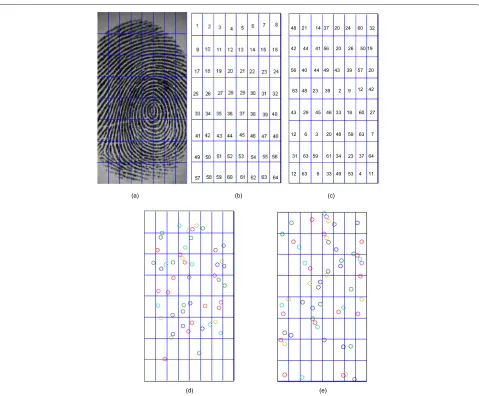
where, cells 1 and 4 are replaced by cell 3 while cell 3 is replaced by cell 4. The cell-wise coordinate val-ues of minutiae points before and after transformation are shown in Figure 3. A pictorial representation of the
cancelability transform, using real minutiae sets is shown in Figure 4. Here, we have divided the heightHand width W of the fingerprint image by 8 to make 8×8=64 cells of size H8 × W8. Also, it may be noted that the height and width of the cells in last row and last column may vary.
After transformation of fingerprint template using this transformation, the transformed template (TC), also known as cancelable template, contains modified minu-tiae points denoted bymsi, which representsith modified minutiae point orith elements of the cancelable template. In the cancelable template, we consider that it contains 50 modified minutiae points. If it exceeds 50, then we con-sider only first 50 elements and if it contains less than 50 elements, then we augment sufficient numbers of zero elements at the end to make it of intended size. In the sub-sequent discussion, the cancelable templates of sender and receiver are denoted byTCSandTCR, respectively, where TCS =
ms
1,ms
2,. . .,ms
NTCS|NTCS= |TCS|
and TCR =
mr1,mr2,. . .,mrN
TCR|NTCR= |TCR|
.
3.3 Steganographic encoding
In this work, cancelable template of one party (say sender) needs to be sent through a shared communication chan-nel to other party (say receiver) and vice versa. Sender (and receiver) uses steganography-based data hiding tech-nique to hide the cancelable template data into a cover image (I) (of sizeMIpixels, say). The cancelable template is converted into binary stream (s1,s2,s3,. . .sL), where L is the number of bits in cancelable template after the
Figure 4A pictorial representation of Cartesian transformation.(a)Original fingerprint image,(b)Cells ,(c)Cells which replaces the original cells,
(d)Original minutiae points,(e)Minutiae points in cancelable template.
conversion, which is to be hidden into cover image using LSB steganography [35]. A secret key, called stego key Kg, is generated from a password (pwd) using pseudo random number generator where the password is used as the seed value. The stego key (Kg = [k1,k2,. . .kNkg]; whereL ≤ Nkg ≤ MI] is used to select the pseudo ran-dom path of pixel locations in cover image (I) to hide the cancelable template bit by bit in cover image. The stego image (Istego) is sent to the recipient from sender and vice versa.
3.4 Steganographic decoding
In this phase, hidden data are extracted from the stego image (Istego) using the decoding function. The stego key (Kg) is used to locate the pixels where data embedding take place. The extracted binary stream is then used to reconstruct the cancelable template.
3.5 Merging cancelable templatesTCSandTCR
After receiving the cancelable template of the counter partner, receiving party merges his own cancelable tem-plate with the received cancelable temtem-plate. Say, sender has its own cancelable templateTCSand received the can-celable template TCR from receiver. Both TCS and TCR consist of modified minutiae points (msi,mri) of sender and receiver, respectively. These two cancelable templates are fused using the feature level fusion [20,36] of modified minutiae features.
Feature level fusion is achieved with concatenation of two feature sets [20] TCS =
ms1,ms2,. . .,msN
TCS
and
TCR=
mr1,mr2,. . .,mrN
TCR
. (|TCS| =NTCSand|TCR| = NTCR) to generate a combined templateTf(|Tf| =NTCS+ NTCR). For this purpose, all x coordinate values of ms
of mrI from TCR are augmented to the same vector. Simi-larly, theycoordinate values ofTCSandTCRare combined and stored in another vectorY. These two vectors (X,Y) generate a new (x,y) coordinates ofTf. The size ofTf is the total size ofTCSandTCR. That is
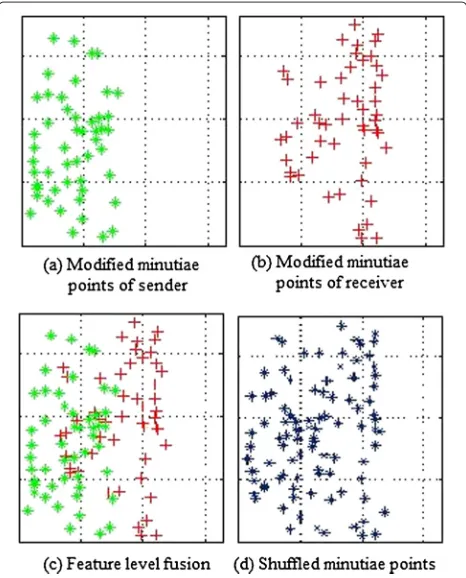
Tf =TCS||TCR; |Tf|=|TCS|+|TCR|. (6) where||denotes the augmentation operation,|Tf|is the size of Tf. In the combined template, redundancy may exist. The redundancy, if it exists, is removed, and only unique modified minutiae points are selected fromTf. As an example, sample feature level fusion of two feature sets is shown in Figure 5c.
The elements of vectorsXandYare shuffled separately using the shuffle key (Kshuf). The initial shuffle key (of 200 bits and 100 bits are required for each template) can be generated randomly. Our proposed shuffling method is illustrated in Figure 6. In this shuffling method, the vector elements where corresponding key bits are 1 are sorted starting at the beginning, and the remaining ele-ments where the key bits are 0 are placed starting from the end. In this way, all elements of vectorXandY are shuf-fled and the shufshuf-fledX,Yvectors (denoted asXSandYS) result a modified F. For example, a sample shuffledF is shown in Figure 5d.
Figure 5A snapshot of fused features and shuffled features.(a)
Modified minutiae points of sender.(b)Modified minutiae points of receiver.(c)Feature level fusion.(d)Shuffled minutiae points.
Each corresponding element of shuffled vectors (XSand YS) is merged using XOR operation. For this purpose,xi andyi (xi ∈ XSandyi ∈ YS) are converted into binary numbers and bitwise XOR operation is followed for all ele-ments ofXSandYS. The results of bitwise XOR operation are stored in a vectorFcode.
Fcode=
Fcodei =
bitwiseXOR(xi,yi) (7)
Finally, the cryptographic key is generated from this Fcodeusing a hash function which is as follows. TheFcode is divided into blocks (i.e.,Fcode = B1||B2||. . .||Bnb; say totalnbblocks) of size 256 bits each. A vector (K) of size 256 bits of all zeros is generated as the initial hash value. Now, blockB1is XORed with initialK and the output is stored inK2. TheK2is XORed with the next blockB2and the result is stored inK3and so on. Finally, the hash value Knb+1 is the cryptographic key (K). That is
Ki+1=(Ki⊕Bi); wherei=1 tonband|Ki|=|Bi|=256 bits (8)
This way, sender and receiver both derive the same secret key which establishes a secure communication between the sender and receiver for a session. For a new session, a new session key can be generated from the same fingerprints using an updated shuffle key, which is discussed in the next sub-section.
3.6 Shuffle key update
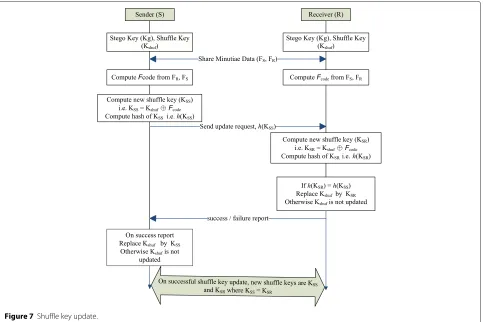
For better security measure, we propose to change the cryptographic key in each session. In other words, if there is a chance to compromise cryptographic key, then it is desirable that the key must be canceled and a new key be used for the next session. Further, we may note that if both cancelable templates become known to a third party then with the knowledge of key generation algorithm, key can be derived by the third party. But, in our approach, cryptographic key generation depends on another factor namely shuffle key (Kshuf). The revocability of the cryp-tographic key is achieved with not only the cancelable fingerprint template but also with shuffled key. Our pro-tocol is also able to update the shuffle key time to time using the fingerprint data of both users. To realize this, we propose to update the shuffle key from one session to another. Session-wise shuffle key update procedure is shown in Figure 7. Initiation to update shuffle key can be taken by sender or receiver.
The steps followed in our shuffle key update process when it is initiated by the sender are given below.
Figure 6Shuffling method.
2. Shuffle key (Kshuf) is XORed with the first|Kshuf|bits
ofFcodeto obtain a new shuffle key (KSS), that is,
KSS=Kshuf⊕Fcode.
3. Sender computes the hash value of the new shuffle key (h(KSS)) and sends it along with update request
to receiver. We have used XOR-based hash function (h), as discussed in Section 3.5.
4. Similarly, receiver also generates a new shuffle key (KSR =Kshuf⊕Fcode) and computes the hash of the
new shuffle key (h(KSR)) using the same one way
hash function (h) which is used in sender side.
5. Receiver compares the computed hash (h(KSR)) with
received hash (h(KSS)), if both are same, then
receiver replaces old shuffle key (Kshuf) with new one
(KSR) and sends success message to the sender.
6. On the basis of receiver’s report, sender also replaces the old shuffle key (Kshuf) with new shuffle key (KSS).
In this way, both sender and receiver are able to update their shuffle key. In every session, a unique shuffle key is generated from the fingerprint data of sender and receiver. After the session is over, old shuffle key is destroyed
and modified one is used for next session of communi-cation. In this way, our approach can provide the diver-sity of cryptographic key of fingerprint-based symmetric cryptography.
4 Experiment and experimental results
There are mainly two objectives in our experiment. First, we investigate the impact of data encoding into cover images (i.e., synthetic fingerprints from DB4 of each database) and accuracy of data decoding from stego images. In the next part of our experiment, we measure the randomness of cryptographic key generated from fin-gerprints of genuine users with respect to the key gener-ated from impostor’s fingerprints. In this regard, the Ham-ming distances between the genuine and impostor’s keys are measured and corresponding histograms are plotted. Here, we consider all possible cases of attacks when differ-ent differ-entities are compromised and the Hamming distances are computed for each case.
4.1 Database
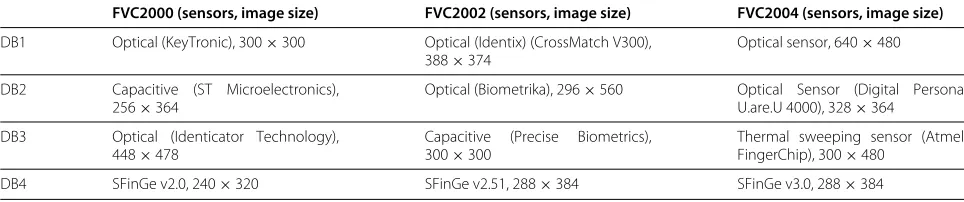
We have tested our work using the fingerprint images from publicly available fingerprint databases, FVC2000 [37], FVC2002 [38], and FVC2004 [39]. Each FVC database has four subsets labeled as DB1 to DB4. Each subset has a development set (B) (from fingers 101 to 110) with ten people and a test set (A) with 100 peoples (fingers from 1 to 100). There are eight samples for each person. The details of fingerprints used in our experiment are shown in Table 1. In these databases, DB1, DB2, and DB3 are real fingerprint databases and DB4 is synthetic fingerprint [40] database. In set B of each databases, total number of fingerprint images are(10×8×4)=320; and in set A of each database, there are 100×8×4= 3, 200 fingerprint instances.
4.2 Experimental setup
A unique pair of fingerprints is taken (as fingerprint of sender and receiver) from a subset (i.e., DB1 or DB2 or DB3 or DB4) of a specific FVC to generate a genuine key. All remaining pairs of fingerprints in the same subset of the same FVC database are taken to generate impostor keys with respect to that genuine key. This way, all pairs of
genuine fingerprints and corresponding pairs of impostor fingerprints are chosen. Initially, all unique combination of two person’s fingerprints from 110 person’s fingerprints of each subset of the fingerprint database is computed. Thus, the total number of pairs for genuine users is 1102 = 55 for each subset (i.e., DB1, DB2, DB3, and DB4 for both sets A and B). For each FVC database (considering all four subsets of set (A+B), the total number of genuine keys is 4× 55 = 220. Similarly, for every genuine key, remaining 54 keys are impostor keys. In our experiment, the duplicate pairs of genuine and impostor fingerprints are avoided carefully. As a result, we get 220×3 = 660 impostor’s keys per FVC database and a total number of 3×4× 55×254 =17,820 impostor’s keys.
Now, the minutiae points from fingerprint images are extracted using NBIS software (MINDTCT) [41]. The MINDTCT tool takes fingerprint image as input and returns minutiae points set in the format of (x,y,θ,q) where q is the quality of that minuitae point. Average number of minutiae points is found as 50. We consider only (x,y) coordinates of first 50 minutiae points accord-ing to the quality of minutiae reported by MINDTCT in our experiment. The minutiae points are transformed into cancelable template with a user-specified transformation key (Section 3.2). We have divided the fingerprint images into 64 cells. The cell size is computed by dividing the height (H) and width (W) with 8 (i.e., cell size= h×w whereh= H8 andw= W8). The cancelable template con-verted into binary stream (Section 3.5). Most of the sizes of fingerprint images are within the range of 256 to 511. The maximum values ofxandycoordinate points thus can be represented with 9 bits binary numbers. However, as exceptions, the ycoordinate value of the fingerprint images in some FVC2002 database (it is A and B sets in DB2), and thexcoordinate values of fingerprint images in FVC2004 database (e.g. A and B sets in DB1) exceed the range of 511. As thexandycoordinate values of minutiae points in almost all fingerprint images are less than 512, we represent them by 9 bits (maximum decimal value with 9 bits is 29−1=511). Of course, the coordinates exceed-ing 511 are with a less approximation, which do not affect the results adversely. The values ofxandycoordinate of modified minutiae points (i.e., the elements of cancelable
Table 1 Fingerprints used in our experiments
FVC2000 (sensors, image size) FVC2002 (sensors, image size) FVC2004 (sensors, image size)
DB1 Optical (KeyTronic), 300×300 Optical (Identix) (CrossMatch V300), 388×374
Optical sensor, 640×480
DB2 Capacitive (ST Microelectronics), 256×364
Optical (Biometrika), 296×560 Optical Sensor (Digital Persona U.are.U 4000), 328×364
DB3 Optical (Identicator Technology), 448×478
Capacitive (Precise Biometrics), 300×300
Thermal sweeping sensor (Atmel FingerChip), 300×480
a specific person. In our approach, stego key (Kg) is also generated randomly (using PRNG in MATLAB) from a password (pwd) and a unique stego key is assigned to each cover image of the synthetic fingerprints (i.e., the fin-gerprints in DB4). A unique shuffle key (pseudo random number) is used for a unique pair of fingerprint images.
We use synthetic fingerprint [40] from DB4 database (of FVC2000, FVC2002, FVC2004) as the cover image to hide cancelable fingerprint template of genuine users using LSB steganography. The cover image is picked up at ran-dom by both sender and receiver. A stego key (Kg) is used to locate the pixels of cover image where the cancelable template (CTS,CTR) bits are hidden during steganographic encoding (Section 3.3). Similarly, the same stego key is used to decode the cancelable template bits from stego image during steganographic decoding (Section 3.4).
Note that in our experiment, both sender and receiver exchange their own cancelable template between them using the same stego key (Kg) but different cover images (sayIS,IR).
4.3 Experimental results
The results of our experiment are stated below with respect to different scenarios.
4.4 Case 1: Impact of steganography
In our experiment, effect of data encoding over cover image is investigated and we follow the evaluation method as given in [26,27]. The stego key Kg is fixed for each unique pair of users and it differs when the pair of sender and receiver is changed.
Few observations are summarized in Table 2. The first column is the average pixel value for cover images. The second column is the average pixel value for the stego images. The third column is the pixel change with respect to cover image. The last column represents the absolute pixel change of the total encoded pixels. It is also observed
Table 2 Effect of steganography
Cover pixel Stego pixel Overall pixel Absolute pixel average average change change
173.26 173.48 0.47% 50.45%
key. In this condition, we compute the Hamming distance between genuine and impostors’ keys and the Hamming distances are plotted using histogram. The histogram in Figure 8a shows the distribution of Hamming distances of 17,820 comparisons between genuine and impostors’ keys. It is observed from the histogram that mean Ham-ming distance is 49.95% which means that the average hamming distance between the genuine and impostors’ key is 128 bits. In this case, the Hamming distances are spreaded between the range of 34.38% to 62.11% with a standard deviation of 0.032. According to the quantity of impostor’s key, it is observed that 40% to 60% bits of the genuine keys are different from 99.89% impostor’s keys. There is a small number (0.04%) of impostor’s key whose unmatched bits are below 40%.
4.6 Case 3: Shuffle key is known
Now, we consider that the shuffle key (Kshuf) is compro-mised by the attacker and an attacker tries to generate the same cryptographic key using this shuffle key from the fingerprints other than genuine fingerprints. In this case, same shuffle key (Kshuf) is used to generate genuine and impostor keys. The transformation keys (Sk andRk) are distinct for each fingerprint. In our experiment, Hamming distances are computed to measure the similarity or dis-similarity of the genuine keys and impostor’s keys. The observation is shown using histogram in Figure 8b. In this case, the Hamming distances are distributed from 37.50% (minimum) to 61.33% (maximum) with a mean of 50% and standard division of 0.0309. Maximum impostors’ keys (i.e., 99.85% impostors’ keys) differ from genuine key with the range of 40% to 60% Hamming distances. Even when the similarity of the impostor’s key is maximum (i.e., 62.5% bits are similar), the attacker needs to guess 96 bits (i.e., 296trials in brute force attacks) to crack the genuine key.
4.7 Case 4: Only one genuine fingerprint/cancelable template is known
Figure 8Hamming distances between genuine and impostor’s keys.(a)Kshufand fingerprints are unknown.(b)OnlyKshufis known.(c)One
4.8 Case 5: One genuine fingerprint and shuffle key are known
In this case, we consider that the impostor knows the cancelable template of either sender or receiver and the shuffle key (Kshuf) to be used in the key generation. In this case, one fingerprint along with transformation key (either Sk orRk) andKshufare common in genuine and impos-tor keys. Hamming distances are computed and plotted using histogram. The histogram in Figure 8d shows that the knowledge of fingerprint and shuffle key helps the attacker slightly. In this case, minimum 31.25% bits of the genuine key is changed with respect to impostor’s key and maximum 65.23% bits of the impostor’s key are different from genuine key.
4.9 Case 6: Both genuine fingerprints are known but shuffle key is unknown
Let us consider that attacker has complete knowledge about both genuine fingerprints or cancelable templates but no knowledge about shuffle key Kshuf. In this case, we have used same cancelable templates (i.e., same finger-prints with sameSkandRk) with ten different shuffle keys to generate ten impostors keys and compare the similar-ity between genuine key and these impostors keys with respect to Hamming distance. The histogram in Figure 8e shows that an attacker is not able to compromise the cryp-tographic key even when both fingerprints/templates are known but the shuffle key is unknown. The average Ham-ming distance between a geneuine and impostor key is 49.99% of the length of cryptographic key. The most of the impostor’s keys (99.86% of impostor’s keys) are reported a dissimilarity between the range of 40% to 60% with respect to genuine key.
From our experimental results, we may conclude that an attacker is not able to generate the cryptographic key without the complete knowledge about both shuffle key and fingerprints of sender and receiver. According to our experiment, for all cases, minimum Hamming distance is 31.25% (case 5), that is, 80 bits of the impostor’s key are mismatched and maximum Hamming distance is about 65.63% (case 4) that is, 168 bits of the impostor’s key are needed to correct to break the genuine key. It is also
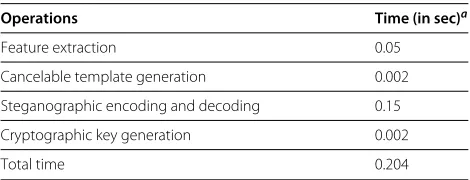
that maximum time is required for steganographic encod-ing and decodencod-ing and minimum time is required for key generation from cancelable template.
5 Security analysis
In this section, security efficacy of the proposed approach is analyzed under different conditions. In our work, both communicating parties exchange their fingerprint data after transformation and mutually agree on two secrets like stego key (Kg) and shuffle key (Kshuf).
5.1 Privacy of fingerprints
We use least significant bit (LSB)-based steganography to exchange fingerprint data between sender and receiver. In our proposed approach, stego key (Kg) is used to hide fingerprint data in the pixels which are randomly chosen from cover image. For each communication, a unique syn-thetic fingerprint image (I) is used as cover image. An eavesdropper does not suspect the existence of the gen-uine fingerprint data (i.e., cancelable template) due to high imperceptible stego image (Istego). The cover image is not required to decode the hidden data from stego image. An adversary, with sufficient knowledge of decoding meth-ods, is not able to extract the correct fingerprint data from the stego imagesIstegoS andIstegoR of sender and receiver, without possessing theKg. Our experimental result shows that only 0.47% pixels of cover image is modified, which assures that the conventionalTargeted Steganalysisis not able to detect the existence and meaning of the hidden data [42]. The statistical steganalysis-likehistogram attack [43] detects only sequential embeddings but it does not detect the random embedding of small size message ( i.e.,
Table 3 Computation time of our approach
Operations Time (in sec)a
Feature extraction 0.05
Cancelable template generation 0.002
Steganographic encoding and decoding 0.15
Cryptographic key generation 0.002
Total time 0.204
size<50% of available LSB ofI). Another steganalysis-like sample pair analysis[44] is able to detect message embed-ding of size up to 5% of the available embedembed-ding space (LSB) of cover image while RS analysis [45] can detect embedding of message of size 2% to 5%.
Both sender and receiver share their fingerprint data in a transformed format, that is, cancelable template. Receiver is not able to derive the minutiae points of sender’s finger-print from cancelable template of sender and vice versa. It assures that fingerprint identity of one user is not dis-closed to other user. Even if the transformation process and transformation key are disclosed, the attacker will not be able to compute the entire set of original minutiae points from the cancelable template. This can be argued as follows.
• According to the nature of transformation key, some cells may replace multiple cells and some cells may not replace any cell but they may be replaced by other cells. For example, say, there are four cells (1, 2, 3, 4) and they are replaced by (3, 2, 4, 3). Now it is found that cell 3 replaces cells 1 and 4, and cell 1 does not replace any cell. If transformation key and cancelable template both are compromised, then attacker may know the minutiae points belongs to cell 2, 3, and 4 but not of the cell 1.
• In fact, an attacker needs to know the complete information about the fingerprint image size, that is, height and width of the image to compute the minutiae points accurately.
The cancelable templates (TCS,TCR) are fused, and the resultant template (Tf) of fusion is shuffled and hashed to generate cryptographic key (K). Therefore, the cryp-tographic key is non-invertible, which confirms that the cryptographic key does not leak any information about the fingerprints of users.
5.2 Security of cryptographic key
In our approach, the cryptographic key is generated from the combination of two fingerprints of sender and receiver. The key is not shared by them but generated at their end separately. There is no need to store the key for the use in decryption. So the key is secured from any attack. An attacker needs to compromise either (stego key Kg, sender’s stego imageIstegoS , receiver’s stego imageIstegoR , shuffle key Kshuf) or (sender’s fingerprint FS, receiver’s fingerprintFR, transformation key of senderSK, transfor-mation key of receiverRK,Kshuf) to generate the genuine cryptographic key (K). Otherwise, the following condi-tions arise for different attacks.
5.2.1 Known stego key attack
It means that the stego keyKg is compromised by eaves-dropper who eavesdrops both stego images IstegoS and
IstegoR . Next, as the shuffle keyKshufis unknown, he has to guess theKshuf which is of 200 bits. It requires a trial of 2200to break theK
shufusing brute force attacks. Indeed, withoutKshuf, it is almost impossible to compute the orig-inal cryptographic key even if both fingerprints data are known.
5.2.2 Known shuffle key attack
It happens when the token is stolen or lost and the attacker gets access to the shuffle key (Kshuf) but he has no knowl-edge about the fingerprint data of genuine sender and receiver. In this case, the attacker has to guess 50 + 50=100 minutiae points for two fingerprints. Otherwise, he has to compute the key using impostor’s fingerprints which may be available to him. As the fingerprint is unique for a person, there is a rare chance to get the same fin-gerprint from impostor’s finfin-gerprint database. Even in our experiment, there is no collision between genuine cryptographic key and impostor’s cryptographic key when the Kshuf is known. The shuffle key is updated in every session, which guarantees that it is impractical to com-pute theKshuf of previous session or the same of future sessions.
5.2.3 Known fingerprint attack
In this attack, there are two scenarios that may occur. In the first scenario, only the fingerprints of both parties are compromised but transformation key is not known by attacker. In the second scenario, the attacker has complete knowledge about the fingerprints along with transforma-tion key, that is, the attacker is able to generate can-celable templates from fingerprints (of both sender and receiver) using the transformation keys and algorithm of transformation.
In the first case, attacker is not able to generate even cancelable template from the knowledge of genuine fin-gerprint. An adversary should know two parameters (i.e., fingerprint and transformation key) along with transfor-mation function (fc), to generate cancelable template from fingerprint template. Now according to the condition, adversary knows FS, FR, and fc but does not have any idea about transformation keys (SK,RK). Similarly, to gen-erate the cryptographic key, an adversary should know another parameter which is shuffle key (Kshuf) also. The key generation function fk is known as it is public, but all other three parameters are to be compromised by the attacker.
K = fk{fc(FS,SK),fc(FR,RK),Kshuf}
= fk{fc(FS, ?),fc(FR, ?), ?}
and or cryptographic key (K) are compromised by the attacker. Our proposed approach assures that compro-mise of (Kshufi or Ki) of ith session does not affect the previous or future session asKshufi = Kshufi+1 = Kshufi−1 orKi =Ki+1=Ki−1. In our approach, bothKshufandK are updated session wise. Initially,Kshufis randomly gen-erated and time to time it is updated with the help ofFcode. Cryptographic key (K) is revocable and is used as a ses-sion key for symmetric cryptography. When the sesses-sion is over, the current session key is destroyed.
5.2.5 Resists replay attack
Our approach can prevent replay attack using session key. In every session of communication, a unique session key is used to establish a secure communication between sender and receiver and the session key is destroyed after the session. Our proposed approach is able to generate 100!×100! different cryptographic keys from two finger-print biometric traits. If an eavesdropper wants to make replay attack using a message previously transmitted by legal users, then it will make no sense to the legal user as the cryptographic key is changed. Even when stego image is used for replay attack, eavesdropper is not able to decode the stego image without the stego key.
5.2.6 Resists man-in-middle attack
In our approach, fingerprints of communicating parties are transmitted over communication channel using data hiding scheme. If the man-in-middle (MiM) eavesdrops the stego image and is able to decode the hidden data by any means, then theMiMrequires the perfect knowledge of secret shuffle key (Kshuf). Otherwise, he is not able to generate the genuine key (K) and, as a result, is not able to decrypt the ciphertext sent by genuine sender.
Case 1: TheMiMis able to receive messages exchanged between sender and receiver. In the worst case, we also consider that theMiMalso knows the stego keyKg.
TCS = Ds
IstegoS ,Kg
TCR = Ds
IstegoR ,Kg
Kest = fk
TCS ,TCR ,Kshuf
able to receive the encrypted message sent by any genuine party.
KS = fk(TCS,Tmim,Kshuf) KR = fk(TCR,Tmim,Kshuf) KestS = fk
TCS ,Tmim,Kshuf
KestR = fk
TCR ,Tmim,Kshuf
where the cancelable template ofMiMisTmimandKS,KR are the keys generated by sender and receiver, respectively, and used in encryption.KestS andKestR are the estimated key by theMiMand used for decryption.
Now, theMiMtries to decrypt the encrypted messages (i.e., CipherSof sender, CipherRof receiver) received from sender and or receiver in the following ways,
CipherS = EKS(messageS) CipherR = EKR(messageR) messagemS = DKS
est(CipherS) messagemR = DKR
est(CipherR)
In the estimation of cryptographic keys KestS ,KestR , MiM trials the Kshuf which produces different keys, i.e., KestS =KS, and KestS =KR, which do not decrypt the ciphertexts correctly (i.e., messageS = messagemS and messageR = messagemR). In this way, our approach resists man-in-middle attack.
6 Conclusions
Cryptographic key generation and subsequently its main-tenance are the two important issues in traditional cryp-tography. A cryptographic key should be generated in such a way that it is hard enough to guess and then it should be managed without any overhead of users. This work addresses these issues and propose a novel approach to generate random cryptographic key using fingerprint biometric of sender and receiver.
trait. More significantly, there is no need to store the key, prior to communication. In fact, our protocol adds more security allowing to generate different keys in dif-ferent sessions. The proposed crypto-biometric system is resilient to many attacks such as known key attacks, replay attack, man-in-middle attacks, etc. Our proposed approach thus provides an effective solutions where we need a session-based cryptographic key during message transmission over an insecure network channel.
Competing interests
The authors declare that they have no competing interests.
Author details
1Department of Computer Science and Engineering, Govt. College of
Engineering and Textile Technology, 4, Cantonment Road, Berhampore-742101, West Bengal, India.2School of Information Technology, Indian Institute of Technology Kharagpur, Kharagpur-721302, West Bengal, India.3Department of Information Technology, Jadavpur University, Kolkata-700098, India.
Received: 15 May 2014 Accepted: 11 March 2015
References
1. W Stallings,Cryptography and Network Security: Principles and Practice, 5e. (Prentice Hall, 2010)
2. Advance Encryption Standard (AES),Federal Information Processing Standards Publication 197. (United States National Institute of Standards and Technology (NIST), November 26, 2001)
3. K Mitnick, W Simon, S Wozniak,The Art of Deception: Controlling the Human Element of Security. (Wiley, New York, 2002)
4. DV Klein, inProceedings of the 2nd USENIX Security Workshop (Portland). Foiling the cracker: A survey of, and improvements to, password security, (1990), pp. 5–14
5. F Hao, R Anderson, J Daugman, Combining Crypto with Biometrics Effectively. IEEE Trans. Comput.55(9), 1081–1088 (2006)
6. U Uludag, S Pankanti, S Prabhakar, AK Jain, Biometric Cryptosystems: Issues and Challenges. Proc. IEEE.92(6), 948–960 (2004)
7. D Maltoni, D Maio, AK Jain, S Prabhakar,Handbook of Fingerprint Recognition. (Springer- Verlag, New York, 2003)
8. K Nandakumar, A Jain, S Pankanti, Fingerprint-based fuzzy vault: Implementation and performance. IEEE Trans. Inf. Forensics Secur.2(4), 744–757 (2007)
9. N CT Charles, DJ Kiyavash, inProceedings of the 2003 ACM SIGMM workshop on Biometrics methods and applications. Lin, Secure smartcardbased fingerprint authentication (ACM New York, NY, USA, 2003), pp. 45–52 10. S Yang, I Verbauwhede, inProceedings (ICASSP’05). IEEE International
Conference on Acoustics, Speech, and Signal Processing,Vol. 5. Automatic secure fingerprint verification system based on fuzzy vault scheme (IEEE Philadelphia, Pennsylvania, USA, 2005), pp. v/609–v/612
11. S Dutta, A Kar, BN Chatterji, NC Mahanti, inProc. Adv. Concepts Intell. Vis. Syst.,LNCS 5259. Network Security Using Biometric And Cryptography (Springer Berlin Heidelberg, 2008), pp. 38–44
12. A Jagadeesan, K Duraiswamy, Secured Cryptographic Key Generation from Multimodal Biometrics: Feature Level Fusion of Fingerprint and Iris. Int. J. Comput. Sci. Inform. Secur.7(2), 28–37 (2010)
13. A Jagadeesan, T Thillaikkarasi, K Duraiswamy, Cryptographic Key Generation from Multiple Biometrics Modalities: Fusing Minutiae with Iris Feature. Int. J. Comput. Appl.2(6), 16–26 (2010)
14. F Monrose, MK Reiter, Q Li, S Wetzel, inProceedings of IEEE Symposium on Security and Privacy. Cryptographic key generation from voice (IEEE Computer Society Washington, DC USA, 2001), pp. 202–213 15. H Feng, CC Wah, Private key generation from on-line handwritten
signatures. Inform Manag. Comput. Secur.10(4), 159–164 (2002) 16. B Chen, V Chandran, inProceedings of 9th Biennial Conference of the
Australian Pattern Recognition Society on Digital Image Computing Techniques and Applications. Biometric Based Cryptographic Key Generation from Faces (Glenelg Australia, 2007), pp. 394–401
17. SVK Gaddam, M Lal, Efficient Cancellable Biometric Key Generation Scheme for Cryptography. Int. J. Netw. Secur.11(2), 57–65 (2010) 18. AK Jain, K Nandakumar, A Nagar, inSecurity and privacy in biometrics.
Fingerprint Template Protection: From Theory to Practice (Springer London, 2013), pp. 187–214
19. NK Ratha, S Chikkerur, JH Connell, RM Bolle, Generating Cancellable Fingerprint Templates. IEEE Trans. Pattern Anal. Mach. Intell.29(4), 561–572 (2007)
20. A Ross, AK Jain, Information fusion in biometrics. Pattern Recognit. Lett. 24, 2115–2125 (2003)
21. A Bodo, Method for Producing a Digital Signature with Aid of Biometric Feature. German Patent DE 4243908A1 (1994)
22. JH RM Bolle, S Connell, NK Pankanti, AW Ratha,Senior, Guide to Biometrics. (Springer-Verlag, New York, 2003)
23. NK Ratha, JH Connell, R Bolle, Enhancing Security and Privacy in Biometric-Based Authentication System. IBM Syst. J.40(3), 614–634 (2001)
24. S Kanade, D Camara, E Krichen, D Petrovska-Delacr˜etaz, B Dorizzi, Evry F, in Proceedings of 6th Biometrics Symposium (BSYM 2008). Three Factor Scheme for Biometric-Based Cryptographic Key Regeneration Using Iris (Tampa, Florida, USA, 2008), pp. 59–64
25. S Kanade, D Petrovska-Delacr˜etaz, B Dorizzi, inProceedings of Fourth IEEE International Conference on Biometrics: Theory Applications and Systems (BTAS), Washington, DC, USA, 2010. Generating and sharing biometrics based session keys for secure cryptographic applications, (2010), pp. 1–7
26. A Jain, U Uludag, Hiding Fingerprint Minutiae in Images. in Proceedings of Third Workshop on Automatic Identification Advanced Technologies (AutoID), (Tarrytown, New York. USA, 97–102 (2002)
27. A Jain, U Uludag, inProceedings of 16th International Conference on Pattern Recognition,vol. 3. Hiding a Face in a Fingerprint Image (Canada, 2002), pp. 756–759
28. A Jain, U Uludag, Hiding Biometric Data. IEEE Trans. Pattern Anal. Mach. Intell.25, 1494–1498 (2003)
29. N Agrawal, M Savvides, inProceedings of IEEE Computer Society Conference on Computer Vision and Pattern Recognition. Biometric data hiding: A 3 factor authentication approach to verify identity with a single image using steganography, encryption and matching (Miami Beach Florida, 2009), pp. 85–92
30. A Juels, M Wattenberg, inProc. 6th ACM Conf. Computer and
Communications Security, ed. by G Tsudik. A fuzzy commitment scheme (ACM New York, NY, USA, 1999), pp. 28–36
31. C Rathgeb, A Uhl.Context-based biometric key generation for Iris. IET Comput. Vis.5(6), 389–397 (2011)
32. C Yao-Jen, W Zhang, T Chen, inProceedings of IEEE International Conference on Multimedia and Expo (ICME’04), Taipei, 2004,Vol. 3. Biometrics-based cryptographic key generation (IEEE, 2004), pp. 2203– 2206
33. N Lalithamani, KP Soman, inThe 2nd International Conference on Computer Science and Information Technology. Towards Generating Irrevocable Key for Cryptography from Cancelable Fingerprints (Beijing China, 2009), pp. 563–568
34. N Lalithamani, KP Soman, Irrevocable Cryptographic Key Generation from Cancelable Fingerprint Templates: An Enhanced and Effective Scheme. Eur. J. Sci. Res.31(3), 372–387 (2009)
35. V Lokeswara Reddy, A Subramanyam, P Chenna Reddy, Implementation of LSB Steganography and its Evaluation for Various File Formats. Int. J. Adv. Netw. Appl.02(05), 868–872 (2011)
36. A Ross, K Nandakumar, AK Jain,Handbook of Multibiometrics. (Springer-Verlag, Berlin, Germany, 2006)
37. Fingerprint Verification Competition FVC2000, [Online]. Available: http://bias.csr.unibo.it/fvc2000
38. Fingerprint Verification Competition FVC2002, [Online]. Available: http://bias.csr.unibo.it/fvc2002
39. Fingerprint Verification Competition FVC2004, [Online]. Available: http://biometrics.cse.msu.edu/fvc04db/index.html
40. R Cappelli, A Erol, D Maio, D Maltoni, inProceedings of 15th International Conference on Pattern Recognition, 2000,vol. 3. Synthetic Fingerprint Image Generation, (2000), pp. 475–478
Submit your manuscript to a
journal and benefi t from:
7Convenient online submission
7Rigorous peer review
7Immediate publication on acceptance
7Open access: articles freely available online
7High visibility within the fi eld
7Retaining the copyright to your article