Result Based on Graphical Password and
Biometric Authentication for High Security
Rahul Bora# , Madhuri Zawar*
#Student ME-Computer Engineering, GF’s GCOE.,NMU GF’s Godavari College of Engineering, India
*Assistant Professor, Computer Engineering, GF’s GCOE.,NMU GF’s Godavari College of Engineering, India
Abstract-In the world of electronics and internet there is the transaction fraud for this it demands for highly secure identification and personal verification systems. The main goal of this security is to combine the graphical password by using persuasive cued click points along with the biometric authentication using finger nail plate surface including usability, security evaluation and implementation. It implements the graphical passwords scheme to improve the difficulty level of guessing it with biometric authentication which is efficient and convenient method by acquiring low resolution images of nail plate surface which is the outermost part of nail unit. Contour and texture is the main characteristics of nail plates which are represented shape based and their appearance features. For implementation of this we use the matching score level rules by employing decision and supporting vector machine. Here is the objective which provide highly secure authentication scheme to use the personal ID with graphical password using persuasive cued click point and biometric authentication using finger nail plate surface. In this there is limit of three fingers which is the scope of this paper. For better and strong password we use only three fingers for highly authentication for the purpose of some applications like banking, military, in forensic labs and civilians etc.
Keywords-Graphical Password, Biometric Authentication,
Security, Finger Nail Plate, Persuasive Cued Click Points.
I. INTRODUCTION
In the modern world of electronic it is important to secure the computer system for this use the high security is required and the ways are in various authentication types like graphical password authentication, token based authentication and biometric authentication. But high security required in military, banking and forensic labs this all types of authentication cannot provide the high security. Hence in the text-based password users can create the passwords which are remembering and it is easy for attackers to guess and also having the possibility to forget the text-based password for that information can be easily stolen by the hackers or attackers.
We are using the biometric authentication in that having some limitations in the existing system like in the finger knuckle which are more difficult to forge and in face recognition the characteristics of face can be changes with the age of an individual and in fingerprint technology the people can leave their fingerprint unconsciously wherever they touch an object and thus increasing the possibilities of imposter attacks and impersonation. So here we use the combination of two types of authentication for the system
to increase the level of security. Andwe provide here high security level by combining and integrating the biometric authentication by using finger nail plate surface and graphical password by using the persuasive cued click points to reach the highly security level as each of the both methods can provide the high secure authentication.
A. Motivation
Authentication of graphical password along with Biometric Authentication using finger nail plates motivates us to work on this. There are various types of applications they require the high security authentication for that there are various type of authentication which provides the security but out of them like textual password in that there is possibility to forget textual password by user and also can easily guess by attacker and also in biometric authentication there is some limitation in face, palm etc. So this scheme motivates us to increase the security level of fooling the access control system by using two different authentication methods in combination like graphical password with biometric authentication using finger nail plate. It combines the biometric and the graphical password based authentication methods to reach a higher security level than each of the both methods can provide alone. In addition it motivates the use of the biometric system in the verification and identification mode.
In nail plate authentication only the nail plate is regenerated as new cells are made, the ridge pattern which is present on the nail plate surface is highly unique and also stability. The structure of nail plate surface is highly unique of the individual and also in case of twins and also different finger nails of the hand. Thus unlike face characteristics which changes with the age of an individual, these characteristics of the nail surface can be very useful for identification over the entire lifespan of the individual. Also there has not been any attempt in utilizing the texture and the appearance based information of the nail-plate along with graphical based password authentication for human authentication and verification in literature. This has motivated us to explore the combination of these two types of authentication for security applications.
II. LITERATURE SURVEY
In the base of Graphical password authentication Pass Point, Cued Click Points technique in literature. In
create password user can selects any pixel in the image as a click-points for their password. The limitation of this method is the HOTSPOTS and attackers can easily guess the password because user forms certain pattern to remember the secret code so that pattern formation attacks are easily possible. In Cued Click Point [4] in that CCP uses one click-point on five different images in sequence instead of five click points on one image. The next image displayed is based on the previously entered the click point on the image. Limitation of this method is false accept (system can be accept incorrect click point) and false reject (system can be reject correct click point).this method reduced the pattern realization attack but HOTSPOT problem is still present. And also in biometric authentication there are various biometric scheme in the literature such as face, retina, fingerprint/palm print Iris, etc. but in hand based biometric scheme like in palm print [5] and finger print[6] the palmer part of the hand is more susceptible to spoof attacks and also people unconsciously leave their palm and finger prints on the object whenever they touch. And also in finger knuckle [7] which are more difficult to forge and in face recognition the face characteristics changes with the age of an individual.
III. BIOMETRIC AUTHENTICATION USING FINGER NAIL PLATE SURFACE
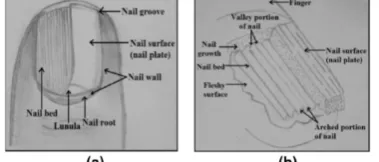
Now a days, the biometric system is received the hand based biometric authentication which can uses the various features which can be discrete and consultative. In this paper we examine that the real performance and some capabilities from the biometric finger nail plates which can be definite character achieved for the personal authentication system. In the biometric authentication of nail plate surface the ridge pattern is available on the nail which is highly uncommon in case of single and in twins and also other fingers of hand. Before that there is no attempt is utilized of texture and appearance based feature of finger nail plate for the personal authentication as like that it is very challenging characteristics of finger nail plate from hand it become visible as a guarantying fundamental of biometric study [1]. This new system is based on the outer part of finger nail and nail plate is challenging biometric device for military, forensic and civilian applications. The tongue-in-groove arrangement of the dermis and epidermis layers of the nail bed is referred to as arched and valley portion in Fig. 1(b) and it forms a structure that is unique, closely parallel and irregularly spaced. This grooved spatial arrangement of the nail bed is observed on the upper (convex) nail plate surface as longitudinal ridges/striations.
Fig 1: Finger nail surface in (a), magnification of the nail bed structure in (b)
These longitudinal striations simulated on the nail plate surface are highly unique for every individual for personal authentication. Thus, the individuality in the uniqueness of nail plate is based on biometrics which is completely depending on the essential anatomic characteristics of the nail organ [1].
IV. PERSUASIVE CUED CLICK POINT
In the previous models of click based graphical passwords it shown problems of hotspots, to reduce the space for effective password which can simplify the improving dictionary attacks. By adding the CCP features into Persuasive Cued Click Points it generates the password. We analyze that passwords choice influenced by user to select random clicks for maintaining the usability. For the generating password, PCCP uses the some requirements like viewport and shuffle. In this model of PCCP when certain image shown randomly selected block known as viewport and other portion of image shaded except the viewport and for this user can select the particular portion of viewport in the image (see Figure 2). For creating the secure graphical password the system can choose images randomly from selecting viewport of each image. User can select or click anywhere in the image of view port and they are having another option to change the position of view port which is known as “Shuffle”. For attackers it is very complex to guess the click points in all images because the limitation of changing the position of view port. The viewport and shuffle button will be appearing at the time of registration process [1].
Fig2: PCCP creates Password hint.The viewport highlights part of the image
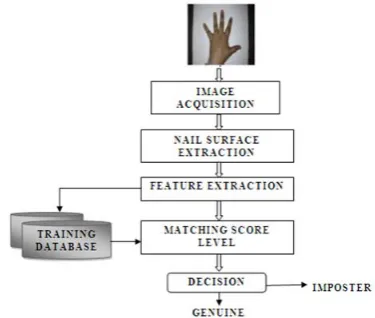
A. Block diagram of personal identification by using nail plate
Fig 3: Block diagram of personal identification using nail plate
Above block diagram shows the dorsal part of the hand image acquired from A630 Digital canon camera. The low resolution images acquired using unconstrained, user-friendly, and peg free imaging setup [2]. User can free for placing the hand in any orientation. Thus, the acquired hand images present a lot of translational and rotational variations. To extract the perfect Region of interest (ROI) of nail plate the pre-processing steps is needed to acquire dorsal hand images. Firstly the each acquired dorsal hand image is first subjected to binarization using a fixed threshold value and remove some noise is still present in image which is subjected to morphological corrections which fills hole inside the background and remove the background debris and resulting the binary mask which is further used for finger localization and alignment. Then to locate the key points in the hand i.e. tips and valley point for eliminate the some rotation and translation variation. Then global hand registration techniques used for normalize the hand and re orientation of the fingers and further used to extract the accurate Region of interest. Then further decompose the finger by drawing the binary line of zeros between two adjacent valley points. Further, the nail plate surface segmentation approach presented to accurately segment the ROI with the grown nail plate or presence of nail polish on the female nail plate surfaces. This approach works at pixel level, and classifying the each pixel into nail plate or non-nail plate region and then Gabor filtering technique is used to extract completely automated and accurate extraction of nail plate ROI .And then matching the extracted feature with database by using score level rules for fusion of matching scores. Then matching the decision will be carried out i.e. imposter or genuine.
B. Mathematical Model
a) Localization of hand extremities: The W1 and W2 represents the size of two moving windows used to locate extremities along the distance distribution function, where W1~N/20 and W2~N/20 and N is the number of pixels in the hand contour.
Let, T = Vector storing the Tips indices , V= Vector storing the valley indices,
Cv = Boundary vector – Boundary Pixels of hand to locate local minima point and local maxima point
M = Midpoint of the hand wrist,
Dv = Distance Vector
Function: Find Extremities (W1, W2, Dv, N, T, V) While k < N-W
Increasing the value of k by 1 Window1 = Dv(k,k+1,…,k+(W1-1))
I1 = min(window1) I2 = max(window1) If i2_1 & i2_W1
If(i2+k-1=w2)<=N&(i2=k-1=W2)>=1 then Window2= Dv(i2=k-1-W2,….i2+k-1+w2)
Else if(i2=k-1-W2)<1 then Window2= Dv(1,2,….i2=k-1+W2) Else
Window2= Dv(i2+k-1-W2,….N) End
i3=max (window2) If i3=W2+1 then
Tip=i2+k-1
Update T with the index of the found Tip End
End
b) Global hand registration: The orientation of palm is found with the orientation of its left and right edges. ELF = palm edge and it can be obtained by calculating the reference distance Dref
DREF = reference distance and which is fixed to 0.7 times of distance from the tip of the little finger to valley between ring and little finger
L1 = Index of the valley between ring and little finger L2 = Other index of little finger
LM = Length of the middle finger Hwv = Horizontal width vector C = contour segment
Wp = Palm width
ETIF = edge between thumb and index finger WP = (mean of ELF - mean of ETIF) * HWV
c) Rotation and translation of binary hand:
θ = Rotation angle of the palm and is found from its horizontal width vector
θ= sign * ((R cos-1 ([0-1]) * HWV )) Where, Sign = sign is sign of first element Hwv.
d) Finger Decomposition:Angle of slope of finger
Midpoint of finger (X1, Y1) Tip of it = (X2, Y2)
e) Feature Extraction:
Haar wavelet- Provides information at finest resolution of image by pyramid. Used to detect local and global texture variations.
ψ(t) = mother wavelet of Haar wavelet ψ(t) = 1 0 ≤ t ≤ ½ t ≤ 0 & t≤0.5 -1 ½ ≤ t ≤ 1 t ≤ 0.5 & t<1 0 , otherwise
Scaling function Φ(t) = 1 0 ≤ t <1
V. EXPECTED RESULTS AND COMPARISION
Firstly user can enter the username and then select 3 images to create password after creating password user will get the message from the system i.e. successfully registered. After the registration user provides the username and verify. If the username is correct then first image will display and it continues till the last image. This process is done in graphical password authentication. After graphical password authentication the verification and identification of the person is done by using finger nail plate. In finger nail plate biometric authentication, the database consists of 2700 nail plate images of 180 users including both male and female. To capture 5 images per user of his/her left hand thus, the database consist of 180×5×3=2700 images of middle, index and ring fingers. For experimentation 3 samples are randomly select for training purpose and 2 samples for testing purpose. Then this training and testing samples are used for generating matching score and performance evaluation. When the test image is matched with the image which belonging to the set of training image of the same user then result will generate genuine otherwise result will generate imposter.
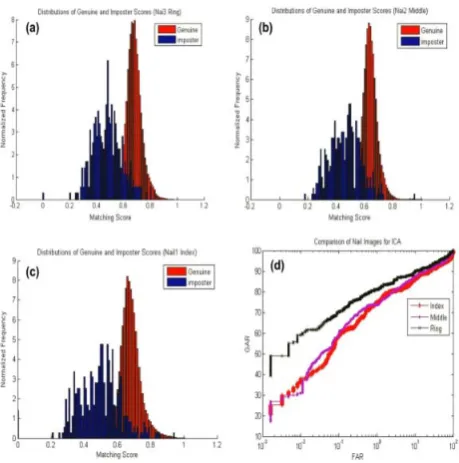
As we are expecting the results of biometric authentication using finger nail plate as per [2] has shown in figure 4 and 5. All the genuine scores and the imposter scores are subjected to a threshold for computing the error rates. The ratio of the number of imposters accepted as genuine to the total number of imposters is termed as FAR while the number of rejected genuine users as imposters to the number of all genuine users is termed as FRR. The database performance is evaluated in terms of the error rates. For a biometric authentication, FAR is specified and the corresponding GAR = 100-FRR is computed. We incorporated nail surface of middle, index and ring fingers from hand. The wavelet features are extracted of each of these finger nail plate surface. The genuine and imposter distribution for middle, index and ring finger as shown in Figure 4.The experiment reports of the performance of Haar wavelet features from individual index, middle, and ring fingers nail-plates.
Fig. 4. Impostor and genuine distribution for nail (a) ring, (b) middle and (c) index (d) their combined ROC.(Haar Wavelet)
Now in this experiment we are extracting wavelet features from ring, middle, and index finger nail-plates. The distribution of genuine and imposter matching scores from these three fingers are shown in Fig. 4(a), Fig. 4(b), and Fig. 4(c). Receiver Operating Characteristics (ROC) curve, this ROC is a plot of GAR vs. FAR for these finger nail-plates corresponding to wavelet feature is shown in Fig. 4(d). It can be observed from Fig. 4(d) that ring nail-plate provides the best performance among the middle and index nail plate surfaces with GAR = 50%, GAR = 40%, and GAR = 32% respectively at the same FAR = 0.001%. However, with increase in FAR = 1%, we
find corresponding increase in GAR = 76%, GAR = 75%, and = 72% for ring, middle, and index nail-plate surfaces, respectively.
The experiment reports of the performance of Independent Component Analysis features from individual index, middle, and ring fingers nail-plates.
Fig. 5. Impostor and genuine distribution for nail (a) ring, (b) middle and (c) index (d) their combined ROC.(ICA)
VI. CONCLUSION
There are various applications where they required high security for this purpose this paper combines the biometric and the username, graphical password based authentication methods to reach a higher security level than each of the both methods can provide alone. This presents a high security level to the system by providing the Persuasive Cued Click-Points technology which encourages users to select less predictable, and makes it more difficult to select graphical passwords where 275 all five click-points are hotspots and it is effective at reducing the formation of hotspots and avoiding known hotspots and also provide the biometric authentication using finger nail plate which provides a novel and fully automatic nail-plate identification framework. The ridge pattern on the finger nail plate surface has high stability over entire life and is highly unique. The nail surface structure is considered to be quite unique, even in the case of two identical twins and in different finger nails of an individual. In this we incorporated the three ring, middle and index finger nails from left hand. This highly secure authentication scheme increases the high security level.
ACKNOWLEDGMENT
We take this opportunity to thank Mr. Dipak pardhi for their valuable guidance and for providing all the necessary facilities, which were indispensable in the completion of this paper. We are also thankful to all the staff members of the Department of Computer Engineering for their valuable time, support, comments, suggestions and persuasion. We would also like to thank the institute for providing the required facilities, Internet access and important books.
REFERENCES
[1] S Chiasson,, E. Stobert, A. Forget, “Persuasive Cued Click-Points: Design, Implementation, and Evaluation of a Knowledge-Based Authentication Mechanism,”Proc. IEEE TRANSACTIONS ON DEPENDABLE AND SECURE COMPUTING, VOL. 9, NO. 2, MARCH/APRIL 2012.
[2] Amioy Kumar, Shruti Garg, M. Hanmandlu, “Biometric authentication using finger nail plates,” Proc in Expert Systems with Applications 41 373–386 Elsevier at sciencedirect,2014.
[3] Wiedenbeck, J. Waters, J. Birget, A. Brodskiy, and N. Memon, “PassPoints: Design and Longitudinal Evaluation of a Graphical Password System,” Int’l J. Human Computer Studies, vol. 63, nos. 1/2, pp. 102-127, 2005.
[4] S. Chiasson, P. van Oorschot, and R. Biddle, “Graphical Password Authentication Using Cued Click Points,” Proc. European Symp. Research in Computer Security (ESORICS), pp. 359-374, Sept. 2007.
[5] D. Zhang, W. K. Kong, J. You, and M. Wong, “Online palmprint identification,” IEEE Trans. Pattern Analysis and Machine Intelligence, Vol. 25 (9), pp. 1041-1050, 2003.
[6] N. Ratha, and R. Bolle, Automatic Fingerprint Recognition Systems, Springer, 2004.
[7] A. Kumar and Ch. Ravikanth,“Personal authentication using finger knuckle surface,” IEEE Trans. Info. Forensics & Security, vol. 4, no. 1,pp. 98-110, Mar. 2009.
[8] Bartlett, M. S., Movellan, J. R., & Sejnowski, T. J. “Face recognition by independent component analysis,” Proc in IEEE Transactions on Neural Networks, 13(6), 2002
[9] Shruti Garg, Amioy Kumar, and M. Hanmandlu, ”Finger Nail Plate: A New Biometric Identifier,”Proc in International Journal of Computer Information Systems and Industrial Management Applications. ISSN 2150-7988 Volume 6 (2014) pp. 126 – 138 and Industrial Management Applications. ISSN 2150-7988 Volume 6 (2014) pp. 126 – 138.