Research
Research
Research
Research
Research
Paper
Paper
Paper
Paper
Paper
Effect of
Effect of
Effect of
Effect of
Effect of βββββ Cyclodextrin Complexation on the
Cyclodextrin Complexation on the
Cyclodextrin Complexation on the
Cyclodextrin Complexation on the
Cyclodextrin Complexation on the
Solubility and Dissolution Rate of Carbamazepine
Solubility and Dissolution Rate of Carbamazepine
Solubility and Dissolution Rate of Carbamazepine
Solubility and Dissolution Rate of Carbamazepine
Solubility and Dissolution Rate of Carbamazepine
from T
from T
from T
from T
from Tablets
ablets
ablets
ablets
ablets
SARASIJA SURESH1, H. N. SHIVAKUMAR* AND G. KIRAN KUMAR1
Department of Pharmaceutics1, Al-Ameen College of Pharmacy, Hosur Road, Bangalore-560 027, Department of Pharmaceutical Technology, K. L. E. S’s College of Pharmacy, Rajajinagar 2nd Block, Bangalore-560010, India.
Carbamazepine was complexed with β-cyclodextrin in an attempt to enhance the solubility features of the drug. Phase solubility studies revealed a linear relationship between carbamazepine solubility and β-cyclodextrin concentration. The 3value of the stability constant (405.42 M-1) calculated from the phase solubility diagram
indicated that the complexes were adequately stable. Carbamazepine-β-cyclodextrin complex prepared by kneading method was used to produce dispersible tablets. A 23 factorial design was employed to investigate the effect of
factors such as amount of binder, hardness and type of disintegrant on the tablet disintegration time and dissolution rate. Mathematical models containing only the significant factors influencing each response were generated using multiple linear regression and analysis of variance. The three main factors studied had a significant influence on both the response parameters. In addition to the main factors, the two-way interaction factors also showed a significant effect on the release rate. Type of disintegrant emerged as the main effect with the highest statistical significance affecting both the responses. Two formulations with a combination of factors within the experimental domain were developed and evaluated to validate the mathematical models. The predicted values were found to agree with the experimental values, confirming the forecasting ability of multi-linear regression and ANOVA.
Carbamazepine is an anticonvulsant drug widely used in made to complex carbamazepine and β-CD with the aim
the treatment of simple and complex seizures, trigeminal to enhance the drug solubility. The work was also
neuralgia, and bipolar affective disorder. The drug is focused to quantify the effect of various formulation and
practically insoluble in water (<200 µg/ml), and its processing variables on the disintegration and dissolution
absorption is dissolution rate limited1. Carbamazepine is rates of dispersible tablets containing carbamazepine β
reported to form inclusion complex with β-cyclodextrin CD complex using a 23 factorial design.
(β-CD), which could improve its biological performance2.
Cyclodextrins are a group of structurally related
MATERIALS AND METHODS
saccharides that are formed by enzymatic cyclization of
starch by a group of amylases termed glycosyl Carbamazepine was a gift sample from Micro Nova
transferases. β-CD is extensively used to trap certain Laboratories Pvt. Ltd., Bangalore. β-cyclodextrin was
drug molecules inside its cavity and thereby modify their generously gifted by M/s Cerestar Inc., Chicago, USA. All
physicochemical and biological activity3. Methods such as
the other chemicals and reagents purchased from S. D.
kneading, neutralization, freeze drying, spray drying, and Fine Chemicals, Mumbai, were of laboratory grade.
solvent evaporation have been cited in literature for
preparation of drug-β-CD complexes3.
Phase solubility studies:
Phase solubility studies were carried out at room
As carbamazepine is the drug of choice in treatment of temperature (25°) in triplicate according to the method
paediatric seizures4, a dispersible tablet of the drug is
reported by Higuchi and Conners5. Excess amount of
highly recommended. In this context, an attempt has been carbamazepine was added to distilled water containing
various concentrations of β-CD (0.5-3 mM) in a series of
*For correspondence stoppered conical flasks and shaken for 48 h on a rotary
Whatman No. 1 filter paper and assayed for carbamazepine using a UV/Vis spectrophotometer (Shimadzu, UV 1601) at 285 nm against blanks prepared
using same concentration of β-CD in distilled water.
Preparation of carbamazepine βββββ-cyclodextrin complex:
Solid complexes of carbamazepine-β-CD were prepared
in 1:2 molar ratio following kneading method3. β-CD was
mixed in a glass mortar along with water to obtain a homogeneous paste. The drug was slowly added to the paste and the mixture triturated for 1 h. During the process, the water content of the paste was empirically adjusted to maintain the consistency of the paste. The paste was dried at 45° for 48 h, pulverized and passed through sieve #100.
Evaluation of the complexes:
An accurately weighed amount of the complex was dissolved in methanol and assayed for carbamazepine spectrophotometrically at 285 nm against blanks prepared
using same concentration of β-CD in the methanol. Thin
layer chromatography (tlc) has been used to a very limited extent to support the formation of inclusion
comlex6. The complex and the reference standard
solutions were spotted on tlc plates that were activated by heating at 105° for 1 h. The plates were developed in a chamber saturated with the solvent system comprising of ammonia and methanol in a ratio of 1.5:100. The plates were exposed to vapours of nitrous oxide and sprayed
with naphthylethylene diamine. The Rf value of the
complex was determined and compared with that of the reference standard.
Infrared spectrophotometry (IR) has been employed as a
useful tool to identify the drug excipient interaction7 .
Samples were analyzed by potassium bromide pellet method in an IR spectrophotometer (Shimadzu, FTIR
8700) in the region between 4600-400 cm-1. Complex
formation was evaluated by comparing the IR spectra of the solid complex and of the drug.
Differential scanning calorimetry (DSC) has been one of the most widely used calorimetric techniques to study the
solid state interaction of drug with β CD8. Samples of the
solid complex, pure drug, and β CD were taken in a
flat-bottomed aluminium pans and heated over a temperature range of 50-250 at a constant rate of 10°/min with purging of nitrogen (50 ml/min) using alumina as a reference standard in a differential scanning calorimeter (DSC-7, Perkin Elmer).
Powder X-ray diffraction technique (PXRD) has been extensively utilized along with DSC to study the interaction
between drug and β CD8. The diffraction studies were
carried out in a powder X-ray diffractometer (STOE
STADI-P) germanium monochromated Cu Kα radiation in
transmission mode. The samples were rotated during data collection to reduce orientation effects. PXRD pattern of
solid complex, pure drug, and β CD were recorded
between 2θ = 5 to 50° at 40 kV and 30 mA.
Formulation of tablets:
Dispersible tablets of carbamazepine-β-CD complex were
prepared by conventional wet granulation technique. The solid complex was dry-mixed with starch/sodium starch glycollate (SSG) and granulated with aqueous solution of polyvinyl pyrollidone (PVP K-30) and passed through sieve #16. The granules obtained were dried at 60° for 1 h and passed through the same sieve to break the lumps. The granules retained on sieve #40 were blended with starch/SSG, magnesium stearate, and talc and compressed into tablets using 12 mm flat punches to a hardness of 3.5 6.5 kg/sq cm in a rotary tablet press (Rimek minipress model RSB-4).
Statistical design:
An 8 run 23 factorial design9 consisting of 3 factors at 2
levels was set up to investigate the effect of different variables on tablet disintegration and dissolution rate. The amount of binder (A) and type of disintegrant (C) were investigated as the formulation variables, whereas tablet hardness (B) was studied as the processing variable. The
disintegration time (DT) and release at the end of 1 h (rel 60)
were evaluated as the responses (dependent variables). The levels and the variation intervals for the 8 formulations are outlined in Table 1.
Analysis of data:
The response parameters were fitted into a first-order
polynomial model (Y= b0+b1X1+b2X2+b3X3+----) by
performing a multiple linear regression analysis on Design expert 6.0.5 trial (Statease statistical software package). ANOVA was performed on the response parameters to identify the statistically significant effects and generate a predictor equation comprising only the significant main and interaction effects.
Evaluation of the tablets:
Uniformity of weight was determined by following the
official method10. Disintegration time was recorded by
following the IP procedure10 using USP XXIII
TABLE 1: SELECTED FACTOR COMBINATIONS AND RESPONSES FOR TABLETS PREPARED ACCORDING TO 23
FACTORIAL DESIGN
Formulation Factor levels*
C o d e Binder (% w/w) Hardness (Kg/sq cm) Disintegrant type Disintegration timea (sec) Release in1 ha (%)
1 -1 (2) -1 (4) -1 (Starch) 144.3±5.08 78.68±3.92 a +1 (4) -1 (4) -1 (Starch) 150.7±4.03 76.92±4.16 b -1 (2) +1 (6) -1 (Starch) 156.0±4.43 73.66±3.76 c -1 (2) -1 (4) +1 (SSG) 108.0±4.10 95.76±3.78 ab +1 (4) +1 (6) -1 (Starch) 168.7±5.50 74.58±3.88 a c +1 (4) -1 (4) +1 (SSG) 120.3±5.12 90.76±3.90 bc -1 (2) +1 (6) +1 (SSG) 126.7±4.63 89.82±4.14 abc +1 (4) +1 (6) +1 (SSG) 132.0±4.94 87.62±4.14
*The parentheses in the data represent the decoded factor levels. aThe data represents Mean values ± Standard deviation of three determinations
Hardness of the tablets was evaluated using a Monsanto
hardness tester11 (Tab Machines, Mumbai). The friability
of tablets for each batch was determined using automated
USP friabilator11 (Model EF-2, Electrolab, Mumbai). The
in vitro drug release studies from the tablets were carried out in USP XXIII dissolution apparatus-II (Model TDT 06T, Electrolab, Mumbai) using distilled water containing
0.1% sodium lauryl sulphate12.
RESULTS AND DISCUSSIONS
In the present work, complexation of carbamazepine with
β cyclodextrin was tried in an attempt to improve its
solubility and dissolution rate. The Phase solubility studies revealed a linear relationship between the aqueous drug
solubility with increase in β-CD concentration (R2=0.9946).
The phase solubility diagram can be classified as AL type,
according to Higuchi and Connors. The extent of complexation is characterized by the apparent 1:1 stability constant Ks, which was calculated based on the solubility
diagram. The Ks value was found to be 405.42 M-1
indicating that the complex formed was adequately stable. The results obtained from tlc studies were not conclusive
as the R values of the complex and the referencef
standard were not significantly different. Therefore, further characterization of the complex was carried out by IR, DSC and PXRD to study the solid state interaction
of drug with β CD. The IR spectra of carbamazepine
showed a characteristic peak at 3462 cm-1 (-NH valence
vibration), 1676 cm-1 (-CO-R vibration), 1598 cm-1 (-C=C
and -C=O vibration), and 1384 cm-1 (-NH deformation)13.
β-CD spectrum presents a large band between 3400 and
3900 cm-1 and peaks at 2923 cm-1, 1639 cm-1, 1417 cm-1 and
1157 cm-1. In the IR spectra of the solid complex, the β
CD main bands were found to overlap with the characteristic drug peaks, which can be attributed to low drug content in the solid complexes (9.43%w/w); however, the Carbamazepine characteristic peak at 1680
cm-1 could be clearly detected in the IR spectra of the
solid complex, which confirmed the formation of the inclusion complex.
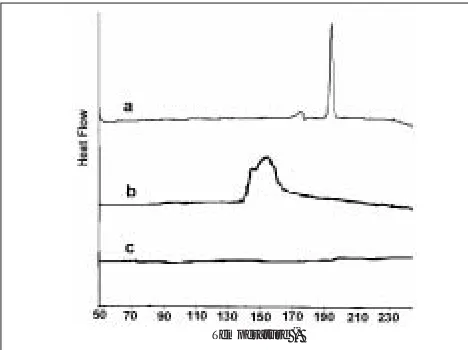
DSC thermograms of carbamazepine, β-CD, and the solid
complex are portrayed in fig. 1. The thermogram of the pure drug presents a sharp endothermic peak at 193.3°,
corresponding to its melting transition temperature14. The
broad band (140-170°) observed with β CD thermogram
corresponds to its dehydration. The solid complex did not display any such characteristic peak corresponding to carbamazepine melting which can be ascribed to the
formation of carbamazepine-β-CD inclusion complex.
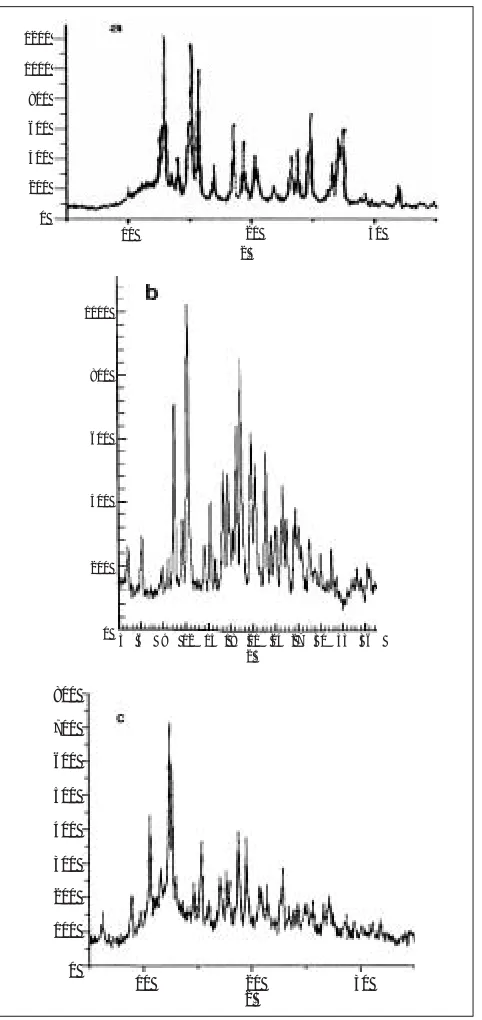
PXRD patterns for carbamazepine, β-CD, and the solid
complexes are shown in fig. 2. The crystalline nature of carbamazepine was clearly demonstrated by its characteristic PXRD pattern containing well-defined peaks. The drug characteristic peaks were observed at
15, 15.5, 24, and 27.5 2 θ values with intensities of 1100,
1000, 650, and 550, respectively. The PXRD pattern of β
Temperature ()
Fig. 1: A differential scanning calorimetric scan.
DSC thermograms of carbamazepine (a), βββββ cyclodextrin (b),
Intensity
Intensity
Intensity
0 200 400 600 800 1000 1200
10 20 30
2�
1000
800
600
400
200
0 3 6 9 12 15 18 21 24 27 30 33 36
2�
800
700
600
500
400
300
200
100
0
10 20 30
2�
Fig. 2: Powder X-ray diffractograms.
X-ray diffraction patterns of carbamazepine (a), βββββ cyclodextrin
(b), and Solid complexes (c).
CD also exhibited well-defined peaks at 12.5 and 19 2 θ
values with intensities of 1000 and 820, respectively. The diffractogram of the complex displayed well-defined
peaks at 12.5, 15, 19, and 22.5 2 θ values with intensities
of 700, 350, 400, and 250, respectively. Even though the PXRD diffractogram of the solid complexes displayed characteristic pattern corresponding to the crystalline drug, the peak intensities were reduced, indicating the
decrease in the drug crystallinity. This decrease in the drug crystallinity was responsible for the increased solubility of the solid complex when compared to that of the pure drug. The increase in solubility with decrease in
drug crystallinity has been cited in literature15. The IR,
DSC and PXRD studies collectively suggest a stronger
interaction between the drug and β-CD in the solid
complex due to formation of inclusion complex.
Several formulation and processing variables are found to affect the properties of tablets. The effect of several factors and their interactions can be determined simultaneously by factorial design experiments. In the present work, factorial design model was employed to quantify the effect of amount of binder (A), tablet hardness (B), and the type of disintegrant (C) on the disintegration time and release rate from tablets. Table 1 portrays the effect of the three factors as well as their interaction effects on the tablet disintegration time and drug release along with their level of significance.
With the aim to develop a tablet formulation with minimum disintegration time and maximum dissolution rate, preliminary trials were undertaken by varying the type of disintegrant and the amount of binder at different values of compressional force. The responses obtained were found to be a linear function of the factors selected. Based on the results obtained, the lower and higher levels of PVP K30 as well as the tablet hardness were fixed for the two disintegrants studied.
Triplicate results from the analysis of data obtained for each response parameter were fitted into a linear polynomial
equation of the form Y = b0+b1X1+b2X2+b3X3+b12X1
X2+b13X1 X3+b23X2X3+ b123X1 X2X3---- (1), where Y is the level of the response parameter, b is the regression coefficient for the first-order polynomial, and X is the level of the independent variable. ANOVA was performed to eliminate the non-significant terms from the equation and generate a simplified predictor equation containing only the significant terms. From this simplified mathematical model, the respective responses can be calculated without any further trials. In addition, the equation provides predictions of the behaviour of different formulations based on various combinations of the above mentioned factors.
The fitted linear model for disintegration time and rel 60
are represented as Eqns. 2 and 3, respectively. DT =
rel = 83.48–1.00 X –2.06 X +7.51 X +0.69 X X –0.7960 1 2 3 1 2
X1X3–0.21 X2X3—(3) (R2 = 1.000, P < 0.01).
From Eqn. 2, it was seen that all the three main effects A, B, and C had a significant effect on the DT. The type of the disintegrant (C) was the main effect with the highest statistical significance (F = 391). This can be attributed to the inclusion of SSG in the formulations that has resulted in appreciable lowering of the DT. The activity of SSG is due to the capillary action resulting in expansion and subsequent disintegration of the compressed tablet. SSG is super disintegrant, which expands in volume by 200 300% in water when compared to that of starch, which
expands by 10-25%16.
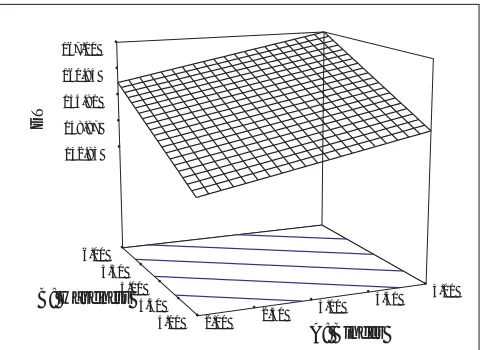
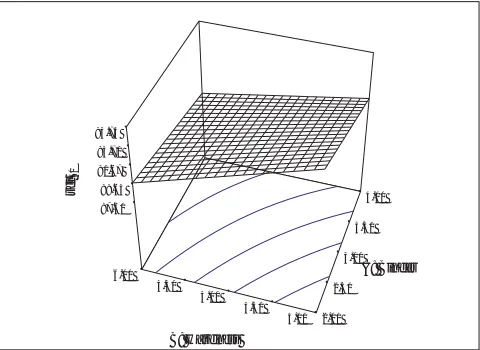
The results of ANOVA indicated that tablet hardness (F = 79.98) had a significant positive effect on the tablet DT. The 3-D surface plots (figs. 3 and 4) portray a linear relationship between tablet hardness and DT for the two disintegrants studied. A similar linear relationship between the increase in tablet DT with increase in the crushing
strength has been cited in literature17.
It is clear from Eqn. 2 that the amount of binder also had a significant positive impact on the DT (F = 29.86). The 3-D plots illustrate that DT augments with increasing levels of PVP K30 in case of both the disintegrants. The linearity of the contour lines reveals the fact that a low DT can be obtained using low levels of the binder at low hardness levels. All the three main effects were found to exert their influence on the DT independently without producing any interactions (C>B>A). This was well
167.00
160.95
154.91
supported by the earlier reports that DT was found to be independent of compressional force when SSG was used as disintegrant16.
Since the absorption of carbamazepine was dissolution rate
limited, drug release at the end of the first hour (rel 60) was
studied as one of the responses. The studies revealed a rank order correlation between the tablet DT and the drug release at the end of the first hour. The results of ANOVA revealed the fact that all the three main factors that influenced the tablet DT also had a significant impact on the drug release. Eqn. 3 shows that the two-way interactions also had a significant effect on the release rate (C>B>A>AC>AB>BC). As observed earlier, the type of disintegrant emerged as the main effect with highest
statistical significance (F = 2.51*105) to influence the drug
release. Tablets formulated using SSG disintegrated quickly and showed faster release when compared to tablets with starch.
The tablet hardness showed a significant negative influence on the drug release (F = 18769). The 3-D surface plots (figs. 5 and 6) portray an inverse
relationship between rel60 and tablet hardness for both
the disintegrants investigated. Eqn. 3 depicts the fact that the amount of binder (F = 4489) also had a significant negative influence on the drug release.
The contour lines showed that maximum release can be obtained using low level of binder coupled with low hardness levels. All the two-way interactions (AB, BC, and AC) were found to have a significant influence on
133.83
127.78
DT
121.74 148.87
142.83 DT
115.70
6.00
109.66
6.00 5.50
4.50 5.00 B: Hardness
3.00 3.50
4.00
2.50
4.00 2.00
A: Binder
Fig. 3: 3-D surface plots of the effect of binder and tablet hardness on disintegration time.
3-D surface plots showing the effect of amount of binder and tablet hardness on disintegration time when starch was used as disintegrant.
5.50
5.00 3.50 4.00
B: Hardness 4.50
2.50 3.00
4.00 2.00 A: Binder
Fig. 4: 3-D surface plots of the effect of binder and tablet hardness on disintegration time.
rel
60
TABLE 2: EXPERIMENTAL AND THEORETICAL VALUES OF THE RESPONSES PREDICTED FOR THE TABLET FORMULATIONS
Formulation Responses Predicted Observed % value value error
78.69
F1 DT 154.91 160.66 3.58
77.43
rel60 37.98 38.72 1.91
76.17
F2 DT 121.75 124.33 2.07
74.90
4.00 rel 45.49 45.86 0.81
60 73.64
3.50 The tablets F 1 and F 2 were compressed using PVP K-30 (3% w/w) as a binder
to a hardness of 5 kg/sq cm. F1 was prepared employing starch as a
3.00 disintegrant, whereas F2 was prepared using sodium starch glycollate as a
A: Binder disintegrant
6.00
5.50 2.50
5.00 4.50
observed response variables, theoretical and the 4.0 2.00
B: Hardness 0
predicted values along with the percent prediction error. The prediction error for the response variables ranged Fig. 5: 3-D surface plots of the effect of amount of binder and
between 0.81 and 3.58% with a mean±SD of the absolute error as 2.09±1.14. The low magnitude of error reflects the ability of multiple linear regression and ANOVA to predict the performance of the optimized formulations.
In the present work, an enhancement of solubility of
carbamazepine was obtained by its complexation with β
CD. The incorporation of carbamazepine previously
complexed with β-CD influenced its solubility and
dissolution rate from tablets. The results obtained justify
tablet hardness on drug release.
3-D surface plots showing the effect of amount of binder and
tablet hardness on drug release when starch was used as
disintegrant.
95.74
93.71
rel
60 91.67
the use of 23 factorial studies to quantify the effect of
89.64
4.00
87.60 several formulation and processing variables as well as
3.50
their interactions on the tablet properties, which would 3.00
A: Binder minimize the number of experimental trials and also 6.00
5.50 2.50 reduce the cost of formulation development. Since
5.00 4.50
4.00 2.00 carbamazepine is a drug of choice for children, the
B: Hardness dispersible tablets developed would be invaluable for
Fig. 6: 3-D surface plots of the effect of amount of binder and paediatric administration.
tablet hardness on drug release.
3-D surface plots showing the effect of amount of binder and
tablet hardness on drug release when SSG was used as
disintegrant.
the drug release. The interaction terms AC (F = 2809) and BC (F = 205.44) had a negative effect on the release, which can be ascribed to the negating influence of the main effects A and B, respectively. The interaction term AB (F = 2085) had a positive influence on the drug release, whereas the three-way interaction (ABC) failed to show any significant effect.
The mathematical models representing the response parameters were validated by preparing formulations with combination of factors within the experimental domain, and the value for each response was determined experimentally as well as theoretically from the respective mathematical equations. Table 2 enlists the value of the
ACKNOWLEDGEMENTS
The authors are grateful to Prof. B. G. Shivananda, Principal, Al-Ameen College of Pharmacy, for providing facilities to carry out the research work. They are also thankful to Micro Nova Laboratories Pvt. Ltd., Bangalore, for providing the gift sample of carbamazepine.
REFERENCES
1. Levy, R., Wilensky, A.J., and Anderson, G.D., In: Evans, W.E., Schentag, J.J., and Jusko, W.J. Eds., Applied Pharmacokinetics, Principles of Therapeutic Drug Monitoring, 3rd Edn., Applied Therapeutics, Vancouver, 1992, 1.
2. El-Nahhas, A.S, Pharmazie, 1996, 51, 960.
3. Loftsson, T. and Brewster, M., Pharma. Manager, 1997, 3, 22. 4. White, H. S., In: Gennaro, A. R., Ed., Remington: The Science and
5. Higuchi, T. and Connors, K.A., Adv. Anal. Chem. Instr. 1965, 4, 117.
6. Aithal, K. S., Udupa, N. and Srinivasan. K. K., Indian Drugs, 1995, 32, 293.
7. Mohamed, K. G. and Moji, C.A., Pharm. Dev. Tech., 2001, 6, 315.
8. Mohamed, K. G. and Moji, C.A., Pharm. Dev. Tech., 2001, 6, 305.
9. Bolton, S., In; Pharmaceutical Statistics, 3rd Edn., Marcel Dekker Inc., New York, 1997, 326.
10. Indian Pharmacopeia, 4th Edn., Controller of Publication, Ministry of Health and Family Welfare, 1996 A-80.
11. Banker, G.S. and Anderson, N.R, In: Lachmann, L., Liberman, H.A. and Kanig, J.L., Eds., The Theory and Practice of Industrial Pharmacy, 3rd Edn., Varghese Publishing House, Mumbai, 1987, 293.
12. The United States Pharmacopoeia, 19th Edn., The United States Pharmacopoeial Convention, Rockville, 1975, 706.
13. Rustichelli, C., Gamberini, G., Ferioli, V., Gamberini, M.C., Ficarra, R. and Tommasini, S., J. Pharm. Biomed. Anal., 2000, 23, 41.
14. Kinalekar, M.S., Kulkarni, S.R. and Vavia, P.R., J. Pharm. Biopharm. Anal. 2000, 22, 661.
15. Eugene, F,F. and Timothy, A.H., In: Lachmann, L., Liberman, H.A. and Kanig, J.L., Eds., The Theory and Practice of Industrial Pharmacy, 3rd Edn., Varghese Publishing House, Mumbai, 1987, 171.
16. Garnet, E.P., Baley, G.J., Mccurdy, V.E. and Banker, G.S., In: Liberman, H.A. Lachmann, L. and Schwartz, J.B., Eds., Pharmaceutical Dosage forms: Tablets, Vol. 1, Marcel Dekker Inc., New York, 1989, 75.
17. Marshall, K., In: Lachmann, L., Liberman, H.A. and Kanig, J.L., Eds., The Theory and Practice of Industrial Pharmacy, 3rd Edn., Varghese Publishing House, Mumbai, 1987, 66.