BIOMETRIC AUTHENTICATION FOR INFALLIBLE
VOTING SYSTEM
Mrs. S.Mithra
1, Mrs. A.Niranjana
21,2
Assistant Professor, Department of Computer Science and Engineering,
Easwari Engineering College, Anna University, Ramapuram, Chennai, (India)
ABSTRACT
This paper is used to create belief about the election system among the common people by means of verifying their vote after the election result is produces with their vote using “Smart Cards”. In old previous voting
systems like Paper programming on EVM 3.mechine defect identification 4.Some one may cast your vote 5.counting the votes and etc..These fault are not Identified in old and present Voting system. This can be detected by this (V-EVM) system by means of “smart card” and other small changes (Random No generation) in present voting system.
Keywords:
Smart Card (Voting Code), Random Number Generator, Biometric Verification,
Modified EVM, Transparent Results With Security
I. INTRODUCTION
India is a constitutional democracy with a parliamentary system of government, and at the heart of the system is a commitment to hold regular, free and fair elections. These elections determine the composition of the government, the membership of the two houses of parliament, the state and union territory legislative assemblies, and the Presidency and vice-presidency.
Fig1.1 Average Voting Percentage India
II. RELATED WORKS
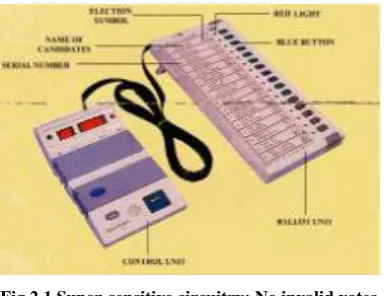
The existing system consists of an ELECTRONIC VOTING MACHINE and a CONTROL UNIT which is used by the polling officials. The Electronic Voting machine is used by the voter to exercise his voting duty. The control unit is used to store the information about the election such as the total number of people who have voted. This can be done with just a push of the button. The main advantage of this type of system is the speed and simplicity of the system.
2.1 Advantages
2.1.1 Independent & Reliable
The EVM is compact and comes in its reusable carry pack. Further, the EVM works/operates on a battery power source, making it independent and totally reliable.
2.1.2 Hi-tech Simplicity
Fig 2.1 Super-sensitive circuitry: No invalid votes
To commence polling, the polling officer activates the "Ballot" switch on the control unit. The voter then has to press the button of his choice on the ballot unit. This is followed by a short beep sound, indicating that the vote has been cast. Once again, the polling officer has to press the "Ballot" switch to clear the machine for the next voter to cast his vote.
Inside the control unit, hidden from you, is an extremely sensitive circuitry that takes care of common election errors or malpractices like vote duplication. For instance, if one were to press two or more buttons simultaneously, then no vote would be cast. Even if there was a micro-second difference in the pressing of the switches, the EVM is sensitive enough to trace and identify the twitch that was pressed first.
2.2 Disadvantages
Susceptible for programming manipulations.
1. This means that the software written for the control unit can be tampered with making it “TAMPER-PRONE”.
2. This may lead to contradictions in the result.
3. Doesn’t detect or avoid “If a citizen is died in current election system that vote is casted by other person in favor of particular party to winning with the acceptance of persons presence in election booth.”
4. Mostly EVM machine don’t get fail. But failure cant detected that is “the Machine is hardware hence there may chance of EVM get fail due to power shortage and many ways”.
III. SYSTEM DESIGN
3.1 Smart Card
For this system need that each and every one citizen must need the Election Smart card, and their personal Database profile in government Site .thus using smart card only the citizen can able to see the details present in their respective profiles. Moreover Finger print of each citizen is taken as authentic checking to open their respective profile.
Smart card consists of 2 types of visible access data
1. Government access which is not visible to Citizen. For example: finger print, photo contains vote of the citizen and his Random no (which he entered on voting process) .
2. Citizen access which is visible to both government and citizens. For example: the information of the citizen and the random number generated by or for him. This also consists of a serial number. This is assigned to the random number to avoid two random numbers given to the same person.
Fig 3.1 Smart Card
3.2 Biometric Authentication
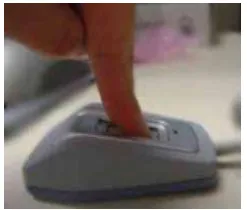
It can be done using by checking the finger print present in the citizen smart card profile and their respective finger print using finger print scanner using the ultrasonic Biometric Authentication. If both matches only allow to access and view the data. Hence no other cannot use your Smart card for any mall activities.
Fig 3.2 Biometric Authentication
IV. METHODOLOGIES
4.1 Fingerprint Identification
Fig 4.1 Fingerprint Based Identification
4.2 Fingerprint Matching
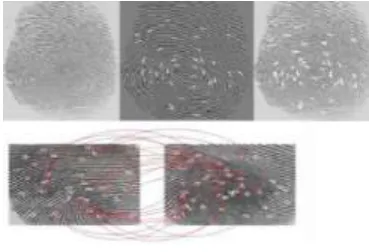
Fingerprint matching techniques can be placed into two categories: minutiae-based and correlation based. Minutiae-based techniques first find minutiae points and then map their relative placement on the finger. However, there are some difficulties when using this approach. It is difficult to extract the minutiae points accurately when the fingerprint is of low quality. Also this method does not take into account the global pattern of ridges and furrows. However, it has some of its own shortcomings. Correlation-based techniques require the precise location of a registration point and are affected by image translation and rotation.
Fig 4.2 Fingerprint Matching
4.3 Fingerprint Classification
Fingerprint classification is a technique to assign a fingerprint into one of the several pre-specified types already established in the literature which can provide an indexing mechanism. Fingerprint classification can be viewed as a coarse level matching of the fingerprints. An input fingerprint is first matched at a coarse level to one of the pre-specified types and then, at a finer level, it is compared to the subset of the database containing that type of fingerprints only.
Fig 4.3 Fingerprint Classification
4.4 Fingerprint Image Enhancement
V. IMPLEMENTATION
“The main aim of this (VEVM) System is create a belief about the voting system among the common public, by verifying their own votes after election”. This can be achieved by some changes in the Election and Result Announcement Process.
The Election will be conducted in three Stages: 1) Stage 1 (SMART card & profile for each citizen) 2) Stage 2 (Random number generation)
3) Stage 3 (EVM machine & controller and Photo machine) This produces two types of result:
1) Contains sequence of “RANDOM NO” generated for each person and their respective vote. 2) Total no of Vote and how much each party got it.
5.1 Stage 1
1. In 1st stage the person entered into the election poll booth will bring his ELECTION card .and this card is Traces in a CARD reader and corresponding PROFILE of citizen is opened In the system. Here the process of checking takes place with the help of the finger print as it is unique for everyone and with the unique smart card which every Indian citizen has.
2. And then he move to the Authentic finger checking process .here the finger print of the citizen and finger print present in his profile or smart card is checked of matching .and the voter can move to 2 nd stage “if both (finger print of voter and finger print of voter present in his profile card) are produce same” else it identifies that this smart card is not belong to voter who come now. Hence he can be punished.
3. This stage prevent that no one cant cast the other person votes and it reduce the checking officers in poll booth which reduce the expense of election commission.
4. After this process Finger print checker produce positive result then only he goes to 2nd stage.
Fig5.1:- SMART card & Profile for Each Citizen
5.2 Stage 2
1. It contains a machine called “RANDOM NUMBER GENERATOR” machine.
2. The citizens enter the random number on this machine by any combination of digits by its own and then press OK. The number of digits depends on the population in that local area.
4. Entered random number is stored and passes this random no to 1st and 3rd stage. In first stage random no is stored in Smart card of voter i.e., Citizen Access viewable data. In 3rd Stage this random no is sent to voting machine display.
Fig5.2:- Random Number Storage Inputted by User
5.3 Stage 3
1. (EVM machine & controller and Photo machine)
2. The vote is casted by pressing the Button adjacent to the party of the voter’s choice.
3. During that period the voter will be able to see his random number and the party the voter selects by displaying at the top of the voting machine.
Sample Result 1
4. These two (symbol and random no) are photo graphed and stored in the Voter’s smart card in Government access viewable data and in Citizen Profile.
5.4 Two Types of Result Produced
1. First type contains Sequence of “RANDOM NO” and their respective Votes. The citizens can verify whether their random number which enters is matching with his/her vote in 1st result.
2. Second type of result contains total no of vote got by each party.
3. If the total number of votes in both the results must be same else the error in count is deducted, which can be corrected later.
4. If any EVM defect or mal programming defect found by compiling by any Citizen of India or local area people .Then RE-ELECTION is depend on the % of error occurs.
Sl.no
Random
Vote
No
1
03123
Xxxx
2
12345(1)
Xxxx
3
12345(2)
AAA
4
23213
Zzzz
5
23133
Xxxx
Fig 5.3 Voting System
5.5 Advantages
1. If any mal-programming or fraud activities is detected then necessary action is taken by election commision , depending on the situation.
2. It ll create belief among the common people about the election commission and election system.
3. Thus the process of election is transparent to public. If error is minor then no RE-election is needed”. There is only a small change in curent result. If the erroe is major the “RE-election is needed” for that local area people. This advantage is not present in our current system.
4. More sped than the current EVM system because of the usage of smart cards.
5. The smart card could be used not only for electoral purpose but also for a variety of purpose like Social Security Number in near future. Implementation is easy and less cost.
6. Super-Sensitive Circuitry: inside the control unit,hidden from normal user is an extremely sensitive circuitry that takes care of common election errors or malpractices like vote duplication. For instance, if one were to press two or more buttons simulaneously,then no vote would be cast. Even if there was a micro-second difference in the pressing of the switches, the EVM is sensitive enough to trace and identify the button that was pressed first.
7. ELECTRONIC fault is detected hence it avoided. But existing system don’t have that detection concepts. 8. Electorate manipulation Most electoral fraud takes place during or immediately after election campaigns,
by interfering with the voting process or the counting of votes.However it can also occur far in advance, by altering the composition of the electorate. In many cases this is not illegal and thus technically not electoral fraud, although it is sometimes considered to be a violation of principles of democracy.
9. Ballot stuffing is avoided
10. In old system they may be a choice if poll both office if in support of one party, can put 50 to 100 votes by pressing the vote button by one officer and controller by other offer then tic the person who r absent for vote also additonaly added .But this thing is not possible here because all vote is casted before the smart card trace and authority verification.
11. Transparency is achieved.
12. Tampering a software or h/w of EVM is identified.
VI. CONCLUSION
increase the confidence and belief in the minds and hearts of the people about the system. Hence implemented this system will be a boon to the election process due to its security and transparency. This type of combination is very hard to find.
VII. FUTURE WORK
Hence this proposed system will contain advantages of both current EVM systems and temper free and fault detection Election system for future. It creates a belief among the people about election and Election system and this will increase the voting percentage of a country which leads to become a developed nation.
REFERENCES
[1] S. Yadav and A. Singh, “A Biometric Traits based Authentication system for Indian Voting System”, International Journal of Computer Applications, pp. 28- 32, Vol. 65(15), 2013.
[2] “Secure Electronic Registration & Voting System Based On Biometrics” National Conference on Future Computing Volume 1, March 2012 by Dr.K.Kuppusamy1 Associate Professor Department of Computer Science Engineering Alagappa University Karaikudi 630 003.& K.Kavitha 2 M.Phil Scholar Department of Computer Science & Engineering Alagappa University Karaikudi 630003.
[3] E-Voting and Biometric Systems, Sonja Hof University of Linz, Austria Institute of Applied Computer Science, Division: Business, Administration and Society; University of Linz, AUSTRIA [email protected].
[4] Highly Secure Online Voting System with Multi Security using Biometric and Stenography‖ B. Swaminathan#1, J. Cross Datson Dinesh#2 2012.
[5] Santin, R. Costa and C. Maziero, “A Three Ballot- Based Secure Electronic Voting System”, IEEE Transaction on Security & Privacy, Vol. 6(3), pp. 14- 21, 2008.
[6] O. Iloanusi and C. Osuagwu, “Framework for a dynamic Fingerprint Indexing Biometric-based Voting System”, African Journal of Computing & ICTs, pp. 55- 63, Vol. 5(4), 2012.
[7] Altun and M. Bilgin, “Web baesd secure e-voting system with fingerprint authentication”, Scientific Research and Essays, pp. 2494-2500, Vol. 6(12), 2011.