546 | P a g e
PUSHOVER ANALYSIS OVER A STRUCTURE WITH
VERTICAL IRREGULARITIES USING SOIL
STRUCTURE INTERACTION
Prajakta Barsinge
1, L. R. Wankhade
21
Research Scholar ,
2Professor, t Applied Mechanics Department,
Government College of Engineering, Amravati (India),
ABSTRACT
The hilly regions are mostly encountered with step-back-set-back configuration for buildings. The presence of
such constructions in seismically prone areas makes them exposed to greater shears and torsion as compared to
conventional construction. Multi-storeyed reinforced concrete buildings lay on slope slants in hilly areas.
Building on slopes has fluctuated setups and asymmetry of variety in mass and stiffness distribution. The effects
of soil-structure interaction are generally ignored in the designing of low-rise buildings resting on shallow
foundations. It has been shown that ignoring such effects lead to unsafe seismic design. Interaction between
foundation and soil takes place when the structure is subjected to earthquake excitation. It gradually changes
the motion of ground. It means that the movement of the whole ground structural system is influenced by type of
soil as well as by the type of structure. An attempt has been made in this paper to study the response of multi
storeyed building subjected to seismic forces with Flexible foundations subjected to seismic forces analysed
under different soil conditions like hard, medium and soft. Also, the present paper gives a detailed methodology
of Pushover analysis.
Keywords: Base Shear, Flexible Base, Natural Period, Soil Stiffness, Soil Structure Interaction,
Storey Drift.
I INTRODUCTION
547 | P a g e
earthquake can be resisted by the building supported on medium stiff soil and stiff soil , however the same building may not be able to resist the minor earthquake supported on soft soil.[1]
In many parts of the world, especially the hilly areas are more prone to seismic movement; for example, Northeast region of India. There is a minimal plain ground in hilly regions which constrains the construction on such a ground that is slant. Hill building developed with mud mortar/concrete mortar without complying with seismic codal requirements have demonstrated risky and brought about death toll and property damage when subjected to Earthquake. During an earthquake these unpredictable and asymmetrical building usually come across lateral shears and torsional moments thus unable to withstand the twisting and pivotal powers created by static loads in isolation.[2] A discontinuity in the medium of wave’s propagation is encountered at the interface of soil and structural foundations which leads to scattering, diffraction, reflection and refraction of the seismic waves at the soil foundation interface their by changing the nature of ground motion at that point.[3] This leads to a subsequent increase in the natural periods of the structural system. Hence, the effect of soil-structure interaction on the structural system resting on isolated foundation needs a detailed investigation.
Simplified linear elastic methods are not adequate for the assessment of structural damage during earthquake. Therefore, a new generation of design philosophy that incorporates performance based design is required and it is changing from simplified linear elastic method to nonlinear technique i.e. Pushover analysis. [4]
The response of a structure subjected to seismicity depends on various parameters namely characteristics of ground motion, allowable deformation limits of the structure, strength of structural material, soil structure interaction and many others. Till date most of studies have been carried out by considering base of the structure as fixed, but this is not the ground reality. Therefore soil structure interaction effect is to be incorporated to study the seismic behaviour of the structure.
II NECESSITY
The behaviour of buildings during earthquake depends upon the distribution of mass and stiffness in both horizontal and vertical planes of the buildings, which vary in case of hilly buildings with irregularity and asymmetry due to step back and step back-set back configuration.
The presence of such constructions in seismically prone areas makes them exposed to greater shears and torsion as compared to conventional construction. In order to highlight the differences in behaviour, which may further be influenced by the characteristics of the locally available foundation material, current building codes including IS: 1893 (Part 1):2002 suggest detailed dynamic analysis of these types of buildings on different soil (hard, medium and soft soil) types.
To assess acceptability of the design, it is important to predict the force and deformation demands imposed on structures and their elements by severe ground motion by means of static pushover analysis.
548 | P a g e
III PUSHOVER ANALYSIS
The recent advent of performance based design has brought the pushover analysis to the forefront. Pushover analysis is a static, nonlinear procedure in which the magnitude of the structural loading is incrementally increased in accordance with a certain predefined pattern. With the increase in the magnitude of the loading, weak links and failure modes of the structure are found out.
Static pushover analysis is an attempt to evaluate the real strength of the structure and a useful and effective tool for performance based design. Pushover analysis can determine the behaviour of a building, including the ultimate load and the maximum inelastic deflection. At each step, the base shear and the roof displacement can be plotted to generate the pushover curve. It gives an idea of the maximum base shear that the structure was capable of resisting at the time of the earthquake.
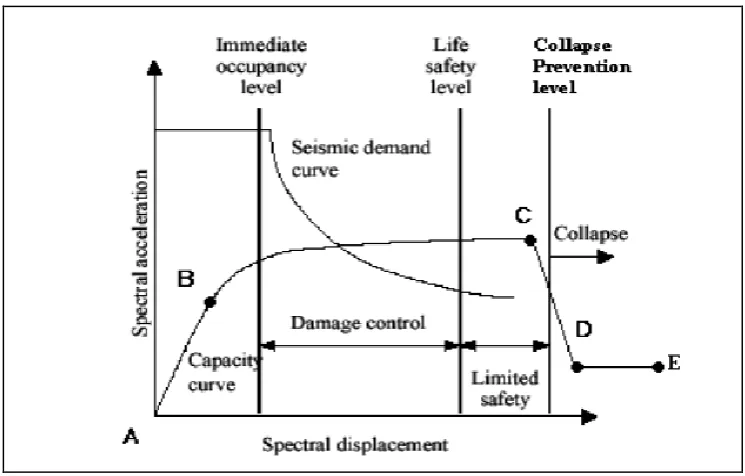
The material model used in the static Nonlinear pushover analysis is based on the procedures proposed by the documents, defining force – deformation criteria for the hinges which is used in the pushover analysis. Figure 1 describes the typical force-deformation relation proposed by those documents. Five points labeled A, B, C, D and E are used to define the force deflection behavior of the hinge. These points labelled as A to B – Elastic state, B to IO- below immediate occupancy, IO to LS – between immediate occupancy and life safety, LS to CP- between life safety to collapse prevention, CP to C – between collapse prevention and ultimate capacity, C to D- between C and residual strength, D to E- between D and collapse >E – collapse.[5]
Fig. 1: Force- Deformation For Pushover Hinge With Levels
IV DESCRIPTION OF THE BUILDING MODEL
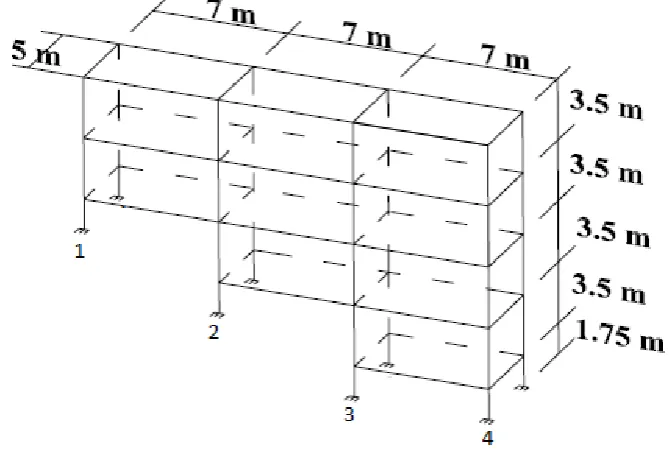
A typical 4 storey step back configuration building lying on slope is considered for the study. The
549 | P a g e
Table 1: Details of the Building Model
Description Value
Number of storeys 4
Typical storey height 3.5
Bottom storey height 1.75
Grade of steel Fe415
Grade of concrete M25
Beam size 300*600
Column Size 300*500
Zone Zone III
Live load Roof- 1.5 KN/m2
Floor-3KN/m2
Finishes Roof finish- 2 KN/m2
Floor finish- 1KN/m2
Fig. 2: 4 Storey Step Back Building
The frame is designed for seismic loads in ETABS 2015. Pushover analysis is performed for the designed frame.
Comparison of storey drift, storey shears and time period is studied further.
550 | P a g e
IV RESULTS
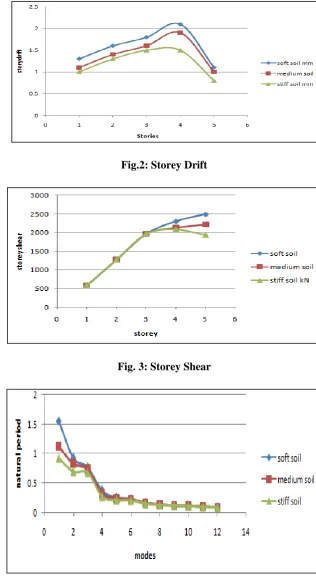
The results obtained by the pushover analysis for the given building are as shown in figure 3.
Fig.2: Storey Drift
Fig. 3: Storey Shear
551 | P a g e
V CONCLUSION
From the results shown with respect to the building models considered leads to the following conclusions: 1. It is observed that the fundamental natural frequencies increase with the increase of soil stiffness and this change is found more in soft soils.
2. The base shear is found to be increased with the increase of soil stiffness with more in soft soils. 3. The storey drift increases when the soil changes from hard to medium and then medium to soft.
4. Thus it can be said that Soil–structure interaction cannot be ignored while designing important structures like buildings, bridges, nuclear power plants, liquid retaining structures, dams, etc., against the expected earthquake forces.
5. The software used for nonlinear static analysis ETABS 2015 having features of performing performance based analysis.
REFERENCES
[1] Ramesh Baragani, S.S.Dyavanal,”Seismic evaluation of multistorey rc buildings considering soil structure interaction with userdefined hinges”, Proceedings of 08th IRF International Conference, 05th July-2014.
[2] Md. Aqeel, Rohan S. Gurav, ”Influence of soil structure interaction in seismic behavior of buildings on hill slopes”, International Research Journal of Engineering and Technology, Volume 2, Issue 8, Nov-2015,
[3] Amar R Chougule, S S Dyavanal,”Seismic Soil Structure Interaction of Buildings with Rigid and Flexible Foundation”, International Journal of Science and Research (IJSR), Volume 4, Issue 6, 2013
[4] Halkude S.A , Kalyanshetti M.G and Kadlag V. A,“Pushover Analysis of R.C Frames Considering Soil Structure Interaction”, International Journal of Current Engineering and Technology, Volume 5, no. 1, Jan
2015
[5] A. Vijayakumar, D. L. Venkatesh Babu,” Pushover Analysis of Existing Reinforced Concrete Framed Structures”, European Journal of Scientific Research, Volume 71, no.2, February 2012