University of Pennsylvania
ScholarlyCommons
Publicly Accessible Penn Dissertations
Winter 12-22-2009
Bidirectional Programming Languages
John Nathan Foster
University of Pennsylvania, [email protected]
Follow this and additional works at:
http://repository.upenn.edu/edissertations
Part of the
Databases and Information Systems Commons
, and the
Programming Languages and
Compilers Commons
This paper is posted at ScholarlyCommons.http://repository.upenn.edu/edissertations/56 For more information, please [email protected].
Recommended Citation
Bidirectional Programming Languages
Abstract
The need to edit source data through a view arises in a host of applications across many different areas of computing. Unfortunately, few existing systems provide support for updatable views. In practice, when they are needed, updatable views are usually implemented using two separate programs: one that computes the view from the source and another that handles updates. This rudimentary design is tedious for programmers, difficult to reason about, and a nightmare to maintain.
This dissertation presents bidirectional programming languages, which provide an elegant and effective mechanism for describing updatable views. Unlike programs written in an ordinary language, which only work in one direction, programs in a bidirectional language can be run both forwards and backwards: from left to right, they describe functions that map sources to views, and from right to left, they describe functions that map updated views back to updated sources. Besides eliminating redundancy, these languages can be designed to ensure correctness, guaranteeing by construction that the two functions work well together.
Starting from the foundations, we define a general semantic space of well-behaved bidirectional
transformations called lenses. Then, building on this foundation, we describe a particular language for defining lenses on strings with syntax based on the familiar regular operators (union, concatenation, and Kleene star). We present extensions to the basic framework that address the subtle complications that arise when lenses are used to manipulate, data containing unimportant details, ordered data, and confidential data.
Degree Type
Dissertation
Degree Name
Doctor of Philosophy (PhD)
Graduate Group
Computer and Information Science
First Advisor
Benjamin C. Pierce
Keywords
bidirectional languages, lenses, view update, regular expression types
Subject Categories
BIDIRECTIONAL PROGRAMMING LANGUAGES
John Nathan Foster
A DISSERTATION
in
Computer and Information Science
Presented to the Faculties of the University of Pennsylvania in Partial
Ful llment of the Requirements for the Degree of Doctor of Philosophy
2009
Benjamin C. Pierce, Professor of Computer and Information Science Supervisor of Dissertation
Jianbo Shi, Associate Professor of Computer and Information Science Graduate Group Chairperson
Dissertation Committee
Zachary G. Ives, Associate Professsor of Computer and Information Science
Val Tannen, Professor of Computer and Information Science
Philip Wadler, Professor of Theoretical Computer Science, University of Edinburgh
COPYRIGHT
John Nathan Foster
ABSTRACT
Bidirectional Programming Languages
John Nathan Foster
Supervisor: Benjamin C. Pierce
The need to edit source data through a view arises in a host of applications across many different
areas of computing. Unfortunately, few existing systems provide support for updatable views.
In practice, when they are needed, updatable views are usually implemented using two separate
programs: one that computes the view from the source and another that handles updates. This
rudimentary design is tedious for programmers, dif cult to reason about, and a nightmare to
maintain.
This dissertation presents bidirectional programming languages, which provide an elegant
and effective mechanism for describing updatable views. Unlike programs written in an
ordi-nary language, which only work in one direction, programs in a bidirectional language can be
run both forwards and backwards: from left to right, they describe functions that map sources
to views, and from right to left, they describe functions that map updated views back to updated
sources. Besides eliminating redundancy, these languages can be designed to ensure correctness,
guaranteeing by construction that the two functions work well together.
Starting from the foundations, we de ne a general semantic space of well-behaved
bidirec-tional transformations called lenses. Then, building on this foundation, we describe a
particu-lar language for de ning lenses on strings with syntax based on the familiar reguparticu-lar operators
(union, concatenation, and Kleene star). We present extensions to the basic framework that
address the subtle complications that arise when lenses are used to manipulate, data containing
Acknowledgments
Some dissertation projects go like this: the student arrives on campus, the adviser sets a topic,
the student disappears into the lab, and emerges several years later with the nished product.
Mine, thankfully, has been nothing like this. The work described in this dissertation is the result
of an extended, close collaboration with Benjamin Pierce and Alan Schmitt, with additional
contributions from Davi Barbosa, Aaron Bohannon, Julien Cretin, Malo Deni´elou, Michael
Greenberg, Adam Magee, St´ephane Lescuyer, Danny Puller, Alexandre Pilkiewicz, and Steve
Zdancewic. I am lucky to be able to count these talented individuals as my colleagues and
friends, and I gratefully acknowledge their contributions to this project.
Throughout my time at Penn, my adviser Benjamin Pierce, has always been available to
brainstorm about research, crank through a proof, hack on some code, or polish a piece of
writing. Thank you Benjamin for setting the standard high, and for encouraging me, nurturing
me, and providing help along the way.
Zack Ives, Val Tannen, Phil Wadler, and Steve Zdancewic all graciously agreed to serve on
my dissertation committee. I wish to thank them for the many hours they spent reading my
proposal and this dissertation. Their many insightful comments and valuable suggestions have
improved it immensely.
Kim Bruce gave me my rst research experience as an undergraduate and told me I would
go to graduate school before I even knew I would want to. I am grateful for the opening into
the research world he gave me and for close to ten years of guidance.
Alan Schmitt helped me navigate the transition to graduate school during the last few
months of his postdoc and has continued to be a collaborator, informal mentor, and close
friend in the years since. He also hosted me at Rhˆone-Alpes for a productive and extremely
Sim´eon, and Lionel Villard for an enjoyable internship at IBM Research during the summer of
2007.
To the members of Penn’s PLClub and Database Groups, thank you for creating a
stimulat-ing and friendly research environment. To my close friends in the department, Colin Blundell,
TJ Green, Greg Karvounarakis, Micah Sherr, Nick Taylor, and Svilen Mihaylov, thank you for
all the lunch runs, coffee breaks, and pleasant distractions from work. Thanks to my running
partners Adam Aviv, John Blitzer, PavolCernˇ ´y, and Jeff Vaughan for many miles of good
con-versation. To Dimitrios Vytiniotis, it’s been... OK :-) To Mike Felker and Gail Shannon, thank
you for solving so many bureaucratic puzzles. The department wouldn’t function without you.
To my family, especially Clare, Mollie, Tita Mary, Ahmad, my parents, stepparents, and
grandparents thank you for keeping me grounded these past six years and for always believing
in me.
To Sara, thank you for reminding me how much fun life can be. I’ll meet you for coffee
anytime.
Philadelphia, PA
December 7, 2009
This work was supported in part by an NSF Graduate Research Fellowship and NSF grants
CPA-0429836 Harmony: The Art of Reconciliation, IIS-0534592 Linguistic Foundations for
Contents
1 Introduction 1
1.1 The View Update Problem . . . 2
1.2 Bidirectional Programming Languages . . . 3
1.3 Goal and Contributions . . . 7
1.4 Acknowledgments. . . 10
2 Notational Preliminaries 11 2.1 Basic Concepts . . . 11
2.2 Formal Language Theory . . . 13
2.3 Regular Languages . . . 15
3 Basic Lenses 18 3.1 Semantics . . . 18
3.2 Basic Lens Properties . . . 24
3.3 Combinators . . . 29
3.4 Summary . . . 44
4 Quotient Lenses 45 4.1 Semantics . . . 48
4.2 Quotient Lens Combinators . . . 50
4.3 Regular Operators . . . 59
4.4 Primitives . . . 66
4.5 Typechecking . . . 69
4.7 Summary . . . 76
5 Resourceful Lenses 77 5.1 Notation. . . 82
5.2 Resourceful Lens Semantics . . . 86
5.3 Resourceful Lens Primitives . . . 90
5.4 Alignments . . . 100
5.5 Summary . . . 105
6 Secure Lenses 106 6.1 Example . . . 109
6.2 Semantics . . . 113
6.3 Annotated Regular Expressions . . . 116
6.4 Secure Lens Combinators . . . 120
6.5 Dynamic Secure Lenses . . . 128
6.6 Summary . . . 133
7 Boomerang 134 7.1 Syntax . . . 134
7.2 Typechecking . . . 140
7.3 Implementation . . . 143
7.4 Augeas . . . 144
7.5 Grammars . . . 146
7.6 Summary . . . 150
8 Related Work 151 8.1 Foundations . . . 151
8.2 Programming Languages . . . 154
8.3 Databases . . . 159
8.4 Model Transformations . . . 161
8.5 Security . . . 162
9.1 Data Model . . . 164
9.2 Syntax . . . 165
9.3 Optimization . . . 165
9.4 Security . . . 166
Bibliography 167 Proofs 179 Basic Lens Proofs . . . 179
Quotient Lens Proofs . . . 188
Resourceful Lenses Proofs . . . 208
List of Figures
3.1 Basic Lens Architecture . . . 19
3.2 Pseudocode forstring lterandstring un lter. . . 42
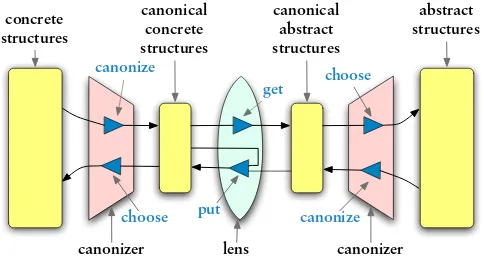
4.1 Lens architecture with “canonizers at the edges” . . . 47
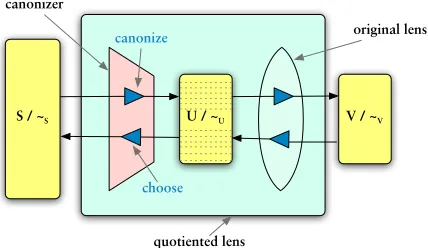
4.2 Adding a canonizer to a quotient lens (on the left) . . . 51
5.1 Resourceful Lens Architecture . . . 82
5.2 Alignment species . . . 102
6.1 Non-interference in Secure Lenses . . . 113
Chapter 1
Introduction
Most programs work in only one direction, from input to output. As Baker observed when he
wrote “the S combinator cheerfully copies ... the K combinator knowingly kills” (1992), the
very fundamentals of computation seem intrinsically unidirectional. However, the world is full
of situations where, after computing an initial output, we need to be able to update it and then
“compute backwards” to nd a correspondingly modi ed input. There are numerous examples,
across many areas of computing where thesebidirectional transformationsare needed:
Data Synchronization: bidirectional transformations bridge the gap between heterogeneous
repli-cas (Brabrand et al.,2008;Kawanaka and Hosoya,2006;Foster et al.,2007a).
Data Management: bidirectional transformations provide mechanisms for propagating updates
to views (Foster et al., 2007b; Bohannon et al., 2006; Bancilhon and Spyratos, 1981;
Dayal and Bernstein, 1982), for data exchange (Miller et al.,2001), and for converting
data into new formats in schema evolution (Berdaguer et al.,2007).
Software Engineering: bidirectional transformations maintain the consistency of formal
soft-ware models (Schurr¨ ,1995;Stevens,2007;Xiong et al.,2007).
Security: bidirectional transformations provide a way to do ne-grained sharing of con dential
documents (Foster et al.,2009).
Serialization: bidirectional transformations map between the on-disk and in-memory
represen-tations of ad hoc and binary data (Fisher and Gruber,2005;Eger,2005).
Systems Administration: bidirectional transformations map between the at low-level
repre-sentations and higher-level structured reprerepre-sentations of system con guration les (
Programming Languages: bidirectional transformations handle boxing and unboxing of
run-time values in embedded interpreters (Benton, 2005; Ramsey, 2003), and they convert
between source code written in different high-level languages (Ennals and Gay,2007).
User Interfaces: bidirectional transformations provide convenient editing interfaces for
com-plex documents (Hu et al., 2008) and can also be used to maintain the consistency of
graphical interface elements (Meertens,1998;Greenberg and Krishnamurthi,2007).
Unfortunately, although the need for bidirectional transformations is ubiquitous, the linguistic
technology for de ning them is embarrassingly primitive. Most of the applications listed above
are implemented using two separate functions—one that transforms inputs to outputs and
an-other that maps outputs to inputs—a rudimentary design that is tedious to construct, dif cult
to reason about, and a nightmare to maintain.
This dissertation proposes a different approach: languages in which every program can
be read in two ways—from left to right as a function mapping inputs to outputs and from
right to left as a function that propagates updates to outputs back to inputs. Our thesis is that
thesebidirectional programming languagesare an effective and elegant mechanism for describing
bidirectional transformations.
1.1 The View Update Problem
Let us start by exploring some of the fundamental issues related to bidirectional transformations
in databases, an area where they have been studied extensively because of their close connection
to theview update problem. Suppose thatsis a source database,q is a query, andv =q(s)is
the view that results from evaluatingq on s. (We will adopt this terminology of sources and
views throughout this dissertation.) The view update problem is the following: given an update
uthat transformsvtov′, calculate a source updatet(the “translation” ofu) that transformss
tos′ and makes the following diagram commute:
. .
S .v
.
s′ .v′
.
q
.
q
.
Despite extensive study over several decades, this problem remains largely unsolved. The main
reason it has proven so challenging is that, in general, the view updateu does not uniquely
determine a source updatet. For example, whenqis not injective, certain updates to the view
have many corresponding source updates. One can impose additional constraints to guide the
selection of an update—e.g., requiring that thethave minimal “side effects” on the source—but
when the query and schema languages are suf ciently complicated, calculating updates
satisfy-ing these additional constraints is intractable (Buneman et al.,2002). Even worse, whenqis not
surjective, some updates to the view produce structures that lie outside of the codomain of the
query! It is not hard to see that in these situations it will be impossible to propagate the view
update back to a corresponding source update—i.e., there is notthat makes the above diagram
commute. Systems often choose to reject these updates, but doing so breaks the abstraction
boundary between the source and view. It adds hidden constraints on how the view may be
updated that are only revealed when the user of the view tries to propagate an update back to
the source.
Because of these dif culties, views in relational database systems are generally read-only
(except for those de ned by very simple queries). In situations where an updatable view is
needed, programmers have to rely a variant of the rudimentary mechanism discussed above:
they de ne a separate procedure called atriggerthat the system executes whenever the view is
modi ed. Triggers are arbitrary programs, so they can be used to implement any view update
policy the programmer wants. However, they are not a very attractive solution. For one thing,
checking that a trigger correctly propagates updates requires intricate, manual reasoning about
the way it works in tandem with the query. Moreover, the trigger and query will necessarily be
redundant—each will embody (at least) the correspondence between the source and view—so
they will be dif cult to maintain if the schemas evolve.
1.2 Bidirectional Programming Languages
A better approach is to de ne the view and its associated update policy together. Bidirectional
programming languagesare organized around this idea: every program denotes both a function that computes a view as well as one that propagates updates. This eliminates the need to
about correctness, because the language can be designed to guarantee it. The main challenge in
the design of a bidirectional language lies in balancing the tradeoffs between syntax that is rich
enough to express the queries and update policies demanded by applications, and yet simple
enough that correctness can be veri ed using straightforward, compositional, and, ultimately,
mechanizable checks.
To illustrate the tradeoffs between these two approaches, consider a simple example.
Sup-pose that the source is an XML document representing the names, dates, and nationalities of a
collection of classical music composers...
<composers> <composer>
<name>Jean Sibelius</name> <lived>1865-1956</lived>
<nationality>Finnish</nationality> </composer>
<composer>
<name>Aaron Copland</name> <lived>1910-1990</lived>
<nationality>American</nationality> </composer>
<composer>
<name>Benjamin Briten</name> <lived>1913-1976</lived>
<nationality>English</nationality> </composer>
</composers>
...and the views are comma-separated lines of ASCII text representing just their names and
dates—i.e., compared to the source, the nationalities and all XML formatting have been dropped:
Jean Sibelius, 1865-1956 Aaron Copland, 1910-1990 Benjamin Briten, 1913-1976
Having computed this view, we might want to edit the ASCII output—e.g., correcting the error
in Sibelius’s death date and the misspelling in Britten’s name...
Jean Sibelius, 1865-1957 Aaron Copland, 1910-1990 Benjamin Britten, 1913-1976
...and push the changes back into the original XML format:
<composers> <composer>
<name>Jean Sibelius</name> <lived>1865-1957</lived>
<nationality>Finnish</nationality> </composer>
<name>Aaron Copland</name> <lived>1910-1990</lived>
<nationality>American</nationality> </composer>
<composer>
<name>Benjamin Britten</name> <lived>1913-1976</lived>
<nationality>English</nationality> </composer>
</composers>
Here is a bidirectional program, written in the language ofbasic lensesdescribed in Chapter3,
that denotes both transformations, from XML to ASCII and from ASCII to XML:
(* regular expressions *)
let WHITESPACE : regexp = [\n\t ] let ALPHA : regexp = [A-Za-z]+ let YEAR : regexp = [0-9]{4}
(* helper function *)
let xml_elt (tag:string) (body:lens) : lens = del WHITESPACE*
. del ("<" . tag . ">") . body
. del WHITESPACE* . del ("</" . tag . ">")
(* helper lens *) let composer : lens =
xml_elt "composer"
( xml_elt "name" (copy (ALPHA . " " . ALPHA) ) . ins (", ")
. xml_elt "lived" (copy (YEAR . "-" . YEAR) )
. xml_elt "nationality" ( default (del ALPHA) (fun (x:string) -> "Unknown") ) )
(* main lens *) let composers : lens =
xml_elt "composers"
(copy "" | (composer . (ins "\n" . composer)* ) )
In the forward direction, it can be read as an ordinary function on strings. The rst few lines
de ne regular expressions (in standard POSIX notation) for whitespace, alphabetic strings, and
years. The helper functionxml_eltde ned next takes a stringtagand a lensbodyas arguments
and returns a lens that processes an XML element namedtag. It rst removes all of the XML
formatting for the element and then processes the children of the element using body. The
concatenation operator (.) combines lenses in the obvious way. Thecomposerlens de ned next,
instantiatesxml_eltseveral times to construct a lens that handles XML elements representing a
single composer. It copies the name of the composer, inserts a comma and a space into the view,
lens, processes XML elements containing a sequence of composers. It uses union (|) and Kleene
star (*) to iteratecomposer over the list of composers, adding a newline between each. Because
this is a bidirectional program, we can also run it backwards. The details of how this works
are not important for now (see Chapter3for precise de nitions); the key point is that we can
use the samecomposerslens to map a modi ed ASCII view back to an updated XML source.
At this point, it is natural to wonder whether bidirectional languages are are really worth
the trouble. After all, how hard could it really be to just write the two functions as separate
programs in a general-purpose language? To explore this idea (and ultimately reject it), consider
implementations of the forward and backward transformations of the composers lens as
sepa-rate functions in the OCaml language. Thecomposers_forwardtransformation can be written as
follows:
let composers_forward s = let sx = parse_string s in List.fold_left
(fun acc sxi ->
let [nx;dx;_] = children xi in
let sep = if acc <> "" then "\n" else "" in (acc ^ sep ^ pcdata nx ^ ", " ^ pcdata dx)) ""
(children sx)
(The functions parse_string, children, and pcdata are functions from a simple XML library).
It parses the source stringsinto an XML structure, and then folds down the list of composer
elements, extracting the name and dates of each composer and adding them to the view. The
correspondingcomposers_backwardfunction is written as follows:
let composers_backward v s = let sx = parse_string s in let sl = children sx in let vl = split "\n" v in
let rec aux acc vl sl = match vl with
| [] -> to_string (element "composers" (List.rev acc)) | vh::vt ->
let [n;d] = split ", " vi in let nx = pcdata_element "name" n in let dx = pcdata_element "lived" d in let c,sl' = match sl with
| sh::st -> (List.nth (children sxi) 2,st) | [] -> ("Unknown",[]) in
let cx = pcdata_element "nationality" c in
let acc' = (element "composer" [nx;dx;cx])::acc in aux acc' vt st in
(Again, the functionspcdata_element,element, andto_stringall come from the XML library.) It
takes two arguments, an updated viewvand the original sources, and weaves them together,
propagating the names and dates from the view, and restoring the nationalities from the source.
One advantage of the lens program over the OCaml version is that we only have to write
one program instead of two. Another is that key correctness properties can be proven
auto-matically for the lens program. In particular, the type system for lenses described in Chapter3
guarantees a number of natural well-behavedness properties—e.g., that the two functions are
totally de ned functions on the sets of strings representing XML sources and ASCII views, and
that composing them in either order yields the identity function. By contrast, to verify that
the two OCaml programs correctly implement the updatable view, we would need to
estab-lish these properties by hand. We can do this, of course, but it would involve alotof manual
pencil-and-paper reasoning about fairly low-level properties—e.g., we would need to check that
lines concatenated in theauxloop of thecomposers_forwardfunction are split the same way in
composers_backward, and so on. Perhaps the most signi cant advantage of the lens program,
however, is that it is much easier to maintain. Suppose that, for whatever reason, we decide
that the character used to separate the elds in each line of ASCII text should be “;” instead of
“,”. To update the lens program, we would simply replace the single occurrence of “,” with a
“;”. Both functions denoted by the lens would change and the typechecker would reverify the
well-behavedness properties automatically. The OCaml programs, however, have multiple
oc-currences of “,”. We would need to make coordinated changes to both functions—something
that would be easy to get wrong, especially if the example were slightly more complicated. We
would also need to modify and reverify the well-behavedness proof by hand. Thus, even for
this almost trivial example, the bidirectional language is a much more attractive option.
1.3 Goal and Contributions
The goal of this dissertation is to show that bidirectional languages are an effective way of
de ning updatable views. Its contributions are divided between three broad areas: foundations,
Foundations
One of the key bene ts of using a bidirectional language is automatic reasoning about
cor-rectness. However, before we can even talk about correctness, we need to characterize the
transformations that have the properties we want. Many current systems for building
up-datable views are constructed in an ad hoc fashion and have a rather casual attitude about
correctness. The rst contribution of this dissertation is a general semantic framework of
well-behaved bidirectional transformations calledlensesthat organizes this whole area and provides
a clean foundation for building reliable updatable views. Chapter3describes the framework
ofbasic lenses, which provide the formal underpinnings for the whole project. Lenses are based on semantic laws that are closely related to the classic conditions on view update translators
that have been proposed in databases. Chapter 4 describes quotient lenses, which relax the
basic lens laws by allowing certain speci ed portions of the source and view to be treated as
“unimportant”. This generalization is motivated by experience writing lenses for real-world
data, which often contain ignorable details such as whitespace. Chapter5describesresourceful
lenseswhich address the issue of alignment, which comes up when the source and view are or-dered structures. In general, to do a good job of propagating an updates to oror-dered structures,
a lens needs to be able to compute a correspondence between pieces of the view and the pieces
of the source. Resourceful lenses extend basic lenses with new mechanisms for calculating and
using these correspondences, which we call alignments, and new properties that ensure that
they use alignment information correctly. Finally, Chapter6describessecure lenses, which
ex-tend basic lenses with additional guarantees about security properties of data. These properties
ensure that lenses do not reveal certain speci ed regions of the source in the view, and that
propagating updates to the view does not corrupt other speci ed portions of the source.
Language Design
Interpreting programs bidirectionally requires changing the way that we describe
computa-tions—some constructs that make sense in ordinary programming languages do not make sense
as lenses. The second contribution of this dissertation is a concrete design for a lens language
with natural, compositional syntax and a type system that guarantees the lens laws. For
such as trees or complex values. However, even strings are simple structures, they still
ex-pose many fundamental issues. Additionally, because there is also a lot of string data in the
world—textual databases, structured documents, scienti c data, simple XML, and all kinds of
ad hoc data—having a language for de ning lenses on strings is quite useful in practice.
Chapter3introduces the core language studied throughout this dissertation. It features a
set of combinators for transforming strings that includes generic operators (identity, constant,
sequential composition), the regular operators (union, concatenation, Kleene star), and some
additional operators we have found useful in applications ( lter, swap, merge, etc.). Types play
a central role in this language. Some of our operators only make sense as lenses when speci c
side conditions are met, and we use types to express and verify these constraints. To ensure
that typechecking can be mechanized, we use regular expressions as types. Regular
expres-sions balance the tradeoffs between precision and decidability: they describe data schemas at
a reasonably high level of detail and all of the properties of regular expressions we need for
typechecking are decidable.
The later chapters in this dissertation all describe extensions of, or re nements to, this basic
language of string lenses: Chapter4extends it with new constructs (canonizers, quotient
oper-ators) for dealing with ignorable data. Chapter5adds features (chunks, keys, thresholds) for
aligning data, and Chapter6extends the language with a more re ned type system based on an
information- ow analysis that tracks security properties of data including con dentiality and
integrity.
Implementation
The nal contribution of this dissertation is an implementation of our ideas in a full-blown
pro-gramming language called Boomerang. This language, described in Chapter 7, demonstrates
our thesis that bidirectional languages are an effective way to specify updatable views. To make
it easier for programmers to develop lens programs of realistic size, Boomerang includes all the
features usually found in a modern functional language: rst-order functions, an expressive
type system, modules, unit tests, etc. Additionally, Boomerang has several features speci cally
designed for expressing string transformations: built-in regular expressions, operator
full working Boomerang prototype and used it to develop lenses for a number of real-world
data formats. Although this prototype is not industrial strength (in particular, we have not yet
attempted to optimize performance), it is ef cient enough to handle many examples of realistic
size—e.g., our largest lens is a 4KLoc program that computes views over XML documents
representing scienti c databases.
Lenses have been applied in industry. Augeas (Lutterkort, 2008), a tool developed by
RedHat, Inc. for managing operating system con gurations, is a near-clone of Boomerang
(it supports some additional constructs for building trees). Augeas programmers have
devel-oped lenses for handling nearly all standard Linux con guration le formats. This independent
application of our ideas provides additional evidence that the concept of lenses is robust, and
that our design for Boomerang is practical.
1.4 Acknowledgments
This dissertation describes work performed in cooperation with many different colleagues and
portions of it are based on papers written in collaboration with them. In particular, the
seman-tics of basic lenses described in Chapter3is based on an article byFoster, Greenwald, Moore,
Pierce, and Schmitt(2007b). The string lenses presented in that chapter are based on
mate-rial from a paper byBohannon, Foster, Pierce, Pilkiewicz, and Schmitt(2008). Chapter4is a
revised version of a paper by Foster, Pilkiewcz, and Pierce(2008b). Chapter5describes new
work with Davi Barbosa and Julien Cretin that generalizes the dictionary lenses described in the
same paper byBohannon, Foster, Pierce, Pilkiewicz, and Schmitt(2008). Chapter6is a revised
version of a CSF paper byFoster, Pierce, and Zdancewic(2009). The design and
implementa-tion of Boomerang described in Chapter7was done in cooperation with Michael Greenberg,
Alexandre Pilkiewicz, Benjamin Pierce, and Alan Schmitt. Davi Barbosa and Julien Cretin also
helped polish and extend many aspects of the Boomerang implementation. Boomerang’s
pre-cise type system was designed and implemented in collaboration with Michael Greenberg. Its
grammar notation was designed with help from Adam Magee and Danny Puller. Finally,
Chap-ter8is an expanded version of survey of related work on lenses byFoster, Greenwald, Moore,
Chapter 2
Notational Preliminaries
This chapter xes notation for a standard mathematical concepts (sets, relations, functions,
etc.) and notions from formal language theory (strings, languages, regular languages, etc.). It
is intended as a reference and can be skipped on a rst reading and referred back to as needed.
2.1 Basic Concepts
We start by xing notation for a few standard mathematical concepts.
2.1.1 Notation [Sets]: We write{x1, . . . , xn} to denote the set containing elements x1 to xn.
We often describe sets by comprehension, writing {x ∈ S | P(x)}to denote the subset of S
consisting of elements satisfying a predicateP. We writex∈Sto indicate thatxis an element
ofS and{}for the empty set. We write(S1∪S2)for the union,(S1∩S2)for the intersection,
and(S1 −S2)for the difference of setsS1 andS2.
2.1.2 De nition [Relation]: ArelationRon setsS andT is a subset of(S×T).
2.1.3 De nition [Relation Composition]: LetQ⊆(S×T)andR⊆(T×U)be relations. The
compositionofQandR, writtenR◦Qis the relation onRandU de ned as follows:1
(R◦Q),{(s, u)∈(S×U)| ∃t∈T.(s, t)∈Q∧(t, u)∈R}
1Note the order of the relations being composed. We write the relations in this order so that function
2.1.4 De nition [Inverse]: Theinverseof a relationR⊆(S×T)onSandT is the relationR−1
onT andS de ned as:
R−1 ,{(t, s)∈(T×S)|(s, t)∈R}
2.1.5 De nition [Equivalence Relation]: A binary relationR ⊆(S×S)onS is an equivalence
if it is
• re exive: i.e.,∀s∈S.(s, s)∈R,
• symmetric: i.e.,∀s∈S, s′ ∈S.(s, s′)∈R =⇒ (s′, s)∈R, and
• transitive: i.e.,∀s∈S, s′ ∈S, s′′∈S.(s, s′)∈R∧(s′, s′′)∈R =⇒ (s, s′′)∈R.
2.1.6 De nition [Identity Relation]: The identity relationId(S), the nest equivalence relation
onS, is de ned asId(S),{(s, s)∈(S×S)|s∈S}.
2.1.7 De nition [Total Relation]: The total relation Tot(S), the coarsest equivalence relation
onS, is de ned asTot(S),{(s, s′)∈(S×S)|s∈S∧s′∈S}.
2.1.8 De nition [Transitive Closure]: Thetransitive closureof a binary relationR⊆(S×S)on
S, writtenTransClosure(R)is the smallest transitive relationSthat containsR.
2.1.9 De nition [Function]: A relationf ⊆(S×T)is afunctionif and only if for every element
ofS there is at most one element ofT related to it byf:
∀s∈S, s′ ∈S, t∈T.(s, t)∈f∧(s, t′)∈f =⇒ t=t′
We writef(s) =tinstead of(s, t)∈f whenf is a function.
2.1.10 Notation [De ned]: Letf ∈S →Tbe a function and lets∈S. We say thatf isde ned
ons, writtenf(s)↓, iff(s) =tfor somet∈T andf(s) =⊥otherwise.
2.1.11 Convention: Throughout this dissertation, we take function application to be strict.
That is, ifg∈S →T andf ∈T →U are functions thenf(g(x))↓impliesg(x)↓.
2.1.12 De nition [Domain, Codomain]: Let f ∈ S → T be a function. The domain of f,
written dom(f), is the subset of S on which f is de ned as dom(f) , {s ∈ S | f(s) ↓}.
Similarly, thecodomainoff writtencod(f)is the subset ofT that is mapped to byf, de ned
2.1.13 De nition [Total Function]: A functionf ∈S→T istotal(onS) ifdom(f) =S.
2.1.14 De nition [Injective Function]: A functionf ∈S→T isinjectiveif for everyt∈Tthere
is at most ones∈Ssuch that thatf(s) =t:
∀s∈S, s′ ∈S, t∈T. f(s) =t∧f(s′) =t =⇒ s=s′
2.1.15 De nition [Surjective Function]: A functionf ∈S →T issurjectiveif for every element
oftthere exists at least one element ofSsuch thatf(s) =t.
2.1.16 De nition [Bijective Function]: A functionf ∈ S → T isbijective if it is injective and surjective.
2.1.17 De nition [Curry and Uncurry]: Let f ∈ A×B → C be a function. The function
curry f ∈A→B →Cis de ned as:
curry f ,λa:A. λb:B. f (a, b)
Likewise, letuncurry f ∈A→B →C be a function. The functionuncurry f ∈A×B →C
is de ned as:
uncurry f ,λ(a, b) : (A×B). f a b
2.2 Formal Language Theory
Now we turn to formal language theory, xing notation for alphabets, strings, languages, etc.
2.2.1 De nition [Alphabet]: LetΣ = {c1, . . . , cn}be a nite set of symbols (e.g., ASCII). We
call the setΣanalphabet and every symbolc∈Σacharacter.
2.2.2 De nition [String]: Astringis a nite sequence(c1· · ·ck)of characters inΣ. The set of
all strings overΣis writtenΣ∗.
2.2.3 Notation [Empty String]: We writeϵfor the empty string.
2.2.4 Notation [Length]: We write|u|for thelengthof a stringu∈Σ∗.
2.2.6 De nition [Language]: Alanguageis a subset ofΣ∗.
2.2.7 Notation [Representative Function]: The functionrepresentative(·) ∈2(Σ∗) → Σ∗takes
as a language L ⊆ Σ∗ as an argument. It yields an arbitrary string belonging toL if L is
non-empty and is otherwise unde ned.
2.2.8 De nition [Language Concatenation]: Theconcatenationof languagesL1 ⊆Σ∗andL2 ⊆
Σ∗, writtenL1·L2, is the language containing every concatenation of a string inL1with a string
inL2:
L1·L2 ,{u·v|u∈L1andv∈L2}
2.2.9 De nition [Language Iteration]: Then-folditerationof a languageL ⊆ Σ∗, written Ln,
is the language containing every concatenation ofnstrings from L. It is de ned formally by
induction onnas follows:
L0 , {ϵ} Li+1 , Li·L
Note thatL1=Las(L0·L) = ({ϵ}·L).
2.2.10 De nition [Kleene Closure]: TheKleene closureof L, writtenL∗, is the union of every
iteration ofL:
L∗=
∞
∪
i=0 Li
Many of our de nitions require that every string belonging to the concatenation of two
languages have a unique factorization into a pair of substrings belonging to the concatenated
languages.
2.2.11 De nition [Unambiguous Concatenation]: Two languages L1 ⊆ Σ∗ andL2 ⊆ Σ∗ are
unambiguously concatenable, written L1·!L2, if for all strings u1 ∈ L1 andu2 ∈ L2 and all
stringsv1 ∈L1andv2 ∈L2 if(u1·u2) = (v1·v2)thenu1 =v1andu2=v2.
Likewise, many of the de nitions that follow require that every string belonging to the
Kleene closure of a language have a unique decomposition into a list of substrings belonging to
2.2.12 De nition [Unambiguous Iteration]: A languageL⊆Σ∗isunambiguously iterable,
writ-tenL!∗, if for all stringsu1 ∈ Ltoum ∈L and all stringsv1 ∈Lto vn ∈L, if(u1· · ·um) =
(v1· · ·vn)thenm=nandui =vi for everyifrom1ton.
2.3 Regular Languages
This section reviews the regular languages, which enjoy many nice properties including closure
under the boolean operators as well as algorithms for deciding equivalence, inclusion,
disjoint-ness, and the ambiguity conditions just de ned. There are many equivalent ways to de ne
regular languages. We give a syntactic characterization in terms of regular expressions here.
2.3.1 De nition [Regular Expressions]: The set ofregular expressionsoverΣis the smallest set generated by the following grammar
R ::= u| ∅ | R·R | R | R | R∗
whereuranges over strings (includingϵ) inΣ∗.
2.3.2 De nition [Semantics of Regular Expressions]: The set of strings[[R]]denoted by a regular
expressionR∈ Ris de ned by structural induction onRas follows:
[[u]] , {u}
[[∅]] , {}
[[R1·R2]] , [[R1]]·[[R2]]
[[R1|R2]] , [[R1]]∪[[R2]]
[[R1∗]] , [[R1]]∗
2.3.3 De nition [Regular Language]: A languageL⊆Σ∗isregularif and only if there exists a
regular expressionR∈ Rsuch thatL= [[R]].
2.3.4 Fact [Closure Properties]: LetL1⊆Σ∗andL1 ⊆Σ∗be regular languages. The following
languages are also regular (Hopcroft and Ullman,1979):
• the intersection(L1∩L2)ofL1 andL2,
• the left quotient(L1\L2) ={u∈Σ∗ | ∃v∈L1. u·v∈L2}ofL1 byL2, and
• the right quotient(L1/L2) ={u∈Σ∗ | ∃v∈L2. u·v∈L1}ofL1 byL2.
2.3.5 Fact [Emptiness]: It is decidable whether a regular languageL ⊆Σ∗is empty (Hopcroft
and Ullman,1979). As regular languages are effectively closed under negation and intersection,
inclusion and equivalence for regular languages are also decidable.
We nish this preliminary section by showing that ambiguous concatenation and iteration
is decidable for regular languages.
2.3.6 Lemma: It is decidable whether the concatenation of regular languages L1 ⊆ Σ∗ and
L2 ⊆Σ∗is ambiguous.
Proof: LetL1 ⊆Σ∗andL1⊆Σ∗be regular languages. De ne languagesS1andP2as follows:
S1 , (L1\L1) = {v | ∃u∈L1. u·v∈L1} P2 , (L2/L2) = {u| ∃v∈L2. u·v∈L2}
We will prove that(S1∩P1)− {ϵ}={}if and only ifL1andL2are unambiguously
concaten-able.
(⇒) Suppose, for a contradiction, that((S1∩P2) − {ϵ}) ={}butL1 andL2 are not
unam-biguously concatenable. Then there exist stringsu1 ∈L1 andu2 ∈L2 andv1 ∈L1 and
v2∈L2such that(u1·u2) = (v1·v2)andu1 ̸=v1oru2 ̸=v2.
Without loss of generality, suppose that|u1|>|v1|and|u2|<|v2|. As(u1·u2) = (v1·v2)
there exists a stringw∈Σ∗such thatw ̸=ϵandu1 = (v1·w)andv2 = (w·u2). Hence,
w∈ (S1∩P2)− {ϵ}, a contradiction. We conclude that L1 andL2 are unambiguously
concatenable.
(⇐) Suppose, for a contradiction, thatL1andL2 are unambiguously concatenable but((S1∩
P2) − {ϵ}) ̸= {}. Then there exists a stringw ∈ Σ∗ such thatw ̸= ϵandw ∈ S1 and
w∈P2. Moreover, by the de nition ofS1 andP2, there exist stringsu1 ∈L1 such that
(u1·w)∈L1 andu2 ∈L2such that(w·u2)∈L2. Hence, as concatenation is associative,
we have
but(u1·w) ̸= u1 andu2 ̸= w·u2, which contradicts the assumption thatL1 andL2 are
unambiguously concatenable. We conclude that((S1∩P2)− {ϵ}) ={}.
The required result is immediate as regular languages are closed under intersection and
differ-ence and as emptiness is decidable for regular languages.
2.3.7 Fact: It is decidable whether a regular languageL⊆Σ∗is unambiguously iterable.
Proof: LetL ⊆ Σ∗. We will prove that ϵ ̸∈ LandL·!L∗ if and only ifLis unambiguously
iterable.
(⇒) Suppose, for a contradiction, thatϵ̸∈ Land(L·!L∗)butL not unambiguously iterable.
Then there exist stringsu1touminLandv1tovninLsuch that(u1· · ·um) = (v1· · ·vm)
but eitherm̸=norui ≠ vi for someibetween1andn. We will prove by induction on
mthatm=nandui =vi forifrom1ton.
Casem= 0: Fromϵ= (v1· · ·vn)andϵ̸∈Lwe have that n= 0. We also haveui =vi
for everyifrom1tonvacuously.
Casem >0: As(u1· · ·um) = (v1· · ·vn)andϵ̸∈Lwe haven >0. As(L·!L∗)we also
haveu1 = v1 and(u2· · ·un) = (v2· · ·vm). By the induction hypothesis, we have
(m−1) = (n−1)andui =vi forifrom2ton.
Hence, we have a contradiction. We conclude thatLis unambiguously iterable.
(⇐) Suppose, for a contradiction, that L is unambiguously iterable but either ϵ ∈ L or not
L·!L∗. On the one hand, ifϵ ∈ L, then we immediately haveϵ·ϵ =ϵwhich contradicts
the assumption thatLis unambiguously iterable. On the other hand, if it is not the case
that (L·!L∗), then there exist strings u1 ∈ L and u2 ∈ L∗ andv1 ∈ L and v2 ∈ L∗
such that (u1·u2) = (v1·v2) but u1 ̸= v1 oru2 ̸= v2. From these facts it follows that
u1 ̸=v1andu2 ̸=v2. However, as(u1·u2)∈L∗and(v1·v2)∈L∗andLunambiguously
iterable, we also have thatu1 =v1, a contradiction. Hence, we conclude thatϵ̸∈Land
Chapter 3
Basic Lenses
“Never look back unless you are planning to go that way.”
—Henry David Thoreau
This chapter presents the syntax and semantics of a simple bidirectional language for
trans-forming strings. Although the computational power of this language is limited—it is based on
nite state transducers (Berstel,1979)—it is still powerful enough to express a large class of
ex-amples. It also cleanly illustrates many of the fundamental choices in the design of lenses. We
begin the chapter in Section3.1by de ning the semantics of lenses and developing some of their
main properties. Section3.2develops some of the main properties of basic lenses. Section3.3
presents syntax for a core set of string lenses combinators. We conclude in Section3.4
3.1 Semantics
Before we can delve into concrete language design, we need a framework in which we can
pre-cisely evaluate whether a bidirectional transformation correctly implements a view, or not. In
this section, we present a natural mathematical space of well-behaved bidirectional
transfor-mations calledbasic lenses, and we develop some of fundamental properties of lenses.
Although we will primarily focus on lenses for strings in this dissertation, the semantics
of lenses can be formulated over arbitrary structures. Thus, in this section, we will work in
a completely abstract setting, parameterizing all of our de nitions on a universeU of objects.
.
.
put/create get
source view
updated view updated
source
lens
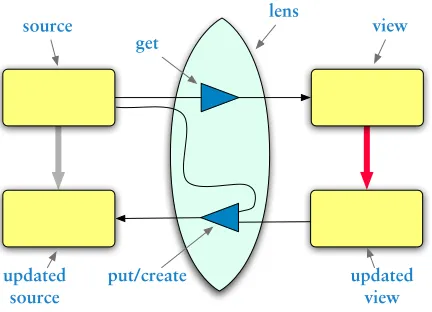
Figure 3.1: Basic Lens Architecture
3.1.1 De nition [Basic Lens]: Fix a universeU of objects and letS ⊆ U(“sources”) andV ⊆ U
(“views”) be sets of objects. Abasic lenslfromStoV comprises three total functions
l.get ∈ S →V
l.put ∈ V →S→S l.create ∈ V →S
that obey the following laws for everys∈S andv∈V:
l.get(l.putv s) =v (PG)
l.get(l.createv) =v (CG)
l.put(l.gets)s=s (GP)
The set of all basic lenses mapping betweenSandV is writtenS ⇐⇒V.
The intuition behind the namesget,putandcreateis that thegetfunction “lifts” a view out
of a source structure, while theputfunction “pushes down” an updated view into the original
source, yielding a new source that re ects the modi cations made in the view. (We will often
say “putvintos(usingl)” instead of “applyl’sputfunction tovands.”) Thecreatefunction
handles the special case where we need to construct a source from a view, but we have no source
to use as the original. It uses the view to manufacture a new source “from scratch,” lling in any
missing data with defaults. The diagram in Figure3.1depicts these components graphically.
1. Lenses are robust abstractions. Users can make arbitrary updates to views without having
to consider whether their changes can be propagated back to the source.
2. Lenses propagate view updates “exactly” to the underlying source.
3. When possible, lenses preserve the source data that is hidden by the view.
Formally, these guarantees are ensured by the “round-tripping” laws given in De nition3.1.1,
which govern the handling of data as it is mapped back and forth between the source and view,
and by the requirement thatputbe a total function. In the next few paragraphs, we describe how
these formal conditions guarantee the informal properties enumerated above, and we discuss
the bene ts and tradeoffs of our design choices.
Robustness A fundamental choice in the design of a bidirectional language is whether it
han-dles every update to a view or only certain updates. Hegner has coined the terms “closed views”
and “open views” to describe these alternatives (1990). Many frameworks take the second
al-ternative—i.e., they allow updates to fail. This gives these systems maximum exibility, since
the decision about whether to propagate a particular update can be made dynamically, on a
case-by-case basis. However, although they can handle many transformations that would not
be valid as lenses, these frameworks also have a signi cant drawback: their views are “leaky”
abstractions of the source. In particular, users cannot treat views like ordinary data structures
because when they update the view, they need to consider the possibility that their update will
be incompatible with the hidden information in the source and will be rejected. By contrast,
theputcomponent of every lens is a total function. Totality is a simple but powerful condition
which ensures that lenses are capable of doing something reasonable with every view and every
source, even when the view has been changed dramatically. In the kinds of applications where
we plan to use lenses—e.g., in data synchronizers (Foster et al., 2007a), which are often run
unsupervised—it critical that views be robust abstractions.
An interesting effect of this choice is that, in practice, it forces lens languages to have
ex-tremely precise type systems. The way that a lens can free itself from the obligation to handle
a particular view is to exclude it from the set of views mentioned in its type. Lenses that
ma-nipulate data in complicated ways typically need to be able to describe the type of that data in
Exact Translation Another fundamental consideration in the design of a bidirectional
lan-guage is the handling of updates. Many systems require that they be translated “exactly” to the
source—i.e., to a new source that re ects all of the changes made to the view. In the framework
of lenses, the PG law is the bedrock principle that guarantees this property. Formally, it
stipulates that, given an updated view and an old source, theputfunction must produce a new
source that the getfunction maps back to the very same view. As an example of a
transfor-mation that violates PG, x an alphabetΣ, let S = Σ∗ be the set of strings over Σ, let
V = (Σ∗ ×N)be the set of pairs of strings and natural numbers, and de ne functionsget,put
andcreateas follows:
l.getu = (u,0)
l.put(u′, n)u = u′ l.create(u′, n) = u′
If we use l to put the view (“abc”,1) into the source “xyz”, we get the new source “abc”.
However, the get function maps this string to (“abc”,0) not (“abc”,1)—i.e., PG fails.
Intuitively, the reason for this failure is some of the information in the view—the number—is
not propagated to the source and so updates to the number are lost. It turns out that requiring
the PG law implies that theput function must be injective (the precise condition,
semi-injectivity, is slightly stronger; see Lemma3.2.1(2) below).
Source Integrity The third key consideration in the design of lenses is the integrity of the
underlying source data. In some cases, for the put function to translate updates to the view
exactly, it needs to modify the underlying source, including the parts of the source that are not
exposed in the view. However, to the extent possible, we would like lenses to preserve this
hidden source data—i.e.,putshould not have extra “side effects”. It turns out that there are
range of conditions one can impose to ensure the integrity of source data. For lenses, we choose
a simple condition, embodied in the GP law, which stipulates that theput function must
restore the original source exactly when its arguments are a viewvand a sourcesthat generates
the very same view—i.e., such thatgets = v. As example of a transformation that does not
natural numbers, letV = Σ∗be the set of strings, and de neget,put, andcreateas follows:
l.get(u, n) = u l.putu′ (u, n) = (u′,0)
l.createu′ = (u′,0)
If we uselto compute a view from(“abc”,1)and immediately put it back, we get(“abc”,0),
which is a different source than the one we started with. One way of seeing the problem with
this transformation is that the put function has extra side effects on the source—it sets the
number to0even when the view is unchanged. The GP law restricts the effects thatput
can have on the source by forcing it to have no effect at all, whenever it is possible for it to do
so without disobeying the other laws.
We might be tempted to go a step further and stipulate that theput function must always
have “minimal” effects on the source, and not only when the view is unchanged. Unfortunately,
even stating this condition requires seems to require building a notion of what constitutes an
update into the semantics—we need to be able to compare two updates to determine which
one has a “smaller” effect. Lenses are agnostic to the way that updates are expressed—the
putfunction takes the wholestateof the updated view (in database terminology, a materialized
view) as input rather than an explicitoperationin an update language. Being state based makes
it easy to use lenses in many different application scenarios (since applications do not need
to be retooled to manipulate the view via operations in a special update language) and to use
lenses with data in non-standard and ad hoc formats (which do not usually come equipped
with canonical update languages). But it makes it hard to express properties formulated in
terms of updates. So, because lenses are agnostic to the way that updates are expressed, we
only impose the weaker GP law, which can be stated abstractly and without assuming any
particular notion of update. However, even though the GP law only provides a relatively
loose constraint on the behavior of lenses, it is still a useful tool for designing lens primitives.
We have used it many times to generate, test, and reject candidate transformations.
A different idea for ensuring the integrity of source data is to require that theputfunction
preserveallof the information in the source that is not re ected in the view. This idea has been
explored extensively in the database literature, where it is known as theconstant complement
to(V ×C), a product consisting of the viewV and a “complement”Cthat contains all of the
source information not re ected in the view. Thegetfunction uses the function witnessing the
isomorphism in one direction to transform the sourcesinto a pair(v, c), and then projects away
c. Theputfunction pairs up the new viewv′with the old complementcand applies the witness
to the isomorphism in the other direction to(v′, c)to obtain the updated source. Importantly,
as theputfunction is implemented by an injective function from(V ×C)to S, it necessarily
propagatesallof the information in the complement back to the source—i.e., the complement
is held “constant”.
We can formulate a law for lenses that is equivalent to the constant complement condition
by stipulating that the source obtained after doing twoputs in a row must be the same as doing
just the second:
l.putv′ (l.putv s) =l.putv′ s (PP)
This law does not explicitly mention complements, but it forces theputfunction to restore all of
the information in the old source that is not re ected in the view—i.e., a complement—because
if the lens did not restore some of this information to the intermediate source produced as
the result of the rst put, then that information would not be available for the second put.
Unfortunately, insisting that every lens obey PP is a draconian restriction that rules out
many transformations that are indispensable in practice. As an example, of a lens that does not
obey PP, letS = (Σ∗ ×N)list be the set of lists of pairs of strings and natural numbers,
letV = (Σ∗list)be the set of lists of strings, and de neget,putandcreateas follows:
l.get[(u1, n1), . . . ,(uk, nk)] = [u1, . . . , uk]
l.put[u′1, . . . , u′l] [(u1, n1), . . . ,(uk, nk)] = [(u′1, n′1), . . . ,(u′l, n′l)]
wheren′i=
nifori∈ {1, . . . ,min(l, k)
0 fori∈ {k+ 1, . . . , l}
l.create[u′1, . . . , u′l] = [(u′1,0), . . . ,(u′l,0)]
Thegetcomponent of this lens takes a list of pairs of strings and numbers and projects away the
numbers. Theputcomponent takes a view and a source and weaves them together, propagating
the strings from the view and restoring as many numbers from the source as there are strings in
different lengths). To see why PP fails, observe that when the list of strings in the view has
fewer elements than the source list, theputfunction discards some of the numbers in the source,
as it must to satisfy PG. For example, putting[“a′′,“b′′]into [(“a′′,1),(“b′′,2),(“c′′,3)]
discards the3and yields[(“a′′,1),(“b′′,2)]. This accurately re ects the change made to the view,
but if we put [“a′′,“b′′,“c′′] into this intermediate source we get [(“a′′,1),(“b′′,2),(“c′′,0)],
which is different than the result[(“a′′,1),(“b′′,2),(“c′′,3)]we would have obtained if we had
put this view into the original source without doing the innerput. Because many applications
depend on transformations that do not obey PP, we do not require it. However, we pay
special attention to lenses that do obey it, calling themvery well behaved.
3.1.2 De nition [Very Well Behaved Lens]: A lensl∈S ⇐⇒V isvery well behavedif and only
if it obeys the PP law for all viewsv′ ∈V andv∈V and every sources∈S.
Interestingly, the weaker integrity guarantee embodied in the GP law can be formulated as
a special case of PP. The PT law stipulates that the effect of doing twoputsusing
the same viewmust be the same as doing just a singleput:
l.putv(l.putv s) =l.putv s (PT)
We show in Lemma3.2.2, below, that every lens obeys PT.
Another important class of lenses are those whose put functions do not use their source
argument. We call these lensesoblivious.
3.1.3 De nition [Oblivious Lens]: A lens l ∈ S ⇐⇒ V isobliviousif(l.putv s) = (l.putvs′)
for all viewsvinV and sourcessands′inS.
Both functions denoted by an oblivious lenses are bijective. They are trivially very well behaved,
since the result computed byputnever depends on its source argument.
3.2 Basic Lens Properties
Now we use the semantics of lenses to derive some of their basic properties. We begin by
proving some lemmas establishing some elementary facts about lenses. The most interesting
result, presented at the very end of this section, is an alternate characterization of lenses entirely
3.2.1 Lemma: For everyl∈S⇐⇒V, the following facts hold:
1. l.getand(uncurry l.put)are surjective functions1
2. l.putissemi-injectivein the following sense: for all viewsvandv′ inV and all sourcess
ands′inSifl.putv s=l.putv′ s′thenv=v′.
3. l.createis an injective function.
Proof: Letl∈S ⇐⇒V be a lens. We prove each fact separately.
1. Letv∈V be a view. Pick an arbitrary sources∈Sand lets′ = (l.putv s)be the source
obtained by puttingvinto s. By the PG law for lwe have(l.gets′) =v. Asvwas
arbitrary, we conclude thatl.getis surjective.
Similarly, lets∈S be a source. By the GP law forlwe have(l.put(l.gets)s) =s.
By the de nition ofuncurryhave(uncurry l.put) (l.gets, s) =s. Asswas arbitrary, we
conclude that(uncurry l.put)is surjective.
2. Letv∈V andv′ ∈V be views ands∈S ands′ ∈S be sources such that(l.putv s) =
(l.putv′ s′). We calculate as follows:
v
=l.get(l.putv s) by PG forl
=l.get(l.putv′ s′) by assumption
=v′ by PG forl
That is,v=v′. We conclude thatl.putis semi-injective.
3. Letv ∈ V and v′ ∈ V be views such that (l.create v) = (l.create v′). We calculate as
follows:
v
=l.get(l.createv) by CG forl
=l.get(l.createv′) by assumption
=v′ by CG forl
That is,v=v′. We conclude thatl.createis injective.
1Note that the surjectivity of(uncurryl.put)andl.putare different conditions: the former means that for every
s∈Sthere exists av∈V ands′∈Ssuch thatl.put(v, s′) =swhile the latter means that for everyf ∈S →S
Next we prove that every lens obeys the PT law.
3.2.2 Lemma: Every lensl∈S⇐⇒V obeys PT for everyv∈V ands∈S.
Proof: Letl∈S ⇐⇒V be a lens,v ∈V a view, ands∈S a source. We calculate as follows
l.putv(l.putv s)
=l.put(l.get(l.putv s)) (l.putv s) by PG forl
=l.putv s by GP forl
and obtain the required equality.
A natural question to ask is whether lenses are semantically complete—i.e., given a total
and surjective functiongfromStoV does there exist a lenslthat hasgas itsgetcomponent?
We answer this question positively in the next lemma.
3.2.3 Lemma: For every total and surjective functiong∈S →V there exists a lensl∈S ⇐⇒
V such that(l.gets) = (g s)for everysinS.
Proof: Letg∈S →V be a total and surjective function fromS ontoV. For everyv∈V, let
b
vdenote an arbitrary element ofSsatisfying(gvb) = v. Asgis surjective,bvexists. We de ne
the components oflas follows:
l.gets = g s
l.putv s =
sifv=g s
b
votherwise
l.createv = bv
By the de nition ofl.get, we immediately have(l.gets) = (g s)for everysinS. We show that
lis a well-behaved lens by proving each of the lens laws directly:
IGetPut: Lets∈S. We calculate as follows
l.put(l.gets)s
=l.put(g s)s by de nitionl.get
=s by de nitionl.put